Office 2013
FOR
by Wallace Wang
Office 2013
FOR
Office 2013 For Dummies®
Published by
John Wiley & Sons, Inc. 111 River Street Hoboken, NJ 07030-5774
www.wiley.com
Copyright © 2013 by John Wiley & Sons, Inc., Hoboken, New Jersey Published by John Wiley & Sons, Inc., Hoboken, New Jersey Published simultaneously in Canada
No part of this publication may be reproduced, stored in a retrieval system or transmitted in any form or by any means, electronic, mechanical, photocopying, recording, scanning or otherwise, except as permit-ted under Sections 107 or 108 of the 1976 Unipermit-ted States Copyright Act, without either the prior written permission of the Publisher, or authorization through payment of the appropriate per-copy fee to the Copyright Clearance Center, 222 Rosewood Drive, Danvers, MA 01923, (978) 750-8400, fax (978) 646-8600. Requests to the Publisher for permission should be addressed to the Permissions Department, John Wiley & Sons, Inc., 111 River Street, Hoboken, NJ 07030, (201) 748-6011, fax (201) 748-6008, or online at http:// www.wiley.com/go/permissions.
Trademarks: Wiley, the Wiley logo, For Dummies, the Dummies Man logo, A Reference for the Rest of Us!, The Dummies Way, Dummies Daily, The Fun and Easy Way, Dummies.com, Making Everything Easier, and related trade dress are trademarks or registered trademarks of John Wiley & Sons, Inc. and/or its affili-ates in the United Staffili-ates and other countries, and may not be used without written permission. All other trademarks are the property of their respective owners. John Wiley & Sons, Inc. is not associated with any product or vendor mentioned in this book.
LIMIT OF LIABILITY/DISCLAIMER OF WARRANTY: THE PUBLISHER AND THE AUTHOR MAKE NO REPRESENTATIONS OR WARRANTIES WITH RESPECT TO THE ACCURACY OR COMPLETENESS OF THE CONTENTS OF THIS WORK AND SPECIFICALLY DISCLAIM ALL WARRANTIES, INCLUDING WITH-OUT LIMITATION WARRANTIES OF FITNESS FOR A PARTICULAR PURPOSE. NO WARRANTY MAY BE CREATED OR EXTENDED BY SALES OR PROMOTIONAL MATERIALS. THE ADVICE AND STRATEGIES CONTAINED HEREIN MAY NOT BE SUITABLE FOR EVERY SITUATION. THIS WORK IS SOLD WITH THE UNDERSTANDING THAT THE PUBLISHER IS NOT ENGAGED IN RENDERING LEGAL, ACCOUNTING, OR OTHER PROFESSIONAL SERVICES. IF PROFESSIONAL ASSISTANCE IS REQUIRED, THE SERVICES OF A COMPETENT PROFESSIONAL PERSON SHOULD BE SOUGHT. NEITHER THE PUBLISHER NOR THE AUTHOR SHALL BE LIABLE FOR DAMAGES ARISING HEREFROM. THE FACT THAT AN ORGANIZA-TION OR WEBSITE IS REFERRED TO IN THIS WORK AS A CITAORGANIZA-TION AND/OR A POTENTIAL SOURCE OF FURTHER INFORMATION DOES NOT MEAN THAT THE AUTHOR OR THE PUBLISHER ENDORSES THE INFORMATION THE ORGANIZATION OR WEBSITE MAY PROVIDE OR RECOMMENDATIONS IT MAY MAKE. FURTHER, READERS SHOULD BE AWARE THAT INTERNET WEBSITES LISTED IN THIS WORK MAY HAVE CHANGED OR DISAPPEARED BETWEEN WHEN THIS WORK WAS WRITTEN AND WHEN IT IS READ.
For general information on our other products and services, please contact our Customer Care Department within the U.S. at 877-762-2974, outside the U.S. at 317-572-3993, or fax 317-572-4002. For technical support, please visit www.wiley.com/techsupport.
Wiley publishes in a variety of print and electronic formats and by print-on-demand. Some material included with standard print versions of this book may not be included in e-books or in print-on-demand. If this book refers to media such as a CD or DVD that is not included in the version you purchased, you may download this material at http://booksupport.wiley.com. For more information about Wiley products, visit www.wiley.com.
Library of Congress Control Number: 2012956422
ISBN 978-1-118-49715-9 (pbk); ISBN 978-1-118-49714-2 (ebk); ISBN 978-1-118-62022-9 (ebk); ISBN 978-1-118-62028-1 (ebk)
About the Author
Dedication
Author’s Acknowledgments
Publisher’s Acknowledgments
We’re proud of this book; please send us your comments at http://dummies.custhelp.com. For other comments, please contact our Customer Care Department within the U.S. at 877-762-2974, outside the U.S. at 317-572-3993, or fax 317-572-4002.
Some of the people who helped bring this book to market include the following:
Acquisitions, Editorial, and Vertical Websites
Project Editor: Pat O’Brien Acquisitions Editor: Bob Woerner Senior Copy Editor: Barry Childs-Helton Technical Editor: Vince McCune Editorial Manager: Kevin Kirschner Editorial Assistant: Annie Sullivan Sr. Editorial Assistant: Cherie Case Cover Photo: © iStockphoto.com /
Cary Westfall
Composition Services
Project Coordinator: Kristie Rees Layout and Graphics: Carl Byers,
Jennifer Creasey
Proofreaders: Lindsay Amones, Toni Settle Indexer: Sharon Shock
Publishing and Editorial for Technology Dummies
Richard Swadley, Vice President and Executive Group Publisher Andy Cummings, Vice President and Publisher
Mary Bednarek, Executive Acquisitions Director Mary C. Corder, Editorial Director
Publishing for Consumer Dummies
Kathleen Nebenhaus, Vice President and Executive Publisher Composition Services
Contents at a Glance
Introduction ... 1
Part I: Getting Started with Office 2013 ... 7
Chapter 1: Introducing Microsoft Office 2013 ...9
Chapter 2: Selecting and Editing Data ...33
Chapter 3: Modifying Pictures ...47
Chapter 4: Getting Help from Office 2013 ...57
Part II: Working with Word ... 63
Chapter 5: Typing Text in Word...65
Chapter 6: Formatting Text ...85
Chapter 7: Designing Your Pages ...105
Part III: Playing the Numbers with Excel ... 133
Chapter 8: The Basics of Spreadsheets: Numbers, Labels, and Formulas ...135
Chapter 9: Playing with Formulas ...167
Chapter 10: Charting and Analyzing Data ...193
Part IV: Making Presentations with PowerPoint ... 221
Chapter 11: Creating a PowerPoint Presentation ...223
Chapter 12: Adding Color and Pictures to a Presentation...241
Chapter 13: Showing Off a Presentation ...263
Part V: Getting Organized with Outlook ... 283
Chapter 14: Managing E-Mail with Outlook ...285
Chapter 15: Calendars, Contacts, and Tasks ...299
Part VI: Storing Stuff in Access ... 313
Chapter 16: Using a Database ...315
Chapter 17: Searching, Sorting, and Querying a Database ...331
Chapter 18: Creating a Database Report ...351
Part VII: The Part of Tens ... 365
Chapter 19: Ten Tips for Using Office 2013 ...367
Chapter 20: Almost Ten Ways to Make Office 2013 Easier to Use ...383
Table of Contents
Introduction ... 1
Who Should Buy This Book ...1
How This Book Is Organized ...2
Part I: Getting Started with Microsoft Office 2013 ...2
Part II: Working with Word ...2
Part III: Playing the Numbers with Excel ...2
Part IV: Making Presentations with PowerPoint ...3
Part V: Getting Organized with Outlook...3
Part VI: Storing Stuff in Access ...3
Part VII: The Part of Tens ...4
How to Use This Book ...4
Conventions ...4
Icons Used in This Book ...5
Getting Started ...5
Part I: Getting Started with Office 2013 ... 7
Chapter 1: Introducing Microsoft Office 2013 . . . .9
Starting an Office 2013 Program ...9
Introducing the Microsoft Office Ribbon ...11
The File tab ...13
Using the Ribbon ...18
Deciphering Ribbon icons ...19
Identifying Ribbon icons ...22
Displaying dialog boxes ...23
Minimizing the Ribbon ...24
Using the Quick Access Toolbar ...25
Using the Quick Access icons ...26
Adding icons ...26
Removing icons ...28
Moving the Quick Access toolbar ...28
Customizing an Office 2013 Program ...29
Changing the file format and default location ...29
Customizing the Ribbon icons ...30
Office 2013 For Dummies
xiv
Chapter 2: Selecting and Editing Data . . . .33
Adding Data by Pointing ...33
Selecting Data ...35
Selecting data with the mouse ...35
Selecting data with the keyboard ...36
Selecting multiple chunks of data with the mouse and keyboard ...37
Editing Text with the Pop-up Toolbar ...37
Deleting Data ...38
Cutting and Pasting (Moving) Data ...39
Copying and Pasting Data ...39
Using Paste Options ...40
Dragging with the Mouse to Cut, Copy, and Paste ...42
Undo and Redo ...43
Sharing Data with Other Office 2013 Programs ...44
Using the Office Clipboard ...44
Viewing and pasting items off the Office Clipboard ...44
Deleting items from the Office Clipboard ...45
Chapter 3: Modifying Pictures . . . .47
Adding (and Deleting) Pictures ...48
Manipulating Pictures ...48
Moving a picture ...48
Resizing a picture...49
Rotating a picture ...50
Enhancing Pictures ...50
Choosing visual effects ...51
Choosing a picture style ...53
Adding a border around a picture ...55
Chapter 4: Getting Help from Office 2013 . . . .57
Browsing the Help Window ...57
Searching in the Help Window ...59
Making the Help Window Easier to Read ...60
Resizing and pinning the Help window ...61
Enlarging the text in the Help window ...62
Printing the text in the Help window...62
Part II: Working with Word ... 63
Chapter 5: Typing Text in Word . . . .65
Moving the Cursor with the Mouse ...65
Moving the Cursor with the Keyboard ...67
Navigating through a Document ...68
Navigating with the mouse ...68
xv
Table of Contents
Finding and Replacing Text ...70
Using the Find command ...70
Customizing text searching ...72
Searching by headings ...73
Browsing through pages ...74
Using the Find and Replace command ...75
Checking Your Spelling ...77
Checking Your Grammar ...78
Viewing a Document ...79
Switching between views ...79
Using Read Mode view ...80
Using Outline view ...81
Chapter 6: Formatting Text . . . .85
Changing the Font ...86
Changing the Font Size ...87
Changing the Text Style ...88
Changing Colors ...88
Changing the color of text ...88
Highlighting text with color ...89
Using Text Effects ...90
Justifying Text Alignment ...91
Adjusting Line Spacing ...92
Making Lists ...93
Indenting list items ...94
Converting list items back into text ...94
Customizing a list ...95
Renumbering numbered lists ...96
Using the Ruler ...97
Adjusting left and right paragraph margins ...98
Defining indentation with the Ruler ...99
Using Format Painter ...100
Using Styles ...101
Using Templates ...102
Removing Formatting from Text ...103
Chapter 7: Designing Your Pages . . . .105
Inserting New Pages ...105
Adding (and Deleting) a Cover Page ...106
Inserting Page Breaks ...107
Inserting Headers and Footers ...107
Creating a header (or footer) ...108
Defining which pages display a header (or footer) ...108
Deleting a header (or footer)...110
Organizing Text in Tables ...110
Creating a table by highlighting rows and columns ...110
Creating a table with the Insert Table dialog box...111
Creating a table with the mouse ...112
Office 2013 For Dummies
xvi
Formatting and Coloring a Table ...116
Selecting all or part of a table ...116
Aligning text in a table cell ...117
Picking a table style ...117
Resizing columns and rows ...118
Sorting a Table ...119
Deleting Tables ...121
Deleting an entire table ...121
Deleting rows and columns ...122
Deleting cells ...122
Deleting cell borders ...123
Making Text Look Artistic ...124
Creating drop caps ...124
Creating WordArt ...125
Dividing Text into Columns ...126
Editing columns ...127
Removing columns ...128
Previewing a Document before Printing ...129
Defining page size and orientation ...129
Using Print Preview ...130
Part III: Playing the Numbers with Excel ... 133
Chapter 8: The Basics of Spreadsheets:
Numbers, Labels, and Formulas . . . .135
Understanding Spreadsheets ...135
Storing Stuff in a Spreadsheet ...137
Typing data into a single cell...137
Typing data in multiple cells ...137
Typing in sequences with AutoFill ...138
Formatting Numbers and Labels ...139
Formatting numbers ...140
Formatting cells ...143
Navigating a Spreadsheet ...146
Using the mouse to move around in a spreadsheet ...146
Using the keyboard to move around a spreadsheet ...147
Naming cells ...148
Searching a Spreadsheet ...150
Searching for text ...150
Searching for formulas ...151
Editing a Spreadsheet ...152
Editing data in a cell ...152
Changing the size of rows and columns with the mouse ...153
Typing the size of rows and columns ...153
xvii
Table of Contents
Adding sheets ...155
Renaming sheets ...156
Rearranging sheets ...156
Deleting a sheet ...156
Clearing Data ...157
Printing Workbooks ...158
Using Page Layout view ...158
Adding a header (or footer) ...159
Printing gridlines...160
Defining a print area ...160
Inserting (and removing) page breaks ...161
Printing row and column headings ...162
Defining printing margins ...164
Defining paper orientation and size ...164
Printing in Excel ...165
Chapter 9: Playing with Formulas . . . .167
Creating a Formula ...167
Organizing formulas with parentheses ...170
Copying formulas ...171
Using Functions ...172
Using the AutoSum command ...174
Using recently used functions ...175
Editing a Formula ...176
Conditional Formatting ...176
Comparing data values...177
Creating conditional formatting rules ...178
Data Validation ...179
Goal Seeking ...182
Creating Multiple Scenarios ...184
Creating a scenario ...184
Viewing a scenario ...186
Editing a scenario ...187
Viewing a scenario summary ...188
Auditing Your Formulas ...189
Finding where a formula gets its data ...190
Finding which formula(s) a cell can change ...190
Checking for Errors ...191
Chapter 10: Charting and Analyzing Data . . . .193
Understanding the Parts of a Chart ...193
Creating a Chart ...195
Editing a Chart ...197
Moving a chart on a worksheet ...197
Moving a chart to a new sheet ...198
Office 2013 For Dummies
xviii
Using the Chart Tools ...199
Changing the chart type ...200
Changing the data source ...201
Switching rows and columns ...202
Changing the parts of a chart ...202
Designing the layout of a chart ...204
Deleting a chart ...204
Using Sparklines ...205
Creating a Sparkline ...205
Customizing a Sparkline ...206
Deleting a Sparkline ...207
Organizing Lists in Pivot Tables ...207
Creating a pivot table ...208
Rearranging labels in a pivot table ...210
Modifying a pivot table ...211
Filtering a pivot table ...213
Summing a pivot table ...214
Slicing up a pivot table ...215
Creating PivotCharts ...217
Part IV: Making Presentations with PowerPoint ... 221
Chapter 11: Creating a PowerPoint Presentation . . . .223
Defining the Purpose of Your Presentation ...223
Creating a PowerPoint Presentation ...224
Designing a presentation with Slide view ...225
Designing a presentation with Outline view ...228
Working with Text ...231
Typing text in a text box ...231
Formatting text ...232
Aligning text ...233
Adjusting line spacing ...234
Making numbered and bulleted lists ...235
Making columns ...236
Moving and resizing a text box ...237
Rotating a text box ...238
Chapter 12: Adding Color and Pictures to a Presentation . . . .241
Applying a Theme ...241
Changing the Background ...243
Choosing a solid color background ...243
Choosing a gradient background ...244
Choosing a picture background ...246
Adding Graphics to a Slide ...247
Placing picture files on a slide...247
xix
Table of Contents
Creating WordArt ...249
Capturing screenshots ...249
Resizing, moving, and deleting graphic images ...250
Rotating graphics ...251
Layering objects ...252
Adding Movies to a Slide ...253
Searching for a video on the Internet ...253
Searching for video on your computer ...254
Trimming a video ...255
Coloring a video ...256
Formatting the shape of a video ...257
Adding Sound to a Slide ...259
Adding an audio file off the Internet ...259
Adding audio from a file ...260
Recording audio ...261
Chapter 13: Showing Off a Presentation . . . .263
Spell-Checking Your Presentation ...263
Organizing Slides in Sections ...265
Adding a section ...265
Expanding and collapsing a section ...266
Deleting a section...268
Adding Visual Transitions ...268
Adding slide transitions ...269
Text and graphic transitions ...271
Using the Animation Painter...272
Adding Hyperlinks ...273
Creating web page hyperlinks ...273
Creating hyperlinks to external files ...274
Running a program through a hyperlink ...274
Viewing a Presentation ...276
Creating a custom slide show ...277
Hiding a slide ...279
Organizing with Slide Sorter view ...279
Creating Handouts ...281
Part V: Getting Organized with Outlook ... 283
Chapter 14: Managing E-Mail with Outlook . . . .285
Configuring E-Mail Settings ...285
Creating E-Mail ...287
Creating a new e-mail message ...287
Replying to an e-mail message ...288
Using a stored e-mail address to create a new e-mail message ...289
Office 2013 For Dummies
xx
Reading and Organizing E-Mail ...292 Grouping messages into categories ...292 Changing the appearance of the Reading Pane...293 Retrieving a file attachment from a message ...295 Deleting E-Mail Messages ...297
Chapter 15: Calendars, Contacts, and Tasks . . . .299
Setting Appointments ...299 Making an appointment ...299 Viewing appointments...302 Deleting an appointment ...303 Storing Names and Addresses ...304 Adding a name ...304 Viewing names ...305 Searching names ...306 Managing Tasks ...307 Storing a task ...307 Searching tasks ...310 Viewing tasks ...311
Part VI: Storing Stuff in Access ... 313
Chapter 16: Using a Database . . . .315
Understanding the Basics of a Database ...316 Designing a Database ...317 Editing and Modifying a Database ...320 Naming a field ...320 Adding and deleting a field ...321 Defining the type and size of a field ...321 Typing Data into a Database ...323 Using Datasheet view ...324 Using Form view ...324 Creating a form ...325 Viewing and editing data in a form ...326 Editing a form ...326 Closing and Saving a Database ...329 Closing a database ...329 Exiting Access ...330
Chapter 17: Searching, Sorting, and Querying a Database . . . .331
xxi
Table of Contents
Querying a Database ...341 Creating a simple query ...341 Creating a crosstab query ...343 Creating a query that finds duplicate field data ...347 Creating an unmatched query ...348 Viewing, renaming, closing, and deleting queries ...349
Chapter 18: Creating a Database Report . . . .351
Using the Report Wizard ...351 Manipulating the Data in a Report ...355 Switching a report to Layout view ...355 Counting records or values ...356 Sorting a field ...357 Filtering a field ...357 Editing a Report ...358 Resizing fields ...358 Deleting fields ...360 Making Reports Look Pretty ...360 Applying themes ...360 Creating conditional formatting ...361 Deleting a Report ...363
Part VII: The Part of Tens ... 365
Chapter 19: Ten Tips for Using Office 2013 . . . .367
Saving Office 2013 Files ...367 Password-Protecting Your Files ...369 Guarding Against Macro Viruses ...370 Customize the Ribbon ...372 Save to SkyDrive ...374 When in Doubt, Right-Click the Mouse ...375 Freezing Row and Column Headings in Excel ...375 Displaying Slides Out of Order in PowerPoint ...376 Reduce Spam in Outlook ...376 Setting up Outlook’s junk e-mail filter ...376 Creating a Safe Senders list ...378 Creating a Blocked Senders list ...379 Using Office Web and Windows RT ...380
Chapter 20: Almost Ten Ways to Make Office 2013 Easier to Use . . .383
Office 2013 For Dummies
xxii
Using Excel’s Data Tab ...385 Saving and Sending Files ...385 Encrypting a File ...386 Checking File Compatibility ...387 Ignoring the Silly Office Ribbon ...387
Introduction
W
elcome to the most popular office productivity software in the world. If you’re already familiar with Microsoft Office 2007 or Microsoft Office 2010, you’ll find that the new Microsoft Office 2013 is familiar enough to use right away with minimal training, but comes jam-packed with addi-tional features to make Office even more useful than ever before. If you’ve been using a much older version of Office (such as Office 2003 or earlier), you’ll find Office 2013 to be a radical leap forward in both features and its new user interface.Like most software, the real challenge is figuring out where to find the com-mands you need to do something useful. While this book won’t turn you into a Microsoft Office 2013 expert overnight, it will give you just enough informa-tion so you can feel confident using the new Office 2013 and get something done quickly and easily without tearing your hair out and losing your mind in the process.
In this book, you find out how to master the “Ribbon” user interface along with discovering the dozens of new features that Microsoft added to your favorite program in Office 2013. More importantly, you find a host of short-cuts and tips to help you work faster and more efficiently than ever before. Whether you rely on Word, Excel, PowerPoint, Access, or Outlook, you’re sure to glean something new from this book to help you master Office 2013 on your own computer.
Who Should Buy This Book
This book is targeted toward three distinct groups. First, there are the people already familiar with Microsoft Office 2007 or Office 2010 who want to catch up with the new features of Office 2013. For these people, this book can serve as a handy reference for finding out how to use the latest features.
2
Office 2013 For Dummies
Finally, there may be people who may have rarely (if ever) used any version of Microsoft Office at all. For those people, this book can serve as a guide through word processing (Microsoft Word), number calculations (Microsoft Excel), presentations (Microsoft PowerPoint), database management (Microsoft Access), and managing your personal resources such as time, appointments, and e-mail (Microsoft Outlook).
No matter how much (or how little) you may know about Microsoft Office, this book can show you how to use the most common and most useful fea-tures of Office 2013 so you can start being productive right away.
How This Book Is Organized
To help you find what you need, this book is organized into parts where each part covers a different program in Office 2010.
Part I: Getting Started with
Microsoft Office 2013
To use Microsoft Office 2013, you need to know how to find the commands you need. This part of the book focuses on showing you how to use the Ribbon user interface that appears in all Office 2013 programs. By the time you finish this part of the book, you’ll feel comfortable using any program in Office 2013.
Part II: Working with Word
Word processing is the most popular use for Office 2013, so this part of the book explains the basics of using Word. Not only will you find out how to create and save different types of documents, but you’ll also master different ways to alter text, such as using color, changing fonts, adding headers and footers, checking spelling and grammar, and printing your written master-piece so it looks perfect.
Part III: Playing the Numbers with Excel
3
Introduction
data, how to create formulas, and how to create different types of charts to help you visualize what your spreadsheet numbers really mean. Not only will you discover how to calculate and “crunch” numbers, but you’ll also find how to analyze the results and turn them into eye-catching charts to help you understand trends that may be buried within your data. If you want to find out how to use Microsoft Excel to create, format, and display spreadsheets, this is the part of the book for you.
Part IV: Making Presentations
with PowerPoint
Throw away your overhead transparencies and clumsy whiteboard and pads of paper. If you need to give a presentation to a large group, you need to know how to create colorful and visually interesting presentations with PowerPoint instead. With PowerPoint, you can organize a presentation into slides that can display text, pictures, animation, and even video. By master-ing PowerPoint, you can create presentations that grab an audience’s atten-tion and emphasize the points you want to make while holding their interest at the same time.
Part V: Getting Organized with Outlook
Almost nobody feels that they have enough time to stay organized, so this part of the book explains why and how to use Microsoft Outlook. With Outlook, you can read, sort, and write e-mail, keep track of appointments, store names and addresses of your most important contacts, and even orga-nize your daily to-do tasks. By using Outlook to manage your busy schedule, you can turn your computer into a personal assistant to make you more pro-ductive than ever before.
Part VI: Storing Stuff in Access
4
Office 2013 For Dummies
Part VII: The Part of Tens
Almost every program offers multiple ways of accomplishing the same task, and Office 2013 is no exception. After you get familiar with using Office, take a peek in this part of the book to read about different types of shortcuts you can use to work with Office even faster than before. By the time you get to this part of the book, you’ll be much more comfortable using Office 2013 so you can feel comfortable exploring and experimenting with different features on your own.
How to Use This Book
Although you can just flip through this book to find the features you need, browse through Part I for a quick refresher (or introduction) to the Office 2013 user interface Ribbon. After you understand the basics of using this new Ribbon user interface, you’ll be able to master any Office 2013 program in no time.
Conventions
To get the most from this book, you need to understand the following conventions:
✓ The mouse pointer usually appears as an arrow and serves multiple
pur-poses. First, you use the mouse pointer to select data (text, numbers, e-mail messages, and so on) to change. Second, you use the mouse pointer to tell Office 2013 which commands you want to use to change the data you selected. Finally, the appearance of the mouse pointer can reveal the options available to you at that moment.
✓ Clicking means moving the mouse pointer over something on the screen
(such as a menu command or a button), pressing the left mouse button once, and then letting go. Clicking tells the computer, “See what I’m pointing at? That’s what I want to choose right now.”
✓ Double-clicking means pointing at something with the mouse pointer and
clicking the left mouse button twice in rapid succession.
✓ Dragging means holding down the left mouse button while moving the
mouse. Dragging typically moves something from one onscreen location to another, such as moving a word from the top of a paragraph to the bottom.
✓ Right-clicking means moving the mouse pointer over something and
5
Introduction
In addition to understanding these terms to describe different mouse actions, you also need to understand different keystroke conventions too. When you see an instruction that reads Ctrl+P, that means to hold down the Ctrl key, press the P key, and then let go of both the Ctrl and P key at the same time. Finally, most computer mice offer a scroll wheel that lets you roll it up or down, or press on it. This scroll wheel works to scroll windows up or down, whether you’re using Office 2013 or nearly any other type of program as well. In Office 2013, the scroll wheel doesn’t serve any unique purpose, but it can be a handy tool for rapidly scrolling through windows in any Office 2013 program.
Icons Used in This Book
Icons highlight important or useful information.
This icon highlights information that can save you time or make it easier for you to do something.
This icon emphasizes information that can be helpful, although not crucial, when using Office 2013.
Watch out! This icon highlights something that can hurt or wipe out important data. Read this information before making a mistake that you may not be able to recover from again.
This icon highlights interesting technical information that you can safely ignore but may answer some questions about why Office 2013 works a certain way.
Getting Started
The best way to master anything is to jump right in and start fiddling with dif-ferent commands just to see what they do and how they work. In case you’re afraid of breaking your computer or wiping out important data, play around with Office 2013 on a “dummy” document filled with useless information you can afford to lose (like your boss’s income tax returns — kidding!).
6
Office 2013 For Dummies
that you know about the powerful Undo command, you should have a surging sense of invulnerability when using Office 2013, knowing that at any time you make a mistake, you can turn back time by pressing Ctrl+Z to undo your last command.
Part I
Office
2013
getting started
with
In this part . . .
✓ Starting an Office 2013 program ✓ Using the pop-up toolbar ✓ Modifying pictures
✓ Opening and browsing the Help window
Chapter 1
Introducing Microsoft Office 2013
In This Chapter
▶ Starting an Office 2013 program ▶ Learning the Ribbon
▶ Customizing an Office 2013 program ▶ Exiting from Office 2013
M
icrosoft Office 2013 consists of five core programs: Word, Excel, PowerPoint, Access, and Outlook, where each program specializes in manipulating different data. Word manipulates text; Excel manipulates num-bers; PowerPoint manipulates text and pictures to create a slide show; Access manipulates organized, repetitive data such as inventories; and Outlook manip-ulates personal information such as e-mail addresses and phone numbers. Although each Office 2013 program stores and manipulates different types of data, they all work in similar ways. First, you have to enter data into an Office 2013 program by typing on the keyboard or loading data from an existing file. Second, you have to tell Office 2013 how to manipulate your data, such as underlining, sorting, arranging it on the screen, or deleting it. Third, you have to save your data as a file.To help you understand this three-step process of entering, manipulating, and saving data, all Office 2013 programs offer similar commands so you can quickly jump from Word to PowerPoint to Excel without having to learn entirely new commands for each program. Even better, Office 2013 organizes commands in tabs to make finding the command you need faster and easier than ever before. If you’re already familiar with computers and previous editions of Microsoft
Office, you may want to browse through this chapter just to get acquainted with the appearance and organization of Office 2013. If you’ve never used a computer before or just don’t feel comfortable using Microsoft Office, read this chapter first.
Starting an Office 2013 Program
10
Part I: Getting to Know Microsoft Office 2013
To start Office 2013 on Windows 7, you can go through the Start menu. To start Office 2013 on Windows 8, you must click the Office 2013 tile that repre-sents the program you want to run.
To load Office 2013 in Windows 7, follow these steps:
1. Click the Start button on the Windows taskbar.
A pop-up menu appears.
2. Choose All Programs.
Another pop-up menu appears.
3. Choose Microsoft Office.
A list of programs appears on the Start menu.
4. Choose the Office 2013 program you want to use, such as Microsoft Word 2013 or Microsoft PowerPoint 2013.
Your chosen program appears on the screen. At this point, you can open an existing file.
To load Office 2013 in Windows 8, follow these steps:
1. Open the Windows 8 tiles by either pressing the Windows key on your keyboard or moving the mouse pointer to the bottom-left corner of the screen and clicking when the Start preview window appears.
The Windows 8 tile interface appears.
2. Scroll sideways until you see the Office 2013 tiles that represent the program you want to start as shown in Figure 1-1.
Figure 1-1:
11
Chapter 1: Introducing Microsoft Office 2013
3. Click the tile that represents the Office 2013 program you want to run, such as Microsoft Word 2013 or Microsoft PowerPoint 2013.
Your chosen program appears on the screen. At this point, you can open an existing file.
Introducing the Microsoft Office Ribbon
In older Windows programs, such as Microsoft Office 2003, the program dis-played pull-down menus at the top of the screen. To find a command, you had to click a pull-down menu and then search for a command buried in the menu. Since this can get tedious and confusing, later versions of Microsoft Office introduced a Ribbon interface.
The basic idea behind this Ribbon interface is to store commonly used com-mands under separate tabs. Clicking each tab displays icons that represent related commands. Now you can see groups of related commands at a glance. Although every Office 2013 program displays different tabs, the three most common tabs are the File tab, the Home tab, and the Insert tab.
The File tab lets you open, save, and print your files. In addition, the File tab also lets you exit out of the program and customize an Office 2013 program as shown in Figure 1-2.
Figure 1-2:
12
Part I: Getting to Know Microsoft Office 2013
The Home tab displays icons that represent the most common commands for that particular Office 2013 program, such as formatting commands (as shown in Figure 1-3).
Figure 1-3:
The Home tab displays common formatting commands.
The Insert tab displays icons that represent common commands for adding items to a file such as pictures and tables, as shown in Figure 1-4.
Figure 1-4:
The Insert tab displays common commands for adding items to a file.
13
Chapter 1: Introducing Microsoft Office 2013
a formula in a spreadsheet while PowerPoint contains a Transitions tab for adding transitions to your presentation slideshows.
The File tab
The various commands available on the File tab include
✓ Info: Protects your file from changes, inspects a file for compatibility
issues with older programs, and manages different versions of your file. The Info command also lets you view the details of your file such as the file’s size and the date you created it, as shown in Figure 1-5.
Figure 1-5:
The Info command on the File tab lets you protect or inspect a file.
✓ New: Creates a new file. ✓ Open: Loads an existing file.
✓ Save: Saves your file. If you haven’t named your file yet, the Save
com-mand is equivalent to the Save As comcom-mand.
✓ Save As: Save the current file under a new name and/or in a different
location such as a different folder or computer.
✓ Print: Prints the current file.
✓ Share: Sends a file as an e-mail attachment or posts it online. ✓ Export: Saves the current file in a different file format.
14
Part I: Getting to Know Microsoft Office 2013
SkyDrive is Microsoft’s cloud computing service that lets you store files online so you can access them from other types of devices such as a smart phone, a tablet, or another computer.
✓ Options: Displays various options for customizing the way each Office
2013 program behaves.
✓ Exit: Closes any open files and exits the Office 2013 program.
In Word, a file is called a document. In Excel, a file is called a workbook. In PowerPoint, a file is called a presentation. In Access, a file is called a database.
Creating a new file
Each time you create a new file, you have the option of choosing different types of templates that are already formatted and designed for specific pur-poses, such as a calendar, newsletter, sales report, or corporate slide-show presentation, as shown in Figure 1-6.
Figure 1-6:
The New command displays a variety of files you can create.
To create a new file, follow these steps:
1. Click the File tab. 2. Click New.
A list of templates appears (see Figure 1-6).
3. Double-click the template you want to use.
15
Chapter 1: Introducing Microsoft Office 2013
Opening an existing file
When you load an Office 2013 program, you may want to edit a file that you created and modified earlier. To open an existing file, you need to tell Office 2013 the location and name of the file you want to open.
The four options for finding an existing file include
✓ Recent Documents/Workbooks/Presentations: Displays a list of files
you recently opened.
✓ Someone’s SkyDrive: Displays a list of files stored on another person’s
SkyDrive account. (You may need to get permission from that other person to access certain files.)
✓ Computer: Lets you browse through the folders stored on your
com-puter to find a file.
✓ Add a place: Lets you define a new location for storing files in the cloud
such as your SkyDrive account. To open a file, follow these steps:
1. Click the File tab. 2. Click Open.
An Open pane appears, as shown in Figure 1-7.
Figure 1-7:
The Open pane lets you change drives and folders to find the file you want to use.
3. Choose an option such as Recent Documents or Computer.
16
Part I: Getting to Know Microsoft Office 2013
4. Click the file you want to open.Your chosen file appears.
If you deleted or moved a file, Office 2013 may still list that filename under the Recent category even if that file no longer exists or has been moved.
Saving files
Saving a file stores all your data on a hard drive or other storage device (such as a USB flash drive). You can also save your files to a SkyDrive account so you can access that file anywhere you have Internet access. The first time you save a file, you need to specify three items:
✓ The location in which to store your file ✓ The name of your file
✓ The format in which to save your file
The location can be any folder on your hard drive or in your SkyDrive account. It’s a good idea to store similar files in a folder with a descrip-tive name, such as Tax Evasion Information for 2015 or Extortion Letters to Grandma. If you save your files to your computer, Office 2013 stores all your files in the Documents folder unless you specify otherwise.
You can give a file any name you want, but it’s also a good idea to give your file a descriptive name, such as Latest Resume to Escape My Dead-End Job or
Global Trade Presentation for World Domination Meeting on October 29, 2014.
The format of your file defines how Office 2013 stores your data. The default file format is simply called Word Document, Excel Workbook, PowerPoint Presentation, or Access Database. Anyone using Office 2013, 2010, or Office 2007 can open these files.
For a quick way to save a file, click the Save icon that appears above the File tab or press Ctrl+S.
Saving a file in other file formats
If you need to share files with people using older versions of Microsoft Office or other word processors, spreadsheets, or database programs, you need to save your files in a different file format. To share files with people using older versions of Microsoft Office, you need to save your files in a format known as
97-2003, such as Word 97-2003 Document or PowerPoint 97-2003 Presentation.
17
Chapter 1: Introducing Microsoft Office 2013
When you save files in the 97-2003 format, Microsoft Office 2013 saves your files with a three-letter file extension, like .doc or .xls. When you save files
in the Office 2013 format, Microsoft Office 2013 saves your files with a four- or five-letter file extension, such as .docx or .pptx, as shown in Table 1-1.
Table 1-1
File Extension Names Used by Different
Versions of Microsoft Office
Program Microsoft Office 2013
File Extension Microsoft Office 97-2003 File Extension
Microsoft Word .docx .doc
Microsoft Excel .xlsx .xls
Microsoft PowerPoint .pptx .ppt
Microsoft Access .accdb .mdb
To save your Office 2013 files in the 97-2003 format, follow these steps:
1. Click the File tab. 2. Click Export.
The middle pane displays different options.
3. Click Change File Type.
A list of different formats appears, as shown in Figure 1-8.
Figure 1-8:
18
Part I: Getting to Know Microsoft Office 2013
4. Click the 97-2003 format option, such as Word 97-2003 Document or Excel 97-2003 Workbook.
5. Click the Save As button near the bottom of the screen.
The Save As dialog box appears.
If you want to share your file with different types of programs, you may need to choose a different file format, such as Rich Text Format or Text.
6. (Optional) Click in the File Name text box and type a descriptive name for your file.
7. Click Save.
Closing a file
When you’re done editing a file, you need to close it. Closing a file simply removes the file from your screen but keeps your Office 2013 program run-ning so you can edit or open another file. If you haven’t saved your file, clos-ing a file will prompt you to save your changes.
To close a file, follow these steps:
1. Click the File tab. 2. Click Close.
If you haven’t saved your file, a dialog box appears asking whether you want to save your changes.
For a faster way to choose the Close command, press Ctrl+F4.
3. Click Save to save your changes, Don’t Save to discard any changes, or Cancel to keep your file open.
If you click either Save or Don’t Save, Office 2013 closes your file.
Using the Ribbon
The Ribbon interface displays tabs that contain groups of related commands. For example, the Page Layout tab displays only those commands related to designing a page, and the Insert tab displays only those commands related to inserting items into a file, such as a page break or a picture.
Using the Ribbon is a two-step process. First, you must click the tab that con-tains the command you want. Second, you click the actual command.
19
Chapter 1: Introducing Microsoft Office 2013
Deciphering Ribbon icons
Each Ribbon tab displays commands as buttons or icons, organized into groups. There are four types of icons displayed on the Ribbon:
✓ One-click icons: These icons do something with a single click.
✓ Menu icons: These icons display a pull-down menu of options you can
choose.
✓ Split-menu icons: These icons consist of two halves. The left or top half
lets you choose a command like a one-click icon, and the right or bottom half displays a downward-pointing arrow, which displays additional options.
✓ Combo boxes: These display a text box where you can type a value in or
click a downward-pointing arrow to choose from a menu of options.
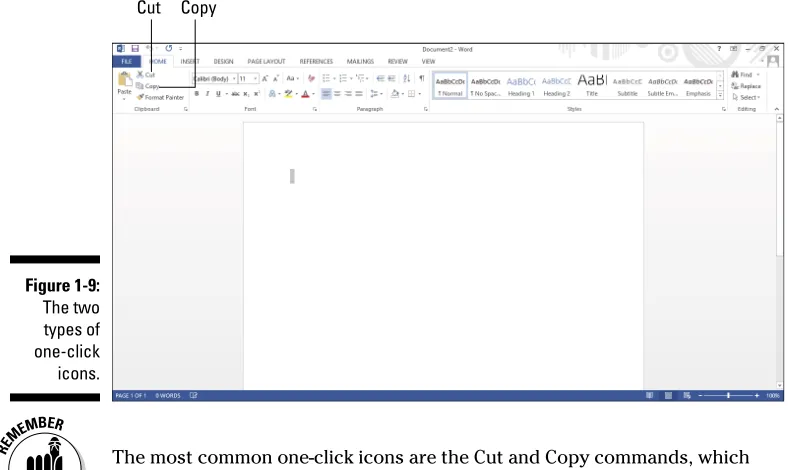
Using one-click icons
[image:43.531.67.461.339.574.2]If you’re in too much of a hurry to double-click, Office 2013 offers you two types of one-click icons (as shown in Figure 1-9).
Figure 1-9:
The two types of one-click icons.
20
Part I: Getting to Know Microsoft Office 2013
Using menu icons
A one-click icon represents a single command. However, there isn’t enough room on the Ribbon to display every possible command as a single icon. As a result, menu icons display a pull-down menu that stores multiple options within a single icon, as shown in Figure 1-10.
Figure 1-10:
A menu icon displays additional options you can choose.
Selecting an option in the pull-down menu immediately manipulates your selected data.
Using split-menu icons
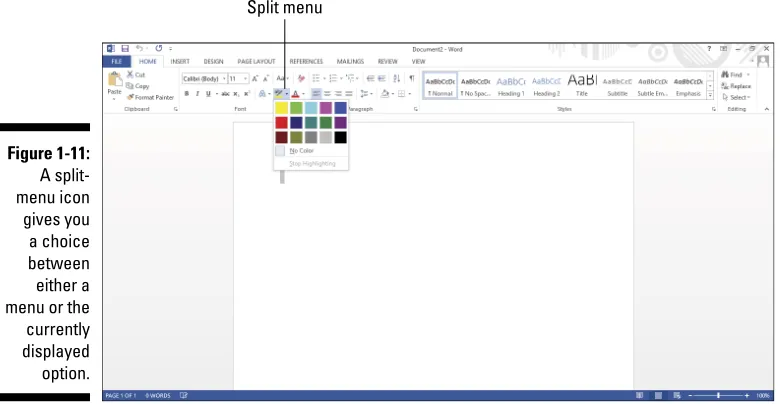
Split-menu icons give you two choices:
✓ If you click the top or left half of a split-menu icon, you choose a default
value. For example, the left half of the Font Color icon lets you choose the currently displayed color.
✓ If you click the bottom or right half of a split-menu icon, a pull-down
menu appears, letting you choose a new default option, as shown in Figure 1-11.
The Paste and Font Color icons, found on the Home tab of Word, Excel, and PowerPoint, are typical split-menu icons.
21
Chapter 1: Introducing Microsoft Office 2013
Figure 1-11:
A split-menu icon
gives you a choice between either a menu or the currently displayed option.
Using combo boxes
A combo box gives you two ways to choose an option:
✓ Type directly into the combo box.
✓ Click the downward-pointing arrow to display a list of options, as shown
[image:45.531.72.462.90.292.2]in Figure 1-12.
Figure 1-12:
22
Part I: Getting to Know Microsoft Office 2013
The Font and Font Size combo boxes, found on the Home tab of Word, Excel and PowerPoint, are typical combo boxes:
✓ If you click the left side of the Font Size combo box, you can type your
own value in for a font size.
✓ If you click the downward-pointing arrow on the right side of the Font
Size combo box, you can choose a value from a pull-down menu.
Identifying Ribbon icons
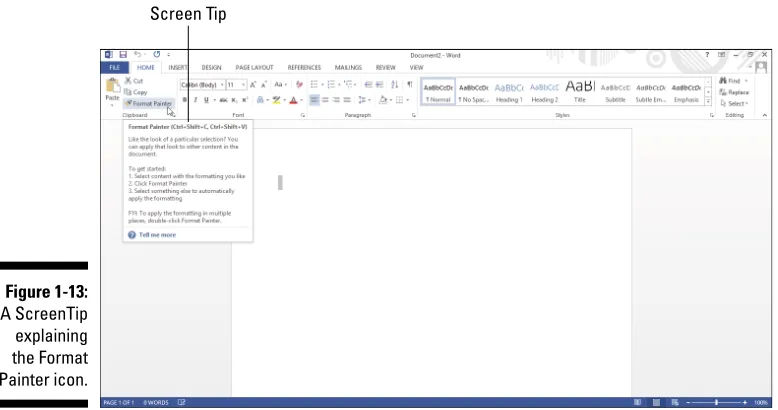
While some icons include descriptive text (such as Format Painter or Paste), most icons simply look like cryptic symbols from an alien language. To get additional help deciphering icons on the Ribbon, just point the mouse pointer over an icon, and a short explanation appears, called a ScreenTip, as shown in Figure 1-13.
ScreenTips provide the following information:
✓ The official name of the command (which is Format Painter in Figure 1-13) ✓ The equivalent keystroke shortcut you can use to run the command
(which is Ctrl+Shift+C in the figure)
[image:46.531.73.462.385.590.2]✓ A short explanation of what the command does
Figure 1-13:
A ScreenTip explaining the Format Painter icon.
23
Chapter 1: Introducing Microsoft Office 2013
Shortcut keystrokes let you choose a command from the keyboard without the hassle of clicking a tab and then clicking the icon buried inside that tab. Most shortcut keystrokes consist of two or three keys, such as Ctrl+P or Ctrl+Shift+C.
Displaying dialog boxes
On each tab, the Ribbon displays related commands in a group. For exam-ple, the Home tab groups the Cut, Copy, and Paste commands within the Clipboard group and the text alignment and line-spacing commands within the Paragraph group.
Although you can choose the most commonly used commands directly from the Ribbon, Word often contains dozens of additional commands that don’t appear on the Ribbon. To access these more obscure commands, you need to open a dialog box.
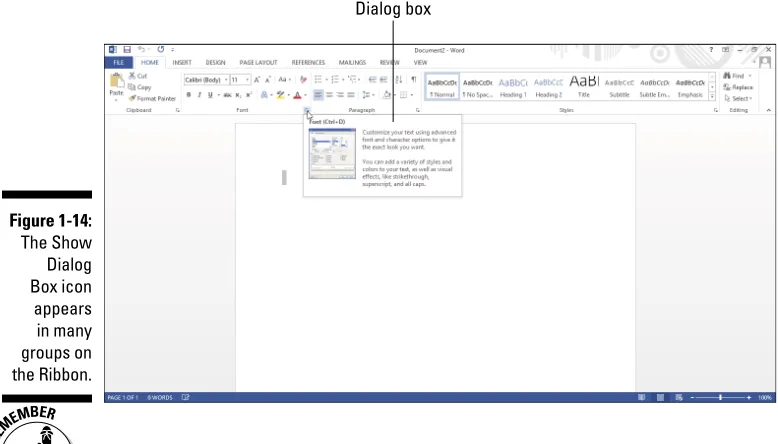
[image:47.531.71.460.349.571.2]In the bottom-right corner of a group of icons on the Ribbon, you’ll see the Show Dialog Box icon, which looks like an arrow pointing diagonally down-ward, as shown in Figure 1-14.
Figure 1-14:
The Show Dialog Box icon appears in many groups on the Ribbon.
Not every group of icons on the Ribbon displays the Show Dialog Box icon. To open a dialog box that contains additional options, follow these steps:
24
Part I: Getting to Know Microsoft Office 2013
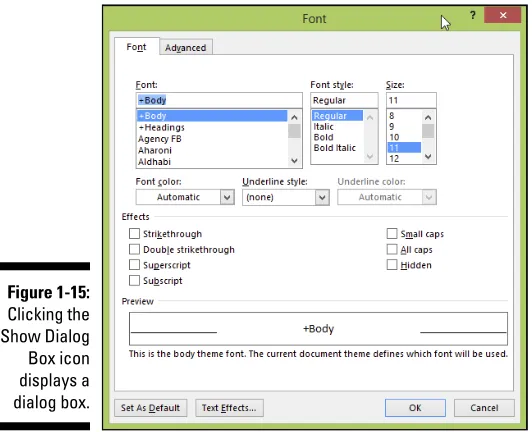
2. Click the Show Dialog Box icon in the bottom-right corner of a group such as the Font or Paragraph group found on the Home tab.
[image:48.531.72.338.153.369.2]Office 2013 displays a dialog box, as shown in Figure 1-15.
Figure 1-15:
Clicking the Show Dialog Box icon displays a dialog box.
3. Choose any options in the dialog box, and then click OK or Cancel when you’re done.
Minimizing the Ribbon
Some people like the Ribbon displaying various icons at all times, but others find that it makes the screen appear too cluttered. In case you want to tuck the Ribbon out of sight (or display a Ribbon that is already tucked out of sight) so icons only appear when you click a tab, choose one of the following methods:
✓ Double-click the current tab. ✓ Press Ctrl+F1.
✓ Click the Full Screen Mode icon that appears on the far right next to the
Help (Question Mark) icon.
25
Chapter 1: Introducing Microsoft Office 2013
✓ Auto-hide Ribbon: Completely hides the Ribbon including tabs and icons. ✓ Show Tabs: Displays the Ribbon tabs but hides the icons on each tab. ✓ Show Tabs and Commands: Displays the Ribbon tabs and icons on
[image:49.531.71.461.144.377.2]each tab.
Figure 1-16:
The Full Screen Mode menu lets you choose how to display the Ribbon tabs.
Using the Quick Access Toolbar
The Quick Access toolbar appears in the upper-left corner of the screen, directly above the File and Home tabs. The Quick Access toolbar displays icons that represent commonly used commands such as Save and Undo, as shown in Figure 1-17.
Figure 1-17:
The Quick Access tool-bar provides
26
Part I: Getting to Know Microsoft Office 2013
Using the Quick Access icons
If you click the Save icon in the Quick Access toolbar, Office 2013 saves your current file. If you’re saving a new file, a dialog box pops up, asking you to choose a name for your file.
The Undo icon is unique in that it offers two ways to use it. First, you can click the Undo icon to undo the last action you chose. Second, you can click the downward-pointing arrow that appears to the right of the Undo icon to display a list of one or more of your previous actions, as shown in Figure 1-18.
Figure 1-18:
The Undo icon dis-plays a list of actions you can undo.
The most recent action you chose appears at the top of this list, the second most recent action appears second, and so on. To undo multiple commands, follow these steps:
1. Click the downward-pointing arrow that appears to the right of the Undo icon in the Quick Access toolbar.
2. Move the mouse pointer to highlight one or more actions you want to undo.
3. Click the left mouse button.
Office 2013 undoes all the multiple actions you selected.
Adding icons
27
Chapter 1: Introducing Microsoft Office 2013
1. Click the Customize Quick Access Toolbar arrow.
A pull-down menu appears, as shown in Figure 1-19.
Figure 1-19: The Customize Quick Access Toolbar menu.
2. Click a command that you want to add to the Quick Access toolbar such as Open or Quick Print.
A check mark appears next to each command that currently appears on the Quick Access toolbar. If you want to add more commands that aren’t displayed on the Quick Access toolbar menu, continue with the rest of Steps 3 through 7.
3. Click More Commands.
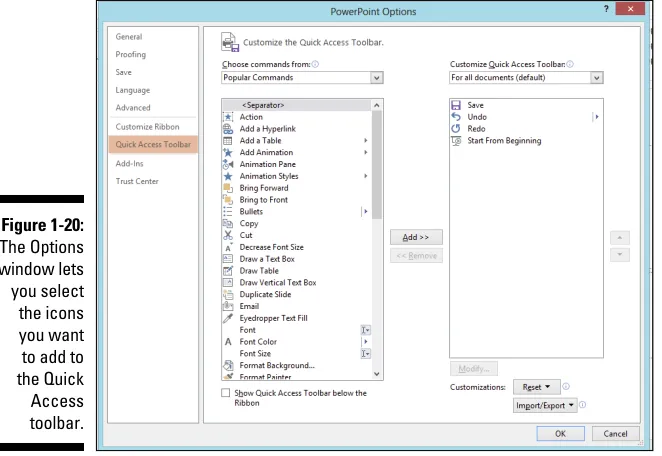
An Options window appears, as shown in Figure 1-20. The panel on the right shows all the current icons on the Quick Access toolbar. The panel on the left shows all the other icons you can add.
4. Click in the Choose commands from list box and choose a title, such as Home Tab or Insert Tab.
The left panel displays a list of icons and commands.
5. Click an icon and then click the Add button.
6. (Optional) Repeat Steps 4 and 5 for each icon you want to add to the Quick Access toolbar.
7. Click OK.
28
Part I: Getting to Know Microsoft Office 2013
Figure 1-20:
The Options window lets you select the icons you want to add to the Quick Access toolbar.
Removing icons
You can remove icons from the Quick Access toolbar at any time. To remove an icon, follow these steps:
1. Right-click an icon on the Quick Access toolbar.
A pull-down menu appears.
2. Click Remove from Quick Access Toolbar.
Office 2013 removes your selected icon from the Quick Access toolbar.
Moving the Quick Access toolbar
The Quick Access toolbar can appear in one of two places:
29
Chapter 1: Introducing Microsoft Office 2013
To move the Quick Access toolbar, follow these steps:
1. Click the Customize Quick Access Toolbar arrow.
A pull-down menu appears.
2. Choose Show Below/Above the Ribbon.
If the Quick Access toolbar currently appears over the Ribbon, you’ll see the Show Below the Ribbon command.
If the Quick Access toolbar appears under the Ribbon, you’ll see the Show Above the Ribbon command.
Customizing an Office 2013 Program
If you don’t like the default settings of your favorite Office 2013 program, you can modify them. Some common ways to modify an Office 2013 program include
✓ Changing the file format and location to save files ✓ Customizing the icons that appear on the Ribbon
Changing the file format
and default location
Every Office 2013 program is designed to share files easily with anyone who uses Office 2013, 2010, or 2007. However, if you need to share files with people who use earlier versions of Office or other programs altogether, you may need to save your files in a different format.
To choose a default file format that each Office 2013 program will use every time you choose the Save command, follow these steps:
1. Load an Office 2013 program. 2. Click the File tab.
3. Click the Options button in the left pane.
30
Part I: Getting to Know Microsoft Office 2013
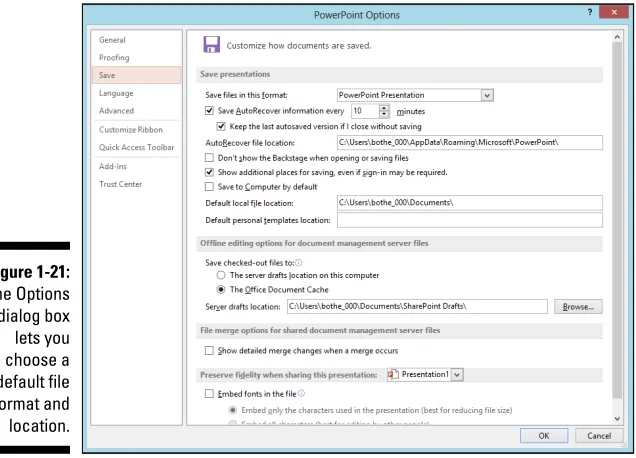
4. Click Save. [image:54.531.82.400.147.376.2]The Options dialog box displays multiple options for defining a default file format and file location, as shown in Figure 1-21.
Figure 1-21:
The Options dialog box lets you choose a default file format and location.
5. Choose a different file format and location.
6. Click OK when you’re done choosing different options.
Customizing the Ribbon icons
If you don’t use certain Ribbon icons, you can remove them and replace them with icons that represent the commands you do use most often. To custom-ize the Ribbon icons, follow these steps:
1. Load an Office 2013 program. 2. Click the File tab.
3. Click the Options button in the left pane.
An Options dialog box appears.
4. Click Customize Ribbon.
31
Chapter 1: Introducing Microsoft Office 2013
Figure 1-22:
The Options dialog box lets you change the icons that appear on the Ribbon.
5. Click different icons and click the Add or Remove buttons. 6. Click OK when you’re done choosing different options.
Exiting Office 2013
No matter how much you may love using Office 2013, eventually there will come a time when you need to exit an Office 2013 program and do something else with your life. To exit from any Office 2013 program, choose one of the following:
✓ Click the Close box in the upper-right corner of the Office 2013 window. ✓ Click the program icon in the upper-left corner and when a menu
appears, click Close.
✓ Press Alt+F4.
Chapter 2
Selecting and Editing Data
In This Chapter
▶ Selecting data
▶ Using the pop-up toolbar ▶ Copying, cutting, and pasting ▶ Copying and cutting with the mouse ▶ Sharing data within Office 2013
A
lthough you create a file only once, you can edit it many times. Editingcan add, rearrange, or delete data, such as text, numbers, or pictures. All Office 2013 programs work in similar ways to edit data, so whether you use Word, Excel, PowerPoint, or Access, you’ll know the right commands to edit data, no matter which program you may be using.
Whenever you edit a file, save your file periodically by clicking the Save icon in the Quick Access toolbar, pressing Ctrl+S, or clicking the File tab and choos-ing Save. That way if your computer crashes or the power goes out, you won’t lose all the editing changes you made.
Adding Data by Pointing
When you enter data into a file, your data appears wherever the cursor appears on the screen. The cursor appears as a blinking vertical bar, which basically says, “Anything you type now will appear right here!”
Because the cursor won’t always magically appear exactly where you want to type data, you must move the cursor by using either the mouse or the key-board. To move the cursor by using the mouse, follow these steps:
1. Move the mouse pointer where you want to move the cursor. 2. Click the left mouse button.
34
Part I: Getting to Know Microsoft Office 2013
To move the cursor by using the keyboard, you can use one of many cursor movement keys:
✓ The (up/down/left/right) arrow keys
✓ The Home/End keys
✓ The Page Up/Page Down keys
Use the up/down/right/left arrow keys when you want to move the cursor a small distance, such as up one line or right to the next cell in an Excel spreadsheet.
To move the cursor faster, hold down the Ctrl key and then press the arrow keys. If you hold down the Ctrl key, the up-arrow key moves the cursor up one paragraph, the down-arrow key moves the cursor down one paragraph, the left-arrow key moves the cursor left one word, and the right-arrow key moves the cursor right one word.
Pressing the Home key moves the cursor to the beginning of a sentence (or a row in a spreadsheet), and pressing the End key moves the cursor to the end of a sentence (or a row in a spreadsheet).
Pressing the Page Up/Page Down keys moves the cursor up or down one screen at a time.
Using any of the cursor-movement keys puts the cursor in a new location. Wherever the cursor appears will be where you can enter new data. Table 2-1 lists ways to move the cursor in each Office 2013 program.
Table 2-1
Moving the Cursor in Office 2013 Programs
Keystroke Word Excel PowerPoint Access
Home Beginning
of the line Column A of the current row that the cursor appears in; (Ctrl+Home moves to cell A1) Displays first slide; beginning of the line (when text box is selected)
First field of the current record
End End of the
line NA; (Ctrl+End moves to last cell)
Displays last slide; end of the line (when text box is selected)
35
Chapter 2: Selecting and Editing Data
Keystroke Word Excel PowerPoint Access
Page Up Half a page
up Up 23 rows Displays preceding slide
Up 25 records Page Down Half a page
down Down 23 rows Displays next slide Down 25 records Up/Down
arrow Up/down one line Up/down one row Next/previous slide; up/ down one line (when text box is selected)
Up/down one record
Left/Right
arrow Left/right one char-acter
Left/right
one column Next/pre-ceding slide; left/right one char-acter (when text box is selected)
Left/right one field
Selecting Data
To modify data, you must tell Office 2013 what you want to change by select-ing it. Then choose a command that changes your data, such as underlinselect-ing text or deleting a picture.
To select anything in Office 2013, you can use either the mouse or the key-board. Generally the mouse is faster — but getting used to coordinating the motion of the mouse with the movement of the mouse pointer onscreen takes some time. The keyboard is slower but much simpler to use.
Selecting data with the mouse
The mouse provides two ways to select data. The first way involves pointing and dragging the mouse:
1. Point the mouse pointer at the beginning or end of the data you want to select.
36
Part I: Getting to Know Microsoft Office 2013
When you drag the mouse, hold down the left mouse button. If you don’t hold down the left mouse button as you move the mouse, you won’t select any data when you move the mouse pointer across the screen.
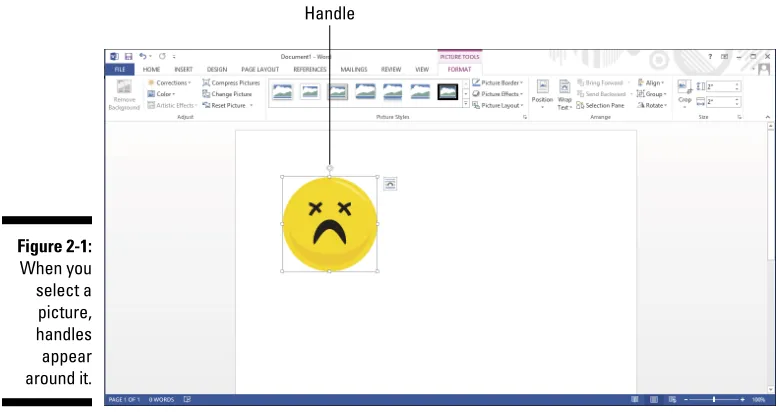
You can also select data by clicking the mouse. To select a picture, such as a chart in Microsoft Excel or a photograph added to a Microsoft Word docu-ment, just click the picture to select it. Office 2013 displays rectangles, called
[image:60.531.71.460.195.405.2]handles, around the border of any selected picture, as shown in Figure 2-1.
Figure 2-1:
When you select a picture, handles appear around it.
To select text with the mouse, you can click the mouse in one of three ways:
✓ Single-click: Moves the cursor
✓ Double-click: Selects the word that you click
✓ Triple-click: Selects the entire paragraph that contains the word you click
Office 2013 defines a paragraph as any chunk of text that begins on a separate line and ends with a Return character (¶), created by pressing the Enter key.
Selecting data with the keyboard
To select data with the keyboard, you need to use the following keys:
✓ The cursor movement keys (up/down/left/right arrow keys, Home/End
keys, or Page Up/Page Down keys)
37
Chapter 2: Selecting and Editing Data
To select all the data in a file, press Ctrl+A.
The cursor movement keys simply move the cursor. When moving the cursor, you can also hold down the Shift key to tell Office 2013 what to select. To select data, follow these steps:
1. Move the cursor to the beginning or end of the data you want to select.
2. Hold down the Shift key. (Keep it pressed down.)
3. Move the cursor by using any of the cursor movement keys, such as the up-arrow key or the End key.
4. Release the Shift key.
Instead of dragging the mouse to select data, you may find it easier to place the cursor by using the mouse and then hold down the Shift key while press-ing a cursor movement.
Selecting multiple chunks of data
with the mouse and keyboard
For greater flexibility in selecting data, you can use both the mouse and the keyboard to select multiple chunks of data that are not located next to each other. To select two or more chunks of data, follow these steps:
1. Select a picture or chunk of text, using either the keyboard or the mouse.
2. Hold down the Ctrl key.
3. Select another picture or chunk of text, using either the keyboard or the mouse.
4. Repeat Step 3 for each additional item you want to select. 5. Release the Ctrl key when you’re done selecting data.
Editing Text with the Pop-up Toolbar
38
Part I: Getting to Know Microsoft Office 2013
Figure 2-2:
Whenever you select text with the mouse, Office 2013 displays a pop-up
tool-bar in the upper-right area.
The pop-up toolbar appears only if you select text by using the mouse. If you select text by using the keyboard, this pop-up toolbar will not appear. To use this pop-up toolbar, follow these steps:
1. Select data by using the mouse.
Selecting data with the keyboard will not display the pop-up toolbar.
2. Move the mouse pointer to the area to the upper right of the selected data.
The pop-up toolbar appears.
The closer you move the mouse to the toolbar, the more visible the tool-bar will appear.
3. Click a command (icon) on the pop-up toolbar.
Deleting Data
The simplest way to edit a file is to delete your existing data. If you just need to delete a single character, you can use one of two keys:
39
Chapter 2: Selecting and Editing Data
If you need to delete large chunks of text, follow these steps:
1. Select the data you want to delete, using either the keyboard or the mouse. (See the earlier section, “Selecting Data.”)
2. Press the Delete (or Backspace) key. Office 2013 wipes away your data.
Cutting and Pasting (Moving) Data
Moving data in Office 2013 requires a two-step process: cut and paste. When you cut data, you delete it but save a copy in a special area of the computer’s memory known as the Clipboard. When you paste data to a new location, you copy the data off the Clipboard and paste it into your file.
To move data, follow these steps:
1. Select the data you want to move, using the keyboard or mouse as explained in the earlier section, “Selecting Data.”
2. Choose one of the following:
• Click the Cut icon (on the Home tab).
• Right-click the mouse; when the pop-up menu appears, choose Cut. • Press Ctrl+X.
3. Move the cursor to a new location. 4. Choose one of the following:
• Click the Paste icon (on the Home tab).
• Right-click the mouse; when the pop-up menu appears, choose Paste.
• Press Ctrl+V.
If you select data in Step 3, you can replace that selected data with the pasted data you selected in Step 1.
Copying and Pasting Data
40
Part I: Getting to Know Microsoft Office 2013
1. Select the data you want to copy, using the keyboard or mouse, as explained in the earlier section, “Selecting Data.”
2. Choose one of the following:
• Click the Copy icon (on the Home tab).
• Right-click the mouse; when the pop-up menu appears, choose Copy.
• Press Ctrl+C.
3. Move the cursor to a new location. 4. Choose one of the following:
• Click the Paste icon.
• Right-click the mouse; when the pop-up menu appears, choose Paste.
• Press Ctrl+V.
Using Paste Options
Cutting, copying, and pasting text from one location to another is easy. However, a problem can occur when you paste formatted text from one loca-tion to another. When you paste formatted text, you have several choices, depending on the Office 2013 program you’re using. Three common choices include:
✓ Paste the text with the original formatting of the copied or cut text. ✓ Merge the pasted data with the formatting of the current text. ✓ Paste the text but strip away the formatting.
Each Office 2013 program displays slightly different options for Paste Options. To use the Paste Options feature, follow these steps:
1. Select text.
41
Chapter 2: Selecting and Editing Data
2. Click the Home tab and click the Cut or Copy icon.
If you select the Cut icon, your selected text disappears.
3. Move the cursor to where you want to paste your cut or copied text. 4. Click the Home tab, and then click the downward-pointing arrow at
the bottom of the Paste icon.
The Paste Options menu appears, displaying the different ways you can paste, as show