Mayur K. Shiyal and Yogesh T. Naliapara*
*Department of Chemistry, Saurashtra University, Rajkot, Gujarat, India.
ABSTRACT
Numerous diversity-oriented synthesis of tetrazole heterocycles have
been demonstrated but most of them are based on point diversity
within the same library and usually include slow sequential multistep
synthesis, which also hurt from low yields and/or poor originator
scopes. In current context, an efficient synthesis has been developed
with the use of methenol under catalytically free reaction conditions.
KEYWORDS: four -component condensation, tetrazole, Ugi-Type
MCR.
INTRODUCTION
Multicomponent reactions (MCRs) constitute a potent synthetic tool due to their ability to
build up high levels of molecular diversity in a single step- and atom-economic manner.[1,4]
Since the first report by Ugi et al. In 1959[5] this reaction has been considered as one of the
most versatile and robust MCRs. Ugi type reaction is not only used for biological screening
in medicinal chemistry but also used for synthesis of drug molecule or drug intermediate as
well.[6] The post functionalization of MCR[7,11] adducts has received considerable attention in
recent years. Because of its combination with various post-transformations, typically
cyclization, provides a fast and efficient entry to libraries of diverse heterocyclic scaffolds.[12] Article Received on
29 Oct. 2019,
Revised on 19 Nov. 2019, Accepted on 09 Dec. 2019,
DOI: 10.20959/wjpr20201-16480
*Corresponding Author
Yogesh T. Naliapara
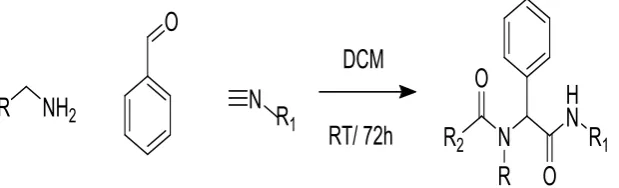
Figure 1: Typical Ugi Reaction with aromatic amine.
Isocyanide-based MCR followed by other synthetic transformations emerged as a powerful
tool for creating fused multicyclic skeletons. As a part of our strategy to discover novel
heterocycles by the skeletal diversity of N-rich cyclic compounds, we report our approach
toward the development of efficient reaction conditions with the use of diverse N-fused
cyclic heterocycles through an Ugi-type MCR.[13]
Figure 2: Our work with aromatic amine.
We are interested to synthesized tetrazol via Post Ugi-MCR. tetrazole represent privileged
moieties in medicinal chemistry and are ubiquitous substructures in pharmaceuticals.[14] For
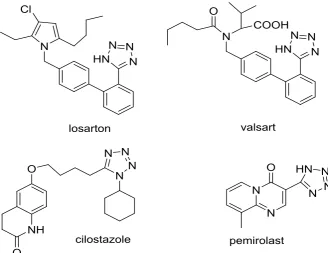
example, losartone (Figure 3) is potent for pulmonary arterial hypertension.[15] valsart &
pemirolast are oral drugs which act as an oxytocin receptor antagonist used for the treatment
of preterm labour.[16,17] cilostazole is a CCR5 entry inhibitor used for the treatment of HIV
infection. Plinabulin (NPI-2358/KPU-2) 348 is a potent antitumor agent that is active in
multidrug-resistant (MDR) tumor cell lines. Because of its biological importance, tetrazole
has attracted much attention to its syntheses. However, despite much effort to its preparation,
efficient methods for the synthesis of tetrazole remain to be developed.[18] We report herein a
novel way to construct tetrazole by using the Ugi MCR and based promoted post Ugi
[image:2.595.133.467.334.436.2]Figure 3: Biological active compound with tetrazole.
MATERIAL AND METHODS
Experimental Section
General All reagents and solvents were purchased from commercial sources and used
without purification. NMR spectra were recorded with 400 MHz spectrometers for 1H NMR
and 100 MHz for 13C NMR in deuterated solvents with TMS as internal reference (chemical shifts δ in ppm, coupling constant J in Hz). Multiplicities are reported as follows: singlet (s),
doublet (d), triplet (t), quartet (q), multiplet (m), and broad singlet (br, s).Melting points were
determined in open capillary tubes on an electrically heated block and are uncorrected. The
reaction progress was routinely monitored by thin-layer chromatography (TLC) on precoated
silica gel plates. Column chromatography was performed over silica gel (230−400 flash). All
compounds were characterized by TLC, 1H NMR and 13C NMR and MS.
General Procedure for the Synthesis of IMCR Products 1 A mixture of aromatic amine (1
mmol) and aromatic aldehyde (1 mmol) stirred at room temperature in methanol (3 mL) for 5
to 10 min afforded Schiff base which further undergoes the reaction TMSN3 (1 mmol) and
isocyanide (1 mmol) at room temperature to gives 1 in affordable yields. After stirring at
room temperature for 24 h, the solid was filtered out to obtain crude products then wash with
4-((1-(tert-butyl)-1H-tetrazol-5-yl)(p-tolylamino)methyl)-2-methoxy-6-nitrophenol(1)
Yield 62%, mp. 125- 126 oC; 1H NMR (400 MHz, DMSO) δ 1.45 (s, 3H), 2.32 (d, J 7.5 Hz,
1H), 3.83 (s,1H), 5.44 (s, 1H), 6.47(d,J 8.4, 2H), 6.8(d,J 8.2, 1H), 7.1(d,J, 8.8, 2H), 7.2 (s,
1H),7.8 (s, 1H), 14.1 (s, 1H).
13
C NMR (100 MHz, Common NMR Solvents)
δ21.3,29.1,56.1,64.8,70.3,113.4,117.0,118.5,129.6,129.8,136.0,136.6137.8,144.6,152.1,159.
Anal. (%) for C20H2N6O4, Calcd. C, 58.24; H, 5.87; N, 20.38; O, 15.52
RESULTS AND DISCUSSION
Initially, the syntheses of Ugi MCR product were achieved by the condensation of
4-hydroxy-3-methoxy-5-nitrobenzaldehyde, substituted aniline, trimethylsilyl azide and
isocyanides under catalytically free reaction condition in methanol.
A small library of tetrazole have been synthesized with the use of optimized reaction
conditions. In order to develop a better reaction conditions, a set of experiments were carried
out by varying base, catalyst and solvent with the use of 1 as the model substrate for
most efficient base to push the reaction forward among the several bases used (Table 2). The
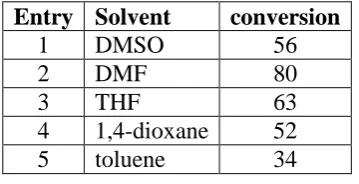
effect of solvent was also investigated, and DMF was found to be the best solvent at 100°C
(Table 3).Excellent yields were observed for 1−10 (Table 4).
Table 1: Survey of the Reaction Condition for Post Ugi cyclization Reactionα.
Entry Catalyst Ligand Base Yield
1 CuI 1,10 phenanthroline Cs2CO3 22
2 CuI ethylinediamine Cs2CO3 25
3 CuI D-proline Cs2CO3 Trace
4 Palledium acetate Xantphos Cs2CO3 30
5 Palledium acetate Sphos Cs2CO3 46
6 - - Cs2CO3 75
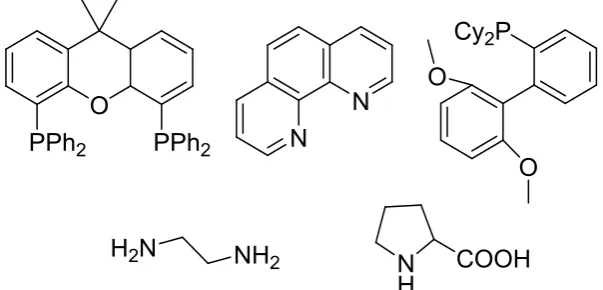
Reaction conditions: substrate 1 (1 mmol), catalyst (10 mol %), Ligand (10 mol %), base (2
[image:5.595.147.449.445.590.2]mmol), solvent (2 mL) under N2 atmosphere.
Figure 4: Ligand used in the model substrate.
Table 2: Selection of base.
Entry Base Yield (%)ζ
1 Cesium carbonate 75
2 Potassium carbonate 80 3 Sodium carbonate trace 4 Potassium phosphete 35
5 sodium hydroxide -
Table 3: Screening of Solvent.
Entry Solvent conversion
1 DMSO 56
2 DMF 80
3 THF 63
4 1,4-dioxane 52
5 toluene 34
Table 4: Synthesis of tetrazole
Code no Molecular formula Molecular weight Melting point°C % of
yield R TIME
MKug 01 C19H21N6O4Cl 432.8 122-123 62 4-Cl 2 Hrs.
MKug 02 C19H21N6O4F 416.4 130-131 69 4-F 2 Hrs.
MKug 03 C20H24N6 O4 412.4 125-126 78 4-Me 2 Hrs.
MKug 04 C19H21N7O6 443.42 127-127 82 4-NO2 2 Hrs.
MKug 05 C19H21N6O4Cl 432.87 118-119 81 3-Cl 2 Hrs.
MKug 06 C21H26N6 O4 426.4 134-135 58 3,4-Di Me 2 Hrs.
MKug 07 C21H26N6 O4 446.9 164-165 69 2,4-Di Me 2 Hrs.
MKug 08 C20H24N6 O4 426.5 121-122 67 4-OMe 2 Hrs.
MKug 09 C20H24N6 O4 428.4 117-118 65 3-OMe 2 Hrs.
MKug 10 C19H21N6O4F 416.4 125-126 73 3-F 2 Hrs.
CONCLUSIONS
An efficient synthesis of novel functionalized tetrazole has been reported. Considering the
availability of starting material, the simple reaction procedure, simple workup and robust
nature, this chemical process provides a very straightforward route to construct various
highly functionalized tetrazole.
ACKNOWLEDGEMENTS
The authors are thankful to the Department of Chemistry, Saurashtra University for providing
the laboratory facilities.
REFERENCES
1. Bienayme, H.; Hulme, C.; Oddon, G.; Schmitt, P. Chem. Eur. J, 2000; 6: 3321-3329.
2. https://doi.org/10.1002/1521-3765(20000915)6:18<3321::AID-CHEM3321>3.0.CO;2-A
3. Domling, A.; Wang, W.; Wang, K. Chem. Rev, 2012; 112: 3083-3135.
4. Cioc, R. C.; Ruijter, E.; Orru, R. V. Green Chem, 2014; 16: 2958-2975.
5. Ravichandiran, P.; Lai, B.; Gu, Y. Chem. Rec; 2017; 17(2): 142-183.
6. Ugi, I.; Steinbruckner, C. Angew. Chem; 1960; 72: 267-268.
12.Isambert, N.; Lavilla, R. Chem. Eur. J. 2008; 14: 8444-8454.
13.Xu, Z.; De Moliner, F.; Cappelli, A. P.; Hulme, C. Angew. Che,. 2012; 124: 8161-8164.
14.Ma, Z.; Xiang, Z.; Luo, T.; Lu, K.; Xu, Z.; Chen, J.; Yang, Z. J. Comb. Chem, 2006; 8:
696-704.
15.Milne, P. J.; Kilian, G. 5.20 - The Properties, Formation, and Biological Activity of
2,5-Diketopiperazines.Comprehensive Natural Products II. Oxford: Elsevier, 2010; 657-698.
16.Maeda, N.; Clave, M.; Bydlowski, S.; Lopes, A. Thromb. Res; 2016; 146: 15-19.
17.Snidow, J.; Miller, H.; Valenzuela, G.; Thornton, S.; Stier, B.; Clayton, L.; Fossler, M.;
Montague. T.; Beach, K.; Williams, P. Am. J. Obstet. Gynecol, 2013; 208: S155.
18.Shinghal, R.; Barnes, A.; Mahar, K. M.; Stier, B.; Giancaterino, L.; Condreay, L. D.;
Black, L.; McCallum, S. W. J. Sex Med, 2013; 10: 2506-2517.