Journal of Chemical and Pharmaceutical Research
__________________________________________________
ISSN No: 0975-7384 CODEN(USA): JCPRC5
J. Chem. Pharm. Res., 2011, 3(2):489-495
Novel One-Pot Synthesis of Schiff Base Compounds Derived From Different
Diamine & Aromatic Aldehyde Catalyzed by P
2O
5/SiO
2Under Free-Solvent
Condition at Room Temperature
Shelar Mahendra Devidas*1, Shujat Hussain Quadri2, Suresh Arjun Kamble2, Faozia Mansoor Syed2 and Dipak .Y. Vyavhare3.
1,2
Maulana Azad College (Dr. Rafiq Zakaria Campus), Rauza Baugh, Aurangabad, Maharashtra, INDIA
3
M.G.M. Polytechnic College, Aurangabad, Maharashtra, INDIA
______________________________________________________________________________
ABSTRACT
A potential method for one-pot synthesis of Schiff base compounds derived from different aldehyde and Di-amine compounds like substituted aromatic aldehyde and Diamines; such as Salicylaldehyde, 3, 4-Tertery butyl 2-Hydroxy Benzaldhyde, Ethylene Diamine, 2-Amino Pyridine, 1, 2-Di-amino Benzene, 1, 3-Diamino Propane by using catalytic amount of P2O5/SiO2
have catalyzed the ligand formation in dry media under free-solvent condition at room temperature. This type of excellent method avoids use of hazardous solvents, longer reaction time and tedious work up procedure. Advantage of this efficient method is excellent yield of products in crystalline form, short reaction time, simplicity of work up procedure and no use of any type of hazardous solvents. Simply this reaction is environmentally Proctive (non polluted) and economically attractive method for synthesis of Schiff base compound. All these Schiff base compounds were characterized by means of IR, 1H-NMR and their Elemental analysis as (C, H, N, and O) spectral analysis data. Above Schiff base compounds shows inherent new generation of series of pharmaceutically important compounds.
Keywords: Salicylaldehyde, 3, 4-Tertery butyl Hydroxy Benzaldhyde, Ethylene Diamine, 2-Amino Pyridine, 1, 2-Diamino Benzene, 1, 3-Diamino Propane, Dichloro Methane and P2O5/SiO2.
______________________________________________________________________________
INTRODUCTION
are widely applied in enantioselective cyclopropanation of styrene’s3. Asymmetric addition of cyanide to aldehydes4. Schiff base compounds containing imines group (-RC=N-) are usually formed by the condensation of primary amine and Diamine with an active carbonyl compound in a methanol solvent5. Some synthesis methods have not been entirely satisfactory owing to a number of drawbacks such as low yields and tedious workup procedures6. According to the tremendous scope of Schiff bases possesses an inherent imidazopyridine, with a high class of compounds of medicinal importance and oblige. Over the past few decades, significant research has been directed towards the development of new technologies for environmentally benign processes (green chemistry) 7. The dipyridyl can attach two molecules of an alkyl-halide thus forming a bi-quaternary base. The method of preparation consisted in preparing first a quaternary base of pyridine and condensing two molecules of it to a dipyridyl compound by treatment with sodium amalgam and successive oxidation8. The deep Studies on a new kind of chemotherapeutic Schiff bases are now attracting the attention of biochemists9,10.Accordin g to ligands, the Isoxazole Schiff bases, methyl salicylaldehyde and 4-methoxy salicylaldehyde with 3-amino-5-methyl Isoxazole potentiometrically titrated with their complexes with Cu(II) Ni(II), Co(II), Zn(II)) and VO(IV)11. The Schiff base ligands have been prepared from carbonyl compounds within a short time, catalyzed by P2O5 under solvent free conditions12. Considerable interest attached with the chemistry of Schiff bases 13, obtained from heterocyclic aldehyde, also various heterocyclic Schiff bases having O,N and S donor atoms, have been reported by several scientists 14,15,16. Most of the routes involve acylation reaction of a 2-aminomethylpyridine followed by cyclization with phosphorus oxychloride or polyphosphoric acid 17. According to high yielding and environment proactive reactions, there some methods are significant for one pot synthesis of pyridil immidazo [1, 5-a] pyridines catalyzed by K4FeCN6 under free solvent conditions; which is technologically and economically attractive18. According to applications root from the facts that the Schiff’s base are capable of chelating various metal ions and the resultant complexes possess a wide range of magnetic, photo physical, and electrochemical properties. Thus, the increment of synthetic methodologies for N, N-bidentate ligands is of paramount importance in chemistry. N, N-Bidentate ligands with mixed five- and six-membered heterocyclic are a high class of compounds in the pursuit of structural diversity for property performance. In particular, 1-pyridylimidazo [1, 5-a] pyridines possess a bidentate structural feature with a pyridil unit directly next to a fused immidazo and have emerged as a new class of ligands19, 20.
Reactions:
+ NH2
NH2
p2O5 sio2 O
benzaldehyde
N
N Scheme-1
CHO H2N
+
p2o5
sio2
N
N
EXPERIMENTAL SECTION
All the chemicals were purchased from Merck German chemically company in high quality standard and purity. IR spectra were recorded as KBr pellets on SHIMADZU spectrometer.1H NMR spectra were recorded in CDCl3 and DMSO with (400 MHZ) spectrometer. Purity of all substances and reaction was monitored by TLC column chromatography using silica gel (60-120 mesh size).
General Procedure For Preparation of Schiff’s Base Compounds:
[image:3.595.47.550.326.697.2]In a detailed discussion of reaction, a mixture of benzaldehyde (2 mmol), amine (2mmol) and P2O5/SiO2 mixture (0.4 g, 2mol % of P2O5/benzaldehyde) was grounded together in a mortar. The resulting mixture was placed in a flask and mechanically stirred for 30-35 minutes. The progress of reaction was monitored on TLC. After completion of reaction ethanol (40-50 ml) was added to reaction mixture, filtered off the solid product and washed with cold methanol. The crude product was further purified and recrystallised in petroleum ether/ diethyl ether. Desired Schiff base compounds are obtained up to 92 % yield21.
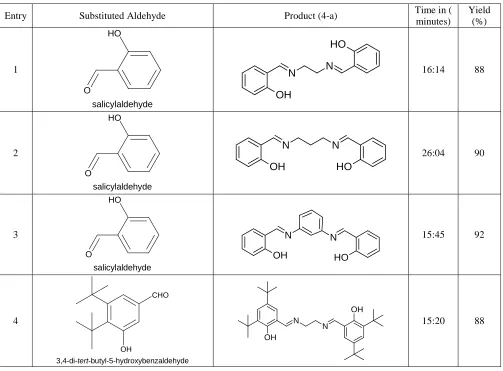
Table -2: Synthesis of Scheff’s Base Compounds
Entry Substituted Aldehyde Product (4-a) Time in (
minutes)
Yield (%)
1
HO
O
salicylaldehyde OH
N N
O H
16:14 88
2
HO
O
salicylaldehyde
OH
N N
O H
26:04 90
3
HO
O
salicylaldehyde
OH
N N
O H
15:45 92
4
OH
CHO
3,4-di-tert-butyl-5-hydroxybenzaldehyde
OH N
N
OH
5
HO
O
salicylaldehyde
N
N OH
14:56 93
6
OH CHO
3,5-di-tert-butyl-2-hydroxybenzaldehyde
OH N
N
19:30 92
7
CHO
benzaldehyde
N N
13:39 92
Spectroscopic and Analytical Data for Schiff Base Compounds:
2, 2’-{ethane-1, 2-diylbis [nitrilo (E) methylylidene]} diphenol No. [4-a]: Colour: bright shine yellow
crystals, Melting Point: 134-136 0C. FTIR (KBr pellets):432.09, 476.40, 648.11,748.43, 856.45, 977.02, 1019.38, 1042.52, 1149.59, 1200, 1284.60, 1374.30, 1416.71, 1459.18, 1496.84, 1576.89, 1632.83, 1798.70, 1941.44, 2926.13, 3056, 3600. 1H NMR (200.13 MHz CDCl3):3.90(s, 4H ), 6.88(m.4H),
7.22(m,4H), 8.32 (s, 2H), 13.20 (bs, 2H) Anal. Calcd. For C16H16N2O2: C, 71.62; H, 6.01; N, 10.44; O,
11.93. Found C, 71.18; H, 5.80; N,10.10; O, 11.15.
2, 2’-{propane-1, 3-diylbis [nitrilo (E) methylylidene]} diphenol [4-b]: Colour: yellow crystals,
Melting Point: 78-81 0C. FTIR (KBr pellets): 462.90, 518.85, 567.13, 642.30, 663.51, 754.17, 777.41, 852.54, 883.41, 976, 1007, 1050, 1147, 1206, 1278, 1415, 1456, 1492, 1579, 1634, 1783, 1900, 2060, 2111, 2441, 2670, 2940, 3002, 3061, 3500.22. 1H NMR (200.13 CDCl3):d 2.09(dd, 2H), 3.70(t, 4H),
6.90(m,4H), 7.29(m,4H), 8.35(s, 2H), 13.41(bs,2H). Anal. Calcd. For C17H18N2 O2: C, 72.32; H, 6.43; N,
9.92; O, 11.33. Found C, 72.00; H, 6.05; N, 9.17; O, 10.80.
2,2'-{1,3-phenylenebis[nitrilo(E)methylylidene]}diphenol [4-c]: Colour: bright orange crystals,
Melting Point: -174-176 0C. FTIR(KBr):438.80,500,581,642,758,810,858,906,974,1036, 1113,1153, 1192,1230,1277,1369,1402,1452, 1482, 1563,1612,1808, 1886, 1950, 1940, 1995, 2052,2106, 2260, 2662, 2986,3058,3400.52 1H NMR (200.13 CDCl3): 6.88-7.40(m,12H),8.63(s,2H), 13.07(s,2H). Anal.
Calcd. For C20H16N2O2: C, 75.93; H, 5.10; N, 8.86; O, 10.11. Found C, 75.20; H, 4.79; N, 8.14; O, 9.92.
6,6'-((1E,1'E)-(propane-1,3-diylbis(azanylylidene))bis(methanylylidene))bis(2,4-di-tert-butyl
phenol) [4-d]: Colour: bright yellow crystals, Melting Point: 184-186 0C. FTIR (KBr): 444.60, 512, 588, 643, 707, 771, 835, 877, 976, 1039, 1131, 1205, 1271, 1318, 1361, 1441, 1469, 1591, 1626, 2867, 2904, 2955, 3500.1H NMR (200.13 CDCl3):1.27(s, 18H), 1.41(s,18H), 3.90(s,2H), 7.06(s,2H ),
7.36(s,2H), 8.37(s,2H), 13.64(bs,2H). Anal. Calcd. For C32H48N2O2: C, 78.00; H, 9.82; N, 5.69; O, 6.49. Found C, 77.44; H, 9.34; N, 5.11; O, 6.00.
7.76(dd,1H), 8.48(d,1H), 9.43(s, 1H), 13.45(s, 1H) Anal. Calcd. For C12H10N2O: C, 72.71; H, 5.08; N,
14.13; O, 8.07. Found C, 72.10; H, 4.80; N, 13.76; O, 7.85.
2, 4-di-tert-butyl-6-[(E)-(pyridin-2-ylimino) methyl] phenol [4-f]: Colour: yellow crystals, Melting
Point: 116-118 0C. FTIR (KBr pellets):430.05, 466.31, 640, 1048.41, 850.41, 970.16, 1010, 1032.54, 1138.60, 1200, 1270.61, 1353, 1400, 1451, 1481, 1571, 1631, 1790.46, 2926.10, 3056.31, 3600. 1H NMR (200.13 MHz CDCl3):3.92(s, 4H ), 6.84(m.4H), 7.20(m,4H), 8.30 (s, 2H), 13.20 (bs, 2H) Anal. Calcd.
For C20H26N2O: C, 77.38; H, 8.44; N, 9.02; O, 5.15. Found C, 77.01; H, 8.03; N, 8.74; O, 4.84.
N, N’-bis [(1E)-phenyl ethylene] ethane-1, 2-diamine [4-g]: Colour: bright yellow crystal, Melting
Point: 123-126 0C. FTIR (KBr pellets):431, 476.01, 648,745, 858, 976, 1022, 1032, 1151, 1203, 1284, 1373, 1420, 1461, 1489, 1542, 1621, 1747, 1941, 2927, 3040
RESULTS AND DISCUSSION
In a typical reaction substituted aldehyde was treated with different types of amines and di-amines; such as Salicylaldehyde, 3, 4-Tertery butyl 2-Hydroxy Benzaldhyde, Ethylene Diamine, 2-Amino Pyridine, 1, 2-Di-amino Benzene, 1, 3-Diamino Propane in the presence of P2O5 supported on SiO2 as catalyst without using any solvent by crushing in a mortar at room temperature within few minutes. There is no requirement to use any solvent. P2O5/SiO2 was used as catalyst in solvent-free media. Here we are kindly intrested to report that the reaction of different substituted aldehyde, amines and di-amines obtained as corresponding Schiff base compounds in excellent yields, in shorter time under free solvent condition at room temperature. The desired results are indicated in Table-1, as shown in Table-1, vast and new series of diffren t Schiff’s base compounds were synthesized using P2O5/SiO2 as catalyst in solvent free media by crushing in a mortar, at room temperature. In comparison, the reaction of Salicylaldehyde, 3,4-tertiery butyl 2-hydroxy benzaldehyde with 2-amino pyridine, ethylene diamine in absence of catalyst as shown at entry no.[8,9] in Table-1, found very low yield of compound and longer reaction time while to verify detailed study, the progress of this methodology, various diamines with different substituted aldehyde were treated in the presence of P2O5/SiO2 the desired results of such studies are mentioned in Table-1Entry(1-7). In Table-1 Entry [5] the salicylaldehyde is taken as (1 mol) and 2-amino pyridine is (1 mol) while in Entry No. [1, 2, 3 & 4] the molar ratios of reactions are taken in (2:1) ratio respectively. According to scheme (1 & 2) we may easily obtain a vast series of excellent high yield products and pharmaceutically important compounds by using P2O5/SiO2 as catalyst under free solven t condition at room temperature. In scheme (1, 2 & 3) the reaction is formed by using Dichloromethane as solvent at reflux condition.
Table-1: Reactions of different benzaldehyde, Salicylalhyde, 3, 4-tertiery butyl 2-hydroxy benzaldehyde with different Di-amines in DCM as solvent at reflux condition.
Entry Amine Substrate (2) Aldehyde Substrate (3) Product (4)
Time in (Minute)
Yield in %
1 Ethylene Di-amine Salicylaldehyde A 16:14 sec. 88
2 1,3-Diamino Propane Salicylaldehyde B 26:04 sec. 90
3 1,2-Diamino Benzene Salicylaldehyde C 15:45 sec. 92
4 Ethylene Di-amine 3,4-tertiery butyl 2-hydroxy benzaldehyde D 15:20 sec. 88
5 2-Amino Pyridine Salicylaldehyde E 14:56 sec. 93
6 2-Amino Pyridine 3,5-tertiery butyl 2-hydroxy benzaldehyde F 19:30 sec. 92
7 Ethylene Diamine Benzilidine G 13:39 sec. 92
8 Ethylene Di-amine 3,4-tertiery butyl 2-hydroxy benzaldehyde D 4 Hours20 min 72
The structures of products were assigned by spectroscopic data from Chemdraw Software. In the IR spectra characteristic Schiff base compounds (C=N) stretching frequency and 1H NMR may be observed.
CONCLUSION
In a typical reaction mild and significant Schiff base compound have been synthesized from different aldehyde and Diamine compounds using P2O5/SiO2 as catalyst with excellent yield of products within few minutes by crushing in a mortar at room temperature under free solvent condition. In short these types of reactions are environ mentally Proctive, technically and economically attractive. Gives high yield of products, short reaction time without using any type of hazardous solvent. Simply we have shown significant path to synthesize a variety of new series of medicinally important and excellent scientific future based Schiff base compounds.
, 3500. Anal. Calcd. For C16H16N2: C, 81.32; H, 6.82; N, 11.85. Found C, 81.00; H, 6.14; N, 11.28.
Acknowledgements
I am very thankful to Dr. Mazhar Farooqui Head-P.G.Research centre chemistry Department and Dr. Maqdoom Farooqui Principal Maulana azad college Aurangabad for their precious guidance and support for research work.
REFERENCES
[1] Shamsipur, M.; Ghiasvand, A.R.; Sharghi, H.; Naeimi, H. Anal Chim Acta 2000, 408, 271. [2] Nimitsirwat, N.; Vernon, C. J Am Chem Soc 2004, 32,126.
[3]Qiu, M.; Liu, G.; Yiao, X. Chin J Catal 2001, 22, 77–80.
[4] Yang, Z.H.; Wang, L.X.; Zhou, Z.H.; Zhou, Q.L.; Tang, C.C. Tetrahedron; A symmetry 2001, 12, 1579.
[5] Santos, J. E.; Edward, R.D. Eder; Cavalheiro, T.G. Carbohydrates Polymer 60, 2005, 277-282.
[6] Michael, J. K.; Miller, J. A. Synthesis 1981, 824.
[7] Bhattacharya, A.; Purohit, V.C.Org Proc Res Dev 2003, 7,254. [8] Hofmann, A. W., Bee. Chem. Ges, 1881, 14, 1497.
[9] Shiva Raj et al J. Chem. Pharm. Res., 2010, 2(1): 375-384
[10]B. Katia, L. Simon, R. Anne, C. Gerard, D. Francoise and M. Bernard, Inorg. Chem., 1995,35: 387.
[11]K. Kiranmai, Y. Prashanthi, N. J. P. Subhashini and Shiva raj, J. Chem. Pharm. Res., 2010,
2(1): 375-384 375.
[12]Hossein Naeimi, Hashem Sharghi, Fariba Salami and Khadijeh Rabiei.; Heteroatom
Chemistry Volume 19, Number 1, 2008.
[13]Angellei, R.J, Coord. Chem.Rev, 1990, 61, 105. [14]Campbell MJM, J Inorg Nucl Chem., 1974, 55, 36.
[15]Dawas H M and Waters T M, Inorg Chim Acta., 1987, 29, 66.
[16]Nuria AI, Francisco H U, Miguel NMC, JRE, J. Inorg. Biochem, 2008, 102 (4), 647.
[17](a) J.D.Bower, G.R. Ramage, J. Chem. Soc. (1955), 2834. (b)K. Winterfeld, H.Franzke, Angew. Chem. Int. Ed. Engl. 75 (1963), 1101.
[21]Hossein Naeimi, Hashem Sharghi, Fariba Salami and Khadijeh Rabiei.; Heteroatom
Chemistry Volume 19, Number 1, 2008.