The influence of class structure on program
comprehension : An empirical study.
ALARDAWI, Ahmed.
Available from Sheffield Hallam University Research Archive (SHURA) at:
http://shura.shu.ac.uk/19232/
This document is the author deposited version. You are advised to consult the publisher's version if you wish to cite from it.
Published version
ALARDAWI, Ahmed. (2013). The influence of class structure on program
comprehension : An empirical study. Doctoral, Sheffield Hallam University (United Kingdom)..
Copyright and re-use policy
See http://shura.shu.ac.uk/information.html
Sheffield S i 1VVD
ProQuest Number: 10694112
All rights reserved
INFORMATION TO ALL USERS
The quality of this reproduction is dependent upon the quality of the copy submitted.
In the unlikely event that the author did not send a com plete manuscript and there are missing pages, these will be noted. Also, if material had to be removed,
a note will indicate the deletion.
uest
ProQuest 10694112
Published by ProQuest LLC(2017). Copyright of the Dissertation is held by the Author.
All rights reserved.
This work is protected against unauthorized copying under Title 17, United States C ode Microform Edition © ProQuest LLC.
ProQuest LLC.
789 East Eisenhower Parkway P.O. Box 1346
The Influence of Class Structure on Program
Comprehension: An Empirical Study
Ahmed Alardawi
A thesis submitted in partial fulfilment of the requirements of
Sheffield Hallam University
for the degree of Doctor of Philosophy
Abstract
This thesis describes and reports on two sets of empirical studies investigating the ease of comprehension of Object Oriented (0 0) programs, including the underlying various types of knowledge that can be present in the program text during the process of comprehension.
The two empirical studies are referred to as the Car and the Line-Edit. These are two well established programming problems in the early literature from the Psychology of programming research. Both novice and experienced 0 0 programmers were asked to undertake comprehension tasks based on a paper and pen exercise and a set of comprehension questions associated with either an 0 0 or a non 0 0 programming version of the Car or the Line-Edit. The studies focus on the elements of class concept, problem characteristics, and solution decompositions and their effect on the comprehension of different types of knowledge which are present in the program text. It is found that 0 0 programs are better understood than of the non 0 0 programs. It is also found that the class concept, problem characteristics, and solution decompositions are empirically to be the influential elements in the comprehension of 0 0 programs, especially for Control Flow, State, and Problem Classes types of knowledge.
Acknowledgements
I would like to thank Dr. Babak Khazaei and Prof. Jawed Siddiqi for their support, supervision, encouragement, and stimulating discussions. I believe it is fair to say that without their help and guidance it is likely that this thesis would never have been completed. It has been a pleasure working with you, gentlemen.
There are also several other individuals who have contributed, in one way or another, towards the body of research contained within this thesis. They are: Alla Elakari, Mohammed Jomma.
Dedication
To the soul of my father, Salem, and my mother, Badrea, for their never-ending love and prayers for my success and happiness.
To my wife, Nessrin, and my beloved children, Logien, Lama, Sanad and Adam for love, patience, sacrifices, and continuous support.
To all my brothers and sisters for their eternal faith in my ability to complete this thesis and for helping whenever they could
List of Publications
1. Empirical Study of Novices Comprehension of Object-Oriented Programs, Ahmed Alardawi, Babak Khazaei, Jawed Siddiqi (2010) In Proceedings of 6th Work-in-Progress Workshop of the Psychology of Programming Interest Group (PPIG), Dundee, UK, 7-8 January.
2. Influence on Novices of Class Structure on Program Comprehension,
Ahmed Alardawi, Babak Khazaei, Jawed Siddiqi (2011a) In Proceedings of 7th Work-in-Progress Workshop of the Psychology of Programming Interest Group (PPIG), Sheffield, UK, 18-19 April.
Table of Contents
CHAPTER 1 INTRODUCTION...1
1.1 Ma in Th e s is Qu e s t io n sa n d Ai m s...7
1 .2 Ou t l in eo f t h e Th e s is... 8
CHAPTER 2 LITERATURE REVIEW...11
2 .1 In t r o d u c t io n... 1 1 2 .2 Ob ject- Or ie n t e d Ap p r o a c ha n dc o n c e p t s...1 1 2.2.1 The Cognitive Benefits of Object-Oriented Approach ...15
2 .3 Pr o g r a m Co m p r e h e n s io n...2 1 2.3.1 What is the Definition of Program Comprehension?...21
2.3.2 Program Comprehension from Different Perspectives...24
2.3.3 Cognitive Theories of Program comprehension...27
2.3.4 Program Comprehension as a Temporal Activity...28
2.3.4.1 Top-Down Models of Program Comprehension... 29
2.3.4.2 Bottom-Up Models of Program Comprehension... 30
2.3.4.3 Integrated Model of Program Comprehension...32
2.3.5 Program Comprehension as Strategies for Deployment...33
2.3.6 Program Comprehension as a Construction of Different types of Knowledge...35
2.3.6.1 Pennington's Model of Program Comprehension... 35
2.3.6.2 Limitations of Pennington's Model for 0 0 programs... 38
2.3.6.3 Burkhardt et al.'s Model of 0 0 Program Comprehension...40
2 .4 Em p ir ic a l Wo r k so n 0 0 ... 4 3 2.4.1 Empirical Works in 0 0 Program Comprehension...44
2.4.2 Problem Characteristics and Solution Decomposition in 0 0 Program Comprehension 55 2 .5 Im p l ic a t io n so ft h e 0 0 Ap p r o a c ho n Dif f e r e n t Ty peso f Kn o w l e d g e...5 9 2 .6 Ch a p t e r Su m m a r y...6 5 CHAPTER 3 RESEARCH METHODOLOGY ... 66
3 .1 In t r o d u c t io n... 6 6
3 .2 Ph il o s o p h yo f Re s e a r c h... 6 6
3 .3 Re s e a r c h Me t h o d... 7 1
3 .4 Ex p e r im e n t a l Fr a m e w o r k ...7 6
3 .5 Sp e c if ico ft h e M e t h o d o l o g y... 8 0
3.5.1 Subjects...83
3.5.2 Materials...87
3.5.3 Measures...91
3 .6 Hy p o t h e s is Te s t in g... 9 7 3 .7 St a t is t ic a l M e t h o d so f An a l y s is...9 9 3 .8 Et h ic a l Is s u e s...1 0 0 3 .9 Ch a p t e r Su m m a r y...1 0 1 CHAPTER 4 SPECIFIC OF THE INVESTIGATION... 103
4 .1 In t r o d u c t io n...1 0 3 4 .2 Ex p e r im e n t a l Co n t e x t... 1 0 3 4 .3 Ch o ic eo f Su b j e c t s...1 0 7 4 .4 Ch o ic e o f Pr o b l e m s Us e da n d So l u t io n s De l iv e r e d... 1 0 9 4.4.1 Designing Car Problem Solutions... 115
4.4.2 Designing the Line-Edit Solution...119
4.4.3 Designing the Experimental Materials...122
4 .5 Ch o ic eo fm e t r ic s...1 2 9 4 .6 Ch a p t e r Su m m a r y... 1 3 2 CHAPTER 5 REPORT OF THE INVESTIGATION...133
5 .1 Th e Ca r St u d y...1 3 4 5.1.1 A im...194
5.1.2 Subjects...134
5.1.3 Materials...136
5.1.6 Experimental Results of the Car Study ... 139
5.1.6.1 Comparison of the Tim e... 141
5.1.6.2 Comparison of the Performance...142
5.1.6.3 Comparison of the Ranking...144
5.1.6.4 Comparison of Performance in Knowledge Category between Program Versions... 145
5.1.6.5 Comparison of Performance in Knowledge Categories... 148
5 .2 Th e Lin e-Ed it St u d y... 1 5 8 5.2.1 The Rationale of the Second Study ...158
5.2.2 A im...159
5.2.3 Subjects...159
5.2.4 Materials and procedure.....160
5.2.5 Metrics and Experimental Hypotheses...160
5.2.6 Experimental Results of the Line-Edit Study...160
5.2.6.1 Comparison of the Performance... 161
5.2.6.2 Comparison of Ranking...162
5.2.6.3 Comparison of Performance of Knowledge Categories between Program Versions 163 5.2.6.4 Comparison of Performance in Knowledge Categories... ... 166
5.2.7 Summary of the Investigation Results...173
CHAPTER 6 DISCUSSION... 176
6 .1 In t r o d u c t io n... 1 7 6 6.2 In t e r p r e t a t io n o f th e S tu d ie s ' F in d in g s ...177
6.3 A n E m p iric a lly G r o u n d e d based M o d e l o f 0 0 P r o g r a m C o m p re h e n s io n ...184
6.3.1 Formulation of the M odel...185
6.3.2 Limitation and Possible Extension of the Proposed Model...193
6.4 M e t h o d o lo g ic a l Issues o f th e In v e s t ig a t io n ...194
6.5 P e d a g o g ic a l Is s u e s ...196
CHAPTER 7 CONCLUSIONS AND FURTHER WORK...198
7.1 F in d in g s a n d C o n t r ib u t io n s ... 198
7 .3 Su m m a r y...2 0 3
REFERENCES...205
APPENDIXES... 219
Ap p e n d ix A : Ma t e r ia l s: Ca r St u d y...2 1 9 The Car Problem's Specification...220
Experimental purposes and procedures...220
The Experimental Treatments...224
A l. Visual Basic Non-Object based Experimental Treatm ent...224
A2. Visual Basic Object based Experimental Treatm ent... 228
A3. JAVA Non-Object based Experimental Treatm ent...232
A4. Java Object based Experimental M aterial... 236
Ap p e n d ix B: Ma t e r ia l s: Lin e-Ed it St u d y...2 4 0 The Line-Edit Problem's Specification...240
Experimental purposes and procedures...241
The Experimental treatments...244
Bl. Visual Basic Non-Object based Experimental Treatm ent... 244
B2. Visual Basic Object based Experimental Treatm ent...248
B3. Java Non-Object based Experimental Treatm ent... 252
B4. Java Object based Experimental Treatm ent... 256
Ap p e n d ix C: Et h ic a l Ap p r o v a l... 2 6 0 Ap p e n d ix D : No r m a l it yt e s tsa n d Ex p e r im e n t a l Da t a... 2 6 5 D l. Normality Test of the Car Study...265
D2 Normality Tests fo r the Line-Edit Study... 267
List of Tables
Ta b le2 .1 : Task sa n da c t iv it ie sr e q u ir in gc o d e u n d e r s t a n d in g (s o u r c e, Vo n M a y r h a u s e ra n d Va n s, 1 9 9 5 ) . . . . 2 5
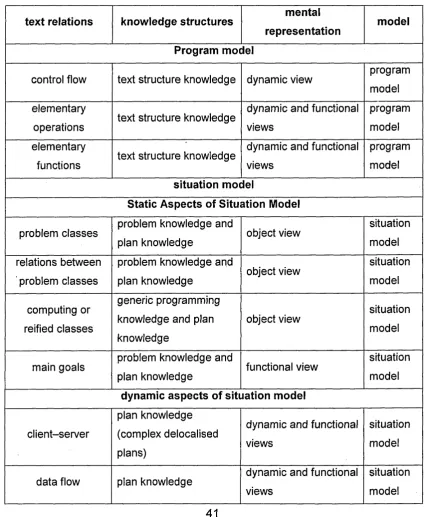
Ta b le2 . 2: Co r r e s p o n d e n c e b e t w e e nt e x tr e l a t io n s, k n o w l e d g es t r u c t u r e s, m e n t a lr e p r e s e n t a t io n, a n d m o d e l
in Pe n n in g t o nm o d e lo fp r o g r a m c o m p r e h e n s io n (s o u r c e Pe n n in g t o n, 1 9 8 7 a ) ... 3 6
Ta b le2 . 3: Co r r e s p o n d e n c e b e t w e e nt e x tr e l a t io n s, k n o w l e d g es t r u c t u r e, m e n t a lr e p r e s e n t a t io n, a n dm o d e l
IN BURKHARDT ET AL.'S MENTAL MODEL OF 0 0 PROGRAM COMPREHENSION. (SOURCE: BURKHARDT ET AL. 2 0 0 6 b ).
... 4 1
Ta b le2 .4 Pr e d ic t io n sa b o u tt h ec o m p r e h e n s io no f d if f e r e n tt y p e so fk n o w l e d g ec a t e g o r ie sin0 0 a n d n o n 0 0
PROGRAMS... 6 3
Ta b le4 .1 : Th ec o r r e s p o n d in g LO C o fe a c hp r o g r a m ine a c hs t u d y...1 2 5
Ta b le4 .2 : Co r r e s p o n d e n c eb e t w e e n k n o w l e d g ec a t e g o r ie s, k n o w l e d g es t r u c t u r e s, a n d m e n t a l
REPRESENTATION OF 0 0 PROGRAM COMPREHENSION MODEL USED IN THIS INVESTIGATION...1 2 6
Ta b le5 . 1: In s t it u t io n sa n dp r o g r a m m in g l a n g u a g et a u g h tine a c he x p e r im e n t a ls e t...1 3 4
Ta b le5 . 2: Gr o u pa l l o c a t io n sf o re a c h e x p e r im e n ts e to ft h e Ca rs t u d y...1 3 6
Ta b le5 .3 : St a t is t ic a ls u m m a r y o ft h et im eo ft h e Ca rs t u d y...1 4 1
Ta b le5 .4 : M e a nr a n k so ft im e int h e Ca rs t u d y...1 4 2
Ta b le5 .5 : Ma n n- Wh it n e y t e s tres u ltso ft im e int h e Ca rs t u d y...1 4 2
Ta b le5 .6 : St a t is t ic a ls u m m a r y o ft h ep e r f o r m a n c eo ft h e Ca rs t u d y...1 4 3
Ta b le5 -7 : Ra n k so fp e r f o r m a n c eint h e Ca rs t u d y...1 4 3
Ta b le5 .8 : Ma n n- Wh it n e yt e s tr e s u lto fp e r f o r m a n c eint h e Ca rs t u d y...1 4 3
Ta b le5 .9 : M e a nr a n k so fp e r f o r m a n c e s ink n o w l e d g ec a t e g o r ie s b e t w e e np r o g r a m v e r s io no ft h e Ca rs t u d y
...1 4 7
Ta b le5 .1 0 : Ma n n- Wh it n e y t e s tr e s u ltso fp e r f o r m a n c e sink n o w l e d g ec a t e g o r ie sb e t w e e np r o g r a mv e r s io n s
Ta b le5 .1 1 : St a t is t ic a ls u m m a r yo ft h e p e r f o r m a n c ein e a c hk n o w l e d g ec a t e g o r yo f Allg r o u p so ft h e Ca r
STUDY... 1 4 9
Ta b le5 .1 2 : Ra n k so f Allg r o u p'sp e r f o r m a n c eine a c h k n o w l e d g ec a t e g o r yo ft h e Ca rs t u d y...1 5 0
Ta b le5 .1 3 : Kr u s k a l- Wa llist e s tr e s u lto f Allg r o u p'sp e r f o r m a n c eine a c hk n o w l e d g ec a t e g o r yint h e Ca r
STUDY... 1 5 0
T a b le 5 .1 4 : P a irw is e c o m p a ris o n o f A l l g ro u p s ' p e r fo r m a n c e in each k n o w le d g e c a te g o r y o f t h e C a r s tu d y 1 5 1
T a b le 5 .1 5 : S t a t is t ic a l s u m m a ry o f t h e p e r fo r m a n c e in each k n o w le d g e c a te g o r y o f No n-Ob je c t g r o u p in t h e
C a r s t u d y...1 5 2
T a b le 5 .1 6 : R an ks o f No n-Ob j e c t g ro u p 's p e r fo r m a n c e in each k n o w le d g e c a te g o r y o f th e C a r s t u d y 1 5 3
T a b le 5 .1 7 : K r u s k a l- W a llis t e s t r e s u lt o f No n-Ob j e c t g ro u p 's p e rfo r m a n c e in e ac h k n o w le d g e c a te g o r y o f
t h eC a r s t u d y... 1 5 3
T a b le 5 .1 8 : P a irw is e c o m p a ris o n o f No n-Ob j e c t g ro u p 's p e r fo r m a n c e in each k n o w le d g e c a te g o r y o f th e C a r
STUDY... 1 5 4
T a b le 5 .1 9 : S t a t is t ic a l s u m m a ry o f t h e p e r fo r m a n c e in each k n o w le d g e c a te g o r y o f Ob j e c t g r o u p o f t h e C a r
STUDY... 1 5 5
Ta b le5 .2 0 : Ra n k so f Objectg r o u p'sp e r f o r m a n c e inea c hk n o w l e d g ec a t e g o r yo ft h e Ca rs t u d y...1 5 6
T a b le 5 .2 1 : K r u s k a l- W a llis t e s t r e s u lt o f Obje c t g ro u p 's p e r fo r m a n c e in each k n o w le d g e c a te g o r y o f th e C a r
STUDY... 1 5 6
T a b le 5 .2 2 : P a irw is e c o m p a ris o n o f Ob j e c t g ro u p 's p e rfo r m a n c e in each k n o w le d g e c a te g o r y o f t h e C a r s tu d y
... 1 5 6
Ta b le5 .2 3 : St a t is t ic a ls u m m a r yo fp e r f o r m a n c eint h e Lin e-Ed its t u d y...1 6 1
Ta b le5 .2 4 : Ra n k so fp e r f o r m a n c eint h e Lin e-Ed its t u d y...1 6 2
Ta b le5 .2 5 : M a n n- Wh it n e yt e s tr e s u lto fp e r f o r m a n c eint h e Lin e-e d its t u d y...1 6 2
Ta b le 5 .2 6 : Me a nr a n k so fp e r f o r m a n c e so fe a c h k n o w l e d g ec a t e g o r yb e t w e e n p r o g r a mv e r s io n so ft h e Lin e
-EDIT STUDY...1 6 5
Ta b le 5 .2 7 : Ma n n- Wh it n e yt e s tr e s u ltso fp e r f o r m a n c eo fe a c h k n o w l e d g ec a t e g o r yb e t w e e n p r o g r a m
T a b le 5 .2 8 : S t a t is t ic a l s u m m a ry o fth e p e r fo r m a n c e in each k n o w le d g e c a te g o r y o f A l l g ro u p s o f th e
Line-Ed its t u d y...1 6 6
Ta b le5 .2 9 : Ra n k so f Allg r o u p'sp e r f o r m a n c ein e a c hk n o w l e d g ec a t e g o r yo ft h e Lin e-Ed its t u d y...1 6 7
Ta b le5 .3 0 : Kr u s k a l- Wa llist e s tr e s u lto f Allg r o u p s' p e r f o r m a n c ein e a c hk n o w l e d g ec a t e g o r yo ft h e Lin e
-EDIT STUDY...1 6 7
T a b le 5 .3 1 : S t a t is t ic a l s u m m a ry o f th e p e r fo r m a n c e in each k n o w le d g e c a te g o r y o f No n-Ob j e c t g r o u p in th e
Lin e-Ed its t u d y...1 6 8
T a b le 5 .3 2 : R an ks o f No n- Ob j e c t g ro u p 's p e r fo r m a n c e in each k n o w le d g e c a te g o r y o f th e L in e -E d it s tu d y . 1 6 9
T a b le 5 .3 3 : K r u s k a l- W a llis t e s t r e s u lt o f No n- Ob je c t g ro u p 's p e r fo r m a n c e in each k n o w le d g e c a te g o r y o f
THE LlNE-EDITSTUDY... 1 6 9
T a b le 5 .3 4 : P a irw is e c o m p a ris o n o f No n- Ob je c t g ro u p 's p e rfo r m a n c e in each k n o w le d g e c a te g o r y o f th e
Line-Ed its t u d y...1 7 0
T a b le 5 .3 5 : S t a t is t ic a l s u m m a ry o f p e r fo r m a n c e in each k n o w le d g e c a te g o r y o f Ob j e c t g r o u p o f t h e L in e -E d it
STUDY... 1 7 1
T a b le 5 .3 6 :R a n k s o f Ob j e c t g ro u p 's p e r fo r m a n c e in each k n o w le d g e c a te g o r y o f th e L in e -E d it s t u d y 1 7 2
T a b le 5 .3 7 : K r u s k a l- W a llis t e s t r e s u lt o f Ob je c t g ro u p 's p e r fo r m a n c e in each k n o w le d g e c a te g o r y o f t h e
Line-EDIT STUDY...1 7 2
Ta b le5 .3 8 : Su m m a r yo ft h es t u d ie s' f in d in g s...1 7 3
Ta b le D . l : De s c r ip t iv es t a t is t ic s, s k e w n e s sa n dk u r t o s ist e s tsr e s u ltsf o rn o r m a l it y f o r Ca rs t u d y...2 6 5
Ta b leD.2: Th ek o l m o g o r o v-s m ir n o v t e s tr esu ltsf o rn o r m a l it y f o r Ca rs t u d y...266
Ta b le D .3 : De s c r ip t iv es t a t is t ic s, s k e w n e s s, a n d k u r t o s iste s ts res u ltso fn o r m a l it yint h e Lin e-Ed its t u d y... 2 6 7
Ta b le D.4: Th ek o l m o g o r o v-s m ir n o vt e s tr esu ltso f n o r m a l it yint h e Lin e-Ed its t u d y...268
Ta b leD.5: Ro w d a t af o rt h er u no ft h e Ca rs t u d y...270
List of Figures
Fig u r e3.1: Ca s e St u d y M e t h o d (So u r c e, Yin, 2009)... 75
Fig u r e4.1: Cl a s s if ic a t io no ft h ep r o b l e m s u s e dint h er e s e a r c h... 112
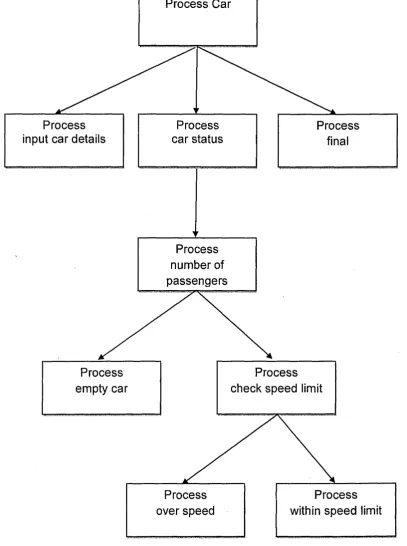
Fig u r e4.2 Th ec o m p l e t er e f in e m e n to ft h e CD1... 117
Fig u r e4.3 t h ec o m p l e t e r e f in e m e n to fCD2...118
Fig u r e4.4 Th ec o m p l e t er e f in e m e n to f LD1...120
Fig u r e4.5: Th ec o m p l e t e r e f in e m e n to fLD2...121
Fig u r e 5 .1 : Gr a p h ic a lr e p r e s e n t a t io no ft h es u b je c t s' r a n k in g f o re a c hp r o g r a m v e r s io no ft h e Ca rs t u d y . 1 4 4 Fig u r e 5 .2 : Gr a p h ic a lr e p r e s e n t a t io n o ft h ep e r f o r m a n c eink n o w l e d g ec a t e g o r ie sf o re a c hp r o g r a m v e r s io n o ft h eC a r s t u d y...1 4 6 Fig u r e 5 .3 : Gr a p h ic a lr e p r e s e n t a t io no ft h es u b je c t s' r a n k in g o fe a c hp r o g r a m v e r s io n int h e Lin e-Ed its t u d y. 1 6 2 Fig u r e 5 .4 : Gr a p h ic a lr e p r e s e n t a t io no fp e r f o r m a n c eine a c h k n o w l e d g ec a t e g o r yf o rea c hp r o g r a m v e r s io n IN THE LINE-EDIT STUDY... 164
Fig u r e6.1: El e m e n t so fs o f t w a r ec o m p r e h e n s io n m o d e l s (s o u r c e: O 'Br ie n, 2003)...186
F ig u re 6 .2 T h e o p e r a t io n a l v ie w o ft h e m o d e l used in th is in v e s tig a tio n ...1 8 8
Chapter 1 Introduction
In a society where considerable reliance is placed on computer software, it is vital constantly to improve software construction methods and practitioner skills, so that ultimately we are able to justify, and have confidence in, this reliance. The motivation and perhaps the ultimate goal of this thesis is to attempt to have a direct bearing on this continuing need for improved software. However, the immediate aim to which this thesis addresses itself is to contribute to the field of software engineering by improving our understanding of the program comprehension process. This investigation, in common with many that involve the study of human behaviour, is empirical in nature. It employs the established principle of such research known as the "scientific method", which consists of conducting empirical experiments to gather, evaluate, and interpret empirical evidence.
This chapter is structured as following: first, the cognitive benefits of Object Oriented (00) programs and the suggestions from research on empirical evaluation of 0 0 are highlighted. Secondly, the approach followed in this thesis to investigating 0 0 program comprehension and the idea underpinnings this approach is introduced. The main thesis questions and aims are given then. Finally, the structure of the thesis is outlined.
changed the nature of software development, these concepts have not brought the unconditional enhancements that were promised, for they have also set a number of new challenges from human factors as well as software engineering perspectives. It is likely that various 0 0 concepts will show different advantages and drawbacks and there is a necessity to understand them better. Advocators of the 0 0 approach (for example, Detienne, 2006a) are claiming that there is a direct correspondence between an 0 0 approach and the nature of how people think about a computation problem. Therefore, the breakdown of a problem's entities into classes may be easier in the 0 0 approach than by any other approach, and the mapping from problem domain to the program domain can be relatively easier and straightforward (Rosson, 1990; Borgida, 1985; Detienne 2006a). Taking a starting position that the 0 0 approach is connected more closely to the problem domain, it has been thought that it might be of benefit not only in program design but also in program maintenance, comprehension, and reuse (Daly, 1996; Burkhardt et.al. 2006a, b).
significant ways from the programming language used, determine the role-play in the comprehension of specific 0 0 concept, determine the stages by which programmers develop more balanced what so called "mental representations" in 0 0 approach, and determine the factors' effect on the comprehension. All these above have started to help in establishing a solid body of empirical knowledge from which general conclusions can be drawn. Most of these studies concentrate on program design and reuse, for example Detienne, (2006b) and Pennington, Lee and Rehder, (1995). However, the number of empirical studies of an 0 0 approach is still comparatively limited compared to the rapid growth of this technology in both industrial and educational fields, especially empirical work on 0 0 program comprehension.
Program comprehension is important, and yet difficult. It is an integral part of the programming process, playing a role in activities such as coding, debugging, and maintenance. Unfortunately, computer science students, especially those who take introductory programming courses, (hereafter referred to as novices) often find it extremely problematic to understand a program; the types of difficulty have been well documented (see Mayer, 1988 for a summary of some of these). .Novices' problems may be compounded by the fact that comprehension per se is often not an explicit part of the curriculum. This may be because attempting to isolate the skill of comprehension and teach it directly can prove to be difficult, as there seems to be no universally agreed definition of what it is, and how it proceeds. This is unfortunate, as comprehension is an implicit first step in coding: learning a new programming approach almost inevitably starts with exposing novices to a short program (e.g. the ubiquitous 'hello world') and then writing similar programs. Thus, even before writing programs, novices must be able to understand them. Good (1999) claimed that,
if teaching comprehension is difficult, a number of other techniques might be used to approach program comprehension in a more indirect way, for example, by choosing a programming approach which claims to make comprehension less painful, or by building learning environments to tackle program comprehension difficulties in novel ways. These are, however, not without their own problems; Ben-Ari (2001), for example, argued that many introductory programming courses teach programming starting with an 0 0 approach. However, several programming teachers and educators argue it is impossible for novices to properly understand and use 0 0 concepts without a viable understanding of fundamental programming concepts such as variables and assignment.
to learning programming, this thesis lays the groundwork for an empirically grounded based model for 0 0 program comprehension.
This thesis suggests a new approach to investigating 0 0 program comprehension which is based on lessons learned from previous approaches. The proposed approach represents in many ways an ideal one. It relies on a number of as yet unsubstantiated suppositions about ways in which 0 0 program comprehension might usefully be fostered. This thesis undertakes a detailed exploration of some of these hypotheses, looking at the elements influencing 0 0 program comprehension and the ways in which they interact. The outcome of the thesis should inform the design of empirically grounded proposed model of 0 0 program comprehension.
less prescriptive approach, which leads to the following research question: Can we teach novices about the different types of knowledge present in a program text, and how to allocate that knowledge, providing support for them as they do so, rather than limiting teaching to a single, invariant process?
Wiedenbeck and Ramalingam, 1999; Wiedenbeck et al, 1999; Khazaei and
Jackson, 2002; and Affandy et al 2011). Issues such as the influence of particular elements (in this thesis, the class concept, the problem characteristics, and solution decompositions) on the ease of comprehension of these different types of knowledge have not been investigated in detail.
1.1 Main Thesis Questions and Aims
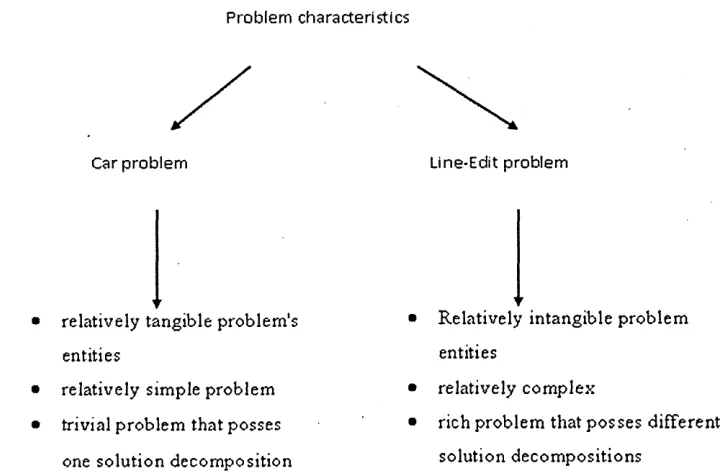
The proposed model of 0 0 program comprehension centres on activities such as searching for and identifying particular types of knowledge in a program. As such, the features of the base programming approach (in this case we consider the concept of class) may play a role in determining the ease (or difficulty) with which different knowledge can be comprehended compared to a program without this particular concept. The characteristics of the problem used and thus the possible solution decompositions derived and used in designing the program may also play a key role in comprehending these different types of knowledge. The thesis attempts to assess the ease of comprehension of 0 0 programs for different problem characteristics that can possess different possible solution decompositions. This suggests that preliminary work should focus on issues such as the relationship between these elements and the comprehension of different types of knowledge. In light of this aim, the following lists the research questions explored in this thesis:
1. Are 0 0 programs easier to comprehend than non 0 0 programs? How to go about empirically investigate 0 0 program comprehension?
2. What are the existing models of program comprehension? What are the main types of knowledge appropriate to investigate 0 0 program comprehension?
3. How do different elements, such as, class concept, problem characteristics, and solution decomposition influence the comprehension of 0 0 programs?
To effectively answer these research questions, the aims of this thesis are to:
• provide a rich view of the difference in the ease of comprehension between 0 0 programs and non 0 0 programs;
• evaluate current models of 0 0 program comprehension;
• propose a new empirically grounded based model of 0 0 program comprehension.
1.2 Outline of the Thesis
This thesis examines the role which different types of knowledge, hypothesised to be present in a program, play in program comprehension. It does that by examining the influence of class concept, the problem characteristics, and solution decomposition in the comprehension of object based programs versus non object based programs. In this thesis, Object based programs are defined as software programs written in 0 0 way. This was done by mainly using of class concept. However, the non object based programs are defined as software programs written in non 0 0 way. More precisely, the non object based programs are written without using of class concept. As such it does not make the claim that any of the hypotheses or findings described are in any way applicable to expert programmers. However, it considers both novice and experienced programming students. Furthermore, it considers primarily the notion of program comprehension rather than program design.
best-known models of comprehension, based on their primary emphasis, fit into and might be relevant to 0 0 program comprehension. It also reviews empirical literature in related empirical research with respect to 0 0 program comprehension, and looks at the notion of program comprehension as derived from different types of knowledge, before going on to describe experiments which have looked specifically at these types of knowledge. Finally, it identifies various implications of using an 0 0 programming approach for studying program comprehension.
Chapter 3 describes the research methodology, research design, and research procedures considered appropriate to the empirical work reported in this thesis. It examines methodologies used in empirical software engineering research and establishes a framework for conducting this investigation.
Chapter 4 discusses the rationale behind using specific settings of the investigation. It identifies important empirical issues that should be given more consideration by researchers in the design of comparable experiments.
Chapter 5 reports the design and conduct of a set of two studies (Car and Line- Edit) carried out using the tailored experimental methodology discussed in chapter 4. It also presents a statistical analysis of the studies' findings.
Chapter 6 includes an interpretation of the findings obtained in the studies described in Chapter 5 and evaluation of the program comprehension model used in this investigation. An empirically grounded based of 0 0 program comprehension model is proposed. It then discusses methodological issues and the way in which they may affect the investigation's findings. Suggestions for
several pedagogical issues to consider when teaching 0 0 programming come at the end of this chapter.
Chapter 2 Literature Review
2.1 Introduction
The purpose of this chapter is to provide information related to the main issues of this thesis. These issues are summarised in four major sections. The first section provides an overview of the 0 0 programming approach and its associated concepts. It also reviews the cognitive benefits of 0 0 approach and its related claims about the ease of comprehension of 0 0 programs. The second section presents a brief discussion about the existent theories, strategies, and models of program comprehension in general and how they can be related specifically to 0 0 program comprehension. The third section describes empirical work on 0 0 program comprehension. It also discusses how elements of problem characteristics and solution decompositions can influence the comprehension of 0 0 programs. Finally, the fourth section gives details about implications of the 0 0 approach on different types of knowledge that are considered important to 0 0 program comprehension. It then gives a research plan that to be followed in this investigation
2.2 Object-Oriented Approach and concepts
Weinberg (1992) makes an interesting statement on the nature of programming in the preface of his book on quality software management when he says:
"When I didn't think right about a program, the program bombed. The computer, I learned, was a mirror of my intelligence, and I wasn't too impressed by my reflection"
He contends that a program is a 'mirror' of the intelligence of the programmer. If we are to accept Weinberg's comment as being realistic about the nature of programming, then we need to understand how to train programmers to understand the intellectual issues that are involved in programming. Weinberg's statement provides some insight into how he, as a programmer, understood what a program was, or what he conceived were the intellectual characteristics that would be reflected in a good program.
0 0 programming is described as a programming approach. A programming approach is defined in a number of different ways, each emphasising different aspects of the concept.
Ambler et al. (1992) describes a programming approach as:
“A collection of conceptual patterns that together model the design process and ultimately determine a program’s structure.” (p 28).
In contrast, Stolin and Hazzan (2007) initially talk about approach in a generic sense that reflects the concept of approach. For their investigation into how the concept of a programming approach is understood, they use the definition:
"Programming paradigms are heuristics used for algorithmic problem solving. A programming paradigm formulates a solution for a given problem by breaking the solution down to specific building blocks and defining the relationship among them" (p 65).
"An approach to software development that organises both problem and Its solution as a collection of discrete objects; both data structure and behaviour are included in the representation”, (p 286)
She also identifies the 0 0 approach by seven concepts: identity, abstraction, classification, encapsulation, inheritance, polymorphism, and persistence (Pfleeger 2010). These concepts have changed the nature of software development; however, Briand et al. (1999) argue that they have set a considerable debate about their appropriateness from both human factors and a software engineering perspective.
The concept of identity in an 0 0 approach refers to the fact that data are organised into discrete, distinguishable entities called "class". A single class has states and behaviours associated with it. Class structure represents one of the essential concepts of the 0 0 approach. Classes are program entities which integrate a structure defined by a type and functionalities. Class is a construct that is defined as a template used to instantiate objects of the class; these objects are instances of classes. Objects and classes will be used interchangeably throughout this thesis. Attributes and methods are defined for the entire class. A class is defined as a structure (a type) and a set of methods. A method is a function attached to a class that describes a part of the behaviour of the objects which are instances of this class (Detienne, 2006a).
Abstraction is essential for building any software system, whether it is 0 0 or non 0 0 . Pfleeger (2010) contends that abstractions in 0 0 help to represent the different viewpoints incorporated in the system being developed. Together, the abstractions form a hierarchy that shows how different system entities relate to one another. Detienne (2006a) argues that abstraction is obtained by the means of encapsulation, polymorphism and late binding. Encapsulation means
an object owns its data and methods. The data and methods are private and may be accessed and used by other objects only if the other objects send an appropriate message to the owner. The initiating object may send the same
\
message to multiple objects which will act on it differently according to their own interpretations. This is the property of polymorphism, which aids abstraction by allowing messages to remain abstract. It is only during execution that the system decides which method will be executed according to the object with which the method is called. This property is referred to as late binding Pfleeger
(2010).
2.2.1 The Cognitive Benefits of Object-Oriented
Approach
Advocates of an 0 0 approach have made strong claims about what they called the ‘naturalness’, ‘ease of use’, and ‘power’ of this programming approach compared to the procedural programming approach (see for example: Meyer, 1988;Rosson and Alpert, 1990; Zhu and Zhou 2003; Detienne, 2006a, b).
Rosson and Alpert (1990) suggest that OO may be especially valuable in new domains or when practised by relatively experienced designers. However, in the procedural approach, problem decomposition is driven by generic programming constructs and specialised design knowledge. In terms of the concepts of problem and solution spaces introduced by Kant and Newell (2002), this implies that reasoning in the problem space is not separate from reasoning in the software solution space; thus, the objects are considered, but remain implicit.
Meyer (1988) does emphasise that objects can be picked directly from physical reality and modelled in software. However, the emphasis is on the way in which software addresses the needs of the problem domain through the development of a model that describes that domain. As such, the model becomes
"If you have a good model for describing the problem domain, you will find it desirable to keep a clear correspondence (mapping) between the structure of the solution, as provided by the software, and the structure of the problem, as described by the model" (p 47).
For Meyer, the programming approach becomes a way of thinking about the problem domain. This idea is picked up by Quatrani (2003) who contends that
"Visual modelling is a way of thinking about problems using models organised around real-world ideas." (p 13)
Concerning problem understanding, Meyer (1988) assumes that the identification of classes should be easy as they form natural representations of problem entities. Thus it seems particularly relevant to organise a model of design around a software representation of these classes. Therefore, we can say that in an 0 0 approach, decomposing the problem into a solution consists of identifying the relations between objects and the associations between their structures and the functionalities.
Detienne (2006b) argues that mapping between the problem domain and the program domain should be more straightforward in an 0 0 approach than in a procedural approach. She states that there is a direct correspondence between the 0 0 approach and the way people naturally think about problem, therefore, decomposition of a problem into classes may be easier in the 0 0 approach than by any other approach, and programmers can easily switch from the problem domain to the program domain. The theoretical argument in support of ease of mapping between domains in 0 0 is that program classes are clear and visible entities in the problem domain. They are represented as explicit entities in the solution domain, and thus the mapping between the problem and solution domains is simple and clear. The domain objects are identified and used to structure the software system. Detienne (2006b) says that
"It has been suggested that 0 0 design, in its initial phase, is based on understanding of the problem itself rather than on specialised knowledge of design, in contrast, procedural design solutions are structured by generic knowledge of programming rather than problem domain entities" (p 60).
knowledge about the design process or particular software design. However, in the case of the procedural approach, this activity is more likely to be derived from generic programming constructs and specialised design knowledge.
In their endeavour to propose an 0 0 methodology as first taught, Zhu and Zhou (2003) argue that 0 0 is not only a programming approach, but also a methodology that deduces from general concepts to the special and induces from the special to the general. These methods are similar to a human’s natural thinking style. Therefore, its basic concepts (identity, abstraction, information hiding, encapsulation, and modularity) can be introduced as a very powerful methodology for both thinking and programming. The authors suggest that the general concept of 0 0 can be effectively shown from a methodology viewpoint as following: everything in the world is an object. For example, in the real world, flowers, trees, and animals are objects; students and professors are objects; desks, chairs, classrooms, and buildings are objects; universities, cities, and countries are objects; even the world and the universe are objects. The second view is that: every system is composed of objects. A subject, such as electrical engineering, computer engineering, and history, is also an object. A cultural system includes history, language, food, costumes, relationships, and people etc. that are all objects; an educational system includes schools, students, professors, administrators, etc. that are also objects; an economic system includes objects like economic regulations, services, customers, and currency, etc.; a control system includes a plant to be controlled, a controller, sensors, actuators, and so on; a computer system includes monitor, keyboard, motherboard, CPU, memory, I/O devices, operating systems, and application software that are all objects. The third methodological perspective is that the development of a system X is caused by the interactions among the objects not
only inside but also outside X. For example, a specific X Institute is a system, its development is caused by the interactions among students, tutors, staffs, and even government officers of the country who are outside X (Zhu and Zhou (2003).
Detienne (2006a) claimed that, since an 0 0 approach is more intimately connected to the problem domain, it might be of benefit not only in program design but also in program comprehension. Ramalingam and Wiedenbeck (1999) stated that:
"In program design the problem is establishing mappings between real world entities and their representation in a program. In program comprehension the problem is making reverse mappings from the given program to comprehending of the real world entities and actions involved'fp 134).
information about those aspects. However; a number of different difficulties and negative effects of other approaches are associated with 0 0 design activity, such as difficulties associated with process of class creation, difficulties in articulating declarative and procedural aspects of the solution (e.g. the hierarchy of classes and the main procedure), misconceptions about some fundamental 0 0 concepts, and the transfer effect associated with shifting from traditional design to 0 0 design. Detienne (2006a) provides a comprehensive survey of these difficulties).
Rist (1996a) claimed that the structure of an 0 0 system is built around its control flow, data flow, and class encapsulation. This system is created by the interaction between the plans and objects in the system. He has defined a plan as a set of actions that, when placed in a correct order, achieves some desired goal. Applying this to 0 0 systems, the actions in a plan are encapsulated in a set of routines, and the routines are divided among a set of classes and connected by control flow. He claims that there is an orthogonal link between plans and objects in 0 0 ; he contends that:
"Plans and objects are orthogonal, because one plan can use many objects and one object can take part in many plans. The code that executes a plan will thus be spread over several classes." (p 555).
This orthogonality allows the structure of a system to be shown as a lattice of nodes, where a node marks the intersection between a plan and an object. Rist argues that this can also be considered as a reflection of the real world, where a plan can use many objects (i.e., a plan for a cake uses flour, eggs, water, and so on), and an object can be used in many plans (i.e., an egg can be used to make a cake, omelette, souffle and so on).
There is a wealth of literature that takes for granted that the 0 0 approach entails a greater focus on the problem, thus it should facilitate not only problem decomposition but also program design and thus program comprehension. However, other studies argue that the 0 0 approach does not support the claims mentioned and argue in favour of the procedural approach being natural. Neubauer and Strong (2002) stated that
"It is true that the world around us consists of objects which possess attributes and have behaviours. But good object-oriented programming does not depend so much upon the identification of objects (as challenging as that can be) as upon the ability to grasp complex patterns of interactions among many objects. While it is possible to anticipate and run many scenarios through an object-oriented application, a complex application has a very large number of possible states. At some point these complex systems begin to exhibit unanticipated behaviour." (pp 284-285).
2.3 Program Comprehension
This section provides a description of program comprehension and considers the importance of program comprehension in the field of software engineering.
2.3.1 What
is
the
Definition
of
Program
Comprehension?
Paradoxically, literature on comprehension tends not to define comprehension explicitly, perhaps because it seems so naturally obvious, in the same way that research papers on reading do not begin by asking what reading is. However, it may be because comprehension, like reading, covers a wide range of activities, with subtle differences between them.
From the perspective of Biggerstaff et al, (1993), a programmer starts to construct an understanding of an unknown software system. He/she is creating an informal, human oriented expression of computational intent. The creation of this expression happens through a process of analysis, experimentation, guessing and puzzle-like assembly. When it comes to a definition of what program comprehension means, we follow the explanation by Biggerstaff et al. (1993):
“A person understands a program when able to explain the program, its structure, its behaviour, its effects on its operation context, and its relationships to its application domain in terms that are qualitatively different from the tokens used to construct the source code of the program. ” (p 482)
Pennington and Grabowski (1990) have also offered a more precise description of the program comprehension task:
“Understanding a program involves assigning meaning to a program text, more meaning than is literally 'there\ A programmer must understand not only what each program statement does, but also the execution sequence (control flow), the transformational effects on data objects (data flow), and the purposes of groups of statements (function). In order to do this, the programmer will employ a comprehension strategy that co-ordinates information 'in the program text' with the programmer’s knowledge about programs and the application area. This results in a mental representation of the program meaning. ” (p 54)
From these descriptions, one possible reason why a general definition of comprehension is not forthcoming is that program comprehension is a highly individual activity. Therefore, the scope of this activity varies from person to person. It can involve an attempt to comprehend an entire program in detail, looking for a specific piece of information in the program, or acquiring a general overview of the program. Since program comprehension is an individual activity, persons who are carrying out the activity could have different levels of previous experience from different domains. Moreover, a person attempts to comprehend program code for a particular programming task (i.e., maintenance, debugging, transferring some aspect of the program to another person, etc.). Since the nature of the task varies, they will necessarily have different requirements in terms of the type and the amount of information extracted from the program and the way it is combined. Comprehension activity also can involve experience about programming domains with very different programming approaches. Each programming approach should have its own characteristics which could largely affect the comprehension process.
views vary, focusing on the processes which arise when people try to comprehend programs, the kind of prior experience they have about programming, the mental representations they construct during the comprehension process, and the role of information the programmer extracts from the program. The author adds that program comprehension can be seen as multi-faceted, encompassing different aspects. There is a need for a generic definition of program comprehension. This definition can serve as a framework to position theories and research on program comprehension, and therefore will lead to better understanding of the relationships between these various aspects.
Good (1999) provides a notable generic model with a definition of program comprehension:
“Given a program in a particular language, program comprehension is a process in which the programmer uses prior knowledge about programming and information present in the program to form a dynamic, evolving model of the program which can then be applied to a task.” (p 14)
She highlights a number of interrelated entities and processes, which are central to theories of program comprehension. These entities represent: comprehension processes and strategies, programming knowledge, mental models of the program, information contained in the program, and purposes of the comprehension.
Despite all attempts to provide a useful description of program comprehension and highlight entities and processes that form theories and models of program comprehension, they lack generalisation in terms of different programming approaches. These attempts were carried out largely in the context of procedural and imperative programming approaches and do not highlight the
major aspects and concepts of other programming approaches, especially the 0 0 approach. Since the descriptions provided are approach-dependent and our research interests lie in the 0 0 approach, there is a need to either generalise these descriptions, or to provide an OO-related description. This 0 0 description could outline entities and processes that take into account 0 0 concepts to form a theoretical framework of 0 0 program comprehension.
2.3.2 Program
Comprehension
from
Different
Perspectives
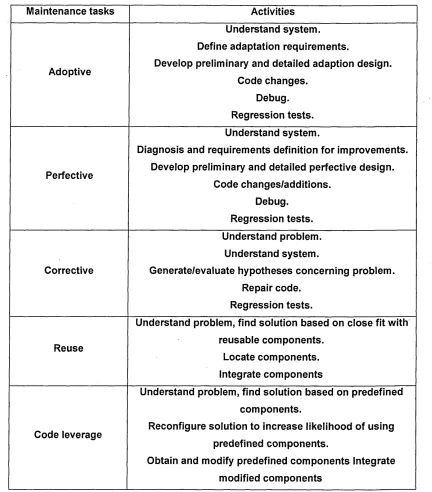
Table 2.1: Tasks and activities requiring code understanding (source, Von Mayrhauser and Vans, 1995)
Maintenance tasks Activities
Adoptive
Understand system. Define adaptation requirements.
Develop preliminary and detailed adaption design. Code changes.
Debug. Regression tests.
Perfective
Understand system.
Diagnosis and requirements definition for improvements. Develop preliminary and detailed perfective design.
Code changes/additions. Debug. Regression tests. Corrective Understand problem. Understand system.
Generate/evaluate hypotheses concerning problem. Repair code.
Regression tests.
Reuse
Understand problem, find solution based on close fit with reusable components.
Locate components. Integrate components
Code leverage
Understand problem, find solution based on predefined components.
Reconfigure solution to increase likelihood of using predefined components.
Obtain and modify predefined components Integrate modified components
Being aware of the fact that program comprehension is a prerequisite in all software evolution and maintenance tasks, improving the efficiency of program comprehension activity will lead to a significant overall efficiency gain. Table 2.1 also shows clearly the link between various programming tasks and program comprehension.
Shneiderman and Marey (1979) categorise the tasks of programming as composition, comprehension, debugging, maintenance, and learning. The learning task could reasonably cover the first four tasks as each includes skills to be learnt. Learning how to comprehend a program is an open question in the software engineering community.
Good (1999) has also highlighted a number of factors which may have caused the lack of instruction in program comprehension. Firstly, many theories and models of program comprehension do not take into account the fact that program comprehension is multi-faceted. They try to propose an invariant model for comprehending an entire program while they are taking a single activity. Additionally, the issue of novice/expert variation is ignored in comprehension models; this difference plays a role in the suitability of the comprehension process the model provides. Von Mayrhauser and Vans (1995) point out that prior knowledge is an important factor in applying some comprehension processes, top-down process in particular, and so would not even be available to novices, at least at the very beginning stage of comprehension. However, in the 0 0 case the situation may be different: the representation of the class, for instance, could facilitate comprehension for novices (Detienne, 2006a).
comprehension model more widely applicable, possibly introducing a more flexible approach to program comprehension that serves an explicit programming approach.
2.3.3 Cognitive Theories of Program comprehension
Francois Detienne represents a good example of a comprehensive survey of the history of cognitive models of program comprehension and sets of empirical experiments over the past forty years (Detienne, 2002). She delves back to a time in the early 1970s when the research lacked a theoretical framework to underpin the evaluation of the software tools. Story (2005) added:
"it was neither possible to understand nor to explain to others why one tool might be superior to other tools" (p 188).
All these lacks, however, have made it difficult to explain the mechanism of an effect. In other words, cognitive models, which provide a richer explanation of the processes of how an effect works, were not applicable. The research of program comprehension started to borrow related theoretical frameworks from other areas of research, such as text comprehension, problem solving, and education (Storey, 2005). Using these theoretical underpinnings, this period is characterised by the development of cognitive theories that give a rich explanation of the way in which programmers comprehend software programs. The perceived benefits of these would lead to more efficient and enriched theoretical frameworks that provide rich and comprehensive descriptions of program comprehension activity (Detienne, 2002; Storey, 2005).
As preliminary, this thesis will recount a brief survey of the different theoretical frameworks of comprehension of natural language text, as these frameworks
represent the underpinning theoretical frameworks of program comprehension. This will enrich the readers’ view about program comprehension models and where they were derived from.
Following this section, a description of the ways in which program comprehension can be categorised will be discussed. The aspects forming this discussion are:
• program comprehension as a temporal activity
• program comprehension as strategies for deployment
• program comprehension as a construction of different knowledge categories
2.3.4 Program Comprehension as a Temporal
Activity
2.3.4.1 Top-Down Models of Program Comprehension
There are numerous theories that consider program comprehension to be top- down. The most notable one is the behavioural theory of program comprehension by Brooks (1983). He postulates that comprehension is the reverse process to coding: while coding involves mapping from the problem domain, possibly through several intermediate domains, into the programming domain, comprehension is process of reconstructing different knowledge about the programming domain and mapping it to the problem domain. This mapping occurs through mainly hypothesis-driven processes and involves different but closely related intermediate knowledge domains; the type of knowledge is primarily based on the nature of the program under consideration. Brooks also assumes that the mental model is built by successively generating and refining hypotheses and by forming subsidiary hypotheses in a hierarchical top-down, depth first manner. Several knowledge domains will act as cues and contribute to refining and evaluating these subsidiary hypotheses, by searching for beacons, until they can be matched to specific code in the program text. Brooks has referred to beacons as:
"Sets of features that typically indicate the occurrence of certain structures or operations within the code." (p 548)
Verification or rejection of these subsidiary hypotheses depends heavily on the absence or presence of beacons. The process will be repeated until the code is understood entirely.
Soloway and Ehrlich (1989) report that a top-down comprehension process typically applies when the code is familiar and therefore the constructed mental
model will contain a hierarchy of goals and plans. A top-down comprehension process presumes progression from a high level of abstraction to a lower level of generation, refinement, and finally verification, of the hypotheses. Storey (2005) also argued that this nature of direction requires a good level of experience with the program code and therefore, this model will be inappropriate for novices. However, there is no empirical evidence about the inappropriateness of this model for novices in the case of 0 0 . Theoretically, in modern 0 0 programming languages - with different hierarchical structure of the classes, the levels of abstractions, and comparatively readable programming languages’ syntax - a top-down model could be assumed to be appropriate for novice programmers and possibly invoked early in the comprehension process. Therefore, there is a need to investigate this assumption.
2.Z.4.2 Bottom-Up Models of Program Comprehension
concerning the statements and basic units in a program, while semantic knowledge is language-independent and is built in progressive layers until a mental model is formed which describes the problem domain (Shneiderman and Mayer, 1979). In the case of 0 0 programs, the claim about closer mapping between program domain and problem domain in 0 0 could also be assumed to facilitate the mental model construction.
Pennington’s adoption theory of program comprehension focuses on describing the general characteristics of the bottom-up model (Pennington, 1987a, b). She derived an adopted comprehension model of program comprehension from a prior theory of text comprehension put forward by Kintsch and van Dijk (1978) and van Dijk and Kintsch (1983). Pennington hypothesises that the comprehension process results in the production of two distinct but interrelated representations of the text, the Program Model and the Situation Model. These two sub-models represent different abstract views of the program text. She empirically observed that the program model is first built based on a procedural reading of the program text. The programmer first develops a control flow abstraction of the program which captures the sequence of operations in the program. This program model is developed through the chunking of microstructure levels in the program text, which represent the program’s statements, control construct, and relationships, into macrostructure levels, which represent text structure abstractions, by making inferences about these microstructures. Once a program model has been fully assimilated, a situation model is developed. The situation model encompasses knowledge about data flow abstraction and abstraction of functional relationships between domain objects. The programmers’ comprehension is further enhanced through the
cross referencing of the artefacts in the program model and situation model. The model’s knowledge categories are fully described in Section 2.3.6.1
2.3A.3 Integrated Model of Program Comprehension
This theory postulates that comprehension is built at several levels of abstractions simultaneously by switching between different comprehensions processes (Storey, 2005). The theory centres on the idea of combining four major sub-models during the comprehension process:
• The top-down model is usually invoked and developed when the programming language or program code is familiar to the programmer. It incorporates domain knowledge as a starting point for formulating hypotheses. However, in the case of 0 0 programs, this model may be invoked in the early stages.
• The program model is a control flow abstraction, invoked when the code is completely unfamiliar.
• The situation model describes data flow and functional abstractions in the program. It is usually developed after a partial program model is formed.
• The knowledge base represents the programmer’s current state of knowledge, usually consisting of the information needed to build the above three models, and is used to store new and inferred knowledge.
related preferred knowledge to the corresponding process involved. As a result of this combination, a mixed model of program comprehension becomes necessary, especially for large size systems. Von Mayrhauser and Vans (1995) also assume that, during the comprehension process, any of the first three sub models might be activated by the programmer. For example, while constructing a program model, a programmer might identify a beacon representing a common task such as sorting. This will cause a jump to the top-down model. The programmer then generates sub-goals and will search for clues to support these sub-goals. If the programmer finds a section of unrecognised code during this search, the programmer returns to constructing a program model. Structures built by any one sub-model component are accessible by the other two, but each sub-model component has its own preferred knowledge types.
2.3.5 Program Comprehension as Strategies for
Deployment
Littman et al. (1987) link the strategy deployed in program comprehension to the breadth of familiarity with program text gained by the programmer during comprehension activities. The authors observed that there are two types of strategy that are deployed by programmers in the context of a maintenance task: a "systematic" strategy, and an "as-needed" strategy. In the systematic strategy, the programmer attempts to read the code in detail, gaining a broad understanding of the entire program by tracing it through the control flow and data flow abstractions in the program before carrying out modifications. On the other hand, in the as-needed strategy, the programmer minimises the amount of code to be comprehended and focuses only on the part of the code where a modification should be made. The authors argue that the systematic strategy is
more successful in modification as it increases the ability to detect interactions between the code central to modification and code elsewhere in the program. However, the problem with as-needed strategy is that the modification may have side effects on other parts of the program which the programmer might not anticipate. Thus the programmer tends to apply as-needed strategy in the case of maintenance rather than modification tasks.
Littman et al. (1987) also found that there is a direct influence between the strategy used by a programmer and the knowledge gleaned and stored in the programmer's mental model. For example, programmers using systematic strategy acquired both static knowledge, which concerns objects, actions and functional components of the program, and dynamic knowledge, which describes the interactions between functional components in the program when it is executed. This strategy enables programmers to form a strong mental model. However, programmers deploying the as-needed strategy only acquired static knowledge,