ARDEN, Madelynne <http://orcid.org/0000-0002-6199-717X> and ARMITAGE, Christopher J.
Available from Sheffield Hallam University Research Archive (SHURA) at: http://shura.shu.ac.uk/5966/
This document is the author deposited version. You are advised to consult the publisher's version if you wish to cite from it.
Published version
ARDEN, Madelynne and ARMITAGE, Christopher J. (2012). A volitional help sheet to reduce binge drinking in students: a randomized exploratory trial. Alcohol and
Alcoholism, 47 (2), 156-159.
Copyright and re-use policy
See http://shura.shu.ac.uk/information.html
A Volitional Help Sheet to Reduce Binge Drinking in Students:
A Randomized Exploratory Trial
Madelynne A. Arden, Health Psychology Research Group, Sheffield Hallam University
&
Christopher J. Armitage, Department of Psychology, University of Sheffield.
Aims
This study tested the ability of a volitional help sheet (VHS) to decrease binge drinking in
UK students.
Methods
Fifty-six participants were randomly allocated to one of three conditions: control, active
control or VHS as part of a questionnaire-based study.
Results
There were significant decreases in units of alcohol consumed and self-reported binge
drinking frequency in the VHS condition, but not in either of the control conditions.
Conclusions
The findings support use of the VHS to help people to reduce their alcohol consumption and
binge drinking.
A Volitional Help Sheet to Reduce Binge Drinking in Students:
A Randomized Exploratory Trial
Alcohol-related morbidity and mortality is an increasing problem across the UK,
particularly among young people (16-24 years) with 25% of young women and 32% of young
men binge drinking at least once a week (Health and Social Care Information Centre, 2009)
Despite government campaigns designed to reduce harmful drinking (Alcohol Harm
Reduction Strategy, 2004), the prevalence of harmful drinking continues to be a concern.
The principal aim of the present study was to test a tool (the volitional help sheet) designed to
facilitate the formation of implementation intentions (Gollwitzer, 1999) to reduce binge
drinking in young people.
Implementation intentions are if-then plans that link in memory a critical situation
with an appropriate behavioural response. When the critical situation is encountered, the
linked behavioural response is activatedautomatically (Gollwitzer & Sheeran, 2006).
Implementation intentions have been shown to be an effective means of changing behaviour,
with an average effect size of d = .65 reported in Gollwitzer and Sheeran’s (2006)
meta-analysis. Although only 1 of the 94 studies reported in Gollwitzer and Sheeran's (2006)
meta-analysis investigated alcohol consumption (Murgraff et al., 1996), implementation
intentions have successfully reduced alcohol consumption in four more recent studies
(Murgraff et al., 2007; Gebhardt et al., 2008; Armitage, 2009; Armitage, Harris and Arden,
2011).
The volitional help sheet (VHS; Armitage, 2008) is a tool designed to enable the
construction of effective implementation intentions in which participants are asked to link in
memory temptations (difficult situations that result in urges to engage in a specific behaviour)
or “critical situations”) with processes of change (means by which behaviour is
(Prochaska & DiClemente, 1983). Armitage (2008) tested the ability of a VHS to encourage
quitting in a sample representative of smokers. The results showed that significantly more
people quit in the experimental group (p < 0.01, 19%, n = 9) when they were asked to form
implementation intentions by linking critical situations (e.g. "If I am tempted to smoke at a
bar or pub while having a drink" adapted from Velicer et al., 1990) with appropriate
behavioural responses (e.g. "then I will remember that I get upset when I think about my
smoking" adapted from Prochaska et al., 1988) compared with the equivalently active control
group (2%, n = 1), who were asked simply to identify critical situations and appropriate
behavioural responses that might be useful to them without linking them together in memory.
No studies to date have utilized a VHS in relation to binge drinking, although
evidence-based drinking temptation scales and processes of change for drinking scales exist
that could be used to create a binge drinking volitional help sheet. A binge drinking VHS
could be a very simple, cost-effective and easy to use intervention to reduce drinking because
VHSs are self-directed and take fewer than five minutes to complete. Therefore, the present
study aimed to pilot an alcohol-reduction VHS in a population at risk of high levels of binge
drinking. It was hypothesised that: (a) planning to reduce binge drinking using the VHS
(linking critical situations and appropriate behavioural responses in a VHS condition) would
reduce binge drinking over and above being asked simply to form a plan (control condition)
or being asked to tick critical situations and solutions (active control condition), and (b) there
will be no difference between being asked to form a plan (control condition) and being asked
Method
Design
A randomized controlled design with one between-subjects factor and one-within
subjects factor was used. The between-subjects factor was condition, which had three levels:
control, active control and VHS condition. The within-subjects factor was time with all
measures being taken at baseline and follow-up. The dependent variables were weekly
alcohol intake in UK Units (a UK “Unit” is defined as 8 grams/10ml of alcohol, which is
equivalent to half a pint/284ml of ordinary strength (3.5% abv) beer, a 125ml glass of wine at
9% abv strength or one measure/25ml of (40% abv strength) spirits and binge drinking
frequency.
Participants
Participants were students recruited via advertisements (for a study about binge
drinking) and opportunity sampling (e.g. in lectures) on a UK University campus, meaning it
was not possible to collect data on the number of participants who were approached and
eligible to take part but who declined. Potential participants were approached and screened
to ensure that they were over 18 and had drunk alcohol within the last month. They were
then asked to take part in a study about binge drinking and asked if they would be willing to
complete a further questionnaire in two weeks time. The University ethics committee gave
approval for the study and all participants gave informed consent to take part in the study and
were made aware of their right to withdraw.
All fifty-six participants completed both baseline and follow-up questionnaires: 17 in
the control condition, 18 in the active control condition, and 21 in the VHS condition. Their
ages ranged from 18 to 28 years (M = 20.57 years, SD = 1.90). Thirty-seven (66.1%) were
women.
Once participants had been recruited to the study they were given a baseline
questionnaire and left alone to complete it. On completion the participant returned it to the
experimenter and an appointment was made to meet in 2 weeks time to complete the second
questionnaire. Personal contact details were kept separate from the questionnaires. Baseline
and follow-up questionnaires were matched on the basis of self-generated personal codes.
Measures
Alcohol consumption. Participants were asked to describe the types and number of
alcoholic drinks that they consumed in 'an average week' (baseline) and 'last week'
(follow-up). Each day of the week was presented on a separate line with space given alongside to
write a description of the type of drink and the size of the glass or bottle. These descriptions
were then converted into units of alcohol for analysis. This method has been utilized
successfully in previous research (e.g., Armitage, 2009; Armitage et al., 2011; Sobell &
Sobell, 1992) and similar self-report instruments have been shown to agree 97.1% with
biological measures (Babor et al., 2000).
Binge drinking frequency. Participants were asked "How often did you binge drink
in the last 2 weeks?”, which was answered on a 7-point (+1 to +7) scale with the endpoints
never and frequently. Binge drinking was defined as females drinking more than 3 units of
alcohol in one session, or males drinking more than 4 units in one session. This definition
was deliberately broad to enable all types of potentially hazardous drinking to be considered,
and is consistent with the wide variations in definition of the term 'binge drinking' used by
young people (Cooke, French & Sniehotta, 2010).
Manipulations
In addition to completing the measures above participants were randomized to one of
participants in all conditions read the statement: "I would like you to plan to avoid binge
drinking in the next two weeks." Participants in the control condition then read a second
statement, which said: "You may do this in whatever way you wish. You may use the space
below to make a plan."
Participants randomized to the active control condition were additionally presented
with the following instructions: "On the following page is a list of situations in which binge
drinking may occur. There is also a list of solutions that could be used to avoid binge
drinking taking place in these situations. You should use these to plan how you will behave in
situations in which you would normally engage in binge drinking. Please read and then tick
all statements you feel are relevant to you. Then use these to assist you in avoiding binge
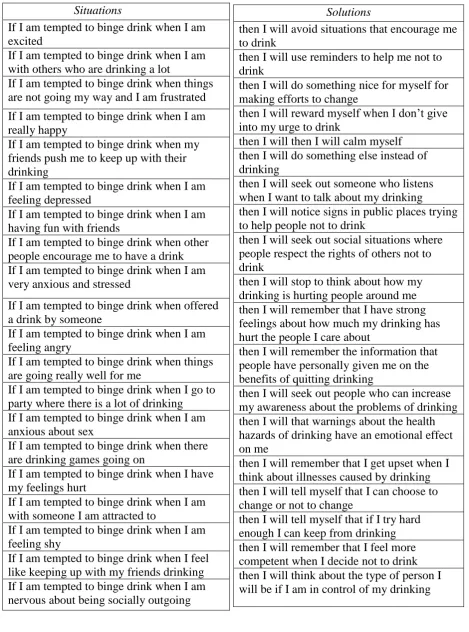
drinking." The next page contained a list (on the left hand side of the page) of 20 situations,
which were adapted from the binge drinking temptation scale (Maddock et al., 1999) to form
critical situation statements (see Table I for a list of the Situation statements). Each critical
situation was accompanied by a tick box. On the right hand-side of the page were 20 possible
solutions: Two for each of the ten of processes of change (Prochaska & DiClemente, 1983).
These were selected from the alcohol processes of change (Cancer Prevention Research
Center, 2010) and adapted to form appropriate behavioural responses (see Table I for a list of
the Solution statements). Each appropriate behavioural solution was accompanied by a tick
box.
Participants randomized to the VHS condition were provided with the same
instructions and the same lists of situations and solutions as the active control condition (see
Table I). In addition they were instructed: "You now need to match up situations you have
ticked with a solution you have ticked by drawing a line connecting the two. You can match
any up in any order; whichever way you think will work best for you. It is important you
each situation with the solution you choose to go with it to form one statement." An example
of a linked statement in relation to smoking behaviour was presented in order to further
clarify the instructions.
Results
MANOVA was used to test whether randomization had been successful. Condition
was the independent variable and age, baseline units of alcohol, and baseline binge drinking
were the dependent variables. Neither the multivariate nor any of the univariate tests were
statistically significant, Fs(2,53) = 0.11-0.62, ps > .54, p2s < .01. There was no difference in
the proportion of men and women in the three conditions either, χ2(2) = 1.31, p = .52).
The effect of condition on alcohol consumption was tested using a one-way
ANCOVA with units of alcohol per week at follow-up as the dependent variable, condition as
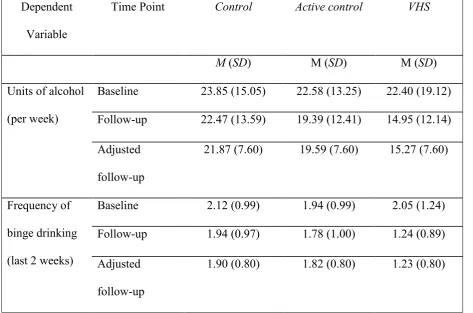
the independent variable and units of alcohol per week at baseline as the covariate (Table 1).
There was a significant effect of condition, F(2,52) = 3.75, p = 0.03, ŋp2 = 0.13, and pairwise
comparisons indicated that participants in the VHS condition reported drinking significantly
(p = .01) fewer units at follow-up, controlling for baseline, than the control condition, and a
trend toward significantly fewer units (p = .08) than the active control condition (Table II)i.
A one-way ANCOVA tested the effects of the intervention on the frequency of
self-reported binge drinking at follow-up with baseline frequency of binge drinking as the
covariate, and condition as the independent factor. Consistent with the reductions in alcohol
consumption, this revealed a significant effect of condition, F(2, 52) = 4.11, p = .02, ŋp2 = .14.
Pairwise comparisons indicated that participants in the VHS condition reported binge
drinking on significantly fewer occasions than both control and active control conditions (p
= .01 and p = .03, respectively, see Table II for adjusted means)ii. Overall, episodes of
Discussion
This is the first study to have looked at the utility of a VHS to reduce binge drinking.
Implementation intentions formed by linking temptations with processes of change in a VHS
resulted in significant decreases in both weekly alcohol consumption and frequency of
self-reported binge drinking compared to planning to reduce binge drinking and listing (but not
linking) temptations and processes of change.
The VHS appeared to provide a useful structure to assist participants in creating
effective implementation intentions. This is consistent with a growing body of research
showing the success of the VHS in other domains (Armitage, 2008; Armitage & Arden,
2010). Further research is now needed to ascertain which pairings of temptations and
processes of change are most effective, the optimal number of implementation intentions that
should be made using the approach, and the extent to which these findings are generalizable
within the domain of alcohol-use, and to other health behaviour domains.
The binge drinking VHS used in this study caused an average decrease of more than
seven units of alcohol per week compared to controls. This compares very favourably with
Armitage (2009) who reported a 3.5 unit per week decrease for people who were asked to
form their own implementation intentions. This suggests that a structured implementation
intention intervention may be more effective than a self-generated implementation intention.
This may be because the VHS provides useful direction about likely temptations to drink and
effective behavioural solutions that participants may not have the insight to generate
independently. Before an individual has attempted to reduce binge drinking they may not
have experienced or reflected on the likely temptations and how they might avoid them.
Further research should therefore compare directly the utility of the VHS with self-generated
Although the present findings seem to support the use of VHSs, it is important to
acknowledge some limitations of the research that could be addressed in future research.
First, being an exploratory study, we utilized a relatively small sample and short follow-up
period of 2 weeks. While future research needs to examine whether these effects can be
sustained over a longer period of time, the magnitude of the effect found in this study (>7
unit weekly reduction compared to controls) is promising given that research has found that
greater initial changes in health behaviour are associated with larger improvements in
ongoing behaviour change (e.g. Jeffery et al., 1998). In addition the effects of
implementation intentions have been found to persist over a 6 month period in the domain of
physical activity (Luszczynska, 2006). Second, the study could have measured intentions to
binge drink alongside binge drinking behaviour. Although implementation intentions have
not been found to affect intentions (Armitage, 2009) due to their automatic action (Gollwitzer
& Sheeran, 2006), their effects are more potent in those with stronger intentions to engage in
the behaviour (Armitage & Arden, 2008) and a measure of binge drinking intention may have
allowed us to test this possibility.
A third limitation was that the binge drinking frequency measure was on a 7-point
scale in order to make it consistent with the other measures in the questionnaire. However, it
is possible that measuring binge drinking frequency in numerical terms (0-14) might have
been more sensitive to changes in behaviour. Nevertheless, our measure was sufficiently
sensitive to detect a significant effect. Fourth, because there are wide variations in the use of
the term ‘binge drinking’ by young people (Cooke et al., 2010), it is possible that definitions
of binge drinking may have varied between individuals. However, the fact that the VHS also
significantly reduced the number of Units people drank suggests a genuine decrease in the
In conclusion, the present research study demonstrated the effectiveness of a
structured implementation intention intervention to reduce binge drinking. The VHS
intervention that required participants to link temptations (critical situations) with processes
of change (behavioural responses) produced significant decreases in weekly alcohol
consumption and frequency of self-reported binge drinking. Although the study was small
and over a short time frame, these findings suggest that the VHS may provide a simple and
effective intervention that could be generalized to broader samples and to other health
behaviours. Future research is needed to establish the best protocol for the delivery of the
References
Armitage CJ. (2008) A volitional help sheet to encourage smoking cessation: A
randomized exploratory trial. Health Psychol 27:557-566.
Armitage CJ (2009) Effectiveness of experimenter-provided and self-generated
implementation intentions to reduce alcohol consumption in a sample of the general
population: A randomized exploratory trial. Health Psychol28: 545-553.
Armitage CJ, Arden MA. (2008) How useful are the stages of change for targeting
interventions? Randomized test of a brief intervention to reduce smoking. Health
Psychol27: 789-798.
Armitage CJ, Arden MA. (2010) A volitional help sheet to increase physical
activity in people with low socioeconomic status: A randomized exploratory trial.
Psychol Health25:1129-1145.
Armitage CJ, Harris PR, Arden MA. (2011) Evidence that self-affirmation reduces
alcohol consumption: Randomized exploratory trial with a new, brief means of
self-affirming. Health Psychol30: 633-641.
Babor TF, Steinberg K, Anton R, Del Boca F. (2000) Talk is cheap: Measuring
drinking outcomes in clinical trials. J Stud Alcohol61: 55-63.
Cabinet Office Strategy Unit (2004). Alcohol harm reduction strategy for England. London:
Crown copyright.
Cooke R, French DP, Sniehotta FF. (2010) Wide variation in understanding about
what constitutes 'binge-drinking'. Drugs - Educ Prev Polic 17: 762- 775.
Gebhardt WA, Van Empelen P, Messchaert E, Kingma L. (2008) Implementation
intentions and alcohol reduction among student association members. Psychol
Gollwitzer PM. (1999) Implementation intentions: Strong effects of simple plans.
Am Psychol54: 493-503.
Gollwitzer PM Sheeran P. (2006) Implementation intentions and goal achievement: A
meta-analysis of effects and processes. Adv Exp Soc Psychol
38:69-119.
Health & Social Care Information Centre (2009) Statistics on alcohol: England, 2009.
London: The NHS Information Centre for health and social care
Jeffery RW, Wing RR, Mayer RR. (1998) Are smaller weight losses or more
achievable weight loss goals better in the long term for obese patients? J
Consult Clin Psych66:641-645.
Luszcynska A. (2006) An implementation intentions intervention, the use of a planning
strategy, and physical activity after myocardial infarction. SocSciMed
62:900-908.
Michie S, Abraham C. (2004) Interventions to change health behaviours:
Evidence-based or evidence-inspired? PsycholHealth19: 29-49.
Murgraff,V, Abraham C, McDermott M. (2007) Reducing Friday alcohol consumption
among moderate, women drinkers: Evaluation of a brief evidence-based intervention.
Alcohol Alcoholism42:37-41.
Murgraff V, White D, Phillips K. (1996) Moderating binge drinking: It is possible to
change behaviour if you plan it in advance. Alcohol Alcoholism31:577-582.
Prochaska JO, DiClemente CC. (1983) Stages and processes of self-change of
smoking: Toward an integrative model of change. J Consult Clin
Psych51: 390-395.
processes of change: Applications to the cessation of smoking. J Consult
Clin Psych56: 520-528.
Sobell LC, Sobell MB. (1992) Timeline follow-back: A technique for assessing self-
reported alcohol consumption. In Litten RZ and Allen JP (eds), Measuring
alcohol consumption, pp. 41-72. Totowa, NJ: Humana.
VelicerWF, DiClemente CC, Rossi JS, Prochaska JO. (1990) Relapse situations
and self-efficacy: An integrative model. Addicte Behav15: 271-283.
VelicerWF, Prochaska, JO, Fava JL, Norman GJ, Redding CA. (1998)
Smoking cessation and stress management: Applications of the transtheoretical model
of behavior change. Homeostasis38: 216-233.
Acknowledgement
Table I: Situations (adapted from Maddock et al., 1999) and Solutions (adapted from Cancer Prevention Research Center (2010) from the binge drinking VHS and active control task
Situations
If I am tempted to binge drink when I am excited
If I am tempted to binge drink when I am with others who are drinking a lot
If I am tempted to binge drink when things are not going my way and I am frustrated
If I am tempted to binge drink when I am really happy
If I am tempted to binge drink when my friends push me to keep up with their drinking
If I am tempted to binge drink when I am feeling depressed
If I am tempted to binge drink when I am having fun with friends
If I am tempted to binge drink when other people encourage me to have a drink If I am tempted to binge drink when I am very anxious and stressed
If I am tempted to binge drink when offered a drink by someone
If I am tempted to binge drink when I am feeling angry
If I am tempted to binge drink when things are going really well for me
If I am tempted to binge drink when I go to party where there is a lot of drinking If I am tempted to binge drink when I am anxious about sex
If I am tempted to binge drink when there are drinking games going on
If I am tempted to binge drink when I have my feelings hurt
If I am tempted to binge drink when I am with someone I am attracted to
If I am tempted to binge drink when I am feeling shy
If I am tempted to binge drink when I feel like keeping up with my friends drinking If I am tempted to binge drink when I am nervous about being socially outgoing
Solutions
then I will avoid situations that encourage me to drink
then I will use reminders to help me not to drink
then I will do something nice for myself for making efforts to change
then I will reward myself when I don’t give into my urge to drink
then I will then I will calm myself then I will do something else instead of drinking
then I will seek out someone who listens when I want to talk about my drinking then I will notice signs in public places trying to help people not to drink
then I will seek out social situations where people respect the rights of others not to drink
then I will stop to think about how my drinking is hurting people around me then I will remember that I have strong feelings about how much my drinking has hurt the people I care about
then I will remember the information that people have personally given me on the benefits of quitting drinking
then I will seek out people who can increase my awareness about the problems of drinking then I will that warnings about the health hazards of drinking have an emotional effect on me
then I will remember that I get upset when I think about illnesses caused by drinking then I will tell myself that I can choose to change or not to change
Table II
Means and standard deviations for Units of alcohol, frequency of binge drinking
Dependent
Variable
Time Point Control Active control VHS
M (SD) M (SD) M (SD)
Units of alcohol
(per week)
Baseline 23.85 (15.05) 22.58 (13.25) 22.40 (19.12)
Follow-up 22.47 (13.59) 19.39 (12.41) 14.95 (12.14)
Adjusted
follow-up
21.87 (7.60) 19.59 (7.60) 15.27 (7.60)
Frequency of
binge drinking
(last 2 weeks)
Baseline 2.12 (0.99) 1.94 (0.99) 2.05 (1.24)
Follow-up 1.94 (0.97) 1.78 (1.00) 1.24 (0.89)
Adjusted
follow-up
Footnotes
iRepeating the same analysis with gender as a second independent variable revealed that
there was no gender x condition interaction for Units of alcohol consumed per week (F[2,49]
= 0.37, p = 0.69).
ii
Repeating the same analysis with gender as a second independent variable revealed that
there was no gender x condition interaction for frequency of self-reported binge drinking