University of Warwick institutional repository: http://go.warwick.ac.uk/wrap
This paper is made available online in accordance with
publisher policies. Please scroll down to view the document
itself. Please refer to the repository record for this item and our
policy information available from the repository home page for
further information.
To see the final version of this paper please visit the publisher’s website
.
Access to the published version may require a subscription.
Author(s): S Liverani, J Cussens and JQ Smith
Article Title: Searching a multivariate partition space using weighted
MAX-SAT
Year of publication: 2009
Link to published article:
http://www2.warwick.ac.uk/fac/sci/statistics/crism/research/2009/paper
09-18
Searching a multivariate partition space using weighted MAX-SAT
Silvia Liverani Department of Statistics
University of Warwick Coventry CV4 7AL, UK
James Cussens
York Centre for Complex Systems Analysis & Department of Computer Science
University of York York YO10 5DD, UK
Jim Q. Smith Department of Statistics
University of Warwick Coventry CV4 7AL, UK
Abstract
Because of the huge number of partitions of even a moderately sized dataset, even when Bayes fac-tors have a closed form, a comprehensive search for the highest scoring (MAP) partition is usually impossible. Therefore, both deterministic or ran-dom search algorithms traverse only a small pro-portion of partitions of a large dataset. The main contribution of this paper is to encode the formal Bayes factor search on partitions as a weighted MAX-SAT problem and use well-known solvers for that problem to search for partitions. We demonstrate how, with the appropriate priors over the partition space, this method can be used to fully search the space of partitions in smaller problems and how it can be used to enhance the performance of more familiar algorithms in large problems. We illustrate our method on clustering of time-course microarray experiments.
1
Introduction
Many Bayesian model selection procedures are based on the posterior probability distribution over the appropriate model space. A very common method is MAP selection, where the most a posteriori probable model is selected (Heard et al., 2006). These selection techniques have the advantage that they incorporate scientific judgements (Liv-erani et al., 2008). However, a full exploration of the parti-tion space is not possible when, as in our case, the number of elements is in the order of tens of thousands, even when using fast conjugate modelling. The number of partitions of a set ofnelements grows quickly withn. For example, there are5.1×1013ways to partition 20 elements. In this paper we demonstrate how to explore a partition space using weighted MAX-SAT. The SAT problem, which addresses whether a given set of propositional clauses is satisfiable, can be extended to the weighted MAX-SAT
problem where weights are added to each clause and the goal is to find an assignment that maximizes the sum of the weights of satisfied clauses. This problem setting has been used by Cussens (2008) for model search over Bayesian networks, a class of models which shares some similari-ties with the search over partitions. For example, in both scenarios, models are scored using a marginal likelihood which is local in the sense of Liverani et al. (2008) and
decomposable(see Section 2).
The advantage of algorithms encoding the weighted MAX-SAT methodology over many greedy search algorithms such as agglomerative hierarchical clustering (AHC) is that they are not intrinsically sequential. Under AHC once a de-cision to combine to clusters is made it cannot be reversed. This is not the case with weighted MAX-SAT solvers gen-erally. In our illustrative examples this is a big advantage since under Bayes factor search via AHC early combina-tions of clusters are prone to be distorted by the presence of outliers (Smith et al., 2008). On the other hand the ad-vantage weighted MAX-SAT has over random search algo-rithms is that it is typically more efficient and finds local maxima of the Bayes score function for sure in a sense ex-plained later in the paper. Thus in small problems weighted MAX-SAT can be used to find an optimal partition for sure, whilst in large problems it can be used to enhance the performance of faster but less refined and adaptable al-gorithms.
Provided the appropriate local prior structure over the par-tition space is used a weighted MAX-SAT algorithm can be very flexible and can be used to search all spaces its com-petitors can. Here we will illustrate how this method can be used to cluster a class of time-course experiments known to exhibit circadian rhythms (Edwards et al., 2006).
2
Evaluating partitions
The main contribution of this paper is to encode the formal Bayes factor search on partitions as a weighted MAX-SAT problem and use well-known solvers for that problem to search over a multivariate partition space.
We use weighted MAX-SAT in conjunction with a conju-gate Gaussian regression model developed by Heard et al. (2006). This model has a wide applicability because it can be customized through the choice of a given design ma-trixX. Conjugacy ensures the fast computation of scores for a given partition because these can be written explicitly and in closed form as functions of the data and the cho-sen values of the hyperparameters of the prior. Applica-tions range from one-dimensional data points to multidi-mensional datasets with time dependence among points or where the points are obtained by applying different treat-ments to the units.
LetYi∈Rrfori= 1, . . . , nrepresent ther-dimensional
units to cluster. In our example in Section 4 these are log expressions of genes overrtime points at which mea-surements are taken. Let D = (Y1, . . . ,Yn)andY =
vec(D)satisfy
Y =Xβ+ε
whereβ= (β1, β2, . . . , βp)0 ∈Rpandε∼N(0, σ2I)is a vector of independent error terms withσ2>0. The poste-rior Normal Inverse Gamma joint density of the parameters
(β, σ2)denoted byN IG(0, V, a, b), is given by
p(β, σ2|y)∝(σ2)−(a∗+p/2+1)× ×exp
½
− 1
2σ2
£
(β−m∗)0(V∗)−1(β−m∗) + 2b∗¤ ¾
with
m∗ = (V−1+X0X)−1X0Y
V∗ = (V−1+X0X)−1
γ = {Y0Y −(m∗)0(V∗)−1m∗}
a∗ = a+rn/2, b∗ = b+γ/2
where a, b > 0 and V is a positive definite matrix. Throughout this paper we assume thatX =1n⊗B, where
B is a known matrix, and thatX0X =nB0B is full rank. The design or basis function matrixB encodes the type of basis used for the clustering: linear splines in Heard et al. (2006), wavelets in Ray and Mallick (2006) or Fourier in Edwards et al. (2006). The latter is the most appropriate choice in the context of a study of daily rhythms as in Sec-tion 4.
The Bayes factor associated with this model can be cal-culated from its marginal likelihood L(y); see for exam-ple Denison et al. (2002) and O’Hagan and Forster (2004). Thus
B= µ1
π
¶nr/2 ba (b∗)a∗
|V∗|1/2
|V|1/2
Γ (a∗)
Γ (a) (1)
Unlike for univariate data, within the class of problems il-lustrated in Section 4, there are a myriad of different shapes of expressions over time possible for each gene. Conse-quently, Bayes factors associated with different gene com-binations are highly discriminative and informative.
Let C denote a partition belonging to the space of parti-tionsC, on a spaceΩof cardinalityn, andc a cluster of such partition. Heard et al. (2006) assume that each obser-vation is exchangeable within its containing cluster. The Normal Inverse-Gamma conjugate Bayesian linear regres-sion model for each observation in a clusterctakes the form
Y(c)=X(c)β(c)+ε(c)
Here β(c) = (β1(c), . . . ,β(pc))is the vector of parameters
with p ≤ r, X(c) is the design matrix of size n
cr×p,
ε(c)∼N(0, σ2
cIrnc)wherencis number of observations in clustercandIrncis the indicator function of sizernc×rnc. A partitionCof the observations divides intoNclusters of sizes{n1, . . . , nN}, withn=PNi=1ni.
Assuming the parameters of different clusters are indepen-dent then, because the likelihood separates, it is straight-forward to check (Smith et al., 2008) that the log marginal likelihood score Σ(C) for any partition C with clusters
c∈ Cis given by
Σ(C) = logp(C) +X
c∈C
logpc(y) (2)
Here the priorp(C)is often chosen from the class of cohe-sion priors over the partition space (Quintana and Iglesias, 2003) which assigns weights to different models in a plau-sible and convenient way: see e.g. Smith et al. (2008).
An essential property of the search for MAP models - dramatically increasing the efficiency of the partition search -is that with the right family of priors the search -is local. That is, ifC+andC−differ only in the sense that the
clus-terc+ ∈ C+ is split into two clustersc−
1, c
−
2 ∈ C− then the log marginal likelihood score is a linear function only of the posterior cluster probabilities onc+, c−
1 andc
−
2.
2.1 Choosing an appropriate prior over partitions
Although there are many possible choices for a prior over partitions, an appropriate choice in this scenario is the Crowley partition prior p(C) (Crowley, 1997; McCullagh and Yang, 2006; Booth et al., 2008) for partitionC
p(C) = Γ(λ)λ N
Γ(n+λ)
N Y
i=1
Γ(ni) (3)
whereλ > 0is the parameter of the partition prior,N is the number of clusters andnis the total number of obser-vations, with ni the number of observations in clusterci.
(2006). The authors argue that this property is extremely desirable for any partition process to hold. Conveniently if we use a prior from this family then the score in (2) decom-poses. Thus
Σ(C) = logp(N, n1, . . . , nN|y)
= logp(N, n1, . . . , nN) + N X
i=1
logp(yi)
= log Γ(λ)−log Γ(n+λ) +
N X
i=1
Si
where
Si= logp(yi) + log Γ(ni) + logλ
Thus, the scoreΣ(C)isdecomposableinto the sum of the scoresSiover individual clusters plus a constant term. This
is especially useful for weighted MAX-SAT which needs the score of an object to be expressible as a sum of compo-nent scores. The choice of the Crowley prior in (3) ensures that the score of a partition is expressible as a linear combi-nation of scores associated with individual sets within the partition. It is this property that enables us to find straight-forward encoding of the MAP search as a weighted MAX-SAT problem.
Note that a particular example of a Crowley prior is the Multinomial-Dirichlet prior used by Heard et al. (2006), whereλis set so thatλ∈(1/n,1/2).
2.2 Searching the partition space
The simplest search method using thelocalproperty is ag-glomerative hierarchical clustering (AHC). It starts with all the observations in separate clusters, our originalC0, and evaluates the score of this partition. Each cluster is then compared with all the other clusters and the two clusters which increase the log likelihood in (2) by the most are combined to produce a new partition C1. We now sub-stitute C1 for C0 and repeat this procedure to obtain the next partitionC2. We continue in this way until we have evaluated the log marginal score Σ(Ci)for each partition
{Ci,1≤i≤n}. We then choose the partition which
max-imizes the scoreΣ(Ci).
A drawback of this method is that the set of partitions searched is an extremely small subset of the set of all parti-tions. The number of partitions of a set of elementsngrows quickly withn. For example, there are5.1×1013ways to partition 20 elements, and the AHC evaluates only 1331 of them!
Despite searching only a small number of partitions, AHC is surprisingly powerful and often finds good partitions of clusters, especially when used for time-course profile clus-tering as in Section 4. It is also very fast. However one drawback is that the final choice of optimal partition is
completely dependent on the early combinations of ele-ments into clusters. This initial part of the combination process is subject to be sensitive and can make poor ini-tial choices, especially in the presence of outliers or poor choices of hyperparameters when used with Bayes factor scores (see Section 4) in a way carefully described in Smith et al. (2008).
Analogous instabilities in search algorithms over similar model spaces have prompted some authors to develop al-gorithms that devote time to early refinement of the ini-tial choices in the search (Chipman et al., 2002) or to pro-pose alternative stochastic search (Lau and Green, 2007). The latter method appears very promising but is difficult to implement within our framework due to the size of the datasets.
We propose an enhancement of the widely used AHC with weighted MAX-SAT. This is simple to use in this context provided a prior such as (3) is used over the model space which admits a decomposable score. Weighted MAX-SAT is able to explore many more partitions and different re-gions of the partition space, as we will demonstrate in Sec-tion 4, and is not nearly as sensitive to the instabilities that AHC, used on its own, is prone to exhibit.
3
Encoding the clustering algorithm
Cussens (2008) showed that for the class of Bayesian net-works a decomposition of the marginal likelihood score allowed weighted MAX-SAT algorithms to be used. The decomposition was in terms of child-parent configurations
p(xi|Paxi)associated with each random variablexiin the Bayesian network. Here our partition space under the Crowley prior exhibits an analogous decomposition into cluster scores.
3.1 Weighted MAX-SAT encoding
For each considered cluster ci, a propositional atom, also
calledci, is created. In what follows no distinction is made
between clusters and the propositional atoms representing them. Propositional atoms are just binary variables with two values: TRUE and FALSE. A partition is represented by setting all of its clusters to TRUE and all other clusters to FALSE.
However, most truth-value assignments for the ci do not
correspond to a valid partition, and so such assignments must be ruled out by constraints represented by logical clauses. To rule out the inclusion of overlapping clusters we assert clauses of the form:
ci∨cj (4)
for all non-disjoint pairs of clusters ci, cj. (A bar over a
equivalent toci∧cj: both clusters cannot be included in a
partition.
In general, it is also necessary to state that each data point must be included in some cluster in the partition. Let
{cy1, cy2, . . . , cyi(y)} be the set of all clusters containing data pointy. For eachya single clause of the form:
cy1∨cy2∨ · · · ∨cyi(y) (5)
is created.
The ‘hard’ clauses in (4) and (5) suffice to rule out non-partitions; it remains to ensure that each partition has the right score. This can be done by exploiting the decompos-ability of the partition score into cluster scores and using ‘soft’ clauses to represent cluster scores. IfSi, the score
for clusterci, is positive the following weighted clause is
asserted:
Si:ci (6)
Such a clause intuitively says: “We wantci to be true (i.e.
to be one of the clusters in the partition) and this preference has weightSi.” If a clustercj has a negative scoreSj then
this weighted clause is asserted:
−Sj:cj (7)
which states a preference forcj not to be included in the
partition. Given an input composed of the clauses in (4)–(7) the task of a weighted MAX-SAT solver is to find a truth assignment to the ci which respects all hard clauses and
maximizes the sum of the weights of satisfied soft clauses. Such an assignment will encode the highest scoring parti-tion constructed from the given clusters.
Note that if a given clustercican be partitioned into clusters
ci1, ci2, . . . cij(i)whereSi< Si1+Si2+· · ·+Sij(i), then due to the decomposability of the partition score,cicannot
be a member of any optimal partition: any partition with
ci can be improved by replacingciwithci1, ci2, . . . cij(i). Removing such clusters prior to the logical encoding re-duces the problem considerably and can be done reason-ably quickly: for example, one particular collection of 1023 clusters which would have generated 495,285 clauses was reduced to 166 clusters with 13,158 clauses using this approach. The filtering process took 25 seconds using a Python script. This cluster reduction technique was used in addition to those mentioned in the sections immediately following.
3.2 Reducing the number of cluster scores
To use weighted MAX-SAT algorithms effectively in this context, the challenge in even moderately sized partition spaces is to identify promising clusters that might be com-ponents of an optimal partition. The method in Cussens (2008) of evaluating the scores only of subsets of less than
a certain size is not ideal to this context since in our applica-tions many good clusters appear to have a high cardinality.
However there are more promising techniques formulated in other contexts to address this issue. One of these, which we use in the illustrative example, is outlined below and others presented in Section 5.
Reduction by iterative augmentation
A simple way to reduce the number of potential cluster scores for weighted MAX-SAT is to evaluate all the pos-sible clusters containing a single observation and to itera-tively augment the size of the plausible clusters only if their score increases too, thanks to the nice decomposability of our score function. We will focus our discussion in this paper to an algorithm, the iterative augmentation algorithm described below.
Step 1 Compute the cluster score for all n observations as if each belonged to a different cluster. Save these scores as input for weighted MAX-SAT. Setk ← 0
andc← ∅.
Step 2 Setk←k+ 1,j ←k+ 1andc← {k}. Exit the algorithm whenk=n.
Step 3 Add elementj to clustercand compute the score for this new clusterc0. IfSc0 > Sc+Sj, then
• Save the score for clusterc0
• Ifj=n, go to Step 2.
• c←c0andj←j+ 1
• Go to Step 3
else
• Ifj=n, go to Step 2.
• Setj←j+ 1
• Go to Step 2.
The main advantage of this algorithm is that it evaluates the actual cluster scores, never approximating them by pair-wise dissimilarities or in any other way. Furthermore, this method does not put any restriction on the maximum size of the potential clusters.
Hybrid AHC algorithm
its performance we use weighted MAX-SAT to reduce de-pendence on poor initialization. By running a mixture of AHC together with weighted MAX-SAT we are able to re-duce the dependence whilst retaining the speed of AHC and its efficacy with large clusters. AHC is used to initialize a candidate partition. Then weighted MAX-SAT is used as a ‘split’ move to refine these clusters and find a new and improved partition on which to start a new AHC algorithm. The hybrid algorithm is described below.
Step 1 Initialize by running AHC to find best scoring par-titionC1on this search.
Step 2 (Splitting step) Take each cluster c in C1. Score promising subsets ofcand run a weighted MAX-SAT solver to find the highest scoring partition ofc. Note that, because our clusters are usually several orders of magnitude smaller than the whole set, this step will be feasible at least for interesting clusters.
Step 3 Substitute all the best sub-clusters of each clusterc
inC1to form next partitionC2.
Step 4 If C1 = C2 (i.e. if the best sub-cluster for each cluster inC1is the cluster itself) then stop.
Step 5 (Combining step)If this is not the case then by the linearity of the scoreC2 must be higher scoring than
C1. Now take C2 and - beginning with this starting partition to test combinations of clusters inC2 - us-ing AHC. (Note we could alternatively use weighted MAX-SAT here as well). This step may combine to-gether spuriously clustered observations that initially appeared in different clusters of C1 and were thrown out of these clusters in the first weighted MAX-SAT step. Find the optimal partitionC3doing this. Step 6 IfC3=C2stop, otherwise go to Step 2.
This hybrid algorithm obviously performs at least as well as AHC and is able to undo any early erroneous combi-nation of AHC. The shortcomings of AHC, discussed in Smith et al. (2008), are overcome by checking each cluster running weighted MAX-SAT to identify outliers. Note that the method is fast because weighted MAX-SAT is only run on subsets of small cardinalities. We note that at least in the applications that we have encountered most clusters of interest appear to contain less than a hundred units.
4
A Simple Example
We will illustrate the implementation of weighted MAX-SAT for clustering problems in comparison to and in con-junction to the widely used AHC.
Here we demonstrate that weighted MAX-SAT can be used to cluster time-course gene expression data. The
clus-ter scores are computed in C++, on the lines of the algo-rithm by Heard et al. (2006) and it includes the modifica-tions suggested by Smith et al. (2008) and Anderson et al. (2006). All runs of weighted MAX-SAT were conducted using the C implementation available from the UBCSAT home page http://www.satlib.org/ubcsat. UBCSAT (Tomp-kins and Hoos, 2005) is an implementation and experimen-tation environment for Stochastic Local Search (SLS) algo-rithms for SAT and MAX-SAT. We have used their imple-mentation of WalkSat in this paper.
4.1 Data
Our algorithm will be illustrated by an example on a re-cent microarray experiment on the plant model organism
Arabidopsis thaliana. This experiment was designed to
de-tect genes whose expression levels, and hence functional-ity, might be connected with circadian rhythms. The aim is to identify the genes (of order 1,000) which may be con-nected with the circadian clock of the plant. A full analysis and exposition of this data, together with a discussion of its biological significance is given in Edwards et al. (2006).
We will illustrate our algorithms on genes selected from this experiment. The gene expression ofn= 22,810genes was measured at r = 13 time points over two days by Affymetrix microarrays. Constant white light was shone on the plants for 26 hours before the first microarray was taken, with samples every four hours. The light remained on for the rest of the time course. Thus, there are two cy-cles of data for each of the Arabidopsismicroarray chip. Subjective dawn occurs at about the 24th and 48th hours – this is when the plant has been trained to expect light after 12 hours of darkness.
4.2 Hybrid AHC using weighted MAX-SAT
Although our clustering algorithms apply to a huge space of over 22,000 gene profiles, to illustrate the efficacy of our hybrid method it is sufficient to show results on a small subset of the genes: here a proxy for two clusters. Thus we will illustrate how our hybrid algorithm can outperform AHC and how it rectifies partitions containing genes clus-tered spuriously in an initial step. In the example below we have therefore selected 15 circadian genes from the dataset above and contaminated these with 3 outliers that we gen-erated artificially.
We set the parameters v = 10, a = 0.001, b = 0.001
and λ = 0.5 and ran AHC which obtained the partition formed by 2 clusters shown in Figure 1. AHC is partially successful: the 15 circadian genes have been clustered to-gether, and so have the 3 outliers. The latter cluster is a typical example of misclassification in the sense of Smith et al. (2008) in that it is rather coarse with a relatively high associated variance. The score for this partition is
30 40 50 60 70
−20
−10
0
10
20
Cluster 1 ( 3 genes) Time
30 40 50 60 70
−0.4
−0.2
0.0
0.2
[image:7.612.326.556.67.359.2]Cluster 2 ( 15 genes) Time
Figure 1: Clusters obtained on 18 genes of Arabidopsis
thalianausing AHC (Σ(CAHC) = 64.89565). They-axis
is the log of gene expression. Note the differenty-axis scale for the two clusters.
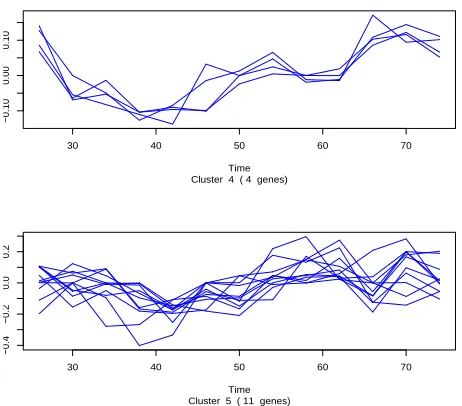
Following the hybrid AHC algorithm we then ran MAX-SAT on both the clusters obtained by AHC. The clusters obtained are shown in Figures 2 and 3. Both the clusters obtained by AHC have been split up by MAX-SAT. The score of the partition formed by these 5 clusters, including the constants, is now Σ(CMAX-SAT) = 79.43005. This is the log of the marginal likelihood and taking the appro-priate exponential, in terms of Bayes factor, this represents a decisive improvement for our model. Note that the in-crease in the log marginal likelihood is supported also by the visual display. The outliers are very different between themselves and from the real data and it seems reasonable that each one would generate a better cluster on its own -note the different scale of they-axis. The other 15 genes have a more similar shape and it seems visually reasonable to cluster them together, as AHC does initially, but MAX-SAT is able to identify a more subtle difference between 2 shapes contained in that cluster. It was not necessary in our case to run AHC again to combine clusters, given the nature of our data. A single iteration of the loop described in our hybrid algorithm identified the useful refinement of the original partition.
This example shows how, as discussed in Smith et al. (2008), AHC can be unstable especially when dealing with outliers at an early stage in the clustering. The weighted MAX-SAT is helpful to refine the algorithm, and obtain a higher scoring partition.
It is clear that in larger examples involving thousands of genes the improvements above add up over all moder-ate sized clusters of an initial partition, by simply using weighted MAX-SAT over each cluster in the partition, as described in our algorithm and illustrated above.
30 40 50 60 70
−20
−10
0
5
Cluster 1 ( 1 genes) Time
30 40 50 60 70
−20
−10
0
10
20
Cluster 2 ( 1 genes) Time
30 40 50 60 70
−5
0
5
10
15
20
[image:7.612.75.306.67.272.2]Cluster 3 ( 1 genes) Time
Figure 2: Clusters obtained on 3 outliers of
Arabidop-sis thaliana using AHC (1 cluster,S1 = −156.706) and
weighted MAX-SAT (3 cluster,S1=−145.571).
5
Further work on cluster scores for large
clusters
In the approach taken in this paper clusters are explicitly represented as propositional atoms in the weighted MAX-SAT encoding and so it is important to reduce the num-ber of clusters considered as much as possible. The hybrid method with iterative augmentation that we have described in Section 3.2 works very efficiently for splitting clusters with cardinality smaller than 100. However it slows down dramatically for greater cardinalities. It would be useful to generalize the approach so that it can also be employed to split up larger clusters. The main challenge here is to iden-tify good candidate sets. Two methods that we are currently investigating are outlined below.
Reducing cluster scores using cliques
30 40 50 60 70
−0.10
0.00
0.10
Cluster 4 ( 4 genes) Time
30 40 50 60 70
−0.4
−0.2
0.0
0.2
[image:8.612.74.305.67.270.2]Cluster 5 ( 11 genes) Time
Figure 3: Clusters obtained on 15 genes of
Arabidop-sis thaliana using AHC (1 cluster, S2 = 255.973) and
weighted MAX-SAT (2 clusters,S2= 259.372).
We suggest using an approach similar to Ben-Dor et al. (1999), enhanced by the use of weighted MAX-SAT and a fully Bayesian model.
We focus on maximal cliques, instead of clique graphs as in Ben-Dor et al. (1999), to identify possible clusters to feed into weighted MAX-SAT. A maximal clique is a set of vertices that induces a complete subgraph, and that is not a subset of the vertices of any larger complete subgraph. The idea is to create an undirected graph based on the adjacency matrix obtained by scoring each pair of observations as a possible cluster and then use the maximal cliques of this graph to find plausible clusters. It is reasonable to assume that a group of elements is really close and should belong to the same cluster when it forms a clique. This considerably reduces the number of clusters that need to be evaluated and are the input for weighted MAX-SAT, which will then identify the highest scoring partition.
The first step is to calculate the proximity between obser-vationsiandj(i, j= 1, . . . , n) such as
D={dij}=Sij−(Si+Sj)
which gives a matrix of adjacenciesA
A={aij}= (
1 ifdij> K 0 otherwise
from which we can draw a graph (Sij is the score for the
cluster of 2 elements,iandj). Each vertex represents an observation. Two vertices are connected by an edge accord-ing to matrix D. The adjacency matrix defines an undi-rected graph. The maximal cliques, the intersections be-tween maximal cliques and the union of maximal cliques
with common elements define the potential cluster scores for weighted MAX-SAT.
Although such methods are deficient in the sense that they use only pairwise relationships within putative clusters, they identify potentially high scoring clusters quickly. Of course, it does not matter whether some of these clusters turn out to be low scoring within this candidate set, because each is subsequently fully scored for weighted MAX-SAT and their deficiency identified. This is in contrast to the method of Ben-Dor et al. (1999) which is completely based on pairwise dissimilarities. So the only difficulty with this approach is induced by those clusters which are actually high scoring but nevertheless are not identified as promis-ing.
Other advantages of this method are that all the scores that are calculated are used as weights in the weighted MAX-SAT and it does not induce any artificial constraint on clus-ter cardinalities.
Reducing cluster scores by approximating
An alternative to the method described above is to represent the equivalence relation given by a partition directly: for each distinct pair of data pointsyi, yj, an atomai,jwould
be created to mean that these two data points are in the same cluster. Only O(n2)such atoms are needed. Hard clauses (O(n3)of them) expressing the transitivity of the equivalence relation would have to be added. With this approach it might be possible to indirectly include infor-mation on cluster scores by approximating cluster scores by a quadratic function of the data points in it. A second-order Taylor approximation is an obvious choice. Such an approach would be improved by using a different approxi-mating function for each cluster size.
6
Discussion
WalkMaxSat appears to be a promising algorithm for en-hancing partition search. It looks especially useful to em-bellish other methods such as AHC to explore regions around the AHC optimal partition and to find close par-titions with better explanatory power. We demonstrated above that this technique can enhance performance on small subsets of the data and on large datasets too, in con-junction with AHC.
There are many embellishments of the types of methods de-scribed above that will potential further improve our hybrid search algorithm. However, in this paper we have demon-strated that in circumstances where the Crowley priors are appropriate weighted MAX-SAT solvers can provide a very helpful addition to the tool box of methods for MAP search over a partition space.
References
Anderson, P. E., J. Q. Smith, K. D. Edwards, and A. J. Mil-lar (2006). Guided conjugate Bayesian clustering for un-covering rhytmically expressed genes. CRiSM Working
Paper(07).
Ben-Dor, A., R. Shamir, and Z. Yakhini (1999). Cluster-ing gene expression patterns. Journal of Computational
Biology 6(3–4), 281–297.
Booth, J. G., G. Casella, and J. P. Hobert (2008). Clustering using objective functions and stochastic search. Journal
of the Royal Statistical Society, Series B 70(1), 119–139.
Chipman, H. A., E. I. George, and R. E. McCulloch (2002). Bayesian treed models. Machine Learning 48(1–3), 299–320.
Crowley, E. M. (1997). Product partition models for nor-mal means.Journal of the American Statistical
Associa-tion 92(437), 192–198.
Cussens, J. (2008). Bayesian network learning by com-piling to weighted MAX-SAT. In Proceedings of the 24th Conference on Uncertainty in Artificial Intelligence
(UAI 2008).
Denison, D. G. T., C. C. Holmes, B. K. Mallick, and A. F. M. Smith (2002).Bayesian Methods for Nonlinear
Classification and Regression. Wiley Series in
Probabil-ity and Statistics. John Wiley and Sons.
Edwards, K. D., P. E. Anderson, A. Hall, N. S. Salathia, J. C. W. Locke, J. R. Lynn, M. Straume, J. Q. Smith, and A. J. Millar (2006). FLOWERING LOCUS C Mediates Natural Variation in the High-Temperature Response of
the Arabidopsis Circadian Clock. The Plant Cell 18,
639–650.
Heard, N. A., C. C. Holmes, and D. A. Stephens (2006). A quantitative study of gene regulation involved in the im-mune response of anopheline mosquitoes: An applica-tion of Bayesian hierarchical clustering of curves.
Jour-nal of the American Statistical Association 101(473),
18–29.
Lau, J. W. and P. J. Green (2007). Bayesian Model-Based Clustering Procedures. Journal of Computational and
Graphical Statistics 16(3), 526.
Liverani, S., P. E. Anderson, K. D. Edwards, A. J. Millar, and J. Q. Smith (2008). Efficient Utility-based Cluster-ing over High Dimensional Partition Spaces.CRiSM
Re-search Report(22).
McCullagh, P. and J. Yang (2006). Stochastic classifica-tion models. InProceedings International Congress of
Mathematicians, Volume III, pp. 669–686.
O’Hagan, A. and J. Forster (2004). Bayesian Inference:
Kendall’s Advanced Theory of Statistics (Second ed.).
Arnold.
Quintana, F. A. and P. L. Iglesias (2003). Bayesian cluster-ing and product partition models. Journal of the Royal
Statistical Society Series B 65(2), 557–574.
Ray, S. and B. Mallick (2006). Functional clustering by Bayesian wavelet methods. J. Royal Statist. Soc.: Series B 68(2), 305–332.
Smith, J. Q., P. E. Anderson, and S. Liverani (2008). Sep-aration measures and the geometry of Bayes factor se-lection for classification.Journal of the Royal Statistical
Society, Series B 70(5), 957–980.
Tompkins, D. A. D. and H. H. Hoos (2005). UBCSAT: An implementation and experimentation environment for SLS algorithms for SAT and MAX-SAT. In H. H. Hoos and D. G. Mitchell (Eds.), Theory and Applica-tions of Satisfiability Testing: Revised Selected Papers of the Seventh International Conference (SAT 2004,
Van-couver, BC, Canada, May 10–13, 2004), Volume 3542
ofLecture Notes in Computer Science, Berlin, Germany,