UNIVERSITEIT TWENTE
Correlating Features of Malicious
Software to Increase Insight in
Attribution
by
K.M. Beunder
A thesis submitted in partial fulfillment for the degree of Master of Science
in the
Electrical Engineering, Mathematics and Computer Science (EEMCS/EWI) Services, Cybersecurity and Safety (SCS)
UNIVERSITEIT TWENTE
Abstract
Electrical Engineering, Mathematics and Computer Science (EEMCS/EWI) Services, Cybersecurity and Safety (SCS)
Master of Science
byK.M. Beunder
This paper discusses research done on malware attribution: finding the author of a
malware sample. Attribution of malware is difficult and complex and with cyber crime
becoming more and more popular, law enforcement is facing an uphill battle.
Malware attribution is a complex problem. Unless the attacker makes a rookie mistake
and gives away his name and/or IP address it will be difficult and sometimes impossible
to determine who the author of a malware sample is (if there is a single author). Not
only is malware typically thoroughly stripped by its user (not always the author) of
any reference to its origin, malware is also likely to be obfuscated which complicates
any analysis procedure. Malware can also be equipped to evade analysis by detecting
specific environmental settings that are reminiscent of analysis.
This research consists of two parts. The first part experiments with the malware
anal-ysis tool Cuckoo Sandbox and different machine learning models to determine possible
attribution accuracy. The second part analyzes malware samples, both obfuscated and
non-obfuscated versions, to determine the effects of different obfuscation tools on the
analysis and the analysis results. Both static and dynamic behavior of the samples are
used in the analysis.
The results show that even when using only features from static analysis, accuracies
of up to 57% and 72% can be achieved. Furthermore obfuscation tools can have an
impact on both static and dynamic features although the simpler obfuscation tools only
influence the static ones.
It is argued that with more research this type of analysis will be useful to law enforcement
with respect to malware attribution. The usefulness will be limited to narrowing down
Acknowledgements
I want to thank my main supervisor, Dr. M.H. Everts, for his patience and guidance.
I am grateful to my second supervisor, Dr. A. Peter, for taking the time to review my
work. I also want to thank J.M. van Lenthe MSc for giving me some insight in the inner
workings of the High Tech Crime Unit.
Finally I want to thank a number of friends and family members for being patient with
me and helping me keep my spirits up especially during the difficult and stressful times.
Contents
Abstract i
Acknowledgements ii
1 Introduction 1
1.1 Key Components . . . 2
1.2 Summary of Contributions. . . 3
2 Malware 4 2.0.1 Threat Landscape . . . 4
2.0.2 Malware Attributes . . . 5
2.0.3 Anti-Malware Measures . . . 7
2.1 Malware Analysis . . . 8
2.2 Anti-Analysis Measures . . . 8
2.2.1 Obfuscation . . . 9
2.2.1.1 Packers . . . 10
2.2.1.2 Cryptors . . . 11
2.2.1.3 Source Code Obfuscators . . . 11
3 Related Work 12 3.1 Author Classification . . . 12
3.2 Stylometry . . . 13
3.3 Malware Behavior . . . 14
3.4 Compiler Provenance. . . 14
3.5 Memory Forensics . . . 15
4 Experimental Setup 17 4.1 Environment Setup . . . 17
4.1.1 Cuckoo Sandbox . . . 18
4.1.2 Profiling Environment . . . 20
4.1.3 Testing Environment . . . 20
4.1.4 Experiment 2 Adjustments . . . 21
5 Experiment 1: Classification of real malware samples based on Cuckoo features 22 5.1 Sample Selection . . . 23
5.2 Experiment Architecture . . . 23
Contents iv
5.2.1 Sample Submission . . . 24
5.2.2 Feature Extraction . . . 24
5.2.2.1 Type Features . . . 25
5.2.2.2 String Features . . . 25
5.2.2.3 Complete Feature Set . . . 26
5.2.3 Machine Learning . . . 27
5.2.3.1 K-Nearest Neighbors . . . 29
5.2.3.2 Decision Tree. . . 30
5.2.3.3 Random Forest. . . 30
5.2.3.4 Neural Network . . . 30
5.2.3.5 Modeling the String Features . . . 31
5.3 Results. . . 32
5.3.1 Model Comparison . . . 32
5.3.2 Analysis of Authors . . . 33
6 Experiment 2: Obfuscation and information loss in Cuckoo reports 36 6.1 Sample Selection . . . 36
6.2 Sample Preparation . . . 37
6.2.1 Packers . . . 38
6.2.1.1 UPX . . . 38
6.2.1.2 Themida . . . 38
6.2.2 Source Code Obfuscator . . . 39
6.3 Experiment Architecture . . . 39
6.3.1 Sample Submission . . . 40
6.3.2 Report Analysis . . . 40
6.4 Results. . . 40
6.4.1 Manual Reports Analysis . . . 41
6.4.2 Info Points . . . 44
7 Evaluation & Discussion 45 7.1 Experiment 1 . . . 45
7.1.0.1 Feature Importance . . . 47
7.1.0.2 Author-specific Statistics . . . 47
7.1.1 Reflection . . . 48
7.2 Experiment 2 . . . 49
7.2.1 Reflection . . . 50
7.3 Discussion . . . 51
8 Conclusion & Future Research 53 8.1 Future Research . . . 53
8.1.1 Sample Database . . . 54
8.1.2 Tool Environment . . . 55
8.1.3 Machine Learning . . . 55
Contents v
A.2 XOR . . . 57
A.3 ROT13 . . . 58
B Classifier Implementations 59 B.1 K-Nearest Neighbors . . . 59
B.2 Decision Tree . . . 60
B.3 Random Forest . . . 60
B.4 Neural Network . . . 60
C Experiment 1 - Feature Importances 61
D Accuracies per Author 63
E Google Code Jam Samples 68
F Cuckoo Report 69
G Results Experiment 2 77
Chapter 1
Introduction
Digital crime has become an increasingly popular form of crime over the past years. It
is a crime you can commit while sitting in the comforts of your home, with a large pool
of victims since a fair part of our lives is digital. Moreover, learning the necessary skills
has become easy, with some help from the internet.
As with every type of crime, the main question law enforcement wants answered is: who
is responsible? Or, to whom can this crime be attributed? A digital crime has a digital
crime scene (for the most part) and requires certain expertise to analyze. There are
dif-ferent types of digital crime, one of those and the one on which this research will focus,
is malware. Basically malware is software written for malicious reasons. In this research
we focus on malware, for which malware or malware-like samples can be collected and
of which it would be interesting to analyze the contents for clues related to the author.
It is worth mentioning that in the case of malware, the attacker/perpetrator and the
author of the malware are not necessarily the same person. Just like a shooter and the
maker of the gun do not have to be the same person.
Several quotes from the book Countdown to Zeroday [1], a book on the discovery and
dissection of Stuxnet, show that malware attribution is a problem that even the most
experienced professionals encounter and sometimes have insurmountable problems in
solving:
“Attribution is an enduring problem when it comes to forensic investigations of hack
attacks. Computer attacks can be launched from anywhere in the world and routed
through multiple hijacked machines or proxy servers to hide evidence of their source.
Unless a hacker is sloppy about hiding his tracks, it’s often not possible to unmask the
perpetrator through digital evidence alone.”
Introduction 2
“But sometimes malware writers drop little clues in their code, intentional or not, that
can tell a story about who they are and where they come from, if not identify them
outright. Quirky anomalies or footprints left behind in seemingly unrelated viruses or
trojan horses often help forensic investigations tie families of malware together and
even trace them to a common author, the way a serial killer’s modus operandi links
him to a string of crimes.”
Finding the responsible party of malware is an ongoing subject of interest. There are
already several research papers in existence on the subject, although most of these do
not use real malware samples but mock-malware samples for the evaluation. The use of
mock-malware samples is usually for the simple reason that it is difficult to find a large
set of real malware samples with any identifiable information on the authors.
What can complicate the analysis of malware is the use of obfuscation by the author.
Obfuscation can be used to distort some potentially identifying features.
The analysis of malware can be further complicated if an author uses some form of
ob-fuscation on the malware. Obob-fuscation can distort some potentially identifying features
in the malware, which most authors will do to some extent.
1.1
Key Components
The main issue we want to investigate in this research is whether automatic malware
attribution could be a reliable supporting system for example for law enforcement. So
the main question is:
Can automatic malware attribution be useful in an investigation to identify the author?
This question is split into two sub questions that we intend to answer, thereby trying to
piece together an answer to our main question.
• Can automatic malware attribution be reliable enough such that it can contribute to an investigation?
• What are the effects of obfuscation on any features, and their content, that can be extracted from malware?
We will explore two aspects of malware analysis. One of the aspects is the classification
of malware samples, based on the features which form the author profile. The other is
Introduction 3
The same setup can be used for both experiments, with a virtual machine were the
malware samples can be run and analyzed. In the first experiment real malware samples
are analyzed and using machine learning we try to determine how accurately the samples
can be classified according to author. In the second experiment features are extracted
from mock-malware samples, some of which are obfuscated, allowing for a comparison
of the type of features that can be extracted and how much information they contain.
1.2
Summary of Contributions
The next chapter starts with some basic knowledge on malware to help understand the
different components and terms used in the rest of the paper. This is followed by a
chapter on previous research that has been done in the same area as this research, which
gives some interesting insights as to how malware analysis can be approached.
Chapter 4 explains how the environment in which the experiments will be executed is
setup and the process driving the configuration of the environment. After this chapter
on the setup for the experiments, two chapters follow, each dedicated to one of the
exper-iments. The experiment chapters describe what samples are used, how the experiment
is constructed (what steps are taken), and ends with the results. The chapter after the
two experiment chapters evaluates the results for each of the experiments. The thesis
Chapter 2
Malware
Malware, short for malicious software, is any software designed to cause detriment to
a user, computer, network or equipement/machinery/etc. connected to the computer
and/or network. There are many types of malware including Trojan horses,
back-doors, worms, downloaders, bots, spyware, adware, fake antiviruses, rootkits, file
in-fector viruses, and the current newest addition, ransomware [2]. Malware can be a
combination of these types since some types are more focused on the infiltration of a
computer system, some on the way the malware replicates and spreads, and others on
staying hidden once it has infected a system. So for example one piece of malware may
fall in the three categories of the fake antivirus, rootkit, and spyware. Using the fake
antivirus angle to get access to a system, hiding itself like a rootkit, and gathering user
information like spyware.
2.0.1 Threat Landscape
There are three main types of attackers: those in it for financial gain, hacktivists who are
motivated by political issues, and nation states which is nation hacking other nations.
Of these three types financial gain is often the motivation behind the malware, like
Cryp-toLocker (ransomware) where a victim’s files are encrypted rendering them unusable to
the user and decryption is offered in exchange for payment of the ransom.
An example of hacktivists is the group Anonymous that for example has executed
sev-eral DDoS (Distributed Denial of Service) attacks against different governments and
corporations.
There are also cases where nations attack other nations. Usually this means a nation’s
military and/or intelligence arm, or hired individuals or teams, hacking another nation’s
assets (like companies, critical infrastructure, government officials, etc.). These cases are
inherently more complex given a nation’s resources and the precautions they are willing
Malware 5
to take to hide their involvement. Some nations might regard “being hacked” as an act
of war. These types of cases are very hard to prove. An example is the Stuxnet worm,
which was most likely an American-Israeli creation (although neither country admitted
to this) that very specifically sabotaged certain components that were in use by Iran’s
nuclear facility thereby delaying the Iranian nuclear program.
You might expect the culprit behind a malware attack to be an expert with a computer
and the knowledge to craft malware. However, if you know where to look, there are
markets for malware where one can simply purchase different malware components, no
special skills required. This concept is known as Malware-as-a-Service (MaaS) and is
part of the cyber black market. All sorts of malware related services can be found in this
market. Among other things you can find malware components or complete packages,
ransomware is a popular product, and botnets can be hired to do a DDoS attack. Such
a market, where malware could simply be bought, allows just about anybody to become
a cyber criminal.
This has a number of major consequences. Since the threshold is lower, there are likely
to be more cyber criminals. The customer service in this market has also become
increasingly professional, further improving the accessibility. Second, for those who know
how to write the malware, they can sell their creations on the black market, making
money with substantially less risk because they are not the ones directly attacking
anybody. Another consequence could be that a lot of knowledge can be exchanged (this
mostly on fora) and different malware or malware techniques can be combined to make
more technical and complex attacks.
2.0.2 Malware Attributes
Before analyzing malware it can be helpful to know what characteristics malware can
possess.
Malware can come in different types of files, executables but also JAR files, some kinds
of script, shortcut files, macros (like .doc), etc.
Malware, like any software, can be written in many languages, the choice is the author’s.
Malware is often written in C or C++, middle level languages (see figure 2.1 for illus-tration of code layers). Writing in an assembly language allows the author to do more
complex things, but assembly language is less readable to humans and significantly more
cumbersome to write, debug and maintain.
Depending on the target of the malware the author has to decide for which operating
Malware 6
Figure 2.1: Flow of compilation and disassembly [3]
OS. However most regular consumers have laptops with Windows or Mac OS on it.
With Windows being the most used operating system, followed by the Mac OS after
Window’s huge head start, it is not all that surprising that most of the malware targets
Windows systems since that means more potential targets. Other reasons that may
makes Windows an appealing target are that Windows has a long history with many
compatibility requirements and there are many illegal copies in circulation which can
not be updated, leaving potential flaws exposed. Hackers’ interest in targeting the Mac
OS has been increasing of late [4]. Also mobile devices and their OSes have become an
interesting target since more and more mobile devices becoming more popular. Even
devices that one might not expect to be targeted could get infected, anything with a
small amount of storage, like your digital thermostat.
When writing code, programmers can import libraries to use existing code to facilitate
their program instead of writing everything themselves. Since different libraries are
used for different things, the imports of a file can help indicate what type of functions
the program needs which can give an indication as to what the program does. These
imported libraries and functions can be extracted for analysis, for a Windows executable
this would be listed in the program’s PE (portable executable) format.
The PE format is a file format that contains information that Windows OS loader needs
to manage the file. Executables, object code and DLLs for instance come in a PE file
format. The PE format consists of a header followed by several sections including the
program code. The header contains metadata like information on the code, the type
of application, required library functions, and space requirements. Malware meant for
Windows machines will also have the PE file format to be able to run and it might be
Malware 7
Figure 2.2: Simple overview of the arrangement of a program in PE file format [5]
2.0.3 Anti-Malware Measures
There are several measures that can be taken to decrease the chance of a malware
infection.
Antivirus tools are popular and available both paid/subscribed and as freeware. The
name is based on times when the focus was mostly on viruses, nowadays however
an-tivirus companies have expanded to combat more than just viruses, but the term remains
the same. Unfortunately, antivirus programs are incapable of detecting and blocking all
malware. Traditional antivirus software depends on signatures stored in the antivirus
company’s database of malware signatures to identify malware. In this case a signature
is a unique value (like a hash), which is calculated from the malware, that identifies that
specific malware sample. When a new malware is encountered, the anti-virus company
must first add the signature of this new malware to its database for the anti-virus
pro-gram to be able to recognize it as malware. They cannot detect malware that is not
known to them.
There are also anti-malware products which are more focused on newer malware that
may be polymorphic (self-modifying) or make use of zero-days1, compared to antivirus
products which mainly deal with more traditional malware from traditional sources.
When installed antivirus and anti-malware hook themselves into the system, similar to
how some malware might do except with permission, and whenever the operating system
accesses a file the antivirus or anti-malware intervenes and first checks whether the file
is legitimate. If the file is flagged as malware, the accessing of the file is stopped (and
typically quarantined) and the user is warned.
1a vulnerability in soft-, firm-, or hardware that is unknown to the party responsible for the patching
Malware 8
Other examples of preventative measures are firewalls, website security scans, awareness
counseling and in extreme cases “air gap” isolation (no connections whatsoever, air all
around).
2.1
Malware Analysis
The analysis of malware is similar to other investigations. With the same basic
ques-tions: Who? What? Where? When? And why?
There are basically two forms of malware analysis, static and dynamic analysis. Static
analysis, also known as code analysis, is the analysis of the actual files/resources
con-taining the malware, which can be as basic as the extracting of any strings to be found
or as advanced as actually reverse engineering the binary. Basically everything you can
do without running the file.
Dynamic analysis, also known as behavioral analysis, is the analysis of behavior of a
running malware sample, for example the internet connections it tries to make, what
processes it creates, etc. Although it is prudent to use a safe environment for both types
of analysis, it is absolutely necessary for dynamic analysis because the malware is made
to execute in order to analyze it.
Static and dynamic analysis are comparable to the approaches of whiteboxing and
black-boxing used elsewhere (for example in this course on malware analysis [2]). Where
whiteboxing is the taking apart of the file itself as to inspect the inner workings and
blackboxing is the running of the malware and observing its behavior to determine what
changes it makes to the machine. Whiteboxing will often help us understand the why
and the who, while the blackboxing will often help with the what, when and where.
2.2
Anti-Analysis Measures
The analysis of malware can be hampered when anti-forensic techniques2 are included
in the malware. For any malware analysis technique, sooner or later a way to counter
or circumvent it is found. Just as new types of attacks will provoke the development of
new defenses against it. Not surprisingly this results in an endless cat and mouse game
of measure and counter-measure.
2
Malware 9
Anti-forensics can be implemented using obfuscation3 techniques. There are several
ob-fuscation tools available online to facilitate this.
Another type of anti-forensic technique are the anti-virtual machine (anti-VM)
tech-niques. Virtual machines are useful environments to use for dynamic malware analysis
for several reasons. They are mostly meant as a closed off separate environment on a
host machine that acts as normal PC but can be viewed from the host machine for
analy-sis. Virtual machines are also easy to manage and clean. The state of a virtual machine
environment can be saved in a snapshot, to which the virtual machine can be reset,
reverting to a clean state after malware analysis. Or they can simply be deleted after
use. Anti-virtual machine techniques can result in the malware altering its functionality
or not running at all if it detects that it is being run in a virtual environment, defeating
the purpose of running the malware in the virtual environment. Another, non-cyber
specific, way of making analysis harder is to commit the crime with multiple people,
especially if the consistency of the group were to change often. If several programmers
instead of one programmer were to have worked on one piece of malware, they might be
obscuring each others identity if the malware is analyzed as a whole for attribution.
2.2.1 Obfuscation
Obfuscators were originally introduced to make it difficult to decode commercial code,
in particular C++, to avoid loss of intellectual property. Malware writers often use
obfuscation to hide their tracks. Obfuscation is mostly used to hide the purpose of the
malware. Depending on how much effort the creator puts into obfuscating the code, this
could result in additional work for anyone trying to analyze it. Obfuscation will at least
complicate the static analysis of the malware.
Tools for obfuscation can be classified under different names such as Packers, Cryptors
(encryption tools) or simply Obfuscators, depending on its technique. The most popular
type of obfuscation is packing. There are many such tools available, ranging in
com-plexity, and it is not unusual to encounter self-made tools. Some packers include options
like encryption, virtual-environment detection, etc. making lone cryptors somewhat
obsolete.
There are also forms of obfuscation that are not usually done with tools, but that are
simply diversion techniques built into the code. For instance having the executable wait
for a substantial amount of time before actually doing anything to give the illusion that
it is harmless.
3According to Google obfuscation is: the action of making something obscure, unclear, or
Malware 10
2.2.1.1 Packers
The packing of a file involves the compressing of the original file and inserting this into
a new executable with a small wrapper program. The wrapper program is responsible
for the unpacking when the packed program is executed. It extracts and decompresses
the original file into memory so the original file can be run. Due to the compression the
packed file takes up less space, with the additional property of making the payload less
easy to recognize or analyze.
There are many types of packers, each with there own packing algorithm; you can even
write your own. The packing algorithm defines how a file is compressed [6]. To unpack
a compressed file you need to know which algorithm was used to pack it or have the
correct tool to decompress the file.
The type of packers relevant to this research are runtime packers, which is the
com-pression of executables were the decomcom-pression occurs at runtime (when the packed
executable is run). These differ from packers like zip and rar in several ways. Zip and
rar for instance require certain type of tools/software to unpack, like 7Zip or WinRAR.
An executable compressed by a runtime packer has the decompression manual built in
as it were. It keeps the .exe extension and when executed unpacks itself in memory
to execute the original program. These compressed executables can also be called
self-extracting archives. If packed, malware is likely to be packed with a runtime packers
[image:16.596.197.436.483.598.2]since malware is meant to remain executable.
Figure 2.3: The state of a program before and after compression (packing), and after
decompression [7]
Originally packers were meant to make files smaller to use less disk space, and the
self-extracting meant that users wouldn’t have to manually unpack it themselves. However
with the current disk sizes and internet speeds these kind of measures aren’t required
anymore [8]. Nowadays a compressed executable is likely to be malware, although there
are very few packers that are used solely for malware [6]. The packing of the malware
Malware 11
footprint on the victim’s machine as a bonus. To do any proper analysis the packer needs
to be unwrapped first.
2.2.1.2 Cryptors
The term cryptors sometimes refers to obfuscation tools, but can include actual
en-cryption which often makes it more complex, applying a transformation to make the
executable harder to detect [8]. Malware writers can choose to use simple ciphers to
encrypt their code, in which case they are just looking for an easy way of preventing
basic analysis from identifying their activities, or they can choose sophisticated ciphers
or even custom encryption, to make reverse engineering that much more difficult.
En-crypted programs will sometimes work in the same way as a packed program, with the
key instead of a decompression stub. Since the program needs to be able to run it needs
to be able to decrypt itself. In some cases the key may not be in the code somewhere, in
that case the malware will need to be given the order to run (by supplying the key) and
the owner of the malware will need some form of access to it to do this. Some simple
transformation examples may be the XOR (exclusive OR) cipher, Base64 encoding, and
ROT13. See Appendix A for more information on these ciphers. These are forms of data encoding, which are key-less unlike encryption which always needs a key.
2.2.1.3 Source Code Obfuscators
One such an example is Stunnix. Stunnix is advertised as a general obfuscator [9],
however it impacts the source code and we will therefore refer to it as a source code
obfuscator in this paper. It is available for several programming languages including C
and C++, and it takes the plain code as input and delivers the obfuscated version of
the code as output. Among other things it replaces symbol names, numeric constants
and characters in strings to meaningless or more difficult to read variants, removes or
obfuscated comments, and renames files and directories to make them meaningless. The
Chapter 3
Related Work
Malware analysis has been the focus of many research papers, some of which with
attribution as main focus. Malware attribution is deemed difficult because there is
a large body of potential authors to distinguish from, and finding fingerprints unique to
each specific author can be quite difficult. Not to mention the added degree of difficulty
when considering that (some parts of) a piece of software may be copied from elsewhere,
constructed by multiple authors or obfuscated in some way (remember for example MaaS
described in2.0.1).
In research focused on author attribution we came across several papers that discuss
author classification of literary texts. Some aspects of the feature selection from literary
texts could be applicable in our own research. However it is expected that the content of
program will differ from any literary text, which is why we also examine research focused
specifically on author attribution of code. Two papers [10,11] on this subject discuss the use of stylometry features. Besides research specifically on author attribution, we
are also interested in other types of software (sometimes malware) analysis. Properties
of malware such as its behavior, which compiler was used and analysis of the malware
while in memory (memory forensics) can be considered as potentially useful features
in creating a fingerprint. A short discussions on each of these different aspects can be
found in the following sections.
3.1
Author Classification
Most author classification research is based on literary texts. To identify the author of a
text basically a kind of “fingerprint” is extracted from the text [12]. This fingerprint can
then be compared to other fingerprints from other texts. Since a fingerprint needs to be
Related Work 13
distinguishing in nature, meaning that the fingerprints of two different authors should
not be the same, it is important to use combination of features that makes conflicting
fingerprints unlikely.
There does not seem to be a consensus on which features produce the best results. A
possible categorization is lexical, syntactic, structural, content-specific, and idiosyncratic
style markers [13].
Using word frequencies to develop a fingerprint is a popular method. Other features
that might be used to characterize an author may be sentence length, word length,
abundance of vocabulary, etc. The features used by Elayidom et al. [12] include: number
of periods, of commas, of question marks, of colons, of blanks, of words, of sentences, of
characters, ratio of characters in a sentence, and top k word frequency. Specifically for
short messages Brocardo et al. [13] uses n-grams, investigating the n-gram sizes of 3, 4,
and 5.
3.2
Stylometry
Turning to attribution research specifically focused on the digital/code, two papers stand
out [10, 11]. In these papers attribution is investigated using stylometry features ex-tracted from code. The first of these papers [10] indicates that stylometry features
extracted from source code are distinguishing and result in rather high accuracies (94%
and 98%). Three types of stylometry features are extracted from source code: lexical,
layout and syntactic. These features are merged into what they call the Code
Stylome-try Feature Set (CSFS). From the CSFS a smaller set of the most informative features
is extracted, and this set is used in a random forest classifier.
However in many (“real life”) cases access to the source code cannot be assumed. Which
leads to the follow-up research [11] in which stylometry features are extracted from
compiled samples. The results in this paper also indicate that stylometry features are
useful in distinguishing authors, resulting in almost equally high accuracies (up to 92%).
In this case the executables are disassembled and decompiled, during which features (like
raw instruction traces and symbol information) are extracted. Once disassembled and
decompiled the rest of the features, lexical and syntactic, are extracted. Here too the
feature set is reduced to a smaller set of the most informative features, using the same
method as in their previous research, after which it is used in a random forest classifier.
In both cases the number of distinctive authors used is limited, far smaller than the
amount of malware authors expected to be existent in “real life”. Although the method
Related Work 14
code stylometry would be in real world situations. However the experiment results
suggest that stylometry features could help reduce the number of suspects when dealing
with attribution.
3.3
Malware Behavior
Research specific to malware and its classification seem to focus mainly on the behavioral
properties of the malware, like those extracted through dynamic analysis. Determining
the behavior of a malware sample means trying to determine what it is doing and maybe
also how. There are several aspects to examine for behavioral properties. One aspect to
analyze is what the malware itself is doing, like what functions it runs. Another aspect
is to analyze the environment for any changes that the malware may be responsible for,
like the creation of a file or registry. To analyze the changes to the environment, it is
easiest to run actually run the malware, preferably in some “safe” environment.
Two examples of research into malware behavior are the papers by Mohaisen et. al. and
Shang et. al. [14,15]. The first of these two [14] describes the design of an analysis and classification system they name AMAL. AMAL is a two part system, AutoMal which is
responsible for the analysis and MaLabel which does the classification and or clustering.
AutoMal analyzes files, registries, network behavior and memory dumps resulting in
features that MaLabel can use to distinguish between different variants within malware
families. The other paper [15] investigates the identification of malware by examining
the function calls found in the assembly code. The function calls are structured in a
so-called function-call graph as vertices and the directed and weighted edges represent the
calls made. Function-call graphs can be compared to each other to calculate similarity.
Although behavior properties are not likely to contain author specific information such
as a name or address, unless perhaps a message was left on purpose, they can help to
trace multiple samples back to a single origin. If the author of one of those samples can
be found it is likely he/she is also responsible for the others. Or perhaps the different
samples reveal different pieces of author information and the correlation can give a better
indication.
3.4
Compiler Provenance
Another possibly relevant aspect to consider is compiler provenance. This is any
infor-mation on the compiler, the compiler version and any other compiler settings with which
Related Work 15
BinComp uses syntactical, structural, and semantical features to recover compiler
prove-nance. Despite the fact that this tool assumes that any binaries to be analyzed are not
obfuscated or stripped and only certain types of architecture and programs are
evalu-ated, the authors conclude that their method and tool could be a practical approach
for real-world situations. While compiler provenance alone may not be enough for
at-tribution, as the authors of the paper say themselves it could be imperative to certain
applications, attribution among other things. It is after all the author who decides how
to compile his/her program.
3.5
Memory Forensics
A different way of analyzing the behavior of an executable is by studying it in memory
while it is being run. The advantage of inspecting a program in memory is that most
of the obfuscation is removed to run the executable and it is more robust against any
anti-forensic techniques [16]. The difficult part is finding it in memory once it is running.
There are several researches on memory forensics [16–18], each with their own approach
at finding, analyzing, and interpreting the program in memory.
One of the ways to access and retrieve properties of a program from memory, according
to Mosli et al. [16], is to use an automated tool like Cuckoo Sandbox [19]. It acquires
memory images and memory dumps, and can extract features, in this case registry
keys, imported DLLs, and API function calls. After obtaining the desired features, the
features are used in a number of different classification techniques are compared for the
different types of features. For the registry features the Stochastic Gradient Descent
performed best (with 96%). The classification techniques with the best performance for
the imported DLLs is the Random Forest (with 90,5%) and for the API function calls
it is the Stochastic Gradient Descent (with 93%).
Another memory forensic tool, focused mostly on how to find a sample in memory, is
presented with the HyperLink tool [17]. It tries to determine the programs placement in
memory without knowing the precise details of the kernel’s data structure. It assumes
that modern OSes organize key information in linked lists and that certain offsets are
a constant. Since a different OS version can mean a change in the kernel code, being
independent of these smaller changes can save time creating an update for each new OS
version. The cost of knowing less details means that only a portion of the information,
depending on properties that persist over different OS versions, is extracted from the
memory. It is stated that with the this partial information (the critical fiels) a process
Related Work 16
The Virtuoso tool [18] is designed to automatically generate an introspection program
(to examine attributes at runtime) regardless of what OS it is examining the (malicious)
software in. It focuses on the finding of a program in memory and “following” its progress
during runtime. Virtuoso acquires its own knowledge of an OS’s algorithms and data
structures by creating a simple program and tracing its execution. By doing multiple
traces Virtuoso can learn to ignore any unrelated system activity and how to find the
currently running process. Virtuoso is considered too slow for online monitoring, but
Chapter 4
Experimental Setup
To explore the answers to the research questions introduced in the Introduction, two
ex-periments are performed. In the following two chapters the method of these exex-periments
is outlined, followed by a survey of the results.
Before starting on the experiments an environment for these experiments is set up. Since
the environment is mainly the same for both experiments, the setup for both is described
here as the same environment. For both experiments existing tools are used to extract
features from (malware) samples. For the second experiment the testing environment
had to be re-established and a number of small changes were made that did not affect
the results of the experiment but made the process of setting up either slightly easier or
they were necessary changes due to the loss of some resources (access to certain hardware
components). What changes were made exactly will be listed at the end of this chapter.
4.1
Environment Setup
For the testing environment several elements need to be set up: (1) an environment
where the malware can be run and analyzed and (2) an environment where the analysis
results can be used to profile the malware samples run, using the set of features for
machine learning.
We use Cuckoo Sandbox1 to analyze the malware samples because it is open source
and modular, making it easier to make your own additions. Some research into malware
analysis tools seems to show that Cuckoo Sandbox is a fairly popular tool among malware
analysts. It is an automated system that analyzes multiple aspects of a malware sample
1Cuckoo Sandbox website: https://cuckoosandbox.org/
Experimental Setup 18
which is easier and more efficient than using multiple tools that need to be activated
one by one (manually).
Cuckoo Sandbox is installed on the host machine, which in this case is also the
environ-ment where the analyzes results can be inspected, and uses a virtual machine to analyze
the malware samples in.
4.1.1 Cuckoo Sandbox
Cuckoo Sandbox is an open source automated malware analysis system. It’s main
ar-chitecture consists of a Host machine and several Guest machines (see figure 4.1). The Host machine is the machine where the central management software runs, it manages
the whole analysis process. The Guest machines are the isolated environments (usually
virtual machines but could also be a physical machine) where the malware samples are
[image:24.596.194.439.364.535.2]executed and analyzed safely.
Figure 4.1: Cuckoo Sandbox Architecture [20]
To begin a Cuckoo analysis procedure a sample can be submitted, either using the
submit utility or in the web interface. There are certain settings that can be decided
on when submitting a sample, one of which is the timeout setting (the length of time
after which the analysis will be halted). After submitting, Cuckoo does all analysis steps
automatically, resulting in reports and dumps etc.
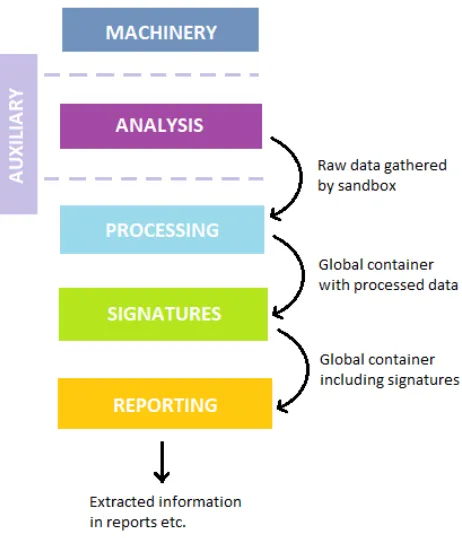
Cuckoo has a modular setup (see figure 4.2), with six types of modules, each of which has its own responsibilities in the analysis procedure. There are auxiliary modules,
machinery modules, analysis packages, processing modules, signatures, and reporting
Experimental Setup 19
Figure 4.2: Cuckoo’s Modular Structure
The auxiliary modules define procedures that are to be run in parallel with the malware
analysis, starting before the analysis and stopping afterward but before the processing
and reporting takes place. An example of such a procedure is sniffer.py, which takes
care of the dumping of generated network traffic.
The machinery modules specify the way Cuckoo should communicate with the
virtual-ization software. A number of virtualvirtual-ization software vendors are supported by default,
like VirtualBox and VMware, otherwise it is possible to add a custom Python module.
Every machinery module comes with a configuration file in which the machines are listed
with their label, platform and IP-address.
Cuckoo’s analysis packages (analyzer/windows/modules/packages) are a core
compo-nent. These packages describe how the analyzer component should conduct its analysis
in the guest environment, depending on the type of file it is to analyze (bin, doc, pdf,
zip, etc.).
The processing modules are scripts that specify how to analyze the raw results that are
gathered by the sandbox. The data returned by each module is appended in what is
called a global container.
The signature modules are used to identify a predefined pattern or indicator that you
might be interested in. There are Helper methods to help in the creation of new
Experimental Setup 20
identifying signatures into one signature to classify.
Finally, the global container that is filled by the processing modules is passed to the
reporting modules each of which can make use of whatever information they want to
extract and make it accessible and consumable in different formats.
4.1.2 Profiling Environment
The profiling environment is the host environment where Cuckoo and the virtualization
software that it used for testing is installed.
On the host machine Ubuntu 16.04 TLS is installed. Since Cuckoo Sandbox is a Python
based program, Python needs to be installed on the host OS. Cuckoo also requires
virtualization software for which we choose to use VirtualBox since it is often used in
combination with Cuckoo Sandbox. Although the newer versions of Cuckoo are
indepen-dent from the choice of virtualization software, VirtualBox used to be the standard and
VirtualBox is still as good a choice as any. Apart from these basics Cuckoo needs several
other programs to be installed, partially depending on the desired extra functionalities.
The Cuckoo website2 lists these other programs and extra functionalities.
4.1.3 Testing Environment
The testing environment is the virtual machine, or guest environment, that Cuckoo uses
to run the malware samples in.
The virtual machine is built with an Windows 7 OS. The choice to use Windows 7
instead of Windows XP is based on the fact that Windows XP isn’t quite as available to
download legally (and reliably) anymore, while Windows 7 is readily available. Cuckoo
loads the guest from a snapshot, this way each malware sample is run in the exact same
start state.
Several popular programs are also installed on the this environment (like Adobe Reader,
Internet Explorer, Microsoft Word, etc.) to make the environment seem more a normal
computer and not malware testing environment. Some anti-virtualization techniques
have been known to check for the presence or absence of certain programs.
Finally, Cuckoo needs an agent.py to be placed and run in the testing environment. The
agent allows Cuckoo the communicate/observe the testing environment.
Experimental Setup 21
4.1.4 Experiment 2 Adjustments
For the second experiment, the experiment environment is adjusted. Cuckoo is run on a
remote server, also in a virtual machine, to increase performance. The most important
differences are:
• Virtualization tool: vSphere in stead of VirtualBox
• Testing environment OS: Windows 10 in stead of Windows 7 (due to availability)
Chapter 5
Experiment 1: Classification of
real malware samples based on
Cuckoo features
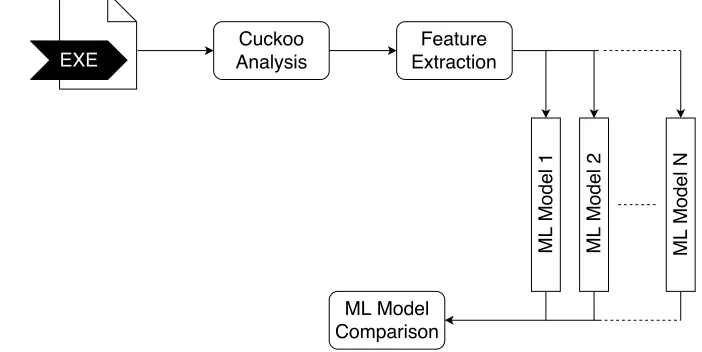
With this experiment (figure5.1) we try to determine whether a sample can be attributed to an author based on a set of extracted features. Using machine learning (ML) a large
number of features can be processed and “learned” for future matching, which suits
the purposes of this experiment and is more efficient than analyzing and classifying
manually. The choice of features is based on related work done on malware analysis
and authorship attribution, and on what results Cuckoo Sandbox can return to us. For
the machine learning part, a number of different models are examined to decide which
seems to fit best.
Cuckoo Analysis
Feature Extraction
ML Model 1 ML Model 2 ML Model N
ML Model Comparison
[image:28.596.135.486.536.712.2]EXE
Figure 5.1: Schematic of Experiment 1
Experiment 1 23
5.1
Sample Selection
Due to the sensitive nature of the data’s origin, the specific origin of the data will not
be provided here. Access to the data was granted for this research by the High Tech
Crime Unit (HTCU) for a limited amount of time. It includes actual malware samples
linked to authors, making it interesting for possible malware authorship investigation.
When selecting what samples to use, it must be taken into consideration that authors
need multiple samples to participate in both the training and testing groups for the
machine learning models. Also, the more samples the machine learning model has to
train with the more accurate it is likely to be.
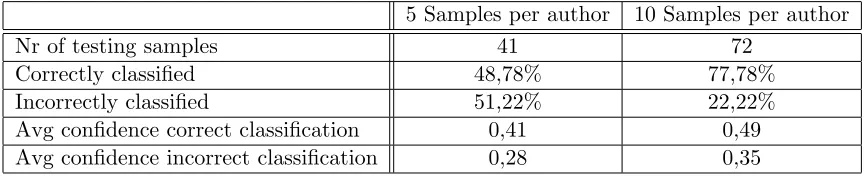
Not all authors had enough samples to participate in the experiment. When the criteria
is that an author have a minimum of 5 samples (executables, not URLs), we are left
with only 37 different authors. With a minimum of 10 samples, only 34 different authors
are left. In the case that there were more samples available than the desired number of
5 or 10, a random selection of 5 or 10 was made among the available samples.
Nr. of different authors Total nr. of different samples
Case: 5 samples per author 37 185
Case: 10 samples per author 34 340
5.2
Experiment Architecture
The design of the experiment is described here followed by more detailed descriptions
of several key parts: the sample submission, the feature extraction (the construction of
the feature set), and the machine learning.
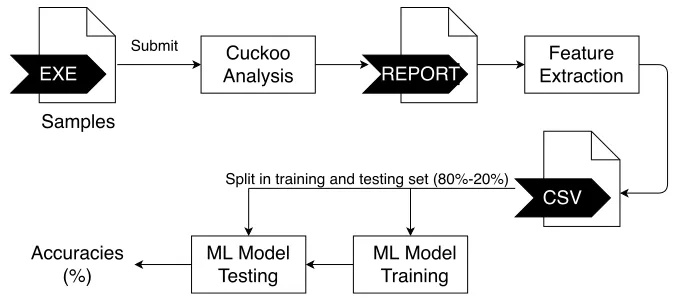
Each malware sample is first analyzed by Cuckoo Sandbox which results in a number of
reports and dumps. One of these is a report.json file, this contains the findings of the
static analysis and a summary of the results of other analyses that Cuckoo is configured
to do. Cuckoo uses this file to display its findings in a web page when you use the web
interface.
Which features to extract is an important decision since they will basically form the
description of the sample. What features to use is based on previous research, discussed
in chapter 3, and whatever features that Cuckoo returns in the analysis report. On examination of the reported features, those that seem to be of most interest are: the
Experiment 1 24
Once extracted, the features can be used to train and test a machine learning model.
The accuracy of the model can indicate whether the combination of features used is
representative enough, or if enough samples were used to train the model, or if the
model was configured correctly for this type of dataset.
Samples
Cuckoo Analysis
Submit
EXE REPORT
Feature Extraction
CSV
ML Model Training ML Model
Testing Accuracies
(%)
[image:30.596.145.482.156.305.2]Split in training and testing set (80%-20%)
Figure 5.2: Architecture: Data flow from sample to accuracy
Each of the main parts of this experiment will be explained in further detail: sample
submission, feature extraction, and machine learning.
5.2.1 Sample Submission
During this experiment the samples are submitted with a timeout setting (which is the
time after which the analysis should timeout, so basically the duration of the analysis)
of 300 seconds.
5.2.2 Feature Extraction
The police may use the term modus operandi to refer to the methods that criminals
used to commit a crime, prevent detection of the crime and escape. Among other things
the modus operandi is used for criminal profiling. It can help to identify, and/or catch
a suspect and to determine whether crimes might be related.
Looking at the report generated by Cuckoo, we decided that the type feature could be a
profiling element as it tells us in what form the malware author chose to execute his/her
crime. If human beings are indeed inclined to behave in a consistent way, this could be
the type of data to help profile the offender. Malware authors may have specializations
and mainly focus on creating certain types of malware.
Other data in the Cuckoo report that looked as though it may contain information that
Experiment 1 25
Cuckoo finds through static analysis there appear to be some readable messages that may
be error messages, possible imports, path-structured strings among other things. With
readable text present there may be characteristics to find to contribute to the author
profile. For instance if there are any error messages written by the author himself,
they could be unique to him/her. Also any path-like strings may contain information,
sometimes even a name, and otherwise may be useful to link different samples if they
contained the same path.
5.2.2.1 Type Features
Cuckoo reports the type of the file it has analyzed in the form of a description. For
example: “Java archive data (JAR)”, “PE32 executable (GUI) Intel 80386, for MS
Windows”’, “ASCII text, with very long lines, with CRLF line terminators”, etc. These
description are then turned into feature vectors by determining whether certain elements
are present in the description and indicating this with a TRUE or FALSE value. The
elements chosen to screen for (not case sensitive) are: Windows, HTML, Java, GUI,
DLL, console, ASCII, executable, archive, image, UPX. These particular elements were
chosen based on a quick scan at the types found in the Cuckoo reports and based on
certain knowledge of Cuckoo, like the fact that it can detect whether a file has been
packed by UPX and will mention this in the type description. The resulting vectors can
now be used for machine learning.
5.2.2.2 String Features
The strings retrieved from a Cuckoo report can be used in certain machine learning
algorithms, so these will be part of the complete feature set as well. However, a number
of features will be extracted from the strings as well to create a vector which can be
used in most machine learning models.
For inspiration on features to extract from strings or text the papers on authorship
attribution [12] and authorship verification [13] are inspected. The first uses n-gram
features which is complex and time consuming but can be effective. The second paper
tries to create a fuzzy fingerprint with frequencies, such as number of words and number
of sentences but also number of periods and number of brackets.
Our experiment deals with “text” extracted from a program, which may contain several
readable parts, but will for a large part contain seemingly random characters. Therefore
Experiment 1 26
The extracting of frequencies would be applicable and result in a vector which would
add to the feature set for the machine learning models. Whether it is a useful addition
to the feature set is hard to tell, but worth trying. In the paper by Elayidom et al.
[12] the list of features consists of counting the following: periods, commas, questions
marks, colons, semi-colons, blanks, exclamation marks, dashes, underscores, brackets,
quotations, slashes, words, sentences, and characters. Due to the nature of the “text”,
strings extracted from binary in stead of a literary text, we might expect some of the more
unusual characters. So, other characters that we chose to also look out for: parentheses,
curly brackets, back slashes, percent signs, number signs, dollar signs, ampersands,
equal signs, plus signs, asterisk signs, greater than signs, and less than signs. These
other characters are chosen because of the origin of the “text”, we would expect to
find more unusual characters. Apart from the extra characters we also search for some
more computer program specific elements such as potential paths, libraries and readable
strings.
Since for the most part we are not expecting any real sentences in our “text”, we have
counted the number of strings in the string set found in the report. Words are counted
when a space occurs, also taking into account that a path string (like C:\User\Users)
also contains words (C:, User, Users). When looking for paths we look for slashes and
backslashes. To identify libraries we search for ‘.dll’ specifically. Readable strings are
any strings that don’t contain any specialcharacters. This isn’t very specific since this
means that “jsiFEINLsfjlne” is considered readable which, to a human reader, it is not.
However any real readable string will be considered part of this group and if much of
the strings are seemingly random most may contain special characters, so this may still
be an interesting group to count.
5.2.2.3 Complete Feature Set
After all raw data (as it was represented by Cuckoo in reports etc.) has been converted
into features we are left with a CSV (comma separated values) file with a feature
rep-resentation of a sample on each row (205 samples means 205 row of features). Each
row starts with the author name and the sample name, both of which are technically
not features, but are either used to label the sample for machine learning or to ID the
sample. Next in the row are the size and type description of the sample. The type
de-scription is the raw data that several of the features are extracted from. The rest of the
row consists of the features extracted from the type description, the features extracted
Experiment 1 27
5.2.3 Machine Learning
After the feature extraction we have a data set of the samples each represented as a
number of features extracted from it and the name of the corresponding author. The
problem that we want to solve with machine learning is finding a mapping from feature
to author name, so future samples that we want to attribute can be mapped to an author
name. To model this problem we first need to find a fitting machine learning model.
The feature set we have to work with consists of numeric representations (counts) of
some of Cuckoo’s findings and the set of strings that Cuckoo extracts from the sample.
Since most machine learning models take only numeric input, the textual input (the
strings) will be classified differently. For the textual feature the Bag of Words model
one of the few models suitable. The Bag of Words, as the name indicates, is specifically
meant for classification based on a set of words. For the numeric features there are a
number of machine learning models to choose from.
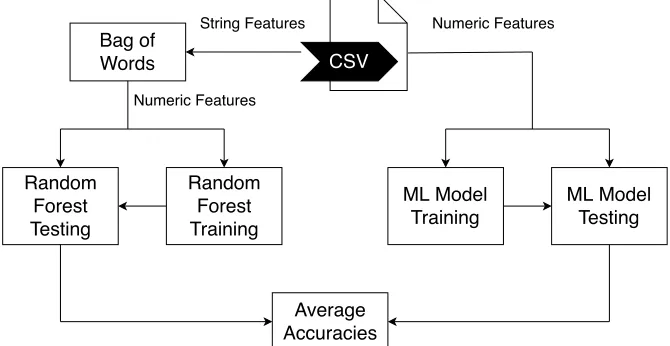
[image:33.596.149.484.347.520.2]CSV Bag of Words String Features Random Forest Testing Random Forest Training ML Model Training ML Model Testing Numeric Features Numeric Features Average Accuracies
Figure 5.3: Machine Learning schematic
FINDING THE RIGHT MODELS
There are many different machine learning (ML) models and they can be classified
according to different traits [21,22]. In choosing a ML model these different traits are compared to find a model best suited for the problem to solve.
The first way of categorizing ML models is according to their learning methods:
super-vised learning, unsupersuper-vised learning, and reinforcement learning. Supersuper-vised learning
methods predict outcomes given a set of predictors, it maps inputs to output.
Unsuper-vised learning methods cluster the samples in groups. Reinforcement learning methods
are trained to make certain decisions and trains itself continuously through trial and
error. Reinforcement learning is often used in robotics where a decision is made based
Experiment 1 28
suitable in this case since our problem consists of a set of features accompanied by
la-bels (the author name), and there is simply need for a mapping from input (features)
to output (labels).
Once having chosen for supervised learning, a distinction can be made between a
clas-sification or a regression model. The basic difference is that a clasclas-sification model maps
an input to a discrete output (or a label) and a regression model maps input to a
con-tinuous output (a quantity). For this experiment a classification model seems the most
appropriate, with the author names as labels.
Other criteria taken into account are whether or not the model is linear and whether it
is a two- or multi-class classification algorithm. Classification algorithms that are linear
expect that the different classes can be divided by a straight line. However if the data
is nonlinear in trend, a linear model would produce more errors than necessary. As for
the two- or multi-class classification: the classes our samples can be classified in are the
author names, which is a set of known authors larger than two, making any two-class
classification algorithms less suitable.
Based on the previous discussion the following models are selected to build and test for
accuracy with our data set:
• K-Nearest Neighbors
• Decision Tree
• Random Forest
• Neural Network
For each of these models a short description and short discussion of the implementation
is given. For the full implementations see AppendixB.
Each model is given the features training set, the labels training set, and the features
testing set. With the training sets the model is trained and once trained it can predict
the associating labels for the testing set. These predictions can come simply in the form
of a label, but also come in the form of a set of floats for each label that indicates the
models confidence in that label being the right one for the features.
MODEL EVALUATION
In contrast to the real machine learning models, we have also created the simple random
classifier which does nothing other than choose a random label as output for each test
sample. The accuracy of this model is added to give a better relative understanding of
Experiment 1 29
To compare the different models we will compare their accuracies. Each model is built
(or trained) and tested twenty times and the accuracies of each are combined together
into one average accuracy of the model. For the above models only the numerical features
are used. The textual feature will be used separately for classification (Bag of Words).
The data set we have after features extraction is split into features and labels, to be the
input and output of the models respectively. The features and labels are then split into
a training set and a testing set, in a 80%-20% proportion. This splitting into training
and testing makes sure that each class is equally distributed over these sets according
to the given 80%-20% proportion.
During the accuracy calculations of each of the models, calculations were also made for
each author. This might highlight if some authors are easier to classify than others.
The textual features that were split off from the rest of the feature set earlier, are
used to train and test the Bag of Words model. With the textual features the Bag of
Words model is trained and tested. The splitting, first into features and labels, and then
into training and testing sets, happens in the same way that it does for the numerical
features. The Bag of Words model will also return its predictions for the features in the
testing set. By combining the predictions of both models, whatever model is used on the
numerical features and the Bag of Words, the combined model may be more accurate
because it uses more (types of) features (as shown in figure 5.3).
5.2.3.1 K-Nearest Neighbors
The k-nearest neighbors classification algorithm uses “lazy learning”. The training set
is not actually used to build the model, it is used as a reference whenever a new sample
is to be classified. It will try to find the k closest training examples to determine the
correct class.
The python sklearn library1 has a KNeighborsClassifier with which the k-nearest
neigh-bors algorithm2 can be implemented.The key settings for the algorithm were the number
of neighbors (set to 3) and the weight function (set to distance). These settings were
based on several experiments where the accuracy was used to determine the algorithms
settings. As part of these same experiments the algorithm for computing the nearest
neighbors was set to the kd tree algorithm.
1
http://scikit-learn.org/stable/
2
Experiment 1 30
5.2.3.2 Decision Tree
Decision tree classification uses a tree-like graph modeling the decisions made to classify
input. Each node represents an internal decision, which is implemented by a function
returning a discrete value that is used to decide which branch to follow to the next node
or leaf. Leaves are found at the ends of the tree, they contain the labels that the tree
can return as output.
In python, the sklearn library has a DecisionTreeClassifier which makes it easier to build
a decision tree. The DecisionTreeClassifier allows for the setting of several variables,
including what function to use for measuring the quality of a split, how many features
to consider for a split, and the maximum depth of the tree. After testing a range of
depth settings on the accuracy, the maximum depth of the tree was set to 25. This is
the only setting we changed.
5.2.3.3 Random Forest
A random forest classifier is a model composed of a number of decision trees. Each of
the trees returns the label it has classified a sample in and the random forest returns
the label which appears most often among those decision trees. By combining multiple
decision trees into a random forest would boost the performance of the model.
Building this model with python, the sklearn library3 offers a RandomForestClassifier
that allows you to decide on a number of settings like the number of trees used or the
depth the trees are allowed to achieve. Some of the more influential settings are
dis-cussed. Based on experiments to determine the accuracy only one setting was changed:
the number of trees in the forest.
The setting of the number of trees in the random forest is by default 10 trees. The
experiments indicated that the accuracy of the model no longer improved after a certain
number of trees and may even decrease slightly. The experiments determined that the
trade-off between accuracy and compute performance was optimal between 25 to 50
trees. A setting of 35 trees was chosen.
5.2.3.4 Neural Network
The idea of the neural network model is a very simplified version of the neural network
of the brain. It constitutes a number of nodes or neurons, of which the output of each is
3
Experiment 1 31
calculated using a non-linear function on the sum of its inputs. Usually these nodes are
organized in layers, where each layer may have a different function that the nodes use
to convert input to output. Data travels from the first (input) layer, through the layers
(maybe even several times), to the last (output) layer.
To build a neural network in python we made use of the MLPClassifier offered by the
sklearn library. MLP stands for multi-layer perceptron. MLP creates an input layer,
an output layer and a number of hidden layers in between. The input layer represents
the input features and has as many nodes. The output layer converts its inputs into
output values. The MLPClassifier has many possible settings, which usually indicates
a flexible model, but also means that there is probably need for much trial and error.
There are many settings and not all of them will be discussed, only a couple of them
that are interesting or made a significant difference in accuracy.
The first two steps in configuring the neural network requires the setting of the number
of nodes per layer and the number of layers. Computational complexity increases rapidly
with the increase of both layer and nodes. Accuracy experiments led to the choice of
a single layer with 250 nodes. It is possible that a higher accuracy is obtainable but
due to time and scope limitations, this is the setting that was chosen for the neural
network model. The remaining two important settings are the threshold function and
the optimizer function. Using the previous experiments two threshold function settings
were evaluated: the tanh and the logistics. Final choice was the logistics function.
Similarly, the choice for the optimizer was the adam which is a stochastic
gradient-based optimizer.
5.2.3.5 Modeling the String Features
As explained before, the string features cannot be inserted into just any model, as most
models only accept numerical values. One of the popular methods to convert words into
vectors is the Bag of Words model. After this conversion a random forest is used to
classify.
The bag of words model is fairly simple and can achieve great results in language
mod-eling and document classification. Basically the bag of words model represents a set of
words of which only the multiplicity is stored, the original word order is insignificant.
There are a couple of measures that can help decrease the size of the vocabulary, such
as ignoring cases, taking only the stem of the words (like “walk” from “walking”) and
removing stop words like “the” and “it” and so on. In this way, by counting the
![Figure 2.1: Flow of compilation and disassembly [3]](https://thumb-us.123doks.com/thumbv2/123dok_us/9665411.468461/12.596.193.441.80.289/figure-flow-of-compilation-and-disassembly.webp)
![Figure 2.2: Simple overview of the arrangement of a program in PE file format [5]](https://thumb-us.123doks.com/thumbv2/123dok_us/9665411.468461/13.596.193.441.82.268/figure-simple-overview-arrangement-program-pe-le-format.webp)
![Figure 2.3: The state of a program before and after compression (packing), and afterdecompression [7]](https://thumb-us.123doks.com/thumbv2/123dok_us/9665411.468461/16.596.197.436.483.598/figure-state-program-compression-packing-afterdecompression.webp)
![Figure 4.1: Cuckoo Sandbox Architecture [20]](https://thumb-us.123doks.com/thumbv2/123dok_us/9665411.468461/24.596.194.439.364.535/figure-cuckoo-sandbox-architecture.webp)