University of Warwick institutional repository: http://go.warwick.ac.uk/wrap
This paper is made available online in accordance with publisher policies. Please scroll down to view the document itself. Please refer to the repository record for this item and our policy information available from the repository home page for further information.
To see the final version of this paper please visit the publisher’s website. Access to the published version may require a subscription.
Author(s): Lozin, Vadim V., Mayhill, Colin and Zamaraev, Victor Article Title: A note on the speed of hereditary graph properties Year of publication: 2011
Link to published article: http://www.combinatorics.org/
Publisher statement: First published in The Electronic Journal of Combinatorics in 18(1), 2011, (published by the American
A note on the speed of hereditary graph properties
Vadim V. Lozin
∗DIMAP and Mathematics Institute University of Warwick, Coventry CV4 7AL, UK
Colin Mayhill
Mathematics Institute
University of Warwick, Coventry CV4 7AL, UK
Victor Zamaraev
†University of Nizhny Novgorod, Russia
Submitted: Jan 27, 2011; Accepted: Jul 27, 2011; Published: Aug 5, 2011 Mathematics Subject Classification: 05C30
Abstract
For a graph property X, let Xn be the number of graphs with vertex set {1, . . . , n} having property X, also known as the speed of X. A property X is called factorial if X is hereditary (i.e. closed under taking induced subgraphs) and
nc1n≤X
n≤nc2nfor some positive constants c1 andc2. Hereditary properties with
the speed slower than factorial are surprisingly well structured. The situation with factorial properties is more complicated and less explored, although this family in-cludes many properties of theoretical or practical importance, such as planar graphs or graphs of bounded vertex degree. To simplify the study of factorial properties, we propose the following conjecture: the speed of a hereditary propertyXis factorial if and only if the fastest of the following three properties is factorial: bipartite graphs in X, co-bipartite graphs in X and split graphs in X. In this note, we verify the conjecture for hereditary properties defined by forbidden induced subgraphs with at most 4 vertices.
Keywords: Hereditary class of graphs; Speed of hereditary properties; Factorial class
∗Research of this author was supported by the Centre for Discrete Mathematics and Its Applications (DIMAP), University of Warwick.
1
Introduction
A graph property is an infinite class of graphs closed under isomorphism. A property is
hereditary if it is closed under taking induced subgraphs. Given a hereditary propertyX,
we writeXnfor the number of graphs inXwith vertex set{1,2, . . . , n}. Following [5], we
call Xn the speed of the property X. In [1], it was proved that for any infinite hereditary
class X different from the class of all graphs,
lim
n→∞
log2Xn
n 2
= 1−
1
k(X), (1)
where k(X) is a natural number called the index of the class X. To define this notion,
let us denote by Ei,j the class of graphs whose vertices can be partitioned into at most i
independent sets and j cliques. In particular,
• E2,0 is the class of bipartite graphs,
• E1,1 is the class of split graphs,
• E0,2 is the class of graphs complement to bipartite.
Then the index k(X) of a class X is the maximum k such that X contains a class Ei,j
with i+j = k. Now let us extend this definition by assuming that the index of every
finite hereditary class is 0, and the index of the class of all graphs equals infinity. With this extension, the family of all hereditary classes is partitioned into countable number of subsets each of which consists of classes with the same index. Moreover, the classes
Ei,j with the same value of i+j are the only minimal classes in the respective subset. In
particular, for k = 2, there are exactly three minimal classes: bipartite, complements of
bipartite, and split graphs. Therefore, an infinite hereditary class of graphs has index 1 if and only if it contains none of the three listed classes. The classes of index 1 have been
called in [2] unitary.
The family of unitary classes is of special interest, since it contains many classes of theoretical and practical importance, such as interval graphs, permutation graphs, chordal bipartite graphs, line graphs, forests, threshold graphs, all classes of graphs of bounded vertex degree, of bounded clique-width [4], all proper minor-closed graphs classes (including planar graphs) [12], etc. In order to provide a differentiation of the unitary classes in accordance with their size, let us introduce the following definition: two graph
classes X and Y will be called isometricif there are positive constantsc1, c2 and n0 such
that Yc1
n ≤Xn≤Ync2 for any n > n0. Clearly the isometricity is an equivalence relation.
The equivalence classes of this relation are called layers.
All finite classes of graphs constitute a single layer, and all classes of index greater than 1 also constitute a single layer. Between these two extremes lies the family of unitary classes, and it consists of infinitely many layers. The first four lower layers in this family have been distinguished in [13]:
• polynomial layer contains classes X with log2|Xn|= Θ(log2n), • exponentiallayer contains classes X with log2|Xn|= Θ(n),
• factoriallayer contains classes X with log2|Xn|= Θ(nlog2n).
Independently, the same result was obtained by Alekseev in [2]. Moreover, Alekseev provided the first four layers with the description of all minimal classes and proposed a structural characterization of the classes in the first three layers (some more involved results can be found in [5, 6]). This characterization shows that the classes in the three
lower layers have a rather simple structure. In particular, for any exponential class X
there is a constant c such that the vertices of any graph inX can be partitioned into at
most c subsets so that each of the subsets is either a clique or an independent set, and
between any two of them there are either all possible edges or none of them.
The factorial layer is substantially richer. It contains most of the unitary classes mentioned above (the unique exception in the above list is the class of chordal bipartite graphs, which is superfactorial [14]). However, no complete structural characterization is available for this layer. As a step toward this characterization, we propose the following conjecture.
Conjecture A hereditary graph property X is factorial if and only if the fastest of the following three properties is factorial: X∩ E2,0, X∩ E1,1, X∩ E0,2.
This conjecture is suggested by the exceptional role of the three minimal non-unitary classes in the study of lower layers of hereditary properties. In particular, all minimal classes in the first four layers are subclasses of bipartite, co-bipartite or split graphs. Therefore, if we replace in the conjecture the factorial layer by any of the first three lower layers, it becomes a valid statement. For the factorial layer, only one part of the conjecture is known to be true (the “only if” part), since all minimal factorial classes are subclasses of bipartite, co-bipartite or split graphs. The three minimal factorial classes of bipartite graphs are [2]:
• P1 = F ree(K3, K1,2) (the notations are given below), the class of graphs of vertex degree at most 1,
• P2, the class of “bipartite complements” of graphs in P1, i.e. the class of bipartite
graphs in which every vertex has at most one non-neighbor in the opposite part,
• P3 =F ree(C3, C5,2K2), the class of 2K2-free bipartite graphs, also known as chain graphs for the property that the neighborhoods of vertices in each part form a chain.
The complements of graphs in P1, P2, P3 form the three minimal factorial classes of
co-bipartite graphs. The remaining three minimal factorial classes also are closely related
toP1, P2,P3. To reveal this relationship, let us observe that by creating a clique in one
of the parts of a bipartite graph we obtain a split graph. By applying this operation to
graphs in P1, P2, P3, we transform these classes into subclasses of split graphs, which
transforms in this way into the subclass of split graphs known as threshold graphs, or
equivalently, (2K2, C4, P4)-free graphs.
To verify the “if” part of the conjecture, we initiate a systematic study a factorial properties based on their induced subgraph characterization. It is well-known (and not
difficult to see) that a graph propertyX is hereditary if and only if it can be described by
a set of forbidden induced subgraphs. In this paper, we show that the above conjecture is true for all properties defined by forbidden induced subgraphs with at most 4 vertices, which is the main result of the paper. The organization of the paper is as follows. In the rest of this section we introduce basic notations. In Section 2, we verify the conjecture for all factorial classes defined by forbidden induced subgraphs on at most 4 vertices with
one exception. The only exception is the class of (K1,3, C4)-free graphs. We study this
class in Section 3, where we prove that this class is factorial.
We use the following notations. For a set of graphs M we denote by F ree(M) the
class of graphs containing no induced subgraphs isomorphic to graphs in the set M and
call the graphs in this class M-free.
For a graph G, we denote by V(G) and E(G) the vertex set and the edge set of G
respectively. The neighborhood N(v) of a vertex v ∈V(G) is the set of vertices adjacent
to v. If N(v) is a clique, then v is a simplicial vertex. The subgraph of G induced by a
set U ⊆V(G) is denoted G[U], andG\U stands for G[V(G)\U]. As usual, Cn, Pn and
Kndenote the cycle, the path and the complete graph onn vertices respectively. Also, by
Kn,mwe denote a complete bipartite graph with parts of size n andm. An n-wheel Wn is
a graph with n+ 1 vertices obtained from a cycle Cn by adding a dominating vertex, i.e.
a vertex adjacent to every vertex of the cycle. The complements of a graph Gis denoted
G and is called co-G.
2
Classes of graphs defined by 4-vertex forbidden
in-duced subgraphs
To avoid triviality, we do not forbid graphs on two vertices. Graphs with at least three vertices will be called non-trivial.
There are four graphs on three vertices (triangle K3, pathP3 and their complements)
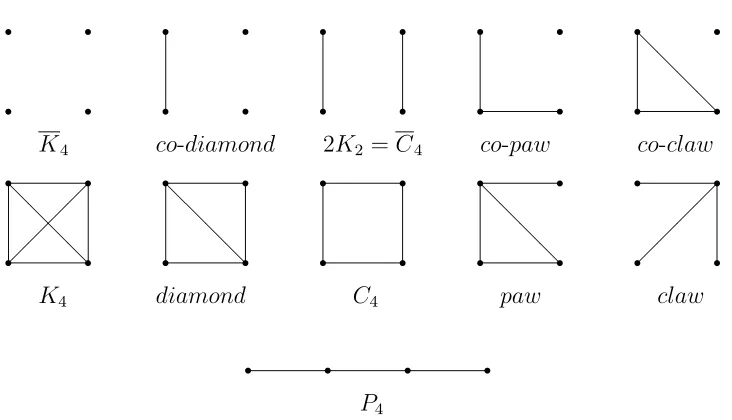
and eleven graphs on four vertices (listed in Figure 1).
In our analysis of classes defined by forbidden induced subgraphs we will use the following two results.
Theorem 1. [4] Every class of graphs of bounded clique-width is (at most) factorial.
Theorem 2. (see e.g. [3]) The class of C4-free bipartite graphs is superfactorial.
r r r r K4 r r r r
co-diamond
r r
r r
2K2 =C4
r r
r r
co-paw
r r r r @ @ @ @
co-claw
r r r r @ @ @ @ K4 r r r r @ @ @ @ diamond r r r r C4 r r r r @ @ @ @ paw r r r r claw
r r r r
[image:6.612.100.466.71.281.2]P4
Figure 1: All graphs on four vertices
Theorem 3. Let M be a set of graphs such that
• either M ∩ E0,2 =∅ • or M∩ E2,0 =∅ • or M∩ E1,1 =∅
• or M∩F ree(C3, C4) =∅
• or M∩F ree(C3, C4) =∅,
then F ree(M) is superfactorial.
Let us call the five classes listed in the theoremcritical. In what follows, we show that
ifM contains a graph in each of the critical classes and each graph in M has at most four
vertices, then F ree(M) is (at most) factorial.
There is just one maximal graph contained in all five critical classes, namely a P4. It
is known (see e.g. [7]) that the clique-width of P4-free graphs is at most 2. Together with
Theorem 1 this gives a factorial upper bound for the class F ree(P4). The class F ree(P3)
contains P1 (one of the minimal factorial classes), which gives a lower bound. Therefore,
Theorem 4. The class F ree(G) is factorial if and only if G is a non-trivial induced subgraph of P4.
From now on, we assume that none of the forbidden graphs is an induced subgraph of
an induced subgraph of P4. It is not difficult to see that each of them belongs to exactly three of the five critical classes. We divide the set of these 12 graphs into four types according to the critical classes they belong to:
(1) K3, K4, co-diamond,co-paw, claw belong to E2,0, E1,1, F ree(C3, C4). (2) K3, K4,diamond, paw, co-claw belong toE0,2, E1,1, F ree(C3, C4). (3) 2K2 belongs toE2,0,E0,2,F ree(C3, C4).
(4) C4 belongs to E2,0, E0,2, F ree(C3, C4).
Thus, a necessary condition for the class F ree(M) to be (at most) factorial is that the
set M contains at least two graphs: a graph of type (1) and a graph of type (2) or (4) (or
their complements). In what follows we show that this condition is also sufficient. Up to symmetry and complementary arguments, we have 20 classes to analyze. Three of them can be easily ruled out by the following observation:
• for any m and n, the class F ree(Km, Kn) contains finitely many graphs due to
Ramsey Theorem.
It is not difficult to verify that the remaining 17 classes are at least factorial, since each of them contains one of the minimal factorial classes. Now we turn to upper bounds.
First, we refer to some known results. In particular, in [7] it was proved that the following graph classes and their complements have bounded clique-width and hence are at most factorial:
• F ree(K4, co-paw)⊃F ree(K3, co-paw),
• F ree(K4, co-diamond)⊃F ree(K3, co-diamond),
• F ree(diamond,2K2)⊃F ree(K3,2K2),
• F ree(paw, claw)⊃F ree(K3, claw),
• F ree(diamond, co-diamond),
• F ree(diamond, co-paw),
• F ree(paw,2K2),
• F ree(paw, co-paw),
• F ree(co-claw, claw),
This reduces the analysis to the following 4 classes:
• F ree(K4,2K2),
• F ree(diamond, claw),
• F ree(co-claw,2K2).
Theorem 5. The classesF ree(K4, claw), F ree(K4,2K2), F ree(diamond, claw)are fac-torial.
Proof. The lower bound follows from the fact that each of these classes contains at least one minimal factorial class. For the upper bound we observe that
- the maximum vertex degree of graphs in F ree(K4, claw) is bounded by 5, since the
neighborhood of each vertex v isK3-free (else v belongs to a K4) andK3-free (else
v is the center of a claw). Therefore, there are at most n5n graphs with vertex set
{1, . . . , n} in the class F ree(K4, claw).
- the chromatic number of a 2K2-free graph G is bounded by ω(G2)+1
[15], where
ω(G) is the size of a maximum clique in G. Therefore, the vertices of a (K4,2K2
)-free graph Gcan be partitioned into at most six independent sets. Each pair of the
independent sets induces a 2K2-free bipartite graph. Therefore, the edges of G can
be partitioned into at most 15 graphs each of which belongs to a factorial class (i.e.
P3), which gives a factorial upper bound on the number ofn-vertex labeled graphs
inF ree(K4,2K2).
- F ree(diamond, claw) is a subclass of the class of line graphs, which is factorial (see e.g. [8]). Independently, a factorial upper bound on the number of graphs in the
classF ree(diamond, claw) can be obtained by observing that each vertex of a graph
in this class belongs to at most two maximal cliques, which shows that the number
of n vertex graphs in this class is at most n2n.
The class F ree(co-claw,2K2) also is factorial, but the proof is more complicated and
we postpone it till the next section. Summarizing the above discussion, we obtain the following conclusion.
3
(Claw, Square)-free graphs
In the previous section we analyzed classes defined by forbidden induced subgraphs with at most four vertices and revealed all factorial classes in this family with one exception,
the classF ree(co-claw,2K2). In this section, we study complements of graphs inF ree(co
-claw,2K2), i.e. graphs which are claw-free and C4-free. It is not difficult to see that the intersection of this class with each of the three minimal non-unitary classes is factorial. Therefore, according to the conjecture in the introduction, this class is factorial too. Below we prove this fact. The proof is based on some structural characterizations of claw-free graphs that can be found in the literature. In particular, the following theorem was proved in [11].
Theorem 7. A graph is claw-free and 4-wheel-free if and only if the neighborhood of each vertex is either the complement of a chain graph or a graph obtained from C5 or W5 by
duplication of some of its vertices (i.e. by substituting the vertices with cliques).
Obviously, F ree(K1,3, C4) is a subclass of F ree(K1,3, W4). Therefore, by Theorem 7,
the neighborhood of each vertex of a (K1,3, C4)-free graph induces either the complement
of a chain graph or a graph obtained fromC5 orW5 by duplication of some of its vertices.
First of all, let us show that without loss of generality we can reduce our analysis to
the case when the neighborhood of each vertex of a (K1,3, C4)-free graph induces the
complement of a chain graph.
LetGbe a (K1,3, C4)-free graph and assume it contains a vertexxwhose neighborhood
induces a graph obtained from aC5 by duplicating some of its vertices. DenoteA=N(x)
and B = V(G)\(A ∪ {x}). We denote the cliques substituting the vertices of the C5 by Ai, i = 0, . . . ,4 with two cliques being adjacent if and only if their indexes differ by
exactly 1 (all additions are taken mod 5). We will show that in order to describe the
graph we need to know G\ {x}and only one neighbor ofxin each of the cliques. To this
end, let us prove the following lemma.
Lemma 1. Let ai ∈Ai for i= 0, . . . ,4, then N(ai−1)∩N(ai+1) = Ai∪ {x}.
Proof. Without loss of generality, leti= 2. It is clear thatN(a1)∩N(a3)∩A=A2. Now
we show that N(a1)∩N(a3)∩B = ∅. Suppose not: then x, a1, a3 and any vertex from
N(a1)∩N(a3)∩B would induce aC4, which is forbidden. This contradiction shows that
a1 and a3 have no common neighbors in B and therefore N(a1)∩N(a3) =A2∪ {x}.
From Lemma 1 it follows that N(x) = (S4
i=0N(ai−1)∩N(ai+1))\ {x}. Therefore, G
can be described by G\ {x} and five neighbors ofx.
Assume now that a (K1,3, C4)-free graph G contains a vertex x whose neighborhood
induces a graph obtained from aW5 by duplicating some of its vertices. Again we denote
A =N(x) and B =V(G)\(A∪ {x}). Also, let C be the clique substituting the central
vertex of the wheel andAi,i= 0, . . . ,4 the cliques substituting the remaining vertices of
Lemma 2. Let c∈C, then N(c)∪ {c} =A∪ {x}.
Proof. It is clear that N(c)∪ {c} ⊇ A∪ {x}. In order to prove the lemma we need to
show the reverse inclusion. Suppose to the contrary that there is a vertex yinB which is
adjacent to c. The neighbors of yin Ainduce a complete graph, since otherwise Gwould
contain an inducedC4. Therefore,N(y)∩A⊆C∪Ai∪Ai+1 for some indexi∈ {0, . . . ,4}.
Without loss of generality let N(y)∩A ⊆C ∪A1 ∪A2, but then c, y together with any
two vertices a0 ∈ A0 and a3 ∈ A3 would induce a K1,3. This contradiction proves the
lemma.
According to Lemma 2 in the graph G\ {x} the set N(c)∪ {c} describes the
neigh-borhood of vertex x in the graph G. Therefore, to describe G we need to know G\ {x}
and an arbitrary vertex c∈C.
Now let us denote byY the class of (K1,3, C4)-free graphs in which the neighborhood of
every vertex induces the complement of a chain graph. Obviously, this class is hereditary.
Lemma 3. The class F ree(K1,3, C4) is factorial if and only ifY is factorial.
Proof. IfF ree(K1,3, C4) is factorial, then Y is factorial, because it is a proper subclass of F ree(K1,3, C4) and it contains one of the minimal factorial classes (the class of comple-ments of chain graphs).
Conversely, suppose that Y is a factorial class and let G be an arbitrary n-vertex
graph in F ree(K1,3, C4). If G contains a vertex x1 whose neighborhood induces either
a C5 or a wheel W5, then we remove it from G and record x1 and (at most) five of its
neighbors a10, a11, a12, a13, a14 which allow us to describe the neighborhood of x1. After this
operation, we have a record containing at most 6 vertices and a graph G1 obtained from
G by deleting x1. If G1 contains a vertex x2 whose neighborhood induces either a C5 or
a wheel W5, we repeat the procedure which leaves us with a record containing at most
12 vertices and a graph G2 obtained from G1 by deleting x2. We repeat this procedure
until we obtain a graph Gk from Y, where k ≤ n is the number of applications of the
operation. The record
x1, a10, a11, a12, a13, a14, . . . , xk, ak0, ak1, ak2, ak3, ak4, Gk, (2)
completely describes the graph G (i.e. allows to restore G from the record). Therefore,
the number of different records of type (2) equals the number of n-vertex labeled graphs
in F ree(K1,3, C4). Since Gk is an (n−k)-vertex graph from a factorial class, an upper bound on this number can be estimated as follows:
n X
k=0 (n
n 5
5!)k(n−k)c(n−k) < n X
k=0
120kn6k+c(n−k) ≤ n X
k=0
120knmax{6,c}n< nc1n, (3)
where c1 is constant. From (3) we conclude that F ree(K1,3, C4) is a factorial class.
Lemma 3 allows us to focus in the rest of the section on graphs in the class Y, which
3.1
Quasi-line graphs without a square
A graph is a quasi-line graph if the neighborhood of every vertex induces a co-bipartite
graph. Obviously, the class of quasi-line graphs is superfactorial, since it contains all
co-bipartite graphs. In this section, we study quasi-line graphs containing no C4 as an
induced subgraph and show that this class is factorial. A crucial role in our proof is played by the structural characterization of quasi-line graphs proposed by Chudnovsky and Seymour [9]. To describe this characterization we need to introduce a few definitions.
Circular interval graph.
Let C be a circle, V a finite set of points of C, and I a set of intervals of C (an interval
is a proper subset of C homeomorphic to [0,1]). Define G to be the graph with vertex
set V and two vertices u, v ∈V(G) being adjacent if and only if {u, v} is a subset of one
of the intervals. We call the triple (C, V, I) a circular interval representation of G. Any
graph that admits a circular interval representation is called a circular interval graph. A
special case of circular interval graphs arelinear interval graphs which are defined in the
same way with C being a line instead of a circle.
Fuzzy circular interval graph.
A graph G= (V, E) is a fuzzy circular interval if the following conditions hold:
1. There is a map φ from V(G) to a circle C (not necessarily injective).
2. There is a set of intervals I of C, none including another, such that no point of C
is an endpoint of more than one interval so that:
(a) If two vertices u and v are adjacent, then φ(u) and φ(v) belong to a common
interval.
(b) If two vertices u and v belong to a same interval, which is not an interval with
endpoints φ(u) and φ(v), then they are adjacent.
In other words, for a fuzzy circular interval graph the pair (φ, I) completely describe
adjacencies, except adjacencies for vertices uand v such that I contains an interval with
the endpointsφ(u) andφ(v). For such vertices adjacency is fuzzy. Note that if we require
φ to be injective, the definition of a fuzzy circular interval graph would be equivalent to
the definition of a circular interval graph. By replacing the circleC with a line we obtain
a definition of a fuzzy linear interval graphs
Strip
A strip is a triple (G, a, b), where G is a graph and a, b are two designated simplicial
vertices of G called the ends of the strip. A strip (G, v1, vn), n > 1 is called a linear
interval strip if G is a linear interval graph with vertices v1, . . . , vn listed in the order of
their appearances in the linear interval representation of G. Fuzzy linear interval strips
are defined analogously, provided that ifa, bare the endpoints of the strip then φ(a), φ(b)
Composition of strips
Thecomposition of two strips (G, a, b) and (G′, a′, b′) is the graph obtained from the union
of G\ {a, b} and G′ \ {a′, b′} by adding to it all possible edges between N(a) and N(a′)
and between N(b) and N(b′).
Let G0 be a disjoint union of complete graphs with an even number of vertices whose
vertex set is partitioned into pairs of nonadjacent vertices, i.e. V(G0) = {a1, b1, . . . , ak, bk}
with ai being nonadjacent to bi for each i= 1, . . . , k. Also, for i= 1, . . . , k, let (G′i, a′i, b′i)
be a collection of k strips that are vertex-disjoint, also from G0. For i= 1, . . . , k, letGi
be the graph obtained by composing (Gi−1, ai, bi) with (G′i, a′i, b′i). The resulting graph
Gn is called a composition of the strips (G′i, ai′, b′i) (1≤i≤k).
Chudnovsky and Seymour proved the following structural result in [9].
Theorem 8. A connected quasi-line graph G is either a fuzzy circular interval graph or a composition of fuzzy linear interval strips.
3.1.1 The structure of quasi-line graphs without C4
In this section we show that the class of quasi-line graphs without a C4 is obtained from
the class of quasi-line graphs by excluding the fuzziness from the definition.
Let G be fuzzy circular interval graph with a representation (φ, I). If [p, q] is an
interval of I such that φ−1(p) and φ−1(q) are both non-empty, then the pair of cliques
(φ−1(p), φ−1(q)) is called afuzzy pair, where φ−1(p) denotes the clique{v ∈V(G)|φ(v) = p}. The following Lemma was proved in [10].
Lemma 4. Let G be a fuzzy circular interval graph with a representation (φ, I). If no fuzzy pair contains an induced C4, then G is a circular interval graph.
As an immediate corollary from this lemma, we make the following conclusion.
Corollary 1. If G is a fuzzy circular interval graph containing no C4 as an induced
subgraph, then G is a circular interval graph.
Also, since a fuzzy linear interval graph is a special case of a fuzzy circular interval graph, we conclude the following.
Corollary 2. If (G, a, b) is a fuzzy linear interval strip containing no C4 as an induced subgraph, then (G, a, b) is a linear interval strip.
Now we show that ifH is a composition of strips and H is a C4-free graph, then each
strip in the composition also isC4-free. Obviously, it suffices to prove this statement only
for two strips.
Proof. Suppose without loss of generality thatG1 contains an inducedC4. Sincea1 andb1
are simplicial, they do not belong to any inducedC4. Therefore,G1\{a1, b1}also contains
an induced C4. By definition, G1 \ {a1, b1} is an induced subgraph of H. Therefore, H
also contains an induced C4, which contradicts the assumption.
Combining this lemma with Corollaries 1 and 2 and Theorem 8 we obtain the following
structural characterization ofC4-free quasi-line graphs.
Theorem 9. A connected quasi-line graph G without an induced C4 is either a circular
interval graph or a composition of linear interval strips.
3.1.2 The number of n-vertex quasi-line graphs without C4
In this section we show that the class of C4-free quasi-line graphs is factorial. The lower
bound follows from the fact that this class contains P1 (one of the minimal factorial
classes). Therefore, we only need to prove an upper bound. To this end, we may restrict ourselves to connected graphs only.
We start by estimating the number of circular interval graphs. It is known (see e.g.
[9]) that this class is a proper subclass of the class of circular arc graphs. A graphG is a
circular arc graph if it is the intersection graph of a setI ={I1, . . . , In} of intervals (arcs)
on a circle C, i.e. if there exists a one-to-one correspondence between the vertices of G
and the intervals ofI such that two vertices ofGare adjacent if and only if the respective
intervals intersect (without loss of generality, we may assume that no two intervals of I
share the same endpoint). The pair (C, I) is called a circular arc model of G. We call
two circular arc models different if they define different labeled graphs and equivalent
otherwise.
Lemma 6. The class of circular arc graphs is factorial.
Proof. The lower bound follows from the fact that this class contains P1. For the upper
bound, letGbe ann-vertex circular arc graph and (C, I) a circular arc model representing
G with I = {[ai, bi], i = 1, . . . , n}. Starting from a1, we write out the labels of the endpoints of intervals in the order they appear on the circle clockwise, which results in a sequence
πI = [c1, c2, . . . , c2n], (4)
where every element of the sequence is either ai or bi for some value of i. In particular,
c1 = a1. It is clear that if πI = πI′, then the models (C, I) and (C, I′) are equivalent,
i.e. they represent the same labeled graph. Therefore, the number of different circular
arc models does not exceed the number of different sequences of type (4), which is (2n)!.
Therefore, the class of circular arc graphs is factorial.
Corollary 3. The class of circular interval graphs and the class of linear interval graphs are factorial.
Proof. Corollary follows from the fact that both classes are subclasses of the class of
Now we turn to estimating the number of different labeled n-vertex compositions of linear interval strips. Without loss of generality, we assume that every strip contains at least 3 vertices, since otherwise it adds nothing to the composition and hence can be ignored.
Any n-vertex composition of k strips is completely determined by
• a 2k-vertex labeled graph G0, which is a disjoint union of cliques, given together
with a partition of its vertices into pairs{a1, b1, . . . , ak, bk},
• an ordered list of k labeled strips (G′i, ai′, b′i) (i= 1, . . . , k).
Note that k ≤ n, since each strip adds at least one vertex to the resulting graph. We
denote the number of vertices in the i-th strip by ni = ti + 2, where ti is the number
of vertices the i-th strip contributes to the resulting graph. Therefore, Pki=1ti = n and
hence Pki=1ni =n+ 2k ≤3n.
Let G = (V, E) be a n-vertex composition of k strips. The strips define an ordered
partition ofV intok nonempty subsets. We fix this partition and estimate the number of
ways to compose G based on this partition. There are at most (2k)2k ways to create G
0
and at most (2k)2kways to pair its vertices. IfGisC
4-free, then by Theorem 9 every strip
in the composition is linear interval. By Corollary 3, the class of linear interval graphs
is factorial and hence the number of labeled linear interval strips on ni vertices does not
exceedncni
i for a constantc. Therefore, for a fixed ordered partition ofV intoknonempty
subsets, there are at most
(2k)4k k Y
i=1 ncni
i ≤(2n)4 nnPk
i=1cni
≤n11cn
ways to compose G= (V, E).
The number of different ordered partitions of V into k subsets does not exceed kn
and therefore the total number of labeled n-vertex compositions of linear interval strips
is bounded by
n X
k=1
n11cnkn ≤n(11c+1)n+1 < nc1n,
for a constant c1. This fact together with Corollary 3 and Theorem 9 imply the following
conclusion.
Lemma 7. The class of C4-free quasi-line graphs is factorial.
Now from Lemmas 3 and 7 follows the main result of the section.
References
[1] V.E. Alekseev, Range of values of entropy of hereditary classes of graphs,Diskret.
Mat. 4 (1992), no. 2, 148–157 (in Russian; translation in Discrete Mathematics and
Applications, 3 (1993), no. 2, 191–199).
[2] V. Alekseev, On lower layers of the lattice of hereditary classes of graphs,
Diskretn. Anal. Issled. Oper. Ser. 1 Vol. 4 ,no. 1, (1997), 3-12 (in Russian).
[3] P. Allen, Forbidden induced bipartite graphs,Journal of Graph Theory, 60 (2009)
219–241.
[4] P. Allen, V. Lozin and M. Rao, Clique-width and the speed of hereditary
prop-erties, Electronic Journal of Combinatorics, 16 (2009) Research Paper 35.
[5] J. Balogh, B. Bollob´asand D. Weinreich, The speed of hereditary properties
of graphs, J. Combin. Theory B, 79 (2000) 131-156.
[6] J. Balogh, B. Bollob´as and D. Weinreich, A jump to the Bell number for
hereditary graph properties, J. Combin. Theory Ser. B 95 (2005) 29–48.
[7] A. Brandst¨adt, J. Engelfriet, H.-O. Le and V.V. Lozin, Clique-Width for
4-Vertex Forbidden Subgraphs Theory of Computing Systems, 34 (2006) 561–590.
[8] P. Cameron, T. PrellbergandD. Stark, Asymptotic enumeration of 2-covers
and line graphs, Discrete Mathematics, 310 (2010) 230–240.
[9] M. Chudnovsky and P. Seymour, The structure of claw-free graphs, London.
Math. Soc. Lecture Note Series, 327 (2005) 153-171.
[10] F. Eisenbrand, G. Oriolo, G. Stauffer and P. Ventura, The stable set
polytope of quasi-line graphs, Combinatorica, 28 (2008) 45–67.
[11] T. Kloks, K1,3-free and W4-free graphs, Information Processing Letters, 60 (1996) 221–223.
[12] S. Norine, P. Seymour, R. Thomas and P. Wollan, Proper minor-closed
families are small, J. Combinatorial Theory B 96 (2006) 754–757.
[13] E.R. Scheinerman and J. Zito, On the size of hereditary classes of graphs,
J. Combin. Theory B 61 (1994) 16–39.
[14] J.P. Spinrad, Nonredundant 1’s in Γ-free matrices, SIAM J. Discrete Math. 8
(1995) 251–257.
[15] S. Wagon, A bound on the chromatic number of graphs without certain induced