RESEARCH ARTICLE
AGE ESTIMATION USING ORTHOPANTOMOGRAM – A REVIEW
*,1
Stella, A.,
2Dr Thirumalai Selvi,
3Dr Jeeva Rathan and
4Dr Emmanuel D. S. Azariah
1
Research Scholar, Department of Computer Science
2
Professor, Department of Computer Science, Nandanam Arts College
3
Professor, Department of Pedodontics and Preventive Dentistry, Balaji Dental College and Hospitals
4Associate Professor, Department of Oral and Maxillofacial Surgery, Sri Ramachandra University
ARTICLE INFO ABSTRACT
One of the legally accepted methods of age estimation is dental age estimation. The differentiation of an adult and a child has been quiet easy. But determining the age of an individual with a mixed dentition has been challenging. This article enlighten on the advantages and pitfalls of few dental age assessment techniques.
Copyright©2016, Stella et al. This is an open access article distributed under the Creative Commons Attribution License, which permits unrestricted use, distribution, and reproduction in any medium, provided the original work is properly cited.
INTRODUCTION
Age estimation has been done for legal and forensic use over the ages. Clinical examination, morphology, anthropological assessment has been used to establish the age of an individual. In certain parts of the world minors are prohibited from certain works and establishment of adulthood has been mandatory as in India, where employment of individuals below the age of 16 is prohibited. In today’s world, ravaged by ethnic crisis and terrorism, the exiled children have a different problem. These children do not have any legal documents related to their date of birth. There are some NGO engaged in providing an appropriate date of birth to these children using dental age estimation. Although clinical examination and presence of third molar has been an accepted norm for adulthood, the determination of age in mixed dentition has had a mixed response. Few commonly followed techniques are discussed in detail. The main stay of these assessments is the fact that humans have two sets of teeth, a primary and a permanent dentition. The primary teeth are 20 in number and are arranged in 4 quadrants, in the maxilla (upper jaw) and Mandible (lower jaw).
*Corresponding author: Stella, A.
Research Scholar, Department of Computer Science
The dental formula in primary dentition is I2C1M2 (2 incisors, 1 canine, 2 Primary molars) and this dentation appears at approximately 6 months of age and can remain till 6 yrs. The primary dentition is replaced by a permanent set of dentition with a dental formula I2C1P2M3. The primary molars are replaced by premolars and 3 molars develop posterior to them (Stanley J. Nelson 9th editon). Tooth development and its eruption follows a chronological pattern, which has been the basis of these age estimation procedures. Orthopantomograph is an extra oral standardized X-ray that allows visualization of all the teeth in the jaws and has been used for this age estimation (Abrahams, 2001). Some of the commonly used methods like Nolla’s(Nolla, 1960) method, Demirjian (Susuan Parekh, 2011; Demirjian et al., 1973)method and Cameriere’s method using open apices are discussed here.
Nolla’smethod
Nolla’s method was introduced in 1960. It is based on the stages of tooth development. Nolla divided it into 11 stages. Fig. 3 (Panchbhai, 2011) shows the diagrammatic representation of each stage for incisors, canines, premolars and molars. Seven teeth in a quadrant (excluding 3rdMolar) are scored according to Nolla’s classification and this score is
ISSN: 0975-833X
International Journal of Current Research Vol. 8, Issue, 05, pp.31681-31685, May, 2016
INTERNATIONAL JOURNAL OF CURRENT RESEARCH
Article History:
Received 23rdFebruary, 2016
Received in revised form 05thMarch, 2016
Accepted 04thApril, 2016
Published online 31stMay, 2016
Key words:
Dental Age, mixed dentition, Demirjian technique,Nolla’smethod, Open Apices method.
Citation: Stella, A., Dr. Thirumalai Selvi, Dr. Jeeva Rathan and Dr. Emmanuel D. S. Azariah, 2016. “Age Estimation Using Orthopantomogram –A
Review”,International Journal of Current Research, 8, (05), 31681-31685.
RESEARCH ARTICLE
AGE ESTIMATION USING ORTHOPANTOMOGRAM – A REVIEW
*,1
Stella, A.,
2Dr Thirumalai Selvi,
3Dr Jeeva Rathan and
4Dr Emmanuel D. S. Azariah
1
Research Scholar, Department of Computer Science
2
Professor, Department of Computer Science, Nandanam Arts College
3
Professor, Department of Pedodontics and Preventive Dentistry, Balaji Dental College and Hospitals
4Associate Professor, Department of Oral and Maxillofacial Surgery, Sri Ramachandra University
ARTICLE INFO ABSTRACT
One of the legally accepted methods of age estimation is dental age estimation. The differentiation of an adult and a child has been quiet easy. But determining the age of an individual with a mixed dentition has been challenging. This article enlighten on the advantages and pitfalls of few dental age assessment techniques.
Copyright©2016, Stella et al. This is an open access article distributed under the Creative Commons Attribution License, which permits unrestricted use, distribution, and reproduction in any medium, provided the original work is properly cited.
INTRODUCTION
Age estimation has been done for legal and forensic use over the ages. Clinical examination, morphology, anthropological assessment has been used to establish the age of an individual. In certain parts of the world minors are prohibited from certain works and establishment of adulthood has been mandatory as in India, where employment of individuals below the age of 16 is prohibited. In today’s world, ravaged by ethnic crisis and terrorism, the exiled children have a different problem. These children do not have any legal documents related to their date of birth. There are some NGO engaged in providing an appropriate date of birth to these children using dental age estimation. Although clinical examination and presence of third molar has been an accepted norm for adulthood, the determination of age in mixed dentition has had a mixed response. Few commonly followed techniques are discussed in detail. The main stay of these assessments is the fact that humans have two sets of teeth, a primary and a permanent dentition. The primary teeth are 20 in number and are arranged in 4 quadrants, in the maxilla (upper jaw) and Mandible (lower jaw).
*Corresponding author: Stella, A.
Research Scholar, Department of Computer Science
The dental formula in primary dentition is I2C1M2 (2 incisors, 1 canine, 2 Primary molars) and this dentation appears at approximately 6 months of age and can remain till 6 yrs. The primary dentition is replaced by a permanent set of dentition with a dental formula I2C1P2M3. The primary molars are replaced by premolars and 3 molars develop posterior to them (Stanley J. Nelson 9th editon). Tooth development and its eruption follows a chronological pattern, which has been the basis of these age estimation procedures. Orthopantomograph is an extra oral standardized X-ray that allows visualization of all the teeth in the jaws and has been used for this age estimation (Abrahams, 2001). Some of the commonly used methods like Nolla’s(Nolla, 1960) method, Demirjian (Susuan Parekh, 2011; Demirjian et al., 1973)method and Cameriere’s method using open apices are discussed here.
Nolla’smethod
Nolla’s method was introduced in 1960. It is based on the stages of tooth development. Nolla divided it into 11 stages. Fig. 3 (Panchbhai, 2011) shows the diagrammatic representation of each stage for incisors, canines, premolars and molars. Seven teeth in a quadrant (excluding 3rdMolar) are scored according to Nolla’s classification and this score is
ISSN: 0975-833X
International Journal of Current Research Vol. 8, Issue, 05, pp.31681-31685, May, 2016
INTERNATIONAL JOURNAL OF CURRENT RESEARCH
Article History:
Received 23rdFebruary, 2016
Received in revised form 05thMarch, 2016
Accepted 04thApril, 2016
Published online 31stMay, 2016
Key words:
Dental Age, mixed dentition, Demirjian technique,Nolla’smethod, Open Apices method.
Citation: Stella, A., Dr. Thirumalai Selvi, Dr. Jeeva Rathan and Dr. Emmanuel D. S. Azariah, 2016. “Age Estimation Using Orthopantomogram –A
Review”,International Journal of Current Research, 8, (05), 31681-31685.
RESEARCH ARTICLE
AGE ESTIMATION USING ORTHOPANTOMOGRAM – A REVIEW
*,1
Stella, A.,
2Dr Thirumalai Selvi,
3Dr Jeeva Rathan and
4Dr Emmanuel D. S. Azariah
1
Research Scholar, Department of Computer Science
2
Professor, Department of Computer Science, Nandanam Arts College
3
Professor, Department of Pedodontics and Preventive Dentistry, Balaji Dental College and Hospitals
4Associate Professor, Department of Oral and Maxillofacial Surgery, Sri Ramachandra University
ARTICLE INFO ABSTRACT
One of the legally accepted methods of age estimation is dental age estimation. The differentiation of an adult and a child has been quiet easy. But determining the age of an individual with a mixed dentition has been challenging. This article enlighten on the advantages and pitfalls of few dental age assessment techniques.
Copyright©2016, Stella et al. This is an open access article distributed under the Creative Commons Attribution License, which permits unrestricted use, distribution, and reproduction in any medium, provided the original work is properly cited.
INTRODUCTION
Age estimation has been done for legal and forensic use over the ages. Clinical examination, morphology, anthropological assessment has been used to establish the age of an individual. In certain parts of the world minors are prohibited from certain works and establishment of adulthood has been mandatory as in India, where employment of individuals below the age of 16 is prohibited. In today’s world, ravaged by ethnic crisis and terrorism, the exiled children have a different problem. These children do not have any legal documents related to their date of birth. There are some NGO engaged in providing an appropriate date of birth to these children using dental age estimation. Although clinical examination and presence of third molar has been an accepted norm for adulthood, the determination of age in mixed dentition has had a mixed response. Few commonly followed techniques are discussed in detail. The main stay of these assessments is the fact that humans have two sets of teeth, a primary and a permanent dentition. The primary teeth are 20 in number and are arranged in 4 quadrants, in the maxilla (upper jaw) and Mandible (lower jaw).
*Corresponding author: Stella, A.
Research Scholar, Department of Computer Science
The dental formula in primary dentition is I2C1M2 (2 incisors, 1 canine, 2 Primary molars) and this dentation appears at approximately 6 months of age and can remain till 6 yrs. The primary dentition is replaced by a permanent set of dentition with a dental formula I2C1P2M3. The primary molars are replaced by premolars and 3 molars develop posterior to them (Stanley J. Nelson 9th editon). Tooth development and its eruption follows a chronological pattern, which has been the basis of these age estimation procedures. Orthopantomograph is an extra oral standardized X-ray that allows visualization of all the teeth in the jaws and has been used for this age estimation (Abrahams, 2001). Some of the commonly used methods like Nolla’s(Nolla, 1960) method, Demirjian (Susuan Parekh, 2011; Demirjian et al., 1973)method and Cameriere’s method using open apices are discussed here.
Nolla’smethod
Nolla’s method was introduced in 1960. It is based on the stages of tooth development. Nolla divided it into 11 stages. Fig. 3 (Panchbhai, 2011) shows the diagrammatic representation of each stage for incisors, canines, premolars and molars. Seven teeth in a quadrant (excluding 3rdMolar) are scored according to Nolla’s classification and this score is
ISSN: 0975-833X
International Journal of Current Research Vol. 8, Issue, 05, pp.31681-31685, May, 2016
INTERNATIONAL JOURNAL OF CURRENT RESEARCH
Article History:
Received 23rdFebruary, 2016
Received in revised form 05thMarch, 2016
Accepted 04thApril, 2016
Published online 31stMay, 2016
Key words:
Dental Age, mixed dentition, Demirjian technique,Nolla’smethod, Open Apices method.
Citation: Stella, A., Dr. Thirumalai Selvi, Dr. Jeeva Rathan and Dr. Emmanuel D. S. Azariah, 2016. “Age Estimation Using Orthopantomogram –A
compared with the table given. Nolla’s gave the score for each tooth according to the level of their development, if the development is between any of the two stages 0.5 is added to the lower stage to give the score. If the development level is almost reached the next stage 0.7 is added to the lowest stage. If the development level is yet to reach the middle of the stage 0.2 is added to the lowest level. These are the way to score the stage of the teeth in Nolla’s method (1960). Nolla has proposed different tables for Boys and Girls and gives the option of using either seven teeth in maxilla or mandible or both together. (Tables I, II)
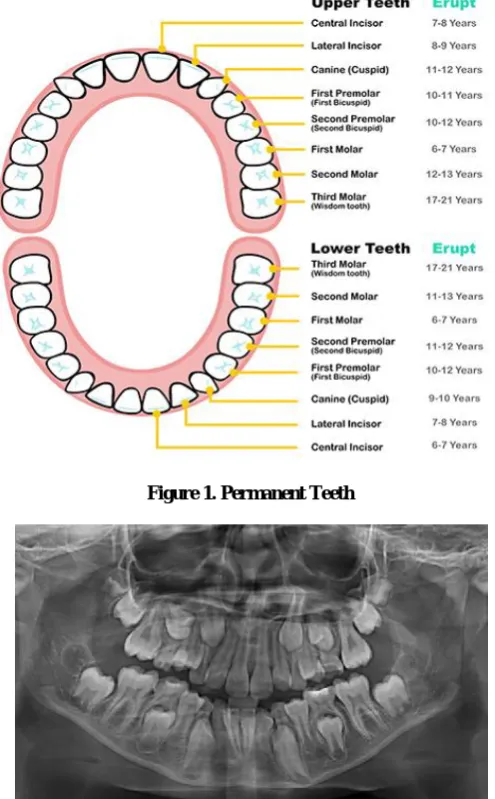
Figure 1. Permanent Teeth
Figure 2. OPG of 9 yrs old child (https://sites.google.com/site/ oralhealthin/ortho-pan-tomogram-opg)
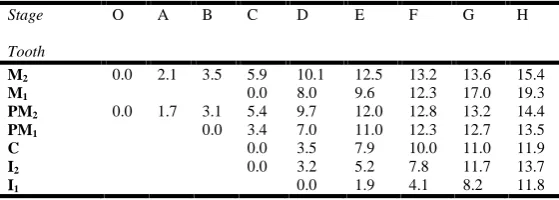
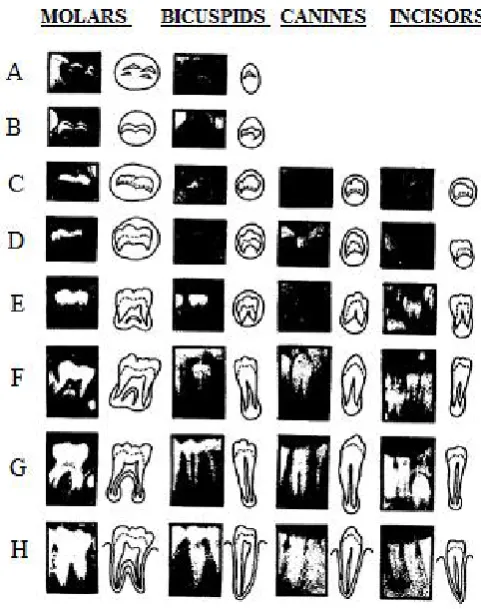
Demirjian method was introduced in 1973 (Demirjian et al., 1973), which gave the development stages of permanent teeth as A to H. All the teeth are rated on a scale of A to H. Each stage is recorded using the table given by Demirjian in Figure 4. Demirjian has taken the Mandibular left side seven teeth and given his weighted scores for boys and girls. Separate self-weighted scores table is given for both girls (TABLE III) and boys (TABLE IV) (Demirjian et al., 1973). Stage O (TABLE III) is not calcified so it is given a score of 0.0.
Figure 3.Nolla’s Stages ofpermanent teeth development
Stage Description
A Cusp tips are calcified B Calcified cusps are united
C Enamel formation is complete, dentin deposition has commenced
D Crown formation is complete to the CEJ
E The walls of the pulp chamber are straight, root length is less than crown height, and also radicular bifurcation is visible
F The root length is equal to or greater than crown height; the apex has a funnel shape
G Walls of the root canal are parallel but apex is partially open
H Apex is completely closed, PDL space is uniform around root apex
Open Apices or Cameriere’s Method
[image:2.595.38.286.199.599.2]Then S is calculated as a sum of X for every tooth with open apex.Cameriere’s Regression formula is
Dental age =9.402–0.879c + 0.663 N0–0.711s–0.106s N0.
Where,
c = Value for boys(c= 1), Value for girls(c=0)
[image:3.595.37.566.88.242.2]N0= Teeth with apical ends of the roots completely closed.
Table 1.Maxillary and Mandibular teeth of girls (Nolla’s)
Age in Years Sum of stages for 7 Mandibular Teeth Sum of stages for 7 Mandibular Teeth Sum of stages for 14 Maxillary and Mandibular Teeth
3 24.6 22.2 46.8
4 32.7 29.6 62.3
5 40.1 37.9 78.0
6 46.6 43.4 90.0
7 52.4 49.5 101.9
8 57.4 54.9 112.3
9 58.4 59.6 118.0
10 64.3 63.4 127.7
11 66.3 64.0 130.3
12 67.9 67.8 135.7
13 68.9 69.2 138.1
14 69.4 69.7 139.1
15 69.8 69.8 139.6
16 70.0 70.0 140.0
[image:3.595.44.563.278.430.2]17 70.0 70.0 140.0
Table 2. Maxillary andMandibular teeth of boys (Nolla’s)
Age in Years Sum of stages for 7 Mandibular Teeth Sum of stages for 7 Mandibular Teeth Sum of stages for 14 Maxillary and Mandibular Teeth
3 22.3 18.9 41.2
4 30.3 26.1 56.4
5 37.1 33.1 70.2
6 43.0 39.6 82.6
7 48.7 45.5 94.2
8 53.7 50.8 104.5
9 57.9 55.5 113.3
10 61.5 59.5 121.0
11 64.0 62.6 126.6
12 66.3 65.3 131.6
13 67.8 67.3 135.1
14 69.0 68.5 137.5
15 69.7 69.3 139.0
16 70.0 70.0 140.0
17 70.0 70.0 140.0
Table 3. Mandibular left side 7 teeth scores for girls (Demirjian)
Stage
Tooth
O A B C D E F G H
M2 0.0 2.7 3.9 6.9 11.1 13.5 14.2 14.5 15.6
M1 0.0 4.5 6.2 9.0 14.0 16.2
PM2 0.0 1.8 3.4 6.5 10.6 12.7 13.5 13.8 14.6
PM1 0.0 3.7 7.5 11.8 13.1 13.4 14.1
C 0.0 3.8 7.3 10.3 11.6 12.4
I2 0.0 3.2 5.6 8.0 12.2 14.2
I1 0.0 2.4 5.1 9.3 12.9
Table 4. Mandibular left side 7 teeth scores for boys (Demirjian)
Stage
Tooth
O A B C D E F G H
M2 0.0 2.1 3.5 5.9 10.1 12.5 13.2 13.6 15.4
M1 0.0 8.0 9.6 12.3 17.0 19.3
PM2 0.0 1.7 3.1 5.4 9.7 12.0 12.8 13.2 14.4
PM1 0.0 3.4 7.0 11.0 12.3 12.7 13.5
C 0.0 3.5 7.9 10.0 11.0 11.9
I2 0.0 3.2 5.2 7.8 11.7 13.7
[image:3.595.158.441.463.564.2] [image:3.595.160.440.595.695.2]s = Sum of A/L ratio for every tooth at open apex.
In the above Figure 4, which is of a male C=1. N0= 3and s= (x1+ x2+ x3+ x4+ x5+ x6+ x7)
x3= A3/ L3(0.41/1.70 = 0.24), x4= A4/ L4(0.43/1.30 = 0.33), X5= A5/ L5(0.76/1.02 = 0.74),X7= A7/ L7(0.82/0.95 = 0.86), s= x3+ x4+ x5+ x7= 0.24 + 0.33 + 0.74 + 0.86 = 2.17
Dental age = 9.402–0.879c + 0.663 N0–0.711s–0.106s N0. = 9.402–0.879 x 1 + 0.663 x 3–0.711 x 2.17–
[image:4.595.45.286.223.528.2]0.106 x 2.17 x 3 = 6.53 + 2.23 = 8.76 years
Figure 4. A to H stages of permanent teeth (Demirjian)
Figure 5.Open apex with marking variables used in Cameriere’s
method
DISCUSSION
There are many techniques that are used to determine the age of an individual. But only mixed dentition assessments give estimations accurate to few months of age. There have been established differences in this assessment based on the sex and ethnic origin of the individuals. The variation based on sex has been accommodated in all the three assessments. Nolla’s method has been used among Mangalore population among 25 children (15 boys and 10 girls) ranging from 3–16 years, and proved to be accurate (Deepthy Thomas et al., 2014). A study done on Lucknow population among 90 children (45 boys and 45 girls) ranging 9 – 12years, results showed insignificant difference between dental age and chronological age (Kiran Sachan et al., 2013). A study on 40 rural free residential school children (20 boys and 20 girls) has given inaccurate results (Nandlal et al., 2014). Demirjian method has been used among Iranian population under the age of 3.5 to 13.5 (Ali Bagherian and Mostafa Sadeghi, 2011). In this study of 519 children (255 girls and 264 boys) to find the dental maturity using orthopantomographs. It was found to be clinically applicable among Iranian population. Among 882 Pakistani children (Rashna H. Sukhia et al., 2012) (455 females and 427 males) under the age of 7 to 14.99 years, and among 535 Southern Turkish children (O Erken Gungor et al., 2015) (276 females and 259 males) under the age of 10 to 18 years concluded that a new table to convert maturity calculated according to Demirjian’s method into dental age is needed for the population because of significant differences between chronological age and dental age.
While 7 teeth are only assessed for the mixed dentition period (ages up to 13yrs.), Demirjian and Nolla’s techniques have a separate table for a eight teeth technique that can be used till 18 years of age A study using Cameriere’s seven teeth method in 15 children (11 girls and 4 boys), indicated that this method was reliable for age estimation (Tapaswini Bagh et al., 2014). In Asian children aged between 5 to 15years (25 boys and 25 girls), it gave close matches with the chronological age (Shrestha et al., 2014). A Malaysian study of multi ethnic Malay(61 boys and 94 girls), Chinese (53 boys and 76 girls), and Indian (62 boys and 75 girls) children insist on reframing the original Cameriere’s formula to suit the population of specific nation (Navaneetha Cugati et al., 2015).
Conclusion
[image:4.595.36.286.560.714.2]REFERENCES
Abrahams JJ., Dental CT imaging: A look at the jaw. Radiology 2001; 5:334-45.
Ali Bagherian and Mostafa Sadeghi. Assessment of dental maturity of children aged 3.5 to 13.5 years using the Demirjian method in Iranian population, Journal of Oral Science, Vol. 53, No. 1, 37-42, 2011
Cameriere R., Ferrante L. and Cingolani M. Age estimation in children by measurement of open apices in teeth. Int J legal Med : 2006:120(1); 49-52.
Deepthy Thomas., Prashanth Shenai., Lakhmikanth Chatra.,Veena K M., Prasanna Kumar Rao. and Rechana Prabhu, Shahin K A. Prathima Shetty. Age Assessment Using Nolla’s Method in a Group of Mangalore Population: A Study on 25 Children. Journal of Contemporary Medicine 2014;4(3): 121-127
Demirjian, A., H. Goldstein and J.M. Tanner, 1973. A new system of dental age assessment. Hum. Biol., 45: 211-227. Dental Age Assessment – Developing Standards for UK
Subjects. Thesis submitted by Susuan Parekh on 2011. Kiran Sachan., V.p.Sharma. and Pradeep Tandon. Reliability of
Nolla’s dental age assessment method for Lucknow population. Journal of Pediatric Dentistry / Jan-Apr 2013 / Vol 1 | Issue 1
Nandlal B., Karthikya Patil., Ravi.S. Estimation of dental age by nolla’s method using orthopantomographs among rural free residential school children. Int J Med Res Health Sci. 2014;3(2):273-277
Navaneetha Cugati., Ramesh Kumaresan., Balamanikanda Srinivasan. and Priyadarshini Karthikeyan. Dental age
estimation of growing children by measurement of open apices: A Malaysian formula, Journal of Forensic Dental Sciences/September–December 2015/vol 7/Issue 3 Nolla, C.M., 1960.The development of the permanent teeth. J.
Dent. Child., 27:254-66.
O Erken Gungor, B Kale, M Celikoglu, AY Gungor, Z Sari. Validity of the Demirjian method for dental age estimation for Southern Turkish children, Nigerian Journal of Clinical Practice• Sep-Oct 2015 • Vol 18 • Issue 5
OPG-Panomaric X-ray from : https://sites.google.com /site/oralhealthin/ortho-pan-tomogram-opg
Panchbhai A S., Dental radiographic indicators, a key to age estimation Dentomaxillofacial Radiology (2011) 40, 199– 212 ’ 2011The British Institute of Radiology
Rashna H.,Sukhia., Mubassar Fida. and Syed Lqbal Azam. Dental age table for sample of Pakistani children. European Journal of Orthodontics 34 (2012) 77-82
Shrestha A., Yadav RP., Shrestha S., Maharjan IK. and Camelio S. Measurement of open apices in teeth for estimation of age in children. Health Renaissance 2014; 12(1):33-37
Stanley J. Nelson, Wheeler's Dental Anatomy, Physiology and Occlusion, Ninth Edition. pg no. - 2
Tapaswini Bagh., Laxmikanth Chatra., Prashanth Shenai., Veena KM., Prasanna Kumar Rao., Rachana V Prabhu., Tashika Kushraj. and Prathima Shetthy. Age Estimation using Cameriere’s Seven Teeth Method with Indian Specific Formula in South Tndian Children. International Journal of Advanced Health Sciences/June2014/vol 1/ Issue 2.