http://wrap.warwick.ac.uk/
Original citation:
Stegle, Oliver, Denby, Katherine J., Cooke, Emma J., Wild, David L., Ghahramani,
Zoubin and Borgwardt, Karsten M.. (2010) A robust bayesian two-sample test for
detecting intervals of differential gene expression in microarray time series. Journal of
Computational Biology , Vol.17 (No.3). pp. 355-367.
Permanent WRAP url:
http://wrap.warwick.ac.uk/60702
Copyright and reuse:
The Warwick Research Archive Portal (WRAP) makes this work of researchers of the
University of Warwick available open access under the following conditions. Copyright ©
and all moral rights to the version of the paper presented here belong to the individual
author(s) and/or other copyright owners. To the extent reasonable and practicable the
material made available in WRAP has been checked for eligibility before being made
available.
Copies of full items can be used for personal research or study, educational, or
not-for-profit purposes without prior permission or charge. Provided that the authors, title and
full bibliographic details are credited, a hyperlink and/or URL is given for the original
metadata page and the content is not changed in any way.
Publishers statement:
This is a copy of an article published in Journal of Computational Biology © 2010. Mary
Ann Liebert, Inc.; Journal of Computational Biology is available online at:
http://online.liebertpub.com
A note on versions:
The version presented in WRAP is the published version or, version of record, and may
be cited as it appears here.
A Robust Bayesian Two-Sample Test
for Detecting Intervals of Differential Gene Expression
in Microarray Time Series
OLIVER STEGLE,1KATHERINE J. DENBY,2EMMA J. COOKE,3DAVID L. WILD,4 ZOUBIN GHAHRAMANI,5and KARSTEN M. BORGWARDT1
ABSTRACT
Understanding the regulatory mechanisms that are responsible for an organism’s response
to environmental change is an important issue in molecular biology. A first and important
step towards this goal is to detect genes whose expression levels are affected by altered
external conditions. A range of methods to test for differential gene expression, both in static
as well as in time-course experiments, have been proposed. While these tests answer the
question
whether
a gene is differentially expressed, they do not explicitly address the question
when
a gene is differentially expressed, although this information may provide insights into
the course and causal structure of regulatory programs. In this article, we propose a
two-sample test for identifying
intervals
of differential gene expression in microarray time series.
Our approach is based on Gaussian process regression, can deal with arbitrary numbers
of replicates, and is robust with respect to outliers. We apply our algorithm to study the
response of
Arabidopsis thaliana
genes to an infection by a fungal pathogen using a
mi-croarray time series dataset covering 30,336 gene probes at 24 observed time points. In
classification experiments, our test compares favorably with existing methods and provides
additional insights into time-dependent differential expression.
Key words:
differential gene expression, Gaussian processes, microarray time series.
1. INTRODUCTION
U
nderstanding regulatory mechanismsthat govern the response to changing external conditions is of great interest in molecular biology. Such changes include environmental influences or treatments that an organism is exposed to, ranging from parasitic infections studied in plant biology to drug responses which are of interest in pharmacogenomics.1
Interdepartmental Bioinformatics Group, Max Planck Institute for Developmental Biology, Max Planck Institute for Biological Cybernetics, Tu¨bingen, Germany.
2
Warwick HRI & Warwick Systems Biology, Wellesbourne, Warks, United Kingdom. 3
MOAC Doctoral Training Centre and4Warwick Systems Biology Centre, University of Warwick, Coventry, United Kingdom.
5
Department of Engineering, University of Cambridge, Cambridge, United Kingdom. Volume 17, Number 3, 2010
#Mary Ann Liebert, Inc. Pp. 355–367
DOI: 10.1089/cmb.2009.0175
A first step towards understanding the mechanisms responsible for a particular response is to identify the set of involved genes. This task can be reduced to a binary decision problem, assessing whether a gene is differentially expressed or not.
In the past, the majority of available datasets contained only a single measurement in each con-dition. Recent advances in microarray technology and falling costs have led to an increasing number of studies where expression levels are measured in different conditions over time rather than in a single snapshot.
A range of techniques to test for differential expression have been proposed in the computational biology and statistics communities. In statistics, this task is often referred to as the two-sample problem. The majority of these existing methods are aimed at identifying differentially expressed genes from static microarray experiments, for example, Kerr et al. (2000), Dudoit et al. (2002), and Efron et al. (2001). Some static tests have been extended to the domain of time series in a naive way. For instance, the ANOVA analysis described in Kerr et al. (2000) has been applied to time series by including time as an experimental factor (Conesa et al., 2006).
In contrast, more recent approaches are specifically designed for time series (Bar-Joseph et al., 2003; Storey et al., 2005; Tai and Speed, 2006; Angelini et al., 2007, 2008), and a range of desired properties of a two-sample test for microarray time series have been established. Firstly, the test should explicitly address the dependencies between consecutive measurements. Particularly for long recordings, it is not appropriate to treat time as a cofactor, for instance within an ANOVA model (Angelini et al., 2007). Secondly, the method should not make overly strong assumptions about functions describing the time series, such as assuming a linear or finite model basis (Yuan, 2006). Thirdly, to accommodate data characteristics specific to the microarray platform, it is beneficial to handle missing values and deal with multiple replicates. Finally, robustness with respect to outliers has proven important for reliable results on microarray datasets (Angelini et al., 2007, 2008).
In this article, we propose a test for differential gene expression based on Gaussian processes (GP), a nonparametric prior over functions. The GP machinery allows appealing properties of existing methods to be combined: it handles multiple replicates, is robust to outliers and employs a flexible model basis. In addition to solving the basic two-sample problem, the presented method can also be used to identify differential behavior in subintervals of the full-time series.
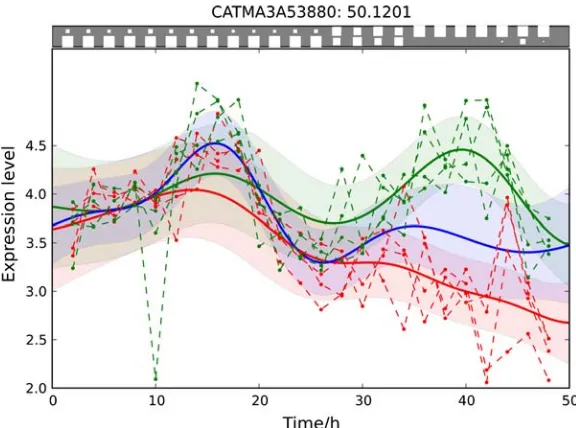
Gaussian processes have been previously applied to model microarray time series, for example, to infer the time dynamics of transcriptional regulatory processes (Lawrence et al., 2007; Gao et al., 2008; Kirk and Stumpf, 2009). In the context of differential expression, Gaussian processes have been used by Yuan (2006). However, the setup in that article differs significantly from what is presented in this work. Both the problem of replicate observations and robustness to outliers have not been addressed in Yuan (2006). The most important difference between the approach presented here and existing methods is the detection of time-dependent differential expression. This feature can be used to understandwhendifferential expression occurs. Such information is valuable in molecular biology, because it provides insights on the temporal order in which genes are activated or inhibited by environmental stimuli. For example, it allows us to study whether there is a delay in response, whether the effect of the treatment is only temporary, or to identify a cascade of genes that trigger each other’s activation during the response. The detection of intervalsof differential expression can be considered the second central step towards uncovering gene regulatory mechanisms, which follows the first step of detecting differentially expressed genes. This key contribution is illustrated in Figure 1 (top), where in addition to a score of differential expression, our test also allows us to pinpoint the intervals in which a gene exhibits differential expression, as indicated by the Hinton diagrams in the top panel.
2. GPTWOSAMPLE: A ROBUST TWO-SAMPLE TEST
FOR TIME SERIES USING GAUSSIAN PROCESSES
Given observed gene expression levels from two biological replicates that are exposed to different conditions, the task is to determine whether a given gene probe is differentially expressed in these con-ditions or not.
The principle underlying the proposed method, GPTwoSample, is a comparison of two models. The first model assumes that the microarray time series in both conditions are samples drawn from an identical
shareddistribution. An alternative model describes the time series in both conditions as samples from two
independentdistributions. As these distributions need to be defined over functions, a Gaussian process is an appealing model. In a GP, all model parameters except for a handful of hyperparameters can be integrated out analytically, allowing for tractable model comparison. The remaining hyperparameters allow beliefs about the time dynamics of microarray time series, such as typical amplitudes and lengthscales, to be incorporated.
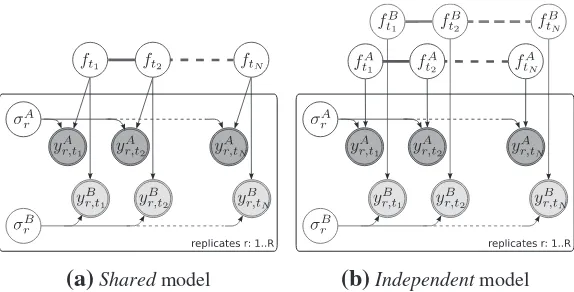
Figure 2 shows a Bayesian network representations for both of these models. Thesharedmodel describes time series observed in two conditions,A andB, by a single latent function f(t). Theindependentmodel assumes two GPs and latent functions (fA(t),fB(t)), one for each condition.
GPTwoSample is an independent test for individual gene probes. We assume that the expression levels for each probe are observed at N discrete time points t¼ ft1,. . .,tNg and in both conditions. These
measurements are repeated forRbiological replicates. To simplify notation, it is convenient to assume that the measurement times in both conditions and for all replicates are synchronized (i.e., share a common time discretization). We will see later that this is not a requirement for the GP machinery, however. The expression matrix for one condition, YA¼ fyA
r,ng, is of dimension RN, and a matrix with the
corre-sponding observation time points is denotedTA¼ ftg. These data for one gene probe in a specific condition are summarized as DA¼ fTA,YAg.
[image:4.612.178.466.67.281.2]The two alternatives, thesharedmodel (S) and theindependentmodel (I), can be objectively compared using the logarithm of the Bayes factor
Score¼logPðDA,DBjHIÞ
PðDA,DBjHSÞ
, (1)
where DA and DB are observed expression levels in conditions A and B. Writing out the GP models
explicitly leads to
Score¼logP Y
AjH
GP,TA)P(YBjHGP,TB
P YA[YBjHGP,TA[TB
: (2)
The union symbol indicates that the shared model effectively treats data in both conditions as a single dataset. In the following, these joint datasets are abbreviated asY¼YA[YBandT¼TA[TB. TheBayes factorhas been previously applied to test for differential expression (Angelini et al., 2007; Yuan, 2006).
2.1. Gaussian process model
A Gaussian process is a non-parametric prior over functions. A comprehensive introduction can be found in Rasmussen and Williams (2006).
Let us first consider thesharedmodel (Fig. 2a), where observations from both conditions are modelled by a single latent functionf(t). Given expression levelsYat time pointsT, the posterior distribution over latent function valuesfis
P(fjY,T,hK,hL)/ N(fj0,KT(hK))
Y
c2fA,Bg
YR
r¼1
YN
n¼1
PL(ycr,tnjftn,hL), (3)
whereN(fj0,KT(hK)) is a zero-mean GP prior with covariance matrixKT(hK) and PL(ycr,tnjftn,hL) is the noise model. The covariance matrix is derived from the covariance functionk(t,t0jhK) evaluated at all pairs
of time points in datasetsDAandDB. These time points can be arbitrary: synchronized observation times are
not required. The chosen covariance function decays exponentially with the squared time distance,
kSE(t,t0)¼A2 exp 12(tt
0)2
L2
n o
, yielding smooth functions with a typical amplitudeA and lengthscaleL.
These kernel hyperparameters are summarised ashK.
Let us first consider Gaussian observation noise. Assuming a separate noise variance for each condition and replicate, it follows from Equation (3)
PðfjY,T,hSÞ / Nðfj0,KTðhKÞÞ
Y
c2fA,Bg
YR
r¼1
YN
n¼1 N ycr,t
njftn, r
c r
Þ2,
(4)
whererc
r is the noise level for all observations in conditioncand replicaterandhS¼ fhK,frcrggdenotes
the set of all hyperparameters.
[image:5.612.146.433.68.214.2](a)
Shared model(b)
Independent modelPredictions at test timest?can be obtained in closed form. Considering the joint distribution overfandf?,
and integrating out function valuesfresults in a Gaussian predictive distribution (Rasmussen and Williams, 2006)fH~N(lH,vH) with
lH¼KH,T(hK)[KT(hK)þR]1y
vH¼KH,H(hK)KH,T[KT(hK)þR]1KT,H(hK), (5)
where Sis a diagonal matrix constructed from noise variancesf(rc r)
2g, depending on the condition and
replicate andyare the observed expression levels rearranged as a vector.
The derivation of the independentmodel (Fig. 2b) follows analogously. The two independent posterior distributions over function values for each condition, fAandfB, are
P(fAjYA,TA,hI)/ N(fAj0,KTA(hK))
YR
r¼1
YN
n¼1 NyAr,t
njf
A tn,
rA
r 2
(6)
P(fBjYB,TB,hI)/ N(fBj0,KTB(hK))
YR
r¼1
YN
n¼1 NyBr,t
njf
B tn,
rBr
2
, (7)
with shared hyperparametershI¼ fhK,frArg,fr B rgg.
2.2. Inference
To compare the alternative models (Equation (1)), we need the probability of the observed data under each model, integrating out parameters. To retain computational tractability, only the latent function values are marginalised out and hyperparameters are set to their most probable values. For instance, for the shared model
P(YjHGP,T)¼
Z
hS
P(YjHGP,T,hS)P(hS)dhS (8)
P(YjHGP,T,^hhS)P(^hhS)D(hS), (9)
where the hyperparametershSare set to maximize the log marginal likelihood subject to a hyper prior
^ h
hS¼argmax hS
flogP(YjHGP,T,hS)þlogP(hS)g: (10)
Similarly, for the independent model:
P(YAjHGP,TA)P(YBjHGPTB)P(YAjHGP,TA,^hhI)·
P(YBjHGP,TB,hh^I)P(^hhI)D(hI) (11)
with
^ h
hI¼argmax hI
fP(YAjHGP,TA,hI)P(YBjHGP,TB,hI)P(hI)g: (12)
Hyperparameters can be chosen to be appropriate for large range of typical microarray time series datasets. The prior probability of the amplitudeAis set toA*G(1, 1), with an expectation value of 1. To ensure that observation noise is not explained by extremely short lengthscales, the prior on the lengthscaleLis set such that the expectation value of the gamma prior corresponds to one fifth of the total length of the time series with a relative standard deviation of 50%. The prior probability of the noise hyperparameters is
rc
r~C(10, 1).
2.3. Robustness with respect to outliers
PL(ycr,tnjf
c
r,tn,hL)¼p0,N(y
c r,tnjf
c r,tn, (r
c r)
2)þ(1
p0)N(ycr,tnjf
c r,tn,r
2
inf), (13)
where p0 represents the probability of the datum being a regular observation and (1p0) of being an
outlier. The variance of the outlier componentr2
infis much larger than for regular observations and hence allows outliers to be discarded. Unfortunately, when using this likelihood model, the posterior in Equation (3) is no longer computable in closed form. To overcome this problem, we use Expectation Propagation (EP) (Minka, 2001), a deterministic approximate inference algorithm. EP approximates the true posterior by a Gaussian process and is efficient enough to allow the algorithm to be applied on large scale datasets. EP for non-Gaussian likelihoods in Gaussian process models is discussed in Rasmussen and Williams (2006); robust Gaussian process regression has been previously applied to biological data in Stegle et al. (2008). The derivation of EP for the robust likelihood and further references can be found in the Appendix.
2.4. Runtime
The computational complexity of a Gaussian process model scales with the third power of the number of training points, resulting in aO((RN)3) scaling forNobservations andRconditions. Since microarray time series datasets are typically small in the sense that they cover at most a few dozens of time points per gene, this cost is not prohibitive. The robust Gaussian process method requires multiple cycles of EP updates which result in a constant factor of additional computation. For the datasets studied below, including 24 time points with 4 replicates, the robust test takes approximately 10 seconds per gene on a standard desktop machine.
2.5. Differential gene expression in
Arabidopsis thaliana
after fungal infection
We applied GPTwoSample to study the plant response to biotic stress on a dataset of microarray time series. Plant stress responses involve a significant degree of transcriptional change, with different stress stimuli activating common signalling components (Fujita et al., 2006).
2.5.1. Dataset.
In this particular experiment, the stress response of interest is an infection of Ara-bidopsis thaliana by the fungal pathogen Botrytis cinerea. The ultimate goal is to elucidate the gene regulatory networks controlling plant defense against this pathogen. Finding differentially expressed genes and intervals of differential gene expression are important steps towards this goal.Data were obtained from an experiment in which detachedArabidopsis leaves were inoculated with a
B. cinereaspore suspension (or mock-inoculated) and harvested every 2 h up to 48 h post-inoculation (i.e., a total of 24 time points).B. cinereaspores (suspended in half-strength grape juice) germinate, penetrate the leaf, and cause expanding necrotic lesions. Mock-inoculated leaves were treated with droplets of half-strength grape juice. At each time point and for both treatments, one leaf was harvested from four plants in identical conditions (i.e., there were 4 biological replicates). Full genome expression profiles were gen-erated from these whole leaves using CATMA arrays (Allemeersch et al., 2005), covering a total of 30,336 gene probes. Data preprocessing and normalization was carried out using a pipeline based on the MAA-NOVA package (Wu et al., 2002). The experimental design is longitudinal in that subsequent time points should show related expression patterns, but also cross-sectional in that at every time point different leaves were harvested. Due to this mixture of a cross-sectional and longitudinal study design, we expect partic-ularly noisy observations and outliers within the replicate time series. This motivates the robust noise model.
2.5.2. Experimental results.
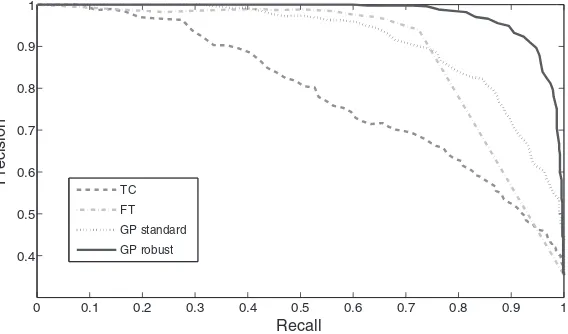
Figure 1 shows an example result of the inference of GPTwoSample for one of the genes in the array. Here the gene probe CATMA3A53880 shows significant differential ex-pression from about 30 h after the fungal infection. One of the replicates (control) shows a strong outlier at 10 h after infection, emphasising the need for a robust noise model.A human expert was asked to annotate 2000 randomly selected probes labeling each as either ‘‘differ-entially expressed,’’ ‘‘not differ‘‘differ-entially expressed,’’ or ‘‘dubious case.’’ After removing the dubious cases, 1890 unambiguously labeled probes remained, out of which 668 were differentially expressed. These probes were used as a gold standard for assessing the accuracy of the compared methods. Figure 3 shows the precision-recall curve for each method. To check the impact of our outlier-robust model, we also computed the precision-recall curve for a variant of GPTwoSample that is not robust to outliers and instead uses a standard Gaussian noise model (GP standard). The precision in our setting is the percentage of truly differential expressed genes among all genes that were deemed differentially expressed by the test. The recall is the percentage of truly differentially expressed genes detected by the test among all truly dif-ferentially expressed genes. By varying the threshold above which the test deems a gene difdif-ferentially expressed, one obtains a precision-recall curve. The area under the precision recall curve (AUPRC) is 1 if one reaches the optimal result of 100% precision and 100% recall, and obviously zero if they are both zero. Hence, a ‘‘perfect’’ test would reach an AUPRC of 1, while a consistently failing test would yield an AUPRC of 0. On this randomly selected set, GPTwoSample with robust noise model (GP robust, AUPRC 0.978) and the simpler non-robust variant (GP standard, AUPRC 0.916) outperformed both benchmark models, F-Test (FT, AUPRC 0.891) and thetimecoursemethod (TC, AUPRC 0.787). The model GP robust achieved an additional improvement over GP standard, showing the merits of a robust noise model.
To further validate the quality of the gene list produced by GPTwoSample, we clustered the 9000 genes considered to be differentially expressed using the SplineCluster method of Heard et al. (2006, 2005). We analyzed the resulting 18 clusters for statistically significantly over-represented Biological Process Gene Ontology (GO) annotations. The probability that this over-representation is not found by chance can be calculated by the use of a hypergeometric test, with a background of the whole genome, as implemented in the Cytoscape plugin BiNGO (Maere et al., 2005). We applied a Bonferroni correction, which gives a conservative (and easily calculated) correction for multiple testing. Figure 4 shows annotations which were significantly over-represented at a Bonferroni-corrected p-value of 0.05. The most common terms are ‘‘response to stress’’ and ‘‘response to abiotic or biotic stimulus,’’ indicating that the clusters derived from GPTwoSample are intuitively meaningful in the context of plant-pathogen interactions.
3. DETECTING INTERVALS OF DIFFERENTIAL GENE EXPRESSION
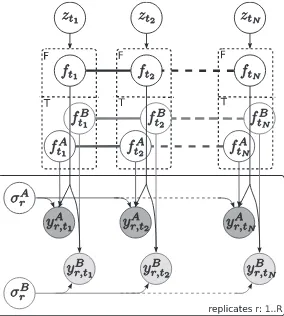
Once we know that a particular gene is differentially expressed, it is interesting to ask in which intervals of the time series this effect is present. To tackle this question, we propose a mixture model, switching between the two hypotheses, corresponding either to thesharedmodel (Fig. 2a) or theindependentmodel (Fig. 2b) as a function of time. Figure 5 shows the Bayesian network representation of this temporal two-sample model. This model is related to mixtures of Gaussian process experts, which have been studied
0 0.1 0.2 0.3 0.4 0.5 0.6 0.7 0.8 0.9 1 0.4
0.5 0.6 0.7 0.8 0.9 1
Recall
Precision
[image:8.612.183.467.528.695.2]TC FT GP standard GP robust
previously (Yuan and Neubauer, 2008; Rasmussen and Ghahramani, 2001). In our setting, we have a fixed number of two experts, where one expert is a single Gaussian process describing both conditions, while the second expert models each condition with a separate process. In order to retain the computational speed required to apply this algorithm on large scale, performing thousands of tests, we use a basic gating network. Binary switchesztnat every observed time point determine which expert describes the expression FIG. 4. Significantly over-represented GO annotations for GPTwoSample gene clusters. Only clusters with significant annotations are shown. Annotations are GOSlim Biological Process terms defined by TAIR (Swarbreck et al., 2007).
FIG. 5. Bayesian network for the temporal GPTwoSamle model. At each observed time pointtn, binary indicator
variablesztn determine whether the observation is explained by the shared Gaussian process expert (f(t)) or the expert
[image:9.612.148.432.346.662.2]level at this particular time point. A priorithe indicator variables are independent Bernoulli distributed,
P(Z)¼QNn¼1Bernoulli(ztnj0:5), assigning both experts equal probability.
The joint probability of both experts and all model parameters, conditioned on the observed data from both conditions, can be written as
P(f,fA,fB,ZjDA,DB,hS,hI)/P(fjhK)P(fAjhK)P(fBjhK)P(Z)·
YR
r¼1
YN
n¼1
N(ftnjy
A r,tn, (r
A r)
2)N(f
tnjy
B r,t, (r
B r)
2)
h i(ztn¼0)
·
N(ftA
njy
A r,tn, (r
A r)
2)N(fB tnjy
B r,t, (r
B r)
2)
h i(ztn¼1)
, (14)
where P(fjhK)P(fAjhK)P(fBjhK) denotes the independent Gaussian process priors on all three processes. Again we simplify the presentation by considering a Gaussian noise model. The full model including the robust likelihood follows analogous to the previous description in Section 2.3.
Inference in this model is achieved using a variational approximation ( Jordan et al., 1999). The joint posterior distribution (Equation (14)) is approximated by a separable distribution of the form Q(f)Q(fA)Q
(fB)QNn¼1Q(ztn). Iterative variational inference updates the approximate posteriors over the latent processes
Q(f),Q(fA),Q(fB) given the current state of Q(Z) and vice versa, until convergence is reached. A varia-tional approximation per se is not suited to perform inference in a mixture of Gaussian process model, due to the coupling of target values induced by the GP priors. However, in this specific application, the approximate posteriors over the indicator variables are sufficiently accurate. Finally, to decide whether a time point is differentially expressed, we use the inferred mixing stateQ(ztn) with a threshold value of 0.5.
3.1. Detecting transition points in the Arabidopsis time series data
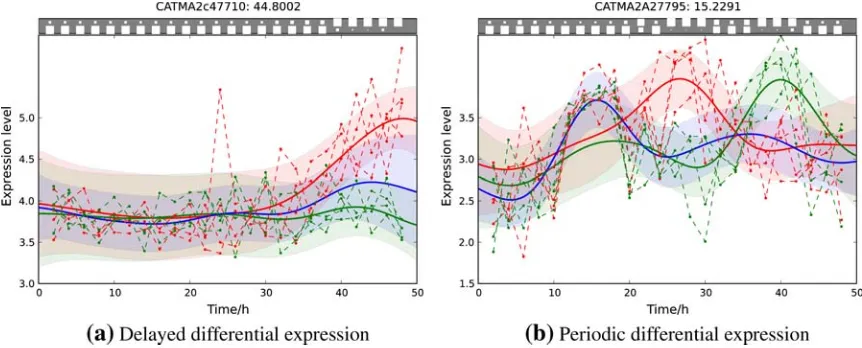
We applied the temporal GPTwoSample model to detect intervals of differential expression of genes from the sameArabidopsistime series dataset as in Section 2.5. Figure 6 shows raw data and the inference results for two selected example genes.
[image:10.612.107.538.490.664.2]3.1.1. Delayed differential expression.
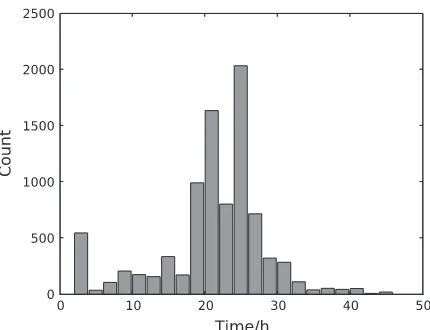
Applying the temporal GPTwoSample test to a larger set of differentially expressed genes, it is possible to study the distribution of their start and stop times of differential expression. For this analysis, we took the top 9000 genes that have a score suggesting significant differential expression. For each gene, the start time of differential expression was determined as the first time point at which the posterior probability of differential expression, Q(ztn¼1), exceeded 0.5. Figure 7 shows the histogram of this start time. Identification of transition points for individual gene expression profiles showsthat a significant change in the transcriptional program begins around 20 h post-inoculation. This program of gene expression change appears to have two waves peaking around 22 and 26 h after inoculation. We expect transcription factors (if regulated by differential expression) to be expressed at earlier time points than the downstream genes whose expression they control. Hence, transcription factor genes whose ex-pression first changes in the 22-h wave (or earlier) would be of particular interest when designing further experiments to elucidate transcriptional networks mediating the defense response againstB. cinerea.
4. CONCLUSION
Detecting differential gene expression and patterns of its temporal dynamics are important first steps towards understanding regulatory programs on a molecular level. In this article, we propose a Gaussian process framework which provides answers to these problems. Our test not only determines which genes are differentially expressed, but also infers subintervals of differential expression over time. The analysis carried out on theArabidopsisexpression datasets demonstrates that this additional knowledge can be used to gain an understanding of pathways and the timing in which, as in this example, the effect of a fungus infection spreads. Source code and additional information about the used dataset will be made available online.
The natural next question to ask is in which manner these genes interact as part of a regulatory program. The algorithmic task is here to infer a network of regulatory interactions from gene expressions mea-surements and prior knowledge. In future work, we will study how the detection of differential expression can be combined with regulatory network inference.
5. APPENDIX
A. Expectation propagation for robust Gaussian process regression
Predictions (Equation (5)) and the log marginal likelihood (Equation (10)) are only available in closed form for a Gaussian likelihood model PL. When using a complicated likelihood function, such as the
mixture model in Equation (13), Expectation Propagation (EP) (Minka, 2001) can be used to obtain a tractable approximation.
In our application, the exact posterior distribution over latent functions f (t) for a given dataset D ¼ ftn,yngNn¼1 is
P(fjD,h)/ N(fj0,KT(hK))
YN
n¼1
PL(ynjfn,hL) (15)
¼ N(fj0,KT(hK))
YN
n¼1
p0,N(ynjfn,r2)þ(1p0),N(ynjfn,r2inf)
[image:11.612.182.397.66.231.2]
,
where again we defineh¼{hK,hL}. The goal of EP is to approximate this exact posterior with a tractable
alternative
Q(fjD,h)/ N(fj0,KT(hK)
YN
n¼1
gn(fn), (16)
wheregn(fn) denote approximate factors. Following Kuss et al. (2005), we choose unnormalized Gaussians as approximate factors
gn(fnjCn,~lln,~n)¼Cnexp
1 2~n
(fn~lln)2
, (17)
which leads to an approximate posterior distribution off(t) that is a Gaussian process again. Evaluated at the training inputs the distribution over function values is a multivariate Gaussian
Q(fjD,hK,hL)/ N(fj0,KT(hK)
YN
n¼1
gn(fnjCn,~n,~n) (18)
¼ N(fj0,KT(hK))N(fj~ll,RR~), (19) where we define~ll¼ f1,. . .,NgandRR~¼diag(f12,. . .,
2
Ng).
The idea of EP is to iteratively update one approximate factor leaving all other factors fixed. This is achieved by minimizing the Kullback–Leibler (KL) divergence, a distance measure for distributions (Kullback and Leibler, 1951). Updates for a single approximate factorican be derived by minimizing
KL N(fj0,KT(hK)
Y
n6¼i
qn(fnjCn,ll~n,~n) ,PL(yijfi,hL)
zfflfflfflfflfflfflffl}|fflfflfflfflfflfflffl{exact factor
N(fj0,KT(hK)
Y
n6¼i
qn(fnjCn,ll~n,~n) ,gi(fijCi,ll~i,~i) |fflfflfflfflfflfflfflfflffl{zfflfflfflfflfflfflfflfflffl}
approximation
(20)
with respect to theith factor’s parametersll~i,~iandCi. This is done by matching the moments between the two arguments of the KL divergence which can then be translated back into an update for factor parameters. It is convenient to work in the natural parameter representation of the distributions where multiplication and division of factors are equivalent to addition and subtraction of the parameters.
There is no convergence guarantee for EP, but in practice it is found to converge for the likelihood model we consider (Kuss et al., 2005). The fact that the mixture of Gaussians likelihood is not log-concave is problematic, as it may cause invalid EP updates, leading to a covariance matrix that is not positive definite. We avoid this problem by damping the updates (Kuss et al., 2005; Seeger, 2005).
After EP converged, we obtain a Gaussian process as approximate posterior distribution again and hence can evaluate a predicted mean and variance as for the Gaussian noise model (Equation (5)).
By capturing the zeroth moment of the exact distribution with the explicit normalization constantCn, we obtain an approximation to the log marginal likelihood
logP(DjhK,hL)¼ln
Z
df,N(fj0,KT(hK))
YN
n¼1
PL(fnjyn,hL)
ln
Z
df,N(fj0,KT(hK))
YN
n¼1
gn(fnjCn,ll~n,~n) (21)
¼1 2
XN
n¼1
( ln~2nþlnCn)
1 2ln
KT(hK)þRR~
1 2~ll
T(K
T(hK)þRR)~ ll~:: (22)
This log marginal likelihood approximation enables us to optimize hyperparameters of the kernelhK, as well
ACKNOWLEDGMENTS
We would like to thank Andrew Mead and Stuart McHattie for data preprocessing. We acknowledge support from the Cambridge Gates Trust (to O.S.), support from the MOAC Doctoral Training Centre at Warwick (to E.C.), grants BBSRC BB=F005806=1 (to K.D. and D.W.), EU Marie Curie IRG 46444 (to D.W.), and NIH GM63208 (to K.B.).
DISCLOSURE STATEMENT
No competing financial interests exist.
REFERENCES
Allemeersch, J., Durinck, S., Vanderhaeghen, R., et al. 2005. Benchmarking the CATMA microarray. A novel tool for Arabidopsistranscriptome analysis.Plant Physiol.137, 588–601.
Angelini, C., De Canditiis, D., Mutarelli, M., et al. 2007. A Bayesian approach to estimation and testing in time-course microarray experiments.Statist. Appl. Genet. Mol. Biol.6.
Angelini, C., Cutillo, L., Canditiis, D.D., et al. 2008. BATS: a Bayesian user-friendly software for analyzing time series microarray experiments.BMC Bioinform.9, 415.
Bar-Joseph, Z., Gerber, G., Simon, I., et al. 2003. Comparing the continuous representation of time-series expression profiles to identify differentially expressed genes.Proc. Natl. Acad. Sci. USA100, 10146–10151.
Conesa, A., Nueda, M.J., Ferrer, A., et al. 2006. maSigPro: a method to identify significantly differential expression profiles in time-course microarray experiments.Bioinformatics22, 1096–1102.
Dudoit, S., Yang, Y.H., Callow, M.J., et al. 2002. Statistical methods for identifying differentially expressed genes in replicated cDNA microarray experiments.Statist. Sin.12, 111–140.
Efron, B., Tibshirani, R., Storey, J.D., et al. 2001. Empirical Bayes analysis of a microarray experiment.J. Am. Statist. Assoc.96, 1151–1160.
Fujita, M., Fujita, Y., Noutoshi, Y., et al. 2006. Crosstalk between abiotic and biotic stress responses: a current view from the points of convergence in the stress signaling networks.Curr. Opin. Plant Biol.9, 436–442.
Gao, P., Honkela, A., Rattray, M., et al. 2008. Gaussian process modelling of latent chemical species: applications to inferring transcription factor activities.Bioinformatics24, i70.
Heard, N., Holmes, C., Stephens, D., et al. 2005. Bayesian coclustering ofAnophelesgene expression time series: study of immune defense response to multiple experimental challenges.Proc. Natl. Acad. Sci. USA102, 16939–16944. Heard, N., Holmes, C., and Stephens, D. 2006. A quantitative study of gene regulation involved in the immune response
of anopheline mosquitoes: an application of Bayesian hierarchical clustering of curves.J. Am. Statist. Assoc.101, 18. Jordan, M., Ghahramani, Z., Jaakkola, T., et al. 1999. An introduction to variational methods for graphical models.
Mach. Learn.37, 183–233.
Kerr, M., Martin, M., and Churchill, G. 2000. Analysis of variance for gene expression microarray data.J. Comput. Biol.7, 819–837.
Kirk, P.D.W., and Stumpf, M.P.H. 2009. Gaussian process regression bootstrapping: exploring the effects of uncer-tainty in time course data.Bioinformatics25, 1300.
Kullback, S., and Leibler, R. 1951. On information and sufficiency.Ann. Math. Statist.22, 79–86.
Kuss, M., Pfingsten, T., Csato, L., et al. 2005. Approximate inference for robust Gaussian process regression [Technical report]. Max Planck Institute for Biological Cybernetics, Tubingen.
Lawrence, N.D., Sanguinetti, G., and Rattray, M. 2007. Modelling transcriptional regulation using Gaussian processes, 785–792. In:Advances in Neural Information Processing Systems 19. MIT Press, Cambridge, MA.
Maere, S., Heymans, K., and Kuiper, M. 2005. BiNGO: a cytoscape plugin to assess overrepresentation of gene ontology categories in biological networks.Bioinformatics21, 3448–3449.
Minka, T. 2001. Expectation propagation for approximate Bayesian inference, 362–369. In:Uncertainty in Artificial Intelligence,Volume 17.
Rasmussen, C.E., and Ghahramani, Z. 2001. Infinite mixtures of Gaussian process experts, 881–888. In:Advances in Neural Information Processing Systems 19, MIT Press, Cambridge, MA.
Rasmussen, C.E., and Williams, C.K.I. 2006.Gaussian Processes for Machine Learning. MIT Press, Cambridge, MA. Seeger, M. 2005. Expectation propagation for exponential families [Technical report]. University of California at
Berkeley. Available at: www.kyb.tuebingen.mpg.de=bs=people=seeger. Accessed December 20, 2009.
Storey, J.D., Xiao, W., Leek, J.T., et al. 2005. Significance analysis of time course microarray experiments.Proc. Natl. Acad. Sci. USA102, 12837–12842.
Swarbreck, D., Wilks, C., Lamesch, P., et al. 2007. The Arabidopsis Information Resource (TAIR): gene structure and function annotation.Nucleic Acids Res.1009–1014.
Tai, Y.C., and Speed, T.P. 2006. A multivariate empirical Bayes statistic for replicated microarray time course data. Ann. Statist.34, 2387–2412.
Wu, H., Kerr, M., Cui, X., et al. 2002. MAANOVA: a software package for the analysis of spotted cDNA microarray experiments, 313–341. In:The Analysis of Gene Expression Data: Methods and Software.
Yuan, C., and Neubauer, C. 2008. Variational mixture of Gaussian process experts. In:Advances in Neural Information Processing Systems 19. MIT Press, Cambridge, MA.
Yuan, M. 2006. Flexible temporal expression profile modelling using the Gaussian process.Comput. Statist. Data Anal. 51, 1754–1764.
Address correspondence to:
Dr. Oliver Stegle Interdepartmental Bioinformatics Group Max Planck Institute for Developmental Biology Max Planck Institute for Biological Cybernetics Spemannstr. 38 72076 Tu¨bingen, Germany