INTERNATIONAL
COUNCIL FOR
SCIENCE
INTERGOVERNMENTAL
OCEANOGRAPHIC
COMMISSION
WORLD
METEOROLOGICAL
ORGANIZATION
WORLD CLIMATE RESEARCH PROGRAMME
REPORT OF THE SECOND MEETING OF THE CLIVAR PACIFIC PANEL
Yokohama, Japan 14 – 16 July 2003
November 2003
WCRP Informal Report No. 18/2003
CLIVAR is a component of the World Climate Research Programme (WCRP), which was established
by WMO and ICSU, and is carried out in association with IOC and SCOR. The scientific planning
and development of CLIVAR is under the guidance of the JSC Scientific Steering Group for CLIVAR
assisted by the CLIVAR International Project Office. The Joint Scientific Committee (JSC) is the
main body of WMO-ICSU-IOC formulating overall WCRP scientific concepts.
Bibliographic Citation
CONTENTS
Action Items
1
1. Introduction 2
2. Opening Session 3
3. Review of Panel relevant activities and developments 3
3.1. Last meeting’s action items 3
3.2. Relevant decisions made at SSG-12 4 4. Pacific Science 1 – Pacific Decadal Variability 4 4.1. The Ocean component of Coupled models 4
4.1.1. The status of WGOMD and OMIP experiment
5
4.2. The Ocean Observing System
5
4.2.1. The status of Argo 6
4.3. Missing Physics 7
5. Ocean State Estimation 8
5.1. The ECCO Consortium 8
5.2. Coupled data assimilation on the Earth Simulator 8
5.3. Discussion 10
6. Process Studies 10
6.1. Existing and planned process studies 10 6.2. Additional process studies for consideration 11 6.2.1. Eastern Mid Latitude Bifurcations 11 6.2.2. Low Latitude Western Boundary Currents 12 6.2.3. Marginal Seas and regional studies 13
7. Ocean Carbon 14
8. Pacific Science 2: ENSO and Decadal Modulation 16 8.1. WGSIP and its links with the Pacific Panel 16 8.2. Relationship between operational centres and CLIVAR Pacific 17
9. Data issues relating to the Panel 18
9.1. APDRC aims and resources for the Pacific Panel 18 9.2. An assessment of the CLIVAR data pages 19 9.3. An assessment of usefulness of the APDRC Website 19 10. Pacific Prospectus and Publicity material 19
11. CLIVAR Conference 19
12. Relationship with other panels. 20
13. Relationship with other programs 20
14. Panel membership 20
15. Dates and locaton of next meeting 20
APPENDICES
I. Agenda 22
II. Data Report 24
ACTION ITEMS
1. Remind Panel to provide information and check pages at regular intervals. (Hill, Panel)
2. Compile a list of diagnostics that the Pacific Panel would like to see in OMIP and request their inclusion through WGOMD. (Deadline End August?) (Balmaseda, Power, Cai; Richards to communicate with WGOMD)
3. Proposal for model comparison on low frequency behaviour of Ocean component (OMIP with variable forcing) to be presented to WGOMD (Chair be Sept, then at WG meeting in March. This will need to take into account what is already there in OMIP. (Richards).
4. Discuss joint statement on OSSE’s at next WGSIP meeting (Richards, Power).
5. Write a proposal to compare existing ocean analyses using a common suite of diagnostics. (Balmaseda) 6. Consider the planning of a LLWBC experiment and determine the way forward (possibly via a local
workshop). (Kuroda, Hacker, Kessler)
7. Provide information on Marginal Seas activities and workshops on the CLIVAR Pacific website. (Varlamov, Hill)
8. Review Carbon Hydro pages and provide updates to the ICPO (Hill) as appropriate. (Panel Members) 9. Ensure that carbon activities and requirements are considered when planning experiments and process
studies for CLIVAR Pacific and vice versa (Lee to act as liaison between Panel and Carbon groups). 10. Those attending the Low Frequency ENSO workshop in Toulouse in September to report back to panel
(Power, Kessler, Hill)
11. Consensus on high priority areas to be addressed at the next WGSIP meeting, November 2003 (Richards, Power)
12. Operational groups need to be aware of data sources – The Panel to provide ICPO info on datasets for model validation to be posted on website. (Panel members)
13. Develop a strawman proposal to take to WGSIP focussing on the deficiencies of models of the equatorial Pacific used for prediction and climate studies. Proposal to be centred on improving the representation of mixing processes in ocean models, with a specific suggestion for a workshop on process studies for improving mixing parameterisation. (Kessler, Balmaseda, Power, Richards)
14. Provide updates to the CLIVAR Global Data Page and Pacific Observations Page to ICPO (Panel members)
15. Cai to act as a contact (for panel and community) from Pacific Website for users of APDRC for feedback on usefulness of the site.
16. Panel to direct data concerns (of panel and community) through Cai. (Panel members Cai to report to Panel)
17. Write an overview of Pacific activities for the CLIVAR Brochure and distribute to panel for comment. (Hill).
18. Chair to liaise with ICPO as to what is required respect to the review of Panel accomplishments and assessment of the PRAs. (Richards)
19. Report to panel on progress in planning of joint PICES/CLIVAR workshop (Richards)
1. INTRODUCTION
The CLIVAR Pacific Implementation Panel is part of the CLIVAR project. The CLIVAR Principle Research Areas (PRA’s) of specific relevance to the panel are:
G1- ENSO – extending and improving predictions of ENSO by advancing our understanding and observation of climate variability associated with ENSO and related global teleconnections.
D4 – Pacific and Indian Ocean Decadal Variability – improving the description and understanding of the decadal variability and its predictability in the Pacific and Indian Ocean basins (and its relationship with ENSO The Panel’s terms of reference are:
1. To oversee and facilitate the implementation of CLIVAR in the Pacific sector in order to meet the objectives outlined in the Science and Initial Implementation Plans particularly with respect to:
• Expanding and Improving ENSO predictions
• Variability and predictability of the Asian-Australian Monsoon system • Indo-Pacific Decadal Variability And also on Pacific impacts on: • Variability and predictability of the American Monsoon system • Southern Ocean Climate variability
• Climate change prediction/detection and attribution
2. To develop broadscale atmospheric sampling plans and processes studies to complement the oceanic observations planned for the Pacific and as an integral component of the strategy to improve atmospheric and coupled models. To work with agencies and nations to sustain broadscale atmospheric sampling in the Pacific.
3. To coordinate the activities of the Pacific nations, facilitating cooperative efforts and coordinating work within the boundaries of the various nations as well as outside those boundaries. To provide a forum for exchange and discussion of national plans in the Pacific.
4. To organize and conduct workshops that will entrain oceanographers, atmospheric scientists, and other investigators from the Pacific nations, that will lead to formulation of plans for broadscale sampling and for sampling locations of high interest (such as boundary currents), and will coordinate not only the field activities but also the modelling, empirical, and paleo studies in the Pacific.
5. To collaborate with WCRP WG on Coupled Modelling, the CLIVAR WG on Seasonal-Interannual Prediction and the WG on Ocean Model Development in order to design appropriate numerical experiments. To be aware of the requirements of these groups for data sets needed to validate models.
6. To liaise with the Ocean Observation Panel for Climate (OOPC), with the Joint Commission for Oceanography and Marine Meteorology (JCOMM), with the Atmospheric Observations Panel for Climate (AOPC), and other relevant groups to ensure that CLIVAR benefits from and contributes to observations in GOOS and GCOS
7. To advise the CLIVAR SSG of progress and obstacles toward successful implementation of CLIVAR in the Pacific.
The members of the CLIVAR Pacific Implementation Panel are: K. Richards (Chair) IPRC, U. Hawaii, Honolulu, USA M. Balmaseda ECMWF, Reading, UK.
W. Cai CSIRO, Division of Atmospheric Research, Aspendale, Australia T. Delcroix IRD/LEGOS, Toulouse, France
H. Freeland IOS, Sidney, Canada
M. Fukasawa JAMSTEC, Yokosuka, Japan
W. Kessler NOAA Pacific Marine Environmental Laboratory, Seattle, USA O. Pizarro Univ. of Concepción, Concepción, Chile
P. Sutton NIWA, Wellington, New Zealand S. Varlamov Kyushu University, Fukuoka, Japan R. Weller WHOI, Woods Hole, USA
Ex Officio:
M. McPhaden NOAA/PMEL, Seattle, USA (TIP)
I-S. Kang Seoul National University, Seoul, Korea (WGSIP) ICPO Representative:
K. Hill CLIVAR IPO, Southampton Oceanography Centre, UK 2. OPENING SESSION
The second session of the Pacific Implementation Panel was opened with an introduction by Dr Kelvin Richards, and a welcome by the local host, Dr Masao Fukasawa from JAMSTEC Yokosuka who gave an outline of local arrangements.
Kelvin Richards opened the meeting by welcoming the Panel members, invited speakers and local participants (see appendix III). Apologies were received from Drs Delcroix, Zhang, Sutton, Weller, Kang and McPhaden. The panel welcomed Dr Magdalena Balmaseda as a new full panel member, and Katy Hill as the new staffer for the Pacific Panel. Katy took her position at the ICPO in November 2002. The participants were reminded that the focus of the meeting would be Pacific Decadal Variability (PDV).
Howard Cattle gave an overview of the International CLIVAR project office recent activities and developments, as well as relevant WCRP activities. In particular, the upcoming CLIVAR Science Conference was highlighted (www.clivar2004.org). Panel members were encouraged to participate, and advertise the conference in their respective circles.
3. REVIEW OF PANEL RELEVANT ACTIVITIES AND DEVELOPMENTS
3.1. Last meeting’s action items
Kelvin Richards reviewed the action items from the last meeting in Hawaii, February 2001. Guidance for the Pacific Panel has wavered since the first panel meeting, due to the panel chair’s relocation from Southampton to Hawaii, and a 6-month hiatus between ICPO Pacific staffers. This meant that limited progress was made on a number of the action items. The following action items require further attention:
1. Increase the panel membership so that it has expertise in atmospheric and satellite observations (ICPO and Chair). Panel membership still needs to be strengthened in a number of areas. In particular, atmospheric expertise would be highly favourable.
2. The international CLIVAR Pacific Panel to look to adopt an implementation strategy closely aligned to PBECS (Panel members). The panel discussed adopting PBECS further during this meeting (see section 6).
4. Discuss with SSG establishing an intergovernmental resource board (ICPO and Chair). The establishment of Intergovernmental Resource Boards was not encouraged by the WCRP as they have considerable resource implications. The Panel could go the route of informal committees for specific aims, i.e. enhancing the moored buoy network.
10. Identify CLIVAR relevant datasets (Cai, ICPO)
11. To review and enlarge contents of SPRINT (ICPO). Pacific data requirements were reviewed further during this meeting (see section 9)
14. Explore ways of making information on models readily available (ICPO). The panel agreed that a formal rout should be established, and asked if the ICPO could explore this.
16. Identify Pacific related issues relating to PAGES and GEWEX (Delcroix, ICPO and Chair). These links are yet to be explored.
17. To send comments for the improvement of the website and to provide updated information on the ongoing and planned CLIVAR related observations in the Pacific to the ICPO (Panel Members). It is important to keep the website up to date as it is an important way of publicising Panel activities, as well as increasing exposure of regional projects.
18. To investigate the possibility of producing a Pacific panel brochure, format and funding with ICPO and CLIVAR SSG (ICPO). In light of the upcoming CLIVAR conference, panel publicity material was one of the discussion items during this meeting (see section 10).
2.2. Relevant decisions made at CLIVAR SSG-12 5.3. Ocean Carbon
23. Accept Maria Hood’s (IOC) proposal to populate the CLIVAR basin panels with Carbon Representatives and work with ICPO on website. In response to this, Dr Kitack Lee was invited to the meeting to represent the carbon community.
6.8. Pacific
27. Recommend that Pacific Panel and WGSIP interact more closely, in particular to address El Niño issues. In response to this, Dr Scott Power from WGSIP was in attendance at the meeting.
7.2. WGOMD
38. Ask WGOMD to investigate the response of ocean models to forcing variations on interannual to decadal timescales. The Pacific Panel can make a strong input here, considering the strong decadal scale focus in its terms of reference. This was discussed under Pacific Science 1 on the agenda (Section 4.1).
9.1. Post Conference/New directions for CLIVAR
53. Organise self-assessment of CLIVAR along PRA lines. This will take place prior to and during the next SSG meeting, which will take place immediately after the CLIVAR conference. This means that the Pacific Panel needs to be prepared well in advance of June 2004.
55. All CLIVAR Panels to prepare summary what they have accomplished compared to what they set out to do, and what they think they can achieve by a sunset date of 2013. This also needs to be completed well in advance of June 2004 (see section 11).
4. PACIFIC SCIENCE 1 – PACIFIC DECADAL VARIABILITY
Kelvin Richards gave an introduction to research into Pacific Decadal Variability, emphasising it was an issue of predictability, as well as description and understanding. Kelvin also emphasised that the impacts of PDV also need to be addressed.
A white paper on Pacific Decadal Variability has been produced by Sarachik and Vincent (www.usclivar.org/ Meeting_Files/PDV_whitepaper1.pdf). This paper is a good summary of where we are to date in relation to identifying the properties of PDV and the mechanisms involved.
Kelvin Richards outlined a number of issues for the Panel’s consideration:
1) Ocean component of coupled models – the dependency of results on model configuration 2) Analysis is usually done using EOF’s that only account for a fraction of the decadal signal. 3) Biases in coupled models – in the tropics, the venerable too cold cold tongue and double ITCZ.
4) Missing physics (i.e. Interleaving, interaction between atmospheric boundary layer and tropical instability waves).
5) Ocean Observing system – is the present system sufficient to answer the question, what is controlling what?
In addition, some modelling issues were highlighted; in particular, the need to consolidate runs and analyses (coupled and ocean and atmosphere only) in terms of model behaviour and controls on decadal variation of SST, ventilation characteristics and the source of equatorial thermocline waters.
4.1. The Ocean Component of Coupled models
The end point of the discussion highlighted the need for an ocean model comparison focusing on low frequency behaviour. This issue was also highlighted at SSG-12 (action item 38). We are unaware, in most instances, of the impact on decadal variability of the many choices that are made in model configurations (resolution, sub-grid scale mixing, etc). The Panel agreed this is something that needs to be addressed (see Action 3 below). 4.1.1. The status of WGOMD and OMIP Experiment.
Dr Hiroyasu Hasumi, who attended the meeting as the representative of the Working Group on Ocean Model Development (WGOMD), summarised the current status of WGOMD activities. In particular, he provided an overview of the Ocean Model Intercomparison Project (OMIP). The focus of OMIP is the long-term mean state of the ocean and stability. The Atlantic thermohaline circulation has specific focus. OMIP uses a climatological surface forcing based on the ECMWF reanalysis data. Each model has a 100-year integration time, and the last 10 years are analysed. WGOMD are holding a workshop in March 2004 to discuss the results of 5 explicit OMIP projects.
The Pacific panel noted that there is currently no explicit Pacific focus to OMIP. The Atlantic panel met alongside WGOMD in April of this year so Atlantic requirements have been included in OMIP. It was agreed that if the Panel wanted to influence this project, then input should be provided now. The Panel identified a number of important diagnostics These included:
1. The equatorial thermocline structure: can the models create the amplitude of ENSO and the upwelling structure?
2. Size of the restoring terms: how close together are the models?
3. Eastern boundary: can they recreate the upwelling structure off of South America? 4. How well does the model Indonesian Throughflow compare with observations?
Scott Power suggested that a set of recommended diagnostics should be presented to WGOMD by the panel for their consideration.
2. ACTION: Compile a list of diagnostics that the Pacific Panel would like to see in OMIP and request their inclusion through WGOMD. (Deadline: End August) (Balmaseda, Power, Cai; Richards to communicate with WGOMD)
Consistent with the SSG’s view it was felt that WGOMD should address low frequency decadal scale forcing in Ocean Models. WGOMD and the Panel should liaise on what is important. This could form a possible second set of experiments
3. ACTION: Proposal for model comparison on low frequency behaviour of Ocean component (OMIP with variable forcing) to be presented to WGOMD (to WGOMD chair by Sept, then at WGOMD meeting in March). This will need to take account of what is already there in CMIP, OMIP. (Richards)
4.2. The Ocean Observing System
There was also much discussion on the usefulness of Observing System Simulation Experiments (OSSE’s). They might help to reinforce the usefulness of certain observations and possibly help to identify additional measurements and areas lacking observations.
Ultimately, it was decided that OSSE’s were not a high priority for the Panel at present. However, it was thought that CLIVAR should establish a clear position on the topic. It was proposed to initiate this via a discussion with WGSIP.
4. ACTION: Discuss joint statement on OSSE’s at next WGSIP meeting (Richards, Power).
4.2.1. The status of Argo
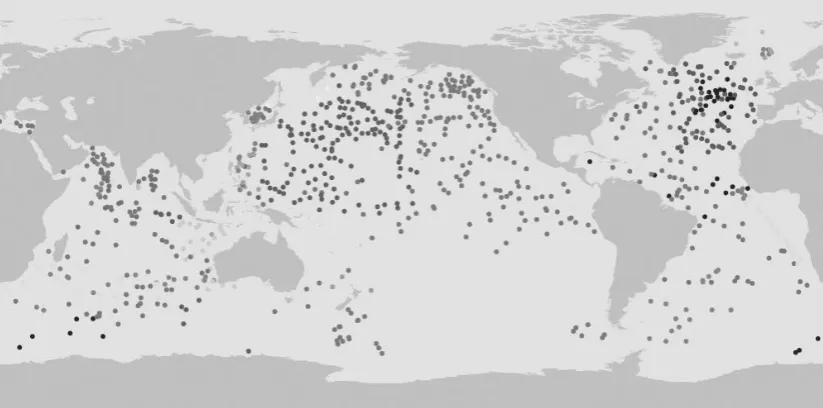
[image:10.595.92.504.213.417.2]Howard Freeland presented the current status of Argo deployment. At the time of the CLIVAR Pacific Panel meeting there were 825 Argo floats in the ocean, of which the majority are in the Pacific Ocean. Fifteen countries are now deploying floats in support of Argo and the distribution in the ocean and colour coded by float-providing nation is as shown in Figure 1..
Figure 1: Float locations in March 2003 colour coded by the supplying nation.
There remain some significant deployment gaps in the northern hemisphere, but the large challenge that awaits the Argo Team is the completion of the array to design density in the southern hemisphere. APEX floats, made by Webb Research Corporation, have been certified for air-launch and this now appears to be a highly successful deployment method.
In the early years of Argo, floats were generally of three species, APEX and PROVOR (made commercially in the USA and France, respectively) and SOLO floats made at US academic institutions. This is changing rapidly as PROVOR floats are now made in Canada, and two new floats designs, COPEX from China and NINJA from Japan are being deployed in steadily increasing numbers.
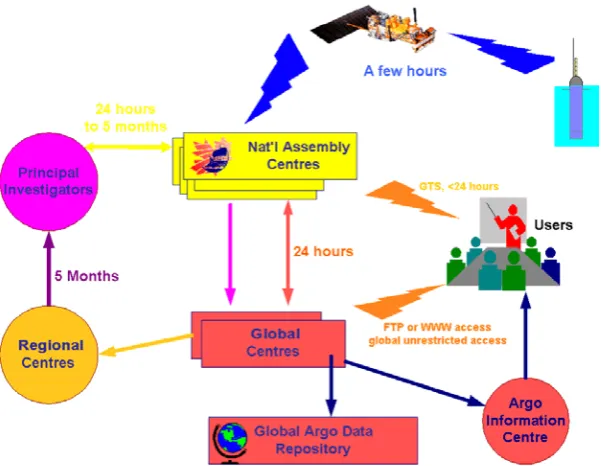
Figure 2: The Argo data system.
Perhaps the greatest achievement of the Argo concept is the creation of a single data paradigm that is being followed by all member countries. This is illustrated in figure 2. In the vast majority of cases Argo data are available in near real time on the World Wide Web and are available to anyone. Tools to ease access to Argo data are being developed. Some challenges remain in the data system, we have not yet established the global archive, and though we have established protocols for delayed-mode quality assurance, the delayed mode data are not yet routinely available. However, all nations are sharing data gathered by their floats quickly, efficiently and without constraints on use.
Most countries active in Argo have established their own Newsletters and information sheets. The Argo Program Office has been established and this has just started releasing a quarterly report. Further information can be found at the home page for the International Argo Science Team: http://www.argo.ucsd.edu/
The panel noted the sparsity of Argo floats in the South Pacific and fully endorses efforts to populate this area. In particular, there is a need to engage South American scientists both in deployment of floats and utilizing data. There is no shortage of technical expertise and ships; it is an issue of lack of funds to purchase floats. CLIVAR can work with Argo to promote Argo in South America, and promote the collaboration of groups with funds to buy floats, with those with the means to deploy them.
4.3. Missing Physics
Kelvin Richards highlighted a number of questions that require focus in terms of representation of physics in models. In particular, what mechanisms can be used to determine what physics is missing from models? Can we determine this from the models themselves? And what is the role of observations in determining solutions? Representativeness as well as accuracy is of importance, i.e. physics in terms of the resolution of the model resolution.
There is no question that models can get the right answer for the wrong reasons. Do we have sufficient observations to know if we are doing something wrong? i.e. does the temperature drift without a diurnal cycle? How does the biology in the surface layers affect heat absorption? In addition, unassimilated variables such as salinity and velocity have impacts.
In addition, correctly capture variability in the system is a major challenge for coupled models. In particular, coupled models in the main produce an ENSO too frequently. The Coupled Model Intercomparison Experiment (CMIP) is run by the WCRP Working Group on Coupled models (WGCM). It is designed to compare the performance of coupled models in terms of their ability to model our climate system: Kelvin posed the question, do they represent PDO at all? He felt that they should be analysed in terms of variability the variability that they show. What is wrong and what is missing?
Aspects of the Panel’s consideration of these will be found in section 8. 5. OCEAN STATE ESTIMATION.
5.1 The ECCO Consortium
Dr Ichiro Fukomori from JPL gave a presentation on the ECCO routine global ocean data assimilation system. The consortium “Estimating the Circulation and Climate of the Ocean” (ECCO; http://www.ecco-group.org) aims to advance ocean data assimilation into an operational tool for studying ocean circulation. To this end, the consortium employs advanced data assimilation methods (Kalman filter and smoother, adjoint, and Green’s function) to integrate as many observations as possible into a state-of-the-art ocean general circulation model (MITgcm; Marshall et al., 1997).
One of ECCO’s products is a near real-time analysis of global ocean circulation (80S~80N) that is being produced on a routine basis since October 2002 (http://ecco.jpl.nasa.gov/external). Analyses are available for general applications from January 1993 to present. These estimates are updated regularly every 10-days from assimilating sea level measurements from satellite altimetry (Jason-1, TOPEX/Poseidon) and temperature profiles available on GTS (courtesy D.Behringer, NCEP). The products are being employed in various studies to understand the nature of seasonal-to-interannual changes of ocean circulation and their effects in climate, biogeochemical cycles, and geodesy.
ECCO assimilation is characterized by the physical consistency of its estimates’ temporal evolution. Temporal evolution of other typical data assimilated estimates cannot be physically accounted for. For instance, mass and tracer budgets (temperature, salt, etc) cannot be closed in a physically consistent manner. The problem stems from data increments in such estimates not being ascribed to explicit physical processes. The smoothers employed in ECCO invert such increments in terms of explicit errors in the model physics, resulting in a consistent evolution of the oceanic state that allows budgets to be closed. Such consistency is important in help identifying processes that control the ocean’s evolution.
The model’s adjoint that is employed by ECCO is also useful in examining the sensitivity of the model to various model controls. In particular, the adjoint of a passive tracer can be identified as describing the origin of the tracer-tagged water mass, whereas a passive tracer can be understood as illustrating the fate of the water mass. Simulated passive tracers and their adjoint provide a powerful means to quantify the pathway of ocean circulation. An application of such tracers, using the ECCO estimates to water occupying the so-called “Nino3” region, shows that the interior pathway of the equatorward branch of the Subtropical Cell (STC; McCreary and Lu, 1994) is significantly enhanced by intra-seasonal variability such as tropical instability waves. Such variability stirs water meridionally, thereby short-circuiting the otherwise circuitous pathway of the subtropical-tropical exchange.
The tracers also illustrate that the STC is not a closed circulation cell as is suggested by a Eulerian mean of the circulation but is an open-circuit. The origin of “Nino3 water” is largely found to be thermocline waters in the eastern subtropics and subpolar regions of the North and South Pacific Oceans. In contrast, the water mass’s destination is water above the thermocline in the subtropical gyres of the North and South Pacific and the Indian Ocean.
5.2 Coupled data assimilation on the Earth Simulator
coupled data assimilation (CDA) system capable of providing a high-quality comprehensive dataset. This is stimulated by recent remarkable progress in the earth observing system and numerical models. Though observations are still sparse in time and space, their synthesis, using state-of-the-art general circulation models (GCMs), has the ability to produce a 4-dimensional (4D) reanalysis dataset. Such datasets are required for the enhancement of seasonal to interannual (S-I) forecast skill and for the better description of the dynamical state of climate change.
The program consists of 5 themes:
1. Development of data assembly systems and quality control through an efficient international data network.
2. Improvement of a high-resolution climate GCM on the Earth Simulator (ES).
3. Construction of a 4D-VAR CDA system on ES and its application to the state estimation of climatological seasonal variations and to ENSO events of the 1990’s.
4. Development of nested coupled GCMs using a cloud-resolving non-hydrostatic AGCM and an eddy-resolving non-hydrostatic OGCM.
5. Development of a functional product server system using DODS/LAS/CAS/EPIC.
The program started in 2002, to run for 5 years. The main target in Theme (1), for which the IPRC of University of Hawaii is responsible, is directed to data access and management to enable the construction of an integrated observational database through the international data network. In 2002, many important datasets were archived. It was found that the BUFR dataset from NCEP/NCAR is the most suitable input data for the 4D-VAR CDA experiment. The ERA-40 of ECMWF is used for the assessment of experimental results. In addition, a very high resolution SST dataset (10km cloud-free and global) has been constructed as well as a dataset of air-sea fluxes in the Pacific.
The ES Center and the FRSGC have markedly improved the high-resolution CGCM climate dynamics and its performance on the earth simulator in terms of computational speed. In particular, observed meso-scale features are well simulated in both atmosphere and ocean.
Based on this CGCM, a 4D-VAR CDA system has been constructed. Though full CDA experiments will be initiated from this autumn, the oceanic component of the 4D-VAR CDA system was applied to the state estimation of the global ocean circulation, whereas the atmospheric component using a dry model version was applied to a sensitivity experiment. A synthesis of available observational records and the model provided realistic oceanic circulation features with no artificial sources/sinks for temperature and salinity fields, in contrast to the nudging approach often used. This new dataset enables us to identify the water mass formation and movement as well as the surface conditions to be quantified. For example, a water mass analysis of the North Pacific Intermediate Water (NPIW) that characterizes the subsurface region in the North Pacific has been made. A sensitivity experiment using the adjoint model revealed that the origin of the NPIW could be traced back to the Sea of Okhotsk and to the Bering Sea in the subarctic region and to the subtropical Kuroshio region further south. This is in good agreement with recent observational findings.
A reanalysis experiment for the 1990s, showed results which had important implications for the so called phase-locked process of the El Niño onset in the western equatorial Pacific, but clarification of the detailed mechanism is left for future work.
An experiment using the atmospheric adjoint model to examine sensitivity to velocity fluctuations input in the upper equatorial troposphere revealed that the signal of the fluctuations can be traced back to the Asian continent, in good agreement with observations. These aspects of the 4D-VAR DA system underline its usefulness for the state estimation of climate change and for seasonal to interannual prediction.
The non-hydrostatic AGCM and OGCM simulates well the evolution of cumulus convection processes in the tropical atmosphere and eddy transport processes in the Kuril Straits, respectively, providing some confidence in more accurate forecasting of atmosphere and ocean.
by AESTO and IPRC. In particular, the Live Access Server (LAS), which is a highly configurable Web server designed to provide flexible access to geo-referenced scientific data, allows us to utilize distributed datasets as a unified virtual data base through the DODS networking. It is anticipated that this server system will work as a very useful basic tool in our data assimilation system.
5.3 Discussion
The Panel sees great merit in ocean state estimation, but there are problems in comparing and contrasting different products. The panel therefore decided to promote a comparison of existing ocean analyses using a common suite of diagnostics. The diagnostics should include information about the assimilation increments. The basic procedure would be to liaise with international projects such as ENACT and ODASI to carry out the comparison. Specific questions to answer are:
•
How is the seasonal cycle, intraseasonal, interannual, and decadal variability of the Pacific Ocean represented by the analysis?•
What is the uncertainty in such representation?•
What additional information does the data assimilation provide?5. ACTION: Write a proposal to compare existing ocean analyses using a common suite of diagnostics. (Balmaseda)
6. PROCESS STUDIES
Kelvin Richards outlined the US Pacific Basin Extended Climate Study (PBECS) ethos which is to provide sustained observations on the broadscale, through systems such as Argo, Repeat Hydrographic sections and TAO, etc, to provide the context for a number of process studies that are focussed on features and processes that are poorly resolved or modelled.
6.1. Existing and planned process studies
In reviewing existing or planned process studies the panel noted that the US PBECS report identified Low Latitude Western Boundary Currents, Subtropical Subduction and Equatorial Upwelling as regions requiring attention.
Dr Billy Kessler outlined the status of US Pacific CLIVAR and PBECS programmes. Of the above processes identified, the only one that has reached the planning stage is the equatorial upwelling process study, called Pacific Upwelling and Mixing Physics (PUMP). The aim of PUMP is to provide observations and interpretation that will help models adequately represent vertical exchanges near the equator. The PUMP program is likely to involve enhancements to existing TAO moorings, plus at least 10 additional moorings as well as extensive shipboard mixing/turbulence surveys. A planning workshop was held in May, which saw vigorous discussion of the possible techniques to measure the mixing and the horizontal divergence that together determine the upwelling transport and its effect on SST. With discussion continuing, the shape of program has yet to gel, and it has not yet been funded. International collaboration on this project would be welcome. The PUMP planning document is available for download at http://www.pmel.noaa.gov/~kessler/clivar/PUMP-document1.pdf The US Kuroshio Extension System Study (KESS) has now been funded, and the observation phase starts early 2004. A bid for a complimentary study has been made to MEXT in Japan, called “North Pacific Climate: Clarification of interdecadal variability and its mechanisms” but has not yet been funded. This will be re-submitted for the next round of funding. It focuses on North Pacific Mode Water, the winter ocean – atmosphere heat flux and the northwest corner of the Subtropical Gyre. KESS is primarily an ocean dynamical study, whereas Japan’s proposal deals with surface processes and water masses.
95°W, north of the intertropical convergence zone. In the ocean, extra sensors and moorings to monitor heat, moisture and momentum fluxes, and upper ocean temperature, salinity and horizontal currents were deployed on enhanced TAO moorings. In the atmosphere, the aim was to study cross-equatorial flow and convergence into the ITCZ. Extensive balloon and radar soundings were made from ships, and numerous aircraft surveys along 95W were conducted.
The Variability in the American Monsoon System (VAMOS) panel is planning a follow-on program, to be called the VAMOS Ocean Cloud Atmosphere Land Study (VOCAL). The aim of VOCAL is to better understand and simulate how Eastern Pacific marine boundary layer cloud systems interact with the coupled ocean-atmosphere-land system on diurnal to interannual timescales. VOCAL is planning for a field experiment in the southeast Pacific to take place in Oct 06 or 07. Initial work will rely heavily on existing observations, but VOCAL will propose sustained and process study enhancements, including boundary layer instrumentation from islands off the Chilean coast, and long-term maintenance of the STRATUS mooring at 20S, 85W. 6.2. Additional Process studies for consideration
The panel was asked to consider how the Pacific Panel could help to instigate process studies in the Pacific. A number of processes were put forward for consideration as follows
6.2.1. Eastern Mid Latitude Bifurcations
[image:15.595.56.366.326.528.2]Howard Freeland gave a presentation on the importance of Mid Latitude Bifurcations.
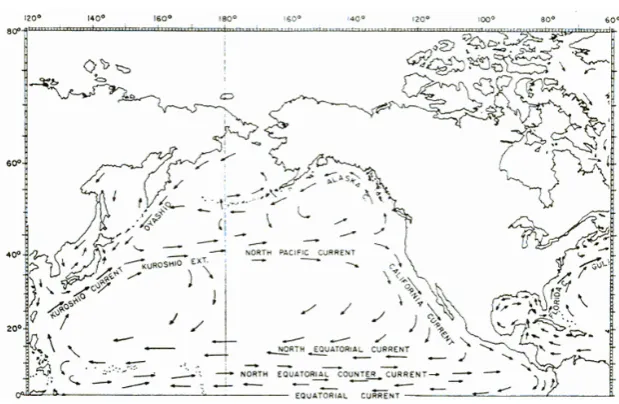
Figure 3: The traditional view of the Gulf of Alaska.
Figure 3 shows the standard view of the circulation of the Gulf of Alaska in particular showing the North Pacific Current, the ultimate extension of the Kuroshio, splitting into two branches one flowing northwards into the Gulf of Alaska and the other southwards into the California Current. It was originally suggested by Chelton and Davis (1982) that changes in the circulation of the N. Pacific could change the fraction of NPC water that flows into these two branches. Thus one might expect some asymmetry at long time scales in sea level north and south of the apparent bifurcation point. This might then have a large impact on the state of the Gulf of Alaska.
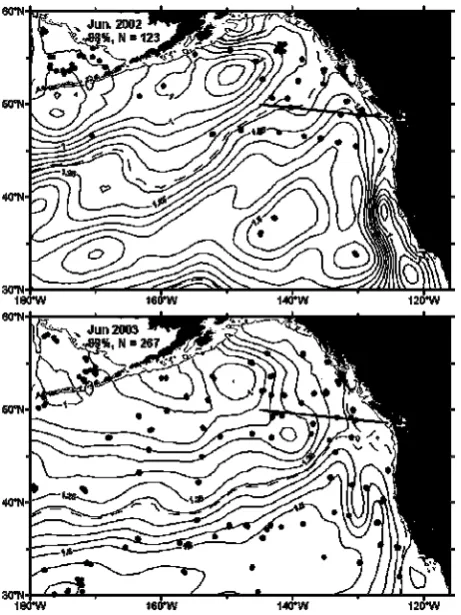
In 2002/03 we have been able to test these ideas. A very large climate anomaly developed during the spring of 2002. Using the Argo data set it is now possible to map the circulation of the Gulf of Alaska and examine the changes in the bifurcation.
suffice to model the circulation patterns.
Figure 4: Dynamic heights in the Gulf of Alaska for June 2002 and 2003. The blue line shows the location of Line-P for reference.
The maps show a dramatic change in the latitude and behaviour of the bifurcation in the NPC. This modified the supply of nutrients to the Gulf of Alaska during 2002 and greatly stabilized the water column especially over the winter of 2002/03. The consequences for the Gulf ecosystems in 2003 at the time of the meeting seemed likely to be substantial and this is apparently being borne out.
Argo is now giving us, for the first time, the ability to map evolving conditions in high latitude bifurcations. There is another such bifurcation in the Pacific Ocean, the area off southern Chile implicated in the formation of Antarctic Intermediate Water. In early 2003 there were few floats available to study the circulation in this region, but this will change substantially over the next 18 months. By 2005 it will be possible to do similar mapping of the circulation of southern Chile.
6.2.2. Low Latitude Western Boundary Currents
Billy Kessler gave an overview of current understanding of Low Latitude Western Boundary Currents (LLWBC’s). Three state-of-the-art models with the same wind forcing give very different transports of the Mindanao current (T. Jensen, per comm.), which flows southwards along the coast of the Philippines. Our understanding has been limited by the difficulty in taking measurements in such areas of high current flow. Technological advances such as glider were discussed, which could be used to monitor the LLWBC transports cheaply, and would enable repeated transects across the current to be made, as well as acting as a virtual mooring.
As part of TOCS programme, several subsurface ADCP moorings were deployed mainly at the TRITON sites along the equator and off New Guinea for observing the temporal variation of southern Pacific low latitude western boundary current (LLWBC). Recent results from the ADCP moorings off New Guinea coast were presented (Ueki et al., 2003). The New Guinea Coastal Current (NGCC) flowed equatorward and intensified during boreal summer, then weakened or reversed direction to poleward during the boreal winter. This seasonal change correlated with the monsoonal wind variation. On the other hand, the New Guinea Coastal Undercurrent (NGCUC) flowed steadily equatorward all year round and intensified during boreal summer. During the growing phase of the 1997-98 El Niño, the NGCUC intensified, and its equatorward flow reached surface even during the boreal winter season. At the same time, the equatorward Sverdrup transport in the ocean interior was also enhanced. Thus the total equatorward transport was significantly increased during the mature phase of the El Niño.
The observation of low latitude western boundary currents is important to understand the process of warm water volume, heat and salt exchanges in equatorial regions, which may affect ENSO, the Asian-Australasian monsoon, and impact on decadal variation. Thus the development of the in-situ observation plan off the Philippines including LLWBC in the northern hemisphere is required in conjunction with continuous TAO/ TRITON measurement, increasing ARGO floats and advanced satellite observations.
This can be seen as an opportunity to collaborate with local scientists in the region of the Philippines, Indonesia and Papua New Guinea, which would benefit all parties by increasing the international visibility of regional scientific activities and improving CLIVAR links in the region. The Panel supported this suggestion and agreed to seek to promote and coordinate this activity.
6. ACTION: Consider the planning of a LLWBC experiment and determine the way forward (possibly via a local workshop). (Kuroda, Hacker, Kessler)
6.2.3. Marginal Seas and Regional studies.
Sergey Varlamov gave a presentation on the role of marginal seas in Climate studies, and current research and projects. In the context of the global climate system, the Pacific Ocean East Asian and Polar Marginal Seas are located at the boundary of the largest continent and largest ocean. This boundary zone has a lot of important physical, chemical and biological processes as a result of air-sea and land-ocean interaction processes. Marginal seas are involved in the intensive ocean-atmosphere interaction including sea ice formation and melting, and specific events caused by atmospheric processes over the ocean near the continental boundary, such as the monsoon circulation etc. An example of globally relevant climatic variations is to be found in dissolved oxygen content in deep waters of the Japan Sea, demonstrating the retreat in the deep water ventilation in this sea as one of the possible results of global warming. The effect of marginal seas on the Pacific Ocean global processes could be related to the water mass formation that takes place there, intensive mixing and dissipation of turbulent energy as well as their role as a source of anthropogenic pollutants etc. Owing to the smaller scale of marginal seas basins, they provide a chance for verification of and improvements to ocean circulation models etc.
A number of international research programs have been initiated. These include such programmes as Circulation Research of East Asian Marginal Seas (CREAMS) and its second phase CREAMS-II that integrated the efforts of Korean, Japanese, Russian and US researchers around the Japan/East Sea and the Sea of Okhotsk; the Bering Sea Impact Study (BESIS) and others.
Symposia on the studies of the East Asian Marginal seas - Bering Sea, Okhotsk Sea, Japan and East-China Sea.
The panel concluded that it is currently not clear that there is any evidence that the local forcing of marginal seas has global ramifications, apart from the intermediate water formation in the Sea of Okhotsk. However, marginal seas are well within the CLIVAR remit. A number of workshops are planned, and regional groups seem to be very active, but with no international/basin scale coordination. No action is needed from CLIVAR at present, but it was decided that it would be helpful to gather information on upcoming activities, and build awareness of marginal seas activities in the CLIVAR community.
7. ACTION: Provide information on marginal seas activities and workshops on the CLIVAR Pacific website. (Varlamov, Hill)
7. OCEAN CARBON.
The issues surrounding ocean carbon have taken on new significance since the founding of the IGBP-IHDP-WCRP Global Carbon Project (GCP) and, to support the monitoring of the ocean’s role in the system, the GCP-IOC-SCOR sponsored International Ocean Carbon Coordination Project (IOCCP). The IOCCP met for the first time in January 2003 in Paris, to begin gathering information on planned observation activities, develop the p potential for collaboration with other research cruises and to increase the observation network.
Kitack Lee was invited to give a presentation on carbon related research in the Pacific, outlining the effects of climate variability on the oceanic uptake of carbon dioxide and gaps in our understanding. Equation 1 summarises the kinetic and thermodynamic controls on the air-sea CO2 flux.
F = k s (pCO2w – pCO2a) = K ∆ pCO2 . (Equation 1)
(k) Is the transfer velocity, which is controlled by wind speed, (s) is the solubility, which is dependant on SST and salinity, and (pCO2w – pCO2a) is the difference in partial pressure of CO2 across the air sea interface.
Climate variability significantly affects the CO2 flux across the air-sea interface. The equatorial Pacific is the largest source of CO2 to the atmosphere. It also has the largest year-to-year variability in oceanic outgasing; during an El Niño there is a reduction in outgasing from the equatorial Pacific. Also the PDO will affect the CO2 flux across the air sea interface due to changes in SST and wind patterns.
[image:18.595.60.399.586.774.2]One of the largest uncertainties is in the quantification of the transfer velocity (k). Decreasing this uncertainty is one of the three main goals of the SOLAS project. In addition, there is currently insufficient surface pCO2 data. The Japanese Voluntary Observing Ship (VOS) project in the North Pacific will help to improve this. Figure 5 shows the routes covered across the North Pacific, and figure 6 shows the patterns of air sea fluxes in this region.
Figure 6: Air sea flux patterns across the north Pacific (Data from VOS project). Contour lines represent the difference in partial pressure of CO2 between seawater and air (pCO2seawater-pCO2air). The arrows depict net
CO2 uptake in the western north Pacific, and outgasing in the east.
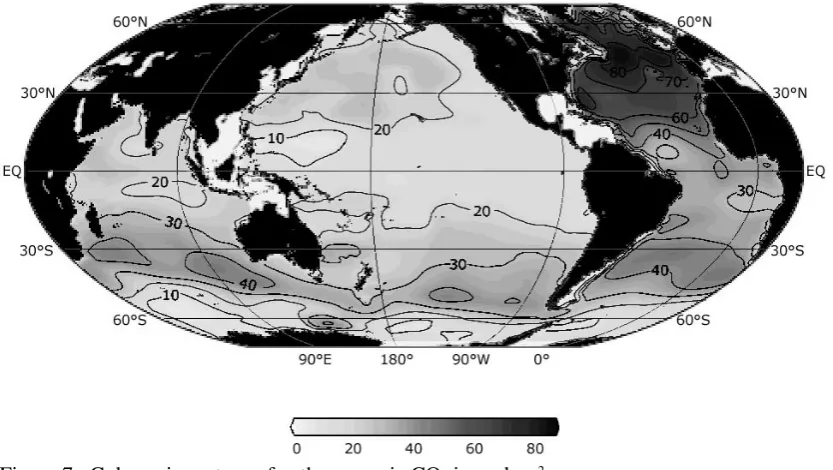
Emissions are, however modifying this system. A global assessment of the ocean anthropogenic CO2 inventory was undertaken as part of a project called GLODAP using data from the WOCE/JGOFS/OACES global CO2 survey (figure 7). The Atlantic is the largest sink of anthropogenic CO2 per (depth integrated) square metre
due to uptake through high latitude deepwater formation. However, the Pacific rivals the Atlantic in total anthropogenic CO2 storage due to its size. A sustained repeat hydrographic program will allow an assessment of changes in uptake and storage of anthropogenic CO2 to be quantified. In addition, the development of models to improve mechanistic understanding will improve the assessment of interannual to interdecadal variability in the net air- sea CO2 flux.
Figure 7. Column inventory of anthropogenic CO2 in mol. m2.
The Panel discussed ways of ensuring a close collaboration between the CLIVAR and carbon communities. Note was taken of the planned joint CLIVAR/Carbon repeat hydrographic sections (http://www.clivar.org/ carbon_hydro/hydro_table.php). One way to promote collaboration is through communication.
8. ACTION: Review Carbon Hydro pages and provide updates to the ICPO (Hill) as appropriate. (Panel Members)
[image:19.595.57.474.383.618.2]8. PACIFIC SCIENCE 2: ENSO AND DECADAL MODULATION.
Kelvin Richards gave an overview of recent ENSO research. One major challenge for the community is improving our predictive capabilities. A number of mechanisms for producing decadal modulation of the system have been put forward. These include, firstly, tropically induced mechanisms such as non linear bursting, and feedback between the background state and ENSO, and secondly, extratropically induced mechanisms such as variation in Sub Tropical Cells (STC’s)
However the length of the observational record makes it difficult to address these longer timescale variations. For instance, the data set used to corroborate the non-linear bursting theory is statistically too short to make the results significant. Paleo data, such as obtained from fossil coral, provides information on ENSO variability over a longer time frame (c.f. Cobb et al, 2003). These datasets need to be fully exploited.
The panel decided to defer discussion on the decadal variability of ENSO until after the Low Frequency ENSO meeting, being held in Toulouse in September. Thierry Delcroix is contributing to its scientific and technical organization in line with the Pacific Panel’s terms of reference.
10. ACTION: Delcroix and those attending the Low Frequency ENSO workshop in Toulouse in September to report back to panel (Delcroix, Power, Kessler, Hill)
8.1. WGSIP and its links with the Pacific Panel
Among the action items from SSG-11 & 12, it was recommended that the Pacific Panel interact more closely with WGSIP, in particular, on El Niño issues. To this end, Scott Power from WGSIP was in attendance at the meeting and gave a presentation on WGSIP activities and potential for collaboration.
Dr Power presented an introduction to WGSIP, which included their terms of reference, membership, and outcomes of last meeting. He then outlined SSG recommendations relating to WGSIP, particularly those of potential interest to the Pacific Panel and current WGSIP proposals and activities.
The areas where the Pacific Panel and WGSIP have a mutual interest were discussed including:
• Improving the simulation of the tropical climate in GCMs (especially the ocean. e.g. the equatorial Pacific
cold tongue and the parameterization of ocean mixing)
• Facilitating greater use of existing ocean analyses by the SIP community
• Increasing the understanding of factors influencing ENSO predictability on multiple time-scales.
WGSIP are meeting in Hawaii 3-7 November 2003, in conjunction with the WCRP’s Climate System Observational and Prediction Experiment (COPE) Workshop on Seasonal Prediction.
It was suggested that WGSIP and the panel reach a consensus on 1-2 high priority areas of interest for a joint workshop or experiment. Potential areas include
• Improving Coupled Model performance (double ITCZ) • Improved simulation of the tropical ocean.
- Excessive cold tongue
- Imperfect temperature structure - Oxygen mixing
It was noted that no single group focuses on tropical ocean model development, and this was seen as a possible area of collaboration between WGSIP and the panel. It was also noted that the Panel currently has no atmospheric representative, so no discussion arose on improving model simulations of the ITCZ.
11. ACTION: Consensus on high priority areas to be addressed at the next WGSIP meeting, November 2003 (Richards, Power)
8.2. Relationship between Operational Centres and CLIVAR Pacific
GCM for operational seasonal forecasts, which relies on the successful prediction of ENSO. To this end, the coupled model should represent the physical processes involved in the evolution of tropical SSTs, so that it can predict the SST evolution when given the appropriate initial conditions. Good ocean initial conditions, especially of the upper thermal structure, are thus required. A realistic estimation of the uncertainty in the initial conditions would be desirable for a useful ensemble prediction system.
Currently, a main obstacle for reliable seasonal predictions is model error, both in the atmospheric and ocean models. Worth mentioning are the deficiencies in the representation of the Madden-Julian Oscillation (MJO), the impact of which on the occurrence of ENSO is still subject to much debate. Progress in understanding this particular scale interaction is handicapped by the inability of many models to represent the MJO correctly. Ocean models struggle with the representation of the equatorial cold tongue, in particular its structure near the South American coast. Mixed layer physics and upwelling are believed to be key players in this region. Errors in the ocean model, together with errors in the forcing fields and data assimilation systems have a negative impact on the quality of the ocean states used to initialize seasonal forecasts. Development of multivariate assimilation methods, able to make optimal use of the existing and future observations, is needed.
The development of ocean data assimilation will benefit from programmes of systematic comparison and assessment of different ocean analysis, such as ENACT or the NOAA Climate Dynamics and Experimental Program (CDEP) Ocean Data Assimilation for Seasonal-to-Interannual Predictions (ODASI). The existence of independent observations that can be used for validation in a common set of diagnostics is a requirement. What follows is a list of items that need attention to allow progress on understanding and predicting climate variability at interannual time scales and beyond.
Observational needs for initialization 1. Prompt and good quality SST analysis.
2. Independent data for verification of data assimilation (salinity, ocean currents…).
3. Well-maintained and updated quality controlled datasets for ocean data assimilation. (Possibility: extension of the QC data set created for ENACT)
4. Estimation of mean surface elevation.
5. Critical assessment of the data needs for the estimation of Pacific decadal variability and its uncertainty. Development of Ocean Data Assimilation
1. Systematic comparison of existing Ocean (re)analysis with adequate metrics 2. Assessment of how ocean (re)analyses represent decadal variability
3. Assessment dispersion in the analysis 4. Further development of DA methods 5. Multivariate covariances
6. Joint assimilation of temperature and salinity 7. Treatment of systematic error
8. Representation of flow dependent errors
9. OSEs with different data assimilation systems to understand the impact of different observations types depending on the method, leading to improvement of the data assimilation techniques. (OSEs would be used to assess the quality of a given data assimilation technique, rather than the usefulness of a given observational system)
10. Feedback to the atmospheric community about quality of the atmospheric fluxes.
11. Assessment of whether future atmospheric reanalysis should include an ocean model (or at least an ocean mixed layer).
Model development
1. Better parameterization of oceanic mixing processes, in particular of vertical mixing and its interaction with the upwelling in the Eastern Equatorial Pacific
2. Data collection campaigns, ensuring ergodicity of the measurements, as a prerequisite for adequate parameterizations
5. Scale interactions: modelling studies 6. Air – sea interaction
7. Role of waves in the exchange of fluxes.
Magdalena Balmaseda pointed out that datasets for the verification of data assimilation is as important as the data to assimilate. In the following discussion, Billy Kessler mentioned that there were already some gridded data sets which could be used, in particular of salinity. It was suggested that the CLIVAR webpages could provide information on such datasets.
12. ACTION: Operational groups need to be aware of data sources – The Panel to provide ICPO info on datasets for model validation to be posted on website. (Panel members)
Both Scott Power and Magdalena Balmaseda highlighted the importance of improving mixing parameterisations in ocean models and understanding of their impacts on the ocean system. A workshop was suggested to explore how we improve the representation of certain ocean processes, and in turn hope to improve our predictive capabilities, such as the dynamics of the cold tongue. This sort of international activity might help PUMP and other unfunded activities win funding if a modelling component was involved. This workshop could be held jointly with WGSIP, inviting modellers and observationalists working on mixing. Focussing on the Tropical Pacific would be ideal, due to the existing observation network, and necessity of forecasts.
Dr Kelvin Richards and other Pacific Panel Members will attend the next WGSIP meeting in Hawaii in November 2003. The Pacific Panel decided that it would be opportune to use this meeting to present a strawman proposal to be developed in the coming months focussing on the parameterization of ocean mixing and deficiencies of models of the equatorial Pacific used for prediction and climate studies. The proposal will include a specific suggestion for a workshop on process studies aimed at improving the parameterisation of mixing.
13. ACTION: Develop a strawman proposal to take to WGSIP: focussing on the deficiencies of models of the equatorial Pacific used for prediction and climate studies. Proposal to be centred on improving the representation of mixing processes in ocean models, with a specific suggestion for a workshop on process studies for improving mixing parameterisation. (Kessler, Balmaseda, Power, Richards)
9. DATA ISSUES RELATING TO THE PANEL. 9.1. APDRC aims and resources for Panel
The director of the APDRC, Peter Hacker gave an overview of their aims, and emphasised that they welcomed input from the panel on any additions and modifications that would be of use. The APDRC receive funding to service the requirements of a number of programs including CLIVAR and GODAE, and aims to be a “one stop shop” for climate data and products including atmospheric, satellite, air-sea flux, and ocean data.
Resources currently available online include Live Access Server (LAS) online plotting capabilities for both station and gridded data to produce profiles, regional surface maps, and sections. Data available include Argo, WOCE CTD, Current Meter, Time series and Upper Ocean Thermal data. In addition, JAMSTEC model output and ocean reanalysis data sets can also be downloaded and plotted interactively.
9.2. An assessment of the CLIVAR Data pages.
Wenju Cai assessed the CLIVAR Data pages in terms of the Panel’s needs and found the site to be a comprehensive tool that compliments the APDRC resource. It was suggested that the APDRC and CLIVAR data sites should be cross-referenced, and that the CLIVAR global data site should reference to projects such as SODA, GFDL and JPL ECCO.
Overall, the Pacific Observations page was thought to provide a comprehensive overview of available data and observations. The panel were encouraged to continue to use this as a resource and provide the Project Office with updates.
14. ACTION: Provide updates to the CLIVAR Global Data Page and Pacific Observations Page to ICPO (Panel members)
9.3. An assessment of the usefulness of the APDRC website.
Wenju Cai gave an overview on the contents of the APDRC website, and its relevance to the Pacific Panel. It contains a gridded data server and an in situ server. Overall the site was seen to be extremely useful with a lot of data available relevant to the scientific research areas covered by the panel (see Appendix 2 for an overview of data products available and an assessment of the site).
It was suggested that it would be highly beneficial if the reanalysis datasets continuously incorporated data from arrays such as TAO and Argo. However, this would clearly require additional resources
15. ACTION: Cai to act as a contact (for panel and community) for the panel and community to provide feedback on the usefulness of the CLIVAR Pacific and APDRC websites (Cai).
16. ACTION: Panel to direct data concerns (of panel and community) through Cai. (Panel members: Cai to report to Panel)
10. THE PACIFIC PROSPECTUS AND PUBLICITY MATERIAL
Following the Asian-Australasian Monsoon Panel’s proposal to produce publicity material in the form of a 7-8 page prospectus, Kelvin Richards put the idea of developing a similar prospectus for the Pacific Panel up for discussion. This idea was not encouraged by the ICPO due to the costs involved. The preferred option would be to produce a small folder, with a loose double-sided sheet on each panel/working group. This is more cost effective, and the contents can be changed/updated as necessary. The panel concurred with the ICPO suggestion that all panels should produce publicity in the same format to promote a coordinated image. In addition, 2 sides of A4 provide enough space to give an overview of a panel. The ICPO are currently looking at funding possibilities to produce this material in time for the conference next June. ICPO Staffer Roberta Boscolo is currently designing a template, and Katy Hill will coordinate producing text/images for the brochure.
17. ACTION: Write an overview of Pacific activities for the CLIVAR Brochure and distribute to panel for comment. (Hill).
11. THE CLIVAR CONFERENCE
Howard Cattle gave an overview of the structure of the CLIVAR conference. As part of the activity surrounding this, the CLIVAR Principle Research Areas will be assessed. The review of Panel accomplishments and assessment of the PRAs was noted.
18. ACTION: Chair to liaise with ICPO as to what is required respect to the review of Panel accomplishments and assessment of the PRAs. (Richards)
12. RELATIONSHIP WITH OTHER PANELS
mandate, which is yet to be finalised, will be to address air-sea fluxes.
The SSG also expressed their approval of plans to form a limited lifetime Indian Ocean Panel, as a sub panel of the Asian-Australasian monsoon panel, whose terms of reference are under discussion. Their mandate will include the development of the Ocean Observations network, as well as variability in the Indonesian Throughflow. Indian Ocean Panel activities will clearly be of interest to the Panel.
The Pacific and Southern Ocean panels also have considerable mutual interests. In particular, the sparsity of observations in the South Pacific. It was decided, however, that it was to early to organise a joint meeting to address this issue.
13. RELATIONSHIP WITH OTHER PROGRAMS
The joint SCOR/IGBP/CACGP/WCRP Surface Ocean Lower Atmosphere Study (SOLAS) and SCOR/IGBP’s Integrated Marine Biogeochemistry and Ecosystem Research (IMBER - formerly named OCEANS) have expressed a keen interest in collaborating with CLIVAR. Key to nurturing this relationship in the Pacific will be close collaboration between the Pacific Panel and the IOCCP to promote the inclusion of a suite of carbon measurements on hydrographic cruises (see section 7).
PICES and the CLIVAR Pacific Panel will be holding a joint workshop at the PICES annual meeting in Hawaii, 2004. The tentative title for the workshop is “Scale interactions of climate and biochemical systems: what do we need to get right?”
19. ACTION: Report to panel on progress in planning of joint PICES/CLIVAR workshop (Richards)
14. PANEL MEMBERSHIP
The most pressing need is to have input to the panel on atmospheric issues. Previous attempts to co-opt an atmospheric scientist onto the panel had failed. The panel agreed to try again.
20. ACTION: Panel members to suggest names of potential atmospheric representatives to Cattle and Richards: (Boundary Layer/Convection expertise?) with a view to having them attend the next panel meeting (Panel members).
15. DATES AND LOCATION OF NEXT MEETING
It was decided that it would be desirable to hold the next Panel meeting promptly in light of the hiatus in activity between the first and second panel meetings. In addition, the planning of a number of major initiatives will need some follow-up work. It was decided that it would be best to hold the next meeting prior to the CLIVAR conference in June of 2004, prior to and during which, the achievements of the CLIVAR PRA’s will be assessed.
In light of this, it was recommended that the next meeting be held in Chile, in March or April of 2004, with a focus on ENSO, South Pacific Observations, and the parameterisation of tropical mixing. Panel Member Oscar Pizaro from the University of Concepcion, Chile has agreed to host the meeting.
References
Cobb, K.M., C.D. Charles, R.L Edwards, H. Cheng, M. Kastner, 2003. El Niño-Southern Oscillation and tropical Pacific climate during the last millennium. ,424, 271-276.
McCreary, J. P., and P. Lu, 1994. Interaction between the subtropical and equatorial ocean circulations: The Subtropical Cell, J. Phys. Oceanogr., 24, 466-497.
APPENDIX 1: AGENDA
Draft Agenda, CLIVAR Pacific Implementation Panel: Yokohama, 14-16 July 2003 Each day: 08:30 Start
10:00-10:30 Coffee break 12:30-13:30 Lunch 15:30-16:00 Tea break 18:00 End Monday 14th July 2003
AM
Registration (08:00)
Welcome, logistics, aims, CLIVAR overview (Richards, Fukasawa, Cattle) Review action items from First Panel Meeting
Review Agenda
Pacific Science 1: Pacific Decadal Variability
What are the issues?
What role does the ocean play?
OGCM sensitivity to PDV (Link with WGOMD, Hasumi)
Can models be used to identify deficiencies in our understanding of the physics? Carbon issues (Lee)
Impacts of PDV
Invited speakers: Ichiro Fukumori (Ocean state estimation) (45 mins)
Toshiyuki Awaji (4D-VAR on the Earth Simulator) (45 mins) Outcomes: Proposal for model sensitivity/intercomparison study (?)
Proposal for focussed workshop PM
Pacific Science 1: Continued (as necessary)
Pacific Science 2: Process studies
The PBECS ethos
Status on the planning of PUMP (Kessler) Enhanced - PUMP, the international element Need for further process studies:
Western boundary currents (Kessler) Eastern mid-latitude bifurcation (Freeland) Marginal Seas (?)
How do we go about initiating new process studies? Outcome: The way forward for Pacific process studies Evening Ice Breaker Reception
Tuesday 15th July 2003
Pacific Science 3: ENSO
Pacific Panel’s links with WGSIP (Power)
Operational centres needs from CLIVAR Pacific (Balmaseda)
Data:
- Discussion of requirements for a regional CLIVAR data/products system - Relationship with APDRC (Hacker)
- Devise a strategy to develop a short (4-6 page) document describing the long-term needs for such a system.
Pacific Prospectus: (Richards) Evening:No host dinner
Wednesday 16th July 2003
AM
Updates on activities not already covered, that need Panel’s attention
Relationship with other panels, working groups, programmes, not already covered Review action items
Any other business
Focus (ENSO?), date and location of next meeting Adjourn Meeting (Lunch)
PM
APPENDIX 2: Data Report
A brief review of the APDRC and CLIVAR servers
Wenju Cai
At the previous Panel meeting (Hawaii, Feb. 2002), the action items include working with APDRC to identify important data sets to CLIVAR-Pacific. At David Legler and Kelvin Richard’s suggestion, Katy Hill and I have undertaken a task to browse the APDRC holdings on their servers. The aims are:
• to produce a list of datasets available; • to assess how easy they are to access; &
• to review the list and develop some written comments/assessment of the available data/products.
The brief comments below that arise from this exercise are meant to foster discussion at the Yokohama meeting on issues such as:
Ø In what areas are the servers well suited to CLIVAR needs? Ø Where are the gaps (eg, atmospheric variables/products)? Ø What additions would be most helpful?
1. Comments on data availability and accessibility at the APDRC
This site has many servers and, together with many links, provides information of a wide range of ocean and atmosphere data relevant to the Pacific panel. The servers at the site are classified into two types:
Grid Data Server & In Situ Data Server . live access server v5.0 (public data)
live access server v6.0 (public data) epic for all data sets
live access server v6.0 (internal) epic for Argo data (testing)
Jamstec model output animation epic for woce uot
OPeNDAP servers epic for woce whpo data
oyakata’s GDS (internal) epic for woce mooring
The content within each server is generally self-explanatory. In the following, I will outline some information on what is available within each server.
Initially, we only had access to the public data areas. We found the first link live access server v5.0 (public data) was not operating properly. It kept shutting down my internet sections. We reported this to APDRC, and it led to the removal of this server from the site. We were later informed by Yingshuo Shen of the IPRC that this is replaced by the live access server v6.0 (public data).
The datasets in live access server v6.0 (public data) include a large body of different products from various institutions. These are:
Ø Assimilated Model Output
Ø COADS Since 1993 Ø Japan GODAE Products 4 days only Ø NCEP Since 1948
Ø Satellite Data (WOCE since 1991 & many others), NASA winds, etc. The most useful, in my view, are the assimilated data sets. They include:
GFDL Ocean Assimilation(remote)
JPL ECCO Adjoint Assimilation 1997-2000(remote) JPL ECCO Kalman Filter Assimilation(remote)
NRL NLOM from 2003.01.31 to yesterday Output(local) RIAM Japan Sea assimilation
SODA Monthly Data(local)
Most these assimilated data products use the GFDL MOM. The GFDL data set is derived from a 1/3o,