Evaluation of a hypermedia maintenance support application
Richard Crowder
*, Gary Wills, Wendy Hall
IAM Group, Department of Electronics and Computer Science, University of Southampton, Southampton SO17 1BJ, UK
Received 14 May 2002; accepted 1 February 2003
Abstract
A large hypermedia application has been developed to demonstrate the concept of factory wide hypermedia to support the maintenance of a major process line. As part of its development cycle, the performance of the software and its acceptance by the user community has been fully evaluated. The evaluation method considered in this paper focuses on the subjective opinion of the users and measured the ease with which users could retrieve the information required to perform specific tasks, and is considered suitable for other large industrial hypermedia applications. This research draws together standard evaluation techniques into a methodology for evaluating an industrial strength hypermedia application. The trials undertaken showed that the users were able to find the identical information in approximately one-third of the time when using the hypermedia system, over a paper-based system, which equate to a significant cost savings during unscheduled maintenance periods.
#2003 Elsevier Science B.V. All rights reserved.
Keywords:User evaluation; Open hypermedia; User interface; Manufacturing
1. Introduction
As manufacturing systems increase in sophisti-cation and complexity, a considerable amount of information is required for plant operation and main-tenance. An effective information management sys-tem for factory floor applications must not only manage a range of document types, but it must also make it easy for any user to follow the interrelation-ship between pieces of information. A hypermedia information system presents users with a range of options, from which they are able to determine the order in which the documents are studied. In effect the
author gives the user a number of alternate routes through the resources.
The acceptance of information technology is greatly influenced by the user interface, particularly where non-computer specialists are concerned. To gain information regarding usability and benefits, a robust evaluation procedure is required which is specifically tailored to industrial application. In this paper, previously used evaluation methodologies are refined to produce a methodology for evaluating the usability of hypermedia applications in the industrial environment. The methodology has been applied to industrial hypermedia application devel-oped for a cable process line located at a UK site of the multinational company, Pirelli Cables. In order to verify the evaluation methodology, a second company The Ford Motor Company, operating in a *Corresponding author. Tel.:þ44-23-8059-3441;
fax:þ44-23-8059-2865.
E-mail address:[email protected] (R. Crowder).
different industrial sector, supplied a number of users for the trials.
1.1. The industrial hypermedia application
The concept of using open hypermedia for informa-tion and document management within manufacturing organisations was proposed by Malcolm et al.[1], who argued that hypermedia systems had to evolve beyond the stand alone application and allow the integration of resources across an enterprise. A number of hyper-media applications including engineering applications
[2–4], medical record keeping[5], historical archives
[6], and education[7] have been reported.
The industrial hypermedia application considered in this paper was developed as part of the Factory Information Resource Management (FIRM) project using Microcosm [8,9]. Microcosm1[10]is an open hypermedia system, where the links are stored sepa-rately from the documentation and through filtering processes are brought together when the user views the document. Microcosm has the concept of a generic link or glossary link, which is an association made from an object at any position in any document to a particular object in a destination document. In addi-tion,compute linkswhich are dynamically computed when requested, and a guided tour that takes the user through a set of documents, are also features of Microcosm.
The FIRM project moved away from a monolithic application to a modular approach for hypermedia development, by using Modular Hypermedia Applica-tions (MHAs)[11]. An MHA is based on the principle where a large problem can be more easily managed by decomposing it into smaller modules that are more easily dealt with. This approach can be applied to the information domain, resulting in the large information space being broken down into smaller hypermedia applications, for the ease of handling and authoring. An authoring environment then compiles the indivi-dual MHA into a single application for delivery.
As previously reported [12], the application was developed for a supertension cable sheathing line at a local site of a major multinational. The 90 m long line extrudes the cross-linked polyethylene outer-sheath
onto a supertension cable.2In addition to the extruder the line includes a bitumen tank, drive systems, cool-ing tank, spark tester and pay-off and take-up stands. The line can take cable drums up to 50 tonnes contain-ing cables up to 155 mm diameter, and 40–50 kg m1 in weight. Due to the scope of the application the development of the hypermedia application not only involved operating company, but also the line builder and a number of their suppliers both in the UK and across Europe. In order for hypermedia systems to be used widely in industry, the hypermedia application must operate enterprise wide, and not solely concern an isolated piece of equipment. The solution, in part, is the incorporation into the hypermedia system addi-tional funcaddi-tionality, such as the ability to query remote information systems and have a direct interface with the equipment, allowing the hypermedia system to provide the correct supporting information, depending on the equipment’s status (Fig. 1).
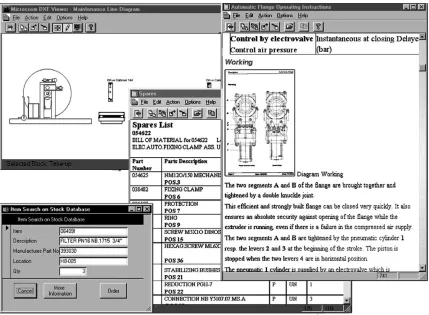
At the conclusion of the project, the information resource base comprised of 850 nodes in 26 MHA, equating to over 640 Mbytes of information. Over 4500 links had been produced and were held in over 70 linkbases.Fig. 2 shows the wide range of materials available to the user during a maintenance procedure. This includes not only the information specific to the line either in text or engineering drawings, but also access to company wide information on processes and safety. One of the advantages of this approach is the ability to directly link from the list of spares to the company’s stores database, hence reducing the time and error associated with manually ordering a component.
The industrial environment brings together users with different and varying computer skills, all of whom need to be supported. Many interfaces for industrial applications try to provide a common look and feel by providing the same user interface for all applications and user groups. In our view, and that of our user community, what is actually required is an appropriate interface for the task that has a common look and feel, yet allows different groups of users, with different abilities, access to the appropriate information. As with many processes running in Microsoft Windows environment, a number of appli-cation interfaces can be on the screen at the same time. 1Microcosm is available from Active Navigation, http://
Fig. 1. Supertension sheathing line, showing the hypermedia system and its interconnection to external resources and the line.
[image:3.544.56.485.322.637.2]The interfaces all act independently of each other in terms of screen management and can therefore be made to overlap or obscure one another; which may cause problems to inexperienced users. One approach is to provide a fixed window layout, however this approach would be very restrictive when applied to the applications envisaged by this work. For this reason, FIRM used the Screen Handler Enabling Process (SHEP) designed and implemented by Hall et al.
[13]. SHEP uses an architecture that promotes the disclosure of state information by the individual pro-cesses and allows screen management propro-cesses to modify the interface as required by the user.
1.2. Evaluation of an industrial hypermedia application
As part of the development process, formal evalua-tion is required which is concerned with gathering of information about the usability of a system, in order to improve features or to assess the interface
[14–16]. The evaluation discussed in this paper was used to assess the application against the following criteria:
The efficiency with which users can successfully navigate through the hypermedia documentation.
The effectiveness of the system in allowing users to locate a correct document or specified point within a document.
The ability with which users can begin to make effective use of the application, by incorporating it into their daily activities.
Acceptance by the user of the hypermedia system into their daily activities.
Identification of features that aid or hinder the task being undertaken.
The evaluation discussed in this paper only addresses information delivery and not impact of hypermedia on the users ability to undertake a task. The evaluation methodology needs to consider the practical aspects (for example, taking personnel from the factory floor for an extended period of time) and the cost of undertaking the evaluation to the company. Due to the availability of resources within the organi-sations, the traditional experimental usability evalua-tions involving specialist usability facilities are not considered an option.
The application discussed in this paper was speci-fically evaluated to examine the following hypotheses:
Hypothesis 1.
H0 Retrieving the information using the hypermedia system is no quicker than using a paper-based system.
H1 Retrieving the information using the hypermedia system is quicker than using a paper-based system.
Hypothesis 2.
H0 The hypermedia system is no easier to use than the paper-based system.
H1 The hypermedia system is easier to use than the paper-based system.
In addition, the following system goal was devel-oped in association with senior management at Pirelli Cables:
. . . to improve the operators and maintainers retrievability of a document by using the open hypermedia documentation system, over the cur-rent paper-based system, through ease of use, by a reduction of at least 10% in the time to locate a specific document. . .
This threshold was based on the company’s experi-ence, where a small reduction in unplanned mainte-nance time would result in a substantial cost saving and was developed using a Goal–Question-Matrix approach,[17–19].
2. Hypermedia evaluation
The majority of the literature on evaluating hyper-media applications focuses on application domains other than manufacturing, for example, museum and educational applications. However, Kosky et al.[20]
measure the behavioral intention, of factory floor personal, towards using a closed hypertext system. The results show that in general the users were favourably disposed to using this technology to sup-port the maintenance of large automated systems within a manufacturing company, or to support the assembly of consumer electronics. Currently, there is no reported hypermedia usability evaluation metho-dology that has been developed specifically for indus-trial hypermedia application. However, Garzotto and Paolini [23]have proposed a framework for the Systematic Evaluation of Hypermedia (SUE) that basically combines inspection with empirical testing in two phases:
Preparatory phase: during which the evaluation process will be developed.
Evaluation phase: involving both expert and user evaluations, the results being fed back as part of the design process.
SUE was originally designed using the Hypermedia Design Methodology (HDM) for museum applica-tions. While superficially similar to our application, a museum application has significant differences, including a focus on education, lack of robustness and low risk if the information is incorrect. The evaluation process developed by Garzotto and Paolini
[23]cannot be directly applied to applications that are not based on HDM, due to the close interrelationship between SUE and HDM. However, the principles distilled from the preparatory phase of the SUE meth-odology included approaches to the:
development of the definitions for the hypermedia model and the design criteria;
definition of the application’s usability criteria;
definition of the tasks to be used in the evaluation process.
If this approach is taken for the evaluation of large-scale industrial applications, care needs to be taken that the tasks are defined and the language used is appropriate to an industrial environment [15,24]. An approach to resolving some of these issues was discussed by Ho¨o¨k who considered the evaluation of adaptive hypermedia as applied to an electronic manual[25].
As the time and personnel resources available within Pirelli Cables and Ford to undertake the required
evaluations were limited, an evaluation methodology was developed based on a number of commonly used techniques. The limited resources available require the use of a structured expert review [16], and in particular discounted usability evaluation. This is a heuristic approach proposed and refined by Nielsen and coworker [26–28]. Discounted usability evalua-tion can be carried out using limited resources and a small number of participants, typically 6–10. Any increase in numbers over this will not produce any significant benefit. The process consists of the following activities:
A limited number of small easily modified scenarios used to test aspects of the system.
Informal thinking aloud, where the evaluators are asked to articulate their thoughts.
Heuristic evaluation to alleviate highlighted pro-blems by a modify–evaluate–modify cycle.
One of the advantages of the discounted usability method is that the majority of application errors can be found without having to waste end users’ time. How-ever, the method does rely on the ability of experts to judge the participant’s reactions, hence, not all the problems will be found.
3. Methodology for evaluating industrial hypermedia
The approach taken in the evaluation process for an industrial hypermedia application required five activities: contextual review, structure expert review of the prototype, training with initial feedback, usa-bility trials and continuing evaluation[8].
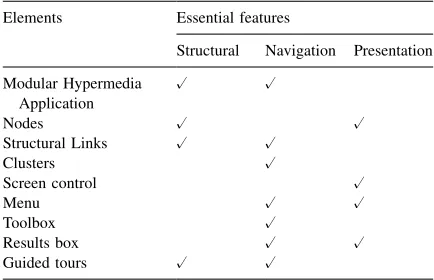
The application’s main elements mapped against the essential features of the application are shown in
Table 1, for example, theModular Hypermedia Appli-cation directly influences the applicationsStructural designandNavigation. This will allow the evaluation process to directly inform the design of specific ele-ments of the application. Garzotto and Paolini [23]
The questionnaires used in the evaluation process were designed to measure the scale of: Impression, Command, Effectiveness, Learnability, Aidability, Navigability and Comprehension, as defined in
Table 3. The first five scales are based on The Soft-ware Usability Measurement Inventory [29], with Navigation and Comprehension, added to specifically measure issues in industrial hypermedia applications.
The design of the questionnaire was such that participants were forced to make a choice, as there was no neutral answer. A positive response to a positively phrased question scoredþ1 (agreed) and
þ2 (strongly agreed), a negative response to a positively phrased question was scored score 1 (disagreed) and2 (strongly disagree). The reverse being true for the responses to negatively phrased questions. The questionnaires used after training and a usability trial are given in Appendices A and B, respectively.
3.1. Contextual review
A contextual review of working practices in the target environment was undertaken prior to the devel-opment of the prototype. The results from Pirelli Cables, identified the following perceived benefits for hypermedia within the industrial domain:
Ensuring that all operators and maintainers have access to the current information at all times.
Reduction in time required to locate the correct information.
Table 1
The design’s elements mapped against the application’s essential features
Elements Essential features
Structural Navigation Presentation
Modular Hypermedia Application
@ @
Nodes @ @
Structural Links @ @
Clusters @
Screen control @
Menu @ @
Toolbox @
Results box @ @
[image:6.544.45.502.422.523.2]Guided tours @ @
Table 2 Usability criteria
Criteria Definition
Retrievability How easily a user can find the relevant information
Orientation The ability of the users to know their current location relative to supporting information, the information context and the ease with which they can return to a position
Reuse While the design and authoring methodology encourages information reuse, is it appropriate in specific instances Intuitive Can the user grasp the meaning and purpose of the information, dialogue box, window, etc. that is being presented Consistency Ensuring that conceptually similar elements are treated in an identical fashion, while different elements are
clearly differentiated
[image:6.544.48.502.565.661.2]Accessibility How accessible with or without the correct permissions is the information
Table 3
Questionnaire scales and definitions
Scale Definition
Impression The users feelings or emotions when using the software Command The measure to which the user feels that they are in control Effectiveness Degree to which the user feels that they can complete the task Aidability Degree to which the application assists the user to resolve a situation
Learnability Degree to which the user feels that the application is easy to become familiar with Navigability Degree to which the user can move around the application
Providing additional background information only when necessary.
Reduction in the production and distribution costs associated with controlled copies.
3.2. Structured expert review of the prototype
As part of the development cycle associated with the hypermedia maintenance support application, a structured expert review was conducted, with experts being selected from staff responsible for the Super-tension sheathing line. This ensured that the comments on the user interface and information content were relevant to the end users[8]. The review showed that:
A toolbar was an effective method of providing short cuts.
A pictorial representation of a process line was an effective gateway to resources.
The traditional fixed-page screen format was too restrictive for a factory floor hypermedia interface, with the SHEP[13]methodology providing some of the solutions.
The review also revealed that while navigating a large information space it is easy for a user to get disoriented. The system must provide users with uti-lities to navigate the information space without getting lost. Hence, evaluation of a large hypermedia system needs to explicitly assess the level to which the system provides navigational aids. To address this point, an additional heuristic, identified asprovide navigational aids, was included in the evaluation.
3.3. Training with initial feedback
After a training programme to introduce the uses to the hypermedia technology and this specific
application, users were asked to complete a question-naire to discover their initial opinion of the application. This approach encouraged users to give their opinion, albeit subjectively during the latter part of the design phase, therefore giving them a degree of ownership and ensuring that the application met their needs at the earliest possible opportunity.
3.4. Usability trials
Usability trial, where predefined tasks developed in association with the line’s management team, were completed using the hypermedia application. The results from the trials were used to evaluate the effec-tiveness of the application. These tasks were analysed using a range of metrics, including time to complete the task, and number of nodes visited.
4. The evaluation of the supertension hypermedia application
After training 21 users at Pirelli Cables, two usa-bility trials were undertaken approximately 3 and 9 months after training. Four members of the manage-ment team, 6 operators, 11 maintenance technicians and 2 apprentices were trained. In addition, 9 person-nel from Ford were also trained to use the system.
[image:7.544.42.499.573.663.2]4.1. User profiles
Table 4gives details of the trial participants, who in this case were all males. The table also identifies the computing system they use at work (either a personnel computer (PC) or special purpose computers asso-ciated with the line (line)) and whether they can programme to the level of spreadsheet macros.
Table 4 User profiles
Number Age Computing skills
Range Mean s Systems Programming
Pirelli management 4 30–55 45 10 PC Yes
Pirelli technicians 11 18–60 42 13.5 PC No
Pirelli operators 6 26–60 46 9.2 Line No
Apprentices 2 18 18 0 PC No
4.2. Comments raised during training
The following specific points raised during training indicated a need to change both information delivery and working practice:
All users asked that the electronic information was available at the point of use, through the use of mobile computing technology[30].
The maintainers wanted to be able to annotate drawings with changes or modifications, to provide a permanent record, and allow dissemination of best maintenance practice.
The maintainers wanted more detailed equipment-specific information that went beyond what they had in any paper-based system. Hypermedia allows information to be tailored more closely to the application [31], and can through the adaptive systems allow the real time adaptation of documen-tation to satisfy the users immediate needs.
The hypermedia system with a suitable interface would allow the maintainers to keep other records more conveniently, resolving the problem of mis-placing handwritten notes.
The users would like to publish or disseminate to other users useful trails through the information
space [32], allowing users to share their experi-ences, leading to a more efficient use of the doc-umentation system.
There were concerns relating to the amount of information that could be displayed and still be legible.
The operators and maintainers had worked on the process line since it was installed, prior to the intro-duction of the hypermedia application, consequently, they have seen many of the faults and problems before, and hence their comments on the application may have been influenced by the familiarity with the line.
4.3. Results from the post-training questionnaires
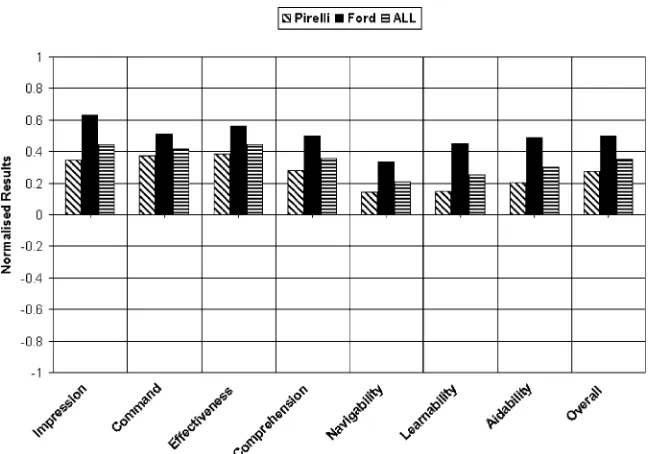
Twenty-three questionnaires from the 30 distributed across both organisations were returned immediately after the training sessions.Fig. 3shows the normalised scores. It was clear that users had a positive impression of the system, in particular:
Nobody agreed with the statement thatthe system was demanding and not enjoyable to use, and 70% of the users would recommend the system.
[image:8.544.113.438.418.645.2]All users felt that the system was effective in retrieving the required information. All users found
the information they required, with 91% indicating that it was straightforward. However, 22% of users thought that there were too many steps to get specific information.
All users found the information to be clearly pre-sented, understandable and consistent, though 26% considered that too much text was displayed at any one time.
The user perception of the aidability was high, though 26% thought that the system was awkward to use when undertaking an unfamiliar task. Simi-larly, 43% of users felt safer keeping to a familiar method of retrieving information.
In the evaluation, 78% of the users found it easy to navigate the information, with 87% finding a wide range of routes to get to the information they required. However, 43% of users felt that it was easy to become disorientated when using the system.
The difference in results from the Pirelli and Ford users was noticeable, this was largely due to the Pirelli personal being very familiar with the line and its documentation leading them to be over critical to content and context. The Ford personnel who were not familiar with the line considered the application from a more conceptual viewpoint.
5. Usability trials
The objective of the usability trials was to measure the effectiveness and ease of using a hypermedia
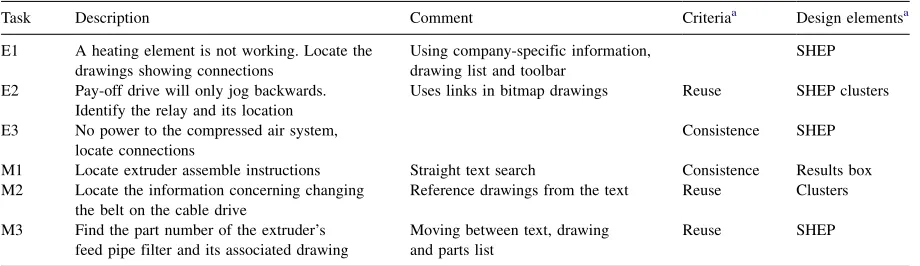
application to locate information and not the fault finding abilities of the maintainers. The usability trials reflected this objective, and only recorded the time and number of nodes taken to locate a specific piece of information. The initial usability trials were under-taken approximately 6 months after training to allow the users to gain experience of the system. The usability trials were of a single factor design [33], the single factor being the information resources used with two variables, electronic information or paper. The tasks inTable 5were specific in their description and were developed with and approved by the line’s senior maintenance engineer. The tasks developed reflected actual activities conducted infrequently on the line, while being well defined they were not highly specific. In addition, a mixture of mechanical and electrical tasks were provided to reflect the skills of the line’s maintainers. The task definitions provided uniformity in the evaluation process, especially when different evaluators were involved.
[image:9.544.42.502.510.643.2]The order in which the maintainers performed the tasks, and whether they carried out a task with the paper system first or the hypermedia system, was randomised to balance out any learning effect. An observer watched each subject undertake the tasks, recording the time, the number of documents visited, the number of content or index pages used, and the number of times they became lost to complete the task. The observer recorded the observation on a tape recorder, so they could freely move around the factory floor. On completion of the tasks the user completed the questionnaire.
Table 5
Usability trials tasks
Task Description Comment Criteriaa Design elementsa
E1 A heating element is not working. Locate the drawings showing connections
Using company-specific information, drawing list and toolbar
SHEP
E2 Pay-off drive will only jog backwards. Identify the relay and its location
Uses links in bitmap drawings Reuse SHEP clusters
E3 No power to the compressed air system, locate connections
Consistence SHEP
M1 Locate extruder assemble instructions Straight text search Consistence Results box M2 Locate the information concerning changing
the belt on the cable drive
Reference drawings from the text Reuse Clusters
M3 Find the part number of the extruder’s feed pipe filter and its associated drawing
Moving between text, drawing and parts list
Reuse SHEP
5.1. Results from the usability trial
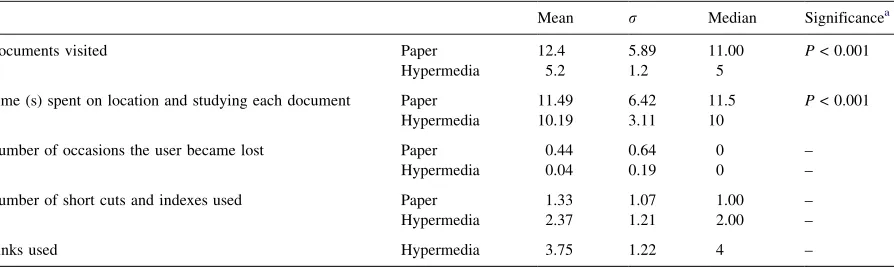
Table 6shows that the mean time to locate informa-tion using the hypermedia system was approximately one-third of the time taken when using the paper-based system. When analysing the entire group together this time difference is highly significant. Hence, the hypothesis that ‘‘retrieving information using the hypermedia system is quicker than using the paper-based system’’ was proven.Table 7shows task usabil-ity data where only pages that the users dwelt on for a period of time were counted as being visited, as a result the number of documents actually visited was higher than recorded. Even with the possible under-estimation for the paper-based system, the user obtained the information by visiting fewer documents than when using the hypermedia application. Similarly, on average, users spent less time on each document.
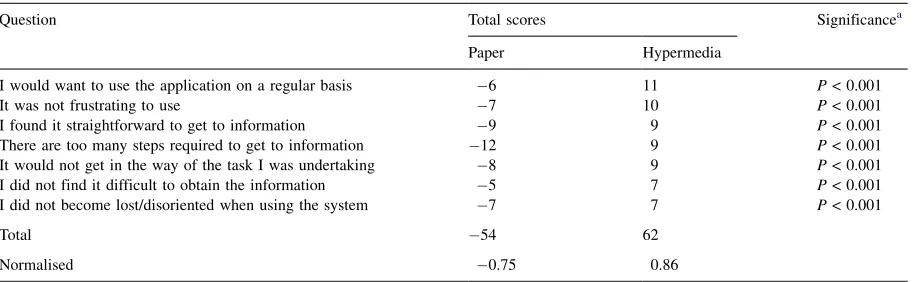
Coupled with users taking fewer incorrect paths and using the short cuts and menus more effectively, it is possible to conclude that the user found the hyperme-dia system easier to use. This was reflected in the response to the questions in the questionnaires to ascertain how the user compared the ease of use of the two systems (Table 8). Hence, a further hypothesis that ‘‘the hypermedia system is easier to use than the paper-based system’’ can be accepted.
The results from the usability trial questionnaire completed showed an increase in each category com-pared to the results after the initial training (Fig. 4). The increased normalised scores from the question-naires after the usability trials suggest that the real benefits of using the hypermedia system only become apparent to the users when they could place the use of the hypermedia system in the context of their working environment and whilst undertaking tasks they could relate to.
5.2. Second usability trial
The usability trials were repeated to ensure that the results obtained were still valid after a period of approximately 6 months of normal usage. During this period the users did not receive any assistance or input from the design team. Following restructuring at the company, only five of the original nine maintainers were available to carry out this second trial, together with the promoted senior apprentice. The procedures, questionnaires and tasks remained unchanged from the first trial.
Table 6
Summary of the usability trial results
Task Media Time (s) Significancea
Mean s
Electrical Paper 176.75 102.71 P< 0.01 Hypermedia 65.71 24.13
Mechanical Paper 123.27 55.49 P< 0.001 Hypermedia 39.73 13.70
All tasks Paper 147.04 82.79 P< 0.001 Hypermedia 51.04 22.66
a
[image:10.544.54.501.520.655.2]Measured byt-test.
Table 7
Task usability data from the first usability trial
Mean s Median Significancea
Documents visited Paper 12.4 5.89 11.00 P< 0.001
Hypermedia 5.2 1.2 5
Time (s) spent on location and studying each document Paper 11.49 6.42 11.5 P< 0.001
Hypermedia 10.19 3.11 10
Number of occasions the user became lost Paper 0.44 0.64 0 –
Hypermedia 0.04 0.19 0 –
Number of short cuts and indexes used Paper 1.33 1.07 1.00 –
Hypermedia 2.37 1.21 2.00 –
Links used Hypermedia 3.75 1.22 4 –
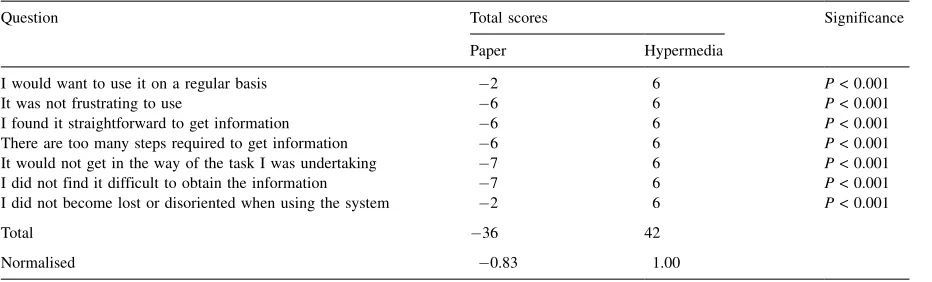
The results from the second usability trial show that a continuing statistically significant difference between using the paper-based information system and the hypermedia system was present. The users were continuing to find the information quicker using the hypermedia system (Table 9). When using the hypermedia system the users again visited less documents in order to find the information (Table 10). In addition, none of the users got lost while using
[image:11.544.43.502.113.254.2]the hypermedia system. However, a number of users found it difficult to obtain information without some assistance when using the paper-based system. The response to the questionnaires continued to show that the users preferred the hypermedia system to the current information system (Table 11). In addition, the normalised scores from the questionnaires increased (Fig. 4). Hence, both hypotheses can still be considered to be proven.
Table 8
Summary of questionnaire response after the usability trial
Question Total scores Significancea
Paper Hypermedia
I would want to use the application on a regular basis 6 11 P< 0.001
It was not frustrating to use 7 10 P< 0.001
I found it straightforward to get to information 9 9 P< 0.001
There are too many steps required to get to information 12 9 P< 0.001 It would not get in the way of the task I was undertaking 8 9 P< 0.001 I did not find it difficult to obtain the information 5 7 P< 0.001 I did not become lost/disoriented when using the system 7 7 P< 0.001
Total 54 62
Normalised 0.75 0.86
a
Significance computed using Wilcox signed rank test.
[image:11.544.66.474.436.647.2]5.3. Apprentice usability trial
The apprentice usability trial was designed to inves-tigate if the hypermedia system could be effective in helping someone who is unfamiliar with fine detail
of the process line and its information system. The apprentices were trained to a level that ensured that they were familiar with the equipment and termino-logy used across the company. The same tasks and questionnaires were used as in the other usability trials. Prior to the trials the apprentices undertook a brief familiarisation of the line, its current information systems, and the hypermedia resources. The appren-tices undertook all six tasks.
[image:12.544.46.263.113.224.2]The apprentice, who carried out the tasks using the paper-based system first, was unable to complete electrical tasks 1 and 3. However, he was able to finish all the required tasks using the hypermedia system. The inability to complete the tasks was due to the apprentice’s unfamiliarity with the paper-based sys-tem. A second apprentice (who used the hypermedia system first) was able to complete the paper-based tasks, but required some guidance.
Table 9
Summary of the second usability trial
Task Media Time (s) Significance
Mean s
Electrical Paper 161.67 82.65 P< 0.01 Hypermedia 49.67 24.15
Mechanical Paper 113.33 31.26 P< 0.001 Hypermedia 41.00 28.71
[image:12.544.47.503.344.477.2]All tasks Paper 137.5 65.52 P< 0.001 Hypermedia 45.33 26.12
Table 10
Task usability data from second usability trial
Mean s Median Significance
Documents visited Paper 12.00 5.10 11.0 P< 0.001
Hypermedia 5.00 1.85 5.0
Time spent on location and studying each document Paper 12.33 4.59 11.2 P< 0.05
Hypermedia 8.90 3.57 7.9
Number of occasions the user became lost Paper 0.33 0.49 0 –
Hypermedia 0 0 0 –
Number of short cuts and indexes used Paper 2.50 2.20 2.0 –
Hypermedia 2.67 1.04 2.0 –
Links used Hypermedia 3.11 1.57 3.0 –
Table 11
Summary of the questionnaire response after the second usability trial
Question Total scores Significance
Paper Hypermedia
I would want to use it on a regular basis 2 6 P< 0.001
It was not frustrating to use 6 6 P< 0.001
I found it straightforward to get information 6 6 P< 0.001
There are too many steps required to get information 6 6 P< 0.001 It would not get in the way of the task I was undertaking 7 6 P< 0.001 I did not find it difficult to obtain the information 7 6 P< 0.001 I did not become lost or disoriented when using the system 2 6 P< 0.001
Total 36 42
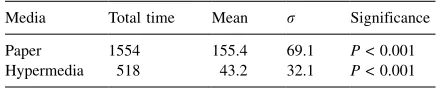
[image:12.544.47.513.523.664.2]Both apprentices completed all the tasks using the hypermedia system much quicker than with the paper-based system, again in approximately one-third of the time (Table 12). They also found the paper-based system difficult to use, this was demonstrated by the number of documents visited, the number of occasions they got lost (Table 13). They found the paper doc-umentation difficult to use, partly due to unfamiliarity and the lack of proper description given to manuals. Hence, these results suggest that the hypermedia sys-tem may also be appropriate for training or induction of personnel to an unfamiliar process line. However, the sample is too small to make any general conclusions.
6. Discussion
6.1. Evaluation results
The results show that there is a statistically sig-nificant difference between using the existing paper information system and the hypermedia system devel-oped as part of this project. That is, the users were able to find the information in approximately one-third of the time when using the hypermedia system, they had to visit less documents, and got lost less often. In addition, the questionnaire responses showed that
the users significantly preferred the hypermedia sys-tem to the existing paper information syssys-tem. The results from the trials using the apprentices showed that the hypermedia system may also be appropriate for training or induction of personnel to an unfamiliar process line.
6.2. Evaluation of the methodology
This paper has discussed the development of a methodology to evaluate industrial hypermedia appli-cations for use on the factory floor. The evaluation of the methodology raised a number of points:
The use of discounted usability evaluation proved to be a quick and cost-effective technique to finding usability problems during the design and prototyp-ing phase.
The evaluation of the methodology concluded that to use the discounted usability evaluation required the extra principle ofprovide navigational aids, to explicitly examine the navigational functions of the hypermedia application as seen by the users on the factory floor.
The discounted usability evaluation process also proved to be a useful method for the line manage-ment and users to gain ownership of the application as it developed. Similarly, the results from the questionnaires suggest that performing the usability trials enabled the users to experience the advantages of using a hypermedia application at an early stage.
Due to the nature of the evaluation process, the evaluator requires limited direct training of evalua-tion techniques, as the process is easily followed. The use of evaluators experienced in the application domain is considered an advantage.
The method used was flexible and did not rely on a user carrying out the evaluations at a specific time or away from their normal workplace.
While the reported evaluation concentrated on a single application, it is our view that the evaluation methodology is relatively generic, and can be applied to other applications with only minor modification.
6.3. Concluding comments
[image:13.544.40.258.114.158.2]The user evaluation of the large-scale industrial strength hypermedia application presented in this
Table 12
Results from the apprentices usability trial
Media Total time Mean s Significance
Paper 1554 155.4 69.1 P< 0.001 Hypermedia 518 43.2 32.1 P< 0.001
Table 13
Apprentices’ usability trial data
Total Mean s
Documents visited Paper 184 15.17 4.5 Hypermedia 54 4.50 1
Number of occasions the user became lost
Paper 5 0.42 0.51
Hypermedia 0 0 0
Number of short cuts and indexes used
Paper 61 5.08 3.78
Hypermedia 26 2.17 0.39
[image:13.544.42.259.198.325.2]paper has focused on the experiences of the factory floor users. The evaluation process was constrained by the realistic premise that the resources of time and personnel available to participate and conduct the evaluation were limited. The approach presented moves away from the technique of using a traditional usability laboratory and presents a general method of user evaluation that can be carried out in and by personnel from the industrial environment.
The results demonstrate that open hypermedia tech-nology can effectively combat the twin problems of information overload and information deprivation found in many industrial situations while navigating a disparate information space. It is our intention to take this work forward and examine the impact of
hypermedia information systems on the ability of the users to undertake their tasks.
Acknowledgements
The authors acknowledge our industrial partners for allowing their personnel to take part in the trials, and the Engineering and Physical Science Research Council for funding the work under Grant Number GR/L/10482. The authors fully acknowledge the contribution made to this work by Dr. I. Heath. The contribution to this research by the staff and manage-ment at Pirelli Cables, Eastleigh and The Ford Motor Company, Southampton is acknowledged.
Appendix A. Questionnaire used after a training
Impression
The system is one that I would want to use on a regular basis. The system was very demanding and not enjoyable to use. This high-tech route to information is intimidating. The system was frustrating to use.
I would recommend this system to my colleagues. I enjoyed working with this system.
This system was really very awkward to use.
Command
The system was responsive to my inputs. I did not find it easy to start the application. I felt I had no control over the system.
The system did not respond quick enough to my selections. If the system stopped working it was not easy to restart it. It was easy to make the system do exactly as I wanted.
Effectiveness
To get to the information I needed was straightforward. Using the system hindered the task I was undertaking. I was not able to find the information I required.
There are too many steps required to get to the information.
Navigability
It was easy to move around the information.
There were plenty of ways to find the information I needed. The toolbar provided useful short cuts.
Appendix A. (Continued)
Learnability
I felt safer when using only the method I was familiar with to find the information. The guidance given before using the system, was enough to use the system. I felt safe trying different ways to get to the information.
Learning to use the system was easy.
Aidability
The system was helpful in coping with the error. The system help files provide enough information. I was unsure if I was using the right command.
There was not enough information displayed on how to respond/proceed.
I found the system awkward to use if I wanted to do something out of the ordinary. I could not understand or act on the information provided by this system.
Comprehension
The information was clearly presented and understandable. The information displayed was inconsistent.
The actions associated with the buttons on the main toolbar were easily understood. The screens became cluttered and confusing.
I understood the action of the window’s tools bars. I understood how to operate the system.
To get to the relevant information I had to scroll down the page. The layout of the manuals was satisfactory.
The buttons were clearly visible in drawings. Too much text was displayed at any one time.
Appendix B. Questionnaire used after a usability trial
Impression
I prefer to use the paper-based system regular. This high-tech route to information is intimidating. The computer-based system was frustrating to use. I found that the paper-based system was awkward to use.
The computer-based system is one that I would want to use on a regularly basis. I enjoyed working with the computer-based system.
I would recommend the computer-based system to my colleagues.
Command
It was able to make the computer-based system do exactly as I wanted. The computer-based system did not react quick enough to my selections. I did not have complete control over the system.
The system was responsive to my inputs.
Effectiveness
References
[1] K. Malcolm, S. Poltrock, D. Schuler, Industrial strength hypermedia: requirements for a large engineering enterprise, in: Proceedings of the Hypertext’91, Seattle, 1991, pp. 13–24. [2] R. Crowder, G. Wills, I. Heath, W. Hall, Hypermedia in-formation management: a new paradigm, in: Proceedings of the Third International Conference on Managing Innovation
in Manufacture, University of Nottingham, 1998, pp. 329– 334.
[3] R. Crowder, W. Hall, I. Heath, G. Wills, Industrial strength hypermedia: design, implementation and application, Inter-national Journal of Computer Integrated Manufacturing 13 (3) (2000) 173–186.
[4] D. Fakun, R. Greenough, User-interface design heuristics for developing usable industrial hypermedia applications, Human
Appendix B. (Continued)
When using the paper-based system I found it difficult to obtain the information I needed. In the computer-based system there are too many steps required to get to the information. In the computer-based system I found it straightforward to get to the information. Using the computer-based system would get in the way of the task I was undertaking. When using the computer-based system I found it difficult to obtain the information I needed.
Navigability
I frequently did not know where to go next with the paper-based system.
I was able to move around the computer-based information easily. The computer-based toolbar provided useful short cuts.
I did not find the computer-based menus and content pages useful. I often become lost/disoriented when using the computer-based system. There were plenty of ways to find the information I needed.
Learnability
Learning to use the system was easy.
I felt safer when using only the method I was familiar with to find the information. The guidance given before using the system, was enough to use the system. I felt safe trying different ways to get to the information.
Aidability
The system messages were helpful in coping with the error.
I understood and was able to act on the messages provided by this system. The system was awkward to use if I wanted to do something out of the ordinary. I was unsure if I was using the right command.
The system help files provided enough information. There was not enough information displayed on how to respond/proceed.
Comprehension
The actions associated with the buttons on the main toolbar were easily understood. I did not understand the action of the window’s tools bars.
I understood how to operate the system.
The information was clearly presented and understandable. The information displayed was inconsistent.
The layout of the manuals was satisfactory. The buttons were clearly visible in drawings. Too much text was displayed at any one time.
Factors and Ergonomics in Manufacturing 12 (2) (2002) 127–149.
[5] H. Ip, K. Law, S. Chan, An open framework for a multimedia medical document system, Journal of Microcomputer Appli-cations 18 (1995) 215–232.
[6] A. Dunlop, M. Papiani, A. Hey, Providing access to a multimedia archive using the World Wide Web and an object-relational database management system, IEE Computing and Control 7 (5) (1996) 221–226.
[7] P. De Bra, Pros and cons of adaptive hypermedia in Web-based education, Cyberpsychology and Behavior 3 (1) (2000) 71–77.
[8] G. Wills, Design and evaluation of industrial hypermedia, Ph.D. Thesis, Department of Electrical Engineering, Uni-versity of Southampton, 2000.
[9] R. Crowder, W. Hall, I. Heath, G. Wills, Factory information provision using hypermedia, International Journal of Com-puter Applications in Technology 11 (1998) 442–453. [10] H. Davis, W. Hall, I. Heath, G.H.R. Wilkins, Towards an
integrated environment with open hypermedia systems, in: Proceedings of the ACM Conference on Hypertext, EHCT’92, Milan, Italy, 1992, pp. 181–190.
[11] I. Heath, W. Hall, R. Crowder, G. Wills, J. Ballantyne, A new authoring methodology for large-scale hypermedia applica-tions, Multimedia Tools and Applications 12 (2/3) (2000) 129–144.
[12] R. Crowder, W. Hall, I. Heath, G. Wills, Integration of manufacturing information using open hypermedia, Compu-ters in Industry 38 (1) (1999) 31–42.
[13] W. Hall, M. Weal, I. Heath, G. Wills, R. Crowder, Flexible interfaces in the industrial environment, in: Proceedings of the Conference on Managing Enterprises-Stakeholders En-gineering Logistics and Achievement (ME-SELA’97), Lough-borough, UK, 1997, pp. 453–460.
[14] J. Preece, et al., To Usability: Human Factors in Computing, Addison-Wesley, Reading, MA, USA, 1993.
[15] A. Dix, J. Finaly, G. Abowd, R. Beale, Human–Computer Interaction, Prentice-Hall, New Jersey, 1998.
[16] J. Preece, Y. Rogers, H. Sharp, D. Benyon, S. Holland, T. Carey, Human–Computer Interaction, Addison-Wesley, Read-ing, MA, USA, 1994.
[17] N. Fenton, S. Pfleeger, Software Metrics: A Rigorous and Practical Approach, second ed., PWS Publishing Company and International Thomson Computer Press, London, 1997. [18] V. Basili, G. Cadiera, H. Rombach,
Goal–question-matrix-approach, Encyclopaedia of Software Engineering, Wiley, New York, 1994, 523–528.
[19] L. Hsu, P. Liu, T. Dawidowsky, A multimedia authoring-in-the-large enviroment to support complex product documents, Multimedia Tools and Applications 8 (1) (1999) 11–64. [20] T. Kosky, A. Gramopadhye, W. Kennedy, N. Ramu,
Applica-tion of hypertext technology to assist maintenance on the shop floor, Computer and Engineering 30 (2) (1996) 283–295. [21] D. Fankun, R. Greeenough, The relevance of a maintenance
hypermedia application to concurrent engineering, in: Pro-ceedings of the 15th National Conference on Manufacturing Research, Bath, UK, 1999, pp. 401–405.
[22] F. Davis, A critical assessment of potential measurement biases in the technology acceptance mode: three experiments, International Journal of Human Computer Studies 45 (1996) 19–45.
[23] F. Garzotto, P. Paolini, Systematic evaluation of hypermedia applications, Tutorial at The Eighth ACM Conference on Hypertext, Southampton, UK, April 6–11, 1997.
[24] S. Yamada, J. Hong, S. Sugita, Development and evaluation of hypermedia for museum education: validation of metrics, ACM Transactions on Computer–Human Interaction 2 (4) (1995) 284–307.
[25] K. Ho¨o¨k, Evaluating the utility and usability of an adaptive hypermedia system, Journal of Knowledge-Based Systems 10 (5) (1998) 311–319.
[26] J. Nielsen, Usability engineering at a discount, in: G. Salvengy, M.J. Smith (Eds.), Designing and Using Human– Computer Interfaces and Knowledge Based Systems, Else-vier, Amsterdam, 1989, pp. 394–401.
[27] R. Molich, J. Nielson, Improving a human–computer dialogue, Communications of the ACM 33 (3) (1990) 338– 346.
[28] J. Nielsen, Finding usability problems through heuristic evaluation, in: P. Bauersfeld (Ed.), Proceedings of Human Factors in Computing Systems, CHI’92, ACM Press, New York, 1992, pp. 373–380.
[29] J. Kirakowski, M. Corbett, SUMI: the software usability measurement inventory, British Journal of Educational Technology 24 (3) (1993) 210–212.
[30] A. Smailagic, B. Bennington, Wireless and mobile computing in train maintenance and diagnosis, in: 47th Annual International Conference, vol. 3, IEEE Vehicular Technology Society, Phoenix, AZ, 1997, pp. 1932–1936.
[31] R. Crowder, Y. Sim, G. Wills, R. Greenough, A review of the benefits of using hypermedia manuals, in: Proceedings of the 12th ACM Conferences on Hypertext and Hypermedia, Arhus, Denmark, 2001, pp. 245–246.
[32] G. Hill, G. Hutchings, R. James, S. Loades, J. Hale, M. Hatzopulous, Exploiting serendipity amongst users to provide support for hypertext navigation, in: Hypertext’97, South-ampton, UK, April 6–11, 1997, pp. 212–221.
[33] J. Foster, Data Analysis using SPSS for Windows: A Beginners Guide, Sage, Beverley Hills, CA, USA, 1998.
specialising in high-performance systems for the aerospace industry. He has additional research interests in biologically inspired robotics systems, with particular reference to manipula-tion. Richard has authored approximately 70 refereed journal and conference papers. He has supervised a number of successful PhD candidates. He is a chartered engineer and a member of the Institution of Electrical Engineers.
Gary Willsis a senior research fellow in the Intelligence, Agents, Multimedia Group within the Department of Elec-tronics and Computer Science at the University of Southampton. He holds a PhD for research into the design and evaluation of industrial hypermedia from the University of Southampton. He currently undertakes research into advance knowledge technologies and open-hypermedia design, particularly for industrial, educational and medical applications. He has published over 20 academic papers.