Second Derivative Generalized Backward
Differentiation Formulae for Solving Stiff
Problems
G. C. Nwachukwu
∗, T. Okor
†Abstract—Second derivative generalized backward differentiation formulae (SDGBDF) are developed herein and applied as boundary value methods (BVMs) to solve stiff initial value problems (IVPs) in ordinary differential equations (ODEs). The order, error constant, zero stability and the region of ab-solute stability for the SDGBDF are discussed. The methods areAv,k−v-stable and0v,k−v-stable with (v,k-v)-boundary conditions for values of the steplength k≥1, v < kwith order p=k+ 1.
Keywords: Linear Multistep Formulae, Boundary Value Methods,Av,k−v-stable
AMS subject classification: 65L04, 65L05
1
Introduction
The mathematical modeling in science and engineering problems often leads to systems of ordinary differential equations (ODEs) and many of these problems appear to be stiff. A potentially good numerical method for the so-lution of stiff systems of ODEs must have good accuracy and some reasonably wide region of absolute stability, see [23]. It is on this ground A-stable (stiffly-stable) methods are required.
Consider the initial value problem (IVP)
y =f(x, y), x∈[t0, T], y(x0) =y0 (1)
Definition 1. (cf: Lambert [37]). The linear system
y=Ay+φ(x), y(a) =η, a≤x≤b (2)
where
y= (y1, y2. . . , ys) and η= (η1, η2, . . . , ηs)
is said to be stiff if
(i)Re(λi)<0, i= 1,2, . . . , s
(ii)M ax|Re(λi)|>> M in|Re(λi)|
∗Corresponding Author: Advanced Research Laboratory
(AR-LAB), Department of Mathematics, University of Benin, Benin City, Nigeria, [email protected]
†ARLAB, Department of Mathematics, University of Benin,
Benin City, Nigeria, [email protected]
whereλi are the eigenvalues of s×s matrix A, and the
stiff ratio is M ax|Re(λi)|
M in|Re(λi)|.
Definition 2.([23]). A numerical integrator is said to be A-stable if its region of absolute stability R incorporates the entire left half of the complex plane denotedC, i.e.,
R={z∈C|Re(z)≤0}. (3)
Backward differentiation formulae (BDF)
k
j=0
αjyn+j=hfn+k (4)
are among the first most popular numerical methods to be proposed for stiff initial value problems (IVPs), see [22, 29]. These methods are found to be A-stable up to orderp= 2 with orderp=kand A(α)−stable fork= 3(1)6. In [19] is introduced a class of extended backward differentiation formulae (EBDF)
k
j=0
αjyn+j=hβkfn+k+hβk+1fn+k+1 (5)
which has some advantage over the usual BDF. It is found to be A-stable for k = 1(1)3 and A(α)−stable
for k = 4(1)8 with order p = k+ 1. The modified ex-tended backward differentiation formulae (MEBDF) by [21] is
yn+k−h(βk−vk)fn+k
=−kj=0−1αjyn+j+hvkfn+k+hβk+1fn+k+1 (6)
where the choice ofvkcan be defined to maximize in some way the region of absolute stability of (6). The MEBDF is A-stable fork= 1(1)3 andA(α)−stablefork= 4(1)8 with orderp = k+ 1. The second derivative extended backward differentiation formulae (SDEBDF) by [20] are of two classes in predictor-corrector pair. They are A-stable fork= 1(1)3 andA(α)−stablefork= 4(1)8 with orderp=k+ 2 and p≥k+ 3 for class 1 and p=k+ 3 for class 2. Other authors such as [34, 26, 42, 5] have also presented some modifications of the BDF. That of [8] and [9] considered the BDF (4) as boundary value methods
IAENG International Journal of Applied Mathematics, 48:1, IJAM_48_1_01
(BVMs) and obtained the generalized backward differen-tiation formulae (GBDF) with better stability properties than the BDF. This class of methods is
k
j=0
αjyn+j =hfn+v (7)
where
v=
k+2
2 f or even k
k+1
2 f or odd k
It is 0v,k−v-stable and Av,k−v-stable for all k ≥ 1 with (v, k−v)-boundary conditions and orderp=k. A survey of some BVMs can be found in the literatures [12, 13, 14, 15, 16, 17, 33, 11, 1, 2, 3, 40, 32, 41]. In this paper second derivative generalized backward differentiation formulae (SDGBDF) shall be derived. This class of methods is an extention of GBDF proposed by [8] and [9]. The methods developed which are also applied as BVMs in the sense of [8] and [9] have improved order properties compared to the GBDF with respect to the steplength k and are suited for the solution of stiff IVPs in ODEs (1).
The paper is organized as follows. In section 2 we recall the main facts about BVMs. The stability of BVMs is discussed in section 3. Section 4 deals with the second derivative BVMs, the derivation and stability. Section 5 is devoted to the computational aspect for the implemen-tation of the proposed class of methods to demonstrate how the class of methods are applied as BVMs. Numer-ical experiments are carried out in section 6. Finally, in section 7 the conclusion of the paper is given.
2
Boundary Value Methods (BVMs)
To obtain the numerical solution of (1) it is usual to use a k-step linear multistep formula (LMF),
k
j=0
αjyn+j=h
k
j=0
βjfn+j (8)
where yn denotes the discrete approximation of the
so-lution y(xn) at x = xn and h = (T −t0)/N and fn = f(xn, yn). If k1 and k2 are two integers such that k1+k2=kthen one may impose thekconditions for the LMF (8) by fixing the firstk1(≤k) values of the discrete solutiony0, y1, . . . , yk1−1 and the lastk2=k−k1 values yN−k2+1, . . . , yN yielding the discrete problem
k2
i=−k1
αi+k1yn+i=h k2
i=−k1
βi+k1fn+i, n=k1, . . . , N−k2,
(9)
y0, y1, . . . , yk1−1, yN−k2+1, . . . , yN f ixed
In this case the given continuous initial value problem (1) is approximated by means of a discrete boundary value problem. The resulting methods are BVMs with (k1, k2)-boundary conditions. Observe that for k1 = k
and therefore k2 = 0 , one has the initial value meth-ods (IVMs). So the class of IVMs is a subclass of BVMs for ODEs based on LMF [7]. The continuous problem (1) provides only the initial valuey0. In the sense of [7], to implement (9) as a BVM, thek−1 additional values
y1, . . . , yk1−1, yN−k2+1, . . . , yN are obtained by introduc-ing a set ofk−1 additional equations which are derived by a set ofk1−1 additional initial methods
k
i=0
α(ij)yi=h
k
i=0
β(ij)fi , j= 1, . . . , k1−1 (10)
andk2 final methods
k
i=0
α(kj−)iyN−i =h
k
i=0
βk(j−)ifN−i , (11)
j=N−k2+ 1, . . . , N
The equations (9), (10) and (11) form a composite scheme assumed to be of the same order where (10) and (11) are the most suitable set of additional methods. The dis-crete problem generated by ak-step BVM with (k1, k2 )-boundary conditions can be put in matrix form as
ANy−hBNf=
⎛ ⎜ ⎜ ⎜ ⎜ ⎜ ⎜ ⎜ ⎜ ⎜ ⎜ ⎜ ⎜ ⎜ ⎜ ⎜ ⎝
k1−1
i=0 (αiyi−hβifi)
.. .
α0yk1−1−hβ0fk1−1
0 .. . 0
αkyN−hβkfN
.. .
k2
i=1(αk1+iyN−1+i−hβk1+ifN−1+i)
⎞ ⎟ ⎟ ⎟ ⎟ ⎟ ⎟ ⎟ ⎟ ⎟ ⎟ ⎟ ⎟ ⎟ ⎟ ⎟ ⎠ (12)
whereAN andBN are (N+ 1)×(N+ 1) matrices given in (39) and (40) respectively, y = (y0, . . . , yN)T is the
discrete solution,f= (f0, . . . , fN)T andhis the step size.
The matrixAN−qBN, whereq=hλ, has a block quasi-Toeplitz structure which is as a result of the additional methods (10) and (11) inAN andBN as given in (12).
3
Stability of BVMs
In order to characterize the stability of the family of methods to be considered the definitions of zero-stability and absolute stability for LMM (8) are generalized to BVM by introducing the following two kinds of polyno-mials [6, 8]:
Definition 3. Consider a polynomial p(z) such that p is a function of a complex variable z, calculated by the formula:
p(z) =
k
j=0
αjzk−j=α0zk+α1zk−1+. . .+αk (α0= 0)
(13)
IAENG International Journal of Applied Mathematics, 48:1, IJAM_48_1_01
The zeros of the polynomial p(z) are denoted by zi, i =
1, . . . , k. If the zeroszi are simple for all values ofitheir
multiplicities are equal to one.
1. The polynomial p(z) is called the Schur polynomial if for all values of i = 1, . . . , k the condition |zi| <1 is satisfied
2. The polynomialp(z)is called the Von Neumann poly-nomial if for all values of i = 1, . . . , k the condition |zi| ≤1 is satisfied ([37]).
Definition 4. A polynomial p(z) of degree k =k1+k2 is aSk1k2-polynomial if its roots are such that
|z1| ≤ |z2| ≤. . .≤ |zk1|<1<|zk1+1| ≤. . .≤ |zk|
and it is aNk1k2 - polynomial if
|z1| ≤ |z2| ≤. . . ≤ |zk1| ≤1<|zk1+1| ≤. . .≤ |zk| being
simple the roots of unit modulus.
Observe that for k1 = k and k2 = 0 a Nk1k2- poly-nomial reduces to a Von Neumann polypoly-nomial and a
Sk1k2-polynomial reduces to a Schur polynomial. Let
ρ(z) =kj=0αjzj andσ(z) =k
j=0βjzj denote the two
characteristic polynomials associated with the LMM (8). Thus (z, q) = ρ(z)−qσ(z), q = hλ , is the stability polynomial when (8) is applied on y = λy, Re(λ) < 0. Then we have the following definitions (see [6, 7]):
Definition 5. A BVM with(k1, k2)-boundary conditions isOk1k2-stable if ρ(z)is aNk1k2 - polynomial.
Observe that Ok1k2-stability reduces to the usual
zero-stability from Definition 5. for LMM when k1 =k and
k2= 0 .
Definition 6. (a) For a giving q ∈ C , a BVM with
(k1, k2)-boundary conditions is (k1, k2)-absolutely stable if(z, q) is aSk1k2-polynomial. Again,(k1, k2)-absolute stability reduces to the usual notion of absolute stability whenk1=k andk2= 0 for LMM.
(b) Similarly, one defines the region of (k1, k2)-absolute stability of the method as Dk1k2 = {q ∈ C : (z, q) is a Sk1k2-pololynomial}. Here (z, q) is a polynomial of type(k1,0, k2)
(c) A BVM with (k1, k2)-boundary conditions is said to beAk1k2 -stable ifC−⊆Dk1k2.
4
Second Derivative BVMs, Derivation
and Stability
The second derivative backward differentiation formulae (SDBDF) are based on the second derivative linear mul-tistep formula (SDLMF) and can be defined generally as:
k
i=0
αjyn+j =hβkfn+k+h2γkfn+k (14)
The conventional SDBDF provides 0-stable methods up to k = 8 and are 0-unstable for k ≥ 9 with an order
p=k+ 1. Following the idea of Brugnano and Trigiante [6, 7, 8, 9], we rewrite (14) as:
k
j=0
αjyn+j =hβifn+i+h2fn+i (15)
where i= 0(1)k and γk has been normalized to 1. The
choice i = k is widely used to derive the conventional SDBDF as IVMs. When (15) is used as BVMs withi=k, we gain the freedom of choosing the values of i which provide methods having the best stability properties for all values ofk ≥1. In fact this is the case if i=v such that
v=
k+2
2 f or even k
k+1
2 f or odd k
. (16)
Consequently (15) becomes
k
j=0
αjyn+j=hβvfn+v+h2fn+v (17)
where the k+ 2 parameters allow the construction of methods of maximal orderp=k+1. The class of methods (17) called second derivative generalized backward differ-entiation formulae (SDGBDF) must be used as BVMs with (v, k−v) boundary conditions. These methods are found to be 0v,k−v-stable andAv,k−v-stable for allk≥1 wherev is the number of roots inside the unit circle and
k−vare the number of roots outside the unit circle. We rewrite the formula (17) as:
k
j=0
αjy(x+jh) =hβvy(x+vh) +h2y(x+vh). (18)
Expanding (18) in Taylor series and applying the method of undetermined coefficients yields a system of linear equations for the coefficientsαjandβv(see [38] and [18]).
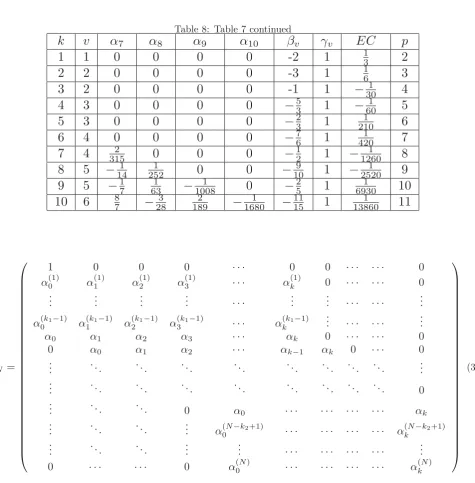
These coefficients are in Tables 7 and 8 fork = 1(1)10. According to [37] and [27] the local truncation error as-sociated with (17) is the linear difference operator
L[y(x);h] =jk=0αjy(x+jh)
−hβvy(x+vh)−h2y(x+vh). (19)
Assuming that y(x) is sufficiently differentiable, we can find the Taylor series expansion of the terms in (19) about the pointxto obtain the expression
L[y(x);h] =
C0y(x) +C1hy(x) +· · ·+Cqhqy(q)(x) +· · · (20)
where
C0=
k
j=0
αj, C1=
k
j=1
jαj+βv, , · · ·
IAENG International Journal of Applied Mathematics, 48:1, IJAM_48_1_01
Cq =
k
j=1 jqα
j
q! +
βvvq−1
(q−1)! −
vq−2
(q−2)!
We say that (17) has order p if
Cj= 0, j= 0(1)p and Cp+1= 0, (21)
see [31]. The Cp+1 is the error constant and Cp+1hp+1yp+1(x) is the principle local truncation error
at the pointx. The order equations (21) is equivalent to ⎡ ⎢ ⎢ ⎢ ⎢ ⎢ ⎢ ⎢ ⎣
1 1 1 1 1 . . . 1 0 0 1 2 3 4 . . . k 1 0 1 22 32 42 . . . k2 2v
0 1 23 33 43 . . . k3 3v2
..
. ... ... ... ... . . . ... ... 0 1 2q 3q 4q . . . kq qvq−1
⎤ ⎥ ⎥ ⎥ ⎥ ⎥ ⎥ ⎥ ⎦ ⎡ ⎢ ⎢ ⎢ ⎢ ⎢ ⎢ ⎢ ⎣ α0 α1 α2 .. . αk βv ⎤ ⎥ ⎥ ⎥ ⎥ ⎥ ⎥ ⎥ ⎦ = ⎡ ⎢ ⎢ ⎢ ⎢ ⎢ ⎢ ⎢ ⎣ 0 0 2 6v .. .
q(q−1)vq−2
⎤ ⎥ ⎥ ⎥ ⎥ ⎥ ⎥ ⎥ ⎦ (22) The order and the error constant of the SDGBDF (17) are shown in tables 7 and 8 fork= 1(1)10.
For the numerical solution of (1) the second deriva-tive BVMs with (k1, k2)-boundary conditions, the main method
k2
i=−k1
αi+k1yn+i=h k2
i=−k1
βi+k1fn+i+h2 k2
i=−k1
λi+k1fn+i ,
(23)
n=k1, . . . , N−k2
y0, . . . , yk1−1, yN, . . . , yN+k2−1 f ixed
together withk1−1 additional initial methods
k
i=0
α(ij)yi=h
k
i=0
βi(j)fi+h2
k
i=0
λ(ij)fi , (24)
j= 1, . . . , k1−1 andk2 final methods
k
i=0α(kj−)iyN−i=h
k
i=0βk(j−)ifN−i
+h2ki=0λ(kj−)ifN −i , j=N, . . . , N+k2−1 (25) can be expressed as
ANy−hBNf−h2CNf=
⎛ ⎜ ⎜ ⎜ ⎜ ⎜ ⎜ ⎜ ⎜ ⎜ ⎜ ⎜ ⎜ ⎜ ⎜ ⎜ ⎜ ⎜ ⎜ ⎝
k1−1
i=0 (αiyn+i−hβifn+i−h2λifn+i)
.. .
α0yn+k1−1−hβ0fn+k1−1−h2λ0fn+k1−1
0 .. . 0
αkyn+N −hβkfn+N −h2λkfn+N
.. .
k2
i=1(αk1+iyn+N−1+i−hβk1+i×
fn+N−1+i−h2λk1+ifn+N−1+i)
⎞ ⎟ ⎟ ⎟ ⎟ ⎟ ⎟ ⎟ ⎟ ⎟ ⎟ ⎟ ⎟ ⎟ ⎟ ⎟ ⎟ ⎟ ⎟ ⎠ (26)
whereAN andBN are defined similarly as in (12), while
CN is given in (41), y = (y0, . . . , yN)T is the discrete
solution,fand f are the first and second derivatives re-spectively, h is the step size and AN, BN and CN are
(N + 1)×(N + 1) matrices with the same structure as those in (12).
To analyze the stability of a specific method (26), (see, [30]) we apply (23) on the test problem
y =λy, y=λ2y (27)
to determine its boundary locus. The class of methods (17) yields the characteristics equation:
k
j=0
αjzj−(qβv+q2)zv= 0, q=λh, q∈C (28)
wherev is defined as in (16). Letting z =eiθ we obtain
two roots (since (28) is quadratic inq) for corresponding values ofk andv to give the stability regions defined by
q given in Figures 1 and 2 for odd and even values of
krespectively. Compared with the generalization of the BDF by Brugnano and Trigiante [8] discussed in section 1 the proposed class of methods (17) are found to have higher orderp=k+ 1 and a smaller error constant for corresponding values of the steplengthk, although with need to compute the second derivative for which it is not expensive for some autonomous stiff systems.
5
Implementation Procedure
In this section the implementation procedure for the SDGBDF(17) of order 4 and 5 as BVMs in the sense of Brugnano and Trigiante [7, 8] is presented. The pro-posed class of methods (17) is used with the following additional initial methods:
k
j=0
α∗jyj =hβifi+h2fi, i= 1,2,· · ·, v−1 (29)
and final methods:
k
j=0
α∗jyj=hβifi+h2fi, i=v+ 1,· · ·, N (30)
The SDGBDF (17) of order 4 which isA2,1-stable and
02,1-stable with (2,1)-boundary conditions requires two
initial methods (y0is already provided by the initial value defining the ODE (1)) and one final method. The fourth order SDGBDF (17) is given as:
−1
6yn+2yn+1− 5 2yn+2+
2
3yn+3=−hfn+2+h
2f
n+2 (31)
The main method ( 31) can be written in the form
−1
6yn−2+ 2yn−1− 5 2yn+
2
3yn+1=−hfn+h
2f
n (32)
n= 2,· · ·, N−1
IAENG International Journal of Applied Mathematics, 48:1, IJAM_48_1_01
and used with the following initial method
2 3y0−
5
2y1+ 2y2− 1
6y3=hf1+h
2f
1 (33)
and final method
2 9yN−3−
3
2yN−2+6yN−1− 85
18yN =− 11
3 hfN+h
2f
N (34)
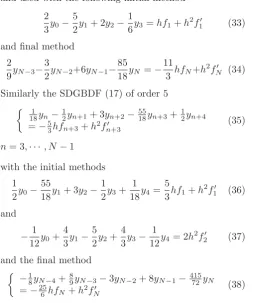
Similarly the SDGBDF (17) of order 5
1
18yn−12yn+1+ 3yn+2−5518yn+3+12yn+4
=−53hfn+3+h2fn+3
(35)
n= 3,· · ·, N−1
with the initial methods
1 2y0−
55
18y1+ 3y2− 1 2y3+
1 18y4=
5
3hf1+h
2f 1 (36)
and
−1 12y0+
4 3y1−
5 2y2+
4 3y3−
1
12y4= 2h
2f
2 (37)
and the final method
−1
8yN−4+89yN−3−3yN−2+ 8yN−1−41572yN
=−256hfN +h2fN
(38)
will be taken together as a BVM.
The methods (31 and 35) are implemented as BVMs ef-ficiently by composing the main methods and the addi-tional methods as simultaneous numerical integrators for the IVP(1). In particular for linear problems, we can solve (1) directly from the start with Gaussian elimina-tion partially using pivoting and for nonlinear problems we can use a modified Newton-Raphson method. In each case, the main methods and the additional methods are combined as BVMs to give a single matrix of finite dif-ference equations which simultaneously provides the val-ues of the solution and the first derivatives generated by the sequences {yn},{yn}, n = 0, . . . , N, where the
sin-gle block matrix equation is solved while adjusting for boundary conditions ([35]).
6
Numerical
Experiments
with
SDGBDF
We consider the following stiff problems (linear and non-linear) to illustrate the implementation and examine the accuracy of the SDGBDF (17) of orders p=4 (31) and 5 (35) implemented as block methods. The fourth order method (17) and the fifth order method (17) are denoted by SDGBDF4 and SDGBDF5 respectively.
Problem 1: A linear stiff problem, see [4, 10, 25, 43]
y1 =−21y1+ 19y2−20y3, y1(0) = 1,
y2= 19y1−21y2+ 20y3, y2(0) = 0,
y3 = 40y1−40y2+ 40y3, y3(0) =−1.
The SDGBDF4 is applied to this problem and the maximum absolute errors (|y(x) − yn|) in the
inter-val 0 < x < 10 are compared with the Adams type block method of Akinfenwa [4] (ATBM7), the general-ized backward differentiation formula of Brugnano and Trigiante [10](GBDF8) and theL(α)-stable block multi-step method of Ehigie and Okunuga [25] denoted by EH-OK5. The rate of convergence, Rateh = log2(errerr2hh) whereerrhis the maximum absolute error at steplength
h= 2n.1100, n= 0,1,2,3 and 4 , is used to verify the order of the methods. Also in comparison with the CBDF5
of degree s = 5 in Ramos and Garcia-Rubio [43], the AbsErr(tf) is obtained by the SDGBDF4 in the inter-val 0≤x≤1. It is observed that the new method even though it is of order 4 performs better than the EH-OK5, the ATBM7 and the GBDF8 of orders 5, 7 and 8 respec-tively. The details of the numerical results are displayed in Table 1. In Table 2, it is noticed that the SDGBDF4 is comparable with the EH-OK5 in [25] and theCBDF5
[image:5.595.38.292.106.410.2]in [43].
Table 1: Maximum absolute error, M ax1<i<N|yi(x)−
yi,n|for problem 1,h= 2n.1100
n SDGBDF4 EH-OK5 GBDF8 ATBM7 (Rate) (Rate) (Rate) (Rate) 0 2.28×10⁻¹⁷ 3.21×10⁻¹³ 1.19×10⁻³ 3.95×10⁻⁶ 1 1.56×10⁻¹⁸ 1.01×10⁻¹⁴ 1.39×10⁻⁵ 2.91×10⁻⁸
(3.87) (4.99) (6.42) (7.08) 2 1.02×10⁻¹⁹ 3.18×10⁻¹⁶ 1.08×10⁻⁷ 2.21×10⁻¹⁰
(3.93) (4.99) (7.00) (7.06) 3 6.21×10⁻²¹ 9.96×10⁻¹⁸ 1.08×10⁻⁹ 6.65×10⁻¹³
(4.04) (5.00) (6.64) (8.36) 4 9.45×10⁻²³ 3.11×10⁻¹⁹ 9.41×10⁻¹² 2.69×10⁻¹⁵
(6.04) (5.00) (6.84) (7.95)
Table 2: Numerical results in comparison with CBDF5
and EH-OK5 for problem 1 the interval 0≤x≤1
Steps SDGBDF4 EH-OK5 CBDF5
(Rate) (Rate) (Rate) 20 1.12×10⁻¹¹ 3.04×10⁻¹¹ 4.12×10⁻¹² 40 7.01×10⁻¹³ 9.75×10⁻¹³ 1.33×10⁻¹²
(4.00) (4.96) (4.95) 80 4.47×10⁻¹⁴ 2.25×10⁻¹⁴ 4.31×10⁻¹⁵
(3.97) (5.43) (4.95) 160 1.47×10⁻¹⁵ 9.69×10⁻¹⁶ 2.55×10⁻¹⁵
(4.93) (4.53) (0.75)
Problem 2: Non-linear stiff system solved by Wu and Xia [44]
y1 =−1002y1+ 1000y22, y1(0) = 1,
y2=y1−y2(1 +y2), y2(0) = 1,
IAENG International Journal of Applied Mathematics, 48:1, IJAM_48_1_01
The exact solution of the system is given by
y1(x) =e−2x, y2(x) =e−x
Problem 2 is solved using SDGBDF5 with a steplength
h= 0.008 in the range 0≤x≤1. The maximum error (Max|yi−y(xi)|) of the method is given in Table 3. From Table 3, it is obvious that the new method of order 5 is better than the methods of Ehigie et al [24] and Wu-Xia [44] and very comparable with the method of Jator and Sahi [36] which are of orders 5, 6 and 8 respectively.
Problem 3: Singularly Perturbed Problem
Table 3: Maximum error, Max|yi−y(xi)|, for problem 2
Method N h y1 y2
(Max|yi−y(xi)|) (Max|yi−y(xi)|) SDGBDF5 125 0.008 1.80×10⁻¹⁵ 6.11×10⁻¹⁶ Ehigie et al 125 0.008 3.88×10⁻¹⁴ 3.10×10⁻¹⁴
(BVM3)
Jator-Sahi 125 0.008 1.63×10⁻¹⁴ 0.00 Wu-Xia 500 0.002 2.56×10−07 8.02×10−08
y1 =−(2 + 104)y1+ 104y22, y2 =y1−y2−y22,
y1(0) = 1, y2(0) = 1 The exact solution is y1 = e−2t, y
2 = e−t, see [30].
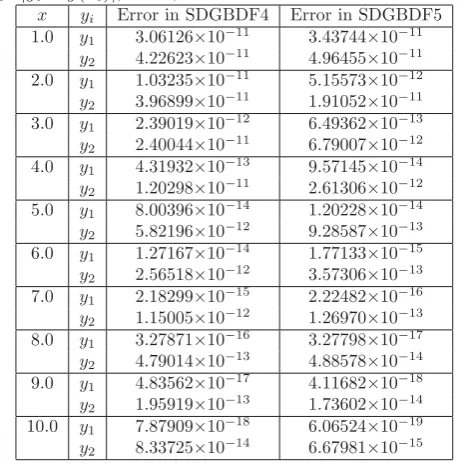
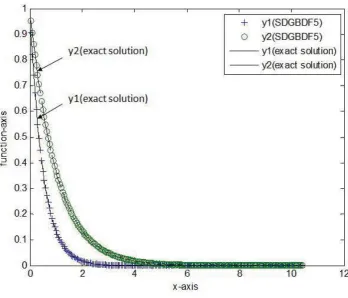
[image:6.595.304.533.266.402.2]The SDGBDF4 and the SDGBDF5 are applied to Prob-lem 3 and the results are compared with the theoreti-cal solution. The SDGBDF5 performs better than the SDGBDF4 as expected, see Table 4. Furthermore, take note that the graphs of the exact and the numerical so-lutions in Figures 3 and 4 coincide.
Table 4: Absolute error in problem 3, h = 0.01, Error
yi=|yi−y(xi)|, i= 1,2
x yi Error in SDGBDF4 Error in SDGBDF5 1.0 y1 3.06126×10⁻¹¹ 3.43744×10⁻¹¹
y2 4.22623×10⁻¹¹ 4.96455×10⁻¹¹ 2.0 y1 1.03235×10⁻¹¹ 5.15573×10⁻¹²
y2 3.96899×10⁻¹¹ 1.91052×10⁻¹¹ 3.0 y1 2.39019×10⁻¹² 6.49362×10⁻¹³
y2 2.40044×10⁻¹¹ 6.79007×10⁻¹² 4.0 y1 4.31932×10⁻¹³ 9.57145×10⁻¹⁴
y2 1.20298×10⁻¹¹ 2.61306×10⁻¹² 5.0 y1 8.00396×10⁻¹⁴ 1.20228×10⁻¹⁴
y2 5.82196×10⁻¹² 9.28587×10⁻¹³ 6.0 y1 1.27167×10⁻¹⁴ 1.77133×10⁻¹⁵
y2 2.56518×10⁻¹² 3.57306×10⁻¹³ 7.0 y1 2.18299×10⁻¹⁵ 2.22482×10⁻¹⁶
y2 1.15005×10⁻¹² 1.26970×10⁻¹³ 8.0 y1 3.27871×10⁻¹⁶ 3.27798×10⁻¹⁷
y2 4.79014×10⁻¹³ 4.88578×10⁻¹⁴ 9.0 y1 4.83562×10⁻¹⁷ 4.11682×10⁻¹⁸
y2 1.95919×10⁻¹³ 1.73602×10⁻¹⁴ 10.0 y1 7.87909×10⁻¹⁸ 6.06524×10⁻¹⁹
y2 8.33725×10⁻¹⁴ 6.67981×10⁻¹⁵
Problem 4: Van der Pol equations, see [30] (nonlinear problem)
y1=y2, y2 =−y1+ 10y2(1−y12),
y1(0) = 2, y2(0) = 0.
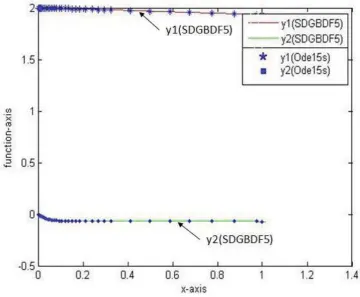
For problem 4, it is clearly seen from Table 5 and Figures 5 and 6 that the proposed class of methods compares favorably with the solution from the Ode15s in MATLAB.
Problem 5: Robertson’s equation, see [30] (nonlinear
Table 5: Errors in problem 4 using the modulus of the solution of SDGBDF minus the solution of Ode15s,h= 0.001. Error yi=|yiSDGBDF −yiOde15s|,i= 1,2
x yi Error in SDGBDF4 Error in SDGBDF5 1.0 y1 1.32308×10⁻⁴ 1.82747×10⁻⁵
y2 8.31878×10⁻⁶ 1.09583×10⁻⁶ 5.0 y1 3.36208×10⁻⁴ 1.47667×10⁻⁴
y2 2.22430×10⁻⁵ 3.98291×10⁻⁶ 10.0 y1 3.67025×10⁻⁵ 2.25767×10⁻⁴
y2 1.98333×10⁻⁶ 1.32565×10⁻⁵ 15.0 y1 2.46188×10⁻⁵ 6.92917×10⁻⁴
y2 3.09782×10⁻⁵ 7.75023×10⁻⁵ 20.0 y1 9.04906×10⁻⁵ 2.00872×10⁻⁴
y2 1.10280×10⁻⁵ 6.98618×10⁻⁶
problem)
y1=−0.04y1+104y2y3, y2= 0.04y1−104y2y3−3×10⁷y22,
y3 = 3×10⁷y22, y1(0) = 1, y2(0) = 0, y3(0) = 0.
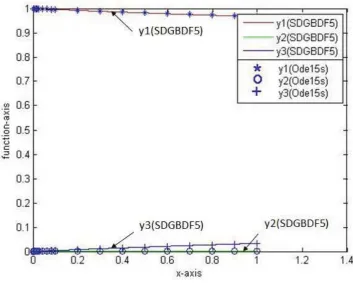
Problem 5 is solved by the SDGBDF4 and the SDGBDF5 and the results are compared with the solution from the Ode15s in MATLAB. It is observed from Table 6 and Fig-ures 7 and 8 that the new methods are very comparable with the Ode15s in MATLAB.
Table 6: Errors in problem 5 using the modulus of the solution of SDGBDF minus the solution of Ode15s,h= 0.0001. Erroryi =|yiSDGBDF−yiOde15s|, i= 1,2,3
x yi Error in SDGBDF4 Error in SDGBDF5 1.0 y1 2.31233×10⁻⁵ 6.11248×10⁻⁶
y2 3.68698×10⁻⁹ 9.74789×10⁻¹⁰
y3 2.31270×10⁻⁵ 6.11346×10⁻⁶ 3.0 y1 3.91192×10⁻⁶ 3.91187×10⁻⁶
y2 4.93245×10⁻¹⁰ 4.93239×10⁻¹⁰
y3 3.91241×10⁻⁶ 3.91236×10⁻⁶ 5.0 y1 1.02179×10⁻⁶ 1.02175×10⁻⁶
y2 2.95023×10⁻¹⁰ 2.95027×10⁻¹⁰
y3 1.02149×10⁻⁶ 1.02146×10⁻⁶ 7.0 y1 4.48772×10⁻⁵ 4.48771×10⁻⁵
y2 4.22263×10⁻⁹ 4.22262×10⁻⁹
y3 4.48814×10⁻⁵ 4.48814×10⁻⁵ 10.0 y1 7.35061×10⁻⁵ 7.35060×10⁻⁵
y2 5.76555×10⁻⁹ 5.76555×10⁻⁹
y3 7.35118×10⁻⁵ 7.35118×10⁻⁵
IAENG International Journal of Applied Mathematics, 48:1, IJAM_48_1_01
[image:6.595.44.277.541.773.2]Table 7: The Coefficients, Error Constant (EC) and Orderpof SDGBDF(18) fork= 1(1)10
k
v
α
0α
1α
2α
3α
4α
5α
61
1
2
-2
0
0
0
0
0
2
2
−
124
−
720
0
0
0
3
2
−
162
−
52 230
0
0
4
3
181−
123
−
5518 120
0
5
3
451−
142
−
49181
−
2010
6
4
−
1201 454−
12 83−
21772 45−
3017
4
−
2801 452−
1032
−
20572 65−
1018
5
7001−
561 19−
12 52−
544918001
9
5
15751−
1121 634−
132
−
52691800 4310
6
−
37801 5252−
1123 638−
12 125−
54891800Table 8: Table 7 continued
k
v
α
7α
8α
9α
10β
vγ
vEC
p
1
1
0
0
0
0
-2
1
132
2
2
0
0
0
0
-3
1
163
3
2
0
0
0
0
-1
1
−
3014
4
3
0
0
0
0
−
531
−
6015
5
3
0
0
0
0
−
231
21016
6
4
0
0
0
0
−
761
42017
7
4
31520
0
0
−
121
−
126018
8
5
−
141 25210
0
−
1091
−
252019
9
5
−
17 631−
100810
−
251
6930110
10
6
87−
283 1892−
16801−
11151
13860111
A
N=
⎛
⎜
⎜
⎜
⎜
⎜
⎜
⎜
⎜
⎜
⎜
⎜
⎜
⎜
⎜
⎜
⎜
⎜
⎜
⎜
⎜
⎜
⎜
⎜
⎜
⎜
⎜
⎝
1
0
0
0
· · ·
0
0
· · · ·
0
α
(1)0α
(1)1α
2(1)α
(1)3· · ·
α
(1)k0
· · · ·
0
..
.
..
.
..
.
..
.
· · ·
..
.
..
.
· · · ·
..
.
α
0(k1−1)α
1(k1−1)α
(2k1−1)α
(3k1−1)· · ·
α
k(k1−1)..
.
· · · ·
..
.
α
0α
1α
2α
3· · ·
α
k0
· · · ·
0
0
α
0α
1α
2· · ·
α
k−1α
k0
· · ·
0
..
.
. ..
. ..
. ..
. ..
. ..
. .. ... ...
..
.
..
.
. ..
. ..
. ..
. ..
. ..
. .. ... ...
0
..
.
. ..
. ..
0
α
0· · ·
· · · ·
α
k..
.
. ..
. ..
..
.
α
(N−k2+1)0
· · ·
· · · ·
α
(kN−k2+1)..
.
. ..
. ..
..
.
..
.
· · ·
· · · ·
..
.
0
· · ·
· · ·
0
α
0(N)· · ·
· · · ·
α
(kN)⎞
⎟
⎟
⎟
⎟
⎟
⎟
⎟
⎟
⎟
⎟
⎟
⎟
⎟
⎟
⎟
⎟
⎟
⎟
⎟
⎟
⎟
⎟
⎟
⎟
⎟
⎟
⎠
(39)
IAENG International Journal of Applied Mathematics, 48:1, IJAM_48_1_01
B
N=
⎛
⎜
⎜
⎜
⎜
⎜
⎜
⎜
⎜
⎜
⎜
⎜
⎜
⎜
⎜
⎜
⎜
⎜
⎜
⎜
⎜
⎜
⎜
⎜
⎜
⎜
⎜
⎝
0
0
0
0
· · ·
0
0
· · · ·
0
β
0(1)β
1(1)β
2(1)β
3(1)· · ·
β
k(1)0
· · · ·
0
..
.
..
.
..
.
..
.
· · ·
..
.
..
.
· · · ·
..
.
β
0(k1−1)β
1(k1−1)β
2(k1−1)β
3(k1−1)· · ·
β
k(k1−1)..
.
· · · ·
..
.
β
0β
1β
2β
3· · ·
β
k0
· · · ·
0
0
β
0β
1β
2· · ·
β
k−1β
k0
· · ·
0
..
.
. ..
. ..
. ..
. ..
. ..
. .. ... ...
..
.
..
.
. ..
. ..
. ..
. ..
. ..
. .. ... ...
0
..
.
. ..
. ..
0
β
0· · ·
· · · ·
β
k..
.
. ..
. ..
..
.
β
(N−k2+1)0
· · ·
· · · ·
β
(kN−k2+1)..
.
. ..
. ..
..
.
..
.
· · ·
· · · ·
..
.
0
· · ·
· · ·
0
β
0(N)· · ·
· · · ·
β
k(N)⎞
⎟
⎟
⎟
⎟
⎟
⎟
⎟
⎟
⎟
⎟
⎟
⎟
⎟
⎟
⎟
⎟
⎟
⎟
⎟
⎟
⎟
⎟
⎟
⎟
⎟
⎟
⎠
(40)C
N=
⎛
⎜
⎜
⎜
⎜
⎜
⎜
⎜
⎜
⎜
⎜
⎜
⎜
⎜
⎜
⎜
⎜
⎜
⎜
⎜
⎜
⎜
⎜
⎜
⎜
⎜
⎜
⎝
0
0
0
0
· · ·
0
0
· · · ·
0
λ
(1)0λ
(1)1λ
(1)2λ
(1)3· · ·
λ
(1)k0
· · · ·
0
..
.
..
.
..
.
..
.
· · ·
..
.
..
.
· · · ·
..
.
λ
0(k1−1)λ
1(k1−1)λ
(2k1−1)λ
(3k1−1)· · ·
λ
k(k1−1)..
.
· · · ·
..
.
λ
0λ
1λ
2λ
3· · ·
λ
k0
· · · ·
0
0
λ
0λ
1λ
2· · ·
λ
k−1λ
k0
· · ·
0
..
.
. ..
. ..
. ..
. ..
. ..
. .. ... ...
..
.
..
.
. ..
. ..
. ..
. ..
. ..
. .. ... ...
0
..
.
. ..
. ..
0
λ
0· · ·
· · · ·
β
k..
.
. ..
. ..
..
.
λ
0(N)· · ·
· · · ·
λ
(kN)..
.
. ..
. ..
..
.
..
.
· · ·
· · · ·
..
.
0
· · ·
· · ·
0
λ
0(N+k2−1)· · ·
· · · ·
λ
(kN+k2−1)⎞
⎟
⎟
⎟
⎟
⎟
⎟
⎟
⎟
⎟
⎟
⎟
⎟
⎟
⎟
⎟
⎟
⎟
⎟
⎟
⎟
⎟
⎟
⎟
⎟
⎟
⎟
⎠
(41)IAENG International Journal of Applied Mathematics, 48:1, IJAM_48_1_01
Figure 1: Stability region (exterior of closed curves) of (17), k=1 (2) 31
IAENG International Journal of Applied Mathematics, 48:1, IJAM_48_1_01
Figure 2: Stability region (exterior of closed curves) of (17), k=2 (2) 32
IAENG International Journal of Applied Mathematics, 48:1, IJAM_48_1_01
Figure 3: Numerical Results for Problem 3 with SDGBDF4, h=0.01
Figure 4: Numerical Results for Problem 3 with SDGBDF5, h=0.01
IAENG International Journal of Applied Mathematics, 48:1, IJAM_48_1_01
[image:11.595.110.459.455.753.2]
Figure 5: Numerical Results for Problem 4 with SDGBDF4, h=0.001
Figure 6: Numerical Results for Problem 4 with SDGBDF5, h=0.001
IAENG International Journal of Applied Mathematics, 48:1, IJAM_48_1_01
[image:12.595.102.463.456.753.2]
Figure 7: Numerical Results for Problem 5 with SDGBDF4, h=0.0001
Figure 8: Numerical Results for Problem 5 with SDGBDF5, h=0.0001
IAENG International Journal of Applied Mathematics, 48:1, IJAM_48_1_01
[image:13.595.107.461.464.747.2]7
Conclusion
The second derivative generalized backward differentia-tion formulae (SDGBDF) have been introduced in secdifferentia-tion (4). This class of methods is Av,k−v-stable and 0v,k−v
-stable with (v, k-v)-boundary conditions for values of
k ≥ 1 with order p = k+ 1. The new class of meth-ods is found to be suitable for the solution of stiff IVPs in ODEs for reason of their stability. The class of meth-ods (17) also finds application in the solution of boundary value problems, see [35, 39].
Acknowledgement
The authors are grateful to Prof. M.N.O. Ikhile (Director of ARLAB) and the anonymous reviewers for comments that have improved the quality of this work.
References
[1] L. Aceto, P. Ghelardoni and C. Magherini, Boundary Value Methods as an extension of Numerovs method for Sturm-Liouville eigenvalue estimates, Appl. Nu-mer. Math., 59, (2009), 1644-1656.
[2] L. Aceto and C. Magherini, On the relations between B2VMs and Runge-kutta collocation methods, Jour-nal of ComputatioJour-nal and Applied Mathematics, 231, (2009), 11-23.
[3] L. Aceto, P. Ghelardoni and C. Magherini, PGSCM: A family of P-stable Boundary Value Methods for second-order initial value problems,Journal of Com-putational and Applied Mathematics, 236, (2012), 3857-3868.
[4] O. A. Akinfenwa, Seven step Adams Type Block Method with Continuous Coefficient for Periodic Or-dinary Differential Equation,Word Academy of Sci-ence, Engineering and Technology, 74, (2011), 848-853 .
[5] B. I. Akinnukawe, O. A. Akinfenwa and S. A. Okunuga, L-Stable Block Backward Differentiation Formula for Parabolic Partial Differential Equations,
Ain Shams Engineering Journal, 7, (2016), 867-872.
[6] L. Brugnano and D. Trigiante, Convergence and sta-bility of boundary value methods for ordinary differ-ential equations,Journal of Computational and Ap-plied Mathematics, 66, (1996), 97-109.
[7] L. Brugnano, Boundary Value Methods for the Numerical Approximation of Ordinary Differential Equations, Lecture Notes in Comput. Sci., 1196, (1997), 78-89.
[8] L. Brugnano and D. Trigiante, Solving Differential Problems by Multistep Initial and Boundary Value Methods, Gordon and Breach Science Publishers, Amsterdam, 1998a.
[9] L. Brugnano and D. Trigiante, Boundary Value Methods: the third way between linear multistep and Runge-Kutta methods, Comput. Math. Appl., 36, (10-12), (1998b), 269-284.
[10] L. Brugnano and D. Trigiante, Block Implicit meth-ods for ODEs in: D. Trigiante (Ed.), Recent trends in Numerical Analysis, New York: Nova Science Publ. inc, 2001.
[11] L. Brugnano and C. Magherini, Blended Implicit Methods for solving ODE and DAE problems and their extension for second order problems, Jour. Comput. Appl. Mathematics, 205, (2007), 777-790.
[12] L. Brugnano, F. Iavernaro and T. Susca, Hamilto-nian BVMs (HBVMs): implementation details and applications, AIP Conf. Proc., 1168, (2009), 723-726.
[13] L. Brugnano, F. Iavernaro and D. Trigiante, Hamil-tonian BVMs (HBVMs): a family of drift-free meth-ods for integrating polynomial Hamiltonian systems,
AIP Conf. Proc., 1168, (2009), 715-718.
[14] L. Brugnano, F. Iavernaro and D. Trigiante, Hamil-tonian boundary value methods (Energy preserving discrete line integral methods), Journal of Numeri-cal Analysis, Industrial and Applied Mathematics, 5, 1-2, (2010), 17-37.
[15] L. Brugnano, F. Iavernaro and D. Trigiante, A note on the efficient implementation of Hamiltonian BVMs.Journal of computational and Applied Math-ematics, 236, (2011), 375-383.
[16] L. Brugnano, G. Frasca Caccia and F. Iavernaro, Efficient implementation of Gauss collocation and Hamiltonian Boundary Value Methods. Numer. Al-gor., 65, (2014), 633-650.
[17] L. Brugnano, F. Iavernaro and D. Trigiante, Anal-isys of Hamiltonian Boundary Value Methods (HB-VMs): a class of energy preserving Runge-Kutta methods for the numerical solution of polynomial Hamiltonian systems, Communications in Nonlin-ear Science and Numerical Simulation, 20, 3, (2015), 650-667.
[18] R. L. Burden and J. D. Faires, Numerical Analy-sis (9th Edition), Brooks/Cole, Cengage Learning, Boston, 2011.
[19] J. R. Cash, On integration of stiff systems of ordi-nary differential equations using extended backward differentiation formula, Numer. Math., 3, (1980), 235-246.
[20] J. R. Cash, Second Derivative Extended Backward Differentiation Formulas for the Numerical Integra-tion of Stiff Systems, SIAM Journal of Numerical Analysis, 18(1), (1981), 21-36.
IAENG International Journal of Applied Mathematics, 48:1, IJAM_48_1_01
[21] J. R. Cash, The Integration of Stiff initial value problems in ODEs using modified extended back-ward differentiation formula, Comput. Math. Appl., 9, (1983), 645-657.
[22] C. F. Curtis and J. O. Hirschfelder, Integration of Stiff Equations, National Academy of Sciences, 38, (1952), 235-243.
[23] G. Dahlquist, A special stability problem for linear multistep methods,BIT, 3, (1963), 27-43.
[24] J.O. Ehigie, S.N. Jator, A.B. Sofoluwe and S.A. Okunuga, Boundary value technique for initial value problems with continuous second derivative multi-step method of Enright,Computational and Applied Mathematics, 33(1), (2014), 81-93.
[25] J.O. Ehigie and S.A. Okunuga, L(α)-stable second derivative block multistep formula for stiff initial value problems,IAENG International journal of Ap-plied Mathematics, 44(3), (2014), 157-162.
[26] A. K. Ezzeddine and G. Hojjati, Hybrid Extended Backward Differentiation Formulas for Stiff Systems,
International Journal of Nonlinear Science, 12(2), (2011), 196-204.
[27] S. O. Fatunla, Block methods for second order IVPs,
Intern. J. Compt. Maths., 41, (1991), 55-63.
[28] V. G. Ganzha and E. V. Vorozhtsov, Computer-Aided Analysis of Difference Schemes for Partial Differential Equations, John Wiley and Sons., Inc., Canada, 1996.
[29] C. W. Gear, Numerical initial value problems in ordinary differential equations, Prentice-Hall, New Jersey, (1971), 253pp.
[30] E. Hairer and G. Wanner,Solving Ordinary Differ-ential Equations II: Stiff and DifferDiffer-ential Algebraic Problems, Second Revised Edition, Springer Verlag, Germany, 1996.
[31] P. Henrici, Discrete Variable Methods in Ordinary Differential Equations, Wiley, New York, 1962.
[32] F. Iavernaro and F. Mazzia, Block-Boundary Value Methods for the solution of Ordinary Differential Equations, SIAM J. Sci. Comput., 21(1), (1999), 323-339.
[33] F. Iavernaro and B. Pace, Conservative Block-Boundary Value Methods for the Solution of Polyno-mial Hamiltonian Systems, AIP Conf. Proc., 1048, (2008), 888-891.
[34] Z. B. Ibrahim, K. I. Othman and M. Suleiman, Vari-able Step Block Backward Differentiation Formula for Solving First Order Stiff Odes, World Congress on Engineering, (2007), 785-789.
[35] S. N. Jator and J. Li, Boundary Value Methods via a Multistep Method with Variable Coefficients for Second order initial and boundary value problems,
International Journal of Pure and Applied Mathe-matics, 50(3), (2009), 403-420.
[36] S. N. Jator and R.K. Sahi, Boundary value tech-nique for initial value problems based on Adams-type second derivative methods,International Jour-nal of Mathematical Education in Science and Tech-nology, 41(6), (2010), 819-826.
[37] J. D. Lambert,Numerical methods for ordinary dif-ferential equations, John Wiley and Sons, New York, 1991.
[38] J. R. LeVeque, Finite Difference Methods for Or-dinary and Partial Differential Equations, SIAM, 2007.
[39] Z.A. Majid, M.M. Hasni and N. Senu, Solving Sec-ond Order Linear Dirichlet and Neumann Bound-ary Value Problems by Block Method, IAENG In-ternational Journal of Applied Mathematics, 43(2), (2013), 71-76.
[40] F. Mazzia, Boundary Value Methods for the nu-merical solution of Boundary Value Problems in Differential-Algebraic Equations, Bollettino dellU-nione Matematica Italiana, (7) 11-A, (1997), 579-593.
[41] F. Mazzia and I. Sgura, Numerical approximation of nonlinear BVPs by means of BVMs, Appl. Numer. Math., 42 (2002), 337-352.
[42] H. Musa, A 2-Point Variable Step Size Block Ex-tended Backward Differentiation Formula for Solv-ing Stiff IVPs,Nigerian Association of Mathematical Physics, 28(2), (2014), 93-100.
[43] H. Ramos and R. Garcia-Rubio, Analysis of a Chebyshev-based Backward Differentiation Formu-lae and Relation with Runge-kutta Collocation Methods,International Journal of Computer Math-ematics, 88, 3, (2011), 555-577.
[44] X. Wu and J. Xia, Two low accuracy methods for stiff systems,Appl. Math. Comput., 123, (2001), 141-153.