$3.00
TABLE OF CONTENTS
Word Processing
Word Processing at Micro C ... 4
Words tar, A Word Processor ... 4
Vedit, A Text Editor ... 5
Two Great Spells ... 6
Smartkey ... 8
Scribble, A Text Formatter ... 8
Tiny Basic In ROM ... 15
Double Density ... 19
REGULAR FEATURES
Letters ... 2
FORTHwords ...
~... 10
Designer's Corner ... 12
Z-80 CPU! 64K RAM!
THE FERGUSON PROJECT: Three years In the works, and maybe too good to be true. A tribute to hard headed, no compromise, high performance, American engineering! The Big Board gives you all the most needed computing features on one board at a very reasonable cost. The Big Board was designed from scratch to run the latest version of CP/M*. Just imagine all the off-the-shelf software that can be run on the Big Board without any modifications needed! Take a Big Board, add a couple of 8 inch disc drives, power supply, an enclosure, C.R.T., and you have a total Business System for about 1/3 the cost you might expect to pay.
SIZE: 8';' x 13]/, IN. (64K KIT BASIC lID)
SAME AS AN 8 IN. DRIVE. REQUIRES: +5V @ 3 AMPS + - 12V @ .5 AMPS. FULLY SOCKETED! FEATURES: (Remember, all this on one board!)
64K RAM
Uses industry standard 4116 RAM'S. All 64K is available to the user, our VIDEO and EPROM sections do not make holes in system RAM. Also, very special care was taken in the RAM array PC layout to eliminate potential noise and glitches.
Z-80 CPU
Running at 2.5 MHZ. Handles all 4116 RAM refresh and supports Mode 2 INTERUPTS. Fully buffered and runs 8080 software.
SERIAL 1/0 (OPTIONAL)
Full 2 channels using the Z80 SIO and the SMC 8116 Baud Rate Generator. FULL RS232! For synchronous or asynchronous communication. In synchronous mode, the clocks can be transmitted or received by a modem. Both channels can be set up for either data-communication or data-terminals. Supports mode 21nl. Price for all parts and connectors: $65.
BASIC 1/0
Consists of a separate parallel port (Z80 PIO) for use with an ASCII encoded keyboard for Input. Output would be on the 80 x 24 Video Display.
BLANK PC BOARD - $175
24 x 80 CHARACTER VIDEO
With a crisp, flicker-free display that looks extremely sharp even on small monitors. Hardware scroll and full cursor control. Composite video or split video and sync. Character set is supplied on a 2716 style ROM, making customized fonts easy. Sync pulses can be any desired length or polarity. Video may be
inverted or true. 5 x 7 Matrix - Upper & Lower Case
FLOPPY DISC CONTROLLER
Uses WD1771 controller chip with a TTL Data Separator for enhanced reliability. IBM 3740 compatible. Supports up to four 8 inch disc drives. Directly compatible with standard Shugart drives such as theSA800 or SA801. Drives can be configured for remote AC off-on. Runs CP/M" 2.2.
TWO PORT PARALLEL 1/0 (OPTIONAL) I Uses Z-80 PIO. Full 16 bits, fully buffered, bl-directlonal. User selectable hand shake polarity. Set of all parts and connectors for parallel 1/0: $19.95
REAL TIME CLOCK (OPTIONAL)
Uses Z-80 CTC. Can be configured as a Counter on Real Time Clock. Set of all parts: $9.95
CP/M* 2.2 FOR BIG BOARD
The blank Big Board PC Board comes complete with full documentation (including schematics), the character ROM, the PFM 3.3 MONITOR ROM, and a diskette with the source of ourBIOS, BOOT, and PFM 3.3 MONITOR.
The popular CP/M" D.O.S. to run on Big Board is available for $159.00.
PRICE CUT!
PFM 3.3 2K SYSTEM MONITOR
The real power of the Big Board lies in its PFM 3.0 on board monitor. PFM commands include: Dump Memory, Boot CP/M", Copy, Examine, Fill Memory, Test Memory, Go To. Read and Write 110 Ports, Disc Read (Drive. Track, Sector), and Search. PFM occupies one of the four 2716 EPROM locations provided.
Z-80 is a Trademark of Zilog.
Digital Research Computers
(OF TEXAS)
P.O. BOX 401565 • GARLAND, TEXAS 75040 • (214) 271-3538
TERMS: Shipments will be made approximately 3 to 6 weeks after we receive your order, VISA, MC, cash accepted. We will accept COD's (for the Big Board only) with a $75 deposit. Balance UPS COD. Add $4.00 shipping.
MICRO CORNUCOPIA 11740 N.W. West Road Portland, Oregon 97229
503-645-3253
Editor & Publisher David J. Thompson Technical Editor Ruth Fredine-Burt
Graphic Design Sandra Thompson
Typography
Patti Morris & Martin White Irish Setter
Cover Illustration Gerald Torrey
MICRO CORNUCOPIA is pub-lished six times a year by Micro Cor-nucopia of Oregon, 11740 N.W. West Road, Portland, Oregon
97229.
SUBSCRIPTION RATES: 1 yr. (6 issues)
1 yr. (Canada & Mexico) 1 yr. (other foreign)
$16.00 $20.00 $26.00
All subscription orders payable in United States funds only, please. ADVERTISING RATES: Available on request.
CHANGE OF ADDRESS:Please send old label and new address. SOFnWARE, HARDWARE, AND BOOK VENDORS: Micro Cornu-copia is establishing a group of re-viewers. We would very much like to review your Big Board compatible products for Micro C. Please send material to Review Editor, Micro Cornucopia.
WRITER'S GUIDELINES: All items should be typed, double-spaced on white paper or better yet, on disk. (Your disk will be returned promptly.) Payment is in contribu-tor's copies.
LEITERS TO THE EDITOR: Please sound off.
CP/M is a trademark of Digital Research, Inc.
Copyright 1981 by Micro Cornucopia. All rights reserved.
IICID CDllfUCD'l1
April 1982
The Journal of the Big Board Users
No.5
All Write!
Word Processing
Well, here it is, word processing from one who processes words hour upon hour, day after day. Actually I don't write text all the time, it just seems like it.
Quite a bit of this issue is devoted to word processing, but it barely scratches the surface of this im-mense field. The software I am now using is not necessarily the best; it's what I'm using, and it does the job very well. If it didn't do the job well, I wouldn't be able to produce Micro C in my "spare time."
New Products
The last month or so has been very interesting for us. We have been try-ing to get several new thtry-ings ready to distribute to the group. It's really a lot of work. Even an apparently sim-ple task like putting together a new User disk almost didn't get done in time for this issue.
This process really makes me ap-preciate the amount of effort that goes into getting a product ready for market. It was March before we be-gan shipping FORTH; IN ROM de-spite being certain in early January that it was "a smidgin away from perfection." Thanks to Hampton Miller, Arne Henden, Sig Peterson, and, of course, Rob Devoe, FORTH IN ROM got shaken out very stoutly. (And having it resident in the system is really growing on me.)
'Undo' carefully
A couple of poor folks have called asking how to undo the damage they did to their directory after 'Un-doing the Fatal Erase' (see page 10 in issue #4).
They didn't reboot the monitor (a HARDWARE reset) after correcting the directory.
If you don't want to take any chances with your disks, simply use the Memory command (MF72F) and change the OA8H 'write' back to a 088H 'read' manually. Then you can read-on (not write-on) in peace.
Delivery time for Micro C has al-ways been slow because we are mailing bulk ra te.
Issue #1 took 7-10 days on the west coast and 14-21 days on the east coast. Issue #4 took 15-25 days on the west coast and the east coast is still receiving it (after 41 days). My father-in-law lives about 15 miles from here and he received issue #4 on February 25th. We mailed issue #4 on February 5th.
Also, bulk mail gets lost fairly eas-ily. One subscriber has yet to receive an issue via bulk mail (his subscrip-tion began with issue #1), but he has received every follow-up issue we sent via first-class (same label).
Bulk mail does not get forwarded. Period. Even if you leave a forward-ing address and bribe your postman, the post office simply ash-cans bulk mail if you're not there.
Anyway, I thought I'd let you know what the situation is. I suspect that more folks will opt for first-class once they find out the kind of service they are getting from the post office. First-class is still very good. Three days seems to be the maximum any-where in the US.
Final note
Daryl Coulthart, author of "Translating Your Keyboard" in is-sue #4 was also the source of the De-signer's Corner in that issue. Thanks Daryl.
0 ; 1 . /
~
David ThompsonDear Editor,
Congratulations on producing three excellent issues of Micro-C.
I bought a bare Big Board early in 1981 and over a period of about 6 months, ac-cumulated enough parts to bring it up. I'm using it with a Keytronics Word Processor keyboard and a converted TV set. I had two problems with the board when I first turned it on: 1) a bad data bus buffer and 2) extreme instability in the video crystal oscillator (!?!). To be fair to Digital Research, I did not buy the crystal from them, but got it from Quality Com-puter Parts in California. The fix was easy: a 100 pf capacitor from pin 13, U11 to ground.
One should be verrry careful with the 4 MHz mod in Micro-C #2. The asym-metric clock does not satisfy Z80A specs. I tried two Z80A's. One ran the monitor memory test OK, but crashed when I tried to run CP/M (wiped out the direc-tory, too). The other Z80A seemed, at first, to run everything OK but after about 10 minutes certain instructions started to fail a few percent of the time. I could get the processor to work again by dabbing alcohol on it, cooling it off.
Evi-IS YOUR DEvi-ISK DRIVE WORKING OVERTIME WITH ONLY MEDIA WEAR TO SHOW FOR IT?
Your floppy drive r o t a t e s disks constantly,grinding d i r t into the delicate surface which contributes to shortened media l i f e while
I g e n e r a t i n g unnecessary n o i s e . Our Drive Control Unit energizes the drive only when disk access is absolutely necessary. Media lasts longer and the system is quiet.
DCU is the best solution for drive A.C. cont roI.
Big Board owners no longer have to look for connectors ,re1ays,and a place to put them. DCU COmes complete with everything and is designed to be e a s i l y i n s t a l l e d within all popular 8 In. drives. DCC mOllnts on the di~k AC connector and eVen energizes only on Zero crossings.Au" output available for 2nd drive. (Big Board should have the CTC option)
Please order DCU/BB for Big Roa rd syst <'ms, for a II other systems order DCV and stale type of drives and controller used in your system.
nCl! is "vail"hle in kit form for
$18.95 0 r ,. sse m b 1 e d $ 2 9.9 5 • por 30in. 2nd drive harness add
$3.00
oPTROlles
TECHIOllSI
716'3770369
PO. BOX 81 PITTSFORD NY 14534
dently, as the Z80A heats up, the inter-nal timing changes just enough to make some instructions unreliable.
My next project for the Big Board is to interface a graphics display to the paral-lel port (probably something similar to the Micrograph display described in By-te) and use the Big Board-graphics dis-play to emulate a Tektronix 4010. I would be very interested if other Big Board owners have ideas on the subject. Ken Stephenson
Physics Division
Argonne National Laboratory Argonne, IL 60439
Dear Editor,
What's our exciting adventure? We are trying to interest a large corporation here in building its own micros (20-30). We have the staff and expertise to do it, and the corporation wants to use micros but it is afraid of the lack of support from lo-cal agents.
We provide hardware and software support for our own minis (Four-Phase 1V90s) throughout Kuwait, Saudi, and Iraq.
Now the corporation wants micros scattered around the Gulf for production and materials control systems and also as front-end processors for equipment and labor systems. This remote process-ing will cut down on communications from the sites to the headquarters. (You can imagine what data communications is like here-you tell Ahmad to ride his camel to the head office with the tapes.)
If we can talk the corporation into as-sembling its own micros, it will be cheaper and support will be guaranteed. A few spare boards on hand will do the trick.
Todd L Davis
Computer Department ICG
Box 25068 Safat, Kuwait
Dear Editor,
Thank you very much for sending me issues 1-3 of Micro Cornucopia. I found the quality of the editorship and con-tents outstanding, and look forward to receiving further issues.
I am grateful for the tip that the 8th bit on the keyboard can be used despite the statement in the BB manual. So, I have purchased a surplus Keytronic keyboard with 12 8-bit special function keys and am now working on a patch to the
key-board area of the ROM so I can use these functions.
Incidentally, I changed my flashing cursor by using DDT to create the follow-ing program at 100H.
MVIA,85 STAFF76 RET
I then 'SAVED' it as CURSOR. COM. It's not a true reverse video type of flash-ing cursor but I find it very useful when using DATASTAR to enter fields of dashes.
Also, I noted that one of the letters in issue #4 (pg 2) mentioned random up-per/lower case changes. I had that prob-lem and after much playing with the stash routine at FF33H, I traced the trou-ble to the keyboard encoder. It was generating random control codes. So, I was immediately in the market for a new keyboard.
Peter Duckworth 11 Chelsea Embankment London SW3 4LE Dear Editor,
I wanted to let you know how much I enjoy each issue of Micro C. In addition to being technically and graphically 'top shelf', one of its best features is its dis-tinct personality. It certainly is a publica-tion with' a great deal of heart.
I'd like to suggest that Micro C contin-ue and perhaps even increase its promo-tion of program readability by encourag-ing authors to clearly document their programs. (Perhaps they should read Software Tools by Kernighan & Plauger.
If space permits, I'd like to see each program accompanied by its functional equivalent in 'algorithmic language', a flowchart, or a paragraph of text (in that order).
As you can tell, program clarity and readability is one of my personal cru-sades and I'd like to volunteer to walk through some programs before they are published. My bookshelf includes both the Kernighan and Plauger book (the lat-est edition in Pascal) and Brodie's book on FORTH. (A neat book. I can tell from reading it that he and I would probably be great friends.) And I wish to help Mi-cro C become even better.
Philip Plumbo 1128 Dayton Ave St Paul MN 55104 Editor's note:
Thank you very much for the offer, Phil. I
will definitely be taking you up on it.
ANNOUNCING
THE BIG BOARD ADD--ON
•••• FEATURES ••••
Program
2708, 2716, 2732,
and
2764
type EPROHS. With four programming
sockets you can program lots of memory at once.
Programs EPROMS sequentially
or in parallel for small production runs.
Second bank (64K) of memory will allow fast screen swaps, larger EPROM
program storage, etc. Memory is fully-static 6116 CMOS type RAMS which will
allow RAMIEPROM intermixing. Battery back-up for CMOS RAM.
More goodies.
Sixteen channels of both 8-bi t
AIDand
01A conversion.
Connect any of the FCC approved modems by NOVATION directly into the board.
Plus, there's an S-100 connector which will allow you to connect an S-100
card directly or interface with an S-100 motherboard.
And speaking of
features, voice output with the on-board VOTRAX phoneme generator chip.
All this plus: four serial channels, four parallel ports, everything
socketed, and it runs at 4 MHz. (In fact, with all this, you may just forget
about the Big Board altogether!)
This is the board you have been waiting ror.
This board is intended for
the serious builder and the novice alike.
It will be available in bare
board, full kit, partial kits, and assembled and tested.
The board has the
same dimensions as the BIG BOARD so it piggy-backs into the same space.
Available
3/20/82.Bare board . . . • . . . $
Complete package
All Prices Plus Postage
•••• OTHER BIG BOARD ACCESSORIES ••••
99.00
CALL
Big Board power supply kit (BB
+2 DRIVES
+ ) ••••••••••••••$ 85.00
Big Board power supply A&T ••••••••••••••••••••••••••••••••• 135.00
C.ITOH 8510 9xN matrix, graphics, 5 char sets printer (ser.) 645.00
C.ITOH 8510 same as above but par. interface •••••••••••••••• 595.00
4Mhz mod that WORKS •••• $7.50
BIG BOARD PARTS...
CALL
E.C.R.L.,INC.
P.O. BOX
387
CANBY, OREGON
97013-0387
Word Processing At Micro C
By
David Thompson
I
can visualize myself doing my writing off on some quiet mountain meadow or a secluded, sheltered beach, a place far away from the bus-tle and jangle that normally sur-rounds me. So, writing could once again be my connection with a mys-tical self.Unfortunately, however, 1 will no longer wander off with a pen, a pad, and a crust of bread to tirelessly scratch out prose. The bread sounds OK but 1 refuse to scrawl ideas, one by one onto a piece of college-ruled wood pulp.
So, until someone comes up with a compact, CMOS Big Board, I'm tied to a power line because I'm ab-solutely addicted to word process-ing.
1 am now using the following software.
1. Vedit (text editor) 2. Scribble (formatter) 3. The Word (spelling) 4. Unica (unix-like functions) 5. My typesetting formatter And the following hardware.
1. The Big Board (three 8" drives) 2. MX-80 printer (dot matrix) 3. Diablo 1650 printer
Word processing at Micro C Almost everything in the maga-zine has come in on disk. 1 do an ini-tial edit before dumping new articles out on the Epson printer. This out-put gets the final editing.
After I've entered all the changes on the articles, Sandy takes new printouts and character counts (done by Unica) and lays out the is-sue. She specifies type sizes, high-lights subheads, figures out head-lines, and so on. This process takes about a week.
Once Sandy has things pretty well placed and specified, 1 enter the typesetting control codes so that the type will come out the right face, size, spacing, width, etc. This usu-ally takes three or four evenings.
Once all the text is ready to go to typesetting, 1 run it through a refor-matting program (ala Lynn Coch-ran) that makes the disk readable by the typesetting controller. Now Patti Morris and Martin White get to
cor-rect all the formatting errors I made (the after-l a.m. ones are the most interesting) and then output the typeset copy.
We get the typeset text in sheets (called galleys) and Sandy then spends a week pasting them onto large two-page boards called flats. If
we find any drastic errors then we have to have some type reset, other-wise we just vow to do better next issue (vows are better than nothing) and plug on.
After the flats are finished we heave a big sigh of relief and take them down to Dave Cramer (the printer). About a week later we get back 24,000 pages of magazine to collate, staple, trim, label, resort, count, and mail.
The whole process from the time the writing and editing are finished
to the time we mail an issue takes 4 to 5 weeks.
50,1 get 3, maybe 4 weeks to select the material for the next magazine, write any additional articles, review any relevant or irrelevant software, and get the editing done.
Meanwhile I'm getting further and further behind on correspon-dence, as many contributors well know. (I love you all and 1 think of you in my dreams when 1 have time.) Therefore, extra little projects like entering the Crowe Assembler source take 6 months or more and neat little software tools don't get done.
1 no longer have any trouble fo-cusing my energies, just fofo-cusing my eyes.
• ••
Wordstar, A Word Processor
Review
by
Jim Showker, Jr.
Without question, Wordstar is the most popular word processing program on the market. It is the mainstay of the Micropro line and everything the company sells is an extension for Wordstar.
1 got the Big Board so that 1 could write letters and technical articles at home. So it is very nice having a sys-tem that works well with Wordstar. The BB emulates an ADM3-A which is on the Wordstar configura-tion menu. This makes it very easy to get up and running since you don't have to make any software patches.
Using Words tar
Wordstar's best feature is its main menu which is displayed at the top of the screen. This menu tells you your page and line number, the file name, and a list of common com-mands.
1 especially like this feature be-cause 1 have a hard time remem-bering control-character type com-mands. (This also means that almost
11174 Penrose St. #6 Sun Valley, CA 91352
anyone cali. sit down and begin us-ing it immediately.)
Features
You can have the program right-justify your text. It does this by ad-ding spaces between words. If you have a variable pitch printer it will add a small part of a space between each letter rather than adding a few whole spaces.
Wordstar does continuous wrap-around. You only have to hit a car-riage-return at the end of a para-graph.
The program has a buffer so it can do such things as printing one docu-ment while you are editing another, or letting you type ahead of the screen without losing characters. If
you run out of RAM space while you are typing, part of the file is auto-matically written out to the disk without interrupting you.
Page breaks are displayed as a line on the screen. Special outputs
WORD PROCESSING
Vedit, A Text Editor
By
David Thompson
If I had to describe Vedit in a few words, I would say that it's small (11K), fast (works primarily in memory rather than on and off the disk), simple (but becoming less so with all the new features they are ad-ding), and user friendly (it operates predictably) .
Configuring Vedit for the Big Board is simple: you select 'Xerox 820' from the menu, choose which control keys will perform which functions, and you're set. (It's a real advantage to have famous off-spring.)
One thing I particularly like about Vedit is that it doesn't do its house-keeping in the file. Words tar does this with a vengeance and so printers, assemblers, typesetters, utilities, and other editors
some-(Words tar continued)
elude underlining, double strike, boldface, and overstrike.
Mailmerge (an option) lets you produce personalized form letters and do some other special types of printing.
Words tar relabels the original file as a backup and the just-edited file becomes the document file (this is standard for text editors).
There is a special mode for creat-ing and altercreat-ing assembly language source files. Editor's note: This non-document mode doesn't fill the file with special Words tar con trol characters.
Negatives
Words tar is quite expensive and unless you need all of its facilities the cost is hard to justify. It also takes a while to become conversant with all the features, but the menu makes it quite easy to get started.
All in all, W ordstar comes close to being a universal word processor. It will handle almost any conceivable task. Whether it is worth the money is up to you.
MicroPro 1299 Fourth St San Rafael, CA 94901
•••
Micro Cornucopia, Number 5, April 1982
times gag when they see Wordstar files. If you are preparing material for other folks (including Micro C) please run Wordstar in the non-doc-umentmode.
Running Vedit
Vedit works in two modes, visual and command. Visual mode does what you'd expect any true screen editor to do. You can go scrolling around, typing over text, inserting text, deleting text, and moving text from one place to another. An 'un-do' command returns the current line to its original form. In visual mode the commands are CNTL-KEY and ESC-KEY sequences.
The command mode is a very powerful line editor with many more features than CP 1M's ED and a much better user interface. You do the global searches and replaces in the command mode and you can change many of the system setups such as tab stops, indentation, and line width. You can insert all or part of a disk file into the file you're edit-ing, or you can send any part of the file you're editing to the printer or the disk. (And that's just a start.) In this mode, one or two ordinary char-acters make up a command.
The manual
I tend to use a manual as little as possible. I like to skim through it ini-tially to get wind of how a package should work and then I refer back when I don't know how to do some-thing. Vedit's short tutorial, the de-tailed command descriptions, and the brief command descriptions work quite well for me. There are more sections in the manual but I haven't read them and probably won't ever need to. It's a clear, com-plete manual.
Updates
During the last five or six months I've seen three updates. Each has added a significant feature to Vedit.
For instance, they have added a simple word-fill formatting function that fills each line of a paragraph to within one word length of the line width you specify. They have also
added word-wrap which automati-cally adds a carriage-return, linefeed each time your line reaches the spec-ified length. This feature is particu-larly important when you are en-tering text from written copy and don't want to have to watch the screen.
The following are some improve-ments they say are coming:
1. A split screen display to let you see what you're doing in command mode.
2. Easier to use search and replace commands (yippee).
3. Conditional global substitution using the visual mode.
4. Making the command mode more powerful and more T eco-like.
5. Adding additional text registers (yahoo).
6. Execute text registers as macro commands (hooray).
7. Do extensive terminal initializa-tion such as programming funcinitializa-tion keys.
Once you have purchased Vedit, you can subscribe to the update ser-vice. For $50.00 you get two updates (once every few months). And, con-sidering the additions they are plan-ning to the editor it would certainly appear worth it.
Bug
I have found only two bugs in the latest version of Vedit. The configu-ration doesn't set the word wrap line length correctly (but the command mode does), and occasionally I lose a character or two when I have it for-mat a paragraph.
Conclusion
Vedit is a very powerful text editor though it doesn't have the menuing or complete word processing facili-ties that Wordstar has. However, at only $145.00 Vedit does a lot for the price.
Vedit
Compu View Products 618 Louise
Ann Arbor, MI 48103
•
••
Two Great Spells
By
David Thompson
I
would be lost without a good spelling program to make a final check of the Micro C text before it goes to the typesetter. A good spell-ing program not only points out those little differences of opinion be-tween my built-in dictionary and Webster's latest, it also ferrets out most of those buggy little typos.I have two spelling programs, both donated for review by their au-thors (bless their hearts). I have used The Word on issues #3 and #4. I re-ceived Spell after completing issue #4.
They are both first class. They both work quickly and efficiently even though their methods and lists of features are quite different.
User friendliness
The Word is friendly until you have to review the words. REVIEW shows you only one word at a time and the word is all upper case. This makes it difficult to remember how it was used. Also, it is frustrating to not be able to invoke LOOKUP from
REVIEW. I spend many minutes looking up words in myoId Web-ster's so I'll know if the word should be marked or added to the user dic-tionary. (Note, The Word's new ver-sion, announced at the Computer Faire lets you use LOOKUP and en-ter corrections while reviewing sus-pect words, and it will display the words in context-rates a 5 in this category. However, The Word Plus, as this extended version is called, costs $150.00. The original Word is still available for $75.)
Meanwhile, Spell presents a true upper/lower case display of the questioned word which helps a lot. Was the word 'TI' (Texas Instru-ments) or 'ti' (it backwards)? Spell also forces me to go to Webster's be-fore adding questionable words to its dictionary. In fact the conse-quences of adding an incorrect word to the Spell dictionary are worse than for The Word.
The Word keeps the user addi-tions in a separate, plain-language file that I can go back and edit at any
time. So if I goof and add an incor-rect word, I can remove it. Spell in-corporates any new words into the hash table so there is no way to re-view the words I have added and there is no way to remove a word.
Versatility
Here, The Word really shines. WORDFREQ, WC, FIND, and LOOKUP are all very useful func-tions that are only available in The Word. Plus, each of the functions is a separate program which means you can use them individually.
Price/Performance
Compared with $200.00 or more for less adequate performers, both of these packages qualify as the real bargains in spelling software.
Disk space requirement
I like to keep spelling software on line all the time, so size is significant. (If it's not there I tend not to use it when I should.) The Word is defi-nitely larger, so if you are using only
The Word
Oasis Systems Descriptions Price: $75.002765 Reynard Way San Diego, CA 92103
Dictionary size 45,000 + words, 138K bytes.
Word storage Complete words in alphabetical order (words not separated into roots, prefixes, and suffixes).
Compression scheme
normal compressed ABACK 3NDON 7ING 7MENT ABACK
ABANDON ABANDONING ABANDONMENT
Word display Words are displayed as all capitals (one area where The Word is not as user-friendly as Spell).
Utilities
DICTSORT . COM 2K FIND .COM 1K LOOKUP .COM 2K MAINDICT . CMP 139K MARK .COM 2K REVIEW .COM 2K SPELL . COM 3K WC .COM 1K WORDFREQ.COM 2K TOTAL 154K
DICTSORT file.ext
Alphabetizes file.ext so it can be used as a dictionary or mark source.
FIND tr??
Returns all four-letter words beginning with tr. LOOKUP mispeled
Returns dictionary words similar to word specified (in this case would return 'misspelled').
MARK text.fil
Marks misspelled words in text.fil (prepends an *). Any alphabetically ordered file can be a source of words to mark. REVIEW
Takes words from the error file and lets you choose to throw them away, use them to mark the text file, or update user dictionary.
SPELL text.fil
(1) Check words against standard dictionary. (2) Check words against user dictionary(ies). (3) List words to screen, file, printer (any or all). (4) Can ignore lines beginning with a period or colon. (5) Can ignore words with all capital letters (VERY handy if your copy includes listings).
WC text.fil
Counts the number of words in text.fil. WORDFREQ text.fil
one or two single-density drives, space is a real consideration.
Dictionary expansion
Both spelling packages make it easy for you to expand the number of words they will recognize. The Word lets you add words to you heart's content. The only penalty is tha t the user dictionary grows as you add words. (My user dictionary is only 3K-about a hundred words-so that doesn't appear to be much of a problem.)
Spell has somewhat limited ex-pandability because of the trade-off between the size of the dictionary and the accuracy. Also, Spell doesn't let you review or remove words you've added to the diction-ary.
Roots vs whole words
By storing only the roots in its dic-tionary, Spell gains a real size ad-vantage over standard spelling rou-tines. Also, Spell gives you the advantage of only having to enter a word into its dictionary once. You won't see 'involvement' and 'involv-ing' as errors after entering 'in-volve'. On the other hand, Spell will not detect incorrect use of prefixes or suffixes (The Word will).
Speed
Spell checked a 5K text file in 27 seconds finding 14 suspects, it checked a 52K file in 131 seconds finding 167 suspects. The Word checked the 5K file in 63 seconds finding 5 suspects, and it checked the 52K file in 108 seconds finding 148 suspects.
There were 12 incorrect words in the 52K file; both found all 12.
Conclusion
If I were to purchase a spelling program today it would certainly be one of these. If I had double density, and did crosswords, the choice would be The Word, hands down. If I had one or two drives, single den-sity, and used the program only oc-casionally then I would lean toward Spell.
Comparison Table
Word
3 5 5 3 5 4
Spell 4
3 5 5 3 4
l=POOR 3=GOOD 5=EXCELLENT
User friendliness Versatility
Price/Performance Disk space required Dictionary Expansion Speed
•••
Spell's Data Compression
Spell adds a word to the dictionary by hashing it (using its characters to calcu-late a number) and using the number as the address of a bit in the dictionary (table). That bit is set to one.
This hashing is done six more times, each time using a different function to calculate an address, and each time set-ting the addressed bit to one (even if the bit had been set to one by a previously entered word).
The program then checks a word against the dictionary by hashing the word with the seven functions and then verifying that the seven bits addressed are ones. If any are zeros, then Spell checks to see if it can strip off any pre-fixes or sufpre-fixes. If so, it goes through the hash routine again, if not, it reports the word as an error.
Of course, as more and more words are added to the dictionary, it begins to fill with ones. As this happens it be-comes more likely that all seven hash codes generated by a misspelled word will point to ones. The manual reports that Spell will miss approximately 2.2 er-rors for every thousand erer-rors it finds. If
you add a thousand additional words to the dictionary the miss rate will increase to 2.9 per thousand errors.
For more information about the hash-ing technique see Knuth, Vol. 3 of The Art of Computer Programming, 561-562,
and Bloom, Communications of the ACM,
13 (1970), 422-426.
Spell
The Software Toolworks 14478 Glorietta Dr Sherman Oaks, CA 91423Descriptions AFFIXTAB.SPL
This is the table of prefixes and suffixes. You can modify it with a standard text editor if you want to add or remove any appendages.
Price: $49.00
Dictionary size 50,000 + words, 30K bytes.
Word storage 18,500 root words plus common prefixes and suffixes (user extendable).
Compression scheme Seven-function hash coding (see the data compression box for more information).
Word display Words are displayed in both upper and lower case, just as they appear in the file.
Utilities
AFFIXTAB .SPL 1K DICTNARY.SPL 30K SPELL .COM 13K
TOTAL 44K
Micro Cornucopia, Number 5, April 1982
DICTNARY.SPL
This is the hash table that comes with Spell. Using Spell, you can add words to this table or create a whole new table of your own.
SPELL file.txt
Spell checks words against the dictionary and creates an alphabetical list of the words not found. This list can go to a file, to the screen, to the printer, or the list can be displayed for user selection.
The user selection (almost identical to REVIEW and MARK above) lets you (M)ark the word in file. txt, (I)gnore the word, (A)dd the word to the dictionary, or add the word's (R)oot to the dictionary.
Spell marks a word in the text file by replacing the last character with a # (or other specifiable character). You can use DDT to change Spell's defaults or you can change them on the command line.
Smartkey
Review
by
Patti Morris
409 SE 21st Portland, OR 97214
Smartkey is a simple CP/M com-patible utility which lets you rede-fine any of the characters your key-board can produce. This software can not only translate characters one-for":'one like 'Translating Your Keyboard' (Issue #4, page 6) but it can also translate a single character into a character string. Once loaded, Smartkey remains active until ter-minated by a companion utility called Fixkey or until you hit the re-set switch (it uses 4K in high mem-ory).
For typesetting, Smartkey is a life-saver. We bought the Big Board to provide backup for our typesetting front-end (a Quadex).
The Quadex uses lots of character and function keys and they have to be touch-typist accessible. We bought a fancy Microswitch key-board, with a lot of keys but the key outputs were not what we needed at all.
Now with Smartkey, we can set up the Microswitch keyboard on the Big Board to match the keyboard on the Quadex. Because many of the characters that the Quadex uses are control characters which lie between OOH and 20H (and the BB doesn't print these), we translate these keys into displayable strings.
For instance, the key which nor-mally generates a 19H on the Quadex keyboard (causes the type-setter to do a "quad left") gets trans-lated into the string" {ql}". Later, the Quadex changes the "{ql}" back into 19H before the file goes to the typesetter.
Smartkey lets you redefine a key any time, even without getting out of an editor, etc. To start a definition, hit the key you've defined as "KEYDEF", then the key you want to redefine, followed by the charac-ters that key will become and finally, enter hit "KEYDEF" again to termi-nate the definition. If you hit "KEYDEF" twice to begin a defini-tion then the key you are redefining takes on the HEX equivalent of the characters which follow.
Fixkey lets you view the present
(continued next column)
Scribble, A Text Formatter
By
David Thompson
Scribble is an extraordinarily ver-satile text formatter. In fact, it does so many things that I could fill this magazine with this review alone.
When I looked through the 100+ page manual, my first thought was that it would be months before I'd be printing justified lines, bold face characters, underlines, footnotes, pageheadings, and so on.
However, despite its long list of commands (called environments and directives) and deluxe giant size manual, it has an incredibly nice set of defaults. Scribble will take straight text and turn it into square-looking justified paragraphs.
A blank line tells Scribble that you want a new paragraph. And, if you add a half dozen simple commands, you get bold face, centered titles, underlined characters, ragged right, or whatever.
The manual
You probably know by now that I am a sucker for friendly manuals. Well, there are places in this one that are absolutely delightful. Don't tell anyone but it's obvious that there is a rabid wit chained somewhere deep in their dungeon.
The manual's before-and-after files showing the commands and the results are better reading than an old MAD magazine.
However, the manual will require some serious reading because no matter how friendly it is or how good the defaults, you still need a solid understanding of this complex and powerful tool, and that will take some time and experience. I have been using Scribble regularly now
(Smartkey continued)
key definitions or save them on disk. Another utility (called Install) helps you set up Smartkey for special ter-minals and inquires whether your keyboard can generate 8-bit charac-ters. If so it will reset the 8th bit for you.
(continued on page 12)
for about 3 months and I still go back often to the examples and the quick reference section.
Printers
Scribble understands many print-ers including: Epson MX-80 and 100, Diablo, NEC, IDS, and Centronics. Plus you can set it up for just about anything else that makes marks on paper. The setup is menu driven so it is not difficult.
Example output
The E.C.R.L. ad in this issue was formatted by Scribble.
Conclusion
Scribble is probably the best deal in a full service stand-alone text for-matter. It handles proportional space fill, proportional print wheels, underlining, inserting names in form letters, centering, bold face, page headings, page footings, su-perscripts, subscripts, footnotes, numbering (chapters, sections, and subsections) and so on. It will wait for you to feed single sheets if you'd like and it will let you enter material into a printout directly from the key-board.
Scribble is available for $175 from:
Mark of the Unicorn
PO Box 423
Arlington, MA 02174
Note: Mark of the Unicorn also produces a text editor called Mince. Mince is a VERY fancy editor with a Word Star size list of com-mands. I don't use Mince because I like to write in silence (the disk drive motors off) and Mince continually accesses the disk (it
doesn't keep the text file in memory). Mince is also perceptibly slow at doing certain com-mands such as long rubouts.
However, Mince's features greatly out-weigh its slow response time for a number of folks I know. In fact, many who have tried Word Star, Vedit, and Mince have stayed with Mince.
You can buy Mince for $175 directly from Mark of the Unicorn, or you can buy Mince from SuperSoft (they have renamed it Star-Edit) for $225. It's the same thing with the same manual.
• = - •
.-0 ·
L r"c:::::::J--
.
'c:::::::::::I'-
• t::l.-• - I
ENCLOSURES
Four piece high-impact thermoplastic enclosure
con-sisting of base, keyboard mounting plate, shroud and
tinted plexiglas screen. Can be cut and drilled with
ordinary hand tools. Ample room inside for a Big
Board, keyboard, power supply, 12" monitor, and a
mini-floppy disk drive. Lots of ventilation holes with a
space for mounting a 4" muffin fan. Available with
blank keyboard panel or precut for Cherry PRO and
auxilliary keyboards. PLEASE SPECIFY.
Color-Blue. SIZE: 21" D x 19" W x 16" H.
LIST $105
NOW ONLY
$89
plus $7 shipping
I/O PANELS
Give your computer that professional look with these
silk screened 12" x 3" aluminum panels. Cutouts for
disk, PIO, two RS-232 connectors, convenience outlet
and line cord.
LIST $12
NOW ONLY
$9
plus $1.50 shipping
MONITORS
These 12" Motorola monitors provide sharp, clean
characters in an 80 x 24 format. Wide 15 Mhz
band-width with 800 line resolution, excellent geometry
and separate video and sync inputs. Open frame
de-sign. Requires 12 VDC at 1.2 amps.
LIST $200
NOW
ONLY
$150
plus $4 shipping
SUPER SAVINGS
ENCLOSURE, MONITOR AND PANEL -
$235
plus$9shippingOCTATRACE
This dandy little gadget will make just about any
scope display 8 channels of TTL level signals.
Invalu-able for troubleshooting computers. Bandwidth is
greater than 3 M Hz. Power supplied by circuit under
test. Kit includes P .C. board, case, decal and
compre-hensive manual with parts list.
LIST $25
NOW ONLY
$20
plus $1.50 shipping
AB COMPUTER PRODUCTS
P.o. BOX 571 Jackson, N.J. 08527 (201) 370·9889A column
by
Arne A-. Henden
7415 Leahy Road &Hampton B. Miller
P.o. Box 816Carpin teria, CA 93013
In this column, I will present some simple benchmarks for FORTH systems and continue the reviews. As an addition, you will find a simple timer designed around the Z-80 CTC. Version 1 of UNI-FORTH (renamed from HART-FORTH) is now available. (See ad.)
From here on, Hampton Miller will be helping me with this column. Hampton is a long-time FORTHer and has different opinions on many subjects. He should be a good com-plement for the column.
Hampton Miller writes:
My first encounter with FORTH, or at least with its close relative STOIC, was around 1977 through the auspices of the late Digital Group. What an incredible sales spiel they gave! Why, if one were to believe the claims, all of the systems software usually associated with my trade (text editors, compilers, link-age editors, even the operating sys-tem itself) could be replaced by a small kernel and some machine in-dependent extensions. To this I could add anything I needed to suit the situation.
I was unimpressed, however, having dealt with religious fanatics before. So, forgetting this foolish-ness, I applied myself to slaving over a machine language monitor which I never finished. Years later, the Au-gust 1980 BYTE showed me the error of my ways and commuted my sen-tence.
Today, I use FORTH to quickly and conveniently verify algorithms which may then be coded in C or some other language, even (shud-der!) assembly language.
SCR II 1
New Carrollton, MD 20784
Since 1971 I have been a systems integrator for the State of California; Digital Equipment Corporation (DEC); and original equipment man-ufacturers (OEMs), including the Heath Company.
I work and live in an environment of PDP-11s, VAXs, and microproc-essors. My software tools are all written in FORTH, and I have brought the FORTH Interest Group's FIG-FORTH up under sev-eral operating systems and process-ors. When I encounter a new proc-essor, I just buy the FORTH listing for it from FIG and move my tools over.
One of the most important aspects of FORTH, as a complete software system, is that it can be completely understood by one person. This is a far cry from the jungle of operating systems and software development systems in use today.
The hard part is getting it up for the first time. I assembled FIG-FORTH for the PDP-11 under the RT-11 operating system after rewrit-ing the terminal and disk 110 rou-tines for stand-alone (bye, bye RT-11!) operation. I also replaced the DEC bootstrap on the disk with my own which just loads memory from the first 56 FORTH blocks, restores the stack pointer and returns to its caller (think about it).
So, I run FORTH underRT-11, ex-ecute a FORTH routine which saves the machine state (including the stack pointer), copies all of memory out to the disk (skipping the boot block!), restores the machine state, and voila! I am the proud owner of a stand-alone FORTH system!
Similar things can be done for the
SCR If 2
Big Board under a friend's CP 1M.
My special thanks to Butler W. Lampson and Robert F. Sproull for their excellent paper, I An Open
Op-erating System for a Single-User Machine'. (See the Proceedings of the Seventh Symposium on Operat-ing Systems Principles, published by the Special Interest Group on Operating Systems (SIGOPS) of the
ACM.
-/damfI{;rrv
FORTH benchmarks
Each attempt to present bench-marks is controversial. My use of FORTH benchmarks has been to compare different processors for speed and ease of use. Benchmarks also show up the relative merits of differen t algorithms.
You must realize that any imple-mentation of FORTH makes trade-offs between speed and memory conservation. FIG-FORTH uses a very small kernel of machine lan-guage routines, and builds all other routines upon these. This makes converting to other processors sim-pIe. Other versions such as SL5 and GSFC use many more machine lan-guage definitions.
My feeling is that the 10 to 20 per-cent speed advantages are usually outweighed by increased complex-ity and size.
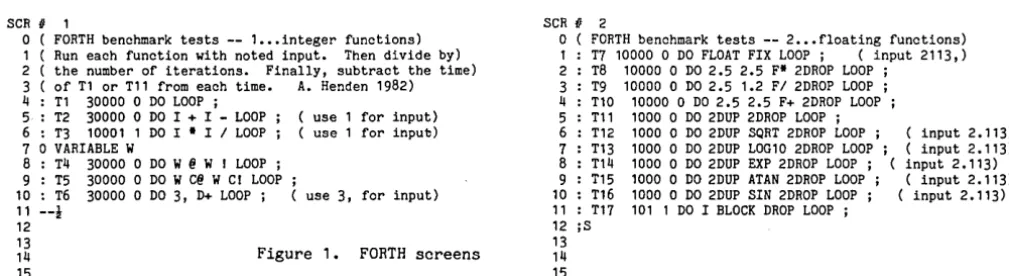
The benchmarks labelled T1 through T17 show the speed of FORTH implementations for basic arithmetic operations. The time found for each test was divided by the number of iterations to deter-mine the time per loop. Then the time for the loop structure (T1 or T11) is subtracted to obtain the time
o ( FORTH benchmark tests -- 1 ••• integer functions) o ( FORTH benchmark tests -- 2 ••• floating functions) 1 : T7 10000 0 DO FLOAT FIX LOOP; (input 2113,) 2 : T8 10000 0 DO 2.5 2.5 F* 2DROP LOOP ;
1 ( Run each function with noted input. Then divide by) 2 ( the number of iterations. Finally, subtract the time) 3 ( of Tl or Tll from each time. A. Henden 1982) 4 : Tl 30000 0 DO LOOP ;
5 : T2 30000 0 DO I + I - LOOP; (use 1 for input) 6 : T3 10001 1 DO I * I I LOOP; (use 1 for input) 7 0 VARIABLE W
8 : T4 30000 0 DO W @ W I LOOP ; 9 : T5 30000 0 DO W C@ W CI LOOP ,
10 : T6 30000 0 DO 3, D+ LOOP; (use 3, for input) 11 --i
12 13
14 Figure 1. FORTH screens
15
3 : T9 10000 0 DO 2.5 1.2 FI 2DROP LOOP; 4 : Tl0 10000 0 DO 2.5 2.5 F+ 2DROP LOOP ; 5 : Tll 1000 0 DO 2DUP 2DROP LOOP; 6 : T12 1000 0 DO 2DUP SQRT 2DROP LOOP ; 7 : T13 1000 0 DO 2DUP LOG10 2DROP LOOP ; 8 : T14 1000 0 DO 2DUP EXP 2DROP LOOP; ( 9 : T15 1000 0 DO 2DUP ATAN 2DROP LOOP ; 10 : T16 1000 0 DO 2DUP SIN 2DROP LOOP 11 : T17 101 1 DO I BLOCK DROP LOOP; 12 ;S
13 14 15
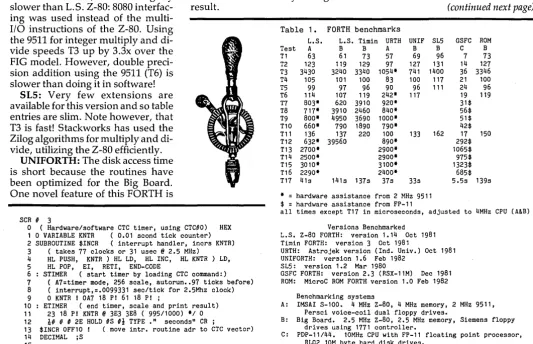
[image:12.617.57.562.616.754.2]for the operations inside the loop. These tests are shown in Figure 1, and the results are given in Table 1.
It's remarkable how similar most FORTHs are! You will gain more by optimizing your application than trying to choose the fastest FORTH.
Implementation Notes
Z-80 FORTH: The software con-versions and F
+
are remarkably fast! In my review, I mentioned that you should define floating point values as constants if they are to be used within loops. For TS-TI0, not using constants slows the times down by a factor of 4 from those shown in the table.Timin FORTH: The disk access is again long on the Big Board because of timing problems with the 3-sector skewing scheme. A 4MHz system would presumably be much faster. Tll time is long because Timin de-fines 2DROP as a colon word.
URTH: Note that though this ver-sion uses the 9511, times are slightly slower than 1. S. Z-SO: SOSO interfac-ing was used instead of the multi-110 instructions of the Z-SO. Using the 9511 for integer multiply and di-vide speeds T3 up by 3.3x over the FIG model. However, double preci-sion addition using the 9511 (T6) is slower than doing it in software!
SL5: Very few extensions are available for this version and so table entries are slim. Note however, that T3 is fast! Stackworks has used the Zilog algorithms for multiply and di-vide, utilizing the Z-SO efficiently.
UNIFORTH: The disk access time is short because the routines have been optimized for the Big Board. One novel feature of this FORTH is
SCR II 3
that the skewing factor is user ad-justable and therefore can be op-timized for other systems. Note that with proper optimization, you can perform multiply/divide faster than interfacing with the 9511!
GSFC FORTH: This is included to demonstrate the speed advantages of a mid-sized minicomputer. You get an Sx advantage on most opera-tions, with 30x on integer multiply/ divide and SOx on basic floating point operations because of the hardware support. Tests T12-T16 are only 3x faster than the 9511, be-ca use they are performed in software on the PDP-11/44.
ROM FORTH: This test was on version 1.0. It showed no bugs and typical FIG-FORTH times.
T17: This test demonstrates some of the problems with benchmarking. Each version of FORTH works well on the system used to develop the language. On other systems, proc-essor speeds and head load/ seek times can dramatically change the result.
A Hardware Software Timer Most Big Board owners have by now purchased a CTC for their board. Listed in screen 3 are some machine-language words to use the CTC for timing software routines. These routines are written for UNI-FORTH, but are easily converted for Z-SO FORTH. The interrupt handler is in machine language to b'e as fast as possible.
CTC#O is set in the timer mode to interrupt every 0.009946 seconds. The variable KNTR is used to count clock ticks. STIMER clears KNTR and sets CTC#O to the proper mode. Routine $INCR does the actual in-crementing on each clock tick. It takes about 30 microseconds for each interrupt, or less than one per-cent of the CPU time. ETIMER takes KNTR, scales it by the lost time due to $INCR, and prints the final value. To use these words, load the block. Call STIMER before the loop to be timed, and ETIMER after the
(continued next page)
Table 1. FORTH benchmarks
L.S. L.S.
Test A B
T1 63 61
T2 123 119 T3 3430 3240 T4 105 101
T5 99 97
T6 114 107 T7 803' 620 T8 717' 3910 T9 800' 4950 T10 660' 790 T11 136 137 T12 632' 39560 T13 2700' T14 2500' T15 3010' T16 2290' T17 41s 141s
Timin B 73 129 3340 100 96 119 3910 2460 3690 1890 220 137s URTH A 57 97 1054' 83 90 242' 920' 840' 1000' 790' 100 890' 2900' 2900' 3100' 2400' 37s
UNIF SL5
B B
69 96 127 131 741 1400 100 117 96 111 117
133 162
33s
, = hardware assistance from 2 MHz 9511 $ = hardware assistance from FP-11
GSFC ROM
C B
7 73 14 127 36 3346 21 100 24 96 19 119 31$ 56$ 51$ 42$ 17 150 292$ 1065$ 975$ 1323$ 685$ 5.5s 139s
all times except T17 in microseconds, adjusted to 4MHz CPU (A&B)
o (Hardware/software CTC timer, using CTCIIO) HEX Versions Benchmarked 1 0 VARIABLE KNTR (0.01 scond tick counter)
2 SUBROUTINE $INCR (interrupt handler, incrs KNTR) 3 (takes 77 clocks or 31 usec @ 2.5 MHz)
4 HL PUSH, KNTR) HL LD, HL INC, HL KNTR ) LD, 5 HL POP, EI, RETI, END-CODE
6 STIMER (start timer by loading CTC command:) 7 (A7=timer mode, 256 scale, autorun •• 97 ticks before) 8 (interrupt,=.0099331 sec/tick for 2.5Mhz clock) 9 0 KNTR ! OA7 18 PI 61 18 PI ;
10 ETIMER (end timer, scale and print result) 11 23 18 PI KNTR @ 3E3 3E8 ( 995/1000) ' / 0
12 ~II U II 2E HOLD US Hi TYPE." seconds" CR ;
13 $INCR OFF10 ( move intr. routine adr to eTe vector) 14 DECIMAL ;S
15
Micro Cornucopia, Number 5, April 1982
L.S. z-80 FORTH: version 1.14 Oct 1981 Timin FORTH: version 3 Oct 1981
URTH: Astrojek version (Ind. Univ.) Oct 1981 UNIFORTH: version 1.6 Feb 1982
SL5: version 1.2 Mar 1980
GSFC FORTH: version 2.3 (RSX-11M) Dec 1981 ROM: MicroC ROM FORTH version 1.0 Feb 19B2
Benchmarking systems
A: IMSAI S-100. 4 MHz Z-BO, 4 MHz memory, 2 MHz 9511, Persci voice-coil dual floppy drives.
B: Big Board. 2.5 MHz Z-BO, 2.5 MHz memory, Siemens floppy drives using 1771 controller.
C: PDP-11/44. 10MHz CPU with FP-11 floating point processor, RL02 10M byte hard disk drives.
[image:13.615.33.566.408.752.2]Ashton Tate dBase II
Condor I (entry level data base sys.) Condor II (relational dbase sys.) Condor III (relational, w/ report writer) Digital Research
MAC (macro assembler)
ZSID (symbolic debugger for Z80) PL/1-80
CBASIC 2
CB 80 (true compiler for CBASIC 2) PASCAL MT+ VERSION 5.5
Ecosoft Microstat (advanced statistics) Supervyz (simplifies CP/M)
Faircom Micro B+ (keyed file accessing) Quickscreen (screen builder)
Graham Dorian (requires CBASIC 2) per module
interactive-per module I.S.A. Spellguard (spelling checker) Ithaca Intersystems Pascal Z
Key Bits Wordsearch (spelling checker)' Lexisoft Spellbinder (word processor) Microtax Level I (fed./individual)
Level I I " "
Level III (fed./partnership) Micro Pro
WORDSTAR (most popular word processor) MAILMERGE
WORDSTAR/MAILMERGE
DATA STAR (data entry, ret. & update) WORDMASTER (text editor)
SUPERSORT I (sort/merge) SPELLSTAR (spell check/diet.) CALCSTAR (electronic spread sheet)
+ + +
list users list users
700.00 517.00 Microsoft
295.00 218.00 BASIC 80 350.00 259.00 595.00 440.00 BASIC COMPILER 395.00 292.00 995.00 735.00 FORTRAN 80 500.00 369.00 COBOL 80 750.00 554.00 90.00 78.00 MACRO 80 200.00 160.00 100.00 86.00 Northwest Analytical Statpak 495.00 366.00 500.00 431. 00 Oasis "The Word" (spell check & dict.) 75.00 56.00 150.00 105.00 Sorcim Pascal/M 395.00 292.00 500.00 431. 00 Supercalc 295.00 218.00 475.00 409.00 Structured Systems per module 1250.00 738.00 295.00 255.00 Supersoft
95.00 62.00 DIGNOSTIC II (hardware checker) 100.00 80.00 260.00 208.00 FORTH (specify Z80 or 8080) 200.00 160.00 149.00 128.00 SSS FORTRAN 250.00 200.00 RAT FOR (language enhancer Fortran) 100.00 80.00 600.00 443.00 SUPER M-LIST (mail list program) 75.00 59.00 1000.00 738.00 TINY PASCAL 85.00 68.00 295.00 218.00 DISK DOCTOR (lost data recovery) 100.00 80.00 395.00 340.00 UTILITIES I or II 60.00 48.00 195.00 169.00 STAR EDIT (text editor) 225.00 180.00 495.00 277.00 NEMESIS 40.00 32.00 250.00 154.00 DUNGEON MASTER 35.00 27.00 1000.00 615.00 ANALIZA 35.00 27.00 750.00 462.00 ANALIZA II 50.00 40.00
Systems Plus
495.00 304.00 FMS 80 995.00 735.00 150.00 93.00 ACCOUNTING PLUS 1 module 431. 00 645.00 396.00 2 modules 800.00 350.00 216.00 3 modules 1169.00 150.00 93.00 4 modules 1538.00 250.00 154.00
250.00 154.00 + specify language 295.00 185.00
Scotch 740-0 8" disks SS SD (while they last) 25.00/10
Please specify computer and disk format. Enclose $2.50 for shipping and handling. For 24 hr. service send cashier's or money order. Personal checks take two weeks. Complete catalog-$1, included with each order. Ca. residents include 6% sales tax. COD ok, call 213-708-8527 after business hours.
USER'S SOFTWARE 7812 White Oak Ave., Northridge, Ca. 91325 213-798-8537
(FORTHwords continued)
loop execution. Simple as pie! The timer words are extremely useful in checking out different algorithm speeds, such as FIG's multiply rou-tine versus Zilog's rourou-tine.
Next issue
By now, you should now be able to make an intelligent FORTH pur-chase. My suggestion is to get one of the three inexpensive versions-ROM FORTH, UNIFORTH or Z80 FORTH-as all three are good sys-tems. ROM is necessary if you don't have disk drives, the other two ver-sions offer many options.
Next issue, we will concentrate heavily on applications. For exam-ple, I have a whole set of words to control the MX-80 printer, and also to make the Big Board function as a terminal.
Hampton will review UNIFORTH and ROM FORTH, and I am work-ing on some additional applications. Any questions? Just ask!
•••
Designer's
Corner
Those who have Microsoft Basic and a CTC timer can start their pseudo-random number generator at a truly pseudo-ran-dom place by using the follow-ing:
nn RANDOMIZE PEEK( &HFF6C)
Location FF6C is the disk ac-tivity timer. If the disk motor is still running, the value will be between 0 and 30. Otherwise, the timer free runs and the value will be between 0 and 255.
John P. Jones
5826 Southwest Ave . St. Louis, MO 63139
(Smartkey continued)
If you need to use the 8th bit on the Big Board then use the following mod suggested by Nick Hammond of FBN. Use DDT to load Smartkey and then do the following:
Lac
OA64 OA87 (OA8A) (OA8B)
From
JZ OA7C CALLOA94
To
JZ OA87 LDAOBF3 NOP NOP
The manual is a little confusing, but most everything you need to know is there somewhere and the screen cues help a lot. If you need to redefine keys on the fly or turn sin-gle keystrokes into whole strings, you need Smartkey-it's a very good friend.
Smartkey is available for $39.00 from:
FBN Software
1111 Sawmill Gulch Road Pebble Beach, CA 93953
UNIFORTH
You've heard about FORTH's interactiveness, speed and versatility. NOW HERE'S YOUR CHANCE TO OWN THE BEST! UNIFORTH is a stand-alone FOR TH for the Big Board. No operating system is needed - - save your
bucks for more important purchases - - but if you have CP
1M,
there is autility available for file transfer.
UNIFORTH is FORTH-79 standard, with the double precision integer and assembler extensions. Don't get stuck with the 128 -byte "blocks" and slow disk access of fig-FORTH! All code is FULLY OPTIMIZED for the Z-80, and all Big Board devices are supported, such as the CTC for listings with date and time. Included with UNIFORTH are:
- All SOURCE CODE except for a 5K byte kernel, so you can easily modify the system. The kernel source will be available in June as part of the Programmer's Manual.
- An interactive CURSOR-ADDRESSED EDITOR (the best around!). Others charge the price of UNIFORTH for just this alone. All keystroke commands are logical, and include string search and
replacement, even across block boundaries. Forget a command? Just inspect the omnipresent :menu.
- Full Z-80 ASSEMBLER, using Zilog :mne:monics, with co:mpletely logical syntax; and it supports the undocu:mented index register instructions.
- Full IEEE-compatable single-precision FLOATING POINT software. Eight-bit signed exponents yield :more range than the AMD-9511. All functions are included, such as sines, cosines and logarith:ms. Co:mpare with the other FOR THs and see the difference!
- A 136-page USER'S MANUAL. Broken into logical function divi-sions, it includes :many exa:mples and leads you step-by-step through the learning process.
Pricing:
Version I (without floating point) $50
Version 2 (with floating point) $85
Own Version l? You can upgrade to Version 2 for only $35. All versions distributed on IBM 3740 standard eight-inch single-density floppy disk. Postage is prepaid within the continental U. S.
UNISOFT
P. O. Box 2644
A New Type of Game
1...-.--...
BIG BOARD
SOFTWARE!
Welcome to an astonishing new experience! ADVENTURE is one of the most challenging and innovative games available for your personal computer. This is not the average computer game in which you shoot at, chase, or get chased by something, master the game within an hour, and then lose interest. In fact, it may take you more than an hour to score at all, and will probably take days or weeks of playing to get a good score. (There is a provision for saving a game in progress).
The original computer version of Adventure was written by Willie Crowther and Don Woods in Fortran on a PDP-10 at MIT. In this version the player starts near a small well house. Upon entering the house, he finds food, water, a set of keys and a lamp. Armed with only these items, he must set out to explore the countryside in search of treasure and other objects of play. He must also confront dwarfs, snakes, trolls, bears, dragons, birds, and other creatures during his quest. The game accepts one-or two-word commands such as GET LAMP* SOUTH* or KILL DWARF. Of course, if you don't have the proper tool to carry out an action, or If you do something foolish, you may find yourself in big trouble.
In playing the game you wander thru various 'rooms' (locations), manipulating the objects there to try to find 'treasures'. You may have to defeat an exotic wild animal to get one treasure, or figure out how to get another treas~re out of a quicksand bog. You communicate thru two-word commands such as 'go west', 'climb tree', 'throw axe', 'look around'.
duenture
ORIGINAL ADVENTURE (by Crowther, Woods, Manning and Roichel) - Somewhere nearby is a collosal cave where others have found fortunes in treasures and gold, but some who have entered have never been seen again. You start at a small brick building which is the well house for a large spring. You must try to find your way into the underground caverns where you'll meet a giant clam, nasty little dwarves, and much more. This Adventure Is BI-Llngual - you may play in either English or French - a language learning tool beyond comparison. Runs in 32K CP/M system (48K required for SAVE GAME feature). Even includes SAM76 language in which to run the game. The troll says "Good Luck."
THROUGH SPECIAL ARRANGEMENT WITH CREATIVE
COMPUTING WE ARE ABLE TO OFFER ONEOFTHE MOST
CHALLENGING AND EXCITING COMPUTER GAMES EVER
DEVISED. BESIDES BEING FUN, WE HAVE FOUND THAT
RUNNING "ADVENTURE" IS ONE OF THE BEST TESTS
FOR A BIG BOARD. SUPPLIED ON 8 IN. DISKETTE WITH
INSTRUCTIONS.
$
2 9
95
(ADD $2.00 POSTAGE)Digital Research Computers
(OF TEXAS)
P.O. BOX 401565 • GARLAND, TEXAS 75040 • (214) 271-3538
Tiny Basic In ROM
From Micro C
OK, OK, I know what you're thinking. I swear on a stack of TRASH-80's that I'm not reverting back to basics.
However, I really like Tiny Basic. It's perfect for those simple little controller or utility projects that might call object code routines. For the small stuff, you really can't beat this for getting something out fast. Commercial outfits have found that writing small utilities and controllers in Tiny Basic is between 10 and 20 times faster than writing them in as-sembly code. And, you don't need CP 1M, even if you are storing da ta or program on disk. (And, of course, you don't have to have a disk.)
Catch a load of this.
1. It can read one or more Basic pro-grams off the disk, append them to-gether, and run them all.
2. It can, of course, also store Basic programs on the disk using its own
($35.00)
simple disk format.
3. It can store object code onto the disk and then read it back (into a re-served memory area).
4. It also looks at the 3rd ROM sock-et for a 2716 containing code. If there is a ROM there, its contents get load-ed into a protectload-ed memory area. This can be object code, called by Tiny Basic to do high speed assem-bly language functions.
5. Plus some other little goodies that you wouldn't expect from Tiny Basic (like a simple renum routine). 6. And best of all, the whole thing fits into two 2716's that can settle right in next to the PFM 3.3 ROM.
This doesn't have fancy floating point numbers or long variable names but it's certainly useful and definitely fun. (Did I say fun? Sssh! Don't tell!) Rob Devoe did the modi-fication for the BB and added the
ex-tra goodies. • • •
12" GREEN BALL BROTHE;:S HONITOR WITII I::JCLOSURE HI:ASU1UNG 19"x16.5"x14". ROm! IIlSDC TO HOUNT A FERGUSOlI SINGLE B01.RD COII!'UTER OR StL\LL SS-50,S-100 SYSTEH. POWER SUPPLY AVAILABLE BELOW. REQUIRES +15 VOLTS DC. @ 1. 5 AlII'S, NON-COHPOSITE (SEPERATE SYNC) INPUT. A SYNC SEPERATOR SCllEHATIC IS AVAILABLE. IT IS ALSO POSSIBLE TO HOUNT A SINGLE 8" DISK DRIVE OR TWO OF THE NEW SLIH LINE 8" DISK DRIVES IN THIS ENCLOSURE. ALL UNITS ARE USED , AND IlAVE BEEN 100;; TESTED.
WANT ADS
The following folks are reaching you for only 20 cents per word. If you would like to reach the same audience, send your words and 20 cents for each, to Mi-cro Cornucopia, 11740 NW West Rd., Portland, OR 97229.
WANTED-EPROMS's for non-disc Big Board. Dumb terminal to 510. Minimal letter writer to PIO, Kansas City or TRS-80 cassette. Tom Mason, 2402 Audubon Road, Akron, OH 44320,216-575-5647.
Printer program to drive NEC 5515 Spinwriter, includes details of minor se-rial interface hardware modifications. $30.00
Professionally made, walnut grain for-mica computer cabinet holds two 8-inch disk drives and Sunny International Power Supply. Has heavy aluminum back panel with cutouts for ten RS232's and whisper fan. Real Walnut Trim. FOB Redondo Beach. $400.00
Custom Formica Walnut Grain Key-board Enclosures, (send cut-out pattern and detailed drawings of keyboard) $200.00
LAMAR INSTRUMENTS 2107 Artesia Blvd.
Redondo Beach, CA 90278 (213) 374-1673
You're different. And C may be the program-ming language you've been looking for.
HODULAR POWER SUPPLY (HISSING REGULATOR CARD) FITS INSIDE ABOVE HONITOR ENCLOSURE. INCLUDES LARGE TRANSFORHER TIIAT OUTPUTS +8.5 VOLTS @
17 AHPS,+/- 18 VOLTS (l 1.5 AHPS EACH, +15 VOLTS G 1.5 AHPS (FOR !lONITOR) THREE LARGE CAPACITORS (1-18kuf,2-8kuf), 1-30 AHr, 2-3 AHP BRIDGE RECTIFIERS. TilE TRANSFORHER AND RECTIFIERS/CAPACITORS HAKE A PERFECT UNREG-ULATED SS-50/S-100 POWER SUPPLY. TilE SCIlEHATIC FOR TilE REGULATOR CARD IS AVAILABLE AND THIS SUPPLY COULD BE HODIFIE