Abstract— Modified Weibull distribution is an appreciable improvement over the Weibull distribution. This paper explores the application of differentiation to obtain the ordinary differential equations (ODE) of the probability functions of the modified Weibull Distribution. The parameters and support that characterized the distribution inevitably determine the behavior, existence, uniqueness and solution of the ODEs. The method is recommended to be applied to other probability distributions and probability functions not considered in this paper. Computer codes and programs can be used for the implementation.
Index Terms— Differential calculus, quantile function,
hazard function, reversed hazard function, survival function, inverse survival function, probability density function, Weibull.
I. INTRODUCTION
ALCULUS in general and differential calculus in particular is often used in statistics in parameter and modal estimations. The method of maximum likelihood is an example.
Differential equations often arise from the understanding and modeling of real life problems or some observed physical phenomena. Approximations of probability functions are one of the major areas of application of calculus and ordinary differential equations in mathematical statistics. The approximations are helpful in the recovery of the probability functions of complex distributions [1-4].
Apart from mode estimation, parameter estimation and approximation, probability density function (PDF) of distributions can be transformed as ODE whose solution yields the respective PDF. Some of which are available: see [5-9].
The aim of this paper is to propose homogenous ordinary differential equations for the probability density function (PDF), Quantile function (QF), survival function (SF), inverse survival function (ISF), hazard function (HF) and reversed hazard function (RHF) of the modified Weibull distribution. This will also help to provide the answers as to whether there are discrepancies between the support of the
Manuscript received February 9, 2018; revised March 14, 2018. This work was sponsored by Covenant University, Ota, Nigeria.
H. I. Okagbue, P. E. Oguntunde, A. A. Opanuga and S. A. Bishop are with the Department of Mathematics, Covenant University, Ota, Nigeria.
[email protected] abiodun.opanuga @covenantuniversity.edu.ng
distribution and the conditions necessary for the existence of the ODEs. Similar results for other distributions have been
proposed, see [10-23] for details.
The modified Weibull distribution considered was the one proposed by [24-26] as a generalization of the parent Weibull, exponential, Rayleigh and linear hazard rate distributions. Since the introduction of the distribution as a lifetime model, several researchers have studied different aspects of the distribution. Gasmi and Berzig [27] worked on parameter estimation based on type I censored samples, Soliman et al. [28] applied Markov Chain Monte-Carlo approach on progressive censored data while Jiang et al. [29] done their estimation based on type II censored samples. There are other modified Weibull models such as
the ones proposed by [30] and [31]. The distribution has been used in the development of new
models which includes; modified inverse Weibull distribution [32], transmuted modified inverse Weibull distribution [33], beta transmuted Weibull distribution [34], the modified Weibull geometric distribution [35] and
Weibull exponential distribution [36-37]. Differential calculus was used to obtain the results.
II. PROBABILITY DENSITY FUNCTION
The PDF of the modified Weibull distribution is given as;
1
( )
(
)e
x xf x
x
(1) Differentiate equation (1);2
1 1
(
1)
( )
x
(
)
( )
f x
x
f x
x
(2)The equation can only exists for
, , ,
x
0
. The ODEs can be obtained for any given values of,
and
. When
1
, equation (2) becomes;( )
(
)
( )
d d
f x
f x
(3)( ) (
)
( )
0
d d
f x
f x
(4) When
2
, equation (2) becomes;2
( )
(
2
)
( )
2
e e
f x
x
f x
x
(5)2
(
2
x f x
) ( ) (2
e
(
2
x
) ) ( )
f x
e
0
(6)Modified Weibull Distribution: Ordinary
Differential Equations
Hilary I. Okagbue, Member,IAENG, Pelumi E. Oguntunde, Abiodun A. Opanuga
and Sheila A. Bishop
When
3
, equation (2) becomes;2 2
6
( )
(
3
)
( )
3
f f
x
f
x
x
f
x
x
(7)2 2 2
(
3
x
)
f x
f
( ) (6
x
(
3
x
) )
f x
f( )
0
(8) Equation (2) is differentiated;2 2 1 2 3 1 2 2 1 1
(
(
1)
)
(
)
(
1)(
2)
( )
( )
(
)
(
1)
)
(
1)
(
)
( )
x
x
x
f
x
f x
x
x
x
x
f x
x
(9)The equation can only exists for
, , ,
x
0
. These presented equations from (2) are needed to furthersimplification of equation (9);
2
1 1
(
1)
( )
(
)
( )
x
f x
x
x
f x
(10)2
1 1
(
1)
( )
(
)
( )
x
f x
x
x
f x
(11)3
1 1
(
1)(
2)
2
( )
(
)
( )
x
f x
x
x
x
f x
(12) 2 2 2 1 1(
1)
( )
(
)
( )
x
f x
x
x
f x
(13) Substitute equations (10), (12) and (13) into equation (9);2 2 1 1
( )
( )
( )
( )
(
)
( )
( )
2
( )
(
)
( )
( )
f
x
f x
f
x
f x
x
f x
f x
f x
x
f x
x
f x
(
1)
x
2) ( )
f x
(14)( )
(1)
(
) e
f
(15)2 ( )
(1)
(
(
1) (
) ) e
f
(16) When
1
, equation (14) becomes;2
2 2
( )
( )
2(
)
( ) (
)
( )
( )
( )
(
) ( )
( )
( )
f
x
f
x
f x
f x
f x
f x
f x
f
x
x
x
f x
(17) 2( ) (2(
)
1)
( )
((
)
(
)) ( )
0
f
x
x
f x
x
f x
(18) See [10-23] for details.
III. QUANTILE FUNCTION
The QF of the modified Weibull distribution is given as;
( )
( )
ln(1
)
Q p
Q
p
p
(19)Equation (19) is differentiated in order to obtain the first order ODE;
1
1
( )
( )
( )
1
Q p
Q
p Q p
p
(20)The equation can only exists for
0
p
1
.1
(1
p
)(
Q
( ))
p Q p
( ) 1
0
(21) The ODE and their initial conditions can be derived for anygiven values of
,
and
. When
1
, equation (19) and (22) become;(1
p
)(
)
Q p
( ) 1
0
(22)(0)
(0)
0
Q
Q
(23)(0)
(
)
Q
(24) When
2
, equation (19) and (22) become;(1
p
)(
2
Q p Q p
( ))
( ) 1
0
(25)2
(0)
(0)
0
Q
Q
(26)(0)
Q
(27)When
3
, equation (19) and (22) becomes;2
(1
p
)(
3
Q
( ))
p Q p
( ) 1
0
(28)3
(0)
(0)
0
Q
Q
(29)(0)
Q
i
(30)Differentiate equation (20), to obtain the second order ODE;
1 2
2
( )
( )
( )
1
(
1)
( )
( )
(1
)
Q p
Q
p Q p
Q
p Q p
p
(31)The equation can only exists for
0
p
1
. The ODEs and their initial conditions can only be derivedfor any given values of
,
and
. When
1
, equation (31) and (20) become;2
1
( )
( )
(1
)
Q p
Q p
p
(32)(0)
(0) 1
Q
Q
(33)1
(0)
Q
When
2
, equation (31) and (20) becomes;2
1
(
2
( ))
( ) 2
( )
(1
)
Q p Q p
Q p
p
(35)(0) 2
(0)
(0) 1
Q
Q
Q
(36) Using equation (27) in (36)(0) 2
(0) 1
Q
Q
(37)1
(0)
Q
(38)When
3
, equation (31) and (20) becomes;2
2
1
(
3
( ))
( ) 6
( )
( )
(1
)
Q p Q p
Q p Q p
p
(39)
2
(0) 3
(0)
(0)
1
Q
Q
Q
(40) Using equation (30) in (40)(0) 3
(0) 1
Q
Q
(41)1
(0)
2
Q
(42) See [10-23] for details.
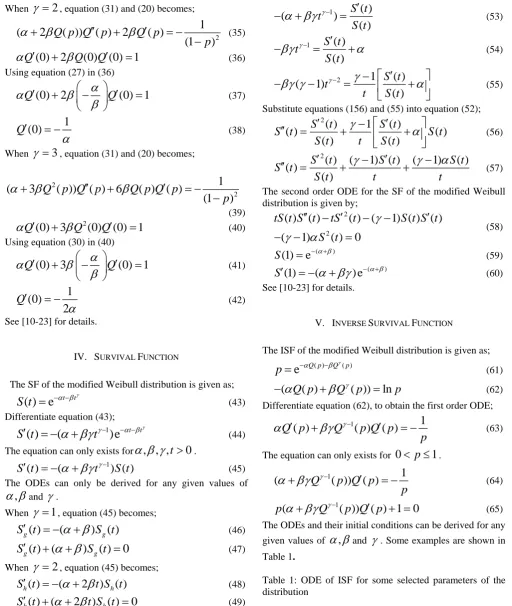
IV. SURVIVAL FUNCTION
The SF of the modified Weibull distribution is given as;
( )
e
t tS t
(43) Differentiate equation (43);1
( )
(
)e
t tS t
t
(44)The equation can only exists for
, , ,
t
0
.1
( )
(
) ( )
S t
t
S t
(45) The ODEs can only be derived for any given values of,
and
.When
1
, equation (45) becomes;( )
(
)
( )
g g
S t
S t
(46)( ) (
)
( )
0
g g
S t
S t
(47)When
2
, equation (45) becomes;( )
(
2
)
( )
h h
S t
t S t
(48)( ) (
2
)
( )
0
h h
S t
t S t
(49)When
3
, equation (45) becomes;2
( )
(
3
) ( )
i i
S t
t S t
(50)2
( ) (
3
) ( )
0
i i
S t
t S t
(51) Differentiate equation (45);
1 2
( )
(
) ( )
(
1)
( )
S t
t
S t
t
S t
(52) These equations derived from (45) are required in the simplification of equation (52);1
( )
(
)
( )
S t
t
S t
(53)1
( )
( )
S t
t
S t
(54)2
1
( )
(
1)
( )
S t
t
t
S t
(55) Substitute equations (156) and (55) into equation (52);2
( )
1
( )
( )
( )
( )
( )
S
t
S t
S t
S t
S t
t
S t
(56)2
( )
(
1) ( )
(
1)
( )
( )
( )
S
t
S t
S t
S t
S t
t
t
(57)The second order ODE for the SF of the modified Weibull distribution is given by;
2 2
( )
( )
( ) (
1) ( ) ( )
(
1)
( )
0
tS t S t
tS
t
S t S t
S t
(58)( )
(1)
e
S
(59)( )
(1)
(
) e
S
(60) See [10-23] for details.V. INVERSE SURVIVAL FUNCTION
The ISF of the modified Weibull distribution is given as;
( ) ( )
e
Q p Q pp
(61)(
Q p
( )
Q
( ))
p
ln
p
(62)Differentiate equation (62), to obtain the first order ODE;
1
1
( )
( )
( )
Q p
Q
p Q p
p
(63)
The equation can only exists for
0
p
1
.1
1
(
Q
( ))
p Q p
( )
p
(64)
1
(
( ))
( ) 1
0
p
Q
p Q p
(65) The ODEs and their initial conditions can be derived for anygiven values of
,
and
. Some examples are shown in Table1.Table 1: ODE of ISF for some selected parameters of the distribution
Ordinary differential equation 1 1 12
pQ p
( ) 1 0
1 1 2
3
pQ p
( ) 1 0
1 2 13
pQ p
( ) 1 0
1 2 24
pQ p
( ) 1 0
[image:3.595.42.555.50.657.2]VI. HAZARD FUNCTION
The HF of the modified Weibull distribution is given as;
1
( )
h t
t
(66) Differentiate equation (66);2
( )
(
1)
h t
t
(67)The equation can only exists for
, , ,
t
0
. Using equation (66) to simplify equation (67), equation (66)can also be written as;
1
( )
t
h t
(68)
2
1
(
1)
t
( ( )
h t
)
t
(69) Substituteequation (69) into equation (67);
1
( )
( ( )
)
h t
h t
t
(70) The first order ODE for the HF of the modified Weibull distribution is given by;( ) (
1)( ( )
)
0
th t
h t
(71)(1)
h
(72) Differentiate equation (67);3
( )
(
1)(
2)
h t
t
(73)The equation can only exists for
, , ,
t
0
. Two ODEs can be derived from equation (73); ODE 1; Use equation (66) in equation (73);2 1
( )
(
1)(
2)
t h t
t
(74)2
( )
(
1)(
2)( ( )
)
t h t
h t
(75)2
( ) (
1)(
2)( ( )
)
0
t h t
h t
(76)ODE 2; Use equation (67) in equation (73);
2
( )
(
1)(
2)
th t
t
(77)( )
(
2) ( )
th t
h t
(78)( ) (
2) ( )
0
th t
h t
(79) Differentiate equation (73);4
( )
(
1)(
2)(
3)
h t
t
(80)The equation can only exists for
, , ,
t
0
. Three ODEs can be derived from the further evaluation ofequation (80); ODE 1; Use equation (66) in equation (80);
3 1
( )
(
1)(
2)(
3)
t h t
t
(81)3
( )
(
1)(
2)(
3)( ( )
)
t h t
h t
(82)3
( ) (
1)(
2)(
3)( ( )
)
0
t h t
h t
(83)ODE 2; Use equation (67) in equation (80);
2 2
( )
(
1)(
2)(
3)
t h t
t
(84)2
( )
(
2)(
3) ( )
t h t
h t
(85)2
( ) (
2)(
3) ( )
0
t h t
h t
(86)ODE 3; Use equation (73) in equation (80);
3
( )
(
1)(
2)(
3)
th t
t
(87)( )
(
3) ( )
th t
h t
(88)( ) (
3) ( )
0
th t
h t
(89)(0)
0
h
(90)(0)
0
h
(91) See [10-23] for details.VII. REVERSED HAZARD FUNCTION
The RHF of the modified Weibull distribution is given as;
1
(
) e
( )
1 e
t t t t
t
j t
(92)Differentiate equation (92), to obtain the first order ODE;
2
1 1
1 2
1
(
1)
(
)
( )
( )
(
) e
(1 e
)
(1 e
)
t t t t
t t
t
t
t
j t
j t
t
(93)
The equation can only exists for
, , ,
t
0
.2
1 1
1
(
1)
(
)
( )
( )
(
) e
(1 e
)
t t t t
t
t
t
j t
j t
t
(94)
2
1 1
(
1)
( )
t
(
)
( )
( )
j t
t
j t
j t
t
(95) Equation (95) is further differentiated;
2 2 1 2
3 1 2
2
1 1
(
(
1)
)
(
)
(
1)(
2)
( )
( )
(
)
(
1)
)
( )
(
1)
+
(
)
( )
( )
t
t
t
j t
j t
t
t
j t
t
t
j t
j t
t
(96)
The equation can only exists for
, , ,
t
0
. These equations derived from (95) are required to furtherevaluate equation (96);
2
1 1
(
1)
( )
(
)
( )
( )
t
j t
t
j t
t
j t
(97)2
1 1
(
1)
( )
(
)
( )
( )
t
j t
t
j t
t
j t
3 1
1
(
1)(
2)
2
( )
(
)
( )
( )
t
t
j t
t
j t
t
j t
(99)
2 2
2
1 1
(
1)
( )
(
)
( )
( )
t
j t
t
j t
t
j t
(100) Substitute equations (97), (99) and (100) into equation (96);
2 2
1
1
( )
( )
( )
( )
(
)
( )
( )
( )
2
( )
(
)
( )
( )
( )
j
t
j t
j t
j t
t
j t
j t
j t
j t
t
j t
j t
t
j t
(101) See [10-23] for details.
VIII. CONCLUDING REMARKS
Ordinary differential equations (ODEs) has been obtained for the probability density function (PDF), Quantile function (QF), survival function (SF), inverse survival function (ISF), hazard function (HF) and reversed hazard function (RHF) of modified Weibull distribution. This differential calculus and efficient algebraic simplifications were used to derive the various classes of the ODEs. Different classes of the differential equations can be obtained for the different values of the parameters that defined the distribution. The parameter and the supports that characterize the distribution determine the nature, existence, orientation and uniqueness of the ODEs. The results are in agreement with those available in scientific literature. Furthermore several methods can be used to obtain desirable solutions to the ODEs [38-50]. This method of characterizing distributions cannot be applied to distributions whose PDF or CDF are either not differentiable or the domain of the support of the distribution contains singular points.
ACKNOWLEDGMENT
The comments of the reviewers were very helpful and led to an improvement of the paper. This research benefited from sponsorship from the Statistics sub-cluster of the
Industrial Mathematics Research Group (TIMREG) of
Covenant University and Centre for Research, Innovation
and Discovery (CUCRID), Covenant University, Ota,
Nigeria.
REFERENCES
[1] G. Derflinger, W. Hörmann and J. Leydold, “Random variate generation by numerical inversion when only the density is known,”
ACM Transac.Model. Comp. Simul., vol. 20, no. 4, Article 18, 2010.
[2] H.I. Okagbue, M.O. Adamu and T.A. Anake “Quantile Approximation of the Chi-square Distribution using the Quantile Mechanics,” In Lecture Notes in Engineering and Computer Science: Proceedings of The World Congress on Engineering and Computer
Science 2017, 25-27 October, 2017, San Francisco, U.S.A., pp 477-483.
[3] C. Yu and D. Zelterman, “A general approximation to quantiles”,
Comm. Stat. Theo. Meth., vol. 46, no. 19, pp. 9834-9841, 2017. [4] H.I. Okagbue, M.O. Adamu and T.A. Anake “Solutions of Chi-square
Quantile Differential Equation,” In Lecture Notes in Engineering and Computer Science: Proceedings of The World Congress on Engineering and Computer Science 2017, 25-27 October, 2017, San Francisco, U.S.A., pp 813-818.
[5] W.P. Elderton, Frequency curves and correlation, Charles and Edwin Layton. London, 1906.
[6] N. Balakrishnan and C.D. Lai, Continuous bivariate distributions, 2nd edition, Springer New York, London, 2009.
[7] N.L. Johnson, S. Kotz and N. Balakrishnan, Continuous Univariate Distributions, Volume 2. 2nd edition, Wiley, 1995.
[8] N.L. Johnson, S. Kotz and N. Balakrishnan, Continuous univariate distributions, Wiley New York. ISBN: 0-471-58495-9, 1994. [9] H. Rinne, Location scale distributions, linear estimation and
probability plotting using MATLAB, 2010.
[10] H.I. Okagbue, P.E. Oguntunde, A.A. Opanuga, E.A. Owoloko “Classes of Ordinary Differential Equations Obtained for the Probability Functions of Fréchet Distribution,” In Lecture Notes in Engineering and Computer Science: Proceedings of The World Congress on Engineering and Computer Science 2017, 25-27 October, 2017, San Francisco, U.S.A., pp 186-191.
[11] H.I. Okagbue, P.E. Oguntunde, P.O. Ugwoke, A.A. Opanuga “Classes of Ordinary Differential Equations Obtained for the Probability Functions of Exponentiated Generalized Exponential Distribution,” In Lecture Notes in Engineering and Computer Science: Proceedings of The World Congress on Engineering and Computer Science 2017, 25-27 October, 2017, San Francisco, U.S.A., pp 192-197.
[12] H.I. Okagbue, A.A. Opanuga, E.A. Owoloko, M.O. Adamu “Classes of Ordinary Differential Equations Obtained for the Probability Functions of Cauchy, Standard Cauchy and Log-Cauchy Distributions,” In Lecture Notes in Engineering and Computer Science: Proceedings of The World Congress on Engineering and Computer Science 2017, 25-27 October, 2017, San Francisco, U.S.A., pp 198-204.
[13] H.I. Okagbue, S.A. Bishop, A.A. Opanuga, M.O. Adamu “Classes of Ordinary Differential Equations Obtained for the Probability Functions of Burr XII and Pareto Distributions,” In Lecture Notes in Engineering and Computer Science: Proceedings of The World Congress on Engineering and Computer Science 2017, 25-27 October, 2017, San Francisco, U.S.A., pp 399-404.
[14] H.I. Okagbue, M.O. Adamu, E.A. Owoloko and A.A. Opanuga “Classes of Ordinary Differential Equations Obtained for the Probability Functions of Gompertz and Gamma Gompertz Distributions,” In Lecture Notes in Engineering and Computer Science: Proceedings of The World Congress on Engineering and Computer Science 2017, 25-27 October, 2017, San Francisco, U.S.A., pp 405-411.
[15] H.I. Okagbue, M.O. Adamu, A.A. Opanuga and J.G. Oghonyon “Classes of Ordinary Differential Equations Obtained for the Probability Functions of 3-Parameter Weibull Distribution,” In Lecture Notes in Engineering and Computer Science: Proceedings of The World Congress on Engineering and Computer Science 2017, 25-27 October, 2017, San Francisco, U.S.A., pp 539-545.
[16] H.I. Okagbue, A.A. Opanuga, E.A. Owoloko and M.O. Adamu “Classes of Ordinary Differential Equations Obtained for the Probability Functions of Exponentiated Fréchet Distribution,” In Lecture Notes in Engineering and Computer Science: Proceedings of The World Congress on Engineering and Computer Science 2017, 25-27 October, 2017, San Francisco, U.S.A., pp 546-551.
[17] H.I. Okagbue, M.O. Adamu, E.A. Owoloko and S.A. Bishop “Classes of Ordinary Differential Equations Obtained for the Probability Functions of Half-Cauchy and Power Cauchy Distributions,” In Lecture Notes in Engineering and Computer Science: Proceedings of The World Congress on Engineering and Computer Science 2017, 25-27 October, 2017, San Francisco, U.S.A., pp 552-558.
[18] H.I. Okagbue, P.E. Oguntunde, A.A. Opanuga and E.A. Owoloko “Classes of Ordinary Differential Equations Obtained for the Probability Functions of Exponential and Truncated Exponential Distributions,” In Lecture Notes in Engineering and Computer Science: Proceedings of The World Congress on Engineering and Computer Science 2017, 25-27 October, 2017, San Francisco, U.S.A., pp 858-864.
Probability Functions of Exponentiated Pareto Distribution,” In Lecture Notes in Engineering and Computer Science: Proceedings of The World Congress on Engineering and Computer Science 2017, 25-27 October, 2017, San Francisco, U.S.A., pp 865-870.
[20] H.I. Okagbue, O.O. Agboola, A.A. Opanuga and J.G. Oghonyon “Classes of Ordinary Differential Equations Obtained for the Probability Functions of Gumbel Distribution,” In Lecture Notes in Engineering and Computer Science: Proceedings of The World Congress on Engineering and Computer Science 2017, 25-27 October, 2017, San Francisco, U.S.A., pp 871-875.
[21] H.I. Okagbue, O.A. Odetunmibi, A.A. Opanuga and P.E. Oguntunde “Classes of Ordinary Differential Equations Obtained for the Probability Functions of Half-Normal Distribution,” In Lecture Notes in Engineering and Computer Science: Proceedings of The World Congress on Engineering and Computer Science 2017, 25-27 October, 2017, San Francisco, U.S.A., pp 876-882.
[22] H.I. Okagbue, M.O. Adamu, E.A. Owoloko and E.A. Suleiman “Classes of Ordinary Differential Equations Obtained for the Probability Functions of Harris Extended Exponential
Distribution,” In Lecture Notes in Engineering and Computer Science: Proceedings of The World Congress on Engineering and Computer Science 2017, 25-27 October, 2017, San Francisco, U.S.A., pp 883-888.
[23] H.I. Okagbue, M.O. Adamu, T.A. Anake Ordinary Differential Equations of the Probability Functions of Weibull Distribution and their application in Ecology, Int. J. Engine. Future Tech., vol. 15, no. 4, pp. 57-78, 2018.
[24] A.M. Sarhan and M. Zaindin, “Modified Weibull distribution”,
Applied Sci., vol. 11, pp. 123-136, 2009. [25] M. Zaindin and A.M. Sarhan, “Parameters estimation of the Modified
Weibull distribution”, Appl. Math. Sci., vol. 11, pp. 541-550, 2009. [26] M. Zaindin and A.M. Sarhan, “New Generalized Weibull
Distribution”, Pak. J. Stat., vol. 27, no. 1, pp. 13-30, 2011. [27] S. Gasmi and M. Berzig, “Parameters estimation of the modified
Weibull distribution based on Type I censored samples”, Appl. Math. Sci., vol. 5, pp. 2899-2917, 2011.
[28] A.A. Soliman, A.H. Abd-Ellah and N.A. Abou-Elheggag, “Modified Weibull model: a Bayes study using MCMC approach based on progressive censoring data”, Relia. Engine. Syst. Safety, vol. 100, pp. 48-57, 2012. [29] H. Jiang, M. Xie and L.C. Tang, “On MLEs of the parameters of a
modified Weibull distribution for progressively type-2 censored
samples”, J. Appl. Stat. Sci., vol. 37, no. 4, pp. 617-27, 2010. [30] S.J. Almalki and J. Yuan, “A new modified Weibull distribution”,
Relia. Engine. Syst. Safety, vol. 111, pp. 164-170, 2013. [31] K.K. Phani, “A new modified Weibull distribution function”, Comm.
Amer. Ceramic Soc., vol. 70, no. 8, pp. 182–184, 1987. [32] M.S. Khan and R. King, “Modified inverse Weibull distribution”, J.
Stat. Appl. Pro, vol. 1, pp. 115-132, 2012. [33] I. Elbatal, “Transmuted Modified Inverse Weibull Distribution: A
Generalization of the Modified inverse Weibull probability
distribution. Int. J. Math. Archive, vol. 4, no. 8, pp. 117-129, 2013. [34] M. Pal and M. Tiensuwan, “The beta transmuted Weibull
distribution”, Austrian J. Stat., vol. 43, no. 2, pp. 133-149, 2014. [35] M. Wang and I. Elbatal, “The modified Weibull geometric
distribution”, Metron, vol. 73, no. 3, pp. 303-315, 2015. [36] P.E. Oguntunde, O.S. Balogun, H.I. Okagbue and S.A. Bishop, “The
Weibull-Exponential Distribution: Its Properties and Applications”, J.
Applied Sciences, vol. 15, no. 11, pp. 1305-1311, 2015. [37] P.E. Oguntunde, A.O. Odetunmibi and A.O. Adejumo, “On the
Exponentiated Generalized Weibull Distribution: A Generalization of the Weibull Distribution”, Indian J. Sci. Tech. vol. 8, art. (35), 2015. [38] A. A. Opanuga, H. I. Okagbue, E. A. Owoloko and O. O. Agboola,
Modified Adomian Decomposition Method for Thirteenth Order Boundary Value Problems, Gazi Uni. J. Sci., vol. 30, no. 4, pp. 454-461, 2017.
[39] A.A. Opanuga, H.I. Okagbue and O.O. Agboola “Application of Semi-Analytical Technique for Solving Thirteenth Order Boundary Value Problem,” Lecture Notes in Engineering and Computer Science: Proceedings of The World Congress on Engineering and Computer Science 2017, 25-27 October, 2017, San Francisco, U.S.A., pp 145-148.
[40] A.A. Opanuga, H.I. Okagbue, O.O. Agboola, "Irreversibility Analysis of a Radiative MHD Poiseuille Flow through Porous Medium with Slip Condition," Lecture Notes in Engineering and Computer Science: Proceedings of The World Congress on Engineering 2017, 5-7 July, 2017, London, U.K., pp. 167-171.
[41] A.A. Opanuga, E.A. Owoloko, H.I. Okagbue, “Comparison Homotopy Perturbation and Adomian Decomposition Techniques for Parabolic Equations,” Lecture Notes in Engineering and Computer Science: Proceedings of The World Congress on Engineering 2017, 5-7 July, 2015-7, London, U.K., pp. 24-25-7.
[42] A.A. Opanuga, E.A. Owoloko, H. I. Okagbue, O.O. Agboola, "Finite Difference Method and Laplace Transform for Boundary Value Problems," Lecture Notes in Engineering and Computer Science: Proceedings of The World Congress on Engineering 2017, 5-7 July, 2017, London, U.K., pp. 65-69.
[43] A.A. Opanuga, E.A. Owoloko, O.O. Agboola, H.I. Okagbue, "Application of Homotopy Perturbation and Modified Adomian Decomposition Methods for Higher Order Boundary Value Problems," Lecture Notes in Engineering and Computer Science: Proceedings of The World Congress on Engineering 2017, 5-7 July, 2017, London, U.K., pp. 130-134.
[44] A.A. Opanuga, S.O. Edeki, H.I. Okagbue, G.O. Akinlabi, A.S. Osheku and B. Ajayi, “On numerical solutions of systems of ordinary differential equations by numerical-analytical method”, Appl. Math. Sciences, vol. 8, no. 164, pp. 8199 – 8207, 2014.
[45] S.O. Edeki , A.A. Opanuga, H.I. Okagbue , G.O. Akinlabi, S.A. Adeosun and A.S. Osheku, “A Numerical-computational technique for solving transformed Cauchy-Euler equidimensional equations of homogenous type. Adv. Studies Theo. Physics, vol. 9, no. 2, pp. 85 – 92, 2015.
[46] S.O. Edeki , E.A. Owoloko , A.S. Osheku , A.A. Opanuga , H.I. Okagbue and G.O. Akinlabi, “Numerical solutions of nonlinear biochemical model using a hybrid numerical-analytical technique”,
Int. J. Math. Analysis, vol. 9, no. 8, pp. 403-416, 2015.
[47] A.A. Opanuga , S.O. Edeki , H.I. Okagbue and G.O. Akinlabi, “Numerical solution of two-point boundary value problems via differential transform method”, Global J. Pure Appl. Math., vol. 11, no. 2, pp. 801-806, 2015.
[48] A.A. Opanuga, S.O. Edeki, H.I. Okagbue and G. O. Akinlabi, “A novel approach for solving quadratic Riccati differential equations”,
Int. J. Appl. Engine. Res., vol. 10, no. 11, pp. 29121-29126, 2015. [49] A.A Opanuga, O.O. Agboola and H.I. Okagbue, “Approximate
solution of multipoint boundary value problems”, J. Engine. Appl. Sci., vol. 10, no. 4, pp. 85-89, 2015.
[50] A.A. Opanuga, O.O. Agboola, H.I. Okagbue and J.G. Oghonyon, “Solution of differential equations by three semi-analytical techniques”, Int. J. Appl. Engine. Res., vol. 10, no. 18, pp. 39168-39174, 2015.