ISSN Online: 2327-5227 ISSN Print: 2327-5219
DOI: 10.4236/jcc.2018.611005 Nov. 14, 2018 55 Journal of Computer and Communications
An Image Enhancement Method Based on
Fractional Calculus and Retinex
Jingang Cao
School of Control and Computer Engineering, North China Electric Power University, Baoding, China
Abstract
In order to resolve the problem of the image degradation, an image en-hancement method based on fractional calculus and Retinex is proposed, which can preserve or enhance texture information and remove the noise of images. The fractional differential is used to preprocess the input image to enhance texture information, and using guided filter to estimate the illumina-tion component, so it has less halo phenomena. The reflecillumina-tion component, obtained according to the Retinex theory, is denoised by fractional integral to remove the noises. The image is equalized by the contrast limited adaptive histogram equalization to improve the image contrast, and a final enhanced image is obtained. The experimental results show that the method can effec-tively achieve image enhancement, and the enhanced image has better visual effects.
Keywords
Fractional Calculus, Retinex, Guided Filter, Image Enhancement
1. Introduction
With the acceleration of the digitalization process, digital images have gradually been applied to many fields, such as medical, transportation, monitoring and detection, et al. However, due to environmental and equipment conditions, the captured image will be degraded and distorted, and image enhancement can im-prove image quality and enrich image information, which is beneficial to further image processing. There are many methods for image enhancement, such as histogram equalization, Retinex, wavelet transform, dark channel prior, and so on.
Image enhancement methods based on Retinex theory are more common. The key is how to estimate the illumination component. Gaussian filtering is
How to cite this paper: Cao, J.G. (2018) An Image Enhancement Method Based on Fractional Calculus and Retinex. Journal of Computer and Communications, 6, 55-65.
https://doi.org/10.4236/jcc.2018.611005 Received: October 21, 2018
Accepted: November 11, 2018 Published: November 14, 2018 Copyright © 2018 by author and Scientific Research Publishing Inc. This work is licensed under the Creative Commons Attribution International License (CC BY 4.0).
DOI: 10.4236/jcc.2018.611005 56 Journal of Computer and Communications usually used to estimate the illumination component. Retinex-based image en-hancement methods include single-scale Retinex (SSR) [1], multi-scale Retinex (MSR) [2], and color-recovery multi-scale Retinex (MSRCR) [3]. SSR is mainly used to enhance grayscale images. MSR and MSRCR are used for color image enhancement, but enhanced images have color distortion and halo artifacts. Re-searchers have done a lot of research on Retinex theory. In [4], a method com-bines dark channel prior and Retinex theory to achieve fast defogging of a single image; In [5], authors use improved fractional differential operators and depth of field measurements of Retinex to enhance images; In [6], fractional differen-tial, dark primary a priori and Retinex method is proposed to dehaze images; In [7], authors use Retinex method based on iterative multi-scale guided filtering to enhance low-light images. Although these improvement methods have achieved certain effective, they are all for a specific scene.
The paper proposes an image enhancement method based on fractional cal-culus and Retinex. The method firstly uses the fractional differential to prepro-cess the image, and then based on the single-scale Retinex algorithm, uses the guided filter [8] to estimate the illumination component and remove it, thereby obtaining the reflection component, then using fractional integral to denoise and obtain the enhanced image.
2. Related Theory
2.1. Fractional Calculus
Fractional calculus is generalization of classical calculus, the order of fractional calculus can be an arbitrary order. According to the application of fractional calculus in digital images, fractional differential has the ability to detect blurred boundary and weak texture of images, and fractional integration can denoise the image [9] [10].
For an arbitrary square integrable energy signal f t
( )
∈L R2( )
, the v-orderfractional derivative is v
( )
tD f t ,
v
∈
R
+, and its Fourier transform:( )
( )
ˆ v( ) ( ) ( )
v ˆ ˆ( ) ( )
ˆv v
t
D f t ⇔ Df w = iw f w =d w f w⋅ (1)
In the formula (1),
d
ˆ
v(
w
)
is called v-order differential multiplier function, and its exponential form:( ) ( )
( )
( )( )
( )
( )
ˆ ˆ ˆ , ˆˆ , sgn
2
v
v i w
v v
v
v v
d w iw a w e
v Z v
a w w w w
θ π θ + = = ∈ = = (2)
Thereby, the amplitude-frequency characteristic curve of the fractional calcu-lus shown in Figure 1.
DOI: 10.4236/jcc.2018.611005 57 Journal of Computer and Communications not change significantly in the low frequency region, while the gray level in the high frequency region changes drastically or the high frequency region is the edge portion of the image. It can be seen from Figure 1 that when v > 0, the dif-ferential operation is realized, which is equivalent to a high-pass filter. The high frequency of the image is strengthened, and the low-frequency information is nonlinearly retained to a certain extent, which is advantageous for highlighting the local detail of the image. So fractional differential can enhance edges and texture of the image. When v < 0, the integral operation is realized, which is equivalent to low-pass filter, and can enhance the low frequency of the image and suppress high frequency information, that is, after the fractional integral, the noise can be removed and the details of the edge and texture of the image can be preserved to a certain extent. When v = 0, it is an all-pass filter.
(a)
[image:3.595.249.498.261.692.2](b)
DOI: 10.4236/jcc.2018.611005 58 Journal of Computer and Communications
2.2. Retinex Theory
The Retinex theory, proposed by Edwin H. Land [11], is based on the behavior of human visual system. The Retinex algorithm is an image enhancement me-thod based on color constancy. In the Retinex algorithm, the input image I con-sists of the illumination component L and the reflection component R, i.e., I = L·R, as shown in Figure 2. To enhance the image with Retinex, it is necessary to first estimate the illumination component L from the input image I. And then discard the estimated illumination from the input image to obtain the reflection component, so the effect of nonuniform lighting can be removed and the visual effect of the image can be improved. In the specific implementation, the image is usually transformed to a logarithm domain, i.e.,
logI =logL+log ,and logR L=logI−logR,
then the enhanced image can be obtained by inverse logarithm transform.
3. The Proposed Algorithm
3.1. Fractional Calculus Mask Structure
Using fractional calculus to process images, one of the key is the design of frac-tional calculus mask operator. Commonly, the size of fracfrac-tional differential mask is (2n + 1) × (2n + 1), n is a positive integer, and Tiansi operator [9] is one of classical fractional differential masks, as shown in Figure 3. The non-zero ele-ments of Tiansi operator are determined by the coefficients of fractional diffe-rential expression, which is defined as follow [10]:
( )
( ) ( ) ( ) ( )(
) ( )
(
)
(
) (
)
1 1 2 2 1 ! 1 v vd f t v v
f t v f t f t
dt
v
f t n
n v n
− − +
≈ + − − + − +
Γ − +
+ −
Γ − + +
(3)
so, a0 =1, a1 = −v,
( )(
)
2
1 2
v v
a = − − + . Tiansi operator has anti-rotation capabil-ity and fractional calculus have 8 directions of negative and positive x-coordinate, negative and positive y-coordinate, left and right upward diagonal, left and right downward diagonal. When using Tiansi operator to improve an image, there will have white lines on the image edges. In order to eliminate the white edge, a fractional calculus mask operator is redesigned. According to the Laplacian op-erator, the fractional differential is introduced and extended to a 5 × 5 fractional differential mask operator, which structure is shown in Figure 4, a0, a1 and
2
a is the same as Tiansi operator.
3.2. The Proposed Algorithm
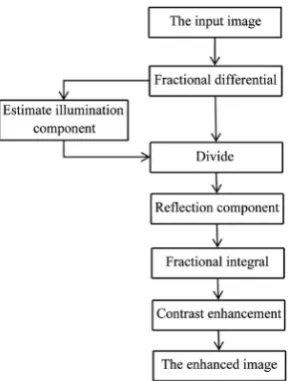
Figure 5 is the flow of image enhancement processing, which combines frac-tional calculus and Retinex.
DOI: 10.4236/jcc.2018.611005 59 Journal of Computer and Communications
[image:5.595.319.428.372.485.2]Figure 2. Retinex theory.
[image:5.595.302.447.514.705.2]Figure 3. 5 × 5 Tiansi operator.
Figure 4. The proposed operator.
DOI: 10.4236/jcc.2018.611005 60 Journal of Computer and Communications 1) The original image is preprocessed by the fractional differential, which can enhance the edge of the image and also can enhance the weak texture nonlinearly. 2) Estimate illumination component of the image according to the guided fil-ter.
3) According to the single-scale Retinex algorithm, the preprocessed image is divided by the illumination component to obtain the reflection component.
4) Denoise the image by a fractional integral on the reflected component. 5) Improve the contrast by contrast-limited adaptive histogram equalization and get the final enhanced image.
4. Experiment Simulation and Results Analysis
In order to verify the effectiveness of the proposed algorithm, Histogram equali-zation (HE), fractional differential (FD), single-scale Retinex algorithm (SSR), multi-scale Retinex algorithm (MSR), fractional differential combined with sin-gle-scale Retinex algorithm (FDSSR) and the proposed algorithms are used to enhance images. The experiment environment is as follows: the operating system is Windows 7, the simulation software is MATLAB R2014b, the processor is In-tel (R) Core (TM) i5-6500, and the memory is 4 GB.
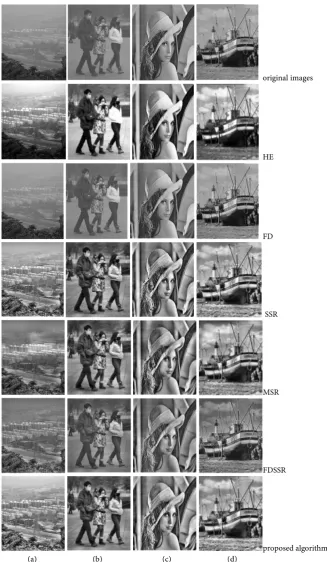
In the experiment, FD and FDSSR adopt Tiansi operator, and the order of fractional differential is 0.5. The order of fractional calculus in the proposed al-gorithm is 0.2 and −0.2, respectively. Figure 6 shows original images and en-hanced images. 1) is the image of building, 2) is the image of people, 3) is the image of lena and 4) is the image of barche. The effect of image enhancement is evaluated subjectively and objectively. The subjective evaluation is based on the visual effect of images. The objective evaluation has no unified standard at present, and it is mainly based on some information of images.
According to the visual effect of images of each group in Figure 6, it can be seen that HE has the largest contrast, the black and white is more distinct, but the image details are not enough. FD and FDSSR have small contrast, the visual effect is dark, and the enhancement is not obvious. Distortion occurs in the en-hanced images of MSR. Compared with SSR, the proposed algorithm has the best visual effect and the most abundant image details.
In order to evaluate the effect of enhanced images objectively, the average gradient, the information entropy, the gray mean and the standard deviation are used to make a comprehensive evaluation. Assuming the size of the image is
M N× .
1) Average gradient: The average gradient of the image reflects the sharpness and texture change of an image. Generally, the larger the average gradient is, the clearer the image details has. A high average gradient also means the better edge preservation effect of an image, but the increase of noise will increase the aver-age gradient. The averaver-age gradient is defined as
2 2
1 1
1 M N 2
i j
f f
AG
x y
M N = =
∂ ∂
= +
∂ ∂
DOI: 10.4236/jcc.2018.611005 61 Journal of Computer and Communications where ∂∂fx is the horizontal gradient, and f
y ∂
∂ is the vertical gradient.
2) Information entropy: Information entropy is an indicator to measure how much information there is in an image. The larger the information entropy is, the
original images
HE
FD
SSR
MSR
FDSSR
[image:7.595.207.535.140.703.2]proposed algorithm (a) (b) (c) (d)
DOI: 10.4236/jcc.2018.611005 62 Journal of Computer and Communications more details and information can be got from the original image. The informa-tion entropy E is defined as
( )
1 0 ln L i i iE − p p
=
= −
∑
(5)where pi is the probability of gray value of i. Assuming the gray scale of a im-age is from 0 to L − 1, so i = 0, 1, , L − 1.
3) Gray mean: The gray mean reflects the brightness of an image. In a certain range, the larger the image gray mean is, the better the visual effect of the image has. Gray mean can be expressed as
( )
1 11 M N , i j g i j M N
µ
= =
=
×
∑∑
(6) where g (i, j) represents the pixel value of a image in the i th row and the j th column.4) Standard deviation: the standard deviation of a image denotes the disper-sion degree between the pixel value and the gray mean of the image. A high standard deviation means a high contrast and the better quality of a image. The standard deviation δ can be defined as follow:
( )
(
)
2 1 11 M N ,
i j g i j
M N
δ µ
= =
= −
×
∑∑
(7)where µ is the gray mean of image.
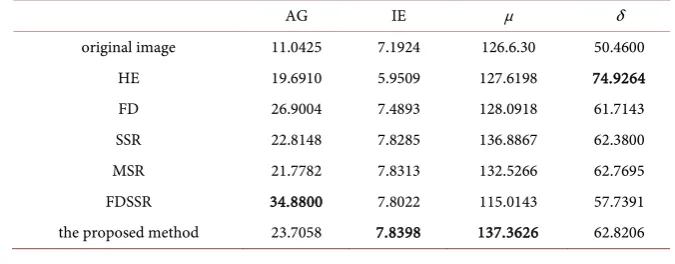
DOI: 10.4236/jcc.2018.611005 63 Journal of Computer and Communications of the proposed algorithm is the largest of the four methods, which indicates that the enhanced image is brighter and the visual effect is better.
Table 1. Comparison of results of algorithms about the image of building.
AG IE µ δ original image 4.0865 6.8138 123.5663 40.7859
[image:9.595.210.541.290.414.2]HE 9.2857 5.8695 127.6235 74.9532 FD 9.9005 7.0547 124.2478 43.5351 SSR 13.3017 7.5074 140.2352 47.0893 MSR 10.0260 7.3362 114.4096 41.3657 FDSSR 20.9871 7.3050 114.1159 40.5345 the proposed method 14.8403 7.6541 148.2499 52.4259
Table 2. Comparison of results of algorithms about the image of people.
AG IE µ δ original image 3.7236 6.5994 116.2724 29.8227
HE 9.9067 5.9187 127.4481 74.7337 FD 9.1291 6.9658 117.3178 34.7969 SSR 10.9007 7.7118 105.3917 54.6149 MSR 10.6647 7.7123 106.3229 54.1543 FDSSR 15.5365 7.4431 105.3887 43.7380 the proposed method 11.3097 7.7140 106.5820 54.7190
Table 3. Comparison of results of algorithms about the image of lena.
AG IE µ δ original image 5.5677 7.4450 124.0459 47.8318
HE 8.6265 5.9774 127.4161 74.8292 FD 11.8011 7.6339 124.6892 52.0603 SSR 11.5319 7.8885 127.8814 61.3986 MSR 10.8721 7.8662 122.3429 60.2206 FDSSR 17.7646 7.7894 118.8989 55.6789 the proposed method 12.1078 7.9010 130.5114 62.3295
Table 4. Comparison of results of algorithms about the image of barche.
AG IE µ δ original image 11.0425 7.1924 126.6.30 50.4600
[image:9.595.213.540.445.570.2] [image:9.595.203.541.602.734.2]DOI: 10.4236/jcc.2018.611005 64 Journal of Computer and Communications
5. Conclusions
The paper presents an image enhancement method based on fractional calculus and single-scale Retinex. The method uses fractional differential to preprocess the input image. While the image edge information is strengthened, it also can preserve the weak texture and other details of the image non-linearly. Fractional integral is used to denoise the reflection component to reduce and eliminate noise interference. Through experiments, the results show that images enhanced by the proposed method have good visual effects and significantly improve var-ious evaluation indicators.
In future work, adaptive fractional calculus can be introduced into the algo-rithm to improve the adaptability of the method, but how to determine the cor-relation factor of the order is difficulty, and improving the versatility of the algo-rithm also needs further research.
Acknowledgements
This work is supported by the Fundamental Research Funds for the Central Universities (2018MS072).
Conflicts of Interest
The author declares no conflicts of interest regarding the publication of this pa-per.
References
[1] Jobson, D.J., Rahman, Z. and Woodell, G.A. (1997) Properties and Performance of a Center/Surround Retinex. IEEE Transactions on Image Processing, 6, 451-462.
https://doi.org/10.1109/83.557356
[2] Rahman, Z., Jobson, D.J. and Woodell, G.A. (1996) Multi-Scale Retinex for Color Image Enhancement. Proceedings of 3rd IEEE International Conference on Image Processing, Lausanne, 19 September 1996, 1003-1006.
https://doi.org/10.1109/ICIP.1996.560995
[3] Jobson, D.J., Rahman, Z. and Woodell, G.A. (1997) A Multiscale Retinex for Bridg-ing the Gap between Color Images and the Human Observation of Scenes. IEEE Transactions on Image Processing, 6, 965-976. https://doi.org/10.1109/83.597272
[4] Liu, H.B., Yang, J., Wu, Z.P., et al. (2015) A Fast Single Image Dehazing Method Based on Dark Channel Prior and Retinex Theory. Acta Automatica Sinica, 41, 1264-1273.
[5] Zhang, X., Wang, W.X., Zhang, Y.F., et al. (2015) Vague Aerial Image Enhancement on Fractional Differential and Improved Retinex. Application Research of Comput-ers, 9, 2844-2848.
[6] Ma, R.G., Wang, W.X., Liu, W., et al. (2016) A Haze Removal Algorithm Combin-ing Fractional Differential, Dark Channel Prior and Retinex. Journal of South China University of Technology (Natural Science Edition), 44, 16-23.
DOI: 10.4236/jcc.2018.611005 65 Journal of Computer and Communications on Pattern Analysis and Machine Intelligence, 35, 1397-1409.
https://doi.org/10.1109/TPAMI.2012.213
[9] Yang, Z.Z., Zhou, J.L., Yan, X.Y., et al. (2008) Image Enhancement Based on Frac-tional Differentials. Journal of Computer-Aided Design and Computer Graphics, 20, 343-348.
[10] Yang, Z.Z., Zhou, J.L. and Lang, F.N. (2014) Noise Detection and Image De-Noising Based on fractional Calculus. Journal of Image and Graphics, 19, 1418-1429. [11] Land, E.H. (1977) The Retinex Theory of Color Vision. Scientific American,237,