ISSN Online: 2161-4725 ISSN Print: 2161-4717
DOI: 10.4236/ijaa.2018.83020 Sep. 28, 2018 275 International Journal of Astronomy and Astrophysics
Evolution of Angular Momentum and Orbital
Period Changes in Close Double White Dwarf
Binaries
Seblu Humne Negu
*, Solomon Belay Tessema
Astronomy and Astrophysics Research Development Department, Ethiopian Space Science and Technology Institute (ESSTI)-Entoto Observatory and Research Center (EORC), Addis Ababa, Ethiopia
Abstract
We have presented the evolution of angular momentum and orbital period changes between the component spins and the orbit in close double white dwarf binaries undergoing mass transfer through direct impact accretion over a broad range of orbital parameter space. This work improves upon similar earlier studies in a number of ways: First, we calculate self-consistently the angular momentum of the orbit at all times. This includes gravitational, tides and mass transfer effects in the orbital evolution of the component structure models, and allow the Roche lobe radius of the donor star and the rotational angular velocities of both components to vary, and account for the exchange of angular momentum between the spins of the white dwarfs and the orbit. Second, we investigate the mass transfer by modeling the ballistic motion of a point mass ejected from the center of the donor star through the inner La-grangian point. Finally, we ensure that the angular momentum is conserved, which requires the donor star spin to vary self-consistently. With these im-provements, we calculate the angular momentum and orbital period changes of the orbit and each binary component across the entire parameter space of direct impact double white dwarf binary systems. We find a significant de-crease in the amount of angular momentum removed from the orbit during mass transfer, as well as cases where this process increases the angular mo-mentum and orbital period of the orbit at the expense of the spin angular momentum of the donor and accretor. We find that our analysis yields an in-crease in the predicted number of stable systems compared to that in the pre-vious studies, survive the onset of mass transfer, even if this mass transfer is initially unstable. In addition, as a consequence of the tidal coupling, systems that come into contact near the mass transfer instability boundary undergo a phase of mass transfer with their orbital period.
How to cite this paper: Negu, S.H. and Tessema, S.B. (2018) Evolution of Angular Momentum and Orbital Period Changes in Close Double White Dwarf Binaries. Inter-national Journal of Astronomy and Astro-physics, 8, 275-298.
https://doi.org/10.4236/ijaa.2018.83020
Received: July 26, 2018 Accepted: September 25, 2018 Published: September 28, 2018
Copyright © 2018 by authors and Scientific Research Publishing Inc. This work is licensed under the Creative Commons Attribution International License (CC BY 4.0).
DOI: 10.4236/ijaa.2018.83020 276 International Journal of Astronomy and Astrophysics
Keywords
Stars: DWD Binaries, Mass Transfer, Methods: Numerical
1. Introduction
Double white dwarf (DWD) binaries provide an interesting key to understand a variety of areas in astrophysics. Their birth properties provide insight into the evolution of their progenitors [1], as well as the dynamics of common envelope evolution [2]. From a population standpoint, the DWD binary systems may make up the largest fraction of the close binary stars in our Galaxy.
Following common envelope evolution, DWD binaries may emerge with a sufficiently short orbital period and rotational angular velocities, allowing gravi-tational radiation (GR), tides and mass transfer to drive the stars closer together on an astrophysically interesting time scale. Prior to the onset of mass transfer, their orbit will be shrink due to the effect of angular momentum via GR. Tidal forces are thought to synchronize the spin and orbital periods of the white dwarfs by the time that the white dwarfs are close enough together to begin transferring mass ([3] [4]).
As the degenerate components of a DWD binary orbit continues to shrink via GR, the less massive component will inevitably fill its Roche lobe and begin transferring matter to its companion and the system will enter into a stable semi-detached state. In the case where the mass transfer is stable, such systems may be identifiable as AM CVn ([5] [6]), which have extremely short orbital pe-riods, but we still lack a uniform theoretical understanding of the detail nature of those binaries for all possible mass ratios, orbital parameters and origins. How-ever, one would like our theoretical understanding to be such that given a white dwarf binary of arbitrary masses and compositions at the time that the less mas-sive component gets into contact, one could reconstruct the previous evolutio-nary pathways and the subsequent evolution to merger, tidal disruption or stable mass transfer.
angu-DOI: 10.4236/ijaa.2018.83020 277 International Journal of Astronomy and Astrophysics lar momentum loss from the systems due to GR. If direct impact drives the sys-tem apart, both [9] and [10] showed that a stabilizing accretion disk is likely to be created. If direct impact mass transfer increases the mass ratio and decreases the orbital period, the mass transfer rate may eventually become dynamically unstable, which can result in a merger.
As we have showed in [12] henceforth called paper I that mass transfer phase in binary stellar evolution can either decrease or increase the orbital period of the system, crucially depending on the exchange of angular momentum between the binary components, the orbit and the component spins. In order to calculate the angular momentum changes during mass transfer, both the studies of [9]
and [10] utilize a numerical prescription based on [13] approximations to more
accurately determine the flow of angular momentum between the component spins and the orbit. In that formulation, it is assumed that the angular momen-tum transferred from the orbit to the spin of the accretor is exactly equal to the angular momentum of the ballistic particle in a circular orbit around the donor at its average radius during its motion from donor to accretor1. The present study will building upon these studies and crucially depending on the changes in the orbital angular momentum, the period and radius of the donor stars and that of its Roche lobe in response to the mass transfer, providing direct ballistic inte-grations of the mass transfer stream using an approximation adopted from the
[13]. This led us to extend the analytical and numerical solution of [14] for the time dependent behavior of the mass transfer by relaxing most of the assump-tions made to provide the problem manipulable. Here, we retain the simplifying assumption of Roche lobe calculation, but allow all the binary parameters to vary self-consistently.
The aim of this paper is to determine the evolution of angular momentum and orbital period changes between the component spins and the orbit in close DWD binaries throughout GR, tides and mass transfer effects by providing dif-ferent range of orbital parameters and stellar models in a full self-consistent manner. In particular, we examine the comparison between numerical and ana-lytical solutions to determine these systems whether, and under what circums-tances, dissipative tidal coupling of the accretor to the orbit, through direct im-pact, can stabilize the dynamical mass transfer. This paper is organized as fol-lows:
In Section (2) we develop the basic differential equations which governing the evolution of orbital parameters, assuming mass transfer through some well-specified model(s) and the basic assumptions with dynamical stability of mass transfer and discuss the difference between this method and the method utilized by the previous studies. In Section (3) we find and discuss the numerical solutions of the systems. In Section (4) we illustrate the results and discussion of this paper in comparison to the previous studies. Finally our main conclusion is summarized in Section (5).
1[9] assume that the donor remains tidally locked, while [10] does allow for variation in the spin of
DOI: 10.4236/ijaa.2018.83020 278 International Journal of Astronomy and Astrophysics
2. Mass Transfer and Evolution of Orbital Parameters
2.1. Basic Assumptions
In this paper, we consider a close binary system of two white dwarfs with masses Md and Ma, volume-equivalent radii of Ra and Rd, and uniform rotational angu-lar velocities of Ωa and Ωd with axes perpendicular to the orbital plane for the accretor and donor, respectively2. We assume that the mass of each star is distributed spherically symmetrically. The binary is assumed to be in an initially circular keplerian orbit with orbital period, Porb. The radius of each object is as-signed following Eggleton’s zero-temperature mass radius relationship of [13]. We chose the Porb of the orbit such that the volume-equivalent radius of the mass of the donor (Rd) is equal to the volume-equivalent radius of its Roche lobe (RL) as fit by [15]. Both the Md and Ma initially rotate synchronously with the orbit3.
2.2. Method
In this paper, we perform a Monte Carlo integration to calculate the vo-lume-equivalent Roche lobe radius [16] over a two dimensional grid in Porb and mass ratio, q parameter space. We also apply Runge-kutta methods for numeri-cally estimating solutions to basic differential evolution equations of obit, which will be discussed in Section (3). Hence, we determine the set of orbital parame-ters and their differential equations which governs the evolution of angular mo-mentum and orbital period changes due to direct impact accretion in close DWD binaries, using the Eggleton function for the Roche lobe, RL E, gg for calculating its size, the dynamical mass transfer rate, and the corresponding synchronization time scales for different cases, under certain restrictive ap-proximations which determine the strength of tidal coupling. We now have all the steps in place to solve the evolution of these systems.
Our basic calculations are performed using a Monte Carlo integration method in a stationary inertial reference frame located at the initial center of mass of the binary system, which solving ordinary differential equations of orbital parameters at equivalent points. Following the above assumptions, we can investigate the out-comes for these systems with total mass, M and the orbital parameters such as Porb:
1 2 2 3
4π ,
orb a
P
GM
=
(1)
where G and a are the universal gravitational constant and semi-major axis, re-spectively, and taking the donor to be the less massive star, the one that fills its Roche lobe.
2.3. Evolution of Angular Momentum
As we have investigated in [12], as the matter is being transferred between the 2Throughout this paper, the subscripts “a” and “d” will correspond to the accretor and donor,
re-spectively.
DOI: 10.4236/ijaa.2018.83020 279 International Journal of Astronomy and Astrophysics components in the binary systems, not only the mass ratio, q, but also the Porb will be changed due to angular momentum redistribution between the components of two stars. Then the total angular momentum, Jtot, of the binary system is given by:
(
)
(
)
2 , 1 ; ,tot orb spin i i
J J J i a d
=
= +
∑
∈ (2)where Jorb is the orbital angular momentum, which is given by: 1 2
,
orb a d Ga
J M M
M
=
(3)
and the spin angular momenta of the accretor and donor are 2
,
spin a a a a a
J =K M R Ω and 2
,
spin d d d d d
J =K M Rω , respectively, where Ka and Kd are
dimensionless constants depending upon the internal structure of the accretor and donor, respectively.
Here, we express the total angular momenta in terms of the rotational rates of the accretor, fa and donor, fd relative to the orbital angular velocities of the stars. Thus the rotational angular velocities of the stars, Ωi can be written in terms of the rotational rates and the angular velocity of the circular orbit, Ωorb is given by
.
i fi orb
Ω = Ω (4)
Then we can rewrite the total angular momentum of the binary system as:
(
)
2
2
1 .
tot a d i i i i orb i
Ga
J M M K M R f
M =
= +
∑
Ω (5)The form of the Jorb term adopted above assumes the binary revolves at the Keplerian angular velocity of the circular orbit, 2 3
orb GM a
Ω = , which is a good approximation if the stars are centrally condensed.
Here, we introduce three effects that change the Jorb, Porb and Ωi over time: mass transfer (MT), tides, and GR. Assuming each effect is independent of the others, we can then write the change of the orbital angular momentum as the sum of the change due to each of the above effects:
(
)
2
, , , ,
1
,
orb orb MT orb GR orb tides i i
J J J J
=
= + +
∑
(6)
which is known as the orbital angular momentum balance equation. To deter-mine the total change in the angular momentum, then, we simply need to write the change due to each of the above effects. A system of two point masses orbit-ing around each other, in circular orbits, radiates gravitationally ([17]). Then the change in orbital angular momentum due to GR for a circular orbit is given by:
3
, 5 4
32 .
5 a d
orb GR G M M M orb
J J
c a
= −
(7)
de-DOI: 10.4236/ijaa.2018.83020 280 International Journal of Astronomy and Astrophysics crease due to the effect of angular momentum via GR as seen in Equation (7). During this time, tidal coupling will act to circularize the binary as well as syn-chronize the spins of the stars with the orbit. As mass transfer begins, angular momentum will be exchanged between the spin of the component stars and the orbit. This will ultimately affect the dynamical stability of the mass transfer process. As in [10], we express the exchange of orbital angular momentum due to tides as:
(
)
2 2
,
1 1 ) .
i i i
orb tides i orb
i i
K M R
J τ f
=
= − Ω
∑
(8)
The term in the bracket of Equation (8) represent the torque due to dissipative coupling upon the accretor and donor. Hence, torques are parameterized in terms of the synchronization time scales ([18]) of the accretor, τa, donor, τd and are linearly proportional to the difference between the component and the orbit spin, which determines the strength of tidal coupling relative to MT and GR. We assume that the tidal synchronization time scales change because the masses and stellar radii relative to the orbital period are changing. As [10], we explore two different values for the synchronization time scale at contact:
15
10 years
τ= (very weak tidal coupling) and τ=10 years (very strong tidal coupling), which may be a better approximation for systems with short orbital periods, as we consider in our analysis.
In this work, we are only interested in direct impact mass transfer and orbital changes due to ballistic integrations where the particle impacts the surface of the accretor within one orbital period. In this case, the evolution of orbital parame-ters is determined by the differential equations, which will be given in Section (2.4). If the particle accretes within one orbital period, we classify this as a direct impact. If the particle does not accrete within one orbital period, it is likely that the ejection stream from the donor will self-intersect, resulting in the eventual formation of an accretion disk.
To determine Jorb MT, , we use the ballistic mass transfer calculations of [19] to examine the instantaneous effect of mass transfer in close DWD binary systems. This method uses a fully self-consistent, conservative, ballistic model of the transferred mass to determine the orbital parameters of the system after a single mass transfer event. Then, the change in the orbital parameters per unit mass that results is directly proportional to the mass transfer rate of our evolving DWD, Md:
,
, orb b ,
orb MT d
P
J
J M
M
∆
=
(9)
DOI: 10.4236/ijaa.2018.83020 281 International Journal of Astronomy and Astrophysics change in the Jorb MT, per unit mass transferred is independent of the mass of the ejected particle as long as MPM Md, a.
2.4. Differential Equations for the Evolution of Orbital
Parameters
As we investigated the rate of change of orbital angular momentum in Section (2.3), we develop the equations for the evolution of orbital period and the rota-tional angular velocities of the stars. It follows from Equation (3) and [12] that
(
1)
13
orb d orb
orb d orb
J q M P
J M P
= − +
(10)
for conservative mass transfer
(
M =0)
4 and d aM q
M
= . Since Ma= −Md.
Hence for the conditions M = constant and Jorb = constant it then follows that:
(
)
3 1 0.
orb a
orb d
P M q
P M
= − − >
(11)
2.4.1. Evolution of the Orbital Period
We examine the changes of the Porb due to dynamical mass transfer, tides and GR. We assume that each effect is independent, and write the total change in the
orb
P due to each of the above effects, respectively, as:
(
)
2
, , , ,
1
.
orb orb MT orb GR orb tides i i
P P P P
=
= + +
∑
(12)
To calculate Porb MT, , we utilize the model for mass transfer developed in [19]. Using this models, we calculate the time rate of change of Porb due to mass transfer rate as:
,
, orb b .
orb MT d
P P P M M ∆ =
(13)
Here, ∆Porb b, is the change in the orbital period for a close DWD binaries as calculated by the above ballistic model of [19] as described in Section (2.3) for the evolution of orbital angualar momentum.
Next we calculate Porb tides, and Porb GR, . As noted by [9] and [10], we used a different metric for changing the spin angular momentum due to tides of Equa-tion (8). Hence we develop Porb tides, from that angular momentum change. Holding the donor mass constant (M =0) for the final two terms of Equation (12) we can combine Equation (6) with Equation (11) to obtain:
( )
, , 31 , ,
orb tides orb GR orb tides GR orb orb
J J P J
P
+ =
(14)
DOI: 10.4236/ijaa.2018.83020 282 International Journal of Astronomy and Astrophysics
, ,
, , 3orb tides 3orb GR . orb tides orb GR orb
orb orb
P P
J J J
P P
+ = +
(15)
Using Equation (3), Equation (7), and Equation (8), it follows that: 2
2 ,
1
3 orb i i i ,
orb tides i
i i
P K M R
P
GaM τ ω
µ =
=
∑
(16)
and
3
, 5 3
96 .
5 a d
orb GR G M M M
P
c a
= −
(17)
From Equation (4) and Equation (8) we can re-write Equation (16) as
(
)
(
)
, 2 1 3
3 ,
orb tides a d
orb
P A D
P M
µ
= +
(18)
where
2
,
a a a a orb a
a orb
K M R
A = τ Ω − Ω Ω
and
2
.
d d d d orb d
d orb
K M R D
τ
Ω − Ω
= Ω
(19) Finally, inserting Equation (13), Equation (17), & Equation (18) into Equation (12) leads to the equation for the dynamical evolution of the orbital period with time as:
(
)
(
)
, , 1 3 2 3 .orb b a d
orb d orb GR
P orb
P A D
P M P
M
µ
P M∆ +
= + −
(20)
2.4.2. Evolution of the Rotational Angular Velocities of the Stars
We derive the equations for the evolution of the components spins, Ωa and d
Ω . Thus the changes in both components can be defined as:
, , , .
i i MT i tides i GR
Ω = Ω + Ω + Ω (21)
Analogous to PMT in Equation (13), the change in Ωi due to mass transfer,
,
i MT
Ω can be expressed as:
,
, b i .
i MT d
P
M M
∆Ω
Ω =
(22)
Here, ∆Ωb i, is the change in the rotational angular velocities of the star i re-sulting from a single mass transfer as described in Section (2.3). As in Equation (4), the spin angular momentum of each component can be written as:
2
, ,
spin i i i i i
J =K M R Ω (23)
syn-DOI: 10.4236/ijaa.2018.83020 283 International Journal of Astronomy and Astrophysics chronous with the orbit (fi=1). Now we can determine Ωi tides, and Ωi GR, by differentiating Equation (22) with respect to time assuming the mass held con-stant:
(
)
2
, , ,
spin i i i i i tides i GR
J =K M R Ω + Ω
(
)
2
2 .
3 i i i i tides GR orb
K M R P P
P
Ω
− + (24)
The second term in Equation (24) depends only upon changes due to tides and GR. Since we do not include any GR effect on the spin angualar momentum of the components, conservation of angular momentum indicates that any changes in the spin angualar momentum of a component must be equal and opposite to the changes in the orbital angular momentum of the system due to tides acting on that component. Using Equation (4) and Equation (8), we have:
(
)
2 2 , 1 .i i i
spin i i orb
i i
K M R J
τ
== −
∑
Ω − Ω (25)
By combining Equation (24) and Equation (25) we can derive the expression for Ωi tides, + Ωi GR, as:
(
)
(
)
, , 2 1 3
3
2 ,
3
a d i i
i tides i GR GR
i orb orb
A D
P
β
P Mτ
µ
+
Ω Ω
Ω + Ω = − − +
(26)
where
3
5 3
96 .
5 a d
GR G M M Mc a
β = (27)
Using Equation (21), Equation (22) and Equation (26) we obtain the equa-tions for the evolution of Ωa and Ωd as:
, 2
3
b a a a
a d
P a orb
M
M τ P
∆Ω
Ω Ω
Ω = − +
(
)
(
2)
1 33 , a d GR orb A D P M
β
µ
+ − + (28) and , 2 3b d d d
d d
P d orb
M
M τ P
∆Ω
Ω Ω
Ω = − +
(
)
(
2)
1 33 , a d GR orb A D P M
β
µ
+ − + (29)2.5. Mass Transfer Rate
DOI: 10.4236/ijaa.2018.83020 284 International Journal of Astronomy and Astrophysics proceed in a stable or dynamically unstable manner depending on the response of the mass losing donor star and its Roche lobe to the mass transfer. For all types of donor star, the mass transfer rate is a strong function of the depth of contact, defined here as the amount by which the donor overflows its Roche lobe as:
,
d L
R R
∆ = − (30)
where Rd is the radius of the donor and RL is the radius of its Roche lobe. The mass loss rate from the donor monotonically increases with
∆
. The way in which the mass transfer rate varies with∆
has been investigated in many ana-lyses (see, for example, [21] [22] [23]). The correct way to treat this is to com-pute the stellar structure ([23]). In accordance with [9], we approximate the mass transfer as adiabatic ([24]). In the adiabatic response, which for a white dwarf donor gives a mass transfer rate of(
, , ,)
3,d a d d
M = −f M M a R ∆ (31)
for ∆ >0, and zero for ∆ <0. Combining results from [24] [25] and [22], the function f is given by:
(
, , ,)
8π3 5 2 3 2(
)
5 2 ,9
e n e
a d d
orb
m Gm
f M M a R
P h
µ′
= Λ
(32)
where
(
3µMd 5r RL d)
3 2 a ad(
d 1)
1 2−
Λ = − , me is the mass of an electron,
n
m is the mass of a nucleon, µ′e is the mean number of nucleons per free elec-tron in the outer layers of the donor (which we will assume to be two) and µ
and ad are parameters associated with the Roche potential
(
)
3 3
1 1
1
and .
1
d
d
a d L L
M a
M M X X
µ µ
µ= = + −
+ − (33)
where, XL1 is the distance from the center of the donor to the inner Lagran-gian point of the donor, in units of the semi-major axis, a.
2.6. Roche Model
In the case of [9], where the rotational angular velocity of the donor is fixed to the orbital velocity and the orbit is circular throughout, the shape and volume of the Roche lobe depends only upon the mass ratio and the semi-major axis of the system. For higher mass ratio, stars become more and more deformed. Thus mass transfer is dynamically unstable. In that case, we introduce the effective ra-dius, rL, of the Roche lobe, the most widely used approximation being from
[15],
(
)
2 3
2 3 1 3
0.49 ,
0.69 log 1
L q
r
q q
=
+ + (34)
effectively, it is a tidal radius where mean density in lobes are equal:
,
L L
DOI: 10.4236/ijaa.2018.83020 285 International Journal of Astronomy and Astrophysics
2 ,
3
L
d orb L
r
L d orb
M P
R
R =
ζ
M + P
(36)
where ζrL takes values between 0.33 and 0.48 is the logarithmic derivative of
L
r with respect to Md for both [26] and [15] small q approximation for the Roche lobe radius. In the same spirit we write the logarithmic time derivative of the donor radius, Rd ≡R M td
(
d,)
as:,
d d
ad
d d
R M
D
R = +
ζ
M
(37)
where
(
log( )
log( )
)
d
d M
D= ∂ R ∂ ∂t , represents the rate of change of the donor
radius due to intrinsic processes such as thermal relaxation and nuclear evolu-tion, whereas ζad usually describes changes resulting from adiabatic variations
of Md [27]. If the donors are degenerate as in the white dwarf case, ζad is
simply obtained from the equilibrium mass radius relationship for the donor5. As ζad and ζrL are both monotonic functions of mass loss, it is a sufficient condition that mass transfer be stable at the onset of Roche lobe overflow in or-der to ensure dynamical stability of mass transfer, which depends on the tidal coupling between the accretor and the orbit undergoing direct impact accretion. The larger ζad, the more stable the mass transfer is. To consider stability in de-tail, we will use the linear stability analysis following ([11] [28]).
3. Numerical Solutions
We integrate numerically the orbital evolution Equation (2), Equation (4), Equa-tion (6), EquaEqua-tion (11), EquaEqua-tion (20), EquaEqua-tion (28), EquaEqua-tion (29), EquaEqua-tion (31), Equations (35)-(37) using 6th and 8th order Runge-Kutta ordinary differen-tial equation solver [29], allowing the binary parameters to adjust self-consistently. We consider that the orbital angular momentum of the system are conserved throughout the integration over the entire parameter space. Spe-cifically, we compute the angular momentum and orbital period changes be-tween the component spins and orbit in close DWD binaries undergoing mass transfer through direct impact of the transfer stream, allow the binary separation to change and compute the values of ζad as it evolve. Here, we use Eggleton’s approximation of the zero-temperature mass radius relationship cited by [13]
and [9], which is a good approximation for systems containing white dwarfs.
Also, a ζad significantly different from −0.33 clearly affects the stability and evolution of the systems at the onset of mass transfer, and can lead to shrinking orbits even if the mass transfer is stable with Md =0. In our subsequent
analy-sis, where we are concerned about the long term integrations of the orbital evolution equations, we set
(
log)
0d
d M
R t
∂ ∂ = and use the zero-temperature
mass-radius relationship.
5The radius of each object is assigned following Eggleton’s zero temperature mass radius relation
DOI: 10.4236/ijaa.2018.83020 286 International Journal of Astronomy and Astrophysics In our integrations, we need to either assume or determine from other as-sumptions how the mass and angular momentum are redistributed in a close DWD binary system during mass transfer. This depends on the mode of accre-tion appropriate for the binary considered: does the stream impact the accretor or is an accretion disk present; is the mass transfer sub-Eddington and conserva-tive, or are mass and angular momentum being ejected from the system follow-ing super-Eddfollow-ington mass transfer. For most of the numerical integrations that follow, we use the appropriate rate of change of orbital angular momentum due to GR, MT and tides. However, if one is interested in the relatively rapid phases of dynamical mass transfer that follow contact and onset, then the qualitative properties of our integrated evolutions depend strongly on these assumptions.
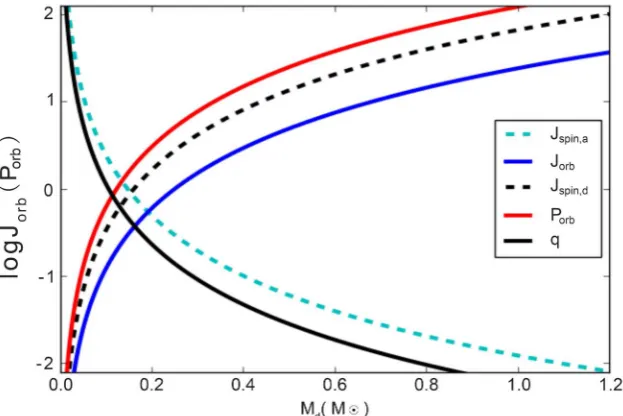
Figure 1 shows the evolution of the orbital period and angular momentum
conservation with their spin angular momentum of the accretor and donor in close DWD binaries over the entire parameter space of interest for integrations that calculated using the Eggleton approximation for the Roche model. In this result, we are only interested in direct impact mass transfer where the particle impacts the surface of the accretor within the orbital periods. Compared to di-rect impact accretion, disc accretion is provide a basic mechanism for redistri-buting spin angular momentum in the accretor back into the orbit through tidal coupling in [7]. As a result, it is likely that once a system enters a phase of disc accretion it will remain in this phase or perhaps even become detached as the orbital period continues to grow and the mass ratio decreases due to continued mass transfer. Thus if a disk is formed at any point the integration stops and the system is assumed to be stable throughout its lifetime.
Figure 1. The evolution of orbital period and angular momentum conservation with their ,
spin a
DOI: 10.4236/ijaa.2018.83020 287 International Journal of Astronomy and Astrophysics As a system evolves, it is possible to pass back and forth through phases of mass transfer and phases of no mass transfer as the orbital period and the two masses change. If Porb increases enough for mass transfer to stop altogether, the integration proceeds (with Md =0) until the action of GR shrinks the orbit
suf-ficiently for mass transfer to resume rather than the analytical one. We integrate over a period of 1.25 G yr. As in [9], if Md less than 0.1Myr−1 at any point
during the integration, the integration continued and the system is desired as dynamically stable.
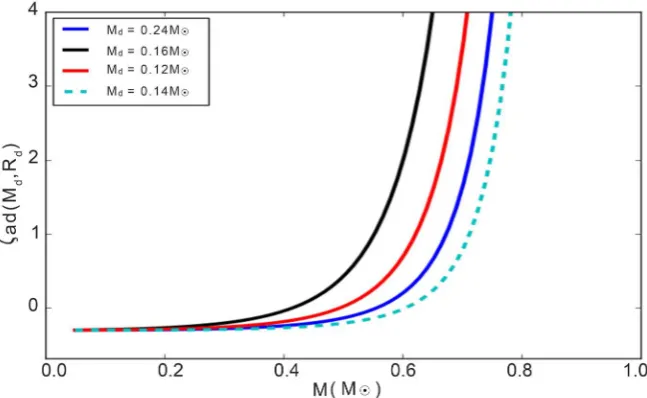
In Figure 2 we show the approximate adiabatic mass radius exponent, ζad
from Equation (37) using the Eggleton’s approximation of the zero-temperature mass radius relationship [13] for stars with initial masses from 0.12M−0.78M
and the corresponding mass radius relations. These were calculated by assuming a constant mass loss rate of 10−5M yr−1
. The large initial values for ζad imply that the star has to lose very little mass to shrink significantly. This simply represents the fact that, in these systems, a large fraction of the envelope con-tains very little mass.
3.1. Angular Momentum and Orbital Period Changes Due to Direct
Impact Accretion
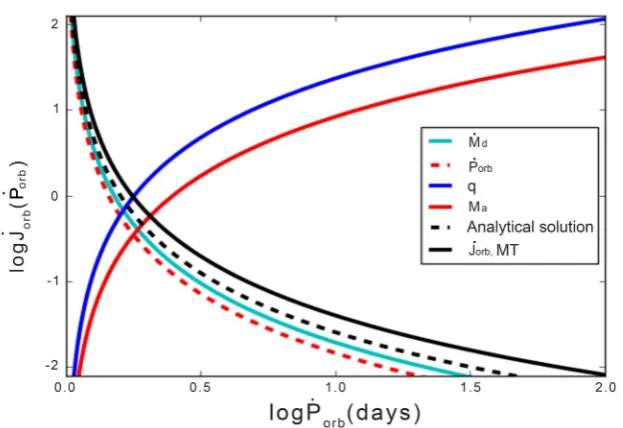
[image:13.595.212.536.491.690.2]In this section, we investigate the numerical integrations for the change in the evolution of orbital angular momentum per unit transferred mass, which is in-dependent of the mass of the ejected particle as long as MPMd from Equa-tion (9) following a single ballistic orbit as a funcEqua-tion of the donor mass for white dwarfs undergoing direct impact mass transfer. Figure 3 shows the evolution of orbital angular momentum change per unit transferred mass, Jorb MT, and pe-riod changes from Equation (9) and Equation (11), respectively, with the less massive donor and the massive accretor stars. Hence, we compared the results of
DOI: 10.4236/ijaa.2018.83020 288 International Journal of Astronomy and Astrophysics Figure 3. The Jorb MT, per unit transferred mass correspond to variations in the mass of accretor and mass ratios of the systems versus Porb. Here, in our calculation the region
above the Jorb MT, shows the unstable mass transfer whereas the region below the Md
shows the stable mass transfer. Hence, the dashed black line represents the analytical so-lution between these stable and unstable systems.
the Jorb MT, and Md due to direct impact accretion with the Porb and Ma. As expected, our numerical results agree quite well to this analytic solution.
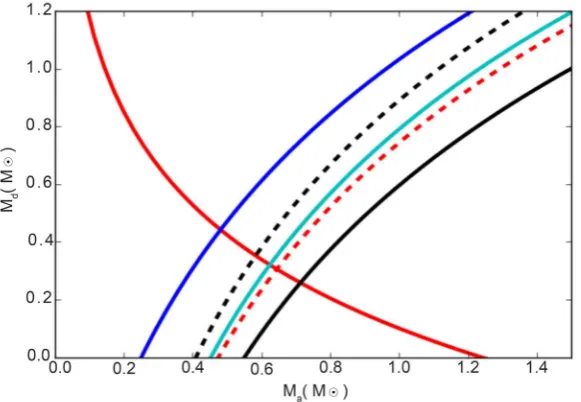
In Figure 4 we investigate a single ballistic integration as a function of the
masses of the donor and accretor. The solid blue and dashed black lines above a solid cyan line are a region corresponds to systems that undergo direct impact and reach stable configuration, while below this solid cyan line such as solid black and dashed red lines are a region corresponds to systems that undergo de-formation. The solid cyan line between these two regions shows the analytical solution to this region, which was first derived and presented by [6] [9]. Thus, the change in the orbital angular momentum appears to become more positive with increasing donor mass. Following them, we calculate this line by taking the distance of closest approach for a ballistic integration given by [30]; as analyti-cally fit by [6] and setting it equal to the radius of the accretor (as given by Eg-gleton’s zero temperature mass radius relationship of [13]. In calculating this line, we assume the donor (also described by the same zero temperature mass radius relationship) completely fills its Roche lobe ([15]).
DOI: 10.4236/ijaa.2018.83020 289 International Journal of Astronomy and Astrophysics Figure 4. Result of a single ballistic integration as a function of the masses of the donor and accretor, which undergoing direct impact accretion from Equation (9).
3.2. Evolution of Systems with Strong Tidal Coupling
It is commonly assumed ([9]; but see also [10]) that the rotational angular veloc-ity of the donor will remain synchronized with the angular velocveloc-ity of the circu-lar orbit. This is generally expected since Roche lobe overflow requires extreme tidal distortions in the donor star which act to synchronize its rotational angular velocity on short time scales. The accretor is generally not affected as strongly by tidal synchronization since, being more massive, it is not expected to be signifi-cantly tidally distorted. Some tidal coupling between the donor and the orbit is generally assumed, though it is not expected to be strong enough to keep the ac-cretor from becoming a rapid rotator.
In Figure 5 we present the orbital parameters of the tides with initial tidal
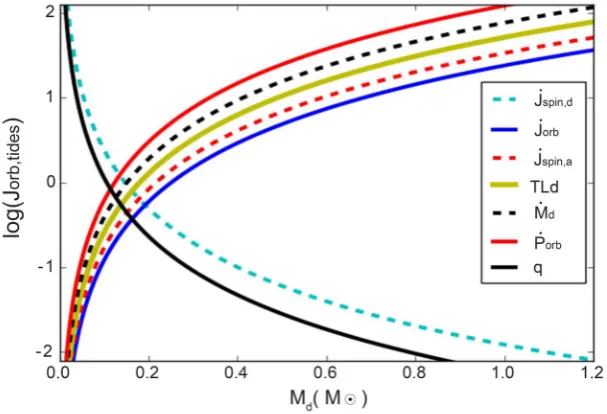
synchronization time scale of τ=10 years: 1) the evolution of the rate of change of the spin angular momenta per unit transferred mass of the the donor (Jspin d, , for Ω =d 0.25) and accretor (Jspin a, , for Ω =a 0.8) from Equation (25), 2) the evolution of the rate of change of orbital angular momentum and period corresponds to the mass transfer rate from Equation (10) and Equation (31), re-spectively, and 3) the effective Roche lobe radius of the donor stars, which shows the end evolution of Roche lobe overflow. In general, systems with a smaller mass conserve orbital angular momentum better than systems with a higher mass. Systems where the orbital angular momentum conservation is larger tend to be systems where the numerical integration runs for many orbits, allowing systematic errors in the numerical integration to accumulate. Even so, all sys-tems presented in this paper conserve mass and orbital angular momentum to better than 1% throughout the entire evolution.
4. Results and Discussion
DOI: 10.4236/ijaa.2018.83020 290 International Journal of Astronomy and Astrophysics Figure 5. Results of evolution for the orbital parameters of the tides generating body with initial tidal synchronization time scale of τ=10 years using the Eggleton
approxima-tion for the Roche lobe that can be calculated from Equaapproxima-tion (8), Equaapproxima-tion (10), Equaapproxima-tion (25) and Equation (31). It shows the rate of change of orbital angular momentum be-tween the donor and the orbit, i.e., the Jspin d, , and Jspin a, correspond to the rotational angular velocities of the donor and accretor, respectively. Here, the rotational angular ve-locity of the donor’s, Ω =d 0.86 remains synchronized to the rotational angular velocity
of the circular orbit, Ωorb=1.25. Hence, we assume the angular momentum that would
be removed from the spin of the donor is immediately returned from the orbit.
parameters in Sections (2) and (3), respectively, we compute the evolution over a grid in Md, Ma and Porb parameter space for two different tidal synchroni-zation time scales at contact: τ=10 years15 and τ =10 years to determine the dynamical stability of various systems. We also elaborate the comparisons be-tween numerical and analytical solutions for the evolution of angular momen-tum and orbital period changes due to direct impact accretion in close DWD binaries by various stellar model approximations of mass transfer, with particu-lar attention payed to the dynamical stability of these processes against runaway on synchronization time scales of the mass donating star.
4.1. Evolution of Systems Using Eggleton Roche Lobe
As we discussed in Section (3), Figure 5 shows the end result of systems with an initial synchronization time scale of τ=10 years using RL Egg, . Assuming that once a disc is reached, the system will remain stable for the remainder of its evolution, therefore we stop the integration once a disc is formed. However, with the exception of dynamically unstable systems, the evolution of all systems in this plot is stopped when the system reaches a phase of disc accretion. The time it takes to reach this phase of disc accretion varies from system to system.
DOI: 10.4236/ijaa.2018.83020 291 International Journal of Astronomy and Astrophysics the resulting effects of tidal coupling between the donor’s spin and the orbit, the number of stable systems increased compared to the analysis of [9]. Hence, the main difference between our analysis and that of [10] is in the treatment of the way we manage the evolution of angular momentum and orbital period changes during the direct impact accretion process. In observing the increase in the number of stable systems compared to the analysis of [10], we conclude that by utilizing a mass transfer treatment that allows the rotation rates corresponds to rotational angular velocities of both components to vary and self-consistently accounts for the exchange of angular momentum between the spins of the com-ponents and the orbit, we are able to increase the number of stable systems.
Stronger tidal coupling will allow more spin angular momentum from the ac-cretor to be transferred back into the orbit, which correspondingly slower in-crease in orbital period, causing the mass transfer rate and the rate of change of orbital angular momentum to decrease. This is to be expected and in agreement with the analyses of [10] and [9]. This results in an increase the stability of the systems in general.
In Figure 5 we have presented the dynamically stable mass transfer with
in-creasing orbital period, but dein-creasing the mass ratio of the systems. However,
in Figure 6 we have presented the dynamically unstable mass transfer with rapid
[image:17.595.223.527.465.672.2]increase in the orbital period for τ=10 years15 is a direct result of the conser-vation of angular momentum: the angular momentum lost during the spin down and mass loss of the donor is greater than the angular momentum gained by the accretor. The net decrease in spin angular momentum corresponds to an in-crease in the orbital angular momentum, increasing the orbital period. The mass transfer rate increases rapidly as the mass loss from the donor causes the radius
Figure 6. Same as in Figure 5, but with τ=10 years15 using ,
L Egg
R for the Roche lobe calculation. In this result, we observe that the Porb increases due to the effect of tides. As
DOI: 10.4236/ijaa.2018.83020 292 International Journal of Astronomy and Astrophysics to increase, even as the Roche lobe grows due to the increasing orbital period (see, e.g., Equation (30) and Equation (31)). Thus, we present the results of evo-lution for the orbital parameters of the tides generating body with tidal synchro-nization time scale of τ=10 years15 . Here, we acknowledge the main limitation of our result to assume that systems are stable once they reach a phase of disc accretion. Systems with the less masses of the donor stars parameter space of in-terest here begin the integration in a disc phase, and are therefore labeled as sta-ble. However, it is feasible that if these high donor mass systems were allowed to evolve through the initial disc phase, they would eventually become su-per-Eddington and potentially dynamically unstable.
4.2. Comparison of System Evolution with analytical Solutions
We have computed different orbital parameters of close DWD binaries and their evolution with synchronization time scales using RL Egg, . Hence, for15
10 years
τ= , the system is dynamically unstable and for τ=10 years the sys-tem is stable, but passes through a phase of super-Eddington accretion. In this section, we compare the analytical solutions of the various orbital parameters of these systems with the numerical solution that we investigated in Sections (3) and (4).
The rotational angular velocities of the component white dwarfs remain closer to synchronize. In our work, when we apply the RL Egg, , the mass transfer rate will continue to increase until tides have transferred sufficient angular momen-tum from the spin of the components to the orbit to expanded the orbit and de-crease the mass transfer rate. Thus, the mass transfer rate is dede-creased and tides continue to redistribute angular momentum between the component spins and the orbit (see, Figure 5). In Figure 7 we show the evolution of the mass radius relationship using the Eggleton approximation for the Roche lobe calculation. We also determine the evolution of the orbital period changes on a much longer time scale for the RL Egg, numerical solution than the analytical solution. This is due to the fact that, as mass transferred from the donor to the accretor, the mass ratio q and the mass of the donor decreases relative to the orbit and the radius and mass of the accretor increases. These were calculated by assuming the con-stant mass loss rate of 1.25 10× −5M yr−1
.
In Figure 8 we show the evolution of orbital parameters (i.e., the mass of the
DOI: 10.4236/ijaa.2018.83020 293 International Journal of Astronomy and Astrophysics Figure 7. Result of the comparison between the numerical integrations and analytical so-lution for the evoso-lution of the Roche lobe radius as a function of the mass of the donor stars for τ=10 years with initial masses of Md=0.12M and Ma=0.8M in a
close DWD binary system. Hence 103 years of evolution with solution obtained using
,
L Egg
R for the calculation of the Roche lobe.
Figure 8. Results of the comparison between the numerical integrations and analytic so-lutions for the evolution of orbital parameters, i.e., M Md
( )
versus the mass ratio, qwith the rotational angular velocities of the donor, Ωd and accretor, Ωa on the Roche
lobe radius in Equation (28) and Equation (29) for the second rotational angular velocity of the WD when the effect of the tides and rotation on the donors structure are ignored (solid red line) or included (green, blue and dotted gray lines).
Figure 9 shows the evolution of orbital parameters due to tidal coupling for
10 years
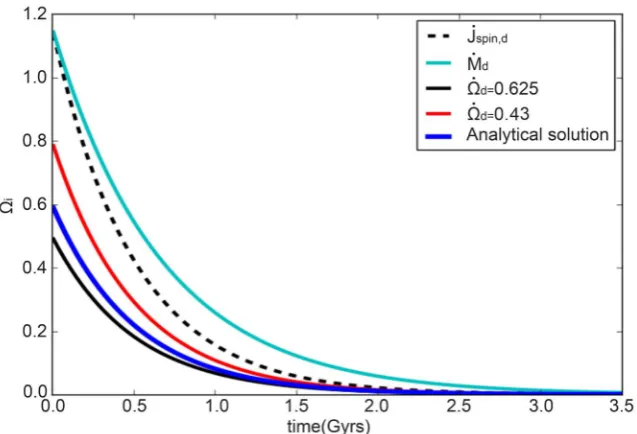
[image:19.595.224.526.378.591.2]DOI: 10.4236/ijaa.2018.83020 294 International Journal of Astronomy and Astrophysics Figure 9. The comparison between the numerical and analytical solutions of orbital pa-rameters for τ =10 years. These results obtained using the RL Egg, calculation of the Roche lobe. In these systems the donor decreases its mass until it finally detached from the Roche lobe and forms a 0.28M He WD and decrease the Jspin d, .
analytically investigate the evolution of the rotational angular velocities of both donor and accretor stars in close DWD systems with initial masses of the donor,
0.86
d
M = M and accretor, Ma =1.2M. In these systems, we provide a
comparison between the numerical and analytical solution for the rate of change of the spin angular momentum for the accretor and the rate of change of the mass transfer rate corresponds to the Ωd and Ωa, which shows our calcula-tion stops when the donor reached 1.45M (disc accretion).
4.3. Comparison to Previous Results
As it was studied by [8] [9][10] that systems with a low donor mass are more likely to remain stable over long periods of time, while the majority of the para-meter space (depending on the strength of the tidal coupling) is expected to be dynamically unstable. Here, by including the additional mass transfer effects presented here in a self-consistent way, DWD direct impact mass transfer may induce a stabilizing effect over a larger area of the parameter space.
As seen in Figures 1-5, we discussed the evolution of angular momentum and orbital changes due to direct impact and evolution of systems with strong tidal coupling. Also, in Figures 7-9, we investigated the comparison between the nu-merical and analytical solution of the systems for the evolution of parameters for
10 years
DOI: 10.4236/ijaa.2018.83020 295 International Journal of Astronomy and Astrophysics happens, the tides continue to redistribute angular momentum between the component spins and the orbit (see, Figure 5). When the system is dynamically unstable, the time scale for changes in the mass transfer rate becomes greater than the time scale at which the orbital period increases due to the effect of tides. As a result, the mass transfer rate increases rapidly and the spin of the accretor increases significantly.
5. Conclusions
We have presented the evolution of angular momentum and orbital period changes between the component spins and the orbit in close DWD binaries un-dergoing mass transfer through direct impact accretion, including the effects due to mass transfer, gravitational radiation, and tidal forces between the donor, ac-cretor, and the orbit. The theoretical framework that we have outlined in this paper can be used to generate the models for the rotational angular velocities and the orbital periods of close DWD binaries in general. Thus, we implemented the ballistic mass transfer treatment developed in [19] to calculate the changes to the evolution of orbital parameters during direct impact mass transfer from the donor to the accretor, which can be described by numerical solutions. Here, the numerical solutions that we have presented are more specific than the analytical solutions of the previous studies in the sense that we allow for conservative mass transfer. By implementing this method, we found that the number of stable close DWD binaries increased for both weak and strong tidal coupling compared with the results of [9] and [10], which shown as in Figures 1-10.
A direct comparison of the results obtained from the numerical solutions in Section (3) with those of analytical solutions in Section (4) shows that both the numerical solution and the Eggleton approximation for the Roche lobe calcula-tions are quite accurate.
In many cases the orbital angular momentum lost from the orbit can be sig-nificantly less than the standard assumption, making this process less destabiliz-ing than expected. This may allow for more DWD to survive the dynamical in-stability of mass transfer rate and evolve into systems like AM CVn, instead of merging to create Type Ia supernovae evolving to higher separations and dimi-nishing mass transfer rates. This result, which was not predicted by the analyti-cal solution in [28] has important consequences for population synthesis models of these objects. Furthermore, we have seen that the near constancy of the mass transfer rate over most of the mass transfer phase seen in the results by previous studies is not a generic feature of this type of evolution but rather a consequence of a particular choice of orbital parameters.
DOI: 10.4236/ijaa.2018.83020 296 International Journal of Astronomy and Astrophysics Figure 10. Evolution of the orbital period, Porb, compared to its initial orbital period,
,0
orb
P , for three different mass ratios with synchronization time scale, τ=1015. Here we observe that the Porb increases due to the effect of the tides. As a result, Md increases
rapidly and the accretor spin, Jspin a, increases, whereas the donor spin, Jspin d, decreas-es.
We also account for the modification of the Roche lobe size due to the orbital period and ζad of the donor stars. As a result, we found that the number of stable systems increases, particularly for the case of strong tidal coupling, as shown in Figure 1, Figure 4, Figure 5 and Figure 7. Note that all the systems that undergo direct impact systems, at least for the system orbital parameters and synchronization time scales that we have considered. Thus, when the system is dynamically unstable, the time scale for changes in the mass transfer rate be-comes greater than the time scale at which the Porb increases due to the effect of tides. As a result, the Md increases rapidly the spin angular momentum of the accretor increases significantly. We conclude that the stable systems occurred when using the Eggleton approximation for the Roche lobe calculation create ar-tificially high mass transfer rates which leads to an arar-tificially high number of dynamically unstable systems. Hence, our finding yields a higher number of sta-ble systems.
Finally, the large scale numerical computations presented in this paper have provided the realistic models that describing the evolution of angular momen-tum and orbital period changes and its stability of mass transfer in close DWD binary systems.
Acknowledgements
DOI: 10.4236/ijaa.2018.83020 297 International Journal of Astronomy and Astrophysics Negu S. H. thanks Jigjiga University for giving study leave. This research has made use of NASA’s Astrophysical Data System.
Conflicts of Interest
The authors declare no conflicts of interest regarding the publication of this pa-per.
References
[1] Nelemans, G., Yungelson, L.R. and Portegies Zwart, S.F. (2001) The Gravitational Wave Signal from the Galactic Disk Population of Binaries Containing Two Com-pact Objects. Astronomy & Astrophysics, 375, 890-898.
[2] Toonen, S., Nelemans, G. and Portegies Zwart, S. (2012) Supernova Type Ia Proge-nitors from Merging Double White Dwarfs. Using a New Population Synthesis Model. Astronomy & Astrophysics, 546, A70.
[3] Fuller, J. and Lai, D. (2012) Dynamical Tides in Compact White Dwarf Binaries: Tidal Synchronization and Dissipation. Monthly Notices of the Royal Astronomical Society, 421, 426.
[4] Burkart, J., Quataert, E., Arras, P. and Weinberg, N.N. (2013) Tidal Resonance Locks in Inspiraling White Dwarf Binaries. Monthly Notices of the Royal Astro-nomical Society, 433, 332. https://doi.org/10.1093/mnras/stt726
[5] Tutukov, A. and Yungelson, L.R. (1996) Double-Degenerate Semidetached Binaries with Helium Secondaries: Cataclysmic Variables, Supersoft X-Ray Sources, Super-novae and Accretion-Induced Collapses. Monthly Notices of the Royal Astronomi-cal Society, 280, 1035-1045. https://doi.org/10.1093/mnras/280.4.1035
[6] Nelemans, G., Portegies Zwart, S.F., Verbunt, F. and Yungelson, L.R. (2001) Popu-lation Synthesis for Double White Dwarfs. II. Semi-Detached Systems: AM CVn Stars. Astronomy & Astrophysics, 368, 939-949.
[7] Frank, J., King, A. and Raine, D. (2002) Accretion Power in Astrophysics. Cam-bridge University Press, CamCam-bridge. https://doi.org/10.1017/CBO9781139164245
[8] Sepinsky, J. and Kalogera, V. (2014) Angular Momentum Exchange in White Dwarf Binaries Accreting Through Direct Impact. The Astrophysical Journal, 785, 157 (8 p).
[9] Marsh, T.R., Nelemans, G. and Steeghs, D. (2004) Mass Transfer Between Double White Dwarfs. Monthly Notices of the Royal Astronomical Society, 350, 113-128.
https://doi.org/10.1111/j.1365-2966.2004.07564.x
[10] Gokhale, V., Peng, X.M. and Frank, J. (2007) Evolution of Close White Dwarf Bina-ries. The Astrophysical Journal, 655, 1010-1024. https://doi.org/10.1086/510119
[11] Soberman, G.E., Phinney, E.S. and van den Heuvel, E.P.J. (1997) Stability Criteria for Mass Transfer in Binary Stellar Evolution. Astronomy & Astrophysics, 327, 620-635.
[12] Negu, S.H. and Tessema, S.B. (2015) Mass Transfer in Binary Stellar Evolution and Its Stabilty. International Journal of Astronomy and Astrophysics, 5, 222-241.
https://doi.org/10.4236/ijaa.2015.53026
[13] Verbunt, F. and Rappaport, S. (1988) Mass Transfer Instabilities Due to Angular Momentum Flows in Close Binaries. The Astrophysical Journal, 332, 193-198.
https://doi.org/10.1086/166645
DOI: 10.4236/ijaa.2018.83020 298 International Journal of Astronomy and Astrophysics
Binary White Dwarfs. Proceedings of the 2nd Conference on Faint Blue Stars, 445. [15] Eggleton, P.P. (1983) Approximations to the Radii of Roche Lobes. The
Astrophys-ical Journal, 268, 368-369. https://doi.org/10.1086/160960
[16] Sepinsky, J., Willems, B. and Kalogera, V. (2007) Equipotential Surfaces and La-grangian Points in Nonsynchronous, Eccentric Binary and Planetary Systems. The Astrophysical Journal, 660, 1624-1635. https://doi.org/10.1086/513736
[17] Landau, L.D. and Lifshitz, E.M. (1975) The Classical Theory of Fields. Pergamon Press, Oxford.
[18] Campbell, C.G. (1984) Tidal Effects in Twin-Degenerate Binaries. MNRAS, 207, 433-443. https://doi.org/10.1093/mnras/207.3.433
[19] Sepinsky, J., Willems, B., Kalogera, V. and Rasio, A.F. (2010) Interacting Binaries with Eccentric Orbits. III. Orbital Evolution Due to Direct Impact and Self-Accretion. The Astrophysical Journal, 724, 546-558.
https://doi.org/10.1088/0004-637X/724/1/546
[20] King, A.R. and Kolb, U. (1995) Consequential Angular Momentum Loss and the Period Gap of Cataclysmic Variables. The Astrophysical Journal, 439, 330-336.
https://doi.org/10.1086/175176
[21] Paczynski, B. and Sienkiewicz, R. (1972) Evolution of Close Binaries VIII. Mass Ex-change on the Dynamical Time Scale. Acta Astronautica, 22, 73-91.
[22] Webbink, R.F. (1977) The Evolution of Low Mass Close Binary Systems. III-1.50 + 0.50 Solar Masses: Unsteady Mass Loss and Shrinking Secondaries. The Astrophys-ical Journal, 211, 486-498. https://doi.org/10.1086/154956
[23] Savonije, G.J. (1978) Roche-Lobe Overflow in X-Ray Binaries. Astronomy & As-trophysics, 62, 317-338.
[24] Webbink, R.F. (1984) Double White Dwarfs as Progenitors of R Coronae Borealis Stars and Type I Supernovae. The Astrophysical Journal, 277, 355-360.
https://doi.org/10.1086/161701
[25] Chandrasekhar, S. (1967) An Introduction to the Study of Stellar Structure. Dover, New York.
[26] Paczynski, B. (1971) Evolutionary Processes in Close Binary Systems. Annual Re-view of Astronomy and Astrophysics, 9, 183.
https://doi.org/10.1146/annurev.aa.09.090171.001151
[27] D’Antona, F., Ventura, P., Burderi, L. and Teodorescu, A. (2006) Modeling the Closest Double Degenerate System RX J0806.3+1527 and Its Decreasing Period. The Astrophysical Journal, 653, 1429. https://doi.org/10.1086/507408
[28] Hjellming, M.S. and Webbink, R.F. (1987) Thresholds for Rapid Mass Transfer in Binary Systems. The Astrophysical Journal, 318, 794-808.
https://doi.org/10.1086/165412
[29] Galassi, M.J.D., Theiler, J., Gough, B., Jungman, G., Booth, M. and Rossi, F. (2006) GNU Scientific Library Reference Manual. 2nd Edition, Network Theory Ltd. [30] Lubow, S.H. and Shu, F.H. (1975) Gas Dynamics of Semidetached Binaries. The