Some Kinds of Sheaf Control Problems for Control
Systems
Nguyen Dinh Phu*, Phan Van Tri
Faculty of Mathematics and Computer Science, Vietnam National University, Ho Chi Minh City, Vietnam Email: *[email protected]
Received November 8, 2011; revised December 20, 2011; accepted December 27, 2011
ABSTRACT
Recently, the field of differential equations has been studying in a very abstract method. Instead of considering the be- haviour of one solution of a differential equation, one studies its sheaf-solutions in many kinds of properties, for exam- ple, the problems of existence, comparison, … of sheaf solutions. In this paper we study some of the problems of con- trollability for sheaf solutions of control systems.
Keywords: Control Systems; Sheaf Solutions; Control Theory
1. Introduction
In [1-4] the authors have investigated sheaf solutions of control differential equations in the fields: comparison of sheaf solutions in the cases’ two admissible controls
and
u t u t
, and some initial conditions x0H0,0 0
x H , where the Hausdorff distance between the sets of initials H0 and H0 is enough small.
The problems of sheaf controllability and sheaf opti- mization are still open. The present paper is organized as follows. In Section 2, we review some facts about sheaf solutions. In Section 3 we give many kinds of sheaf con- trol problems, of sheaf controllability optimal problems.
2. Preliminaries
In n-dimension Euclidian space usually we have con- sidered the control systems (CS):
n
R
dd x t
f t x t u t
t (2.1)
where [0 ]
n
x t T R
[ ] n d
, u t
U Rd n0
f t T R R R . A solution to CS (2.1) is represented by:
0
0 0 , 0
t
t
d
x t x t x t u x
f s x s u s s (2.2)0 0
n
x H R , t [t T0 ] R ,
H0 is a collection of
some given initials.
Definition 2.1. We say that a control u t
U is admissible, if:1) u t
satisfies (2.2) for all tt0;2) u t
is bounded by norm u t
.That means the functions are measurable (inte-
grable) satisfiying almost everywhere on [0
u t
]
t T the relationships (2.1) and (2.2), then x t
is called the tra- jectory of the CS (2.1) and is called the control. Therefore, we shall always understand a pair of functions
u t
x t u t,
interrelated by the relationship (2.1) and (2.2). It is clear that several controls can corre-spond to one
u t
x t trajectory and if CS (2.1) has a non-unique solution, then several trajectory x t
can corre-spond to one control u t
.Definition 2.2. A state pair
x t
0 ,x t1
of solu-tions of control systems (2.1) will be a controllable if after time t1 we shall find a control u t
U such that:
1
0, ,1
1
1x t x t t u t x (2.3) Definition 2.3. A control system (2.1) is said to be: (GC) global controllable if every state pair of set solu- tion
0 , 1n
x t x t R .
(GA) global achievable if for every 1
n
x R we have
a state pair of solutions 0x1 that is GC.
(GAZ) global achievable to zero if for every 1
n
x R
we have a state pair 1 0
n
x R that will be controlable. In [2] the authors have compared the sheaf solutions for set control differential equations (SCDEs).
In [4] the author has study the problems (GC), (GA) and (GAZ) for set control differential equations (SCDEs).
, p,u t u t U R t[0, ].T
Definition 2.4. A sheaf solution (or sheaf trajectory)
t u
H is denoted by a number of solutions that make into
sheaves (lung one on top of the other and often tied to- gether) for all t [t T0 :
0 0
]
0 0 0
t u
H x t x t u t x H t t T u t U
(2.4) Definition 2.5. A cut-set (a cross-area) of sheaf solu- tion Ht u at time is denoted by: t1
1 ( )1 0 0 1 1 0 0
1 0
,
t u t x t x t u t x H
t t
1 1
H x t
T u t U
(2.5)
3. Main Results
Let’s consider again the control systems (CS):
dd
x t
f t x t u t
t (3.1)
where t
t T0
R
, x t
Q Rnd
U R
, Q is a compact
set in and —admissible controls.
Assume that for CS (3.1) there exists solution (2.2) and sheaf solution (2.4).
n
R u t
We will need the following hypotheses on the data of control problem for CS (3.1):
(Hf1):
1
f t x t u t f t x t u t
c t x t x t
(Hf2):
2 1
f t x t u t f t x t u t
c t x t x t u t u t
where c t c t1
2 L
[0T]
.[0 t I
Assume that at all , ]T , u t
0 0 x t
0 x0for two admissible controls u t u
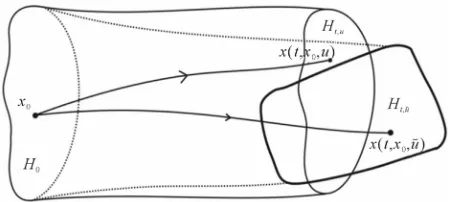
t U we have two forms of sheaf solutions:
0 0 0 0
0 0 0 0
t u
t u
H x t x t x t u t x H t I u t U
H x t x t x t u t x H t I u t U
(3.2)
where x t
x t x t u t
0 0
—solution of CS (2.1) (see Figure 1).Figure 1. The sheaf solutions of CS (2.1) in two admissible controls.
Definition 3.1. The Hausdorff distance between set
t u
H and Ht u is denoted by:
( ) ( )
max sup sup
t u t u
H t u t u
t u t u
x t H x t H
d H H
d x t H d x t H
Definition 3.2. The pair of the any sets 0 1
n
H H R
will be controllable if after time we shall find a control
1
t
u t U and one map such
that:
n n
R R R
H t0 1
H1 (3.3) Theorem 3.1. Under Hypothes (Hf1), let 0 0
n
x H R
—is initial, any set 1
n
H R . Thepair of the sets
0 1
n
H H R will be controllable if:
1) x t
belongs to solutions of CS (3.1), and2) H1 is cut-set of sheaf solution to (3.1), that means
1 0 0 1 1 0 0 1
H x t x t u t x H u t U t I .
Proof. If x t
belongs to solutions of CS(3.1) then it is
0
0 0 , 0 d
t
t
x t x t x t u x
f s x s u s s.
For any x1H0 we have a pair
x x0 1
that iscon-trollable, because x1x t x t u
0 0 1 t1
, where x1H1—cut-set of sheaf solutions with
1 0 0 1 1 0 0 1
H x t x t u t x H u t U t I
As in results, we have one map moving H0 to H1
that means
H u t0
1
H1.
Definition 3.3. The control system (3.1) is said to be: (SC1) sheaf controllable in type 1, if for all , there exists
0
1
and admissible controls u t u t
that satisfy u t
u t 1 then ( ) ( )H t u t t u t
d H H (3.4) (SC2) sheaf controllable in type 2 for any admissible control u t
, if for all 0, there exists 2
0such that the initials x0H0 x0H0 with
0, 0
2H
d H H then
H t u t u
d H H (3.5) (SC3) sheaf controllable in type 3, if for all , there exist
0
1 , 2
0 such that the initials0 0
x H x0H0 with dHH H0 02 and for any
admissible controls u t u t
that satisfy
1u t u t then
or t u
H t u t u H t u
[image:2.595.60.287.606.707.2]there exists
0 if control system (3.1) with:
x t x t
then two cut -sets of sheaf-solutions of CS (3.1) satisfy an estimate:
1 ( )1 2 (2)
H t u t t u t
d H H (3.7)
Proof. Suppose that for CS (3.1) the right hand side
f t x t u t
satisfies (Hf1) then there exists uniquesolution x t x t x t u t
0 0 ,
which satisfies (2.2).If Ht u —sheaf solution of CS (3.1) then for admissi-
ble control we have the cut-sets at any
times , that satisfy estimate (3.7):
du t U R
1
t t 2
1 ( )1 0 2
H t u t
d H H
and 2 (2) 0
2
H t u t
d H H
.
We have
1 1 2 2
1 1 2 2
( ) ( )
( ) 0 ( ) 0
H t u t t u t
H t u t H t u t
d H H
d H H d H H
.
Theorem 3.2. Assume that, under Hypothes (Hf2), the admissible controls u t u t
that satisfy
1u t u t , then CS (3.1) is sheaf-controllable
SC1.
Proof. Suppose that for CS (3.1) the right hand side
f t x t u t
satisfies (Hf2) then there exists uniquesolution x t x t x t u t
0 0 ,
which satisfies (2.2).If Ht u —sheaf solution of CS (3.1) then for admissi- ble control u t
U Rd we have the cut-sets at everytimes t, that satisfy estimate (3.7): , 0
2
H t u
d H H
and 0
2
H t u
d H H . We have
( ) ( )
( ) 0 ( ) 0
H t u t t u t
H t u t H t u t
d H H
d H H d H H
as results the CS (3.1) is sheaf-controllable SC1.
Corollary 3.1. If CS (3.1) is SC1, the right hand side
f t x t u t
0
satisfies condition of lemma 3.1 then for all there exists t1[0, ]T such that:
1 0 H 0 1
t t ,d H H
Proof. Because solution of CS (3.1) is equivalent:
0
0 d
t
t
x t x
f s x s u s s then
1 0 0 1 1 0 0 1 0
H x t x t u t x H t t u t U
by lemma 3.1 we have: dH
H H0 1
Theorem 3.3. Under hypothes (Hf1), assume that the initials x0H x0 0 H0 for all 0, there exists
0 such that: dHH H0 0 then for any ad-
missible control u t
we have:H t u t u
d H H
that means CS (3.1) is sheaf controllable CS2.
Proof. We have estimate
0 0 0 0
H t u t u
H t u H H t u
d H
d H d H H d H H
H H
For all 0,
such that t t t0
0 H0
0 dH
H t
d HuH H and
0
H t u
d H H , choosing
3
then we have dHHt u Ht u . As results imply that CS (3.1) is SC2.
Theorem 3.4. Under Hypothes (Hf2), assume that for all 0
0 and satisfy the followings:1) u t u t
U u 2) H H0 0 Q dHH H0 0 ,then for any admissible controls u t u t
we have:H t u t u
d H H
that means CS (3.1) is sheaf controllable CS3.
Proof. Beside (2.4) for H0 and H0 we have:
0 0 0 0
0 0 0 0
t u
t u
H x t x t u t x H u t U t I
H x t x t u t x H u t U t I
and estimate dHHt u Ht u as following:
0 0 0
0 , , ,
H t u t u H t u H
H t u H t u t u
d H H d H H d H H
d H H d H H
Choosing 4
, we have:
H t u t u
d H H
Definition 3.4. We say that for control system (3.1) are given OCP—
the optimization control problem if it denotes:
0 0
0
min
d
d
0
d
u U
n d
T
I u
x t
f t x t u t t
x H R u t U R t T R
I u t x t u t t h x T
(3.8)
to Hamillton Jacobi Bellman (HJB)—partial differential equation:
0
V t x V
t x u f t x u
t x
(3.9)
We have to find the optimal control u
t U for OCP (3.8).Lemma 3.1. In optimization control problems (3.8) if
then
V T x h x T
V
0x0
I u d
u U R
Proof. Putting d
d
y t V V
f t x u
t t x
we have integral for all t [ ] I [0T]:
V V
dy y f t
t x
x u tBecause
V V
t x u f t x u
t x
impilies that
dy y t x u t u
Ut
dV x V x t x u
0
0
0 d
T
V x
t x u t V T x T
0
0
0 d
T
V x
t x u th T x T I u
Theorem 3.5. Assume that OCP (3.8) has V t x
and there exists feedback u t
g t x t
such that:
inf u U
V
t x u f t x u x
V
t x g t x t f t x g t x t x
then exists optimal control u
t g t x
t
for OCP (3.8).Proof. Assume that x t
—one of solutions of con- trol systems (3.1) such that x
0 x0H0
x t
there exists
feedback u
t g t :
0
inf
0 0 d
u U
T
V
t x t u f t x t u x
V
t x t g t x t f t x t g t x t x
V T x T V x t x t g t x t t
By lemma 3.3 we have
0
0 0
d
T
V x h X T
t x t g t x t t
such that u
t g t x
t
—optimal control for OCP (3.8).
Definition 3.5. We say that for control system (3.1) are given SOCP—the sheaf-optimization control problem if it denotes:
0 0 0 0
0
min
d
d
0
( ) d d d
t u t u
u U
t u
n
T
H H
I u
x t
f t x t u t t
H
x t x t u t x H R u U t T R
I u t x t u t x t h x T x
T
(3.10) where
t u
H
—integral on Ht u Rnand
h x T V T x such that is solution to (HJB)—partial differential equation:
V T x
,
, ,
V V
f V t x divf t x u
t x
0
(3.11)
Lemma 3.2. Assume thatV(t, x) is a solution of HJB partial differential Equation (3.10) with the boundary conditions:
,
,
0,
0
V T x h x T V x V 0,x If function
, ,
V V
, , ,
0W t x u f V t x div f t x u
t x
andu(t) is admissible control then for optimization con- trol problem SOCP (3.10) there exists estimate:
0 ,
0 0
0
0, d , , d d
t u
T
H H
I u
V x x
W t x t u t x tProof. Putting
, 0 ,
, , d , , d .d
t u t u
t
H H
P t u
V t x x
t x t u t x t *we have:
,
,
d d
, , d ,
d d
, , d t u
t u
H
H
P t u V t x x V t x x
t t
t x t u t x
d d dt
,
d
, ,
d
, , , d , tu
t u
H
H
V V
P t u f V divf t x t u t x
t t x
W t x t u t x t x
, d
where d d
dd
divf x x
t
then
,
0 0
, 0,
d
d , , d d
d
t u
T T
H
P T u P u
P
t W t x t u t x t
t
**d d
By (*) we have
, ,
, ,
0
0
, , d ) , ,
d , , d d
T u t u
T u t u
T
H H
T
H H
P T u V T x x T t x u x t
h x T x T t x u x t
I u
and
then (**) impilies that0
0 0
0, 0, d
H
P u
V x x
0 ,
0 0
0
0, d , , d d
t u
T
H H
I u
V x x
W t x t u t x t
Theorem 3.6. (Necessary Conditions)
Assume that SOCP (3.10) has solution, that means there exists optimal control u*
tsuch that
*
min
u U
I u I
u and V T
,x
is a solution of HJB-partial differential Equation (3.11) then the necessary conditions for this SOCP (3.10) are:
1) V T x
,
h x T
2) W t x u
, *, *
0, where
, , , ,
, , , ,
V V
W t x u f t x u t x
V divf t x u t x u
Proof. Suppose that a function SOCP (3.10) that means
*
min u U
I u I
u . Because V(t, x)-solution of HJB-
partial differential Equation (3.11):
, ,
, ,
, ,
0V V
f t x u V divf t x u t x u
t x
with V V f t x u
, ,
V T x
,
h x T
t x
,
if function W t x u
, ,
satisfies:
, , , ,
, , , , 0
V V
W t x u f t x u
t x
V divf t x u t x u
,
t u
H
that integrable on sheaf solutions . By lemma 3.2, if u t
l prob
is ad e control t for
optimization contro lem SOCP (3.10) there exists
estimate:
missibl hen
0 ,
0 0
0
0, , , d d
t u
H H
d
T
I u
V x
W t x t u t x tAssume th
x
* u tat for SOCP (3.10) has optimal control then for all t[0, ]T , we have W t x u
, *, *
0
Theorem 3.7. t Con
Assume that
(Sufficien ditions)
u t any admissible control for SOCP (3.10) and V T x
,
is a solution of HJB-partial d - ential Equation ) then the s tions for iffer ufficient condi th(3.11
is SOCP(3.10) are: 1) V T x
,
h
T
2)
x
, , V V , ,
W t x u f t x u
t x
, ,
, ,
0 V divf t x u t x u
3) there exists u*
tsuch that
0
0 0
0,
H
* d
I u
V x xexist admissible control
Proof. There s the other
du t U R , such that for SOCP (3.1 we have 0)
( ) , , d d
T
I
0Ht u
u I u
W t x u x tBy condition
(1) of theorem 3.6 we have a function
V divf t x u, , t x u, ,
, , V V , ,
W t x u f t x u
t x
that integrable on sheaf solutions
t u
H .
, ,
0
, , d d d
t u t u
T
H H
I u
t x t u t x t
h x T x TWe find the function V t x
from equation:
div
0V V
f t x u V f t x u t x u
t x
with condition V T x
h x T
. n (2) of this theorem: By conditio*
*
*
0 0
0
(0, )d , , d d 0
t u
T
H
I u V x x W t x t u t x t
0
H ,
and implies that u t g t x t
—optimal control
for SOCP (3.10).
rpos
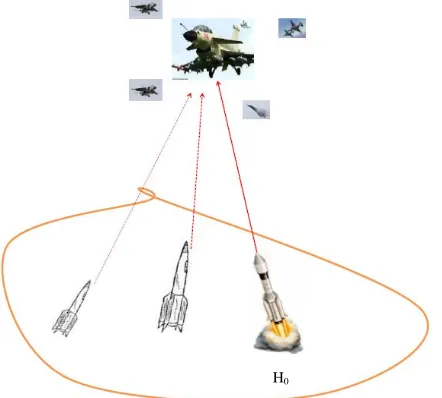
Example 3.1. for the pu
of shooting down aircraft noise bomb attack as B52 shot ckets can not su
wil
When using missiles not e
if only 01 or 02 ro cceed. The rockets
be
ore results. The rockets have to be con- tro
ee Figure 2). explosive.
A problem arises: What to do in order to shoot down aircraft noise when operating in the sky. To solve this problem, we must fire simultaneously from SAM sites from 03 or m
(SOPCS) have a high practical significance, as the series of SAM to destroy B52 attack aircraft with fighter jamming, or laser beam to destroy targets, like the beams in materials research of Physical nuclear, etc, … This paper described some types of sheaf optimal problems. We can solve them by Pontryagin’s Principle, Lya- punov’s Energy Function or by the Hamilton’s Principle. In this paper we present the necessary and sufficient conditions for this problem by Hamilton’s Principle, namely by HJB equations.
lled from headquarters and shot to pick the exact point-B52.
Mathematical model for problem shooting attack aircraft noise control system with (3.10), the test bundle (2.4) and optimization problem are (SOCP) in the above
with n = 3 (s In the near future, we will set the numerical calcula-
tions can be applied to a clearer and will study the diffe- rent Optimization problems with some controls u t
,v t .4. Conclusions
The Sheaf Optimization problem for Control Systems
5. Acknowledgements
H0
The authors gratefully acknowledge the referees for their careful reading and many valuable remarks which im- proved the presentation of the paper.
REFERENCES
[1] A. D. Ovsyannikov, “Mathematical Methods in Sheaf Con- trols,” Leningrad University Pub., Saint Petersburg, 1980. [2] N. D. Phu and T. T. Tung, “Some Properties of Sheaf- Solutions of Sheaf Fuzzy Control Problems,” Electronic Journal of Differential Equations, Vol. 2006, No. 108, 2006, pp. 1-8.
[3] N. D. Phu and T. T. Tung, “Some Results on Sheaf Solu- tions of Sheaf Set Control Differential Equations,” Jour- nal of Nonlinear Analysis: Theory, Methods & Applica- tions, Vol. 67, No. 5, 2007, pp. 1309-1315.
doi:10.1016/j.na.2006.07.018
[image:6.595.64.285.274.473.2][4] N. D. Phu, “On the Global Controllable for Set Control Differential Equations,” International Journal of Evolu- tion Equations,Vol. 4, No. 3, 2009, pp. 281-292. Figure 2. The sheaf of SAM shooting down aircraft noise bomb