Field induced phase transition in the few photon regime
A. D.Panferov1,,S. A.Smolyansky1,A. I.Titov2,B.Kämpfer3,4,A.Otto3,4,D. B.Blaschke2,5,6, andL.Juchnowski5
1Saratov State University, Saratov, Russia
2Joint Institute for Nuclear Research, Dubna, Russia 3Helmholtz-Zentrum Dresden-Rossendorf, Germany 4Institut für Theoretische Physik, Dresden, Germany 5University of Wroclaw, Wroclaw, Poland
6National Research Nuclear University (MEPhI), Moscow, Russia
Abstract. Some features of the field induced phase transition accompanied by the vac-uum creation of an electron-positron plasma (EPP) in strong time-dependent electric fields have been discussed in the work [1] in the domain of the tunneling mechanism (ωm, whereωis the characteristic frequency of the external field andmis the elec-tron mass). In the present contribution the features of this process will be considered in the few photon domain whereω∼m. We observe a narrowing of the transient domain of the quickly oscillations and, mainly, a considerable growth of the effectiveness of the EPP production. Under these circumstances, we see an increase of the effectiveness of the EPP creation in the particular case of a bifrequent excitation, where both mechanisms (tunneling and few photon) act simultaneously [2, 3].
1 Introduction
The present note is devoted to the investigation of some features of the dynamical Schwinger effect which concerns the creation of an electron-positron plasma (EPP) from the vacuum in fast varying spatially homogeneous external electric fields. Initially, the Schwinger effect was predicted for a constant electric field [4–6]. According to these estimates a noticeable vacuum creation of electron-positron pairs in a strong electric field is possible only near the very high critical value of the field strengthEc = m2/e = 1.3×10¹⁶ V/cm. For this reason, the interest in this problem is linked to a
practical basis provided, e.g., by the further development of ultra-high intensity laser systems. The characteristic frequency of the pulse for a laser in the optical range is considerably smaller than the electron mass (using natural units =c=1). A virtual pair must accumulate the energy of a very large number of photons of the external field before being "created". The dependence of the efficiency of the pair production on the field strength has approximately the same character as in the case of a constant field. Therefore the hope for detecting the creation of an EPP created from vacuum by the dynamical Schwinger effect can be realized only for field strengths in the immediate vicinity ofEc.
Encouraging predictions of enhanced efficiency of EPP vacuum excitation for the assisted Schwinger effect using the bifrequent external field of two lasers stimulate the interest to study the
high frequency domain (few photon area) in the single-frequency regime. Below we discuss some preliminary results of research on the field induced phase transition in this domain using the kinetic equation (KE) approach [7] as the basis. A brief description of this tool is given in Sect. 2. Some features of the phase transition under the influence of a quickly alternating external field from an initial vacuum state to the out-state of residual EPP are presented in Sect. 3. We put emphasis on comparison with the tunneling domain. On the examples of the simplest models for pulsed fields we demonstrate a significant increase of the efficiency of the EPP creation in the few photon domain for both, the distribution function and the observable pair density in the final state. The reason for this enhancement is the Breit-Wheeler mechanism. A second feature is the significant narrowing of the transient domain of fast oscillations. A discussion of the results is given in Sect. 4.
2 Kinetic equation
The creation of the EPP in a homogeneous, linearly polarized electric fieldE(t) = −A˙(t) with the vector potential (in Hamiltonian gauge) Aμ(t) = (0,0,0,A(t)) is described by the KE [7] for the distribution function
˙
f(p,t)=1 2λ(p,t)
t
t0
dtλ(p,t)[1−2f(p,t)] cosθ(t,t), (1)
where
λ(p,t)=eE(t)ε⊥/ε2(p,t), θ(t,t)=2
t
t
dτ ε(p, τ).
Hereλis the amplitude of the vacuum transitions, andθis the high-frequency phase. The quasienergy
ε(p, τ), the transverse energyε⊥and the longitudinal quasimomentumP(t) are defined as
ε(p,t)=
ε2
⊥(p)+P2(t), ε⊥=
m2+p2
⊥, P(t)=p−eA(t).
Herep⊥andpare the momentum components perpendicular and parallel to the field vector.
The integro-differential equation (1) is equivalent to a system of three time-local ordinary diff er-ential equations
˙
f(p,t)=1
2λu(p,t), u˙(p,t)=λ(1−2f(p,t))−2εv(p,t), v˙(p,t)=2εu(p,t), (2) whereu(p,t), v(p,t) are auxiliary functions describing vacuum polarization effects.
The distribution function f(p,t) is zero in the in-vacuum state where the external field is absent. The KE (1) allows to describe the EPP evolution and to get the final distribution functionfout(p) in the
out-state. The duration of the action of the external field is limited, its time dependence is arbitrary. The in- and out-vacuum states are different althoughEout=Ein=0 due to the fact thatAoutAin.
The total pair number density in the out-state is defined as
nout=2
dp
(2π)3fout(p). (3)
3 EPP creation in the few photon area
We will investigate the KE (1) numerically for the simplest Eckart-Sauter model of the one-sheeted electric field with characteristic durationT of its action defined by
A more realistic laser pulse model is the one with a Gaussian envelope [8]
E(t)=E0cos (ωt)e−t 2/2τ2
, A(t)=−
π
8E0τexp (−σ
2/2) erf
t
√
2τ−i
σ √
2
+c.c., (5)
whereσ=ωτis a dimensionless measure for the characteristic duration of the pulseτconnected with the number of oscillations of the carrier field.
Figure 1.Behaviorfout(p=0) (Left panel) and density (3) (Right panel) in the tunneling area (N1), the few photon regime (N∼1) and the domain of high-energy photons (N1) for the field model (4) withE0=0.2Ec.
In figure 1 we demonstrate the resonant behaviour of the residual distribution function fout(p)
in the pointp = 0 (left panel) and the total residual EPP number density nout (3) (right panel) as
functions of the field pulse durationT of the field model (4). The tendency of the function fout to
assume a constant value in the tunneling areaT 1 can be associated with the accumulation effect
nout ∼T (right panel). This effect is well known from the exact solution of the problem [9]. A sharp
decrease of the EPP creation efficiency is observed in the region of very small durationT m 1. Analogous results can be obtained for the field model (5).
It would be natural to interpret these results in terms of the minimal photon numberN required to overcome the energy gap and to create an electron-positron pair. The field models (4) and (5) themselves do not allow this because of the non-monochromaticity of these fields. However, on the qualitative level one can connect the valueTmaxm 0.5 of the maximal efficiency of EPP creation
with the Breit-Wheeler process of electron-positron pair creation by a pair of colliding photons. Thus,
Tmaxm∼Nmax =2. When extrapolating this relation to both sides, the large and small durations, we
obtainN=4T mfor the field model (4). So, we can mark out on figure 1 and next figures the border between few photon and tunneling areas.
A similar correspondence can be introduced for the field model (5) in the case of a long pulse
σ1, whereN=2m/ω.
The existence of the maximum in the two photon domain correlates with the result of standard perturbation theory forE0/Ec1 in the few photon region where this process is dominant [11].
The field strength dependence of the efficiency of EPP creation is depicted in figure 2. The left panel shows that sizeable values of the distribution functionfout(p=0) can be reached for moderate
field strengths when entering the few photon domain.
The right panel of figure 2 shows the dependence of the created EPP density on the field strength
Figure 2. Left panel:Relation betweenfout(p=0) and the amplitude of the external fieldE0for different values of pulse durationT.Right panel:The dependence of the densitynouton the external fieldE0in the few photon regime forT m=5.
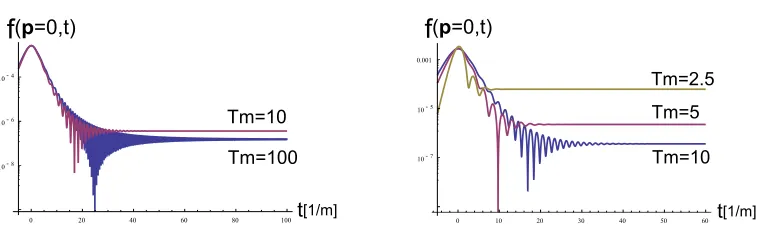
Figure 3. The transition from the quasiparticle EPP to the final out-state for the Eckart-Sauter pulse (4) with E0 =0.2Ecat different values ofT andp=0.Left panel:Transfer from the tunneling (T m=100) to the few photon area (T m=10).Right panel:Few photon area at differentT.
E0 0.5Ecthe efficiency of the pair creation process decreases very quickly (exponentially, as in
the tunneling area). But atE0 0.02Ecand smaller it decreases asE20. This promises an observable
density of EPP even at field strengths several orders of magnitude smaller thanEc.
The left panel of the figure 3 shows a behavior of the distribution function that is typical for the phase transition from the vacuum to a final state of the EPP in the tunneling region (T m=100) for a one-sheeted external electric field (4).
These are the three stages of evolution [1]: (i) quasiparticle EPP in the region of the maximal values of the external field, (ii) the transition region with rapid oscillations of the distribution function and (iii) the final state approaching a constant residual value fout.
Moreover, in the tunneling domain the saturation of the distribution function for a fixed point in momentum space appears. For example, the value of foutat a given pointp =0 does not depend on T and is defined by the field amplitudeE0only. The left panel of figure 3 shows the deviation from
this rule forT m=10. The right panel shows a further sharp increase of foutat the sameE0only due
transient domain. This is due to the fact that the role of the vacuum polarization effects decreases with decreasingT.
Figure 4.At a fixed electric fieldE0the maximum offout(p=0) occurs in the vicinity ofT(N)∼1/m. Entering further into the region with high photon energies results in a reduction of the efficiency of the pair creation process.Left panel:Features of the evolution of the distribution function in the vicinity ofT ∼1/mfor the field (4).Right panel:Similar results for field (5) in the vicinityN∼1 andσ=5.
Figure 4 shows that both field models (4) and (5) exhibit a rapid growth of foutin the few photon
domain. However, nearT(N)∼1/mthe growth stops and turns to a decrease for further increasing energy of the photons of the external field. There is a complication of the character of the evolution of the distribution function in the case of a more complex time dependence of the field (5) (right panel of figure 4). Here one observes also a gradual attenuation of oscillations in the transient region.
4 Conclusion
The results obtained in this contribution show that in the transition from the regime of tunneling (constant field and a field with a relatively slow time-dependence) to the few photon regime (quickly alternating fields with a characteristic frequency comparable to the Compton frequency) there are qualitative changes in the characteristics of the process of EPP creation from vacuum under the action of an external electric field. The evolution of the distribution function from the initial vacuum state to the final state loses a specific transient region of strong fluctuations. The transition to the few photon region is accompanied also by a considerable growth of the pair production effectiveness. So for the field strengthE0 =0.2Ecthe pair density in the out state increases 3.34×10⁵ times. But more
importantly, the effect of pair production in the few photon domain can still be detected for much weaker fields, with field strengths several orders of magnitude smaller thanEc.
In contrast to the works on the bifrequent mechanism of vacuum EPP excitation [2, 3] the present investigation has shown that the transition in the few photon area ensures in itself a high intensity of the EPP creation process without participation of the tunneling mechanism. This is the main result of this work. It would be highly topical to perform a detailed comparison of the results of these two approaches.
Acknowledgements
S.A.S. and A.D.P. are grateful to the organizers of the XXIII Baldin Seminar for the support of their participation at this conference. The work of S.A.S., D.B.B. and L.J. was supported in part by the Pol-ish Narodowe Centrum Nauki under grant No. UMO-2014/15/B/ST2/03752. D.B.B. was supported by the MEPhI Academic Excellence Project under contract No. 02.a03.21.0005. L.J. acknowledges support from the Bogoliubov-Infeld program for his visits to JINR Dubna in 2016.
References
[1] S. A. Smolyansky, A. D. Panferov, D. B. Blaschke, L. Juchnowski, B. Kämpfer and A. Otto, arXiv:1607.08775 [hep-ph]
[2] A. D. Panferov, S. A. Smolyansky, A. Otto, B. Kämpfer, D. B. Blaschke and L. Juchnowski, Eur. Phys. J. D70(3), 56 (2016)
[3] A. Otto, T. Nousch, D. Seipt, B. Kämpfer, D. Blaschke, A. D. Panferov, S. A. Smolyansky and A. I. Titov, J. Plasma Phys.82, 655820301 (2016)
[4] F. Sauter, Z. Phys.69, 742 (1931)
[5] W. Heisenberg and H. Euler, Z. Phys.98, 714 (1936) [6] J. S. Schwinger, Phys. Rev.82, 664 (1951)
[7] S. M. Schmidt, D. Blaschke, G. Röpke, S. A. Smolyansky, A. V. Prozorkevich and V. D. Toneev, Int. J. Mod. Phys. E7, 709 (1998)
[8] F. Hebenstreit, R. Alkofer, G. V. Dunne and H. Gies, Phys. Rev. Lett.102, 150404 (2009) [9] N. B. Narozhny, and A. I. Nikishov, Sov. J. Nucl. Phys.11, 1072 (1970)
[10] A. I. Titov, B. Kämpfer, A. Hosaka and H. Takabe, Phys. Part. Nucl.47(3), 456 (2016)