WHAT IS THE RELATION BETWEEN ARTIFICIAL INTELLIGENCE AND PATTERN RECOGNITION?
School of Software Engineering, Department of Information, Beijing University of Technology, Software College
Building, Ping Park No. 100, Chaoyang District, Beijing 100124, People’ s Republic of China
ARTICLE INFO ABSTRACT
At present, the electronic commerce and the customer alliance network shopping and network analysis is becoming increasingly popular, mainly is the result of highly developed and popular wireless communication. The work of software mainl
of things, and the knowledge of artificial intelligence will be used in the research of the Internet of things. Assembly language mainly includes sequential branch cycle programming, subroutine definition
Pentium MMX (multi energy Pentium), Pentium Pro (high energy Pentium), Pentium two generation, three generation, four generation and so on. And Itanium. IBM is also known
IBM PC series microcomputer has the characteristics of advanced design, rich software, complete functions, cheap price and openness. The system function call mainly includes two kinds of DOS and BIOS. In the DOS operating system, the
they are the basic input
of DOS are similar to those of BIOS calls. They both have similar writing formats, but DOS prov more necessary tests. Therefore, DOS operation is generally easier than the corresponding BIOS part. Assembly language mainly involves BCD code and ASCII code. Software engineering mainly involves the use of visio_project_powerdesign mapping, library
report and project development plan writing, data flow diagram and system flow chart production. Project
the field of software eng
Visio, powerdesign, and rationalrose. important application of the Internet of things
Copyright © 2018, Yibin Hou and Jin Wang. This unrestricted use, distribution, and reproduction in any medium,
INTRODUCTION
The first achievement of AI is to develop a chess playing program that can solve difficult problems. By studying the chess playing program, people have developed search strategies and problem reduction techniques in AI. The problem solving research design problem represents the study of space, the research of search strategy and the study of the reduction strategy. The typical problem solving procedure is chess playing program, computer chess programming, Chinese chess, chess and checkers, etc., which has reached the level of international championships. Twelfth International Joint Conference on artificial intelligence held in Sydney in August 1991, IBM company developed Deep Thought 2 computer system with the Australian chess champion Johannsen held a man-machine match, results 1:1 a draw; IBM supercomputer
*Corresponding author: Yibin Hou,
School of Software Engineering, Department of Information, Beijing University of Technology, Software College Building, Ping Park No. 100, Chaoyang District, Beijing 100124, People’ s Republic of China
ISSN: 0975-833X
Article History:
Received 19th December, 2017 Received in revised form 22nd January, 2018
Accepted 01st February, 2018 Published online 28th March, 2018
Citation: Yibin Hou and Jin Wang. 2018. “What is the relation between Artificial Intelligence and Pattern Recognition?
Research, 10, (03), 66595-66613.
Key words:
Knowledge of Artificial Assembly Language Mainly, Microcomputer and Characteristics.
RESEARCH ARTICLE
WHAT IS THE RELATION BETWEEN ARTIFICIAL INTELLIGENCE AND PATTERN RECOGNITION?
*
Yibin Hou and Jin Wang
School of Software Engineering, Department of Information, Beijing University of Technology, Software College
Building, Ping Park No. 100, Chaoyang District, Beijing 100124, People’ s Republic of China
ABSTRACT
At present, the electronic commerce and the customer alliance network shopping and network analysis is becoming increasingly popular, mainly is the result of highly developed and popular wireless communication. The work of software mainly includes artificial intelligence and the Internet of things, and the knowledge of artificial intelligence will be used in the research of the Internet of things. Assembly language mainly includes sequential branch cycle programming, subroutine definition and call. The core component of microcomputers is microprocessors. Intel introduces Pentium MMX (multi energy Pentium), Pentium Pro (high energy Pentium), Pentium two generation, three generation, four generation and so on. And Itanium. IBM is also known
IBM PC series microcomputer has the characteristics of advanced design, rich software, complete functions, cheap price and openness. The system function call mainly includes two kinds of DOS and BIOS. In the DOS operating system, there are two layers of internal subroutines for users to use, and they are the basic input-output subroutines, BIOS and DOS layer function modules. Many functions of DOS are similar to those of BIOS calls. They both have similar writing formats, but DOS prov more necessary tests. Therefore, DOS operation is generally easier than the corresponding BIOS part. Assembly language mainly involves BCD code and ASCII code. Software engineering mainly involves the use of visio_project_powerdesign mapping, library management system feasibility study report and project development plan writing, data flow diagram and system flow chart production. Project 2003 project management and Gantt chart. "Ticket booking system" is an important issue in the field of software engineering. The UML modeling under software engineering is modeled with Visio, powerdesign, and rationalrose. The aerospace science and technology industry is also an important application of the Internet of things.
is an open access article distributed under the Creative Commons medium, provided the original work is properly cited.
The first achievement of AI is to develop a chess playing program that can solve difficult problems. By studying the chess playing program, people have developed search strategies and problem reduction techniques in AI. The problem represents the study of space, the research of search strategy and the study of the reduction strategy. The typical problem solving procedure is chess playing program, computer chess programming, Chinese eached the level of international championships. Twelfth International Joint Conference on artificial intelligence held in Sydney in August 1991, IBM company developed Deep Thought 2 computer system with the Australian chess champion Johannsen held a achine match, results 1:1 a draw; IBM supercomputer
School of Software Engineering, Department of Information, Beijing University of Technology, Software College Building, Ping Park No. District, Beijing 100124, People’ s Republic of China.
deep blue in May 1997 to develop IBM company in the United States of New York and Manhattan at the human world chess champion in the Soviet Union Kasparov played 6, won the blue. Artificial intelligence is the ability to simulate people's consciousness, thinking, and handling things. This is a big field, and all you can think of is the "intelligence" that can be included. The so-called smart home, the smart city of everything is. Pattern recognition
theory, probability density function estimation, linear discriminant function, nonlinear discriminant function, nearest neighbor method, minimizing the empirical risk minimization and orderly risk selection and feature extractio
expansion feature extraction based on unsupervised learning method, artificial neural network, fuzzy pattern recognition, statistical learning theory and support vector machine, the application of pattern recognition in the processing of speech signal in the application of printed Chinese characters recognition. Pattern recognition is a subject, and you can use it as a way of thinking and way to deal with problems. From the name, pattern recognition, first is the "mode", the nature of the International Journal of Current Research
Vol. 10, Issue, 03, pp.66595-66613, March, 2018
What is the relation between Artificial Intelligence and Pattern Recognition?
WHAT IS THE RELATION BETWEEN ARTIFICIAL INTELLIGENCE AND PATTERN RECOGNITION?
School of Software Engineering, Department of Information, Beijing University of Technology, Software College
Building, Ping Park No. 100, Chaoyang District, Beijing 100124, People’ s Republic of China
At present, the electronic commerce and the customer alliance network shopping and network analysis is becoming increasingly popular, mainly is the result of highly developed and popular y includes artificial intelligence and the Internet of things, and the knowledge of artificial intelligence will be used in the research of the Internet of things. Assembly language mainly includes sequential branch cycle programming, subroutine and call. The core component of microcomputers is microprocessors. Intel introduces Pentium MMX (multi energy Pentium), Pentium Pro (high energy Pentium), Pentium two generation, three generation, four generation and so on. And Itanium. IBM is also known as the blue giant. The IBM PC series microcomputer has the characteristics of advanced design, rich software, complete functions, cheap price and openness. The system function call mainly includes two kinds of DOS and re are two layers of internal subroutines for users to use, and output subroutines, BIOS and DOS layer function modules. Many functions of DOS are similar to those of BIOS calls. They both have similar writing formats, but DOS provides more necessary tests. Therefore, DOS operation is generally easier than the corresponding BIOS part. Assembly language mainly involves BCD code and ASCII code. Software engineering mainly management system feasibility study report and project development plan writing, data flow diagram and system flow chart production. 2003 project management and Gantt chart. "Ticket booking system" is an important issue in ineering. The UML modeling under software engineering is modeled with The aerospace science and technology industry is also an
Commons Attribution License, which permits
deep blue in May 1997 to develop IBM company in the United States of New York and Manhattan at the human world chess champion in the Soviet Union Kasparov played 6, won the ence is the ability to simulate people's consciousness, thinking, and handling things. This is a big field, and all you can think of is the "intelligence" that can be called smart home, the smart city of Pattern recognition including Bayesian decision theory, probability density function estimation, linear discriminant function, nonlinear discriminant function, nearest neighbor method, minimizing the empirical risk minimization and orderly risk selection and feature extraction, K-L expansion feature extraction based on unsupervised learning method, artificial neural network, fuzzy pattern recognition, statistical learning theory and support vector machine, the application of pattern recognition in the processing of speech al in the application of printed Chinese characters recognition. Pattern recognition is a subject, and you can use it as a way of thinking and way to deal with problems. From the name, pattern recognition, first is the "mode", the nature of the OF CURRENT RESEARCH
problem into a model; then "recognition", from this point of view is the main job of classification (it's). The problem of target detection and classification in image processing is a typical pattern recognition problem. Is machine learning and pattern recognition is very close, the two have a lot in common; some sense are the areas of artificial intelligence. The conclusion is that AI is a concept. Pattern recognition is applied in some ways, and there are many specific methods. Data mining is an application. The methods used include both knowledge and knowledge in machine learning and pattern recognition. Artificial intelligence is the two level subject, and pattern recognition is a class of three. Pattern recognition should be in a branch of artificial intelligence, artificial intelligence, including artificial intelligence, pattern recognition, neural network, expert system of Natural Language Processing, so better, as to why the two side by side, that is because in recent years, the pattern recognition in artificial intelligence field more and more important role, made a lot of important the results of. Like the prevalence of the 80s neural network, neural networks and artificial intelligence are often tied together. At present, the electronic commerce and the customer alliance network shopping and network analysis is becoming increasingly popular, mainly is the result of highly developed and popular wireless communication. The work of software mainly includes artificial intelligence and the Internet of things, and the knowledge of artificial intelligence will be used in the research of the Internet of things. Assembly language mainly includes sequential branch cycle programming, subroutine definition and call (Golden Sea Soluble, 2007). The core component of microcomputers is microprocessors. Intel introduces Pentium MMX (multi energy Pentium), Pentium Pro (high energy Pentium), Pentium two generation, three generation, four generation and so on. And Itanium IBM is also known as the blue giant.
The IBM PC series microcomputer has the characteristics of advanced design, rich software, complete functions, cheap price and openness. The system function call mainly includes two kinds of DOS and BIOS. In the DOS operating system, there are two layers of internal subroutines for users to use, and they are the basic input-output subroutines, BIOS and DOS layer function modules. Many functions of DOS are similar to those of BIOS calls. They both have similar writing formats, but DOS provides more necessary tests. Therefore, DOS operation is generally easier than the corresponding BIOS part. Assembly language mainly involves BCD code and ASCII code. Software engineering mainly involves the use of visio_project_powerdesign mapping, library management system feasibility study report and project development plan writing, data flow diagram and system flow chart production. Project2003 project management and Gantt chart. "Ticket booking system" is an important issue in the field of software engineering (Li Jingxia, 2006). The UML modeling under software engineering is modeled with Visio, powerdesign, and rationalrose. This part is mainly based on artificial intelligence, machine learning, data mining, big data, neural network, SVM, pattern recognition, statistical learning and theory, and Internet Internet of things in order of theoretical and applied research. Artificial intelligence is a branch of computer science, it is the current science and technology is developing rapidly, the new idea of (Li Pei, 2006), new ideas, new theory, a discipline of the emergence of new technology, but also a involving mathematics, computer science, cybernetics, information theory, psychology, cross disciplinary and interdisciplinary philosophy and (Li Yun, 2001) other subjects.
Artificial intelligence research and application area, problem solving, machine learning, expert system, pattern recognition, automatic theorem proving, automatic programming, natural language understanding, robot, artificial neural network, intelligent retrieval and other (Bao Xinzhong, 2009). Machine learning is an important field of artificial intelligence (Gao Zhijun, 2001). Knowledge discovery and data mining techniques should also belong to the scope of machine learning (Sun Xida, 2001). Data mining models and algorithms mainly include artificial neural networks, genetic algorithms and regression analysis (Zhou Hongmei, 2010). Machine learning: machine learning, basic data based on machine learning is a very important aspect of modern (Ma Chi, 2007) technology, we mainly study how from some observations (samples), are currently can not be obtained by the analysis of principle of (Cao Zhaolong, 2006), the use of these rules to analyze the object and data or data (Ma Chi, 2007) predict the future may not be observed. The purpose of machine learning is to get the correlation between input and output of a system based on a given known training sample, and to predict the location output accurately (Mao ting, 2006). The training process is the design process of the classifier (Lin Peng, 2007). This step will generate parameters for identification. Emphasis on learning ability, the machine under the guidance of the algorithm has a certain learning ability, such as neural network, training algorithm, and other (http://blog.csdn.net/u 011023036/ article/d etails/49).
In the view of statistical and data mathematician, machine learning is a computer scientist doing statistical (Zhang Yangsen, 2017). What is the relationship between machine learning, statistical analysis, data mining, neural networks, artificial intelligence and pattern recognition? Machine learning, statistical analysis, data mining, neural network, artificial intelligence, pattern recognition, it is hard to say who can contain who can only separate the meaning of each concept, and service data mining is a concept from data to meaningful information. Many people think that data mining is a new subject, is based on big data, this is not true, if you provide a data, Li Jiacheng has more than $100 billion, giving you a data is the national average level of 13279 yuan per capita disposable income, you can dig a message called (http://blog.csdn.net/u0110230 36/article/details/49.), Li Jiacheng it is also very rich, data mining. Pattern recognition is the purpose of identifying a pattern, for example, the two eyes of the nose are the face type. If there is no manual through the computer, through the calculation to identify the model, also belong to the pattern recognition of machine learning is a method commonly used in pattern recognition, machine learning is not intuitive data to obtain the model, which will require the use of a variety of knowledge, such as statistical analysis of knowledge.
The concept of AI is big, its concept is to create artificial and human intelligence, so many people come up with science fiction products such as robots, human intelligence, and rely on the powerful computing power of machines. In fact, AI is not necessarily related to computers, but now only computers have such a powerful computing power. If one day, biotechnology can be broken, maybe it can also be achieved. Neural network is a very difficult mode in learning algorithm. It is called multidisciplinary simulation of human neural process combination. It is a good way to learn. It can be said that it is based on statistics. Artificial intelligence is the largest, and the content is the same as the (technology) name, and is devoted to the development of more intelligent machines and software (http://blog.csdn.net/u011023036/article/details/49...). Machine learning is a study of algorithms and is devoted to the study of algorithms that can be automatically improved according to experience. Neural network is a kind of (model), and is a mathematical model simulating central nervous system, which can be used for pattern recognition and machine learning. Statistical analysis is a part of data and statistics, and is a tool in machine learning. There are many methods in machine learning is the use of statistical theory to estimate a probability estimator and forecast. In the view of statistical and data mathematician, machine learning is the statistics of a computer scientist. The difference between data mining and machine learning is that data mining problems usually have huge data, especially for computing efficiency, which is more important than statistical accuracy. Usually from a business perspective, machine learning is more biased towards AI. Pattern recognition is a field of machine learning, which refers to the process of labeling input (the process of prediction). In the classification problem, the input is classified. In regression, the real value of (http://www.w2bc.com/article/181993) is given to the input. What does data mining have to do with neural networks? Neural network is part of AI, but it can be used for data mining, such as training neural network models through a batch of data, and testing new data (http://www.liuxingshe.com/qt/1038575.html). It is the application of classification technology in data mining. Data mining is a large amount of data from mining useful
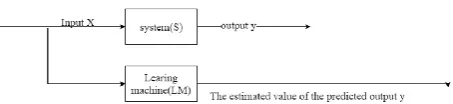
[image:3.595.320.547.343.395.2]knowledge. Neural network is a learning ability similar to human brain activity technology. In fact, knowledge is being refined. Data mining and many disciplines are intersecting, probability and statistics, database, machine learning and other (http://www.liuxingshe.com/ qt/1038575.html). Pattern recognition mainly includes SVM model, BP neural network model, machine learning and so on. The three idea is to first use small sample training to get the model, then use the model to complete the prediction or classification task. The theory and method of pattern recognition: image recognition system of image frame, image information is identified to obtain the feature extraction decision information processing. The purpose of pattern recognition research is to construct a machine system that automatically handles some information in place of the task (Pan Zhijie, 2008) to complete the classification and identification. The basic problem of machine learning theory: machine learning based on data is a very important aspect of modern intelligent technology. It mainly studies how to proceed from some observation data (samples), and obtains the rule (Hu Zhenxin, 2011) which cannot be analyzed in principle. By using these rules, we can analyze objective objects, predict future data or unobservable data (Ma Chi, 2007). The basic model of machine learning problems can be shown in the (Mao ting, 2006) as shown in Figure 1.
Figure 1. The basic model of machine learning problems
The basic model of machine learning is (Lin Bihua, 2008) as shown above. Among them, the system S is the object of research, it is a certain input x to get a certain output y, LM is the learning machine, the output of the estimated value of y (Li Siguang, 2008). The purpose of machine learning is to get the estimation of the relationship between input and output of a system based on a given known training sample, so as to predict the location output accurately (Mao ting, 2006). Predictors are often referred to as learning functions, learning models, or learning machines (Ma Jie, 2006). Under the premise of sufficient sample size, the traditional pattern recognition and machine learning methods are studied. The proposed method only guarantees the (Liu Jingli, 2010) of the sample performance and the infinite theory. In most practical applications, the number of samples is usually limited to (Yang Banghua, 2006). This is also the case with the image sample, because the amount of storage and calculation required for the image is large, and it is unthinkable to take a large amount of sampling for it. Statistical learning theory is a small sample statistics, statistical pattern recognition of limited samples and more extensive machine learning research has established the theoretical framework of (Liu Jian, 2009) better, but also developed a new pattern recognition method of support vector machine, can better solve the problem of small sample. Training: the training process is the design process of the classifier (Sun Zhihui, 2009). This step will generate the parameter(Zhang Yangsen, 2017) used to identify.
METHODS
It has become the battlefield of public relations and the attraction of network media. Then, press conference, forum, government strategic planning introduced, all kinds of news declared a "smart too busy to attend to all, is king" era. What is artificial intelligence in the end? What is the stage of the present study? How will it be developed in the future? This is a common concern. Due to the wide range of disciplines and technologies covered by AI, it is a very difficult task for us to understand and understand AI in a short time. Therefore, a lot of propaganda and decision-making are now before understanding, which inevitably leads to some confusion of thought and public opinion. One, artificial intelligence is a very wide area. AI currently covers many large disciplines. I have summarized them into six parts: (1) computer vision (for example, pattern recognition, image processing and other problems). (2) the understanding and communication of natural language (and the introduction of speech recognition and synthesis, including dialogue). (3) cognition and reasoning (including a variety of physical and social common sense). (4) Robotics (machinery, control, design, motion planning, task planning, etc.). (5) game and Ethics (the interaction of multi agent agents, confrontation and cooperation, robot and social integration). (6) machine learning (a variety of statistical modeling, analysis tools, and calculation methods). At present, these areas are still relatively scattered, and at present they are in the process of intersecting and moving towards unity. I regard them as "popular during the Warring States six male", Chinese history is originally "Warring States", I am here to save trouble, put the two small areas: game and ethics of the merger, all equilibrium ethics itself is the game.
The ultimate goal is to form a complete scientific system, from the current engineering practice rattly become a real science Science of Intelligence. Due to the scattered disciplines, most of the professionals who are engaged in related studies, such as doctorate, professors and so on, are usually only involved in the above subjects, or even focus on specific problems in a discipline for a long time. For example, face recognition is a very small problem in computer vision. Deep learning is a popular school in machine learning. Many people now use deep learning as artificial intelligence, which is the equivalent of saying a prefecture level city into the country. You will find that no matter how many layers of the CNN network, it is still very shallow, and the tasks involved are still very small. Researchers in various fields of artificial intelligence, according to Indian proverb can be called "on the basis of one-sided viewpoint", but this is obviously a verbal offence, or Chinese writer Su Shi tour of Mount Lu have a standard: cross as a peak, near and far different level. Do not know the true face of Mount Lu, just because in the mountains."
Second, the artificial intelligence development of the generation of the phenomenon. Due to the development of the history of artificial intelligence, since 1980s, has been more than a few differentiated University, independent development of these disciplines and basic research methods abandoned 30 years before by logical reasoning and heuristic search based, instead of the probability and Statistics (modeling, learning) method. In the traditional AI field, such as logic reasoning, search game, expert system and so on, there is a lot of global vision in the older generation without shunting to the above branches, but most of them have passed away or retired. Only a few of them in the 80-90 era, with sharp eyes, or led the way of probability statistics and learning, became academic leaders.
However, there are few researchers in the field of artificial intelligence after the 80s. The differentiation and historical dating of this field objectively lead to confusion in the current academic and industrial circles. However, with a positive attitude, this situation is indeed on the young generation of researchers, now the students provide a good opportunity to make contributions and wide stage. In view of these phenomena, the colleagues and colleagues of the editorial department of the visual search urged me to write a review and introduction of an AI. I will avoid it for its difficulty. I will talk about what AI is based on the experience, observation and speculation of 30 years' reading and interdisciplinary research, its research status, tasks and framework, and how to achieve unification. Machine learning and pattern recognition learning summary. Combining the knowledge points of pattern recognition and data mining concept and technology, we sort out and summarize some knowledge structures of machine learning: machine learning includes two main problems: 1, what to learn, how to learn and how to learn 2. First of all, to sort out what to learn. A study of 1., what to solve what problem? Machine learning mainly solves the following three problems: a) supervised learning problem: given a set of input and output sets, i.e., a set of artificial markers, we use this data set to train a selected model, and the trained model can predict its output for new input. The specific prediction tasks include the classification problem, the annotation problem and the regression problem. B) semi supervised learning problem: the use of part of the artificial labeled samples and not labeled samples consisting of sample set to train the model trained on the new model can predict the output input. C): non supervised learning problems on learning without artificial markers samples, in order to find out the structural knowledge in the data. Cluster analysis and association analysis all belong to this kind of problem.
The clustering problem is mainly from the four aspects of clustering mining (1), the clustering model based on the division of K K, the mean center point, the main principle is divided based on attribute similarity (2) clustering model based on hierarchical agglomerative clustering: mainly for the inverse process and the method, the method (Division Division) mainly used for the formation of clustering and partition groups. (3) the density based method: (1) (2) the shortcoming of the method is mainly the structure with arbitrary shape is found in the cluster, the density based method can overcome this shortcoming, the high density region to identify the clustering structure of China Unicom (in image processing OCR recognition can be used for preprocessing operation the character image). (4) a grid based approach.
Second, the basic understanding of the problem. After choosing the model, we need to solve the problem of how to learn the model: two. How to learn. 1. data collection, feature extraction, pre processing data: data preprocessing is often used to fill the missing values, or abnormal value removal operations, including appropriate transformation of the original data (such as PCA, ICA, wavelet transform, FFT and so on), including the conversion of data format and size (such as processing in HD map image compression for images of fixed size, the specified format). The 2. what algorithm and optimization model: model and algorithm depends on the cost and time of learning system. The common optimization algorithms include gradient descent algorithm, Newton method, quasi Newton method, LM algorithm, and constraint solving algorithm using Lagrange duality. Different methods need the corresponding model according to the optimization criteria in the process of building the model (method of distributed parameter estimation using the maximum likelihood method, using the EM method, to estimate the hidden variables for decision tree using information gain for a class of objects, etc.) model of the different optimization criteria are different, this process is worthy of further study. At the same time, in order to avoid overfitting, the regularization method is usually added to the model. 3. evaluation model: after solving the model is completed, need certain standards on the quality of the measurement model, including evaluation indexes commonly used: accuracy, recall, TP, FN, FP, TN, ROC curve and area, cross validation, regression problems will measure using the fitting residual and fitting goodness. Not every indicator is effective, it is the key to measure the use of the appropriate indicators to measure the business problems.
Pattern recognition: from 70s to 80s, the emphasis is how to make a computer program to do some looks very "smart" things, such as the distinction between "3" and "B" or "3" and "8", often need to design some special manual classification rules, such as filtering, edge detection and morphological processing technology. (the birth of an intelligent program). Machine learning: at the beginning of 90s, stressed that in the computer program to input some data (or machine), he must learn these data, and this learning step is clear, the study results are classified on the existing data and a prediction model, the prediction model can be used to predict unknown data. (an intelligent program that is learned from the sample, data-driven). Deep learning: twenty-first Century is very popular, emphasizing the model you use, such as deep convolution multilayer neural network, and the parameters in the model can be learned from data. (frame monopolized) artificial intelligence is relative to the human brain intelligence,
intelligent display machine, is a fuzzy concept. The combination of the robot field is more direct than the other concepts. Artificial intelligence is a branch of computer science, it is a subject in the current rapid development of science and technology and new ideas, new ideas, new theories, new technologies continue to emerge the situation, is an involved in mathematics and computer science, cybernetics, information theory, psychology, philosophy and other disciplines. And the cross edge discipline. The term artificial intelligence has been proposed for the first time since 1950s, in the past 40 years, the development of artificial intelligence has experienced controversy, many difficulties and challenges, twists and turns, ups and downs, but the researchers removed hundreds of indomitable efforts, it still continues to grow. Its birth and development became one of the greatest scientific achievements in the twentieth Century. Researchers believe that AI technology will play a decisive role in the information technology led knowledge economy in twenty-first Century, and will play a greater role in promoting the progress and development of science and technology.
The birth and development of artificial intelligence
The birth of artificial intelligence can be traced back to 1950s. In the summer of 1956, the United States some engaged in computer science, mathematics, psychology, information theory and neuroscience research of young scholars, gathered at Dutt Maus University (Dartmouth), held a two month long symposium, serious and lively discussion with the simulation of human intelligence machine. At this meeting, the term "artificial intelligence" was used for the first time to represent the research direction of machine intelligence. This is the first artificial intelligence Symposium in human history, which marks the birth of artificial intelligence, which is of great significance. Since the birth of artificial intelligence is more than 40 years old, the development of artificial intelligence has experienced a lot of twists and turns over the past 40 years. In 1950s, the research on artificial intelligence was started based on game and game theory. The reasoning process of intelligent system is in fact the process of problem solving. It not only depends on the reasoning method used, but also depends on the control strategy of reasoning. The control strategy of reasoning including reasoning direction, search strategy, conflict resolution strategy, strategy, strategy and solving limit; reasoning method is that after the reasoning control strategy is determined, to take the matching method or uncertainty transfer method in the specific reasoning.
The basic concepts of deterministic reasoning, reasoning, and reasoning
inference engine according to the facts in a database, to the knowledge base to find the matching of knowledge, and in all, choose a proper knowledge knowledge (called knowledge reasoning, if enabled) to obtain some intermediate conclusions, also need them as known facts or evidence put into a comprehensive database, and can continue to search for matching knowledge, so repeated so far, until the launch of the final conclusion. This reasoning process is actually a problem solving process. The methods of reasoning and their classification are like many ways of thinking in human intelligence, and there are many kinds of reasoning in artificial intelligence. The following reasoning methods are classified according to the logical basis of reasoning, the certainty of knowledge and monotonicity of reasoning process. According to the logical basis of reasoning, classification is based on logical basis of reasoning. Commonly used reasoning methods can be divided into deductive reasoning, inductive reasoning and default reasoning. (1) deductive reasoning. Deductive reasoning is a process that deducts a conclusion suitable for some particular case from the known general knowledge. It is a general to individual reasoning method. The most commonly used deductive form is syllogism, which includes 3 parts: the big premise, the small premise and the conclusion. Among them, the major premise is the judgement of known general knowledge or reasoning process; the minor premise is the judgement about a specific situation or a specific instance; the conclusion is deduced from the premise and is suitable for the judgement of minor premise. For example, there are 3 judgements as follows: (1) the students of the music department will play at least one instrument; (a major premise). Li Cong is a student of the music department; (small premise). (3) Li Cong will play at least one instrument. (conclusion). This is a typical syllogism. The conclusion is obtained by using the big premise (general knowledge) and the small premise (the judgment of a specific instance) through reasoning. This way of reasoning is deductive reasoning. A typical characteristic of deductive reasoning is that in any case, the deduction deduced from deductive reasoning is always contained in the general knowledge given by the major premise. Due to the assumption that the general knowledge in the large premise is correct, so long as the judgment in the small premise is correct, the conclusions from them are also correct. (2) inductive reasoning. Inductive reasoning is a process of inference from a large number of special cases and generalize the general conclusions, which is from individual to general.
The method of reasoning
The basic idea is: First guess a conclusion from the known
facts, then confirm the correctness of the conclusion, and confirm that mathematical induction is a typical example of inductive reasoning. The inductive reasoning can be divided into complete inductive reasoning and incomplete inductive reasoning, if the scope of the special cases is selected from the induction. If the method of reasoning is used, inductive reasoning can be divided into enumerative inductive reasoning, analogical inductive reasoning, etc. The so-called complete inductive reasoning refers to the investigation of all instances or objects of the selected thing when it is induced, and according to whether all these instances or objects have some attribute, it is introduced whether this kind of thing has this property. For example, if you want to a company's computer product quality inspection, when each machine on the company's production of quality inspection, and are qualified,
can infer the conclusion "the company's computer quality", this is a complete inference induction. Incomplete inductive reasoning refers to the conclusion that when we summarize, we only examine some instances or objects of the selected things, and we get the conclusion about the attributes of the thing. For example, conduct quality inspection on a company's computer, in order to simple, just random checks of the parts of the machine which is based on the investigation of these machines results indicated that the company produced by the machine is qualified conclusion, this is the incomplete inductive reasoning. Forward reasoning is a reasoning way from the known facts, and is using the inference rule forward. It is a data (or evidence) driven reasoning way, also known as the front Necklace reasoning or bottom-up reasoning. The rule of forward inference is to choose knowledge or rules by matching the known facts in the integrated database with the precondition (or rule antecedents) of knowledge in the knowledge base. The basic idea of forward reasoning is that the user provides a set of initial evidence in advance and puts it into a comprehensive database. After the start of the inference engine reasoning, according to the facts in the database, to find the matching knowledge, the formation of a current matching knowledge set, and then follow the conflict resolution strategy, choose a knowledge as knowledge reasoning from the knowledge enabled, and new facts added integrated database, as back to the known facts available reasoning, so this process is repeated until find a solution or knowledge base is no longer available knowledge so far.
Reverse reasoning
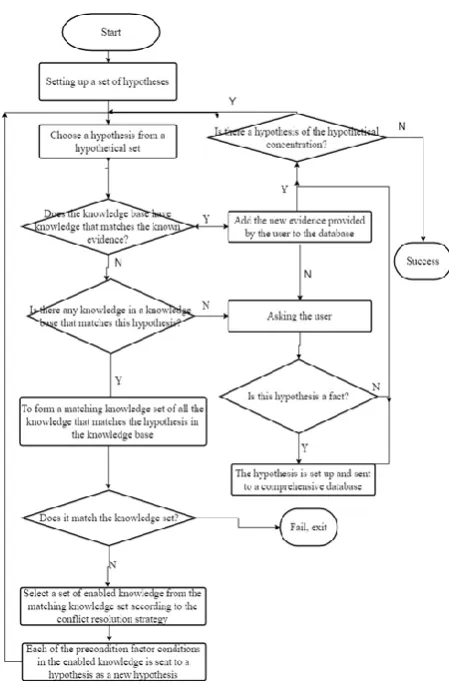
Reverse reasoning is a reasoning way based on a hypothetical target and reversely using inference rules. It is a goal driven inference method, also called backward chain inference or top-down reasoning. The so-called reverse reasoning rules is in reasoning, with the known facts in the database (the actual fact is the assumption that goal or sub goal reasoning) and knowledge conclusion (or rule consequents) matching, selection of available knowledge or rules. The basic idea is: firstly, according to the reverse reasoning problem solving, to prove the goal (called assumptions) constitute a hypothesis set, then took out a hypothesis from the assumption that the focus of its verification, whether there is evidence supporting the hypothesis, check if there is a comprehensive database, the hypothesis; if not, whether there is a conclusion that matches the hypothesis of knowledge check the knowledge base, and the use of conflict resolution strategies, selected from all the knowledge, a knowledge reasoning is used as the opening, the prerequisite of knowledge enabled all conditions as a new hypothesis in the hypothesis set. Repeat the above process on all hypotheses of the hypothetical centralization until it is successfully exited.
In order to verify the assumption, if there is no match with the evidence for the hypothesis that the comprehensive database, ask the user whether the hypothesis as evidence, if can be used as evidence that this hypothesis is true, and add it to the database; if it is not possible to explain the hypothesis as evidence to verify the hypothesis of failure then, from the assumption that the centralized verification takes the next hypothesis and repeat, until the assumption of centralized hypothesis until the end. The reverse reasoning process can be described by the following algorithms: (1) a hypothesis set is formed by the objective of the requirement (called hypothesis). (2) select a hypothesis from the hypothesis, whether this hypothesis, check if there is a comprehensive database, is that this hypothesis is true, at this time, if the set is empty, then the successful exit, if the set is not empty, then choose the next assumption, execution (2) without the assumption; comprehensive database, execute (3). (3) check the knowledge of whether there is a conclusion in the knowledge base to match the selected assumptions. If no matching knowledge, is to ask the user whether the assumptions for the original facts can be confirmed by the user if this hypothesis is true, and put it into the database, and then re select a new hypothesis, if not, turn (5); if the matching knowledge is executed (4). (4) a matching knowledge set is composed of all the knowledge that matches the hypothesis in the knowledge base. (5) check whether the matching knowledge set is empty, if empty, failed to exit; otherwise, execution (6). 6) use the conflict resolution strategy to select a knowledge from the matching knowledge set as the enabling knowledge and continue to execute (7). (7) every subcondition in the knowledge premise is put into a hypothesis set as a new hypothesis, and (2). The algorithm can be expressed as a schematic diagram as shown in Figure 3. Reverse reasoning is obviously more complex than forward reasoning. The algorithm presented here is only a frame description of reverse reasoning, and there are still many problems to consider when it is implemented concretely.
For example, at the beginning of the algorithm, the selection of the initial target directly affects the efficiency of the inference engine. If the target selection is accurate, the efficiency of inference will be higher.
There are two methods to select the initial target, one is to specify the target by the user, the other is the independent selection of the intelligent system. Although the former is simple, but the degree of automation is poor, the latter, although the degree of automation is high, but the blindness is relatively large. In addition, when a premise that a hypothesis is matched is a logical combination of multiple sub conditions, the relationship between these sub conditions may be "relationship" or "or". How will these conditions into the integrated database and schedule them in order to improve the reasoning, reasoning efficiency, but also need to seriously consider; for instance, the verification of a subset of conditions, need to take it as a new hypothesis, and find the knowledge base with this new hypothesis, this knowledge. It will produce a new set of conditions, so the reasoning process constantly down, will produce at different levels on the multi group condition, form a tree structure. When reasoning arrives at a leaf node (that is a fact in a comprehensive database), it will go back up layer by layer, and it may need to go down again in the process of return. It can be proved that the reverse reasoning is a very complicated process. The main advantage of reverse reasoning is that the goal of the reasoning process is clear, and it is not necessary to find and use information and knowledge which are not related to the assumed target, but also to provide users with explanations, which is more effective in the diagnostic expert system. The main drawback is that when users are not clear about the solution situation, the blindness of the target is chosen by the intelligent system. If the choice is not good, it may need to make many assumptions, which leads to the reduction of the reasoning efficiency of the intelligent system.
Mixed reasoning
As mentioned above, forward reasoning and backward reasoning have their own advantages and disadvantages. For a more complex problem, any application of them will not have high inference efficiency. In order to give full play to the strengths of these two ways of reasoning, avoid their respective shortcomings and make up for each other, they can be used together. The reasoning that combines positive and reverse reasoning is called mixed reasoning.
The implementation of mixed reasoning
Figure 2. Positive reasoning schematic diagram
[image:8.595.52.317.58.758.2]Figure 3. Reverse reasoning schematic diagram
Figure 4. A mixed reasoning diagram that is first and backward backward
Figure 5. A schematic of a backward backward forward mixed reasoning
[image:8.595.319.546.352.639.2] [image:8.595.51.276.422.767.2]facts or evidence of positive reasoning the reasoning process is likely to make it. In this case, we first use forward reasoning to find some matching knowledge, and take the conclusions of these knowledge as hypotheses, and then verify the hypotheses by reverse reasoning, so as to solve the problems. Second, the conclusion derived from positive reasoning is not reliable. In some cases, although positive reasoning can be used to deduce the conclusion of the problem, the reliability of the conclusions is low. To solve this problem, can choose a few relatively high reliability of the conclusion as a hypothesis or goal, starting from their use of backward reasoning reasoning, in the process of reasoning, the system can be interactive to the user asking for further evidence, after obtaining reliable evidence, in turn forward inference. Because of the higher reliability of the evidence obtained by the use of reverse reasoning, the positive reasoning may introduce a more credible conclusion. I hope to draw more conclusions. In reverse reasoning, intelligent system can provide some questions to users by interacting with users, so as to get some previously unknown facts or evidences. Using these facts, intelligent systems can be used not only to verify the assumptions that need to be proved, but also to introduce some other conclusions. That is to say, after proving some hypotheses with reverse reasoning, we can take these assumptions as new evidence and give some other conclusions by forward reasoning.
Bi-directional reasoning
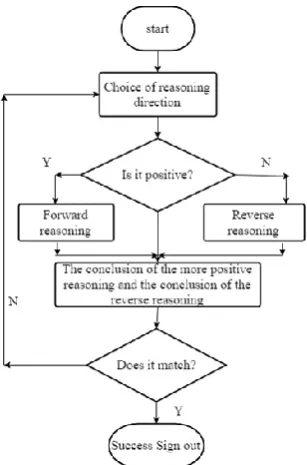
[image:9.595.87.241.542.775.2]The so-called two-way mixed reasoning is a reasoning method that is based on the simultaneous inference of forward reasoning and reverse reasoning, which makes the reasoning process end in a certain step in the middle. The basic idea is to make positive reasoning according to the known facts of the problem according to some choice, or to do reverse reasoning from the hypothesis goal. During the whole reasoning process, the two reasoning algorithms are executed alternately based on a certain control strategy. Forward reasoning is not expected to push from the initial evidence to the final goal. Reverse reasoning does not expect to move from one hypothesis to the original one, but rather to expect the reasoning process to converge somewhere in the middle.
Figure 6. Bidirectional reasoning schematic diagram
This convergence shows that the intermediate results obtained from forward reasoning just satisfy the requirements of reverse reasoning, which indicates that the conclusion of reasoning is the conclusion of reasoning when the conclusion is successful. If in the reasoning process in one step, a sub hypothesis conclusion and backward reasoning reasoning in contradictory, it shows that the assumption of backward reasoning is wrong, it can give up this hypothesis, this will reduce the reverse reasoning target (assumption) choice blindness, so as to improve the efficiency of reasoning problems solving. Figure 6 is a description of the reasoning process.
The conflict resolution strategy of reasoning
In the process of using reasoning to solve problems, if known facts in the integrated database (evidence) matched with a plurality of knowledge in the knowledge base, or a number of known facts (evidence) can be matched with a certain knowledge in the knowledge base, or a plurality of knowledge of a number of known facts and knowledge in the library, then call the condition of knowledge (or rules) conflict. At this time, we need to choose a best knowledge from these matching knowledge according to some strategy, which is called conflict resolution. The strategy used for conflict resolution is called the conflict resolution strategy. A conflict resolution strategy is discussed with the production system as an example. Generative system of rules in the use of forward inference, if multiple generative rule's premise and comprehensive database of facts, success, or comprehensive database has a set of facts, the success of the first with the same generative rules, or integrated data library contains a number of known facts with the knowledge base of the plurality of generative rules before a match, that happened conflict rules. Similarly, when backward reasoning is done by production system, if the posterior parts of multiple production rules are successfully matched with the same hypothesis, or if there are multiple production rule's successes, it can also be successfully matched with multiple hypotheses, also known as a rule conflict. Conflict resolution is the task of resolving conflicts, select a rule from the multiple matching rules as enabled rules, it will be used for the reasoning for forward reasoning, is given by the operation of the production rules after a pointed out conclusion or execution of rules; for backward reasoning, as new that is before will match the rules, into a comprehensive database, in order to continue reasoning. The basic ideas of many existing conflict resolution strategies are sorting the matching knowledge or rules to decide the priority level of matching rules. The high priority rule will be used as the enabling rule. There are several commonly used sorting methods. (1) sort by the nearest principle. This strategy takes knowledge recently as a basis for knowledge sorting, giving priority to recent knowledge and prioritized it. This is in line with human behavior norms, and if a knowledge or experience is often used recently, people tend to give priority to this knowledge. (2) sort according to the particularity of knowledge. This strategy takes the particularity of knowledge as the basis of knowledge sorting, with special knowledge arranged in front, and gives higher priority. In current matching knowledge, special knowledge generally requires more prerequisite knowledge, special knowledge is more pertinent than general knowledge, and conclusion is closer to the characteristics of goals.
the context of order as the basis of knowledge, namely knowledge according to the description of the context is divided into several groups, in the process of reasoning, according to the situation, the current database facts or evidence and context (distance), from which the group decided to choose knowledge enabled knowledge, distance or small good knowledge of the group, have higher priority. (4) sort by the freshness of knowledge. This strategy takes the freshness of knowledge as the basis of knowledge ranking, and holds that fresh knowledge is the renewal and improvement of old knowledge, which is more effective than old knowledge. Therefore, it gives higher priority to fresh knowledge. Fresh knowledge is based on the knowledge (or rules) of fresh facts or evidence for the premise to determine, and fresh facts or evidence is based on the integrated database has added to determine that this idea is somewhat like a depth first search strategy. Generally, it is assumed that the fact or evidence in a comprehensive database is more fresh than the facts or evidence that is added first. (5) sort according to the difference of knowledge. This strategy takes the difference of knowledge as the basis for the sort of knowledge, giving a higher priority to the knowledge that has been used in the last time. In this way, it is possible to avoid repeated execution of those similar knowledge and prevent the system from doing inefficient, repetitive reasoning near a problem. (6) sorting according to the characteristics of the field, this strategy regards the characteristics of the field as the basis of knowledge ranking, that is, knowledge is arranged in a certain order according to the characteristics of the field problems, and the prior knowledge has a higher priority. (7) order according to the order of rules.
This strategy is based on the order of rules in the knowledge base in the knowledge base, and the precedence of the rules has a higher priority. (8) sort the scale according to the precondition. This strategy takes the size of knowledge's precondition as the basis of knowledge ranking. In conclusion, the knowledge with fewer preconditions has higher priority in the conclusion of the same multiple knowledge. The reason is that the knowledge of less premise is easy to be realized when it matches the knowledge in the comprehensive database, and it takes less time. In addition to the several knowledge sorting strategies discussed above, in the process of system implementation, there are many strategies that can be used in accordance with the actual situation. For example, in uncertain reasoning, knowledge is sorted according to the matching degree of knowledge. Of course, some of these strategies can also be combined to sort knowledge to form a more effective conflict resolution strategy.
The method of uncertainty reasoning
After simply discussing the general concept of reasoning and the natural deductive reasoning method, this paper mainly introduces the method of resolution reasoning based on first order predicate logic. This method is based on the evidence that the predicate is deterministic, the knowledge represented either "true" or "false", the reasoning process is based on symbolic logic, reasoning process is rigorous, the conclusion is determined, the conclusion is either established or not established. Therefore, the method of resolution based on the first - order predicate logic is a deterministic reasoning method. However, in everyday life, what people usually encounter is that information is not perfect and accurate, that is, the knowledge that is mastered is uncertain. People use this
uncertainty knowledge to think, reason and solve problems. Therefore, in order to solve practical problems, we must study uncertain knowledge and reasoning process, which is the uncertainty reasoning method discussed in this chapter. There are many ways to express and analyze uncertain knowledge, but the most important and famous methods are credibility, subjective Bayes and evidence theory. In this chapter, the three methods are discussed in detail on the basis of an overview of the uncertain reasoning methods and their concepts.
RESULTS
An overview of uncertainty reasoning and the concept of uncertainty reasoning
Reasoning is the process of thinking from the known facts and using related knowledge or rules to gradually produce conclusions or prove that a hypothesis is established or not. Among them, the known facts and knowledge (rules) are the two basic elements of reasoning. The known fact is the starting point of the reasoning process and the knowledge used in the reasoning. It is called evidence, and knowledge (or rule) is the basis for reasoning to go forward and reach the final goal gradually. An artificial intelligence system consists of a total database, a knowledge base and a reasoning machine. Among them, the total set of database is known facts, and the knowledge base is the rule base, is a collection of people summed up the rules of the reasoning machine is composed of some algorithms, these algorithms will be based on the rules in the knowledge base and database in fact reasoning calculation. Among them, the knowledge base is the core of the artificial intelligence system. The relationship between the real world and things is extremely complex, inadequate exposure plus the objective existence of randomness and fuzzy, and some things or phenomena, which leads to their understanding of the inaccurate and incomplete, has certain uncertainty. This uncertainty of cognition is reflected in the knowledge and rules that people summarize and the evidence obtained from the observation, forming uncertain knowledge and uncertainty evidence respectively. Therefore, the knowledge base in AI system is often composed of some uncertain rules, and its total database contains some evidences with certain uncertainties. In this case, if in the process of reasoning is still using the classic, based on logic and precise reasoning method, is bound to the uncertain relationship of objective things with the original uncertainty and things exist as uncertainty, thus losing the authenticity of the description of the objective world. It can be seen that the research of reasoning in AI can not stay on the level of deterministic reasoning, but should be further expanded, so that computer can simulate human's thinking and carry out uncertainty reasoning. And this uncertainty reasoning is based on the evidence with uncertainty, using knowledge with uncertain knowledge in the knowledge or rule library, and finally launching the thinking process with a certain degree of uncertainty, but a reasonable or almost reasonable conclusion
The classification of uncertain reasoning methods
uncertainty are corresponding to different models. Some of the uncertain reasoning methods introduced below belong to the model method. The characteristics of the control method is the influence caused by the uncertainty of some characteristics and the corresponding control strategy to limit or reduce the uncertainty through system identification in the field, this kind of method not unified model uncertainty, the effect is greatly dependent on the control strategy, control strategy selection and research is the key to this kind of uncertainty inference method. Heuristic search, correlation guidance backtracking and so on are several common control methods. The model method is divided into two categories: numerical method and non numerical method.
Numerical method is a quantitative representation and processing method for uncertainty. At present, the research and application of the numerical method are much more, and a variety of application models have been formed. It can be divided into probability based methods and fuzzy reasoning methods according to the theoretical differences it is based on. The theory based on probability is the theory of probability, while the theory based on fuzzy reasoning is fuzzy theory. The non numerical method refers to all the other methods of processing uncertainty except the numerical method. It also includes many methods. Logical method is a non numerical method, which uses multi valued logic and non monotone logic to deal with uncertainty. In all the above uncertain reasoning methods, because of the perfect theory of probability theory, and the existing formula for the synthesis and transmission of uncertainty, it is used to represent and deal with the uncertainty of knowledge, and become an important measure to measure uncertainty. The method of expressing and dealing with uncertainty purely by probability model is called the pure probability method or the probability method. Although the pure probability method has strict theoretical basis, it requires the priori probability and conditional probability of events, and these data are not easy to get, so their applications are limited. Therefore, after many years of research, based on probability theory, people have developed some new ways to deal with uncertainty. These methods include credibility, subjective Bayes and evidence theory. The focus of this chapter is to introduce the three kinds of uncertain reasoning methods.
The basic problem in uncertain reasoning
In uncertain reasoning, knowledge and evidence have some degree of uncertainty, which makes the complexity and difficulty of the design and implementation of the inference engine increase. It must not only solve the reasoning direction, reasoning method and control strategy issues, measurement and representation problem of uncertainty, but also solve the general knowledge of evidence and the uncertainty of knowledge (or rules) synthesis problem matching problem, uncertainty propagation algorithm and multiple evidence also supports the conclusion under the condition of uncertainty. 1. the uncertainty is expressed. The uncertainty mainly includes two aspects, one is the uncertainty of the evidence and the other is the uncertainty of knowledge.
Therefore, the representation of uncertainty is included in the representation of evidence and knowledge representation. (1) the representation of the uncertainty of the evidence. In the process of reasoning, the source of evidence is generally two: one is the initial evidence required to solve the problem by the observation. For example, in solving the problem of medical
diagnosis, some symptoms of the current patient and the results of the test are all initial evidence. Because of the inaccuracy of the observation itself, the resulting initial evidence is uncertain. Another source is to use the previous reasoning in the process of reasoning as the current new reasoning evidence. Because of the uncertainty of the initial evidence used in the preceding reasoning and the uncertainty of knowledge in the reasoning process, the uncertainty of the result is caused. That is to say, the evidence that the current reasoning depends on is bound to be uncertain. The representation of evidence uncertainty is usually a numerical value to indicate the degree of uncertainty of the corresponding evidence. For the initial evidence obtained from observation, its value is usually given by users or experts, and for the conclusion that the preceding reasoning is used as the evidence of current reasoning, its value is calculated by the uncertainty transfer algorithm in reasoning. (2) the representation of knowledge uncertainty. In the second chapter, various methods of knowledge representation are discussed in detail. Most of these methods represent deterministic knowledge, and the representation of uncertain knowledge is not discussed in depth.