Engineering, 2011, 3, 1063-1071
doi:10.4236/eng.2011.311132 Published Online November 2011 (http://www.SciRP.org/journal/eng)
An Application Expert System for Evaluating Effective
Factors on Trust in B2C Websites
Mehrbakhsh Nilashi1, Karamollah Bagherifard2, Othman Ibrahim3, Nasim Janahmadi1, Mousa Barisami1
1
Department of Computer Engineering, Roudsar and Amlash Branch, Islamic Azad University, Roudsar, Iran 2
Deptartment of Computer Engineering, Islamic Azad University, Yasooj Branch, Yasooj, Iran 3
Faculty of Computer Science and Information Systems, University Teknologi Malaysia, Johor, Malaysia E-mail:{Nilashidotnet, Karam_bagheri}@yahoo.com, [email protected],
[email protected], [email protected] Received May 7, 2011; revised July 22, 2011; accepted August 1, 2011
Abstract
In new environments of trading, customer’s trust is vital for the extended progress and development of elec- tronic commerce. This paper proposes that in addition to known factors of electronic commerce B2C web- sites such a design of websites, security of websites and familiarity of website influence customers trust in online transactions. This paper presents an application of expert system on trust in electronic commerce. Based on experts’ judgment, a frame of work was proposed. The proposed model applies ANFIS and Mam- dani inference fuzzy system to get the desired results and then results of two methods were compared. Two questionnaires were used in this study. The first questionnaire was developed for e-commerce experts, and the second one was designed for the customers of electronic websites. Based on AHP method, Expert Choice software was used to determine the priority of factors in the first questionnaire, and MATLAB and Excel were used for developing the fuzzy rules. Finally, the fuzzy logical kit was used to analyze the generated factors in the model. Our study findings show that trust in EC transactions is strongly mediated by perceived security.
Keywords:Trust, Security, ANFIS, Fuzzy Logic, Rule Based Systems, Electronic Commerce
1. Introduction
Recent use of electronic commerce and especially the type of B2C has increased remarkable and electronic commerce is newly operating under its expected capacity, principally because merchants find it very difficult to trust one another online for trading decisions. It is there- fore very important to develop an effective trust man- agement system that aid e-commerce participants to make right decisions on electronic B2C websites. Trust is considered as a critical fact for the success of e-com- merce. Online trading has introduced new problems and challenges to online buyers: The uncertainty about the quality of products or services and the ability of sellers to stay anonymous have lead to a high level of risk in online transaction environments, virtual communities and online auctions [1,2].
However, according to a survey by Information Sys- tems Audit and Control Association (ISACA), security
and then trust are still some of the main key problems in the e-commerce world, all of which directly or indirectly have significant impact on trust [3]. Trust management systems therefore can help to reduce risk (e.g., ID theft), and make it easier for users and agents to interact with one another in a low risk environment. The importance of trust management has also been increasingly ac- knowledged due to the advent of virtual communities. Since participants in these communities do not know each other and do not have face-to-face contact, the abil- ity to provide a system that allows communication to be done in a trusted environment is vitally desirable [2].
1064 M. NILASHI ET AL.
tomer Trust, in which there contains three main factors security, design and familiarity. Figure 1 shows key
problems in electronic commerce.
Spending on online marketing in Europe will double in the next five years, from around 7.5 billion euros in 2006 to more than 16 billion euros in 2012, according to a new Forrester report, “European Online Marketing Tops 16 Billion In 2012.”
Online marketing—email, and search and display ad- vertising—will account for 18% of total media budgets in Europe in five years, according to the projections.
The reason for this shift in spending is that audience and attention are moving online, according to Forrester research Inc:
Some 52% of Europeans are regularly online while at home, and 36% of online Europeans say that they watch less TV because they’re online.
On average, they spend three hours per week more online than watching TV.
Consumers’ reliance on online services is growing
36% of online adults have recently downloaded mu- sic online, and 20% have downloaded games
35% have bid or sold in online auctions
Trust in many types of advertising is eroding: 67% of online consumers say advertisers don’t tell the truth in ads.
34% of online consumers say they don’t mind ads if they relate to their interests.
40% of online consumers trust price-comparison sites.
36% of online consumers trust online product reviews from other users.
Customer Change Accptance Scalability Trust Cost/Benefit-Bussiness Plan
Risk Management
[image:2.595.67.281.471.706.2]Regulations Security
Figure 1. Key problems in electronic commerce [3].
The Trust model presented in this study has various aspects of consumer trust, online Environment, website designs, security and familiarity of websites. We have also addressed the importance of online customer service and its impact on consumer trust. The trust model high- lights the importance of building trust in the online envi- ronment with the process of customer service. The con- tribution to theory of this paper is based on empirical data and information from three websites regarding our research problem.
2. Analytical Hierarchy Process (AHP)
AHP is a mathematical technique used for multi-criteria decision-making. In a way it is better than other multi- criteria techniques, as it is designed to incorporate tangi- ble as well as non-tangible factors especially where the subjective judgments of different individuals constitute an important part of decision making [4]. Apart from other facts, this is rooted in the special structure of the AHP, which follows the intuitive way in which managers solve problems, and in its easy handling compared with other multi criteria decision-making procedures. Hence the intuitively solved decision problems can now be solved as procedure-orientated using AHP. The use of AHP leads to both, more transparency of the quality of management decisions and an increase in the importance of AHP [5].
Because of its intuitive appeal and flexibility, many corporations and governments routinely use AHP for making major policy decisions. Applications of AHP can be seen in a wide range of areas like merit salary rec- ommendation system [6], environmental impact assess-ment [7], credit evaluation of the manufacturing firms [8], indoor environment assessment [9], selection of alterna-tive transportation options [10], performance measure-ment system [11], TQM implemeasure-mentation [12], evaluation of highway transportation [13], determination of key capabilities of a firm [14] and for evaluation of an AHP software [15] itself.
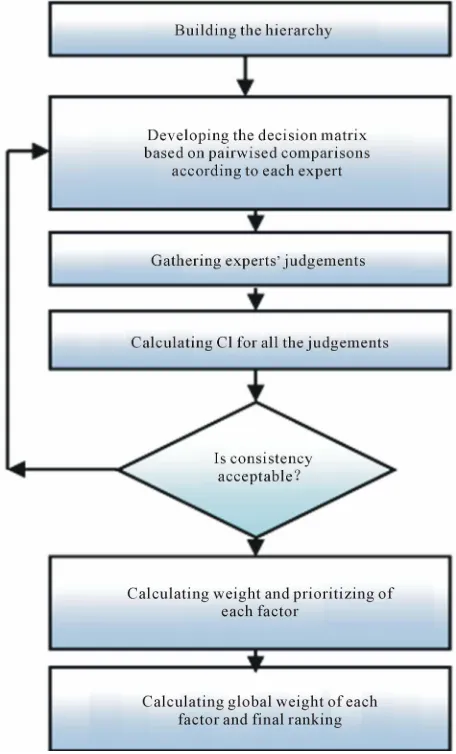
AHP uses a five-step process to solve decision prob- lems. They are
Create a decision hierarchy by breaking down the problem into a hierarchy of decision elements.
Collect input by a pair wise comparison of decision elements.
Determine whether the input data satisfies a consis- tency test. If it does not, go back to Step 2 and redo the pair wise comparisons.
Calculate the relative weights of the decision ele- ments.
M. NILASHI ET AL. 1065
One of the major reasons for the popularity of AHP is that the decision maker does not require advanced knowledge of either mathematics or decision analysis to perform first two steps. Last three steps are computa- tional and can be performed manually or using software such as Expert Choice. However, the first two are the steps where the decision maker is very much involved in the model. On the basis of the decision maker’s under- standing of the problem, the hierarchy can be designed and pair wise comparisons can be made of the decision elements. AHP uses redundant judgments for checking consistency, and this can exponentially increase the number of judgments to be drawn out from decision makers [5,16-20].
The AHP method can tolerate the inconsistency by providing the measurement of assessment inconsistency. This measurement is one of the important elements in priority determination process according to pairwise comparison. The higher consistency ratio, the assessment result becomes more inconsistent. The acceptable con- sistency ratio is less than or equal to 10 percent, although in some cases the consistency ratio which is higher than 10 percent is still considered acceptable [21].
According to Taylor III [15], Consistency Index (CI)
can be calculated by using formula as follows: .
1
maks eigenvalue n CI
n
(1)
.
i
maks eigenvalue
wi ci. (2)After acquiring Consistency Index (CI), the next step
is calculating Consistency Ratio (CR) by using formula
(3):
CI CR
RI
(3)
Description:
N = Amount of items compared wi = Weight
ci = Sum of column CR = Consistency Ratio CI = Consistency Index
RI = Random Consistency Index
[image:3.595.309.537.319.696.2]Random Consistency Index (RI) can be observed in Table 1 as follows:
If CR≥ 10%, the data acquired is inconsistent
If CR < 10%, the data acquired is consistent
The test of consistency result will be very useful in the AHP method. If the test result is inconsistent (CR ≥
10%).
Table 1. Random consistency index.
n 1 2 3 4 5 6 7 8 9 10
RI 0 0 0.58 0.90 1.12 1.24 1.32 1.41 1.45 1.49
Then the result from the AHP method will be of no use in decision making.
Figure 2 illustrates the steps needed to be taken in this
research for AHP method.
3. Fuzzy Expert Systems
The world of information is surrounded by uncertainty and imprecision. The human reasoning process can han- dle inexact, uncertain, and vague concepts in an appro- priate manner. Usually, the human thinking, reasoning, and perception process cannot be expressed precisely. These types of experiences can rarely be expressed or measured using statistical or probability theory. Fuzzy logic provides a framework to model uncertainty, the human way of thinking, reasoning, and the perception process. Fuzzy systems were first introduced by Zadeh [22].
A fuzzy expert system is simply an expert system that
M. NILASHI ET AL.
1066
uses a collection of fuzzy membership functions and rules, instead of Boolean logic, to reason about data [23].
Neuro-fuzzy modeling is concerned with the extrac- tion of models from numerical data representing the be- haviour of a system. The models in this case are rule- based and use the formalism of fuzzy logic, i.e. they
[image:4.595.115.481.420.706.2]consists of sets of fuzzy “if-then” rules with possibly several premises. The learning capability of feedforward neural networks supports the model extraction if the ar- chitecture of the network, once properly trained, may be translated into rules without loss of information. This idea has been thoroughly studied by several authors starting with the beginning of the nineties (see e.g. [24- 31]) and continues to be an important research area [32].
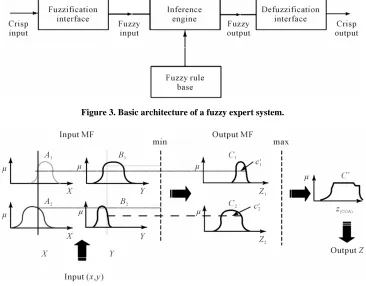
Figure 3 illustrates the basic architecture of a fuzzy
expert system. The main components are a fuzzification interface, a fuzzy rule base (knowledge base), an infer- ence engine (decision-making logic), and a defuzzifi- cation interface. The input variables are fuzzified where- by the membership functions defined on the input vari- ables are applied to their actual values, to determine the degree of truth for each rule antecedent. Fuzzy if-then rules and fuzzy reasoning are the backbone of fuzzy ex- pert systems, which are the most important modeling tools based on fuzzy set theory. The fuzzy rule base is characterized in the form of if-then rules in which the antecedents and consequents involve linguis-tic variables.
The collection of these fuzzy rules forms the rule base for the fuzzy logic system. Using suitable inference pro- cedure, the truth value for the antecedent of each rule is computed, and applied to the consequent part of each rule. This results in one fuzzy subset to be assigned to each output variable for each rule. Again, by using suit- able composition procedure, all the fuzzy subsets as- signed to each output variable are combined together to form a single fuzzy subset for each output variable. Fi- nally, defuzzification is applied to convert the fuzzy output set to a crisp output. The basic fuzzy inference system can take either fuzzy inputs or crisp inputs, but the outputs it produces are always fuzzy sets. The defuzzification task extracts the crisp output that best represents the fuzzy set. With crisp inputs and outputs, a fuzzy inference system implements a nonlinear mapping from its input space to output space through a number of fuzzy if-then rules.
In what follows, the two most popular fuzzy inference systems are introduced that have been widely deployed in various applications. The differences between these two fuzzy inference systems lie in the consequents of their fuzzy rules, and thus their aggregation and de- fuzzification procedures differ accordingly.
According to Mamdani, fuzzy inference system [33]— see Figure 4—the rule ante-cedents and consequents are
defined by fuzzy sets and has the following structure:
Figure 3. Basic architecture of a fuzzy expert system.
M. NILASHI ET AL. 1067
if x is A1 and y is B1 then z1 = 1.
There are several defuzzification techniques. The most widely used defuzzification technique uses the centroid of area method as follows:
C
d Centroid of area
d A z COA
A z
z z z z
z z
(4)where µA(z) is the aggregated output MF.
[image:5.595.312.536.81.218.2]Also a neuro-fuzzy model comes from combining fuzzy logic with neural networks to give a system of postulates, data and inferences to describe an object or process. Some of the ways of combining fuzzy logic and neural networks to create a neuro-fuzzy model are: 1) to use a supervised learning technique to build a rule based fuzzy model; 2) to use a non supervised learning tech- nique to build a rule based fuzzy model; 3) to use a non supervised learning technique to make a partition of the input space. One of the most popular and well docu- mented neuro-fuzzy systems is ANFIS, which has a good software support [34]. Jang [35] present the ANFIS ar- chitecture and application examples in modeling a non- linear function, a dynamic system identification and a chaotic time series prediction. Given its potential in building fuzzy models with good prediction capabilities, the ANFIS architecture was chosen for modeling in this work.
Figure 5 shows the block diagram of ANFIS structure.
Our model is based on the Adaptive Network Fuzzy Inference System (ANFIS) and Mamdani, fuzzy infer-ence system.
4. Framework of Research
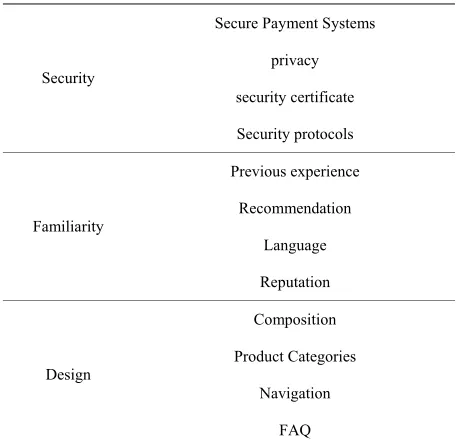
[image:5.595.309.537.246.470.2]The proposed model has been established based on this principle that each real level of transactions in B2C web- sites includes 3 major factors and 12 sub factors as Fig- ure 6 after prioritization using AHP.
[image:5.595.60.286.575.708.2]Table 2 shows 12 sub factors of research model.
Figure 5. ANFIS structure diagram.
Figure 6. Emerged Frame of work.
Table 2. 12 sub after prioritization using AHP.
Secure Payment Systems
privacy
security certificate
Security protocols Security
Previous experience
Recommendation
Language
Reputation Familiarity
Composition
Product Categories
Navigation
FAQ Design
5. Data Collection an Analysis
This study used a web-based survey because of its ad- vantages such as convenience; viable, effective way to access difficult-to-reach respondents.
The selected population in this study was included in two groups. The first group was included ten experts in the field of e-commerce and the Second group was in- cluded 150 numbers of e-commerce and IT students.
The first group completed the first questionnaire and after obtaining results from the first questionnaire and the second group completed the second.
1068 M. NILASHI ET AL.
6. Prioritization of Sub Factors Using AHP
Calculation of Relative Weight of Criteria Regarding Each of the Main Factors
For prioritization of sub-criteria expert choice was used for all Pairwise Comparison matrixes.
Figure 7 shows Relative Weight of all sub-criteria of
security factors.
According to the results of the software, security pay-ment system is the most importance, weighted 0.224 and so it is in the top priority. Privacy policy, security cer-tificate and security protocol are in the second, third and fourth priority weighted 0.204, 0.189 and 0.118. Incon-sistency rate of pairwise comparison is equal to 0.03 which is acceptable; because it is lower than 0.10.
Figure 8 show Relative Weight of all sub-criteria of
design factor.
As shown in Figure 7, navigation is the most impor-
tance, weighted 0.250 and so it is in the top priority. Composition and FAQ criteria are in the second priority (weighted 0.198), third (weighted 0.155) and update are in the fourth priority (weighted 0.140). Inconsistency rate of pairwise comparison is 0.04 and since it is lower than 0.10 these comparisons is acceptable.
For all sub-criteria of familiarity factor, previous ex- perience is the most importance, weighted 0.266 and so it is in the top priority. Recommendation and language criteria are in the second priority (weighted 0.207), third (weighted 0.187) and reputation are in the fourth priority (weighted 0.129). Inconsistency rate of pairwise com- parison is 0.03 and since it is lower than 0.10 these
Figure 7. Prioritization of sub-criteria of security using expert choice software.
Figure 8. Prioritization of sub-criteria of design using ex-pert choice software.
comparisons is acceptable.
7. Developing ANFIS and Mamdani Fuzzy
Inference System
The general trust model proposed in this section is com- posed of two modules. One module will be used to quan- tify the trust measure of the three factors identified in our trust model (security, design, and familiarity) based on Mamdani fuzzy inference system. The second module will be same model based on ANFIS. Figure 9 shows
Trust module pseudo code based on Mamdani fuzzy in- ference system in Matlab software.
Example of the rules used to process the final decision for the trust model based on Mamdani fuzzy inference system are as Figure 10.
Figure 11 shows that Trust level is monotonically in-
creasing for increasing perceived familiarity of a website for any given level of security and design.
Figure 12 shows that Trust level is monotonically in-
creasing for increasing perceived security of a website for any given level of familiarity and design.
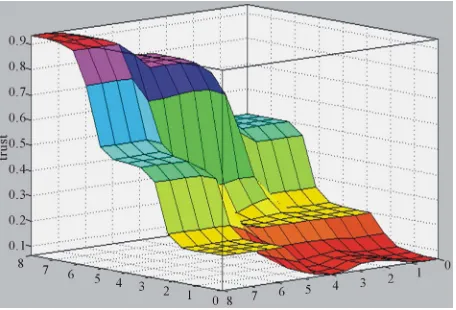
Figure 13 shows Trust level as a function of Security
Figure 9. Trust module pseudo code based on mamdani fuzzy inference system.
[Rules]
3 3 3, 5 (1) : 1 3 3 2, 5 (1) : 1 3 3 1, 4 (1) : 1 3 1 3, 4 (1) : 1 3 1 2, 3 (1) : 1 3 1 1, 3 (1) : 1 3 2 3, 5 (1) : 1 3 2 2, 4 (1) : 1 3 2 1, 3 (1) : 1 1 3 3, 2 (1) : 1 1 3 2, 2 (1) : 1 1 3 1, 1 (1) : 1 1 1 3, 1 (1) : 1
1 1 2, 1 (1) : 1 1 1 1, 1 (1) : 1 1 2 3, 2 (1) : 1 1 2 2, 1 (1) : 1 1 2 1, 1 (1) : 1 2 3 3, 3 (1) : 1 2 3 2, 3 (1) : 1 2 3 1, 2 (1) : 1 2 1 3, 2 (1) : 1 2 1 2, 2 (1) : 1 2 1 1, 2 (1) : 1 2 2 3, 3 (1) : 1 2 2 2, 2 (1) : 1 2 2 1, 2 (1) : 1
M. NILASHI ET AL. 1069
0 0.1 0.2 0.3 0.4 0.5 0.6 0.7 0.8 0.9 1
0 1 2 3 4 5 6 7 8
Tr
u
s
t
Familiarity
Trust versus familiarity for constant security and design
[image:7.595.60.285.76.232.2]Moderate Low High
Figure 11. Trust versus familiarity for constant security and design.
0 0.1 0.2 0.3 0.4 0.5 0.6 0.7 0.8 0.9 1
0 1 2 3 4 5 6 7 8
Tr
u
s
t
Security
Trust versus security for constant design and familiarity
[image:7.595.311.536.77.165.2]Low Moderate High
Figure 12. Trust versus security for constant familiarity and design.
Figure 13. Output of the trust module1 based on mamdani fuzzy inference system.
[image:7.595.309.538.157.312.2]and Familiarity in Mamdani infrence system.
Figure 14 shows the ANFIS system that can be used
to derive the trust level and Figure 15 shows Trust level
[image:7.595.59.285.269.411.2]as a function of Security and Familiarity.
Table 3 shows the comparison of Fuzzy Mamdani in-
frences model with ANFIS model and the results.
[image:7.595.309.538.372.407.2]Figure 14. The ANFIS trust model.
Figure 15. Output of the trust module1 based on ANFIS-system.
Table 3. Trust models comparison.
Type of models Mamdani Fuzzy Model ANFIS Model
Trust Output 0.937 0.966
8. Conclusions
In this study, we presented a system based on Mamdani inference system and ANFIS to support the evaluation and the quantification of trust in B2C E-commerce web- sites.
The trust relationships among customers and vendors are hard to assess due to the uncertainties involved. Two advantages of using fuzzy-logic to quantify trust in E-commerce applications are: Fuzzy inference is capable of quantifying imprecise data and quantifying uncer- tainty in measuring the trust index of the vendors. Also Fuzzy inference can deal with variable dependencies in the system by decoupling dependable variables.
The main purpose of this research is to tell the readers specially the managers of the B2C websites to under- stand how these B2C website to build trust, how the consumers’ attitude to the issue of information security and how they influent the web trust during shopping. In this study, the connection of trustworthiness and security is disclosed.
[image:7.595.59.287.453.608.2]1070 M. NILASHI ET AL.
and “familiarity” are detected.
9. References
[1] B. Sulin and A. P. Pavlon, “Evidence of the Effective Trust Building Technology in Electronic Markets, Price Premiums and Buyer Behavior,” Electronic Economy Research Program, Marshall School of Business, MIS Quarterly, Vol. 26, No. 3, 2002, pp. 243-268.
[2] H. Y. Lee, H. Ahn and I. Han, “Analysis of Trust in the E-Commerce Adoption,” Proceedings of the 39th Annual Hawaii International Conference on System Sciences
(HICSS’06), 4-7 January 2006, p. 113.
[3] P. M. Stephen, “Formalizing Trust as a Computational Concept,” PhD Thesis, Department of Mathematics and Computer Science, University of Stirling, Stirling, 1994. [4] T. L. Saaty, “The Analytic Hierarchy Process,” McGraw-
Hill, New York, 1980.
[5] W. Ossadnik and O. Lange, “AHP-Based Evaluation of AHP-Software,” European Journal of Operational Re-search, Vol. 118, No. 3, 1999, pp. 578-588.
doi:10.1016/S0377-2217(98)00321-X
[6] M. D. Troutt and S. K. Tadisina, “The Analytic Hierarchy Process as a Model Base for a Merit Salary Recommen-dation System,” Mathematical and Computer Modeling,
Vol. 16, No. 5, 1992, pp. 99-105.
doi:10.1016/0895-7177(92)90122-2
[7] R. Ramanathan, “A Note on the Use of The analytic Hi-erarchy Process for Environmental Impact Assessment,”
Journal of Environmental Management, Vol. 63, No. 1,
2001, pp. 27-35. doi:10.1006/jema.2001.0455
[8] M. Yurdakula and Y. Tansel, “AHP Approach in the Credit Evaluation of the Manufacturing Firms in Tur-key,” International Journal of Production Economics,
Vol. 88, No. 3, 2003, pp. 269-289.
doi:10.1016/S0925-5273(03)00189-0
[9] C. M. Chianga and C. M. McLain, “A Study on the Com-prehensive Indicator of Indoor Environment Assessment for Occupants’ Health in Taiwan,” Building and Envi-ronment, Vol. 37, No. 4, 2002, pp. 387-392.
[10] S. Yedla and R. M. Suresh, “Multi-Criteria Approach for the Selection of Alternative Options for Environmentally Sustainable Transport System in Delhi,” Transportation ResearchPart A: Policy and Practice, 37, No. 8, 2003,
pp. 717-729. doi:10.1016/S0965-8564(03)00027-2
[11] P. Suwignjo, U. S. Bititci and A. S. Carrie, “Quantitative Models for Performance Measurement System,” Interna-tional Journal of Production Economics, Vol. 64, No. 1-3,
2000, pp. 231-241. doi:10.1016/S0925-5273(99)00061-4
[12] K. S. Chin, K. S. Pun, Y. Xu and J. S. F. Chan, “An AHP Based Study of Critical Factors for TQM Implementation in Shanghai Manufacturing Industries,” Technovation,
Vol. 22, No. 11, 2002, pp. 707-715.
doi:10.1016/S0166-4972(01)00065-7
[13] W. Weiwu and K. Jun, “Highway Transportation Com-prehensive Evaluation,” Computers & Industrial Engi-neering, Vol. 27, 1994, pp. 1-4.
[14] K. Hafeez, Y. Zhang and N. Malak, “Determining Key Capabilities of a Firm Using Analytic Hierarchy Proc-ess,” International Journal of Production Economics, Vol.
76, No. 1, 2002, pp. 39-51.
doi:10.1016/S0925-5273(01)00141-4
[15] W. Bernard and Taylor III, “Management Science, (Seven Edition),” Pearson Prentice-Hall, Inc., New Jersey, 2002.
[16] S. Karapetrovic and E. S. Rosenbloom, “A Quality Con-trol Approach to Consistency Paradoxes in AHP,” Euro-pean Journal of Operational Research, Vol. 119, No. 3,
1999, pp. 704-718. doi:10.1016/S0377-2217(98)00334-8
[17] K. S .Chin, K. S. Pun, Y. Xu and J. S. F. Chan, “An AHP Based Study of Critical Factors for TQM Implementation in Shanghai Manufacturing Industries,” Technovation,
Vol. 22, No. 11, 2002, pp. 707-715.
doi:10.1016/S0166-4972(01)00065-7
[18] P. R. Drake, “Using the Analytic Hierarchy Process in Engineering Education,” International Journal of Engi-neering Education, Vol. 14, No. 3, 1998, pp. 191-196.
[19] L. Frair, J. O. Matson and J. E. Matson, “An Under-graduate Curriculum Evaluation with the Analytic Hier-archy Process,” Proceedings of 1998 Frontier in Educa-tion Conference, 4-7 November 1998, Tepme, Vol. 3,
1998, pp. 992-997.
[20] K. Hafeez, Y. Zhang and N. Malak, “Determining Key Capabilities of a Firm Using Analytic Hierarchy Proc-ess,” International Journal of Production Economics, Vol.
76, No. 1, 2002, pp. 39-51.
doi:10.1016/S0925-5273(01)00141-4
[21] E. Forman and M. A. Selly, “Decisions by Objectives,” Expert Choice Inc, 2001.
http://www.expertchoice.com.
[22] L. A. Zadeh, “Fuzzy Sets,” Information and Control, Vol. 8, 1965, pp. 338-353.
doi:10.1016/S0019-9958(65)90241-X
[23] M. Schneider, G. Langholz, A. Kandel and G. Chew, “Fuzzy Expert System Tools,” John Wiley & Sons, New York, 1996.
[24] P. Y. Glorennec, C. Barret and M. Brunet, “Application of Neuro-Fuzzy Networks to Identification and Control of Nonlinear Dynamic Systems,” Proceedings of Interna-tional Conference on Information Processing and Man-agement of Uncertainty in Knowledge-Based Systems
(IPMU), 1992, pp. 507-510.
[25] S. I. Horikawa, T. Furuhashi and Y. Uchikawa, “A New Type of Fuzzy Neural Network for Linguistic Fuzzy Modeling,” Proceedings of 2nd International Conference on Fuzzy Logic and Neural Networks, Iizuka, Japan, 1992,
pp. 1053-1056.
[26] J. S. R. Jang, “ANFIS: Adaptive Network Based Fuzzy Inference System,” IEEE Transacrions on Systems, Man and Cybernetics, Vol. 23, No. 3, 1993, pp. 665-685. doi:10.1109/21.256541
[27] J. S. R. Jang and C. T. Sun, “Neuro-Fuzzy Modeling and Control,” Proceedings IEEE, Vol. 83, No. 3, 1995, pp.
M. NILASHI ET AL. 1071
[28] J. M. Keller, R. R. Tager and H. Tahani, “Neural Net-work Implementation of Fuzzy Logic,” Fuzzy Sets and Systems, Vol. 45, 1992, pp. 1-12.
doi:10.1016/0165-0114(92)90086-J
[29] H. Takag and I. Hayashi, “NN-Driven Fuzzy Reasoning,”
International Journal of Approximate Reasoning, Vol. 5,
No. 3, 1991, pp. 191-212.
doi:10.1016/0888-613X(91)90008-A
[30] H. J. Yi and K. W. Oh, “Neural Network Based Fuzzy Production Rule Generation and Its Application to an Approximate Reasoning Approach,” Proceedings of 2nd International Conference on Fuzzy Logic and Neural Networks, Iizuka, Japan, 1992, pp. 333-336.
[31] J. Han and C. Moraga, “Parametric Feedforward Network Based Adaptive Fuzzy Modeling,” Proceedings of Inter-national Symposium on Intelligent Industrial Automation and Soft Computing, Reading UK, ICSC Academic Press,
Canada, 1996, pp. 159-165.
[32] A. B. Tickle, F. Maire, G. Bologna and J. Diederich,
“Ex-tracting the Knowledge Embedded within Trained Artifi-cial Neural Networks: Defining the Agenda,” Proceed-ings of International Symposium on Soft Computing
(SOCO'99), Genova, Italy, ICSC Academic Press,
Can-ada, 1999, pp. 732-738.
[33] E. H. Mamdani and S. Assilian, “An Experiment in Lin-guistic Synthesis with a Fuzzy Logic Controller,” Inter-national Journal of Man-Machine Studies, Vol. 7, No. 1,
1975, pp. 1-13. doi:10.1016/S0020-7373(75)80002-2
[34] G. Arulampalam and A. Bouzerdoum, “Application of Shunting Inhibitory Artificial Neural Networks to Medi-cal Diagnosis,” Seventh Australian and New Zealand In-telligent Information Systems Conference, 18-21
No-vember 2001, pp. 89-94.
[35] G. S. Ng, S. S. Erdogan and P. W. Ng, “Contenders Net-work, A New Competitive-Learning Scheme,” Pattern Recognition Letters, Vol. 16, No. 11, 1995, pp. 1111-
![Figure 1. Key problems in electronic commerce [3].](https://thumb-us.123doks.com/thumbv2/123dok_us/9231230.410379/2.595.67.281.471.706/figure-key-problems-electronic-commerce.webp)