http://www.scirp.org/journal/eng ISSN Online: 1947-394X
ISSN Print: 1947-3931
DOI: 10.4236/eng.2019.111005 Jan. 28, 2019 48 Engineering
Practical Study for the Effect of Speed,
Direction of Acceleration and Type of
Machine on Vibrations Transferred
to the Steering Wheel Horticulture
Tractor Type (Goldoni)
Ghazwan Ahmed Dahham, Saad Tawfik Muhamed, Shamel Mohammed Saleh
Department of Agricultural Machines and Equipment, University of Mosul, Mosul, Iraq
Abstract
Field an experiment was carried out in the farms of Agriculture and forestry academy at University in Nineveh. The research was conducted to investigate a practical study for the effect of four forward speeds (1.9, 2.6, 3.8 and 4.7 km/hr.) and three acceleration direction of axes lateral, longitudinal and vertical, and two types machines control (Mower and Rotovators) on the vibrations trans-ferred to the steering wheel horticulture tractor type (Goldoni). The vibration points on the handgrip were calculated and tested. Root mean square accele-ration (RMS), given in m/sec2, was calculated. Results showed increased acce-leration vibration of the three directions (longitudinal, lateral and vertical) transferred to the steering wheel tractor by increased forward speed. The Mower score recorded the highest acceleration vibration for the three direc-tions of Rotovators. The levels of vibration emitted from tractor to hand an operator during the experiment was high comparing with standard mechani-cal vibration. Handgrip vibration intensity in the vertimechani-cal direction is bigger than the lateral and longitudinal direction. The total vibration evaluating was denoted as the square root mean of the three sum value (lateral, longitudinal and vertical) directions. The paper purpose was measuring and analyzing vi-bration level transferred to the steering wheel and reduces the machine vibra-tion. This paper is helpful for design in order to increase the develop safety systems in easy and economical way.
Keywords
Ergonomics, Vibrations, Hand-Transmitted Vibration, Tractor
How to cite this paper: Dahham, G.A., Muhamed, S.T. and Saleh, S.M. (2019) Practical Study for the Effect of Speed, Direction of Acceleration and Type of Machine on Vibrations Transferred to the Steering Wheel Horticulture Tractor Type (Goldoni). Engineering, 11, 48-58. https://doi.org/10.4236/eng.2019.111005
Received: November 28, 2018 Accepted: January 25, 2019 Published: January 28, 2019
Copyright © 2019 by author (s) and Scientific Research Publishing Inc. This work is licensed under the Creative Commons Attribution International License (CC BY 4.0).
http://creativecommons.org/licenses/by/4.0/
DOI: 10.4236/eng.2019.111005 49 Engineering
1. Introduction
DOI: 10.4236/eng.2019.111005 50 Engineering
2. Material and Methods
A field experiment was conducted at experimental field of agriculture and Fore-stry College at the University of Mosul in the north west of the city of Mosul.
2.1. Tasted Tractor
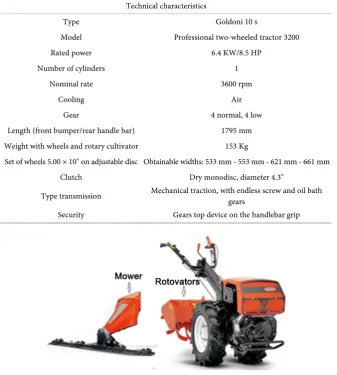
[image:3.595.206.544.336.712.2]The implementation of the horticulture Goldoni tractor search type is shown in
Table 1.
Used two types control machines (Mower) width work 120 cm and (Rotova-tors) width work 85 cm as shown in (Figure 1).
2.2. Soil
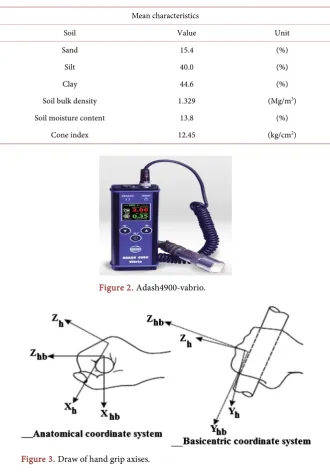
Soil type was clay-silt as shown in (Table 2).
2.3. The Experiment
Used vibration meter type (Adash4900-vabrio M) to measure the vibration force
Table 1. Tasted tractor-technical characteristics. Technical characteristics
Type Goldoni 10 s
Model Professional two-wheeled tractor 3200 Rated power 6.4 KW/8.5 HP
Number of cylinders 1 Nominal rate 3600 rpm
Cooling Air
Gear 4 normal, 4 low Length (front bumper/rear handle bar) 1795 mm Weight with wheels and rotary cultivator 153 Kg
Set of wheels 5.00 × 10'' on adjustable disc Obtainable widths: 533 mm - 553 mm - 621 mm - 661 mm Clutch Dry monodisc, diameter 4.3''
Type transmission Mechanical traction, with endless screw and oil bath gears
Security Gears top device on the handlebar grip
DOI: 10.4236/eng.2019.111005 51 Engineering of the three orthogonal directions (longitudinal: Yh), (vertical: Zh) and (lateral: Xh), hand grip shown in (Figure 2).
The device consists of sensor vibration which contains the introduction of the magnet secures the required surface measurement relates to mainstream sensor rattled by wire measurement device that contains the digital display shows the values of the vibration. The vibration was sensitive side and portrait layout ac-cording to the system for the hand as shown in the (Figure 3).
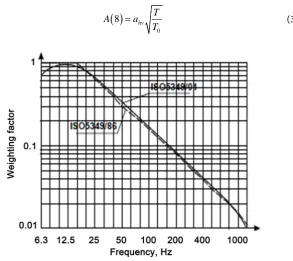
[image:4.595.207.538.259.736.2]The quantity used to describe the magnitude of vibration shall be the frequency weighted acceleration in meters per second squared (m/s2), expressed as a root- mean-square. As, it is important that for additional purposes frequency spectra must be acquire, the frequency weighted acceleration can get using ISO 5008:
Table 2. Mean characteristics of the soil at the site of the experiment.
Mean characteristics
Soil Value Unit
Sand 15.4 (%)
Silt 40.0 (%)
Clay 44.6 (%)
Soil bulk density 1.329 (Mg/m3) Soil moisture content 13.8 (%)
[image:4.595.206.539.265.561.2]Cone index 12.45 (kg/cm2)
Figure 2. Adash4900-vabrio.
DOI: 10.4236/eng.2019.111005 52 Engineering 2002 was estimate by analyzing the range of 1/3 of octave using acceleration val-ues:
(
)
2 1 2 . 1 .n
j w j
j h w
a = w a
=
∑
(1) where: ɑh.w frequency weighted acceleration in the direction i (i = x, y or z), ɑwj is the acceleration acquired (m/sec2) and Wj is dimensionless weighting factor as given in (Figure 3) (Figure 4).
It is also important vibration measure location shall be as close together as possible that significantly affect the measured value.
In consensus with the indicated ISO standards, the three directions of an or-thogonal coordinate system, in which the vibration accelerations should be ac-counted, were as follows: z-axis, x-axis and y-axis.
In accordance with ISO 5349 the assessment of vibration exposure depends on a quantity that combines all three axes. This is weighted acceleration sum or vi-bration total value it is defined as the root-mean-square of the three constituent values:
2 2 2
hv hwx hwy hwz
a = a +a +a (2)
where: ɑhwx; ɑhwy; ɑhwz are frequency weighted acceleration values for the single axes.
The vibration exposure depends on the duration of the exposure and on the magnitude of the vibration total value. Daily exposure duration is the total time for which the hands are exposed to vibrations during the working day. The daily vibration exposure should be expressed in terms of the 8-hour energy-equivalent acceleration or frequency-weighted vibration total value:
( )
0
8 hv
T
A a
T
[image:5.595.239.533.450.711.2]= (3)
DOI: 10.4236/eng.2019.111005 53 Engineering where: T is the total daily duration of the exposure (sec), and T0 is the reference duration of 8 h.
When total daily vibration exposure contains many process, with various vi-bration magnitudes, the daily vivi-bration exposure, A (8 hours) shall be calculates using:
( )
21 0
1
8 in hvi i
A a xT
T =
=
∑
(4)where ɑhvi is the vibration gross rate for i the process, n is number of single expo-sures, and Ti is the period of i the process.
The total daily vibration exposure calculated approximately 3.5 (hr.) working day the operator spends, in Mower, and spends approximately 2 (hr.) in Rotova-tors:
( )
(
2 2)
2
1
8 . 1 12600 21.84 7200 20.56 28800
17.73 m sec
A For L = × + ×
=
( )
(
2 2)
2
1
8 . 2 12600 27.84 7200 26.65 28800
22.72 m sec
A For L = × + ×
=
( )
(
2 2)
2
1
8 . 3 12600 33.54 7200 32.15 28800
27.39 m sec
A For L = × + ×
=
( )
(
2 2)
2
1
8 . 4 12600 39.78 7200 38.55 28800
32.61 m sec
A For L = × + ×
=
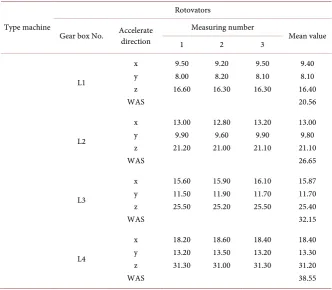
Weighted acceleration sum (WAS), forward speed, vibration value for all the di-rection, for tow machines, and their presentation are shown in Table 3 and Table 4.
3. Results and Discussion
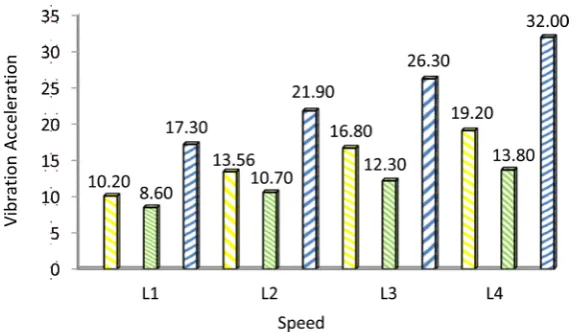
Note from Figure 5 and Figure 6 the vibration acceleration of the three axes (Longitudinal, Lateral, Vertical) increase as the forward speeds of the tractor increases that may be due to the increase the frequency of vibration of the agricultural tractor when increasing forward speed, where the fourth forward speed highest recorded vibration acceleration three axles were the results (19.20, 13.80, 32.00 m/sec2) respectively. While the first front speed less than vibration acceleration of three axles were the results (9.40, 8.10, 16.40 m/sec2) respectively. These results agree with [11] who found the vibration accelera-tion increase as the forward speeds of the tractor increases.
DOI: 10.4236/eng.2019.111005 54 Engineering Table 3. WAS mean value for Mower (m/sec2).
Type Machine
Mower
Gear box No. Accelerate direction Measuring number Mean value
1 2 3
L1 x y z WAS 10.40 8.50 17.40 10.20 8.30 17.50 10.00 9.00 17.00 10.20 8.60 17.30 21.84 L2 x y z WAS 13.40 10.50 21.60 13.0 10.80 21.40 14.00 10.80 22.70 13.47 10.70 21.90 27.84 L3 x y z WAS 16.50 12.50 26.00 16.90 12.20 26.10 17.00 12.20 26.80 16.80 12.30 26.30 33.54 L4 x y z WAS 19.50 13.50 31.80 19.30 13.90 32.00 18.80 14.00 32.20 19.20 13.80 32.00
L1 = 1.9 km/h; L2 = 2.6 km/h; L3 = 3.8 km/h; L4 = 4.7 km/h.
Table 4. WAS mean value for Rotovators (m/sec2)
Type machine
Rotovators
Gear box No. Accelerate direction Measuring number Mean value
1 2 3
L1 x y z WAS 9.50 8.00 16.60 9.20 8.20 16.30 9.50 8.10 16.30 9.40 8.10 16.40 20.56 L2 x y z WAS 13.00 9.90 21.20 12.80 9.60 21.00 13.20 9.90 21.10 13.00 9.80 21.10 26.65 L3 x y z WAS 15.60 11.50 25.50 15.90 11.90 25.20 16.10 11.70 25.50 15.87 11.70 25.40 32.15 L4 x y z WAS 18.20 13.20 31.30 18.60 13.50 31.00 18.40 13.20 31.30 18.40 13.30 31.20 38.55
[image:7.595.206.539.420.710.2]DOI: 10.4236/eng.2019.111005 55 Engineering Figure 5. Effect Speed (km/hr.) in Vibration Acceleration (m/sec2) three axes (X, Y, Z)
[image:8.595.230.519.275.400.2]Mower L1 = 1.9 km/hr., L2 = 2.6 km/hr., L3 = 3.8 km/hr., L4 = 4.7 km/hr.
Figure 6. Effect Speed (km/hr.) in Vibration Acceleration (m/sec2) three axes (X, Y, Z)
Rotovators. L1 = 1.9 km/hr., L2 = 2.6 km/hr., L3 = 3.8 km/hr., L4 = 4.7 km/hr.
Figure 7. Effect Types Machines in Vibration Acceleration (m/sec2) three axes (X, Y, Z).
L1 = 1.9 km/hr., L2 = 2.6 km/hr., L3 = 3.8 km/hr., L4 = 4.7 km/hr.
be due to the Mower consider equipment to control the Plant Holt through in-creased dramatic inequalities in the soil, leading to a decline in the front of the tractor speed and increase the effectiveness of the force in the soil vibration at-tenuation while Rotovators consider equipment to control the Plant Holt on the soil surface without depth in the soil. These results agree with [12] and [13] who reported that.
[image:8.595.234.512.450.575.2]DOI: 10.4236/eng.2019.111005 56 Engineering Figure 8. Effect Speed (km/hr.) and Types Machines in Vibration (Hz). L1 = 1.9 km/hr., L2 = 2.6 km/hr., L3 = 3.8 km/hr., L4 = 4.7 km/hr.
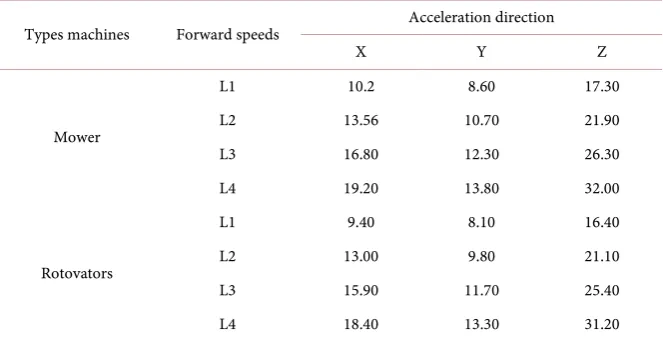
Table 5. Effect Speed (km/hr.), Types Machines and acceleration direction (m/sec2).
Types machines Forward speeds Acceleration direction
X Y Z
Mower
L1 10.2 8.60 17.30 L2 13.56 10.70 21.90 L3 16.80 12.30 26.30 L4 19.20 13.80 32.00
Rotovators
L1 9.40 8.10 16.40 L2 13.00 9.80 21.10 L3 15.90 11.70 25.40 L4 18.40 13.30 31.20
L3, L4) highest recorded total vibration were the results (21.84, 27.89, 33.54, 39.79) Hz respectively, while the interaction between the Rotovators and for-ward speed (L1, L2, L3, L4) less value recorded total vibration were the results (20.56, 26.65, 32.16, 38.58) Hz respectively. It is clear from this the Mower with the fourth speed record the highest value, while the Rotovators with the first speed record the less value.
As indicated in Table 5, the Mower with forward speeds (L1, L2, L3, L4) and acceleration direction (X, Y, Z) highest recorded vibration, while the Ro-tovators with forward speed (L1, L2, L3, L4) and acceleration direction (X, Y, Z) less value recorded vibration and also shows the Mower with the fourth (L4) forward speeds with acceleration direction (Z) highest recorded vibra-tion was the results (32.00) m/sec2, while the Rotovators with the first (L1) forward speeds with acceleration direction (Y) less value recorded vibration was the results (8.10) m/sec2.
4. Conclusions
• The velocity of the tractor had the strongest effect on the vibration
[image:9.595.207.539.266.436.2]DOI: 10.4236/eng.2019.111005 57 Engineering
• Hand-arm vibration intensity is greater in the vertical direction than the
lat-eral and longitudinal direction.
• Like these value acceleration (rms) effects on driver and caused discomfort,
will produce finger blanching, tired, and less performance and not complete-ly control operation to the tractor by driver, and also appear the type of ma-chine influence on the vibration.
Conflicts of Interest
The authors declare no conflicts of interest regarding the publication of this pa-per.
References
[1] Bovenzi, M. (1997) Hand Transmitted Vibration: Encyclopedia of Occupational Health and Safety. 4th Edition, International Labor Office, 1-50.
[2] Issever, H., Aksoy, C., Sabuncu, H. and Karan, A. (2003) Vibration and Its Effects on the Body. Medical Principles and Practice, 12, 34-38.
https://doi.org/10.1159/000068155
[3] ISO (2002) Agricultural Wheeled Tractors and Field Machinery Measurement of Whole-Body Vibration of the Operator. International Standardization Organiza-tion, ISO5008.
[4] Kacian, N. (1997) A Statistical Report on Occupational Diseases in Croatia. Work Safety 2.Journal Work and Safety, 2, 271.
[5] ISO (2001) Mechanical Vibration Measurement and Evaluation of Human Expo-sure to Hand-Transmitted Vibration Part 1: General Requirements. ISO, Geneva, ISO5349-1.
[6] Goglia, V. and Gospodaric, Z. (2002) Driver’s Exposure to Hand Transmitted Vi-bration from the Steering Wheel of the LPKT 40 Tractor. The 30th International Symposium on Agricultural Engineering, Opatija, 12-15 March 2002, 163-170. [7] HSE, Health and Safety Executive (2008) Health and Hazards from Whole-body
Vibration Caused by Mobile Agricultural Machinery. HSE Sheet No 20.
http://www.hse.gov.uk/index.htm
[8] Mohsen, F., Lorestani, A.N., Rabbani, H. and Javadikia, P. (2012) Measurement and Analysis of Vibration of Operator in Universal 650, Massey Ferguson 285 & MF 299 Tractors. International Journal of Mechanics and Applications, 2, 88-92.
https://doi.org/10.5923/j.mechanics.20120205.06
[9] Fabbri, A., Cevoli, C. and Cantalupo, G. (2017) A Method for Handlebars Ballast Calculation in Order to Reduce Vibrations Transmissibility in Walk behind Trac-tors. Journal of Agricultural Engineering, 48, 81-87.
https://doi.org/10.4081/jae.2017.599
[10] Vallone, M., Bono, F., Quendler, E., Febo, P. and Catania, P. (2016) Risk Exposure to Vibration and Noise in the Use of Agricultural Track-Laying Tractors. Annals of Agricultural and Environmental Medicine, 23, 591-597.
https://doi.org/10.5604/12321966.1226852
[11] Hamid Ahmed, A.A. (2013) Vibration Efficiency of Grass Mower. The Iraqi Journal of Agricultural Science,44, 540-552.
DOI: 10.4236/eng.2019.111005 58 Engineering Agriculture,39, 188-197.