EFFECT OF URBANIZATION ON SOME KEY ATMOSPHERIC PARAMETERS: A STUDY OVER
Abida Choudhury, B. and
Department of Physics, Assam University, Silchar, India
ARTICLE INFO ABSTRACT
Long-term behavior of atmosphere in terms of temperature, pressure, humidity, cloud cover, precipitation etc defines climate of a specific area. Urban areas are characterized by high density of human created structures viz., high buildings, roads etc and h
climate is greatly influenced by human activity. Due to human activity, the temperature of any urban area in general is higher than the surroundings and hence they behave as heat islands. The building materials are n
during day
factories and increased car use within the city causes pollution which pollution dome. This pollution dome allows short
wave terrestrial radiation, therefore increasing the amount of heat retained. These urban heat islands can have effect on pressure,
In this piece of work,
pattern over northeastern region of India during last two decades and tried to
with rapid urbanization in the region. It is observed that the rapid urbanization has led to substantial irregularities in precipitation pattern and cloud cover over the region.
Copyright © 2015 Abida Choudhury and Atri Deshamukhya
permits unrestricted use, distribution, and reproduction in any medium, provided the original work is properly cited.
INTRODUCTION
Industrialization, urbanization, transportation and deforestation are main anthropogenic activities that change the environment and influence climate (IRC 2002). Climate change refers to change in weather pattern, which is attributed directly or indirectly to human activity that alters the composition of the global atmosphere in addition to natural climate variability observed over comparable periods (Jeyalakshmi
The state of the environment with reference to the climate change can be observed from the condition of atmosphere and the hydrological system of the earth (Kumar
Climate includes essential climatic variables like the mean temperature, humidity, amount of precipitation etc (Shahmohamadi et al., 2012). In North Eastern India, the percentage of urban population has increased from 13.89 to 18.26 in the last two decades (Devi 2014)
increase in the figure. Because of topography the infrastructure facility available in this region is very poor and this along with the poor communication link with rest part of the country has
*Corresponding author: Atri Deshamukhya
Department of Physics, Assam University, Silchar, India
ISSN: 0975-833X
Article History:
Received 16th July, 2015
Received in revised form 20th August, 2015
Accepted 17th September, 2015
Published online 31st October,2015
Key words: Urbanization, Cloud cover, Precipitation, Deforestation and NDVI.
Citation:Abida Choudhury, B. and Atri Deshamukhya north east India”, International Journal of Current Research
RESEARCH ARTICLE
EFFECT OF URBANIZATION ON SOME KEY ATMOSPHERIC PARAMETERS: A STUDY OVER
NORTH EAST INDIA
Abida Choudhury, B. and
*Atri Deshamukhya
Department of Physics, Assam University, Silchar, India-788011
ABSTRACT
term behavior of atmosphere in terms of temperature, pressure, humidity, cloud cover, precipitation etc defines climate of a specific area. Urban areas are characterized by high density of human created structures viz., high buildings, roads etc and high concentration of population. Urban climate is greatly influenced by human activity. Due to human activity, the temperature of any urban area in general is higher than the surroundings and hence they behave as heat islands. The building materials are non-reflective, concrete road surfaces have high thermal capacity and hence absorb heat during day-time which is slowly released at night thereby increasing the temperature. Presence of factories and increased car use within the city causes pollution which
pollution dome. This pollution dome allows short-wave insolation to enter, but traps outgoing long wave terrestrial radiation, therefore increasing the amount of heat retained. These urban heat islands can have effect on pressure, humidity, cloud cover and hence precipitation over the region as a whole. In this piece of work, we have examined the trends in relative humidity, cloud cover and precipitation pattern over northeastern region of India during last two decades and tried to
with rapid urbanization in the region. It is observed that the rapid urbanization has led to substantial irregularities in precipitation pattern and cloud cover over the region.
Abida Choudhury and Atri Deshamukhya. This is an open access article distributed under the Creative Commons Att use, distribution, and reproduction in any medium, provided the original work is properly cited.
Industrialization, urbanization, transportation and deforestation are main anthropogenic activities that change the environment . Climate change refers to change in weather pattern, which is attributed directly or to human activity that alters the composition of the global atmosphere in addition to natural climate variability Jeyalakshmi et al., 2013). The state of the environment with reference to the climate d from the condition of atmosphere and Kumar et al., 2009). Climate includes essential climatic variables like the mean temperature, humidity, amount of precipitation etc
. In North Eastern India, the percentage of urban population has increased from 13.89 to
), which is a brisk increase in the figure. Because of topography the infrastructure this region is very poor and this along with the poor communication link with rest part of the country has
Department of Physics, Assam University, Silchar, India-788011.
restricted the rate of increase in urban population over this region compared to the other parts of this country. With this little increase in urbanization (compared to the rest of the country) and the resulting urban population has given an alarm call to the nature of the region reflected in the rapid decrease in the NDVI i.e. at the rate of which is at 99% of significance level. The increasing rate of temperature with the decrease in relative humidity and precipitation may lead to the formation of urban heat islands (Shahmohamadi
defined as an arena of stagnant warm air over the heavily built up areas of cities (Emmanuel 2005
Study region
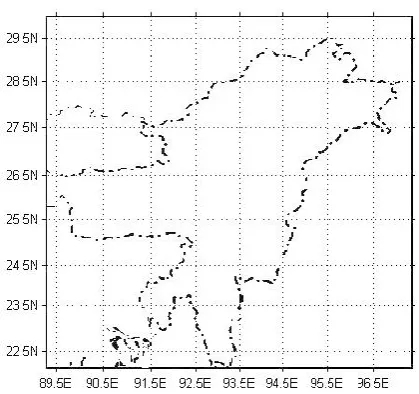
The region selected for the study is the Northeast (NE) region of India. The region stretches from 22
to 97˚E. This region of India comprises of the seven states viz. Arunachal Pradesh, Assam, Manipur, Meghalaya, Mizoram, Nagaland and Tripura.
International Journal of Current Research
Vol. 7, Issue, 10, pp.21704-21708, October, 2015
Atri Deshamukhya, 2015. “Effect of urbanization on some key atmospheric parameters: A study over
International Journal of Current Research, 7, (10), 21704-21708.
EFFECT OF URBANIZATION ON SOME KEY ATMOSPHERIC PARAMETERS: A STUDY OVER
788011
term behavior of atmosphere in terms of temperature, pressure, humidity, cloud cover, precipitation etc defines climate of a specific area. Urban areas are characterized by high density of igh concentration of population. Urban climate is greatly influenced by human activity. Due to human activity, the temperature of any urban area in general is higher than the surroundings and hence they behave as heat islands. The building reflective, concrete road surfaces have high thermal capacity and hence absorb heat time which is slowly released at night thereby increasing the temperature. Presence of factories and increased car use within the city causes pollution which creates smog and forms a wave insolation to enter, but traps outgoing long-wave terrestrial radiation, therefore increasing the amount of heat retained. These urban heat islands
humidity, cloud cover and hence precipitation over the region as a whole. we have examined the trends in relative humidity, cloud cover and precipitation pattern over northeastern region of India during last two decades and tried to see their correlation with rapid urbanization in the region. It is observed that the rapid urbanization has led to substantial irregularities in precipitation pattern and cloud cover over the region.
is an open access article distributed under the Creative Commons Attribution License, which
restricted the rate of increase in urban population over this region compared to the other parts of this country. With this little increase in urbanization (compared to the rest of the country) and the resulting urban population has given an alarm the nature of the region reflected in the rapid decrease in the NDVI i.e. at the rate of which is at 99% of significance level. The increasing rate of temperature with the decrease in relative humidity and precipitation may lead to the formation of Shahmohamadi et al., 2012) which is defined as an arena of stagnant warm air over the heavily
built-Emmanuel 2005).
The region selected for the study is the Northeast (NE) region stretches from 22˚N to 29.5˚N and 89.5˚E ˚E. This region of India comprises of the seven states viz. Arunachal Pradesh, Assam, Manipur, Meghalaya, Mizoram,
OF CURRENT RESEARCH
Figure 1. Study region- North Eastern states of India
MATERIALS AND METHODS
The data has been obtained from different sources for different parameters. Rainfall data has been collected for 1990-2007 from http://www.chikyu.ac.jp/precip/, This is the most widely used reliable data source for rainfall data but the datasets are not available after 2007. The maximum and minimum temperature data has been obtained from http://badc.nerc.ac.uk/ browse/badc/cru/data/cru_ts/cru_ts_3.21/data/ for the period 1990-2012. Daily temperature data at various stations has been obtained from the site http://data.giss.nasa.gov/gistemp/station_ data/. Total cloud cover and relative humidity data has been obtained from ERA interim's link, which is http://apps.ecmwf.int/datasets/. NDVI data has been obtained from http://jisao.washington.edu/data/ndvi/(1990-2000) and http://modis.gsfc.nasa.gov/data/ dataprod/dataproducts (2001-2012) having the same resolution of 1°×1° grid.
The trend of the parameters has been seen to get idea how the parameters have changed over the two decades in the study region.
Sen’s estimator of slope has been employed to estimate the magnitude of the trend. This method is widely used to determine the trend of hydro-meteorological parameters (Jain et al., 2012(a)). The statistical significance of the trend is determined by Mann-Kendall (MK) test of significance (Mann 1945, Kendall 1975).
RESULTS
The result obtained from the trend test for various parameters has been discussed in details with graphical representation in this section:
Trend Analysis for total cloud cover
Over the last two decades, the cloud cover has increased but not significantly. IF we consider some more years data(32 years) then we can find a significant trend. An important factor responsible for this increase may be urbanization. Due to the
[image:2.595.314.551.124.261.2]rapid increase in urbanization, the number of vehicles and factories have increased resulting in increase in aerosol content of the atmosphere. This offers more number of nuclei for condensation of water vapor which leads to more cloud formation and in turn to more total cloud cover over the region.
Figure 2. Annual trends of total cloud cover (TCC) from 1991-2011 over NE India
Trend Analysis of Air Temperature
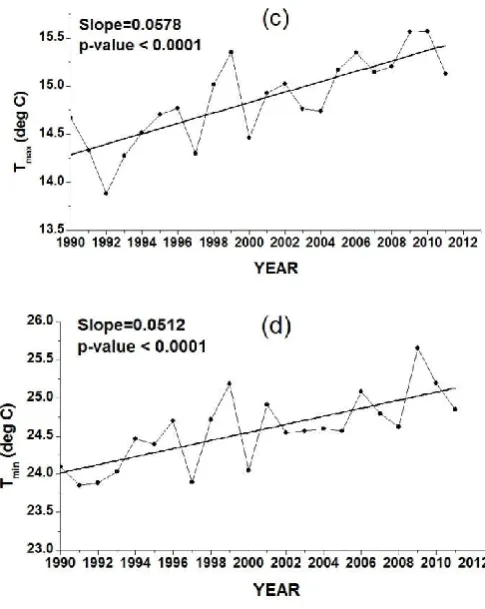
Figure 3. (a) Annual trends of Mean Temperature, (b) DTR, (c) maximum temperature (Tmax), (d) minimum temperature
(Tmin), from 1990-2011 over NE India
Trend Analysis for Relative Humidity
[image:3.595.40.283.56.361.2] [image:3.595.320.548.158.286.2]There is a decreasing trend in relative humidity (RH) over the NE region of India during the study period. It has decreased at an annual rate of 2.75% over the last two decades. This is expected from increasing trend observed for temperature. Figure 4 shows the trend of RH from 1990-2011 over NE India.
Figure 4. Annual trends of Relative Humidity (RH) from 1990-2011 over NE India
Trend Analysis for Precipitation
Over the study zone precipitation mainly implies rainfall. The average rainfall over the period shows no significant trend but the number of days having rainfall less than or equal to 5mm has increased whereas days with heavy rainfall (higher than 5mm) has decreased (not significant). The number of rainy days has decreased significantly over the last two decades.
Figure 5. Annual trends of Rainfall from 1990-2011 over NE India
Trend Analysis for forest cover
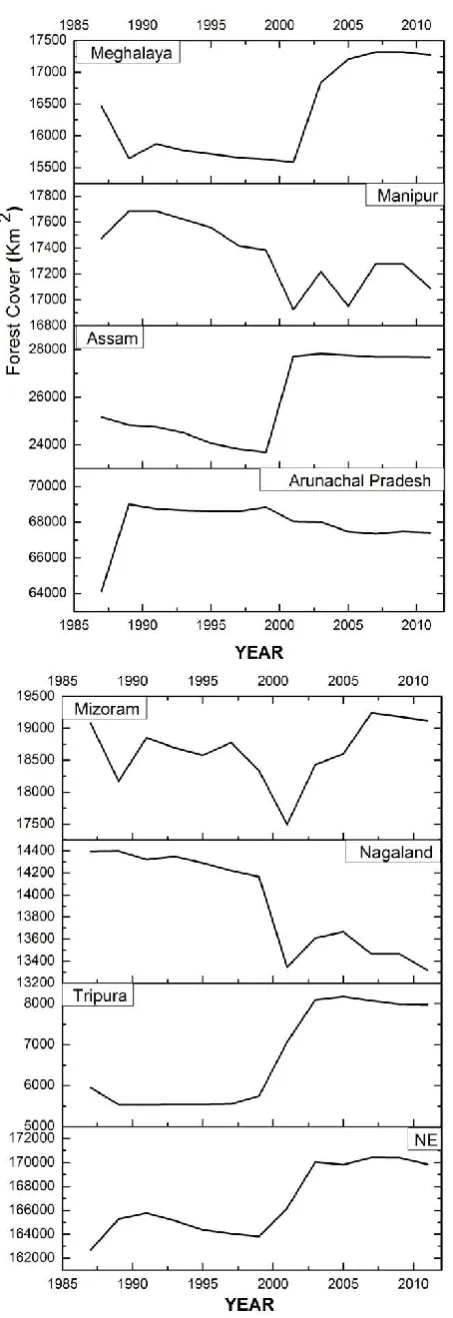
From the data available in "Statistics Related to Climate Change - India"(2013) by Ministry of Statistics and Programme Implementation Government of India, it has been found that the forest cover of the NE states of India was decreasing gradually from 1987 to 1999. After 2001 there is an increase in forest cover over Assam, Tripura and Meghalaya whereas over rest of the states decreasing trend (Figure 7) continues. The large increase observed over Assam during 1999-2001 is enough to bias the decreasing trend over whole NE region. Over this period there is a sudden increase of forest by 4000 km2 in Assam which looks a bit abnormal. If we include the NDVI data from AVHRR and MODIS for this region, we find on the contrary a significant decreasing trend (Figure 6). It has a slope of -0.0022 at 99% significance level. The rate of its decrease is 0.06/year. Many other authors like Panday et al. 2012 and Saikia 2009 have also obtained the negative slope for NDVI over NE region.
Figure 6. Annual trends of Normalized differential Vegetation Index (NDVI) from 1990-2011 over NE India
Table 1. Result displaying slope and p-values of the parameters under study
Parameter TCC DTR Rainfall Tmin Tmax T RH NDVI
Slope 0.0003 -0.0025 -8.3531 0.0578 0.0512 0.1623 -0.0883 -0.0022
p-value 0.7300 0.7810 0.4101 < 0.0001 < 0.0001 < 0.0001 0.0198 < 0.0001
[image:3.595.39.282.512.657.2] [image:3.595.320.550.548.675.2]The results of the statistical analysis for the different parameters are given in the Table 1.
[image:4.595.51.278.78.738.2]
Figure 7. Plot Showing Forest Cover (km2) over different NE states of India during 1987-2011
TCC-total cloud cover, DTR-diurnal temperature range, T-mean temperature, Tmin-minimum temperature, Tmax-maximum temperature, RH- Relative Humidity, NDVI- Normalized Differential Vegetation Index.
DISCUSSION
The changing weather is a major concern for the NE region of India because of its diverse natural heritage. The global warming and increase in urbanization over this region is degrading the stability of the environment. Though afforestation projects have been taken up by many nongovernmental and governmental organizations but the pace at which deforestation is taking place --- the replacements are not adequate. The negative trend of NDVI obtained in this present study supports the statement. These types of changes are bringing a lot of change in weather of this region. It may lead to extreme weather events in near future. The change (increase) in temperature and DTR has led to the increasing trend of cloud cover over the region. Rainfall anomaly over this region is very high (Rajeevan et al., 2009). Heavy precipitations cause flood in most areas of the region in most of the years. Assam floods during 1998 and 2012 were devastating ever. The recent (August 2015) flood in Manipur is one of the natural calamities that have affected life and property in a major way. Such type of event has not occurred in last three decades over Manipur. Unpredictable calamities, erratic atmospheric phenomena have become common in recent years.
The result of the trend analysis of some of the parameters obtained in this present study matches with already reported works. The study performed by Jain et al. 2012 (b) concluded that there is no significant trend of rainfall and increasing trend of temperature over northeast. As over the study region the temperature is increasing significantly we have checked the trends of related parameters e.g relative humidity shows a significant decreasing trend.
The increase in temperature may be one of the possible reasons for the decreasing trend of vegetation; the increase in temperature possibly is giving an unfavorable situation for the growth and production of the flora of this region. Zhou et al. (2004) in their study over China found a negative correlation between NDVI and Tmin with a good R-value of -0.67. In the
same study, negative correlation has been obtained between DTR and increase in percentage urban. Many other authors like Panday et al. 2012 and Saikia 2009 have also obtained the negative slope for NDVI over NE region. The parameters in this study are the key ingredients of the earth's atmosphere which governs the hydrological cycle; the affect on one will directly affect the other and vice versa.
Conclusion
Urbanization in North-east India is restricted to few pockets, and there is no obvious reason to believe that the recent weather change has direct correlation with urbanization.
-0.67. In the same study, negative correlation has been obtained between DTR and increase in percentage urban. Shahmohamadi et al (2010) reported that the lack of vegetation and increasing number of buildings and constructions has led to increase of temperature over those high-density urban areas. It was confirmed by Santamouris (2013) that weather conditions such as cloud cover, precipitation, etc are affected by the urban environment.
In the present study, we have also noticed similar changes over North –East –India, which indicate that it might have link with urbanization phenomena over the region.
Yet rigorous study with detailed investigation is required to confirm the cause. Ample scopes are there on this area of research.
Acknowledgements
The authors are thankful to all the data sources mentioned in the materials and methods subsection, for making the valuable data available at their websites.
REFERENCES
Emmanuel M.R. 2005. An Urban Approach to Climate-Sensitive Design; Strategies for the Tropics, London, Spon Press.
IRC 2002. Climate Change and the Indian Subcontinent: India Resource Center (IRC) Retrieved October 23, 2002 from http://www.rediffnews.com.
Jain S.K. and Kumar V. 2012. Trend analysis of rainfall and temperature data for India, Current Science, 102(1). Jain S.K., Kumar V. and Saharia M. 2012. Analysis of rainfall
and temperature trends in northeast India. International Journal of Climatology, 33(4), 968–978. DOI: 10.1002/ joc.3483
Jeyalakshmi S., Parameswaram V., Mathew J., Kaur A. and Panwar R.K. 2013. Statistics related to climate change- India, Ministry of statistics and programme implementation government of India, central statistical office, social statistics division New Delhi. www.mospi.gov.in, November 2013.
Kendall M. G. 1975. Rank correlation methods. Charles Griffin: London, UK. 4th ed.
Kh. B.D. 2012. A Study on urbanization in northeastern states of India. International Journal of Current Research,4(10), 272-276.
Kumar V. and Chopra A. K. 2009. Impact of climate change on biodiversity of India with special reference to Himalayan region-An overview, Journal of Applied and Natural Science, 1(1), 117-122.
Mann H.B., 1945. Nonparametric tests against trend. Econometrica, 13, 245–259.
Panday P. K. and Ghimire B. 2012. Time-series analysis of NDVI from AVHRR data over the Hindu Kush–Himalayan region for the period 1982–2006. International Journal of Remote Sensing, 33 (21), 6710–6721.
Rajeevan M., Gadgil S. and Bhate J. 2010. Active and break spells of the Indian Summer monsoon. Journal of Earth System Science, 119(3), 229-247.
Saikia A. 2009. NDVI Variability in North East India, Scottish Geophysical Journal,125(2), 195-213.
Shahmohamadi P., Che-Ani A.I., Abdullah N.A.G., Tahir M.M., Maulud K.N.A., Mohd-Nor M.F.I. 2010. The Link between Urbanization and Climatic Factors: A Concept on Formation of Urban Heat Island. WSEAS transactions on environment and development,6(11).
Zhou L., Dickinson R.E., Tian Y., Fang J., Li Q., Kaufmann R.K., Tucker C.J., Myneni R.B. 2004. Evidence for a significant urbanization effect on climate in China. Proceedings of National Academy of Sciences, 101 (26), 9540–9544. DOI: 10.107/pnas.0400357101.