Stochastic Orders Comparisons of Negative Binomial
Distribution with Negative Binomial—Lindley Distribution
Chookait Pudprommarat, Winai Bodhisuwan
Department of Statistics, Kasetsart University, Bangkok, Thailand Email: [email protected]
Received January 20, 2012; revised February 18, 2012; accepted March 4, 2012
ABSTRACT
The purpose of this study is to compare a negative binomial distribution with a negative binomial—Lindley by using stochastic orders. We characterize the comparisons in usual stochastic order, likelihood ratio order, convex order, ex-pectation order and uniformly more variable order based on theorem and some numerical example of comparisons be-tween negative binomial random variable and negative binomial—Lindley random variable.
Keywords: Stochastic Orders; Negative Binomial Distribution; Negative Binomial—Lindley Distribution
1. Introduction
The negative binomial (NB) distribution is a mixture of Poisson distribution by mixing the Poisson distribution and gamma distribution. The NB distribution is em-ployed as a functional form that relaxes the overdisper-sion (variance is greater than the mean) restriction of the Poisson distribution (see [1]). If X denote a random variable of NB distributed with parameter r and p then its probability mass function is in form
r xf x 1p 1 pr
x x
0 p 1
, x 0,1, 2, ,
for r 0 and , with E X r 1 p p
and
2
r 1 X
p
p
Var .
The negative binomial—Lindley (NB-L) distribution which is a mixed negative binomial distribution obtained by mixing the negative binomial distribution with a Lind- ley distribution. The NB-L distribution was introduced by Zamani and Ismail in [2] and it provides a model for count data of insurance claims. If Y is a NB-L random variable with parameter r and then its probability mass function is in form
2 y
j
r y 1 y
g y
1 2j 0
r j 1
y j r j
r 0
,
y 0,1, 2, , for and , with
3
r
1 1
2 r 1
E Y , when
, and
2 2 2 3
2 2
2 2 2 3
2
2 4
r r 1 2r r
Var Y
1 2 1 1
r 1 1
r ,
1 1
2
when
.
In this respect, the aim of this work is to compare a negative binomial distribution with negative binomial— Lindley distribution base on stochastic orders such as usual stochastic order, likelihood ratio order, convex or-der, expectation order and uniformly more variable order.
2. Stochastic Orders
Stochastic orders are useful in comparing random vari-ables measuring certain characteristics in many areas. Such areas include insurance, operations research, queu-ing theory, survival analysis and reliability theory (see [3]). The simplest comparison is through comparing the expected value of the two comparable random variables. The following, we will define some notions of the sto-chastic orders which will be used in the context of the paper. For more details, we refer to Ross [4], Misra [5], Shaked [6,7] and Singh [8].
Definition 1.Let X and Y be random variables with
densities f and g, respectively, such that g k f k
isnon-decreasing function in k over the union of the
sup-ports of X and Y, or, equivalently,
f u g v f v g u u v
lr
X Y
, for all . Then X is smaller
than Y in the likelihood ratio order which is denoted by
Definition 2. Let X and Y be two random variables
such that , for all . Then
X is smaller than Y in the usual stochastic order which is
denoted by .
Pr Y k
X Y
X k
Pr
k
E Y
st
Definition 3. Let X and Y be two random variables
such that , for every real valued
convex function
E X
where expectations are assumed to
be existed. Then X is smaller than Y in convex order
which is denoted by cx .
Definition 4. Let X and Y be two random variables
such that , where expectations are
as-sumed to be existed. Then X is smaller than Y in the
ex-pectation order which is denoted by .
X Y
X
YE E
X Y
E
Definition 5. Let X and Y be two random variables
with densities f and g, respectively. Recall that supp(X)
and supp(Y) denote the respective support of X and
re-spective support of Y, such that supp(X) supp(Y)
and the ratio f k g k
uv
X Y
is a unimodal function over
supp(Y). Then X is smaller than Y in uniformly more
variable order which is denoted by .
3. Comparison
We make comparisons between the negative binomial random variable and negative binomial—Lindley random variable with respect to the likelihood ratio order, sto-chastic order, convex order, expectation order and uni-form more variable order. The following lemma will be useful in proving the main results.
Lemma 1. Define,
k 1
j
j 0
k
j
j 0
k 1 1 j a k 1
k ( 1) j
2
2
r j 1 r j r j 1 r j
and
j 1 r
1
m m 1 m
k 0,1, 2, a k
k 0,1, 2,
2,
k
mk 0,1, 2,
k
k
j 0
j r j
,m
, 0 m 1 , Then,
1) is a non- increasing function of ,
2) For each fixed , is concave function of .
k 0,1,
m 0,1
Proof.
1) We may write for a k
, that
kd
E W d
h
k 1 r
0
k r
0
e 1 e h ;
a k 1
e 1 e h ;
,
where is the Lindley distribution defined by
2
z e
zh z; 1
1
and 0
, z 0
and Wk is a random variable havin proba ility
density function:
g the b
k rz z k k
1 e 1 e h z;
z 2
j
2 j 0
k r j 1
( 1)
j r j
, z 0 .
For fixed k
0,1, 2,
, the ratio k 1
x k
xis obviously a non-increasing function of x 0 . Then, by Definitions 1 and 2, we have Wklr Wk 1 , which yields Wkst Wk 1 and therefore E W
k E W
k 1
or, equivalently, a k
a k 1
. This proves a k
is a non-increasing function of k
0,12) For k 0
, 2, .
, note that
m m is both ex and concave. For k 1, 2, 0conv , we can write
j 1
j
r k
j k 1
j r 1
m 1 m 1 m , m, 0 m 1.
(1) The relationship between negative binomial and beta probabilities is of the form
j
1 p
r 1r k 1
j k
k r 1 ! r r 1
0
p 1 p t 1 t dt
j k
,1 ! r 1 !
k 0,1, 2, .
Therefore, k
m in Equation (1) can be written as
1 r
1 m 0
m 1
m
r 1 k
k
k r !
t 1 t dt k! r 1 !
,, 0 m 1
.
Thus,
k 1
1 1
2 1
r r
k
k r ! 1
m m 1 m 0
r r 1 !r!
2
m
,
m
, 0 m 1
.
which proves concavity. □
Theorem 1. Let X ~ NB r, p
, Y ~ NB-L r,
and
2
r 2 r p0 3
r 1
,
1
2 r
1 2
r 1 p
r
,
22 3
1 1
p
. Th 0 p 2p1p01
Furthermore, 1) X lr Y
en .
if and only if pp0,
2) Xst Y if and only if p p 1,
3) X E
E Y if and only if p
p2, of.he likel tw n Y and X can be written as
Pro
2 k k rk r j 1
,
X k p 1 p 1
k 0,1, 2, .
(2)
By Definition 1, we have
j 2 j 0 1 jPr Y k r j
l k Pr
lr k 1 j j 0 k j j 0 0X Y l k l k+1 , ,
2
2
0,1, 2, ,
1 r j 1
1
r j
p 1 ,
k r j 1
1
j r j
p a k , , 0,1, 2, , p p a 0 .
k k k k
Since
k+ j
a k is non-increasing in k (by part 1) in e , then 0
L mma 1) p p which provides a necessary and conditio for the
sufficient n l k
in Equation (2) to be ob
n n-decreasing. This completes the proof of the result. 2) Let Xst Y y Definition 2, we have
2 r 2 r 1Pr Y 0 Pr X 0 p ,
r 1 2 r 1 2 r 1
p p . r
Conversely, suppose that 0 p 1 p 1.
k 0
For ,1, 2,, consider
k i r i 0 2 k i j 2 i 0 j 0i r 1
k p 1 p
r j 1 i r 1 i
1 ,
i j 1 r j
X ~ X ~ NB r, p
1
, then1 Xst X1.
q
k i 1 1 1p k Pr X k Pr Y i
and if
lr
X X
Conse
NB r, p and nce, we get
ly, . He uent
k i r ri 0 i 0
i r 1 i r
p 1 p p 1 p
i i
k k ,
p p .
For fixed
and therefore
1
k 0,1, 2, ,
1 2 r 2 r 1 r , 1 p
p exp and ~ Lindley
. We get
1 kk
pr ip 1 1
i 0
k i j
2 i 0 j 0
1 p i
r j 1 i r 1 i
1 ,
i j 1 r j
1 i 1 kr r r p i 0 k i r i 0
i r 1
k E P 1 E P
i i r 1
E P 1 P , i
Using concave function (by part 2) in Lemma 1),
1
p k
can be written as
1
r r
p k k E P E k P
.
Applying Jensen’s inequality to concave function, we have
E P
r
E
Pr
and
k 0 for2
i r 1
k k p1
k
, k
0,1, 2,
. Conversely, where Xst Yat
im-plies th Pr Y 0
Pr
X 0
. This proves p p 1.3) The proofs of the results are obvious. □ Theorem 2. Suppose that, for every 0 t 1 ,
t p 1
Pr 0, then
1) No value of 0 p 1 can ensure that Xst Y,
2) XuvY if and only if 0 p p 11.
Proof.
1) We find
Pr X k
0,1,
R k
Pr Y k
, k , b
tor and
2, y re-
fr d owing:
ying the numera enominator as foll
j r j k 1 p r 1k 1 r 1
0 r
k 1 p ,
j k r 1 !
t 1 t dt, k 1 ! r 1 !
1 p 1 t dt, k 1 ! r 1 !
1 p 1 p k r 1 !
.
k 1 ! r 1 ! r 1 p
k
For any 0 p p1 1
k 1
0
1 p
k r 1 !
j r 1 p
Pr X
, k 0,1, 2, ,
2 i j 2 i k j 0i r 0 i r i k 0 1 e r 1 k 1 0
r j 1 r i 1 i
Pr Y k 1 ,
i j r j
r i 1
e 1 e h ; d ,
i r i 1
e 1 e h ; d ,
i
k r 1 !
t 1 t dt
k 1 ! r 1 !
i k
0 1 log 1 t 1 r 1 k 1 0 0 1 r 1 k 1 0h ; d ,
k r 1 !
t 1 t h ; d dt,
k 1 ! r 1 !
k r 1 ! 1
t 1 t H log ; dt,
k 1 ! r 1 ! 1 t
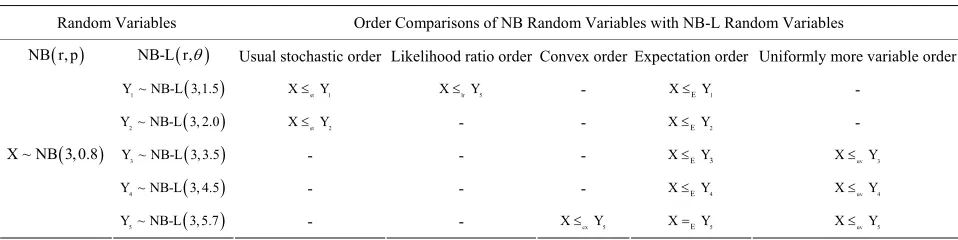
Table 1. Stochastic orders comparisons of NB random variables with NB-L random variables.
Random Variables Order Comparisons of NB Random Variables with NB-L Random Variables
NB r, p NB-L r, Usual stochastic order Likelihood ratio order Convex order Expectation order Uniformly more variable order
B-L 3,1.5
1
Y ~ N st XlrY5 XEY1 -
2
Y ~ N XstY2 XEY2 -
3
Y ~ NB-L 3, 3.5 - - - XEY3 XuvY3
4
Y ~ NB-L 3, 4.5 - - - XEY XuvY4
5
Y ~ NB-L 3, 5.7 XEY XuvY5
1
X Y -
B-L 3, 2.0 - -
4
X ~ NB 3,0.8
- - XcxY5 5
where H
is cumulative distribution function of Lindley distribution:
1 ze z1 H z; 1
, z 0 and 0
.
1
1 p
r 1 1
k r 1
1 1
k r 1 !
Pr Y k H dt,
1 ! H p ; p
1
k
t
1 1
0 k 1 ! r 1 !
p ; p
r k 1 ! r
1
1 p .
k
! k
So,
k
r 1
1 1
p 1 p
R k
1 p r 1 p p H p ;
.
r
1
k 1
Since
k r
1 1
k 1 p 1 p
lim 0
1 p r 1 p p H ;
, we have
then
r 1 k
1
p
klim R k 0, p1 p 1.
lidates the result. ose that The part 2) in
2, it is clear that ran-dom d Y are not ordered by the usual sto-chast from the arguments used in the proof of pa 1, since 0
Ther t follows that, for any 0 p 1 , there ex-ists a sufficiently large k such that
Pr X k Pr Y k efore, i
. This va1
0 p p
rt 1) in Theorem 2) Supp
Theorem
1. n, from 1 and pa
variables X an ic order. Also,
rt 1) in Theorem p p it follows that
Pr s non-increasing and unimodal, hat . The converse part follows by
mi nts. □
hat 2
X k Pr Y k i
uv
X Y
lar argume Suppose t implying t
using the si
Theorem 3. p p . Then,
uv
2) Xcx Y
ows from part 2) in Theorem 2, we ha , where 1
1) X Y
.
Proof.
1) Foll ve
uv
X Y p2p .
uv
X Y and 2) Since
3 2
r 1 r
E Y r X
p
1 1
,
p E
by ed in [4], X
with negative binomial—Lindley random variable in usual stochastic order, likelihood ratio order, convex or-der, expectation order and uniformly more variable order and the results are provided in Table 1.
Then, we explain that negative binomial random vari-able (X) is smaller than negative binomial—Lindley ran-order implies that X Y
dom variable (Y) in the usual stochastic
E . In addition, if X and Y have respective
supp(X) supports supp(X) and supp(Y), such that
supp(Y) and the ratio Pr X
k Pr Y k
is a uni-modal fun tion over supp but X and Y e not or-dered in t usual stochast order. Furtherm re, if X and Y have a same mean. Then XuvY impl thatcx
X Y
c he
(Y) ic
ar o ies
.
4. Conclusion
This paper sh ws stochast orders compariso f nega-tive binomial random variable with a neganega-tive binomial—
, ex d
uniformly more variab compari
inomial—Lindley random
va negati ial random
va le (X) is smaller than negative binomial—Lindley ra m variab (Y) in the usual stochastic order. Its us is that it gives a simple sufficient condition for
X xt, if
supp(X) (Y) is t t it implies that the ratio
o ic n o
Lindley random variable by usual stochastic order, like-lihood ratio order, convex order pectation order an
le order. Some advantages of sto-chastic orders son between negative binomial random variable and negative b
riable are as follows: If ve binom riab
ndo le
efulness
is smaller than Y in the expectation order. Ne supp ha
the result of Shak cx Y.
Next, We shows some numerical examples of the comparisons between negative binomial random variable
Pr X k Pr Y k nimodal function over supp(Y) but X and Y are not ordered in the usual stochastic r. Finally, If X and Y have a same mean, it is known X is smaller than Y in uniformly more variable order im-n coim-nve rder. This con-cl
R
is a u
orde that
plies that X is smaller than Y i x o usion is supported by numerical examples.
5. Acknowledgements
We are grateful to the Commission on Higher Education, Ministry of Education, Thailand, for funding support under the Strategic Scholarships Fellowships Frontier
[image:4.595.58.285.258.441.2]REFERENCES
[1] W. Rainer, “Econometric Analysis of Count Data,” 3rd Edition, Springer-Verlag, Berlin, 2000.
[2] H. Zamani and N. Isma al—Lindley Distribution and Its Application,” Journal of Mathematics and Statistics, Vol. 6, No. 1, 2010, pp. 4-9.
il, “Negative Binomi
doi:10.3844/jmssp.2010.4.9
[3] M. Shaked and J. G. Shanthikumar, “Stochastic Ord Academic Press, New York, 2006.
Stochastic Processes,” Wiley, New York, ers,”
[4] S. M. Ross, “ 1983.
[5] N. Misra, H. Singh and E. J. Harner, “Stochastic Com-parisons of Poisson and Binomial Random Variables with Their Mixtures,” Statistics and Probability Letters, Vol.
65, No. 4, 2003, pp. 279-290. doi:10.1016/j.spl.2003.07.002
[6] M. Shaked, “On Mixtures from Exponential Families,” Journal of the Roy
No. 2, 1980, pp. 192-198. al Statistical Society: Series B, Vol. 42,
[7] M. Shaked an “Stochastic Orders
and Their Ap Press, New York,
fe Distributions,” d J. G. Shanthikumar,
plications,” Academic 1994.
[8] H. Singh, “On Partial Orderings of Li
Naval Research Logistics, Vol. 36, No. 1, 1989, pp. 103- 110.