3-T Imaging of the Cochlear Nerve and
Labyrinth in Cochlear-Implant Candidates: 3D
Fast Recovery Fast Spin-Echo versus 3D
Constructive Interference in the Steady State
Techniques
John I. Lane, Heidi Ward, Robert J. Witte, Matt A. Bernstein, and Colin L. W. Driscoll
BACKGROUND AND PURPOSE:High-resolution imaging of the internal auditory canal and labyrinth at 1.5 T is often performed by using three-dimensional (3D) fast spin-echo or T2* techniques. We evaluated both techniques at 3 T in the preoperative assessment of patients being considered for cochlear implants.
METHODS:Sagittal 3D fast recovery fast spin-echo (FRFSE) and 3D constructive interfer-ence in the steady state (CISS) images were acquired in eight patients at 3.0 T by using dual surface coils. Contrast-to-noise ratios (CNRs) for the intracanalicular nerve and CSF were measured in the internal auditory canal. Two neuroradiologists reviewed the images to deter-mine whether the techniques provided images of diagnostic quality.
RESULTS:CNRs for 3D CISS were twice those obtained with 3D FRFSE. Both techniques provided images of diagnostic quality, though spurious signal intensity loss at the apex of the superior semicircular canals was encountered on 3D FRFSE images in four of eight patients.
CONCLUSION:Both 3D FRFSE and 3D CISS provide high-resolution images of the internal auditory canal and labyrinth at 3.0 T. We predict that the superior CNRs obtained with 3D CISS will prove advantageous as we move to smaller fields of view at higher field strength.
Imaging plays a crucial role in the selection of candi-dates for cochlear implants to treat profound senso-rineural hearing loss. High-resolution sequences us-ing three-dimensional (3D) fast spin-echo and 3D gradient-echo techniques have been recently advo-cated for this type of application at 1.5 T (1–3). Two techniques we currently perform at 3.0 T to image the cochlear nerves and membranous labyrinth are 3D fast recovery fast spin-echo (FRFSE) and 3D con-structive interference in the steady state (CISS), which is also referred to as fast imaging employing steady-state acquisition with phase cycling (FIESTA-C). We undertook this study to evaluate the strengths and weaknesses of both techniques.
Methods
All studies were performed on a clinical 3.0-T machine (GE Medical Systems, Milwaukee, WI) by using a hybrid
phased-array coil to optimize both resolution and the signal intensity– to-noise ratio (SNR) (4). We examined eight cochlear implant candidates utilizing both techniques in the oblique sagittal plane, perpendicular to the long axis of the cochlear nerve. Efforts were made to standardize imaging parameters between the two techniques (eg, imaging time), but image quality and acceptance ultimately determined the imaging protocol. The inherently lower SNR of the 3D FRFSE technique prohibited imaging at fields of view (FOVs) smaller than 12 cm. 3D FRFSE was performed with the following parameters: 12-cm FOV, TR/TE/NEX of 2000/300/1, 32 sections of 1-mm thick-ness, 256 ⫻ 256 matrix, bandwidth of⫾32 kHz, echo train length of 64, and an acquisition time of 4 minutes 23 seconds. FRFSE differs from standard fast spin-echo by the addition of a⫺90° pulse at the end of the echo train. The purpose of this pulse is to return transverse magnetization with a long T1 and a long T2, such as that of CSF, to the longitudinal axis. This in turn allows heavily T2-weighted images to be acquired with a shorter TR (eg, 2000 msec instead of 5000 msec) (5).
3D CISS was performed with these parameters: 10-cm FOV, TR/TE of 8/4, 32 sections of 1-mm thickness, 256⫻256 matrix, flip angle of 45°, bandwidth of⫾32 kHz, two phase cycles, and an acquisition time of 2 minutes 24 seconds. Phase-cycling involved two 3D steady-state datasets acquired sequentially, each with a specific radiofrequency phase shift added at every TR. This tech-nique provided a means to reduce or eliminate banding artifact caused by susceptibility variation. Both acquisition techniques used zero-filled reconstruction in all three directions.
Received July 11, 2003; accepted after revision September 10. From the Departments of Radiology (J.I.L., H.W., R.W., M.A.B.) and Otolaryngology (C.D.), Mayo Clinic, Rochester, MN. Address reprint requests to John I. Lane, MD, Department of Radiology, Mayo Clinic, 200 First St. SW, Rochester, MN 55905.
©American Society of Neuroradiology
Two neuroradiologists (J.I.L., R.J.W.) reviewed the studies. Contrast-to-noise ratios (CNRs) between nerve and CSF were calculated in the internal auditory canal (IAC) by using both acquisition techniques. CNR was calculated by using mean signal measurements within regions of interest (ROI) drawn around the facial nerve (SFN), CSF in the IAC (SCSF), and
background signal in the temporal bone (SBG). CNR was
de-fined as (SCSF⫺SFN)/SBG. Facial nerve ROIs were used to
avoid issues of cochlear-nerve atrophy in these profoundly deaf patients. Ratios of CNRs between protocols were calculated for each IAC to account for signal changes arising from ana-tomic differences and surface coil placement. Hypothesis test-ing was performed to evaluate the null hypothesis that the CNR of the two protocols were equal, or equivalently, to determine whether the mean ratio of CNR between protocols was equal to 1. Data were tested for normality, and a pairedt
test was performed.
Images were reviewed for definition of all four intracanal-icular nerves (facial, cochlear, superior, and inferior vestibu-lar), the modiolus and scalar lamina of the cochlea, all three semicircular canals, and the presence of an endolymphatic duct and for visualization of the seventh cranial nerve within the facial nerve canal (FNC).
Results
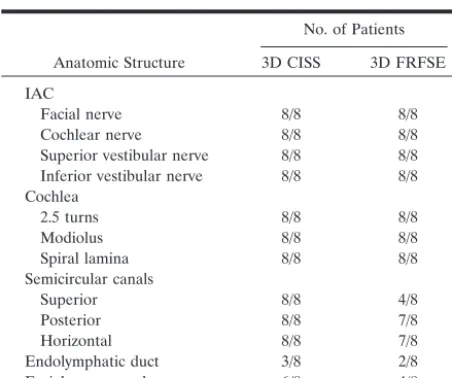
In all patients, 3D CISS resulted a CNR more than twice that of 3D FRFSE in the IAC (Table 1). The subjective evaluation of the structures within the IAC and membranous labyrinth are shown in Table 2. Nerve discrimination was satisfactory with both tech-niques (Fig 1), but the increased signal intensity in the IAC on 3D CISS images provided better nerve defi-nition, particularly in patients with smaller IACs (Fig
2). The spiral lamina and modiolus were adequately visualized with both techniques (Fig 3). Loss of fluid signal intensity in the labyrinth, particularly in the semicircular canals, was encountered on 3D FRFSE images in one-half of the cases (Fig 4). Visualization of the FNC and endolymphatic duct was limited with both techniques (Figs 5, 6). Banding artifact inherent to the 3D CISS technique was partially corrected by using two phase cycles postprocessed as MIPs (Fig 7). Any motion during the two acquisitions caused signifi-cant misregistration artifact on MIP images (Fig 8).
Discussion
The increased CNR and improved resolution avail-able on clinical 3-T units provides us the opportunity to advance high-resolution imaging of the cranial nerves. T2 and T2* 3D sequences have been advo-cated as techniques best suited for demonstration of the seventh and eighth nerves (2, 6). Although these techniques have been compared at 1.5T, to our knowledge this is the first comparison at 3 T. Each sequence was optimized by using phantoms and vol-unteers before the clinical study was performed.
We considered both techniques equally capable of producing diagnostically acceptable images of the IACs and intracanalicular nerves (Fig 1). However, CNRs were superior with the 3D CISS technique. This difference was most notable when we imaged patients with small IACs (Fig 2). The relative paucity of CSF signal intensity in the small IACs with the 3D FRFSE technique made it difficult to define the mar-gins of the cochlear nerve. The nerve was better depicted by using the 3D CISS technique because of its improved CNR.
The labyrinthine structures were better depicted by using the 3D CISS technique. Although both tech-niques resolved the spiral lamina and modiolus, edge definition was sharper with CISS (Fig 3). The loss of signal intensity in the SSC in four of eight patients with the FRFSE technique could potentially lead to misinterpretation as an anatomic anomaly (Fig 4). We directly attributed this result to the decreased CNR of the FRFSE sequence. We cannot adequately explain why this was noted more often in the SSC than in the lateral and posterior canals. Visualization of the endolymphatic duct was inconsistent both tech-niques (Fig 6, Table 1) and probably related to the small size of the duct in the healthy patient. The 3D CISS technique more reliably depicted the FNC (Fig 5, Table 1) than did 3D FRFSE; this difference was most likely related to its increased CNR.
[image:2.603.55.533.71.114.2]We attempted to keep imaging time in the range of 4 minutes to reduce patient motion artifacts. This time constraint required an echo train length of 64 for
TABLE 1: Contrast-to-Noise Ratios
Technique Facial Nerve IAC CSF Background CNR
3D CISS 96 (51.3–130.7) 475.0 (313.1–843.8) 47.2 (37.1–60.0) 7.9 (0.70–11.9) 3D FRFSE 117.8 (65.6–315.7) 269.0 (126.9–603.0) 44.6 (31.3–73.3) 3.3 (2.0–5.4)
Note.—Data are the mean (range). The ratio of CNRs for 3D CISS to 3D FRFSE was 2.5 (2.2–3.5).
TABLE 2: Subjective evaluation of the structures in the IAC and membranous labyrinth
Anatomic Structure
No. of Patients
3D CISS 3D FRFSE IAC
Facial nerve 8/8 8/8
Cochlear nerve 8/8 8/8
Superior vestibular nerve 8/8 8/8 Inferior vestibular nerve 8/8 8/8 Cochlea
2.5 turns 8/8 8/8
Modiolus 8/8 8/8
Spiral lamina 8/8 8/8
Semicircular canals
Superior 8/8 4/8
Posterior 8/8 7/8
Horizontal 8/8 7/8
Endolymphatic duct 3/8 2/8
Facial nerve canal 6/8 4/8
[image:2.603.55.281.161.350.2]FIG 2. Comparison of a small IAC on oblique sagittal images.
A,3D CISS image demonstrates sat-isfactory nerve definition within the IAC despite the small caliber of the bony ca-nal. Note CSF surrounding the cochlear nerve (arrow).
B,3D FRFSE image shows relatively low CSF signal intensity and high back-ground noise. Note the loss of CSF sig-nal intensity around the cochlear nerve (arrow).
FIG 3. Comparison of the spiral lamina and the modiolus of the cochlea on oblique sagittal images..
AandB,3D CISS (A) and 3D FRFSE (B) images demonstrate a linear focus of decreased signal intensity that repre-sents the spiral lamina (arrow).
CandD,3D CISS (C) and 3D FRFSE (D) images demonstrate the modiolus (arrow).
FIG 1. Comparison of the IAC on
oblique sagittal images.
A, Two-phase– cycled, 3D CISS re-constructed image oriented perpendicu-lar to the long axis of the cochlear nerve demonstrates excellent signal intensity in the IAC good definition of all four nerves.
FIG 4. Comparison of the semicircular canal and its apex (arrow) on oblique sagittal images.
A,3D CISS reformatted in the plane of the superior semicircular canal (SSC) demonstrates excellent definition of fluid in the apex.
B,Volume-rendered maximum inten-sity projection (MIP) ofA shows intact fluid rings in all semicircular canals.
C,3D FRFSE image also reformatted in the plane of the SCC demonstrates signal intensity loss at the apex.
D,Volume-rendered MIP ofDalso de-picts this finding.
FIG 5. Comparison of the FNC (arrow) on oblique sagittal images.
A,3D CISS image adequately displays the normal course of the FNC.
B, Corresponding 3D FRFSE image shows considerably less signal intensity.
FIG6. Comparison of the endolym-phatic duct on oblique sagittal images.
A,3D CISS demonstrates modest sig-nal intensity in the normal small en-dolymphatic duct in the vestibular aque-duct, which is seen just medial to the common crus of the superior and poste-rior SSCs (arrow).
the FRFSE technique. Therefore, we had to accept some image blurring, a limitation inherent to fast spin-echo techniques that results from the long echo trains needed to achieve heavily T2-weighted images in as short a time as possible. Image blurring can be minimized by reducing the echo train length at the expense of increasing imaging time.
Banding artifact was problematic with the CISS technique and partially compensated for by MIP pro-cessing of the two phase cycles (Fig 7). In general, banding is more problematic at 3.0 T than 1.5 T because susceptibility changes linearly with field strength. Increasing the number of phase cycles from 2 to 4 reduces banding artifacts at the expense of doubling the imaging time. We are currently working on a nonlinear averaging technique that promises to be more effective in removing banding artifact
Motion artifact was problematic with both tech-niques. It was particularly troublesome when any mo-tion occurred between acquisimo-tions of the two phase cycles of the CISS sequence (Fig 8). Preliminary re-sults with motion correction algorithms show promise
in addressing this issue. We noted no problems with susceptibility artifact on the 3D CISS images, an ob-servation also made by Schmalbrock (2) in a compar-ison of 3D FRFSE with 3D gradient-echo acquisitions at 1.5 T. Schmalbrock also noted more loss of fluid signal intensity in the cerebellopontine cisterns sec-ondary to CSF pulsation on FRFSE images, a finding that was also evident in our series. This could be an issue in evaluating the integrity of the cisternal seg-ments of the cranial nerves.
Conclusion
Both techniques provide reliable definition of the pertinent anatomy in the clinical setting of an evalu-ation for a cochlear implant. Improved CNR in the IAC with 3D CISS may lead to more accurate assess-ment of nerve integrity. Further refineassess-ment of the 3D CISS technique will need to address problems related to banding artifact and motion sensitivity. Although 3D FRFSE remains useful in the imaging of candi-dates for cochlear implants, its relatively low CNR will limit its utility compared with 3D CISS as we move toward higher resolution at smaller FOV.
References
1. Casselman JW, Kuhweide R, Deimling M, Ampe W, Dehaene I, Meeus L.Constructive interference in the steady state-3DFT MR imaging of the inner ear and cerebellopontine angle.AJNR Am J Neuroradiol1993;14(1):47–57
2. Schmalbrock P.Comparison of three-dimensional fast spin echo and gradient echo sequences for high-resolution temporal bone imaging.J Magn Reson Imaging2000;12(6):814–825
3. Lo W.Imaging of cochlear and auditory brain stem implantation.
AJNR Am J Neuroradiol1998;19(6):1147–1154
4. Kocharian A, Lane J, Bernstein M, et al.Hybrid phased array for improved internal auditory canal imaging at 3.0-T MR.J Magn Reson Imaging2002;16:300–304
5. Naganawa S, Koshikawa T, Fukatsu H, et al.Fast recovery 3D fast spin echo MR imaging of the inner ear at 3T.AJNR Am J Neuro-radiol2002;23:299–302
6. Stone JA, Chakeres DW, Schmalbrock P.High-Resolution MR imaging of the auditory pathway.Magn Reson Imaging Clin N Am 1998;6(1):195–217
FIG7. 3D CISS banding artifact.
A,Oblique sagittal source image from two-phase– cycled 3D CISS demon-strates marked banding artifact through the SSC and vestibule (arrow).
B, Postprocessed MIP image at the same level demonstrates subtle irregu-larity of the contour of the SCC, which represents incomplete averaging of the banding artifact (arrow).