Interference in the Steady State Three-dimensional MR
Stephen L. Stuckey, Allan J. Harris, and Suzanne M. Mannolini
PURPOSE: To compare constructive interference in the steady state (CISS) three-dimensional
Fourier transform (3DFT) MR imaging with contrast-enhanced T1-weighted spin-echo MR imaging for accuracy in detecting acoustic schwannoma. METHODS: One hundred twenty-five consecutive patients with possible acoustic schwannoma were examined. The accuracy of CISS-3DFT MR imaging in detecting abnormalities of the cerebellopontine angle, the internal auditory canal, and the inner ear was compared with T1-weighted contrast-enhanced spin-echo MR imaging by independent assessment of both image sets by two observers. RESULTS: The postcontrast T1-weighted MR images revealed 18 cases of unilateral disease of the cerebellopontine angle and/or the internal auditory canal and no case of an abnormal bilateral cerebellopontine angle and/or internal auditory canal. Twelve cases were pathologically proved acoustic schwannomas. One meningioma of the cerebellopontine angle and one metastatic ependymoma to the cerebellopon-tine angle and the internal auditory canal was encountered. The four remaining cases had a provisional diagnosis of acoustic schwannoma and were scheduled for follow-up imaging and clinical review. Analysis of whether contrast material would have been administered to the appro-priate patients (ie, those with disease of the cerebellopontine angle and/or internal auditory canal) according to CISS MR imaging findings revealed a sensitivity of 100% and a specificity of 98% for observer 1 and a sensitivity of 94% and a specificity of 94% for observer 2. CONCLUSION: CISS-3DFT MR imaging, in this patient population, provided high sensitivity and specificity in detecting lesions of the cerebellopontine angle and internal auditory canal; however, further experience is required before a definitive statement regarding the suitability of this technique as a screening procedure can be made. When contrast material cannot be administered, CISS MR imaging may be considered an adequate examination for the evaluation of possible acoustic schwannoma.
Index terms: Magnetic resonance, comparative studies; Neuroma; Temporal bone, magnetic
resonance
AJNR Am J Neuroradiol17:1219 –1225, August 1996
Contrast-enhanced T1-weighted spin-echo magnetic resonance (MR) imaging has rapidly become the accepted standard of reference for the evaluation of acoustic schwannoma. How-ever, of every 100 patients referred to a major otorhinolaryngology outpatient clinic who have clinical features attributable to a lesion of the
cerebellopontine angle, internal auditory canal, or inner ear, possibly only one may have an acoustic schwannoma (1). Referring clinicians continue to use nonimaging screening investi-gations, such as auditory brain stem evoked responses, to a variable degree. The frequency of positive MR studies, in which clinical circum-stances suggest an acoustic schwannoma, is quite low despite the availability of these inves-tigations. In our current selected series, we found 14 cases of disease of the cerebellopon-tine angle, internal auditory canal, or inner ear per 100 MR imaging examinations performed with contrast enhancement. The imaging time and cost of examining these patients could be dramatically reduced if an acceptable MR
Received December 5, 1995; accepted after revision March 5, 1996. From the Department of Medical Imaging, St Vincent’s Public Hospital, Fitzroy (S.L.S., A.J.H., S.M.M.), and the Department of Nuclear Medicine, Repatriation General Hospital, Heidelberg (S.L.S.), Australia.
Address reprint requests to Dr Stephen L. Stuckey, Department of Medical Imaging, St Vincent’s Public Hospital, Fitzroy, 3065, Australia.
AJNR 17:1219–1225, Aug 1996 0195-6108/96/1707–1219
qAmerican Society of Neuroradiology
screening sequence of the peripheral vestibulo-cochlear pathway was available to complement the T2-weighted whole-brain survey, which ex-amines the central vestibulocochlear pathways. If a satisfactory screening sequence was avail-able, contrast-enhanced images would be re-quired only when this sequence was subopti-mal, equivocal, or positive, or when an abnormal finding on the T2-weighted sequence required further evaluation. The same MR se-quence could be considered an acceptable ex-amination in patients with a possible acoustic schwannoma who are unable to receive intra-venous contrast material. The replacement of nonimaging screening investigations by such an MR sequence would be justified because of the improved cost effectiveness relative to the standard of reference.
Superb detail of the cerebellopontine angle, internal auditory canal, and inner ear may be obtained with some of the newer MR imaging sequences. In particular, constructive interfer-ence in the steady state (CISS) MR imaging has been shown to be capable of displaying both the normal and abnormal cerebellopontine angle, internal auditory canal, and inner ear (2). The CISS MR imaging technique, as used in this study, produces excellent resolution and en-compasses both inner ears in a minimal amount of time by using the standard circular polarized head coil (2).
This study was designed to compare the ac-curacy of CISS MR imaging with the standard of reference, contrast-enhanced T1-weighted spin-echo imaging, for the detection of lesions in the cerebellopontine angle, internal auditory canal, and inner ear. The suitability of CISS MR imaging for identifying the patients most likely to benefit from contrast-enhanced MR imaging would thereby be assessed.
Subjects and Methods
One hundred twenty-five consecutive patients (63 women, 62 men; age range, 19 to 80 years; mean age, 50 years) with clinical features necessitating full evaluation of the cerebellopontine angle, internal auditory canal, and inner ear were studied. Enrolled patients were examined by CISS three-dimensional Fourier transform (3DFT) MR imaging and contrast-enhanced T1-weighted spin-echo imaging. The CISS images and the contrast-enhanced T1-weighted spin-echo images were assessed independently by two experienced radiologists. The CISS images were evaluated first, without knowledge of the clinical data or of the findings on the contrast-enhanced T1-weighted
im-ages. Each sequence was evaluated for diagnostic quality (eg, presence of movement artifacts, excessive cerebro-spinal fluid flow artifacts extending into the cerebellopon-tine angle) on a subjective scale according to whether nerves were sufficiently visible to allow confident exclusion of a lesion. The observer graded each sequence as either optimal or suboptimal, and, if suboptimal, whether it was still acceptable for diagnostic purposes. Each side of the sequence was then assessed for abnormalities and judged normal, indeterminate, or clearly abnormal, with indeter-minate and abnormal ratings falling into the positive group, which would require contrast-enhanced imaging. Each abnormality was described in terms of the lesion’s size, location, extensions, and signal intensity; and each interpretation was rated in terms of the confidence with which the diagnosis of an abnormality was made (subjec-tive scale of low, moderate, or high). The side was consid-ered to be free of disease if the seventh and eighth cranial nerves were seen clearly through their course to be of normal size and no mass lesion was discernible. The re-sults were compared with surgical findings or with fol-low-up contrast-enhanced T1-weighted images in the pos-itive group.
Imaging was performed during a 6-month period on a 1.5-T MR imaging unit (Magnetom, Siemens, Erlangen, Germany) with A2.5 software. The T1-weighted spin-echo contrast-enhanced images used as the standard of refer-ence were obtained either in the coronal (120 cases) or axial (five cases) plane, with parameters of 500/15/3 (rep-etition time/echo time/excitations), a circular polarized head coil, 3-mm section thickness, 0.3-mm intersection gap, 9 to 11 sections centered on the internal auditory canal, a matrix of 2563192, a field of view of 180 mm, and an acquisition time of 4.51 minutes. Ten milliliters of gadopentetate dimeglumine (Magnevist, Schering) was in-jected intravenously, and fat saturation was used.
CISS-3DFT MR imaging was also performed with the circular polarized head coil, and a localizing coronal fast low-angle shot sequence was obtained. For the CISS im-ages, two 3DFT data sets were acquired with true fast imaging with steady-state precession sequences (which include flow compensation applied to each gradient over each repetition-time cycle). One data set was acquired with an alternating radio frequency pulse and one was acquired with a nonalternating radio frequency pulse. Se-quence parameters for the 3DFT data sets were 14.65/21, flip angle of 608, acquisition time of 2.02 minutes, trans-verse orientation of a 32-mm-thick volume with 32 parti-tions, field of view of 170 mm, and a matrix of 2563256. Postprocessing consisted of summation of the 3DFT data sets and multiplanar reconstruction in the axial plane only centered on the internal auditory canal, resulting in an effective section thickness of 0.7 mm (2). Owing to cost and time restraints, the CISS images were presented only in the axial plane, on one sheet of film, and this consisted of 22 images.
has been planned for the other four cases in which con-trast-enhanced T1-weighted images showed findings typ-ical of acoustic schwannoma. In two patients, no signifi-cant growth was observed on follow-up studies at 13 months; in one patient, no significant growth was seen on a follow-up study at 6 months. One patient is still awaiting follow-up imaging at 17 months.
Results
The results are presented in the Table. Observer 1 correctly detected all eventual contrast-enhancing cerebellopontine angle/in-ternal auditory canal lesions on the CISS im-ages (sensitivity 100%). Observer 2 correctly detected all but the smallest contrast-enhancing cerebellopontine angle/internal auditory canal lesion on the CISS images (Fig 1). In all true-positive CISS MR imaging interpretations, ob-server confidence was high.
A histogram showing the largest dimension of each lesion is provided in Figure 2. The number of small lesions in this study (four tumors, each less than 1 cm in maximum diameter) is lim-ited; however, it reflects the true frequency of lesions of this size in our referral population. Seven lesions were essentially of the internal auditory canal (minimal or no protrusion into the porus acusticus/cerebellopontine angle) on CISS MR images and one of these extended into the cochlea (Fig 1). CISS MR images showed nine lesions predominantly in the cerebellopon-tine angle and two lesions that had an approx-imately equal contribution from their internal auditory canal and cerebellopontine angle com-ponents. CISS MR images showed 13 lesions predominantly or entirely isointense with brain (including the meningioma). The isointense le-sions were up to 2.5 cm in their largest dimen-sion. Four lesions had a predominantly hetero-geneous intensity on CISS MR images (a mixture of isointensity and a significant propor-tion of hyperintensity relative to brain). Among the lesions with heterogeneous intensity, the Analysis of both observers for identifying patients who require contrast-enhanced MR imaging
Observer Sensitivity, % Specificity, % Accuracy, % 1 100 (18/18) 98.5 (105/107) 98 (123/125)
2 94 (17/18) 93.5 (100/107) 94 (117/125)
[image:3.612.319.560.82.587.2] [image:3.612.62.302.106.149.2]Note.—Sensitivity indicates true-positive CISS/contrast-enhanced positive findings; specificity, true-negative CISS/contrast-enhanced negative findings; and accuracy, true-positive CISS and true-negative CISS/total number of cases.
Fig 1. Acoustic/cochlear schwannoma.
A, Axial reconstruction CISS image of the smallest acoustic/ cochlear schwannoma (AS) encountered. This lesion is in the lateral extent of the internal auditory canal, is isointense with brain, and involves the cochlea on both these images and at pathologic examination (not shown).
largest dimension was 2 cm or greater. Hetero-geneous intensity on CISS MR images was not accompanied by the same degree of heteroge-neity of contrast enhancement; however, the larger lesions were more heterogeneous in their enhancement patterns, in keeping with previous observations (3, 4).
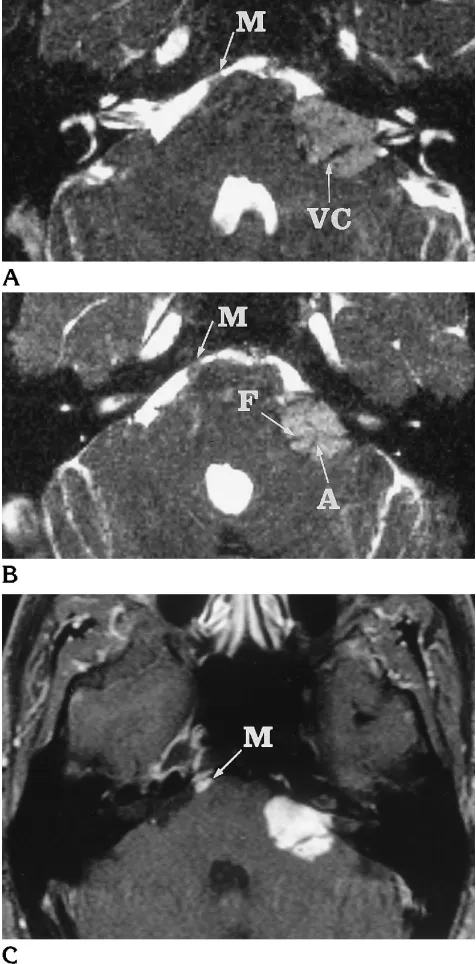
One lesion, the metastatic ependymoma, had a markedly homogeneous hyperintensity on CISS MR images (more so than any other le-sion) except for the hypointense traversing sev-enth and eighth cranial nerves and a vascular loop (presumably the anterior inferior cerebellar artery) (Fig 3).
Within the volume of the CISS MR acquisition, only one contrast-enhanced T1-weighted im-age showed a significant abnormality that was missed by both observers on the CISS MR im-aging study. In this instance, the large left cer-ebellopontine angle ependymoma (Fig 3) was seen by both observers on the CISS MR images; however, additional subarachnoid metastatic ependymoma seedings, approximately 5 mm in diameter in the right aspect of the prepontine cistern and in the right cerebellomedullary cis-tern, were only apparent to the observers on the contrast-enhanced T1-weighted images. These lesions, which were apparent on the CISS MR images in retrospect for both observers, were probably overlooked because the observers’ at-tention was focused on the cerebellopontine an-gle, internal auditory canal, and inner ear. The small hyperintense (relative to brain) lesions could easily be mistaken for cerebrospinal fluid flow artifacts.
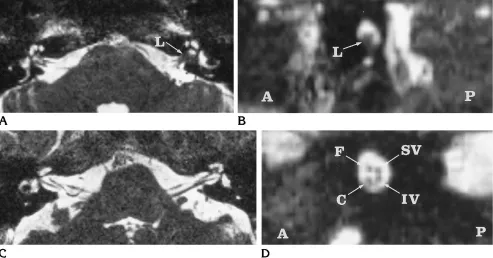
[image:4.612.62.302.77.183.2]Only two false-positive lesions were identified on CISS MR images by observer 1, and in both instances, poor separation of the internal audi-tory canal nerve complex (the facial nerve and the components of the vestibulocochlear nerve) in the inferior and lateral aspect of the internal auditory canal contributed to the misinterpreta-Fig 2. Histogram shows distribution of largest diameter of each lesion.
Fig 3. Subarachnoid metastatic ependymoma, a possible false-negative finding at CISS MR imaging, with a distinctive appearance. AandB, Axial reconstruction CISS images show the meta-static ependymoma of the cerebellopontine angle, which was relatively homogeneously intense (more so than any solid com-ponent of the other lesions) except for the hypointense traversing seventh and eighth cranial nerve complex (F andVC, respec-tively) and a vascular loop (A) (presumably the anterior inferior cerebellar artery). Note the further small hyperintense metastatic lesion (false negative in this study by both observers) in the right aspect of the prepontine cistern (M).
[image:4.612.320.558.84.566.2]tion (Fig 4). Observer 2 identified seven false-positive lesions— cases in which contrast mate-rial would have been administered without benefit. Clustering of the internal auditory canal nerve complex in the inferolateral aspect of the internal auditory canal contributed to four of these false-positive interpretations, and one of these was also one of the two cases misinter-preted by observer 1; however, observer 1 was focused on the opposite side. Two other false-positive interpretations occurred in patients with particularly narrow internal auditory canals (Fig 5), and the final false-positive interpretation by observer 2 occurred in an internal auditory ca-nal that narrowed toward the porus acusticus by means of a small superior bony ridge, which, on axial images, appeared separate from the re-mainder of the canal wall. In this last instance, further images in either the coronal or sagittal plane would have been of assistance. Two of observer 2’s false-positive studies (one in which there was a coexistent narrow internal auditory
Fig 4. CISS imaging finding mimicking an inferolateral left internal auditory canal acoustic schwannoma.
A, Axial reconstruction CISS image shows how clustering of the components of the vestibulocochlear nerve and the facial nerve close to the inferior wall may mimic a lesion (L) in the internal auditory canal.
B, CISS reconstruction image perpendicular to the mid-portion of the left internal auditory canal inAshows the poorly separated internal auditory canal nerve complex (L) at the inferior aspect of the internal auditory canal.Aindicates anterior;P, posterior.
C, Axial reconstruction CISS image of a patient with capacious internal auditory canals and widely separated components of the vestibulocochlear nerve and the facial nerve.
D, CISS reconstruction image perpendicular to the middle portion of the left internal auditory canal inCshows the nonclustered appearance of the vestibulocochlear nerve components and the facial nerve. SV indicates superior vestibular division; IV, inferior vestibular division;C, cochlear nerve;F, facial nerve;A, anterior; andP, posterior.
[image:5.612.320.560.504.614.2]canal and one in which there was clustering of the internal auditory canal nerve complex) were considered degraded by patient movement but acceptable to that observer.
The CISS studies were considered of diagnos-tic quality in 125 (100%) and 124 (99%) of 125 cases (observers 1 and 2, respectively). The CISS studies were considered acceptable but suboptimal in 14 (11%) and 18 (14%) of 125 cases (observers 1 and 2, respectively). No contrast-enhanced spin-echo study was consid-ered suboptimal. The patients unable to tolerate the entire imaging session were not included in this study, and this may have led to an under-estimation of the true prevalence of unaccept-able studies.
Discussion
The evaluation of acoustic schwannomas and their frequently accompanying symptoms of sensorineural hearing loss and tinnitus has de-veloped rapidly over the past two decades. Con-trast-enhanced T1-weighted spin-echo MR im-aging has emerged as the standard of reference because of the superb contrast and spatial res-olution it provides.
Our sample of cases is biased owing to the variable, but significant, application of nonim-aging tests and computed tomographic studies used for screening. Hence, our patients were often those who were going on to MR imaging for clarification. In this biased sample, the prev-alence of positive findings of abnormalities of the cerebellopontine angle or internal auditory canal on contrast-enhanced T1-weighted MR images was only 14 per 100 referred cases. The relatively low prevalence of positive studies in patients referred for exclusion of acoustic schw-annoma coupled with the frequency with which an MR imaging unit performs this examination indicates that refinement of the MR protocol may result in a considerable saving of imaging time and expense.
The CISS MR sequence is specifically de-signed for MR myelography and cisternogra-phy. There is a distinct reduction in cerebrospi-nal fluid flow artifacts as compared with other, similar sequences with high-intensity cerebro-spinal fluid (eg, fast or turbo spin-echo and other gradient-echo techniques). CISS MR im-aging produces high spatial resolution, bilateral simultaneous acquisition, and high contrast of cerebrospinal fluid relative to brain and bone. It
acquires these characteristics by the summa-tion of two 3DFT data sets obtained with true fast imaging with steady-state precession se-quences (which include flow compensation ap-plied to each gradient over each repetition-time cycle), one with an alternating radio frequency pulse and one with a nonalternating radio fre-quency pulse (2).
False-positive interpretations of CISS MR im-aging findings caused by clustering of the inter-nal auditory cainter-nal nerve complex in the infero-lateral aspect of the internal auditory canal may be avoided by the use of other imaging planes (Fig 4) and possibly by greater experience in recognizing this pitfall. Particularly narrow inter-nal auditory cainter-nals have hindered a previous attempt to produce a screening MR imaging sequence for acoustic schwannomas (5). The normal vertical diameter of the internal auditory canal may be as narrow as 2 mm, which leaves a minimal amount of cerebrospinal fluid to sur-round the facial and vestibulocochlear nerves (6). Difficulties may arise in distinguishing the homogeneous soft tissue of a small acoustic schwannoma from a normal seventh and eighth cranial nerve complex at the lateral aspect of a narrow internal auditory canal (Fig 5). Clearly, care must be taken when interpreting CISS MR images, as the lesions may be particularly small (Fig 1). False-negative findings on CISS MR images may also result from hyperintense areas of abnormality (Fig 3).
multiple cranial nerve palsies in meningeal in-filtration).
The ideal screening test for acoustic schwan-noma must be particularly sensitive, specific, simple, inexpensive, noninvasive, and without significant complication as compared with the accepted standard of reference (contrast-en-hanced T1-weighted spin-echo MR imaging). On the basis of these criteria, CISS MR imaging could be a suitable screening investigation for acoustic schwannoma. The new diagnostic al-gorithm would involve using CISS MR imaging to select those patients most likely to benefit from contrast-enhanced T1-weighted spin-echo MR imaging, regardless of previously used screening tools.
Recently, several new MR imaging tech-niques that can show the peripheral vestibulo-cochlear pathway without the use of intrave-nous contrast material have been developed and have undergone preliminary evaluation. Fast spin-echo imaging in conjunction with the standard head coil has been proposed; how-ever, only 43% of such examinations may be considered satisfactory, owing to partial volum-ing and cerebrospinal fluid flow artifacts (5). More apparently favorable techniques include the use of surface coils with either fast spin-echo (8) or high-resolution 3-D gradient-spin-echo (9) sequences.
In conclusion, CISS MR imaging, or similar methods, will find use in the examination of patients with clinical features referable to the vestibulocochlear system who are unable or un-willing to receive contrast material. In these cir-cumstances we can be confident of the CISS MR imaging sensitivity for identifying mass lesions of the cerebellopontine angle and internal audi-tory canal. In our experience, CISS MR imaging
in this patient population proved to be highly accurate; however, further experience is re-quired before a definitive statement regarding the suitability of this technique as a screening procedure can be made.
Acknowledgments
We thank Kodak Australia for supplying film for this project and the staff of our MR imaging unit as well as the Royal Melbourne Hospital and the Peter MacCallum Hos-pital photography departments. Our thanks also extend to Ian Cox and Richard Kirsner for their comments regarding the manuscript and to Siemens for the opportunity to use a “works in progress” sequence.
References
1. Pfleiderer AG, Evans KL, Grace ARH, Lloyd GAS. A screening protocol used for the detection of acoustic neuromas: a clinical evaluation.Clin Otolaryngol1988;13:145–151
2. Casselman JW, Kuhweider R, Diemling M, Ampe W, Dehaene I, Meeus L. CISS-3DFT MR imaging of the inner ear and cerebel-lopontine angle.AJNR Am J Neuroradiol1993;14:47–57 3. Duvoisin B, Fernandes J, Doyon D, Denys A, Sterkers J-M, Bobin
S. Magnetic resonance findings in 92 acoustic neuromas.Eur J Radiol1991;13:96 –102
4. Mulkens TH, Parizel PM, Martin JJ, et al. Acoustic schwannoma: MR findings in 84 tumors.AJR Am J Roentgenol1993;160:395– 398
5. Renowden SA, Anslow P. The effective use of magnetic resonance imaging in the diagnosis of acoustic neuromas.Clin Radiol1993; 48:25–28
6. Valvassori GE, Pierce RH. The normal internal auditory canal.AJR Am J Roentgenol1964;92:1232–1241
7. Mark AS, Seltzer S, Harnsberger HR. Sensorineural hearing loss: more than meets the eye?AJNR Am J Neuroradiol1993;14:37– 45 8. Tien RD, Feisberg GJ, Macfall J. Fast spin-echo high-resolution MR imaging of the inner ear.AJR Am J Roentgenol1992;159: 395–398
9. Schmalbrock P, Brogan MA, Chakeres DW, Hacker VA, Ying K, Clymer BD. Optimization of submillimeter-resolution MR imaging methods for the inner ear.J Magn Reson Imaging1993;3:451– 459