Rule-based Semantic IS Standards
A conceptual framework for rule-based semantic IS standards development
Author
Rule-based Semantic Standards
A conceptual framework for rule-based semantic IS standards development
Author
Thomas Büyükkılıç
E-mail: [email protected] Student number: s0011061
Organization
University of Twente
School of Management and Governance MSc Business Information Technology
Supervisors ir. E.J.A. Folmer dr. ing. A. Wombacher
Date
August 17th, 2011
When I first started the Business Information Technology program, I had no idea where I was going, but the idea of being a bridge between the business world and the IT world appealed to me. In the years that followed I had setbacks and was close to giving up, but my stubbornness never let me. I have always known that I am capable enough, but I never had the motivation to put the time in it, so it became a big mess. Luckily, I asked Céline Heijnen to help me sort out the mess I had created. She was willing to help me and had put me on the right track. I thank her for that. It has been a long and stressful road from there, but the end is near: You are reading the final deliverable of my Master’s in Business Information Technology. First of all, I would like to thank my supervisors at the University of Twente for putting the time and the effort to help me get this done in time before september 1st. Erwin and Andreas, thank you for steering me
in the right direction when I needed it and helping me get the insight I needed.
Also I would like to thank the following people. My wife, who is pregnant and in the hospital while I’m writing this, for being the support and motivation I needed during my studies. It has been a very tough period and I could not have done this without you, thank you! My mother, who has been my rock throughout my life, for never giving up on me, no matter what. Thank you for being you! My sister, who has always had my back, for her kind words and support, God bless you. My brother, for having faith in me and for his wise words, thank you. Finally, I would like to thank my family and my friends for their faith, support, and understanding during this project.
I hope you enjoy reading my thesis.
Enschede, August 14th 2011
It is estimated that only 2% of the businesses worldwide that could benefit from standards, actually adopt and use them. The adoption of a standard is influenced by its quality, which is inherent to the tactics used for developing the standard. Other aspects that influence adoption are the cost of the standard, and the understandability of the standard. In this research we are taking a non-traditional approach (i.e. tactic) to semantic IS standard development — a business rule approach. With a business rule approach we aim to increase the understandability and the quality of semantic IS standards, while reducing the (development/ maintenance) costs.
Business rules are known to function as bridges between business people and IT people. They can be defined in rule modeling languages which can be expressed in both natural language and formal language at the same time, which might increase the understandability of the standard. One such rule modeling language is ‘RuleSpeak’. RuleSpeak is based on OMG’s Semantics of Business Vocabulary and Business
Rules (SBVR), which is an platform-independent model. Business rules defined in RuleSpeak can be translated to other Meta-Object Facility models such as Unified Modeling Language. This is especially important for semantic IS standards as their contents often involve models and diagrams. Managing one set of business rules from which models can be generated, will result in a more consistent standard, which is a key characteristic of the quality of the standard. Being able to generate models from a single source might also reduce development/maintenance duration, which directly translates to cost reduction.
The result of this research is a conceptual framework for and an approach to rule-based semantic IS standards development. The approach is based on defining business rules based on the functionality they have. Business rules can define structure, power, and control. Structure emerges by creating structural rules that define the relationship that concepts have with each other. Power (i.e. processes) is generated by creating declarative processes with pre-, boundary-, and post-conditions. Control is exerted by constraining the power (i.e. processes).
To validate the proposed approach, an experiment was conducted in which the SETU Standard for Reporting Time & Expenses was translated to RuleSpeak. The case study served as input for the evaluation of the hypothesis which states that ‘a business rule approach to semantic IS standards development can lead to reduction of costs and increase of quality and understandability’. The evaluation was done in the form of an interview and a survey with a focus group consisting of standards developers from SETU. The focus group disagreed that the proposed approach to semantic IS standards development could lead to cost reduction or remove direct adoption barriers, but they agreed that it could lead to quality increase in the form of completeness, consistency, compliance and precision increase.
1.
Introduction
...
1
2.
Research design
...
3
2.1.
Problem statement
...
3
2.2.
Research objectives
...
4
2.3.
Research scope
...
4
2.4.
Research methodology
...
4
2.5.
Report structure
...
7
3.
Semantic IS standards
...
9
3.1.
What are standards?
...
9
3.2.
Conceptual model
...
10
3.3.
Contents of semantic IS standards
...
11
3.4.
Summary
...
12
4.
State of the Art: Business rule approach
...
13
4.1.
What are business rules?
...
13
4.2.
Principles of the business rule approach
...
15
4.3.
Business rules concepts
...
16
4.4.
Rule modeling languages
...
25
4.5.
Disadvantages of rule-based systems
...
29
4.6.
Business rules management
...
29
4.7.
SBVR-specific tools
...
31
4.8.
Summary
...
35
5.
Creating rule-based semantic IS standards
...
37
5.1.
Framework
...
37
5.2.
BRASD
...
42
5.3.
Summary
...
47
6.
Experiment — Rule-based SETU standard
...
49
6.1.
SETU Standard for Reporting Time & Expenses 1.1
...
49
6.2.
Business vocabulary
...
50
6.3.
Structure
...
54
6.4.
Power
...
59
6.5.
Control
...
61
6.6.
Summary
...
62
7.
Evaluation
...
65
7.1.
Motivation
...
65
7.2.
Approach
...
65
7.3.
Interview
...
66
7.4.
Survey
...
69
8.2.
Limitations of the research
...
74
8.3.
Future work
...
74
...
References
75
...
Appendix A — Conceptual model of semantic IS standards
79
...
Appendix B — The BRS rule classification scheme
81
...
Appendix C — RuleSpeak templates
83
...
Appendix D — XMI files for the M2M example
87
...
Appendix E — XMI example from the SBVR standard
89
...
Appendix F — SETU business vocabulary
93
...
Appendix G — SETU structure rules
95
...
Appendix H — SETU power rules
99
...
Appendix I — SETU control rules
101
...
Appendix J — SETU standard attribute descriptions
103
...
1.
Introduction
E-business has seen significant growth over the past few years, partly because it leads to better coordination and better interoperability in the supply chain, as well as new business opportunities (Lee & Whang, 2004). The interoperability of the e-business information systems (IS) is a key characteristic to achieve common e-business benefits such as reduced costs, increased flexibility, and faster response times (Lee & Whang, 2004). There is a growing need for standardization as a means to achieve IS interoperability (Folmer & Verhoosel, 2011). In many industries, firms develop e-business standards collaboratively in a standard consortium (Zhao, Xia & Shaw, 2007), these consortia are considered vertical
standards development organizations (SDOs), or better known as standards settings organizations (SSOs). Standards organizations can typically be categorized into two groups: SDOs and SSOs. SDOs are considered formal/traditional development organizations that develop and maintain standards on national, regional and international level (Folmer & Verhoosel, 2011; Spivak & Brenner, 2001), examples are. ISO
and ITU. All the other organizations that develop standards are considered SSOs, examples are OASIS,
W3C, or SETU.
Semantic IS standards are typically developed and maintained by SSOs and they are critical for e-business to e-business transactions because they prescribe guidelines for inter-system communication, with the goal of increasing interoperability of information systems (Folmer & Verhoosel, 2011). However, standards need sponsor support (standards organizations and technology providers) and early adopters to be created (Choia, Raghu & Vinze, 2004) and this is lacking. Semantic IS standards even need support from all stakeholders (Folmer & Verhoosel, 2011). This lack of sponsor support and adopters, translates into a 5% usage of standards by organizations that could benefit from them (Beck & Weitzel, 2005 as cited by Folmer & Verhoosel, 2011). It is estimated that 2% of the business worldwide (that could benefit from standards) actually use them (Wigand, Markus & Steinfield, 2005 as cited by Folmer & Verhoosel, 2011). There many explanations for these low values, one of them is that there are network externalities1 in effect in the
adoption of standards (Boh, Soh & Yeo, 2007; Cathomen & Klein, 1997; Katz & Shapiro, 1985; Thomas, Probets, Dawson & King, 2008; Weitzel, Beimborn & Koenig, 2006), so it necessary for standards to have a “critical mass” of supporters and adopters to be adopted. The lack of adoption can also be caused from barriers such as difficulty understanding the standard, standards revision process, and the cost of the standard (Thomas et al., 2008). It is also important to have all the stakeholders participate and to keep them involved during the standardization to increase adoption (Markus, Steinfeld, Wigans & Minton, 2006).
A survey on semantic standards quality involving 37 standards organizations including SSOs like XBRL,
HR-XML, SETU, and Aquo showed that more than 90% of the respondents agreed that the quality of their standards can be improved (Folmer & Punter, 2010). Also, a vast majority (90%) agrees that quality increase in their standards will increase system interoperability.
The adoption of a standard is influenced by its quality, which is inherent to the tactics used for developing the standard (Markus et al., 2006). In this research we are taking a non-traditional approach (i.e. tactic) to semantic IS standard development — a business rule approach. Major motivations for adopting a business rule approach in organizations are agility and consistency (Halle & Goldberg, 2006: p.21). A business rule approach to cost- and quality-related problems within organizations has shown effective in real-life cases (Halle & Goldberg, 2006; Masud & Lucker, 2009; Myers, 2010), especially in a changing environment where business rules can offer high levels of automation as well as flexibility (Paschke, 2006). We call our approach BRASD (a Business Rule Approach to Semantic IS standards Development) and with it we aim to:
1 From Wikipedia: “In economics and business, a network effect (also called network externality or demand-side economies of scale) is the effect that
1. Increase the understandability of semantic IS standards. Business rules are known to function as bridges between business people and IT people. They can be defined in rule modeling languages which can be expressed in both natural language and formal language at the same time, which might increase the understandability of the standard.
2. Increase the quality of semantic IS standards. Business rules have shown potential for data quality increase (see real-life cases in the previous paragraph). In this research we research if and how a BRASD can contribute to data quality. Data quality is strongly related to standards quality (Folmer & Verhoosel, 2011: p.95). The ISO/IEC 25012 document defines 15 data quality characteristics. We have selected 8 of these characteristics which might be related to semantics IS standards (ISO IEC, 2008): accuracy, completeness, consistency, compliancy, precision, traceability, understandability, and portability. Consistency is especially important for semantic IS standards, as they rely heavily on consistency in inter-related diagrams, models, data (e.g. XML schemas), and sometimes across multiple standards.
2.
Research design
In this chapter we describe the design and approach used to perform this research. This is an IS research, which implies that it needs to be reproducible by other people as well. If an IS research is not reproducible, it has little relevance (Hevner, March & Park, 2004).
Just like every chapter after this one, a section outline will be given. First, we will state the problems we mentioned in the introduction explicitly in section 2.1. Our research objectives and expected contributions are explained in section 2.2. The research scope is determined in section 2.3. The research model (i.e. the setup of the research) and the research questions are explained in section 2.4. The scope of our research is defined in section 2.5. The research approach (i.e. strategies used for information acquisition) is detailed in section 2.6. Finally, this chapter concludes with a chapter outline of the report.
2.1.
Problem statement
In this research we focus on improving cost-, quality- and adoption aspects of semantic standards. Below, we formulate the problems as goals that need achieving.
‣ Semantic IS standard development and maintenance costs need to be reduced.
‣ Semantic IS standard quality needs to be increased.
‣ Semantic IS standard adoption needs to be increased.
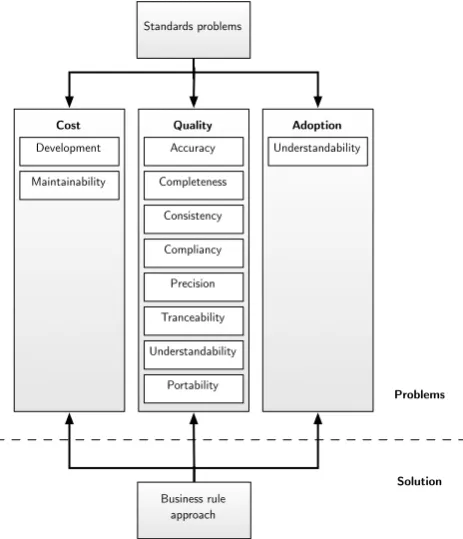
[image:13.595.211.443.464.734.2]We are not trying to solve these problems completely, because just a different approach to development will not eliminate these problems, instead we focus on solving problems that contribute to our goals. Cost-related problems can be reduced if a BRASD can decrease the development- or maintenance duration of semantic IS standards. Quality-related problems can be reduced if a BRASD can increase accuracy, completeness, consistency, compliancy, precision, traceability, understandability, and/or portability. Adoption-related problems can be reduced if a BRASD can increase understandability of the standard. Fig. 1 illustrates our problems and the proposed solution.
Figure 1. Proposed solutions to standards problems. Standards problems
Cost Development
Maintainability
Adoption Understandability Quality
Accuracy
Portability
Business rule approach
Problems
Solution Understandability
2.2.
Research objectives
The objective of this research is to determine if a business rule approach can contribute to reducing the cost-, quality-, and adoption-related problems within semantic IS standards. Even though our focus is semantic IS standards, other kinds of standards might benefit from a business rule approach as well. The contribution of this research will be a conceptual framework and an approach (BRASD) which can be applied in practice. If the BRASD proves itself valuable (i.e. it addresses some of the mentioned problems), then our framework and approach can serve as guide into the world of business vocabularies, business rules,
concepts, fact types, and much more.
2.3.
Research scope
We are not trying to address all of the problems that standards organizations are facing with a “holy grail”. Instead we focus on the points mentioned in section 2.1. The goal of this research is to show that a BRASD can help to reduce cost-, quality-, and adoption-related problems within semantic IS standards. Other types of standards are out of scope. We will also not focus on the implementation of a rule-based semantic IS standard.
To evaluate our conceptual framework and BRASD, we will conduct an experiment (as part of a case study) in which we translate a semantic IS standard to business rules, that will serve as discussion material in an open interview with experts. The SETU Standard for Reporting Time & Expenses 1.1 (Folmer, Roes & van Bekkum, 2009) from the ‘Dutch list of open standards’2 will be used for the case study. This
standard is developed and maintained by SETU, which is an SSO that has a brach in Enschede. Access to both the standard and the SSO led to the choice of interviewing SETU.
2.4.
Research methodology
This research is built as a design-science approach, which is fundamentally a problem solving paradigm (Hevner et al., 2004). An IS research (i.e. design-science research) consists of two main processes and one or more artifacts (March & Smith, 1995). The processes are (1) development and (2) evaluation. The
artifacts that are produced are a conceptual framework that is a combination of constructs (vocabulary and symbols) and an approach (BRASD). Fig. 2 illustrates Hevner’s framework which is the basis of this research. For better understanding of the problems and to add additional richness and detail, a case study will be added to the evaluation. This way the problems are approached from different perspectives, to provide additional insight. This merger of two approaches is known as ‘multi-method’ or ‘complementary’ research (Petter & Gallivan, 2004). In the next sub-sections we will explain how our research relates to Hevner’s framework.
Figure 2. IS research framework (adapted from Hevner et al., 2004).
Knowledge Base Foundations
Methodologies Environment
People
Organizations
Technology
IS Research Development
Evalution assess refine business
needs knowledgeapplicable
application in the appropriate
environment additions to theknowledge base
2.4.1.
Environment
The environment determines what the business needs are. In our case the environment consists standards development organizations (both SDOs and SSOs) and their business needs are formulated in ‘problem statement’ (section 2.1). We will apply our approach (BRASD) to the SETU standard and determine its utility in the environment it was created. It is good practice to evaluate the application of an artifact in the same environment that experiences the problems.
2.4.2.
Knowledge Base
Our knowledge has been formed from different sources: a booklet, search engines, knowledge databases, and related work. The first source is a booklet we had direct access to that describes the state of the art (SOTA) on semantic IS standardization (Folmer & Verhoosel, 2011)3. It helped us understand the basic
concepts of semantic standards. The second source of information comes from various search engines (e.g. Google Scholar, Web of Knowledge, and Wikipedia), knowledge databases (e.g. IEEExplore, arXiv, JSTOR, and ACM), and related work such as an unpublished thesis on rule-based process design (Stornebrink, 2010), which was another source that we already had direct access to.
Techniques for selecting applicable knowledge were predominantly ‘forward citation search’ followed by ‘narrative reviews’ and ‘descriptive reviews’ (King & He, 2005) followed by ‘backward citation search’. ‘Vote counting’ articles that were pointed out by Folmer and Verhoosel (2011) were used as well.
For a SOTA on the business rule approach Wikipedia was used as a starting point. By searching for the term ‘business rules’ we have come across many key sources like the Business Rules Group, one of the first (if not the very first) organization focusing on business rules. Also key literature like Principles of the Business Rule Approach (Ross, 2003) and The Business Rule Revolution (Halle & Goldberg, 2006) was found this way. By doing a forward citation search on Principles of the Business Rule Approach, various sources have been found on which a backward citation search was done to find the related articles.
We have also specifically reviewed the work of Ross because he is considered a key figure in the development and evolution of the business rules approach. A simple Google search with ‘business rules’ and ‘Ross’ led to the Business Rules Community4 which is an active community in the business rules domain
and a good source of information on the business rules approach. Stornebrink’s work has also served as an important source of information on the business rule approach — declarative process modeling specifically.
2.4.3.
Development
The development (or build) process consists of defining the business needs and selecting applicable knowledge (Hevner et al., 2004), see sub-sections 2.4.1 and 2.4.2. The development process leads to two artifacts — a conceptual framework which describes characteristics of rule-based semantic IS standards and an approach (BRASD) which can be used to create rule-based semantic IS standards. By answering the following main research question we will be able to create these artifacts:
‣
RQ — “What are the characteristics of a rule-based semantic IS standard that has advantages in relation with current technologies and how can it be created?”The technologies here refer to current technologies for standards development and maintenance such as manual remodeling of Unified Modeling Language (UML) diagrams if requirements from the environment change. Our main research question has been divided into multiple (sub) research questions to keep the whole manageable. Answering the research questions, will answer the main research question. The information that we get from answering each research question is explained below.
3 The digital version of the booklet can be downloaded from http://www.semanticstandards.org/ or by searching Google with the terms ‘state of the
art’, ‘semantic’, and ‘standards’.
‣
Q1 — “What is a semantic IS standard?”The answer to Q1 will give us an introduction on the basic concepts of semantic IS standards, which is essential for determining which parts of a semantic IS standard need to be expressed with business rules.
‣
Q2 — “Which semantic IS standard concepts need to be expressed with business rules?”Following Q1, the answer to this research question will give us a conceptual model of semantic IS standards, which will be used to determine which parts of the standard need to be expressed with business rules.
‣
Q3 — “What is the business rule approach?”The answer to the second research question will give us a SOTA on the business rules approach, which will help us to determine which business rules concepts, languages, best practices and drawbacks there are.
‣
Q4 — “Which business rule concepts are needed to express semantic IS standards with business rules?”The answer to this research question will be acquired in a similar way to Q2 and its result (i.e. a conceptual model of a business rule) will help us determine which types of business rules are needed to define the semantic IS standard concepts in business rules.
The research model in fig. 3 shows which topics will be studied and how the research questions will be answered. The model consists of arrows and rectangles with straight and rounded edges. An arrow depicts a process flow and an arrowhead points to the output or answer to a research question (i.e. ‘Qx’, with x ∈
1..4). All rectangular objects represent outputs, except for ‘Evaluation’, which is a processes. The evaluation is explained in the next sub-section. The framework is defined in chapter 5. Based on the framework, we will create an approach to rule-based semantic IS standards development (BRASD), which will be explained in chapter 5 and applied in chapter 6.
Figure 3. Research model.
2.4.4.
Evaluation
The goal of the evaluation is to determine how complete and effective our research is, i.e. in what level our conceptual framework and approach satisfy the requirements and constraints of the problems that it was designed to solve/reduce (Hevner et al., 2004). The evaluation of the artifacts provides us with feedback information and a better understanding of the problems in order to improve our framework and approach (Hevner et al., 2004). The evaluation of our research will consist of a case study and the interpretation of the results. The case study consists of an open interview and a survey at SETU to evaluate if a business rule approach can help reducing the problems mentioned in section 2.1. The case study will be explained in detail in 7. The results of the case study will be assessed and serve as input for improvement of our method (i.e. ‘refinement’). This research will be performed sequentially, which indicates that the results of one method serve as input for the other. See fig. 4 for our alternative IS design framework. The findings from the evaluation can either lead to a re-development process or to “lessons learned” in the conclusions.
Framework for rule-based semantic IS
standards BRASD
State of the Art: Business rule
approach
Business rules concepts Semantic IS standard concepts
(Q3) (Q4)
(Q1) (Q2)
(RQ) Evaluation
Figure 4. Alternative IS research framework.
2.5.
Report structure
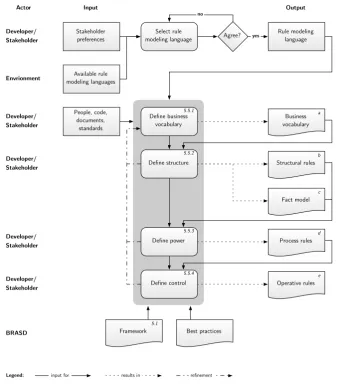
The remainder of this report is structured as depicted in fig. 5.
Figure 5. Research process.
• Chapter 3 gives an introduction on the topic of semantic IS standards. This results in a basic understanding of the topic and serves as input for concepts analysis, which leads to a conceptual model of semantic IS standards. This chapter answers research questions Q1 and Q2.
• Chapter 4 gives a SOTA on the topic of the business rule approach. This results in a basic understanding of the topic and serves as input for concepts analysis, which leads to a conceptual model of business rules. This chapter answers research questions Q3 and Q4.
• Chapter 5 provides a conceptual framework describing characteristics of rule-based semantic IS standards and an approach (BRASD) to create rule-based semantic IS standards. The framework consists of characteristics of semantic IS standards, classification of rule sentence templates. The
Knowledge Base
Semantic IS standards
Business rule approach
problems SOTA
case study contributions
IS Research Development Evalution Case study refine assess Environment SDOs/SSOs SETU
State of the Art: Business rule
approach
Framework for rule-based semantic IS
standards Semantic IS standard concepts Experiment Semantic IS standards Evaluation
Literature study (Q1) Chapter 3
Literature study (Q3)
(Q2)
Concepts analysis
Concepts analysis Chapter 4
Chapter 5 Chapter 6 Chapter 7 Activity Output Framework development Business rules concepts (Q4) (RQ) Activity Output Rule-based semantic IS standard input for results in Legend: Interview Kno wledge Base
Development & Evaluation cycle
refinement BRASD
Chapter 5
approach consists of a method to create rule-based semantic IS standards and guidelines for its application.
• Chapter 6 describes an experimental application of our BRASD approach to the SETU standard. The result is a rule-based semantic IS standard.
• Chapter 7 is the evaluation of our research consisting of the interview and a survey at SETU and the interpretation of the results.
3.
Semantic IS standards
This chapter provides an introduction to semantic IS standards. It will answer the first research question
“What is a semantic IS standard?” and the second research question “Which semantic IS standard concepts need to be expressed with business rules?”. First, the definition and the aim of standardization in general is explained followed by defining semantic IS standards from literature in section 3.1. Then the second research question is answered by analyzing a conceptual model of semantic IS standards (section 3.2) and determining which concepts can be expressed using business rules (section 3.3). Finally, this chapter concludes with a summary in section 3.4.
3.1.
What are standards?
Standards are used 24/7 to create the world around us. From electronic devices like mobile phones, computers, and televisions, to paper, bottles and even french fries at the McDonalds, all are produced using some (international) standard. Standards can support whole nations and even change them (Krislov, 1997). Standards are developed and published by SDOs and SSOs. They exist on national, regional, and global level (Folmer & Verhoosel, 2011). SDOs are considered formal/traditional development organizations (Spivak & Brenner, 2001). All the other standards development organizations are considered SSOs, they also exist on national, regional and global level. The world’s largest developer and publisher of international standards is ISO which is an SDO. ISO defines a standard as:
‣ “... a document, established by consensus and approved by a recognized body, that provides, for common and repeated use, rules, guidelines, or characteristics for activities or their results, aimed at the achievement of the optimum degree of order in a given context. Standards should be based on the consolidated results of science, technology and experience, and aimed at the promotion of optimum community benefits.”
Even though this definition is considered somewhat biased towards ISO in general (van Wessel, 2008), it is widely accepted. Based on an ISO booklet from 1972, Spivak and Brenner (2011) mention that standardization aims to provide the following:
• Simplification for society to prevent unneeded variation in products.
• Interchangeability, because simplification tends to limit variation and increases interchangeability. • Standards as a means for communication between producers and customers by specifying with which
requirements (ordered) goods will comply.
• Symbols and codes to eliminate the effects of differences in languages. • Safety by uniforming products, so variation in failures is minimized.
• Meeting consumer and community interest in properties like durability, energy consumption, flammability, etc. by using product labels that report the results of (inter)national tests carried out by certified laboratories.
• Reduction in trade barriers to prevent individual nations from excluding the products of others, e.g. by imposing unique standards on imported goods.
3.1.1.
What are semantic IS standards?
Folmer et al. (2011a) mention that semantic IS standards are often referred to as Vertical Industry Standards (VIS) but that VIS exclude horizontal standards and government-related standards. To define semantic IS standards properly, they have adapted the VIS definition to include horizontal and government-related standards (adapted from Steinfield, Wigand, Markus & Minton, 2007):
‣
“Semantic IS standards are designed to promote communication and coordination among the organizations; these standards may address product identification, data definitions, business document layout, and/or business process sequences.”So in short, semantic IS standards prescribe guidelines for inter-system communication to increase interoperability and the quality of information systems (Folmer & Verhoosel, 2011). The better tactics we use to develop these standards, the better the quality will be, the more likely it is that they will get adopted (Markus et al., 2006). The VIS definition distinguishes the following concepts: product identification, data definitions, business document layout, and business process sequences. These concepts gives us an indication of what needs to be expressed using business rules.
3.2.
Conceptual model
To be able to evolve semantic IS standards, Folmer et al. (2011b) argued that a better understanding of the conceptual structure of these standards is needed (Folmer, Oude Luttighuis & Van Hillegersberg, 2011). They have composed a conceptual model based on extensive research of 72 scientific papers on semantic IS standards, a fragment of the model is illustrated in fig. 6. The complete model can be found in appendix A.
Figure 6. Conceptual model of a semantic IS standard (adapted from Folmer et al., 2011).
There are three levels in this conceptual model: (1) categories; (2) sub-categories; and (3) concepts. Starting from the third level, there are 34 concepts in total. These concepts are assigned to sub-categories to keep them comprehensible, see fig. 49 in appendix A for a complete overview. The sub-categories are assigned to four categories, which are:
• Context • Contents
• Development & Management • Appliance
The context is the environment where the standard can be applied, i.e. the environment where a solution for a problem is needed. The actual solution is defined in the contents of the standard. The third category is development & management, because every standard needs to be developed and maintained. Finally, the
Meta solution Semantic IS Standard
Context Contents Development & Management
Organizational domain
Problem domain
Appliance
Conceptual solution
Technical solution
Knowledge transfer
Implementation
Legend:
root
category
sub-category Component development
Marketing
Organization
usage is described in the appliance category. Out of these four categories, the contents category is the most important one for this research as it is considered the core of semantic IS standards (Folmer et al., 2011). The other three categories (context, development & management, and appliance) are left out of scope.
3.3.
Contents of semantic IS standards
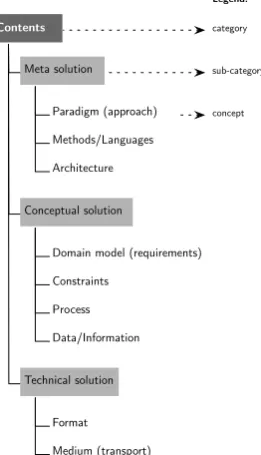
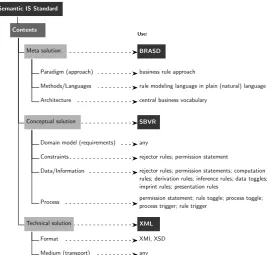
[image:21.595.255.386.223.451.2]The contents category is regarded as the core of a semantic IS standard, which means that it is a determent for quality of the standard. It consists of the sub-categories: (1) meta solution; (2) conceptual solution; and (3) technical solution, see fig. 7. These three concepts are explained in the following sub-sections.
Figure 7. Concepts in the content category of a semantic IS standard.
3.3.1.
Meta Solution
The meta solution of a semantic IS standard describes the selected approaches that were used to develop the standard. It has the following concepts:
• Paradigm (approach) • Methods/Languages • Architecture
The paradigm concept describes high level thoughts behind the design approach. The methods/languages
concept describe the methods and languages used in designing the standard. The architecture concept describes the architectural design choices made in terms of functional architecture, technical architecture, relationship with other standards, or selecting new techniques is part of architecture (Folmer et al., 2011).
3.3.2.
Conceptual solution
The conceptual solution of a semantic IS standard describes the design of the standard in terms of descriptions and models, it includes the concepts:
• Domain model (requirements)
Meta solution Contents
Conceptual solution
Technical solution Paradigm (approach) Methods/Languages Architecture
Domain model (requirements) Constraints
Process
Data/Information
Format
Medium (transport)
category
sub-category
• Constraints • Process
• Data/Information
The domain model describes the requirements to the environment in which the standard is applied and the scope of the standard. The constraints concept refers to constraints that determine the scope and use of the standard. They can also express data dependencies based on the process status (Folmer et al., 2011). Constraints are usually expressed with business rules. The process concepts entails the flow of activities within the standard, e.g. process diagrams, actors, etc. Finally, the data/information concept refers to the data and information entities that are represented within the standard. These can be messages, documents, ontologies, etc.
3.3.3.
Technical solution
The technical solution of a semantic IS standard describes the design of the standard in a more detailed level of abstraction in terms of technical artifacts. This sub-category includes the following two concepts:
• Format
• Medium (transport)
The format concept describes the format of the technical solutions in which the conceptual solution are represented, for semantic IS standards this is typically in UML, Extensible Markup Language (XML) or XML Schema Definition (XSD) document format. The medium represents the communication aspects of a standard.
3.4.
Summary
We discussed briefly what standards are and why they are used. By looking at the concepts of semantic IS standards, we have set of concepts that our framework needs to be applied to. We highlighted a total of nine concepts that form the contents of a semantic IS standard. These concepts cover a fair amount of the concepts of the VIS definition (section 3.1):
• Product identification is covered by the concepts domain model and constraints. • Data definitions is covered by the concept data/information.
4.
State of the Art: Business rule approach
This chapter contains a SOTA on the business rule approach, which answers the third research question
“What is the business rule approach?” and the fourth research question “Which business rule concepts are needed to express semantic IS standards in business rules?”. First, the definition of a business rule is given in section 4.1. This is followed by the principles of the business rules approach in section 4.2. The business rule approach concepts (structure, power, and control) are explained with a ‘running example’ in section 4.3. A suitable rule modeling language (RML) is selected in section 4.4. The (dis)advantages of business rules are discussed in section 4.5. Business rule management (BRM) is explained in section 4.6. Additionally, tooling is discussed in section 4.7. Finally, this chapter concludes with a summary in section 4.8.
4.1.
What are business rules?
Business rules haven been used formally since the late 1980’s and they can be found in most organizations on some level, but their effects affect our daily lives. The Business Rules Group (BRG) formulates statements and supporting standards about the nature and structure of business rules, the relationship of business rules with the way an enterprise is organized, and the relationship of business rules with systems’ architectures. There are active business rule communities, such as Business Rule Community, The Rule Markup Initiative, the Dutch BR-Platform, and many more. There are also organizations that help the development and implementation of business rules in practice as well, such as Business Rules Solutions. Business rules give the enterprises true agility (Ross, 2010) but they can do true damage as well, if the enterprise is not aware of their existence. Business rules have the most impact (i.e. can do the most damage) when they are unseen or unknown (Halle & Goldberg, 2006). So what are business rules?
4.1.1.
Definition
Business rules have been defined numerous times since we became aware of them (Ross, 2003). Business rules can be viewed from different perspectives: (1) from an information system perspective, where business rules relate to entities (i.e. data in the system) and to the constraints on the values of those entities and (2) from a business perspective, business rules relate to the (human) behavior of people in the enterprise. Because these two perspectives are distinct, a definition for a business rule form each perspective is given (Hall & Healy, 2000).
From a business perspective, business rules can be defined as:
‣
“... a statement that defines or constrains some aspect of the business. It is intended to assert business structure, or to control or influence the behavior of the business.” (Hall & Healy, 2000)With addition of the following statement:
‣
“This [statement] must be either a term or fact, a constraint, or a derivation. It is ‘atomic’ in that it cannot be broken down or decomposed further into more detailed business rules. If reduced any further, there would be loss of important information about the business.” (Hall & Healy, 2000)The definition from the business perspective is all about the semantics of a business rule. The terms ‘term’, ‘fact’, ‘constraint’ and ‘derivation’ are explained in section 4.3. A more idealistic definition from a business perspective comes from Von Halle & Goldberg (2006), they define business rules as:
From an information systems perspective, business rules can be defined as:
‣
“An atomic piece of re-usable business logic, specified declaratively.” (Ross, 2003)The term ‘atomic’ means the same thing as in the additional statement in the business perspective above. The term ‘declaratively’ is explained below. Business rules determine how an enterprise acts in certain situations, but what do they look like?
There are many systems that have rule engines of the condition-action (CA) or event-condition-action (ECA) types, both of which can be executed by a computer. For example: the most e-mail clients have a rule system to filter out incoming mail.
A CA type rule has the structure:
An ECA rule has the structure:
The CA and ECA type of rules are called “imperative rules” or “production rules”, because they command actions to be executed by computers which in turn produce actions (Joosten, Wedemeijer & Michels, 2010). In this research we use business rules as constraints, also known as “declarative rules”, because they declare what must happen, but not necessarily prescribe a particular action. This is best explained by an example of a business rule and its formal rule statement (i.e. an expression of a business rule in a specific formal grammar).
This formal rule statement is somewhat ambiguous as we are missing some information, e.g. “what does an order need to have?”, “in which situations?”, etc. The formal rule statement of the example above can be expressed in an RML (formal expression language) like Structured English, with either one of the following three business rules:
The same rule can be defined in another RML like RuleSpeak as:
Or even in predicates:
These three business rules mean exactly the same thing and they are all declarative — the do not prescribe
how things need to be, but what must be. This will be discussed in detail in section 4.3.
Not every statement is a rule, which can be confusing sometimes. To decide whether a statement is a rule, Joosten et al. (2010) have defined three definitions with an example, shown in fig. 8.
if <some condition is fulfilled> do <perform some activity>
when <some event has happened> and if <some condition is fulfilled> do <perform some activity>
Statement: An order cannot be empty
Each order always has at least one item
An order must have at least one item
.Figure 8. Example of statements and rules (adapted from Joosten et al., 2010).
Now that we know what business rules are we can discuss what the principles of the business rule approach are in the next section.
4.2.
Principles of the business rule approach
The business rule approach can be defined as (Halle & Goldberg, 2006):
‣
“... a formal way of managing and automating an organization’s business rules so that the business behaves and evolves as its leaders intend.”Von Halle & Goldberg (2006: p.17-31) have conducted a maturity survey among anonymous companies to establish a status quo of the business rules marketplace. The survey showed that major motivations for adopting the business rule approach are: (1) agility; (2) consistency; (3) business control or empowerment (being closer to the authoring, resting and discussing of rules); (4) knowledge retention; and (5) legacy renewal (Halle & Goldberg, 2006: p.21). Business rules offer high levels of automation as well as flexibility to adapt to rapidly changing business requirements (Halle & Goldberg, 2006; Paschke, 2006; Ross, 2003). They have advantages such as being expressed in natural language and thus being understandable by business people. Business rules also force users to think about the rules of the business and reduce miscommunication about business concepts (Ross, 2003).
Ross (2003) defined a set of ten principles to apply the business rule approach in practice. He states that: 1. Rules should be written and made explicit — When a rule is important enough, it should be
made explicit and written down.
A business rule is a verifiable statement that some stakeholders intend to obey, within a certain context. Here is an example of a rule:
In our club, a coat of any guest shall be in the cloakroom, as long as the guest is in the club.
Let us analyze this statement, to better understand what we mean by a business rule.
1. Rules have a scope.
The context of the stakeholders is our club in which this rule is valid. We call this the scope of this rule.
2. Rules have stakeholders.
Anyone involved in a rule is called stakeholder. If a rule has no stakeholders, then no one is interested if the rule is obeyed or violated. Such a rule has no business merit, and we do not consider it to be a business rules. For example, guests must put their coats in the cloakroom, there may be a bell boy to take them in and hand them out again, there may be staff who sees to it that people who try to smuggle their coats inside are intercepted, etcetera. Stakeholders who “live by the rules” are working to satisfy rules, each in his or her own role.
3. Rules are verifiable.
2. Rules should be expressed in plain language — If rules can’t be interpreted well, they lose their purpose.
3. Rules should exist independent of procedures and workflows — A procedure is not always
needed and sometimes it is crucial to separate them. For business rules based enterprises it is crucial that business processes and business rules are separated in the architecture. By separating them in this point the architecture enables business rules to be changed independently of process or the other way around (Halle & Goldberg, 2006: p. 57).
4. Rules should build on facts, and facts should build on concepts as represented by terms —
This is one of the basic principles of business rules.
5. Rules should guide or influence behavior in desired ways — Meaning that rules should be
complete and should serve the business instead of holding it back.
6. Rules should be motivated by identifiable and important business factors — Business rules
are “the ultimate levers with which business management is able to guide and control the business” (Halle & Goldberg, 2006), they should serve the business to achieve its goals.
7. Rules should be accessible to authorized parties — If rules are not accessible they are forgotten
and lose their purpose.
8. Rules should be single-sourced — This ensures consistency.
9. Rules should be specified directly by those people who have relevant knowledge — Rules
are based on knowledge and therefore the people with the knowledge should be involved in specifying them.
10.Rules should be managed — Because rules can have a great impact on the business, all changes to them must be reviewed, approved, incorporated, and disseminated carefully. Some rules might even become obsolete or even dangerous. Section 4.6 discusses business rule management in more detail.
Ross (2003) points out an interesting thing about the business rule approach:
“...it did not arise as a response to any emerging new class of software tools — knowledge-oriented or otherwise. Rather, the business rule approach is a real-world, grassroots movement whose driving force is business success, not technology”.
The principles will help us form our conceptual framework in chapter 5.
4.3.
Business rules concepts
Ross (2003), who is recognized internationally as the “father of business rules”5, identifies three components
of business systems, i.e. (1) structure; (2) power; and (3) control. Ross uses the analogy of the human body to describe these components (Ross, 2003). To explain structure, power and control, we have defined a fictive example (“handle claim”) which will be used throughout this section. These components will be used to shape BRASD in chapter 5.
For example: Imagine an insurance company that gets claims (i.e. medical bills that need payment) from clients (i.e. medical institutions and individuals). Each received claim is either accepted or rejected based on some decision logic. Every individual has an ‘own risk’ which has a limit determined by the government. If a claim is accepted, it is processed to see if the ‘own risk’ has ben exceeded. If it has not been exceeded,
5 Ronald G. Ross is recognized internationally as the “father of business rules”. He was a charter member of the BRG in the 1980s, and an editor of two
the insurance company pays the medical institution directly, then the process terminates. If the own risk has been exceeded, the insurance company pays the medical institution, but also sends an invoice to the client (i.e. individual) as well, which then if paid, terminates the process. If it is not paid, another invoice is sent to the individual. Fig. 9 illustrates this process in a process flow diagram.
Figure 9. “Handle claim” process flow diagram.
Note that every process has a procedure belonging to it, and every decision some decision logic. Changes in the decision logic could change the process and vice versa. We will use this example to explain the three components of business systems.
Before starting with defining structure, a business vocabulary needs to be created and relevant concepts should be defined. For this example, we assume that his has already happened.
4.3.1.
Structure
The Object Management Group (OMG) states that “rules are built on facts, and facts build on concepts as expressed by terms” (Object Management Group, 2008).
Basic business knowledge is structured with terms and fact types. Terms form concepts that have a meaning for the business, e.g. customer and fact types express relationships between two or more concepts. It is important to mention the difference between concepts and instances. The business vocabulary represents concepts of entities rather than instances of those entities. For example, an insurance company might have thousands of clients, but they are represented by the concept client. A fact type represents relationships between concepts, whereas facts represents an instance of those relationships, e.g. ‘Thomas
sends claim#1234’ is of fact type ‘client sends claim’.
Every term that has some value for the business needs to be defined in the business vocabulary. Both terms and fact types can be a type of business rule, which in turn can consist of other terms and fact types. This abstraction goes far as its level has value for the business. For example: a client is a person or a medical institution. It might be valuable for the business to define a what a person is and what a medical institution is to be able to separate individuals from organizations when invoicing. If defining the definition, doesn’t add value, then it should stop there.
When concepts get connected to each other through fact types a structure emerges, this is also called a ‘structural assertion’ (Hall & Healy, 2000). The BRG defines a structural assertion as follows:
‣
“... a statement that something of importance to the business either exists as a concept of interest or exists in relationship to another thing of interest. It details a specific, static aspect of the business, expressing things known or how known things fit together.” (Hall & Healy, 2000).accept? receive claim reject claim process claim own risk exceeded? send invoice to individual send payment to institution receive payment received? terminate process Yes Yes Yes No No No send payment to institution terminate process decision start/end process Legend: Procedure
Procedure Procedure Procedure Procedure
Ross (2003) compares this structural assertion to the human skeleton where the individual bones represent terms (or concepts) and the ligaments that connect the bones represent the fact types. Another word for structural assertion is a fact model; “a drawing or diagram of the complete human skeleton ... to illustrate the overall structure of terms and facts” (as cited by Ross, 2003).
In our example, entities like claim, client, medical institution, individual, payment, own risk,
invoice, etc. are considered concepts (expressed in terms). Relationships like claim belongs to client
and individual is treated by medical institution are considered fact types. Fig. 10 depicts the fact model (i.e. structure) for our example. The dashed lines represent a relationship, the thick lines represent ‘category of’, e.g. both a rejected claim and accepted claim are claims.
Figure 10. “Handle claim” fact model.
We see that there are four groups of categorization: medical institution and individual are both clients; rejected claim and accepted claim are both claims; within limit claim and over limit claim are both accepted claims; direct payment and invoice payment are both payments. All of these concepts and fact types need to be defined in the business vocabulary to create the structure.
4.3.2.
Power
Processes are what produce products or services, they are what give a business system its power. They are compared to the muscles of the human body that can move the skeleton around (Ross, 2003). Just like muscles are connected to the skeleton, so are processes connected to the concepts and fact types of the business. Processes and business rules are highly related but should be separated according to the business rule principles, see section 4.2.
The idea of business process management (BPM) comes from the observation that products and services are the result of a series of activities performed (Weske, 2007). BPM is considered a holistic approach that
claim accepted claim rejected claim own risk client invoice payment individual belongs to
⟶
is paid b y
⟶
belongs to
⟵
received b y⟵
has⟵
results in⟶
within limit claimover limit claim belongs to
⟵
invoice payment direct payment
insurance company is paid b
y
⟶
medical institutionis received b y
⟵
is treated byfocuses on aligning the organization from a business and IT perspective in an effective and efficient way to meet the needs of its customers and to stimulate flexibility and agility at the same time (Brocke & Rosemann, 2009). The series of activities are also called business processes and they are key to understanding how the organization works and reacts to the environment. Business processes are defined as:
‣
“A structured, measured set of activities designed to produce a specific output for a particular customer or market.” (Davenport, 1992).There are two distinct approaches to business process modeling, i.e. procedural process modeling and
declarative process modeling.
Procedural process modeling
Business processes are called procedural when they contain explicit information about how the process should proceed (Goedertier & Vanthienen, 2007), i.e. every possible business scenario that is allowed must be modeled explicitly (Stornebrink, 2010). Procedural process modeling is based on imperative languages that specify the “how” and this makes todays systems rigid (Pesic & Aalst, 2006), e.g. Business Process Execution Language (BPEL), Business Process Modeling Notation (BPMN) and UML Activity Diagrams. The disadvantage of procedural modeling is that business rules cannot be formulated independently from process models (Goedertier & Vanthienen, 2007), so when a process changes, all of the process models need to be examined for changes. The process flow model of the “handle claim” process is a procedural process, see fig. 9.
Declarative process modeling
The second kind of approach for business process modeling is a declarative one. A declarative approach specifies the “what” of business process modeling and makes the governing aspects of business processes explicit in the form of business rules. A process is declarative when it explicitly takes into account the business concerns that govern business processes (i.e. business rules) (Goedertier & Vanthienen, 2007), but not how they are enforced. Declarative also means that the rule makes no reference to any business event or update event (Ross, 2003). This way business rules modeling can be separated from business rule enforcement (in the form of process flows), which is the third principle of the business rule approach (Goedertier & Vanthienen, 2007; Ross, 2003). More specifically it is crucial for rule-driven enterprises that business processes and business rules are separated in the architecture. By separating them at this point, the business rules can be changed independently of process or the other way around (Halle & Goldberg, 2006: p.57). Table 1 provides an overview of the differences between procedural- and declarative process modeling.
Procedural modeling Declarative modeling
Rule enforcement imperative (what, when, how) declarative (what)
Business concerns implicit explicit
Procedural modeling Declarative modeling
Execution mechanism state-driven goal-driven
Modality what must what must, ought, can
Table 1. Procedural vs. declarative modeling (adapted from Goedertier & Vanthienen, 2007).
Based on the work of Joosten & Joosten (2007) and Goedertier (2008), Stornebrink (2010) has proposed a framework for rule-based BPM. This framework enables us to model processes declaratively, which is needed for a complete business rule approach to semantic IS standards as process models are a part of semantic standards. The next sub-section will briefly discuss the principle behind rule-based BPM.
Rule-based process management
Joosten & Joosten (2007) describe rule-based process management as follows:
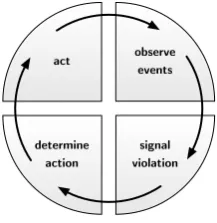
‣
“The principle of rule-based process management is that any violation of a business rule may be used to trigger actions”.This means that every time a business event occurs, a rule engine checks all related business rules for violations. If a violation is detected, some action needs to be taken. This can be an automated action if the violations are maintained by the system. If they are not maintained by the system, it prompts users for action in the form of signals. This functionality is provided by projector rules which will be detailed in section 4.3.3. Fig. 11 illustrates the principle of rule-based BPM. Before we can explain how this works for our example, we need to define business rules that will guide and constrain our process i.e. exert control. For readability purposes, we will define these business rules and illustrate how the principle of rule-based BPM works in section 4.3.3.
Figure 11. Principle of rule-based process management.
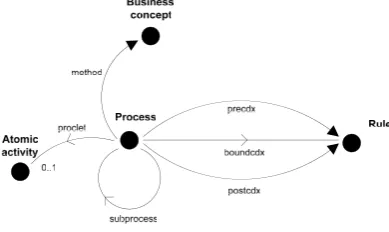
This principle has been translated into a framework for rule-based process design (Stornebrink, 2010). A process can be modeled with three kinds of rules (i.e. conditions): (1) pre-conditions (precdx); (2) post-conditions (postcdx); and (3) boundary-conditions (boundcdx). A process consists of one pre-condition, which defines the condition upon which it may start; one post-condition, which defines the condition upon it may terminate; and any number of boundary-conditions, each of which need to be satisfied within the process at any time. These principles have been translated into a set of 11 characteristics, see fig. 12.
Rule engine
Violation
automated Worker
signal
Business rules
Business vocabulary Terms
Fact types
Constraints Rejector rules
Producer rules
Projector rules Processes
Rejector rules
Producer rules
Figure 12. Rule-based process model principles (adapted from Stornebrink, 2010).
Fig. 13 depicts the principles for rule-based process design. The conceptual model is depicted in ADL6.
Figure 13. Conceptual model of rule-based process design in ADL (adapted from Stornebrink, 2010).
Note that Stornebrink’s framework has been proven to work with a proof-of-concept. However there are no open-source or commercial implementations of rule-based BPM as described by Joosten & Joosten (2007). To be able to provide a complete business rule approach to semantic IS development, we will use the principle of rule-based BPM. How this would work our example, will be explained in the next sub-section.
4.3.3.
Control
Control is enforced by business rules, since they constrain a certain aspect of the business. These kinds of business rules are also called ‘action assertions’ (Hall & Healy, 2000). Where structure (i.e. structural assertions) defines possibilities, control (i.e. action assertions) imposes constraints on the behavior within the business. Control rules concern the dynamic aspect of the business. They are usually recognized
1. A process can only start if the precdx rule is met.
2. All work done within a process is aimed at fulfilling the postcdx rule.
3. All word done within a process is constrained by boundcdx rules.
4. Complex processes can be decomposed into more basic processes by means of subprocess. 5. Subprocess is anti-symmetric and irreflexive
An irreflexive process cannot be a subprocess of itself and anti-symmetry prohibits child objects to be linked back to their parent by the same relation.
6. The postcdx rule of a subprocess process must contribute to the postcdx rule or boundcdx rule
of its parent process.
7. Every process shall maintain every constraining boundcdx rule of its parent processes.
8. A business concept is the define-time specification of data sets that are to be treated according to a specific set of rules.
A business concept here is the same as a concept (i.e. term) to which the process in question refers to. 9. Method: A process is defined as a method to operate on instances of a business concept. 10. An atomic activity is the way of executing a process (i.e. procedure or script).
11.Proclet: Every process that is not decomposed into sub processes must be assigned an atomic activity.
6 ADL stands for A Description Language and is based on relational algebra. It can be used to define a repository in which rules can be stored within
through the words ‘must’ (or ‘should’) or ‘must not’ (or ‘should not’). The BRG definition of an action assertion is as follows:
‣
“A statement that concerns some dynamic aspect of the business. It specifies constraints on the results that actions can produce.” (Hall & Healy, 2000).Control rules can usually be seen in the processes of a business system (Ross, 2003). Ross compares control rules to the nervous system of the human body. Just like nerves trigger muscles to move in a certain way, so can business rules control or constrain processes. Ross (2003) distinguishes three types of rules, based on the type of control they exercise: (1) rejectors; (2) producers; and (3) projectors. All rules fall in one these three categories. A complete list of control rules, can be found in table 12, appendix B. From this point on, the following typographical convention will be used to define different aspects of business rules. The rules will be depicted in Structured English.
• terms are underlined
• fact types are given in italics
• literal values and instance names are shown with double underlines
• keywords are shown in bold font
• uninterpreted text is shown in normal font style
Rejector rules
Most rules are naturally rejector rules (or constraints), they simply reject any event that would violate the rule. Looking at our running example, the following business rules (BR) would be rejectors:
BR1 A rejected claim may not be processed
BR2 A claim from an unknown client is rejected
BR3 A claim with a treatment date ofclaim older than one year is rejected
BR4 An invoice payment must be paid within the payment limit
BR5 An invoice payment must be based on an invoice
Producer rules
Then there are producer rules that neither rejects or project events. Producers compute or derivate values based