How software process improvement standards and
agile methods co-exist in software organisations?
This thesis is presented for the degree of Master of Science of the University of Twente.
Author:
Ngoc Tuan Nguyen
Thesis MSc. Business Information Technology.
Enschede, August 2010.
Graduation commission:
Dr.Ir. Maya Daneva
MSc. Zornitza Racheva (PhD Associate)
Dr. Chintan Amrit
Management summary
We are living in the world of extreme uncertainty. There is always an excess of changes, the unknown, and we often have to solve various life problems. In many cases, not only the solutions are unknown, but also the problems are unknown.
In the software industry, the situation is the same. Software projects are inherently chaotic and unpredictable, and as a result, cannot be managed by processes that are best suited to well-defined problem domains. Those processes are defined by traditional waterfall methodologies which are commonly used to date. Agile Software Development methodologies evolved out of the need to address the serious problem facing the software industry, and promise to help “software” people comfortable with chaos, ambiguity and the unknown.
Many software companies have successfully adopted agile methodologies. Moreover, the processes of adopting and adapting agile approaches take place concurrently with the process of getting more mature in those companies. There might have been two tracks of getting more mature: 1) get to higher level of agile maturity, in which agile practices and processes in a company become more disciplined and scalable; and 2) get to higher maturity by adapting or blending agile processes and practices with some standard maturity model such as CMM-SW or ISO 9001.
This research project first looks at literature to see the relationships between high level of maturity to the value and quality of software, as well as the value created to customers. We expected that high maturity level has positive impact on software quality, user satisfaction and value creation. The results drawn from literature review consolidate that, and more interestingly, they show that high process maturity significantly reduces waste as well. As waste reduction, value creation and user satisfaction are believed to be the focus of agile methods, we next examine how agile practices and a maturity model can co-exist in an organisation and together bring more benefits to the organisation and its customers. The results show that the SPI standards really fit with agile methods, and that it is better if organisations can embrace both, since they benefit each other and bring more customer satisfaction as well as reducing waste and creating higher software quality and higher value creation.
How to read this report?
We highly recommend that you read this report from beginning to the end. However, if at any point you want to look at specific important pieces of information, the following guide could be helpful:
• To get information on the research objective you can have a look at Chapter 2, especially sections 2.2. Research objective, 2.3. Problem statement and 2.4. Research questions.
• To get an overview of agile software development, agile methods and agile practices you can read Chapter 3. For the introduction to the most two popular agile methods XP and Scrum, please go to sections 3.5. Scrum and 3.6. XP.
• If you want to know about the definitions of all the main concepts used in this thesis, please read Section 4.1.
• The rest of Chapter 4 (sections 4.2, 4.3) is about the main findings from previously published studies about the issues that related to the research questions in Section 2.4.
• To get the results of the case study, please read Chapter 6, especially Section 6.4. Data analysis.
• To discuss the results of the case study as well as getting some recommendations for the case study organisation, please read Chapter 7.
Preface
This thesis is the result of my final assignment for my study in the UT. The project takes me more than six months but the story about how I chose the agile software development area as my final research started long before. About one year ago, I contacted Dr. Maya Daneva for a research topic and she told me the term “Agile Software Development”. I remember asking her exactly: “Is that about coding?!”, and she answered that it is about software project management, and that Agile is the new way to manage the work that teams carry out to deliver a software product. Then I entered the “Agile world”.
Since then, I have learned a lot more about agile philosophy as well as software development processes. The Agile world is so large as agile approaches are getting into the mainstream of software development. I believe agile is the most suitable approach in my home country, where most of the software companies are small and medium-sized organisations. In addition, many software companies in my country are either certified a CMM-SW or an ISO 9001, or pursuing one in order to be recognized as high mature organisations. Therefore, my study about the coexistence of software process improvement standard and agile methods in organisations would be really useful for me when I go back to my country to work.
I am indebted to a lot of people. Of course, the first person I would like to thank is Dr. Maya Daneva who introduced me to the field of research as well as introducing me to my other supervisors Msc. Zornitza Racheva and Dr. Chintan Amrit. Maya has supported me all the way, all the time. The second person I am very grateful to is Zornitza, who has been closely guiding me from the start of the project. It was amazing that she answered my emails at anytime. I am also thankful to Chintan for suggesting and revising my case study analysis as well as giving valuable comments on other parts of my research. Thank you all my supervisors for always being patient with my questions and for giving meaningful and useful feedback on my research.
I also would like to say thanks to Dr. Klaas Sikkel. One year ago, he and Maya, Zornitza together gave me some very helpful suggestions for starting my research in agile world, and for this master project, Klaas reviewed the questionnaire of my case study and gave me valuable comments. I am so grateful to Thijs Munsterman, Martin Krans, Johan te Winkel, and Niek Hoogma from Topicus for attending my interviews for the case study and answering my emails. Those Topicus people really impressed me so much, not only with the information they provided, but also with the way they welcomed me at Topicus as well as the way they responded to my questions.
As an international student, I never just simply take your all support for granted.
Ngoc Tuan Nguyen Friday, July 23 2010,
Table of contents
Chapter 1: Introduction ... 8
1.1. Motivation ... 9
1.2. Related work... 9
Chapter 2: Problem definition ... 10
2.1. Project boundaries ... 10
2.2. Research objective... 10
2.3. Problem statement ... 10
2.4. Research questions ... 11
2.4.1. Research question 1 (RQ1) ... 11
2.4.2. Research question 2 (RQ2) ... 11
2.5. Research method ... 12
2.5.1. Literature review ... 13
2.5.2. Case study ... 14
Chapter 3: Agile development... 15
3.1. Introduction to agile development ... 15
3.2. Agile practices ... 16
3.2.1. The Manifesto for Agile Software Development... 16
3.2.2. Principles... 18
3.3. Agile Software Development... 19
3.4. Agile Project Management ... 19
3.5. Scrum... 20
3.6. Extreme programming (XP) ... 22
Chapter 4: Literature background ... 24
4.1. Definitions ... 24
4.1.1. Customer value... 24
4.1.2. Customer satisfaction... 24
4.1.3. Software quality ... 24
4.1.4. Cycle time ... 25
4.1.5. Waste ... 25
4.1.6. CMM-SW ... 27
4.1.7. ISO 9001 ... 29
4.1.8. CMM versus ISO 9001 ... 29
4.2. Level of maturity and software value... 32
4.2.1. Maturity level and value creation... 33
4.2.2. Maturity level and customer satisfaction ... 34
4.2.3. Maturity level and software quality... 35
4.2.4. Maturity level and cycle time... 35
4.2.5. Aggregation of the findings ... 36
4.2.6. Maturity level and waste reduction ... 37
4.2.7. Adding the new findings to the aggregation model ... 39
4.2.8. Conclusions and discussions... 39
4.3. Level of maturity and Agility ... 40
4.3.1. The CMM – Agile fit... 41
4.3.2. Mutual benefits of combining high level of maturity and Agile... 45
4.3.3. Implementation of agile methods into mature organisations... 47
4.3.4. The adaptation of agile methods in organisations that have higher maturity level 47 4.3.5. Conclusions and discussion ... 49
Chapter 5: The model... 50
Chapter 6: Case study ... 51
6.2. Case study design ... 52
6.2.1. Questionnaire ... 52
6.2.2. Units of analysis ... 53
6.3. Data collection ... 54
6.3.1. The interviews ... 54
6.3.2. Selecting the interviewees... 54
6.3.3. The interview procedure ... 54
6.4. Data analysis ... 55
6.4.1. Analytic strategy... 55
6.4.2. The analysis and results ... 55
6.5. Conclusions... 71
Chapter 7: Disscussion and recommendations ... 72
7.1. Discussion... 72
7.2. What do we really need to do?... 75
7.3. Threats to validity ... 78
Chapter 8: Conclusions ... 81
8.1. Practical implications ... 81
8.2. Theoretical implications ... 81
8.3. Limitations of this study ... 82
8.4. Implications for further research... 82
References: ... 83
Appendix A. A quick overview of Extreme Programming... 88
Appendix B. Scrum... 93
Appendix C. The waterfall model ... 96
List of tables
Table 3.1. The differences between Waterfall and Agile projects………16
Table 3.2. Different Scrum practices……….21
Table 3.3. Different XP practices………..23
Table 4.1. Definitions of the major concepts……….27
Table 4.2. Key process areas in the CMM……….28
Table 4.3. Summary mapping between ISO 9001 and CMM………32
Table 4.4.XP practices and CMM KPAs………..43
Table 4.5.Scrum practices and CMM project management process areas………44
Table 6.1. Units of analysis………53
Table 6.2. Agile practices used in Topicus……….61
Table 6.3. Project-based characteristics………..69
Table 6.4. Practices used in the two projects………..70
Table 7.1. Topicus’ agile practices and CMM-SW KPAs………..74
Table A. The “extreme” in Extreme Programming……….88
Table C.Methodology comparison……….97
List of figures
Figure 2.1. Research model……….12Figure 2.2. Research approach………12
Figure 3.1. Scrum process overview………...20
Figure 3.2. A visual process model for eXtreme Programming………..22
Figure 4.1. Waste decomposition………26
Figure 4.2. Research results question 1 in details………...37
Figure 4.3. The relationships between process maturity and cost, development effort, cycle Time………38
Figure 4.4.Model for research question 1 in abstract level………39
Figure 5.1. The research framework………...50
Figure A. The practices support each other……….92
Figure B. Scrum process in details………..93
Chapter 1: Introduction
This chapter aims to provide some background information regarding the research area in this master thesis. Moreover, the rationale behind the study and the related work done in previously published studies will also be discussed.
Numerous agile methods [45] have appeared in the last decade. Software development processes following agile methods (e.g., XP [2], Scrum [42]) and those following software process improvement (SPI) approaches (e.g., ISO 9001 [35], CMM [21] which define maturity levels) are normally considered contradictory [50]. Agile methods, on one hand, are light-weight methods and focus on fast delivery of valuable products. On the other hand, maturity standards have become heavy-weight and too much bureaucratic since they heavily focus on quality and documentation. CMM relies on institutionalization and documentation of process and methodologies, while Agile emphasizes interaction among workers and “working software over comprehensive documentation” (Agile Manifesto [1]).
Boehm and Turner [3], however, point out that organisations require both agility and discipline in order to be successful. Successful software development is challenged by the supplier’s ability to manage complexity, technology innovation, and requirements change (or uncertainty at large). While management of complexity requires process discipline, management of change requires flexibility and adaptability [13]. Moreover, other researchers also conclude that while SPI standards guide organisations what to do in general terms, agile practices (e.g., XP) provide specific how-to information. Therefore, for the purpose of software success, the software engineering literature sources [3, 7, 8, 10, 11, 12, 13, 15, 37, 39, 43, 51] agree that agile methods and software processes at SPI-standards-compliant organisations can be complementary if cleverly combined.
With the advancement of agile methods and their penetration in the software industry, many people believe that agile methods and practices and maturity standards can co-exist in an organisation as a means to achieve excellence. One implication of that excellence is to develop the highest quality software in the shortest possible time.
In this research, process refers to the description of phases in the product life-cycle through which the software is being produced, and practices are concrete activities and work-products that a method defines to be (regularly) used in the process.
1.1. Motivation
Nowadays there are more and more software companies pursuing a certification of software process maturity standards, and also a lot of firms adopting agile methods as an approach to increasing their software development efficiency. That might be because improving the development or working process is more focused, since it as important as product innovation. Although the two approaches can contribute to the same organisation’s goals (e.g., developing higher quality software, gaining more customer satisfaction, and reducing waste), they are different approaches as introduced above. Therefore a study is needed on how the two ways can take advantages of each other to achieve the common goals.
1.2. Related work
There have been a number of publications focusing on the relationship between CMM/ISO and agile development [8] as well as literature sources discussing the application of CMMI/ ISO 9001 to agile software development [10, 12]. Previously published relevant studies by other researchers only discussed how organisations with certain level of maturity aligns or conforms to agile practices and the other way around, but do not examine thoroughly how agile practices and SPI standards in turn should adjust when adopted to organisations.
There are certain aspects in which this study is different from the others.On one hand, other studies [8, 9, 10, 11, 13, 15, 51] only discuss the compatibility of Agile methods and CMM/CMMI, or the application of a specific agile methods (XP or Scrum) in CMM or ISO 9001. Only a few examined the implementation of CMM or ISO 9001 in combination of agile methods, which are XP and Scrum (XP@Scrum [37, 47, 53]) [37]. Therefore, it is possible to make a conclusion that the issues on the “marriage” between agile methods and SPI standards have not been investigated in sufficient depth and breadth.
Chapter 2: Problem definition
The objective of this chapter is to define the problem as well as introducing the way to solve the problem. Below, the following issues will be discussed: the boundaries of the research project in this master thesis (Section 2.1), the research objective (Section 2.2), the problem statement (Section 2.3), the research questions (Section 2.4) and the research methods that are used (Section 2.5).
2.1. Project boundaries
This master project research focuses only on common SPI standards such as ISO 9001 and CMMI (and its predecessors), as well as the most popular agile software development (or application development) and management methods which are Scrum and XP. In our study, the literature sources are publications including papers in scientific libraries (Scopus) and books by prominent practitioners on agile software development.
The research context is that of organisations willing to blend agile methods with SPI standards. However, this project also includes empirical research that is a case study carried out in a Dutch agile software company, Topicus. Therefore, we will narrow the discussion on the marriage of agile and SPI-standard based certification as it applies to the particular contextual settings of this company.
2.2. Research objective
This research aims to provide a better understanding about the relationship between SPI standards and agile practices as well as to identify the possible ways for improvement that co-existence in some specific settings, and to recommend some guidelines for their adoption to each other. It is the case that the majority of people (even if they adopt CMM or ISO) agree that in most cases they understand what need to be improved, but they need more guidance about how to improve it.
The objective of this research is to take the best of SPI standards and the agile methodologies and combine them. To do that, this research will show how the most widely used agile methods (e.g., XP and Scrum) address the areas of SPI standards (e.g., CMM). This is useful for those organisations that have their plan-driven process based on an SPI standard model and are planning to improve its processes towards agility.
2.3. Problem statement
2.4. Research questions
In order to achieve the research goal, two main questions need to be answered:
2.4.1. Research question 1 (RQ1)
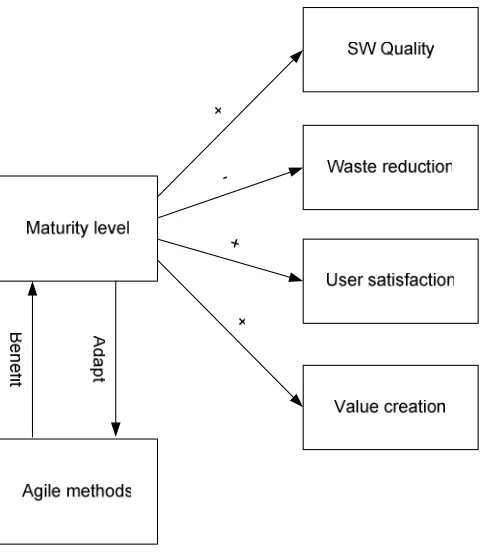
What are the relationships between maturity level and software quality, waste reduction, value creation and user satisfaction?
In this question, the term “maturity level” refers to the degree of traditional maturity alone, which is usually defined by a CMM-SW [21] or ISO 9001 [35] requirements and without considering the adoption of agile methods. Software quality, waste reduction, value creation, and user satisfaction are examined in the software development as a whole.
As the IT industry is growing very fast due to rapid innovations, there has been an intense competition among IT firms at large as well as among software development companies. Therefore, making high quality software products, delivering on-time and on-budget (or low-costs) has always been crucial for software firms.
In the context of this research, software quality is the focus of both SPI standards and agile methods, but the concepts of waste reduction, value creation, and user satisfaction are of the main benefits that agile methods promise [1, 3, 60, 64].
We make the note that RQ1 means the author of this research expects that the higher level of maturity, the higher quality of software delivered and the less waste reduction exists. Moreover, as value creation and user satisfaction depend on context and are client-dependent, this research will also examine in respect to what aspects value creation and client satisfaction increase or decrease in conjunction with the growth of maturity.
2.4.2. Research question 2 (RQ2)
What is the relationship between process maturity models and agile software development methods?
For this question, there are three sub-questions:
i) Does process maturity models fit with agile methods
ii) How can agile methods benefit from higher level of maturity of an organisation?
iii) How can agile methods be adapted in organisations that have high level of maturity? We make the note that the two main research questions (RQ1 and RQ2) are inter-related. They are all about how maturity level and agile methods can take advantages of each other strength as well as minimizing the disadvantage of each approach on the adoption of the other.
Figure 2.1. Research model.
2.5. Research method
In this master thesis we conduct a qualitative research [14] in order to obtain a good understanding on the problem that is being investigated. In this approach to empirical research, the focus is to study the objects and concepts in their own environment.
Literature review of SPI
Literature review of Agile methods
Literature review of application of agile in SPI
Literature study How SPI and Agile fit
Case study How it is in reality
Insight in SPI – Agile fit
Reccommendations
[image:12.612.92.524.465.663.2]As shown in the Figure 2.2, the main research methods to be used in this project are literature study and case study. The literature study on how SPI and Agile fit together is served by three literature reviews as the inputs.
Firstly, for Literature review of SPI, the traditional way of developing software and the SPI standards such as CMM-SW and ISO 9001 are studied. Their main principles, patterns and practices are discussed to show how and where they best work.
Secondly, this research looks at Agile as a toolbox in the Literature review of Agile methods, where Agile as a philosophy, as a value system, and as a software development paradigm, is discussed. Furthermore, the most popular agile practices or methods such as XP and Scrum, which have chosen elements from the general agile toolbox, are deeper dug into. Those practices are what practitioners really do nowadays. Similar to the review on SPI, the review on Agile also shows how and where agile practices work best.
Lastly, and closer to the main literature study part, is the review on the application of Agile in SPI. This part will review from existing studies, research and publications on how agile methods or practices can be matched to SPI processes and practices. That is, about the matches among CMM-SW, ISO 9001 and Scrum, XP.
Then, the conclusions on how SPI and Agile fit together are formed from the literature reviews above. Some ideas from the author of this research are also expressed. This shapes Chapter 4 (Literature background).
Next, in this project we take one specific organisation as the site of a case study about how practitioners fit their existing agile philosophy, values, and development approach to the goal of achieving an SPI-standard based certification. The case study, Topicus is a Dutch middle-sized company adopting agile and getting more mature.
Drawing on the results from our literature study and our case study, this research comes up with the answers of the research questions and with guidelines and recommendations for companies in certain contexts to deal with achieving higher maturity with agile, and shows whether the research objectives are met or not.
2.5.1. Literature review
2.5.2. Case study
The case study will be conducted according to Yin [14] which consists of the following phases:
• Design: in this research, it is a single exploratory case study
• Implementation: the designed case study is developed to answer the (sub) research questions. A questionnaire is made, together with some documentations on the case will be collected. Moreover, there can be both electronic (email) interviews and face-to-face interviews.
• Analyse the data gathered
• Draw conclusions and recommendations
More details about the case study will be discussed in Chapter 6 of this report.
Chapter 3: Agile development
This chapter will first give an introduction into agile software development, which consists of agile values, agile principles, and agile practices based on those values and principles. Next, some results are drawn from existing reviews ([45, 46]) about agile methods, their processes and practices. Lastly, the two most widely used agile methods (eXtreme Programming and Scrum) will be discussed.
3.1. Introduction to agile development
Agile – denoting “the quality of being agile; readiness for motion; nimbleness, activity, dexterity in motion” [45] – software development methods are attempting to offer an answer to the eager business community asking for lighter weight along with faster and nimbler software development processes. This is especially the case with the rapidly growing and volatile Internet software industry as well as for the emerging mobile application environment.
Agile development is a way of organizing the development process, emphasizing direct and frequent communication – preferably face-to-face, frequent deliveries of working software increments, short iterations, active customer engagement throughout the whole development life-cycle and change responsiveness rather than change avoidance [12]. Thus, agile software development recognizes that software development is inherently a type of product development and therefore a learning process. It is iterative, explorative and designed to facilitate learning as quickly and efficiently as possible. Two of the most significant characteristics of agile approaches are: 1) they can handle unstable requirements throughout the development cycle; and 2) they deliver products in shorter time-frames and under budget constraints when compared with traditional development methods.
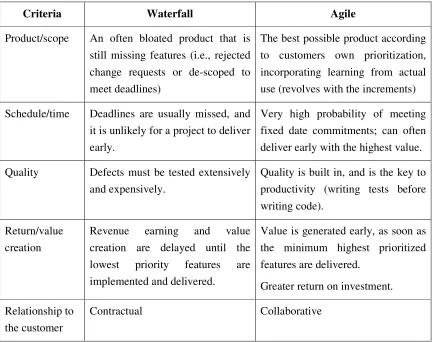
An agile approach can be seen as a contrast to waterfall-like processes [42, 52, 66] which pay attention to thorough and detailed planning and design upfront and consecutive plan conformance. The waterfall model is the oldest and the most mature software development model [52]. In practice, the waterfall development model can be followed in a linear way, and an iteration in an agile method can also be treated as a miniature waterfall lifecycle. Table 3.1 (on next page) summarizes some of the differences between waterfall and agile projects.
Usage of agile approaches
Criteria Waterfall Agile
Product/scope An often bloated product that is still missing features (i.e., rejected change requests or de-scoped to meet deadlines)
The best possible product according to customers own prioritization, incorporating learning from actual use (revolves with the increments)
Schedule/time Deadlines are usually missed, and it is unlikely for a project to deliver early.
Very high probability of meeting fixed date commitments; can often deliver early with the highest value.
Quality Defects must be tested extensively and expensively.
Quality is built in, and is the key to productivity (writing tests before writing code).
Return/value creation
Revenue earning and value creation are delayed until the lowest priority features are implemented and delivered.
Value is generated early, as soon as the minimum highest prioritized features are delivered.
Greater return on investment.
Relationship to the customer
[image:16.612.101.534.57.399.2]Contractual Collaborative
Table 3.1. The differences between Waterfall and Agile projects
3.2. Agile practices
Experiencing a project with no practices to guide its execution is a nightmare. Firstly, the lack of effective practices leads to unpredictability, repeated error, waste effort, and so on. Moreover, customers (or clients) are disappointed by slipping schedules, growing budgets, and poor quality. Also, developers are disheartened by working ever longer hours to produce ever worse software. This part discusses the principles behind all agile practices contemporarily used.
3.2.1. The Manifesto for Agile Software Development
The Manifesto for Agile Software development was created in 2001 by Agile Alliance – a group of experts in software industry. The Manifesto [1] says:
“We are uncovering better ways of developing software by doing it and helping others do it. Through this work we have come to value
•
Individuals and interactions
over processes and tools•
Customer collaboration
over contract negotiation•
Responding to change
over following a planThat is, while there is value in the items on the right, we value the items on the left more.” Firstly, by valuing individuals and interactions over processes and tools, the manifesto confirms that people are the most important ingredient of success. A good process will not help the project deliver the truly satisfying product if the team does not have strong enough players (who work well with others). Moreover, it is the case that even a group of skillful people can fail badly if they do not work effectively as a team [40]. Furthermore, the valuation suggests that the right tools (e.g., editors, compliers, IDEs (Integrated Development Environment), source-code control systems, etc.), or the development environment at large, can be very important to success but they should not be overemphasized. Building the team is more important than building the environment.
Secondly, working software is considered more important than comprehensive documentation. This mean a development team should concentrate on developing valuable software for customer, and “produce no document unless its need is immediate and significant” [40]. Working software is fully tested software that is ready for release, in the context of agile development it is also a package of high-value prioritized functions and features. However, it is obvious that software without documentation is a disaster. The team needs to produce human-readable documents that describe the system and the rationale for their design decisions. Documents are needed for transferring “knowledge” among the members of the team, between the team and customer, or for maintenance or reuse in the future (or the knowledge management of the organisation at large). In the cases documentation is needed, however, it should be also short and only the most important features or the highest-level structures in the system are included.
Thirdly, the manifesto values customer collaboration over contract negotiation. A normal contract specifies the requirements, schedule, and cost of a project. In most cases, those terms are not appropriate even long before the project is finished. For software product, mostly customer do not know exactly all what they want (the requirements) in the beginning. They sometimes cannot even articulate what they need the software to have. So the best contracts are those that specify the way the development team and the customer would work together. To be successful, the project should involve customer feedback frequently by closely working between customer and the development team.
customers are likely to alter their requirements once they see the working software (“I will know when I see it” (IWKWISI) seems not to be an uncommon customer’s statement). That is why a good planning strategy should be only detailed for the next two or three weeks, and the time beyond that should only be planned roughly, so that we can better respond to change.
3.2.2. Principles
There are twelve principles behind the Manifesto described above. The principles, which form agile concepts, are also characteristics that differentiate agile practices from a heavy-weight process [1, 2, 4, 40]:
• Our highest priority is to satisfy the customer through early and continuous delivery of valuable software.
• Welcome changing requirements, even late in development. Agile processes harness change for the customer’s competitive advantage.
• Deliver working software frequently, from a couple of weeks to a couple of months, with a reference to the shorter time scale.
• Business people and developers must work together daily throughout the project. • Build project around motivated individuals. Give them the environment and the
support they need, and trust them to get the job done.
• The most efficient and effective method of conveying information to and within a development team is face-to-face conversation.
• Working software is the primary measure of progress
• Agile processes promote sustainable development. The sponsors, developers, and users should be able to maintain a constant pace indefinitely.
• Continuous attention to technical excellence and good design enhances agility
• Simplicity – the art of maximizing the amount of work not done – is essential. The reason is change is inevitable, thus planning for the future functions is a waste of time (YAGNI – You Aren’t Going to Need It).
• The best architectures, requirements, and designs emerge from self-organizing teams. • At regular intervals, the team reflects on how to become more effective, then tunes
and adjusts its behavior accordingly.
Each iteration includes tasks needed for releasing a working software in the end of the iteration which meets minimal highest priority requirements. Working software is the primary measure of progress. At the end of each iteration, the rest requirements are re-prioritized. Thus agile methods “embrace” change, focus on simplicity, and release often. Moreover, agile methods emphasize the face-to-face, real-time communication over written documents. Each development team also includes some people from clients (business side) to get feedback frequently. This means most agile teams include all people necessary to finish the software, which are developers, project managers, business analysts, actual (on-site) customer, and testers. All these members are typically co-located.
Tacit knowledge
As can be implied from the principles, agile methods rely on tacit knowledge [3, 56]. Tacit knowledge is highly personal. It is hard to formalize or document and, therefore, difficult to communicate to others [56]. Tacit knowledge is also deeply rooted in action and in individual’s commitment to a specific context, and can only be learnt through observation, imitation, and practice. One of the obvious examples of tacit knowledge is technical skills – the kind of informal, hard-to-pin-down skills captured in the term “know-how” [74]. In a software project, agility is achieved by establishing and updating the project knowledge in the participants’ heads rather than in documents (explicit knowledge) [3]. Explicit knowledge in terms of documentation and design should be kept to a minimum.
3.3. Agile Software Development
Agile software development (ASD) is a conceptual framework for undertaking software projects. It is defined as “evolutionary approaches which are collaborative and self-organizing in nature, producing high-quality systems that meets the changing needs of stakeholders in a cost effective and timely manner” [22]. There are a number of agile software development methodologies such as eXtremely Programming (XP, see more 3.6. eXtreme Programming), Crystal methods, Dynamic Systems Development Model (DSDM), Feature-Driven Development (FDD).
3.4. Agile Project Management
Agile project management (APM) approaches refer to “the work of energizing, empowering and enabling project teams to rapidly and reliably deliver customer value by engaging customer and continuously learning and adapting to their changing needs and environments” [22].
Figure 3.1. Scrum process overview [38].
APM practices more clearly separate from ASD practices in the challenge of scalability. For example, XP mostly works well with small-sized teams but Scum has evolved to fit any team size [68, 69, 79].
The line of the present research seems to focus much more on APM than on ASD. However, in this thesis, the author mainly considers agility as a philosophy, thus takes into consideration both ASD and APM practices in the same way. This means when saying “agile practice”, the practice can be either software development practice or software management practice.
3.5. Scrum
As can be seen in Figure 3.1, Scrum is a light-weight process to manage and control development work. That is, it implements process control techniques. It is a team-based approach to iteratively, incrementally develop systems and products when requirements are rapidly changing.
[image:20.612.183.458.58.286.2]Project planning in Scrum is based on a Product Backlog [44], which contains functions and technology enhancements imagined or formed for the project. There are two meetings held, one is for deciding the features of the next Sprint and the other for planning out the work. In addition, a Sprint Goal is set which serves as a minimum success criterion for the Sprint and acts to keep the team focused on the broader picture rather than narrowly on the task at hand. Therefore, Scrum offers a means of introducing agile methods into a traditionally disciplined environment. However, Scrum is not conceived as an independent method, but a complement to other methods like XP. Therefore, Scrum stresses management values and practices, but it does not include practices for the technical parts (requirements, design, and implementation) which are already complemented by other agile methods (see more in Appendix B. Scrum). Since Scrum’s emphasis is on project management, it requires certain management practices and tools in its various phases to avoid the chaos caused by unpredictability and complexity [42]. Table 3.2 presents three lists of the different Scrum practices that have been adopted and adapted in reality and mentioned in previously published studies [44, 45, 65].
Schwaber & Sutherland [44] Abrahamsson et al [45] Upender [65]
Sprint Sprint Sprint
Daily Scrum Daily Scrum meeting Daily Scrum
Sprint planning meeting Sprint planning meeting Sprint planning
Sprint review Sprint review meeting Sprint review
Sprint retrospective Not applied. Not applied.
Release planning meeting Effort estimation Not explicitly mentioned.
Product backlog (User stories/use cases)
Product backlog Product backlog
Sprint backlog Sprint backlog Sprint backlog (as a subset of product backlog)
Release burn-down Not mentioned. Burn-down chart
Sprint burn-down Not mentioned. Burn-down chart
Just-in-time planning at Daily Scrum
Not mentioned. Just-in-time design
It is possible to conclude from Table 3.2 that Scrum practices have been sustained and refined and that in each specific context or situation, the adoption of the practices may include some adaptation both in terms of the names and the content.
3.6. Extreme programming (XP)
Extreme Programming or XP was created for small and medium size software development teams where requirements are vague, change rapidly or are very critical. XP was designed in order to address the problems with traditional development methodologies with respect to deadlines and client satisfaction [37]. The core objective of XP is to succeed in reaching the client satisfaction (see more in Appendix A. A quick overview of eXtreme Programming). XP recommendations are oriented towards getting high quality software.
[image:22.612.109.531.436.624.2]With XP, work is usually performed by small teams that include a customer continuously present on-site. As shown in Figure 3.2, XP development begins with the planning game, where customers and developers negotiate requirements in the form of user stories. The system concept is captured in terms of a metaphor, to support a single vision of success. The fundamental short cycle time (iteration) is no more than three weeks. Moreover, the technical process assumes collective ownership of the product so that anyone can work on anything. This fits with simple design, pair programming, and emergent design through refactoring to work. Coding standards are established by the team, and quality is assured through a test-first approach and continuous integration.
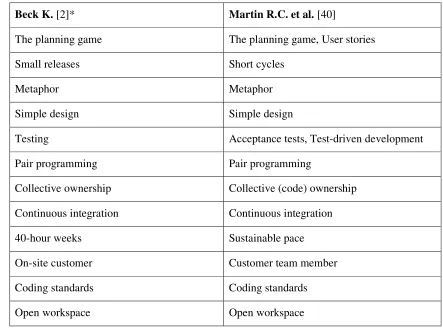
Table 3.3 presents common XP practices named differently by different authors ([2, 40]). The items in the lists are in order that compares the similar or same practices in the two literatures. As can be seen, the names of basic practices are mostly unchanged.
Beck K. [2]* Martin R.C. et al. [40]
The planning game The planning game, User stories
Small releases Short cycles
Metaphor Metaphor
Simple design Simple design
Testing Acceptance tests, Test-driven development
Pair programming Pair programming
Collective ownership Collective (code) ownership
Continuous integration Continuous integration
40-hour weeks Sustainable pace
On-site customer Customer team member
Coding standards Coding standards
[image:23.612.91.534.131.464.2]Open workspace Open workspace
Table 3.3. Different XP practices.
Chapter 4: Literature background
The goals of this chapter is to discuss some main concepts related to the issues in the research questions (Section 2.4) as well as the main findings from literature study for answering those research questions (Sections 4.2 and 4.3). As a literature review should be complete and focuses on concepts [48], we first introduce the concepts by giving their definitions.
4.1. Definitions
Below, the following definitions of terms and phrases will serve to help readers understand the terminologies used in this research: customer value, customer satisfaction, software quality, cycle time, waste, CMM/CMMI, and ISO 9001.
4.1.1. Customer value
The common understanding of customer value is the customer’s perceived trade-off between benefits (what the customer receives) versus sacrifices (what he or she gives up) while acquiring and using the product in a given situation [27, 31]. That is, customer value can be the level of return in the product benefits for a customer’s payment in a purchase exchange, or in wider meaning, it is the judgment of value results from a trade-off between what the customer receives (e.g., quality, benefits, worth, ease of use,) and what he or she gives up (e.g., price, sacrifices).
Customers in this context are understood mainly as the clients who pay for the software (this also include the business-side people in each agile development team). So customer value means business value, which delivers profit to the organisation paying for the software in terms of, for example, the reduction of costs (less money), the improvement in service or performance (software quality), or the rise in revenue. However, the business cannot get value unless the software is used. That is the reason why the value creation process will also have to deal with the people who eventually use the software (end-users or target-users).
4.1.2. Customer satisfaction
Customer satisfaction generally refers to the degree of customer’s positive (or negative) feelings about the value they receive as a result of using a product (or a service). In this research’s context, customer satisfaction can be measured as the difference between the customer’s (or client’s) expectations on the output of the software contract and their experience. Therefore, customer value drives customer satisfaction.
4.1.3. Software quality
increased software functionality provide more opportunity for the existence of errors. The possibility of defects is also increased by more modules and the degree of cohesion between them.
What is more, this definition is based on errors uncovered in system and acceptance testing, and these errors are determined according to customer specifications. There are certain levels of testing that are carried out to recognize software quality in software development life-cycle. First, unit testing (or component testing) refers to tests that conducted separately for a specific section of code (module or component) to ensure that specific function is working as expected. This white-box test aims to detecting and removing syntactical errors. Second, system testing tests the complete product to verify whether discrete modules when integrated together will work to meet requirements. Lastly, acceptance tests are carried out by real customers to make sure the product meets all their specifications.
In 1991, the International Organisation for Standardization (ISO) adopted ISO 9126 as the standard for evaluating software quality. ISO/IEC 9126, which deals with the quality assurance of the process used for developing software products, provides quality models (internal, external and quality in use [25]) presenting an approach to look at different quality attributes.
4.1.4. Cycle time
Typically, cycle time is the time to develop the product, i.e., the elapsed time in days from the start of design on the product until its final acceptance by the customer [20]. Cycle time includes certain software development life-cycle phases which are high-level design, detailed design, coding, unit testing, system testing and acceptance testing. According to Argawal and Chari [18], cycle time is important outcome variable because software projects are often carried out under strict delivery schedules.
In ASD, cycle time is iterative (which usually is called iteration). This is the cycle that starts with a list of requirements (or an idea) and ends with a finished working software (or a finished product).
In typical software development life-cycle, it may take months, whereas in ASD, it is usually a couple of weeks (2-4 weeks).
4.1.5. Waste
In broad understanding, any work and work product that is not directly contributing to the development of software should be considered as waste and thus should be avoided or minimized [12].
Development effort refers to the person-months (or days) required to develop the software product. It also includes cost and is often regarded as a surrogate for software development cost since personnel cost is the dominant cost in software development.
[image:26.612.224.408.173.346.2] [image:26.612.96.533.544.733.2]Figure 4.1 shows the relationships considered among waste, too much development effort, cost, and cycle time (see the definition of cycle time in 3.1.4. Cycle time).
Figure 4.1. Waste decomposition. The arrows show the direction of contribution, e.g. waste in money contributes to the total waste of developing the software.
Figure 4.1 shows that in this research, waste consists of waste in development effort (personnel), waste in money (cost) and waste in development time. More waste of time and effort (more personnel) might lead to more waste of money (cost), but we do not examine those relationships. We only consider effort, money, and time as “ingredients” for estimating waste.
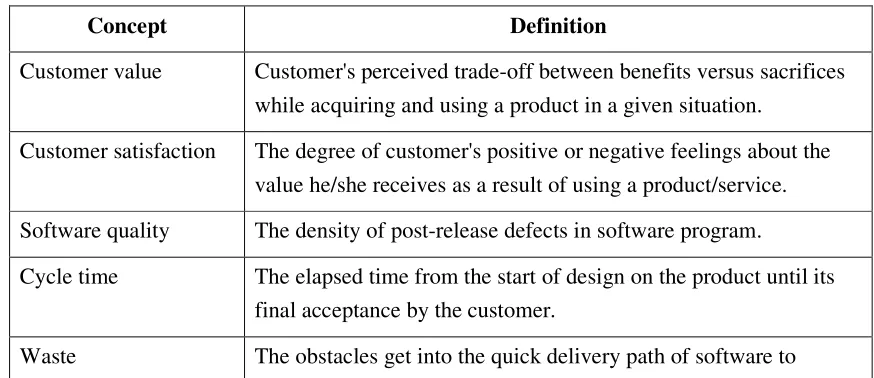
We summarize the definitions of the terms in Table 4.1 below.
Concept Definition
Customer value Customer's perceived trade-off between benefits versus sacrifices while acquiring and using a product in a given situation.
Customer satisfaction The degree of customer's positive or negative feelings about the value he/she receives as a result of using a product/service.
Software quality The density of post-release defects in software program.
Cycle time The elapsed time from the start of design on the product until its final acceptance by the customer.
customer.
Development effort Person-months (or days) required to develop a software product.
[image:27.612.101.534.61.144.2]Cost Money spent on developing a software product (mostly on personnel)
Table 4.1. Definitions of the major concepts.
4.1.6. CMM-SW
The Capability Maturity Model for software (CMM-SW) was developed by Software Engineering Institute to describe the principles and practices underlying software process maturity. Its aim is to help organisations improve their software process maturity through an evolutionary path, from ad hoc, chaotic to mature, and disciplined. CMM-SW also helps assess how well defined the software development processes in an organisation are. A well-defined process is one that has readiness criteria, clear inputs and outputs, probably some standards, and procedures for performing the work (or separate phases). Moreover, there are also verification mechanisms as well as completion criteria (when it is completely “done”) for that process [21]. In CMM-SW model, organisations at level 3 possess defined processed.
The CMM is organized into 5 levels. Level 1 Initial is where the software process is characterized as ad hoc, or even chaotic in some cases. From level 2 to level 5, each level consists of a set of key process areas (KPA) that an organisation should focus on to improve its software process. Each key process area in turn comprises a set of key practices that indicate if the implementation and institutionalization (we will discuss more about the concept of institutionalization later in Section 4.3.3) of that area is effective, repeatable, or lasting (see Table 4.2). As a glance at Table 4.2 shows, the KPAs are clearly important to all types of software organisations. In addition, while the KPAs in CMM Level 2 are project-oriented, those from CMM Level 3 upwards are organisational-oriented.
CMMI-SW
Capability Maturity Model Integration Software (CMMI-SW) evolved from the multiple models of CMM as a single reference model to make it easier for organisations to follow the model requirements.
CMM Level KPAs
Defect prevention
Technology change management Level 5: Optimizing
Continuous process improvement is enabled by quantitative feedback from the process and from piloting innovative ideas and technologies.
Process change management
Quantitative process management Level 4: Managed
Detailed measures of the software process and product quality are collected. Both the software process and products are quantitatively understood and controlled.
Software quality management
Organisation process focus
Organisation process definition
Training programme
Integrated software management
Software product engineering
Intergroup coordination Level 3: Defined
The software process for both management and engineering activities is documented, standardized, and integrated into a standard software process for the organisation. All projects use an approved, tailor version of the organisation’s standard software process for developing and maintaining software.
Peer reviews
Requirement management
Software project planning
Software project tracking and oversight
Software subcontract management
Software quality assurance Level 2: Repeatable
Basic project management processes are established to track cost, schedule, and functionality. The necessary process discipline is in place to repeat earlier successes on projects with similar applications.
Software configuration management
Level 1: Initial
The software process is characterized as ad hoc, occasionally even chaotic. Few processes are defined, and success depends on individual effort and heroics.
[image:28.612.99.533.75.712.2][No key area]
In this research, CMM and CMMI are mostly mentioned with their common characteristics. However, there are several parts in which we examine them differently, to the extent of their structure.
4.1.7. ISO 9001
ISO 9001 is the standard in the ISO 9000 series developed by the International Organisation for Standardization that pertains to software development and maintenance, identifies the minimal requirements for a quality system, when a contract between two parties requires the demonstration of supplier’s capability to design and supply a product [35]. The two organisations could be an external client and supplier, or could be both internal like the finance (IT-demand side) and engineering groups (IT-supply side) in the same company. Of the ISO 9000 series, ISO 9001 is the most directly relating to software development and maintenance. Organisations use it when they have to make sure that the supplier obeys specified requirements during several phases of development, including design (high-level and detailed), development, production, installation, and servicing. For applying ISO 9001 to the development, supply, and maintenance of software, guidelines are provided by ISO 9000-3. In fact, the standards are frequently used to register a third-party’s quality system. Requirements identified by ISO 9001 in terms of clauses. For example, in clause 4.2: Quality system, organisations are required to establish a documented quality system, including quality manual and plans, procedures, and instructions. Together with ISO 9000:3, this quality system is characterized as an integrated process throughout the life cycle.
As ISO 9001 implicitly addresses software improvement process at such minimum requirements, it would be quite flexible to apply practices and activities to meet its requirements. This leaves a space for the adoption of agile practices and methods. Since agile development is not an exact defined methodology, there exist a handful of agile methods variations that can be adopted in different organisations.
4.1.8. CMM versus ISO 9001
When it comes to comparing ISO 9001 and CMM, there are certain differences. First of all, ISO explicitly addresses customer satisfaction, while CMM assumes that adhering to the requirements of various key process areas implicitly leads to higher customer satisfaction (more in part 3.2.2. Maturity level and user satisfaction). Second, CMM explicitly emphasizes on continuous process improvement, whereas ISO 9001 addresses only the minimum criteria for an acceptable quality system. Another difference is that CMM focuses strictly on software, while ISO 9001 covers much broader scope such as hardware, software, processed materials, and services.
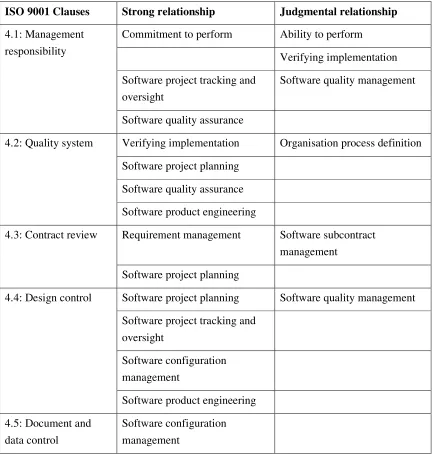
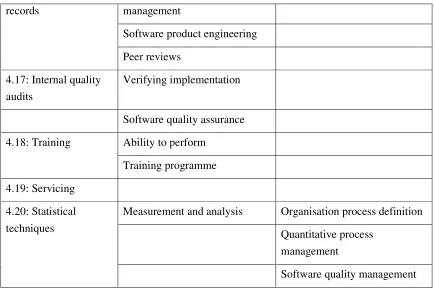
require documentation. CMM-based processes must be documented and practiced as documented. It is the case that CMM KPAs are characterized by the phrases such as “conducted according to documented procedure” and “following a written organisational policy” [35]. ISO 9001, in turn, requires documentation containing instructions or guidance on what should be done (or sometimes how it should be done). Their similarities are further shown on a more detailed level, where some clauses in ISO 9001 are compliant to equivalent CMM practices. Every CMM KPA is related to ISO 9001 (at least weakly) in some way (see table 2). For instant, every CMM KPA at level 2 is strongly related to ISO 9001, and an ISO 9001 – compliant organisation would satisfy many CMM level 3 goals [35]. Since there exists the significant degree of overlap, an organisation should consider both while pursuing continuous software process improvement. Below (Table 4.3) we present the mappings found by Paulk [35].
ISO 9001 Clauses Strong relationship Judgmental relationship Commitment to perform Ability to perform
Verifying implementation
Software project tracking and oversight
Software quality management 4.1: Management
responsibility
Software quality assurance
Verifying implementation Organisation process definition
Software project planning
Software quality assurance 4.2: Quality system
Software product engineering
Requirement management Software subcontract management
4.3: Contract review
Software project planning
Software project planning Software quality management
Software project tracking and oversight
Software configuration management
4.4: Design control
Software product engineering
4.5: Document and data control
[image:30.612.101.533.284.738.2]Software product engineering
4.6: Purchasing Software subcontract management
4.7: Control of customer-supplied product Software subcontract management Software configuration management 4.8: Product identification and traceability
Software product engineering
Software project planning Quantitative process management
Software quality assurance Technology change management 4.9: Process control
Software product engineering
Software product engineering 4.10: Inspection and
testing
Peer reviews
4.11: Control of inspection, measuring, and test equipment
Software product engineering
Software configuration management
4.12: Inspection and test status
Software product engineering
Software configuration management
4.13: Control of non-conforming product
Software product engineering
Software quality assurance Defect prevention 4.14: Corrective and
preventive action Software configuration management Software configuration management 4.15: Handling, storage, packaging, preservation, and delivery
Software product engineering
management
Software product engineering records
Peer reviews
4.17: Internal quality audits
Verifying implementation
Software quality assurance
Ability to perform 4.18: Training
Training programme
4.19: Servicing
Measurement and analysis Organisation process definition
Quantitative process management
4.20: Statistical techniques
[image:32.612.100.535.55.343.2]Software quality management
Table 4.3. Summary mapping between ISO 9001 and the CMM. Relationship columns show the CMM practices and features mapped to equivalent ISO 9001 clauses. [35]
Usage of CMM and ISO 9001
CMM and ISO 9001 are often used in critical software development life cycles (in the domain of high cost of failure) [68]. Their use is deemed appropriate in the cases of external strategic outsourcing of large projects, in-house large projects for low level transaction processing system such as integrated ERP solution, large contracts within defense (weaponry), aerospace (aircraft and spacecraft), and healthcare (safety-critical medical devices). This is because large projects are typically associated with significant risks (be it business risks or technical risks). For example, if a plane clashes, the cost of failure is extremely high.
4.2. Level of maturity and software value
In this section, we study from literature to find the answer to the following question:
What are the relationships between maturity level and software quality, waste reduction, value creation and user satisfaction?
The next sections summarize the review of previously published work on the relationships between maturity level and those factors.
Conventional wisdom suggests that there are conflicting influences on software development effort, quality, and cycle time: cycle time may be compressed at the cost of quality, experienced professionals may improve quality but at increased costs, quality may be achieved at the cost of increasing testing effort, larger team size may reduce development time while raising total costs, process maturity may improve quality but at high cost... However, the review from literature reveals an alternative perspective of getting “both”.
4.2.1. Maturity level and value creation
As mentioned above, the general definition of customer value is the customer’s perceived trade-off between benefits (what the customer receives) versus sacrifices (what he or she gives up) while acquiring and using the product in a given situation [31]. Therefore, the essence of value creation is that value emerges in customers’ working processes, when they make use of the solutions they purchased. In other words, value is not created in the development and production process, but determined by customers. Furthermore, customers perceive value differently in different contexts, and the product developers support customers create their own values.
It is obvious that people choose a product according to the value that the product brings to them in use. Johnson and Weinstein [32] also add “a strong competitive advantage can be gained through consistently providing superior customer value” (pg.10). In the software industry, development organisations (teams or companies) do recognize the importance of customer value and try to enable value creation. Value-based approach for requirements engineering has been widely used and further applied in value-based release planning context while studying stakeholders’ perspectives and values influencing requirement selection [22, 27, 29].
What is more, since it is generally accepted that product features form the core of value creation, an implicit assumption is that more value creation is perceived while companies deliver more product features (and faster) to customers (by doing so they also bring better customer satisfaction). In the next sections, the discussion is about the increase in product quality, as well as the decrease of development cycle time, and cost due to higher maturity level. From the standpoint of the author of this research, value creation for the customers also means that the development organisations meet customer’s quality, delivery and cost expectation. Therefore, those viewpoints all suggest that higher maturity indirectly increases value creation.
delivered incrementally to customer, with the highest value first. Therefore, it is possible to make a conclusion that high maturity processes still need agile practices in order to best deliver customer value.
4.2.2. Maturity level and customer satisfaction
This research mainly focuses on the concept of customer satisfaction, which is strongly related to the concept of customer value. According to the understandings of customer satisfaction and customer value in this context (see more in 3.1. Definitions), customer satisfaction tells the development organisations how much more they have to do, while customer value can show more concisely the direction on what to do.
The strong relationship between customer value and satisfaction is illustrated in both some certain facts and some beliefs. First of all, in many cases, the more cost and time the development organisations save for clients, the more value the clients perceived to be delivered or the more satisfaction is achieved. This again lets us think that, although customer value and customer satisfaction are subjective and not defined by the software suppliers, the software production process itself still has significant impacts on the customers’ perceptions of value being delivered and the level of satisfaction with the product. Secondly, there exists a held belief that the more satisfied the customers are, and the more value is added for their benefits, the greater their loyalty, the more secure their retention and the better the supplier’s image and reputation [34]. In this way, customer value and satisfaction both contribute to the development organisations’ competitive advantage. As mentioned above, expectations play a significant role in customer satisfaction. Jones et al. [33] state that “when expectations are met or exceeded, customers report higher level of satisfaction” (pg. 11). That could explain why expectation management has always been stressed in software development projects.
One of the basic facts from the business realities in the software industry is that everything in software engineering boils down to user satisfaction, and this satisfaction is conditional on the overall behavior of the system, with software is in the first place. In this way, user satisfaction is part of software quality in use.
ratings of customer satisfaction reach 100% at CMM level 3 (Defined), from 80% at the level 1 (Initial).
4.2.3. Maturity level and software quality
A number of approaches have been proposed to improve software quality. These include TQM, Six Sigma, and CMM. The basic idea behind all these approaches is to identify ways to improve quality in a given situation.
Much literature shows clearly the focus of SPI standards on quality assurance. Firstly, in a published study [18], Agrawal and Chari emphasize the idea that SEI-CMM has been one of the most popular efforts in enhancing software quality and reducing development costs. Secondly, in the CMM model, we observe that software quality is first positioned in level 2 with software quality assurance, and then in level 4 with software quality management for product and process quality.
Previously published studies [16. 17, 19, 20] also provide strong evidence confirming the significant impact of higher maturity on software quality. For example, Herbsleb et al. [16], find that organisations engaged in CMM-based SPI tended to improve substantially in quality, cycle time, and productivity. Their empirical study shows that the performance of product quality also improves with increased maturity levels, and reaches 100% of excellence at level 3. In another study, Krishnan [17] showed that process maturity significantly increased quality (but did not show evidence of direct effect on cost).
There is also quantitative empirical evidence that supports the fact that improvements in process maturity lead to higher quality [20]. There, Harter et al find that a one percent improvement in process maturity was associated with a 1.589 percent increase in product maturity. Furthermore, Diaz and Sligo [19] explain also the relationship between software quality and maturity levels and report that in the case of Motorola, each level of the CMM improves quality by a factor of about 2. The improvement in quality is expected for projects that transition from level 2 to level 3 due to the KPA Peer Review in level 3. Peer Review has been widely recognized as one of the most important factors in detecting and preventing defects in software products. From level 3 to level 4, quality is improved through the KPAs Quantitative Process Management and Software quality management. As a consequence, when a software unit at Motorola has upgraded from CMM level 2 to level 5, the average defect density reduced from 890 defects to 126 defects (per million assembly-equivalent lines of code).
4.2.4. Maturity level and cycle time
The authors of existing research [16, 17, 18, 19, 20] believe that short cycle time is the major measure that can truly make development teams different, and reducing cycle time means getting a software feature into the hands of a customer as fast as possible.
There are two different perspectives of viewing the relationship between process maturity, cycle time, and software quality [20]. One view (we refer to it as the ‘conventional way’) is that cycle time must be traded off against improvements in quality. That is, while trying to increase higher process maturity, more time and effort required for testing, code inspections (ensuring quality), and for creating documentation. However, there has been also an alternative perspective that improvements in quality can lead to overall reductions in cycle time and development effort [17, 18, 20]. This is because in the context of software production, several studies have indicated that more time is needed to fix defects uncovered at later stages in software development than in earlier stages, but adopting disciplined practices (like described in CMM family) means focusing on preventing and uncovering defects early in the development process, so that less time wasted or spent in later stages. Findings from the examined literature show the positive and direct effect of process maturity on cycle time, but product quality is significantly and negatively associated with cycle time. Interestingly, the net effect of process maturity on cycle time is negative. Based on the measurements at Motorola, Diaz and Sligo [19] report that the cycle time is about eight times faster at CMM level 5 than at CMM level 1. The similar time savings are also reported from process improvements by Harter et al. [20].
4.2.5. Aggregation of the findings
Figure 4.2. Research results question 1 in details.
4.2.6. Maturity level and waste reduction
By its definition (section 3.1.Definitions), waste reduction deals with reducing waste in development effort, cost and cycle time.
It is obvious in software engineering that reusing software components can reduce the time and the costs of developing a software application (and can also improve the quality of the product because the existing components are often tested well a
![Figure 3.1. Scrum process overview [38].](https://thumb-us.123doks.com/thumbv2/123dok_us/1210214.644650/20.612.183.458.58.286/figure-scrum-process-overview.webp)


![Table 4.2. Key process areas in the CMM [21].](https://thumb-us.123doks.com/thumbv2/123dok_us/1210214.644650/28.612.99.533.75.712/table-key-process-areas-cmm.webp)