Unsupervised Document Classification with Informed Topic Models
Timothy A. Miller1 and Dmitriy Dligach2 and Guergana K. Savova1
1Boston Children’s Hospital Informatics Program, Harvard Medical School, Boston, MA 02115
{firstname.lastname}@childrens.harvard.edu
2Department of Computer Science, Loyola University Chicago, Chicago, IL 60611
Abstract
Document classification is an important and common application in natural lan-guage processing. Scaling classification approaches to many targets faces a bot-tleneck in acquiring gold standard labels. In this work, we develop and evaluate a method for using informed topic mod-els to noisily label documents, creating a noisy but usable set of labels for train-ing discriminative classifiers. We inves-tigate multiple ways to train this noisy classifier, and the best performing method uses Wikipedia-seeded topic models to ap-proximately label training instances with-out any supervision. We evaluate these methods on the classification task as well as in an active learning setting, in which they are shown to improve learning rates over traditional active learning.
1 Introduction
Document classification is a standard task in ma-chine learning and natural language processing which has been studied extensively (Joachims, 1999; Sebastiani, 2002). For many instances of this problem, standard supervised machine learn-ing methods are now sufficient, so that any given document classification problem may be consid-ered an application or engineering task rather than an interesting research problem. Recent work re-lated to this problem has come mainly from the machine learning community and has focused on a generalization of the task called multi-label
clas-sification, in which each instance has multiple cat-egories that must be predicted (Tsoumakas and Katakis, 2007; Read et al., 2011). That work has been concerned with the problem of how to best make use of correlations between the different la-bels, and using that information to perform the classifications non-independently.
In contrast, the work here is concerned with the more practical problem of obtaining these labels, and particularly the issue that ad hoc classification targets require obtaining supervised training data from scratch. This problem may arise in any ap-plication area of natural language processing, but in the clinical domain this problem is potentially more pressing because expert annotators (physi-cians) are expensive and traditional cost-saving approaches such as crowdsourcing are not always viable due to privacy concerns.
A common use case for clinical document clas-sification is physicians mining patient notes for diseases, then using genetic samples of that “vir-tual cohort” to do phenotype-genotype correlation studies. Billing codes have high recall but vary-ing precision dependvary-ing on the disease. Thus, ma-chine learning and NLP applied to the narrative text in the clinical record are now often used as a solution to this problem.
Our approach to this task is to use the unsuper-vised method of topic modeling, specifically La-tent Dirichlet Allocation (LDA), which can learn word probabilities for semantically coherent top-ics, and by providing informed priors, we can steer topics to categories of interest and use these word lists like features in a classifier. As a first step, we take advantage of the crowd-sourced knowledge
contained in Wikipedia to build a representation of the category of interest. We then use this cate-gory representation as an informed prior to LDA. This informed LDA algorithm then finds the top-ics that best satisfy the data given the priors, in-cluding both informed topics and traditional unin-formed topics. In particular, we are able to guide the topic model to learn separate topics for similar categories if that is required by the categories we are interested in for classification.
The ability to extract pre-specified topics of varying granularity is interesting on its own, as it could be used for more guided data explorations of the kind that LDA is already in use for. But we can also use the output of this process to gener-ate classifiers, by treating the occurrence of these topics in a document as a noisy label for that doc-ument. Given these noisy labels, we can immedi-ately train a classifier, which performs much better than chance, without seeing a single gold standard training example.
Finally, we show that this has potential appli-cations to active learning by using our noisy clas-sifier’s certainty estimates to select training exam-ples, rather than first annotating a random seed set. This method results in faster learning rates than passive learning, standard active learning, and a baseline method that uses the Wikipedia-trained priors directly.
2 Background
2.1 Topic Modeling with Latent Dirichlet Allocation
Latent Dirichlet Allocation (LDA) (Blei et al., 2003) is a probabilistic unsupervised method for grouping tokens into a set of corpus-wide clusters. By setting parameters that constrain each docu-ment to use a subset of the clusters, frequently co-occurring words tend to get placed into the same clusters, and since distributionally similar words are often semantically similar, the result is that the clusters are often semantically coherenttopics.
A document in LDA is represented as a bag of words. Each document has a probability distribu-tion across K topic indices, and each topic is a global probability distribution across V words in the vocabulary. This leads to a generative story where the topic distribution for a document is drawn from a Dirichlet distribution, and each word is generated by first drawing a topic from the topic distribution, then drawing a word from the word
distribution indexed by that topic. One common inference method for LDA is to use Markov Chain Monte Carlo sampling, which is an iterative algo-rithm where each variable of interest is sampled probabilistically. In LDA, the standard sampling algorithm is derived by integrating out the topic and word distributions from the joint probability, so that the only random variable left to sample is the topic assignment for each word. Each topic as-signment is typically randomly initialized, then at each iteration a topic is sampled from the sampling equation (from Griffiths and Steyvers (2004)):
p(zi =j|z−i,w)∝ n wi
−i,j +β n(−·)i,j+|V|β ·
ndi−i,j+α ndi−i,·+T α
(1) where iindexes words in the corpus and j is an index intoKtopics. The first factor represents the probability of the given word being selected for this topic (nwi−i,j is the count of the word at po-sition iin topicj). The second factor represents the probability of topicjbeing selected for a word in this document (ndi−i,j is the count of words in the same document as wi with topicj). α andβ
are the hyper-parameters from the Dirichlet priors used to draw the probability distributions. While the Dirichlet distribution accepts a vector of hyper-parameters the size of the output distribution, in most work these hyper-parameters are symmetri-cal, and are set using intuition or experimentation. Low values of these parameters (≤ 1) encourage sparse distributions, and sparsity constraints give rise to the clustering behavior typical of LDA.
be addressed by hierarchical models, in which top-ics that are higher in some hierarchy tend to model more general terms and lower topics are more spe-cific. Hierarchical topic models (Blei et al., 2003) make use of a nested Chinese Restaurant Process where a word is a sample from a mixture between all the topics in a path from the root to a leaf node in a topic tree. Higher-level nodes will tend to be on more paths, and will thus be sampled more often and contain higher probability words. This method can then, for example, run on text with-out stop words removed and recover them as the top level of the hierarchy. One might imagine that for the baseball and hockey example, a hierar-chical model would recover a higher-level sports topic with lower level topics specific to baseball and hockey.
Another method, Pachinko Allocation Model (Li and McCallum, 2006), general-ized hierarchical topic models so that the topic hierarchy did not need to be a tree. This retains a hierarchy with higher and lower nodes corre-sponding to more or less general topics, but also allows for different words to be generated by different topic paths. While these hierarchical models have attractive properties, they are signif-icantly more complex than standard LDA, which means they have more parameters, may take longer to train, and still may not recover topics of interest to a user.
Some relevant recent work in topic modeling has explored the importance of the prior valuesα
andβ. Wallach et al. (2009) developed optimiza-tion procedures for α andβ and found that opti-mization of the document-topic priorαled to im-proved results, as measured by perplexity on held-out data. Jagarlamudi et al. (2012) found that pri-ors on bothα andβ allowed them to incorporate information into the LDA inference, though they found that a more complex model structure was necessary to properly incorporate the information, which requires a more complex inference proce-dure.
Other relevant topic modeling work involves the augmentation of LDA-style models for la-beling documents with multiple topics. Labeled LDA (Ramage et al., 2009) creates a topic for each label in a multi-label setting, and takes advantage of gold standard labels to learn topic distributions for each label. In the author-topic model (Rosen-Zvi et al., 2004), a document is generated by a set
of authors, and an author is a distribution over top-ics. While both models are relevant to the multi-label classification problem, they both require gold standard labels, and we suspect that given gold standard labels discriminative classifiers will be superior.
3 Methods
Building on this existing work in topic modeling, we propose an extension to the LDA model that is able to find specific topics of interest, with mini-mal human effort. We call this method informed LDA, and the following sections will describe the method and how it can be used to train classifiers.
3.1 Building Informed Priors
We first build models for each of the target labels we are interested in. For this work, we use top-ics from two corpora, the 20 Newsgroups dataset mentioned above, as well as the 2008 i2b2 Chal-lenge dataset1, a set of 730 clinical discharge
sum-maries labeled for multiple obesity-related dis-eases. Table 2 shows the 14 i2b2 labels we used for this work.
To build these models, we retrieved the Wikipedia article closest in meaning to each la-bel. For most labels, there was an article with the exact title or a very similar title. We tokenized the articles and then TF-IDF (term-frequency/inverse document frequency) weighting was applied to these tokens (for the clinical articles we used an IDF derived from a sub-index of Wikipedia arti-cles containing clinically relevant artiarti-cles). The purpose of the TF-IDF reweighting is to down-weight commonly occurring words like those rep-resenting broad terms (especially in the clinical data, terms like ”disease” ”surgery” are not as in-formative as they are generally).
While in the present work the step of identify-ing the relevant Wikipedia article required a small amount of manual effort, there are many ways that it could be automated – for example, by querying Wikipedia or the Web with the category name and performing token counts over multiple retrieved articles. Performing this step manually and ob-taining high quality models of each category al-lows for a purer evaluation of the more technically challenging downstream steps.
1The i2b2 Challenge datasets are publicly available with
3.2 Informed LDA
The standard LDA sampling equation, Equation 1, has a single value ofαandβ, assuming symmetric Dirichlet priors. A simple extension of the sam-pling equation for arbitrary priors can be obtained by vectorizing~αand~β:
p(zi =j|z−i,w)∝ n wi
−i,j +βwi n−(·)i,j+Pi|V′=1| βi′
·
ndi−i,j+αj ndi−i,·+PKj′=1αj′
(2)
Since each article has a different length, the prior vectors are first normalized so that all in-formed priors have equal strength. The ~β parame-ters are then filled in by these normalized weights. For token values that are not in the article, we use a default value of 0.01 in the prior.
To do inference using this model, we modi-fied the source code of Mallet (McCallum, 2002), allowing for arrays of priors and modifying the sampling equation as described above. The num-ber of topics K was set to 30, as this value gave reasonable results during preliminary experiments with standard LDA. This means that, in contrast to methods like Labeled LDA, not all topics are associated with a label – 16 of our topics were in-formed and the remaining 14 are uninin-formed, al-lowing the model to fit other topics in the data that we may not be currently interested in.
3.3 Creating a Bronze Standard
After running inference on the informed LDA model, the output of interest is the empirical es-timates of document-topic probability – frequen-cies of each topic in each document. For exam-ple, the output may say that in document 0, the topic forasthma accounted for 3% of the tokens. Our goal is to use these values to assign noisy la-bels to each document for the value of that cluster category. We call this set of labels abronze stan-dard, in contrast to the gold standard of expert-generated labels.2
There are many ways one might go about con-verting topic frequencies to labels. For binary classification, as in the i2b2 data, one could set a threshold value and give all documents with topic frequencies above that threshold a positive label.
2Silver standardis already used to describe huge
automat-ically labeled datasets (Rebholz-Schuhmann et al., 2010).
Possible thresholds include 0 and1/K. We found that thresholds allowed for too much variation, and led to some severely skewed label distributions, so that the next stage classifier may have only a few positive examples to work with. Even if this ap-proximates a true distribution, it is probably not enough data points to find a signal in the features, and so the resulting classifier probably will not be useful.
Another option is, for each informed topic, sort all documents by that topic’s frequency, and then split the data at the median frequency value into thetrueandfalseclasses, so that the classifier gets training data with no skew in its distribution. We found that this method was the most reliable across labels and does not require fitting any parameter.
For multi-way classification, as in the 20 News-groups data, we use as the bronze label the topic whose document-topic probability was the maxi-mum of all the informed topics. To simplify fur-ther, this is just the topic that accounts for the greatest number of words in the document.
3.4 Building a Classifier
However bronze labels are obtained, they can now be used in the typical way to train a classifier. The feature representation may also be varied. We will describe classifier settings in detail in the Evalua-tion, but we experimented with a variety of classi-fiers. The representation used here is bag of words for a document.
3.5 Active Learning with Bronze and Gold Labels
While this technique may have value as a low-cost low-accuracy classifier, we suspect that it might have additional value as an input to other systems. One such potential application is as an input to an active learning-based annotation system, as a way of obtaining gold standard labels to achieve op-timal classification performance. Active learning is an annotation technique that has a classifier in the loop – instead of labeling examples randomly, examples are selected for labeling based on some notion of usefulness, such as classifier uncertainty (see Settles (2010) for an excellent overview of active learning). To initialize the active learning classifier, however, a small set of “seed” examples are randomly selected to be labeled.
we get a probability distribution across categories for every instance in the training data. We use uncertainty sampling to select the next instance, which in the two-class case means selecting the instance whose classification probability is closest to 0.5. The bronze standard label is then replaced with the gold standard label (simulating annota-tion of the instance) and the classifier is re-trained. This process repeats until every instance in the training data has its gold label uncovered. To test this method experimentally (as in Section 4), we would also have a set of held out data, and every time we train a classifier we would evaluate it on this held out data.
The active learning method just described dif-fers from standard active learning in that there is no longer a breakdown into initial seed set and a pool set from which examples are drawn, but rather we have a mixed gold/bronze training set. Since the gold labels are more reliable, we give them a higher weight relative to the bronze labels, so the classifier can treat them differently.
4 Evaluation
To evaluate the effectiveness of this method, we will start with one brief qualitative evaluation to inspect the topics found, and then proceed to two quantitative evaluations. The first evaluation at-tempts to get a preliminary look at how the in-formed LDA method works on topics that are su-perficially similar, to gauge how adding informa-tion can guide the model to make difficult distinc-tions. The first quantitative evaluation is a sim-ple set of unsupervised classification experiments. We build a bronze standard for the 20 Newsgroups and i2b2 data sets, then train classifiers for each category and evaluate the classifier. The second quantitative evaluation examines the use case of active learning. Our experiment uses the unsuper-vised classifiers from the previous experiment to evaluate whether active learning can be made even faster by using those classifiers to select examples at the start of the active learning procedure, when the gold standard training data is still quite small.
4.1 Qualitative Inspection of Similar Topics
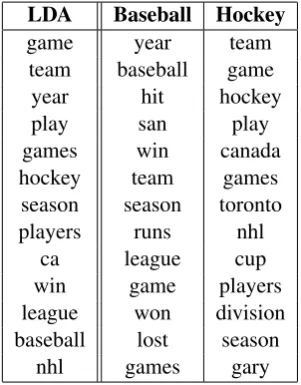
Table 1 shows the results of inspecting a few sports-related topics from the 20 Newsgroups cor-pus. This is to simply see if this method can ad-dress the issue discussed in Section 2, the con-flation of similar topics. The first column shows
LDA Baseball Hockey
game year team team baseball game year hit hockey play san play games win canada hockey team games season season toronto players runs nhl
ca league cup win game players league won division baseball lost season
[image:5.595.340.491.62.255.2]nhl games gary
Table 1: Comparison of topic words in similar top-ics with standard LDA (first column) and informed LDA (last two columns).
the words in a sports-related topic using standard LDA. It clearly finds words related to both hockey and baseball, with no other topics containing any significant amount of hockey or baseball content.
In contrast, the last two columns show the formed topics for baseball and hockey using in-formed LDA. In addition to the sport names there are additional terms that are discriminative, in-cluding hit, runs, and wins (a pitching statistic) for baseball, andcanada,nhl, andcupfor hockey. Informed LDA also did not have any other topics containing significant amount of hockey or base-ball content. This kind of evaluation is of limited use, but it does verify that the algorithm is able to find closely aligned topics.
4.2 Experimental Configuration
The data sets used for evaluation are the 20 News-groups data set3and the 2008 i2b2 Challenge data
set described above. The 20 Newsgroups data set contains around 11,000 training documents, partitioned into 20 topics, which are used as la-bels for the documents. These include lala-bels such as alt.atheism for atheism-related conversations,
sci.cryptfor cryptography-related discussions, and so forth. While each document may have multiple “topics” in the strict semantic sense, it will have one topiclabel– in other words, a classifier must choose a single category from 20 possibilities.
The 2008 i2b2 Challenge data consists of
clin-3This data set can be downloaded here:
ical discharge summaries from patients at an obe-sity clinic. This data contains 730 notes in the training set, with each note being labeled for 16 disease categories, with both textual and intuitive labels.4 We use the more challenging intuitive
la-bel set, which did not require explicit confirmation of a diagnosis in the text. We discard two labels, hypertriglyceridemia and venous insufficiency, af-ter preliminary work on the training set indicated that those two labels could not be learned satisfac-torily even with fully supervised approach. The likely cause of the difficulty is that these two cate-gories contained the fewest number of positive ex-amples, an important issue but one we will have to reserve for future work. In contrast to the 20 Newsgroups data, in the i2b2 data the labels are not mutually exclusive, so we frame the task as 14 binary classification problems.
We used the Weka machine learning toolkit (Hall et al., 2009) during develop-ment, and evaluated many different classifiers on both datasets, including Adaboost, support vector machines, logistic regression, and naive bayes. We use the Adaboost algorithm (Freund and Schapire, 1996) with decision stumps as the weak learner for the i2b2 data. For the 20 Newsgroups data we used a support vector machine with linear kernel for the classification experiment and switched to Naive Bayes for the active learning experiments for speed reasons. Besides being relatively accurate, using boosting with decision trees has the beneficial property that the models it builds have some degree of transparency, which clinical researchers appreciate.
For the first experiment we evaluate the effec-tiveness of informed LDA on generating labels that can train a classifier. We compare first to a random labeling baseline (labeledRandL), that generates a random labeling, trains a classifier with those labels, and then uses it to classify the training set. This is not intended to be a com-petitive baseline, as much as it is a check to set a lower bound on what kind of performance we would get if informed LDA labeling had no signal whatsoever. We also compare to a standard ran-dom classifier (RandC) which is based on a recall of 0.5 and a precision of the category’s prevalence. This baseline is important for the binary classi-fier to make sure our classiclassi-fier is learning more
4In actuality, not every note is labeled for every category,
but most are.
than just how to do random guessing based on our evenly split labels. In the main experimental con-dition (Bronze), we use informed LDA to gener-ate a bronze standard label set for the training data as described in Section 3.3, train a classifier with those labels and evaluate it on those same exam-ples from the training set. The upper bound we compare against is a 5-fold cross-validation of the training set using gold labels.
The next experiment examines the usefulness of these unsupervised classifiers in an augmented ac-tive learning scheme described in Section 3.5. We use the two baselines of passive learning and stan-dard active learning. The passive learning baseline is equivalent to just plotting a learning curve for a machine learning problem with random ordering of the instances. The active learning baseline uses an initial seed set of 25 examples from within the pool set. We use uncertainty sampling to select the next example, which uses the example which has the smallest difference in probability estimates between the two most likely classes.
The condition we are testing is labeledBronze. This condition does not use a seed set, but starts with a classifier trained on the entire bronze-labeled pool set. Learning proceeds by finding ex-amples in the pool set that the current iteration of the classifier is uncertain about and uncovering the gold label (i.e. simulating annotation). This means that, in the active learning curve, the x-axis, which traditionally indicates the size of the training data used to train the classifier, now indicates the num-ber of gold instances in the training data (the re-maining instances still have bronze labels).
We give gold and bronze instances different weights to reflect varying quality of the labels. This weight is used in calculating the cost func-tion during training – a higher weight on gold la-bels means the classifier will try harder to get gold-labeled instances correct. Here we use a weight of 0.1 for bronze-labeled instances and a weight of 1.0 for gold-labeled instances.
4.3 Results
bronze-Category RandL RandC Bronze CV Asthma 0.02 0.20 0.47 0.91 CAD 0.05 0.54 0.66 0.91 CHF 0.07 0.50 0.75 0.86 Depression 0.07 0.29 0.26 0.77 Diabetes 0.06 0.58 0.83 0.95 Gallstones 0.02 0.22 0.33 0.83 GERD 0.04 0.33 0.39 0.77 Gout 0.05 0.21 0.42 0.88 HC 0.08 0.51 0.56 0.83 HTN 0.06 0.62 0.67 0.96 OA 0.10 0.26 0.27 0.66 Obesity 0.07 0.46 0.56 0.97 OSA 0.02 0.22 0.28 0.91 PVD 0.11 0.25 0.37 0.76 Table 2: F1 scores for traditional supervised clas-sifier (CV) vs. unsupervised clasclas-sifier trained us-ing informed LDA (Bronze), classifiers trained with random labels (RandL), and a classifier that makes random guesses (RandC). (CAD=Coronary Artery Disease, CHF=Congestive Heart Fail-ure, GERD=Gastroesophageal Reflux Disease, HC=Hypercholesterolemia, HTN=Hypertension, OA=Osteoarthritis, OSA=Obstructive Sleep Ap-nea, PVD=Peripheral Vascular Disease)
RL RC Bronze CV Accuracy 0.05 0.05 0.64 0.85 Table 3: Multi-way classifier accuracy on the 20 Newsgroups dataset using random labels (RL), a random classifier (RC), bronze labels obtained from informed LDA (Bronze) and a supervised cross-validation (CV).
trained classifier also outperforms the RandC ran-dom classifier in 13 out of 14 categories, by an av-erage of approximately 12 points F1 score. Cross-validation using the gold standard can be very ac-curate, ranging from 0.66 to 0.96.
There are a few interesting things to point out from these results. First, our analysis of the er-rors shows that the classifiers trained by the bronze labeling did not systematically favor either preci-sion or recall. A linear regrespreci-sion with the Gold score as the independent variable and the Bronze score as the dependent variable shows that the Gold score is a statistically significant predictor of the Bronze score (p= 0.01), but with so few data
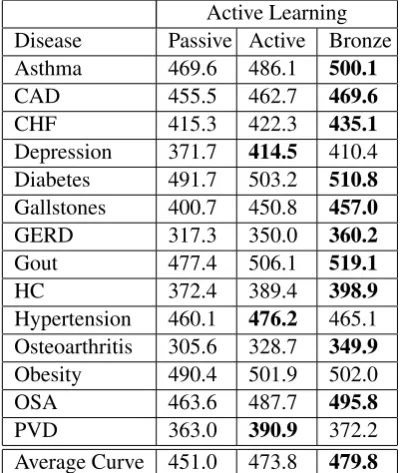
Active Learning Disease Passive Active Bronze Asthma 469.6 486.1 500.1
CAD 455.5 462.7 469.6
CHF 415.3 422.3 435.1
Depression 371.7 414.5 410.4 Diabetes 491.7 503.2 510.8
Gallstones 400.7 450.8 457.0
GERD 317.3 350.0 360.2
Gout 477.4 506.1 519.1
HC 372.4 389.4 398.9
Hypertension 460.1 476.2 465.1 Osteoarthritis 305.6 328.7 349.9
Obesity 490.4 501.9 502.0 OSA 463.6 487.7 495.8
[image:7.595.315.517.63.300.2]PVD 363.0 390.9 372.2 Average Curve 451.0 473.8 479.8
Table 4: Performance of augmented active learn-ing on 14 categories from the 2008 i2b2 Challenge data .
Passive Active Bronze ALC 7203 7469 7678
Table 5: Performance of augmented active learn-ing on 20-way classifier for 20 Newsgroups data. Unit is Area Under the Learning curve (ALC).
points the exact nature of this effect is not clear. Table 3 shows the results of the three classifiers on the Newsgroups data. For this multi-category experiment we use accuracy as the metric instead of F1 score. Here the accuracy of the RandL and RandC are both quite low, at 0.05. Bronze label-ing can train a classifier that attains an accuracy of 0.64. The Gold labeling gives us an approximate ceiling performance of 0.85.
Table 4 shows the area under the active learning curve (ALC) for 14 categories in the i2b2 data un-der three conditions. Both the active learning and the bronze-augmented active learning outperform passive learning on all 14 categories. In 11 of the 14 categories the bronze-augmented version is su-perior to traditional active learning. We also aver-aged the curves together and computed the average learning curve, for which the bronze-augmented algorithm is again optimal.
0 0.2 0.4 0.6 0.8 1
0 20 40 60 80 100
F-score
Number of gold instances Active Learning Curve
[image:8.595.75.286.68.170.2]Passive Active Bronze
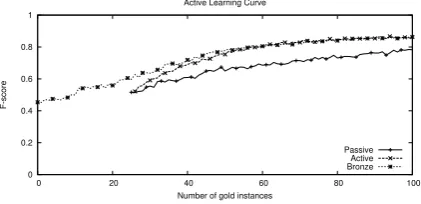
Figure 1: Average active learning curve across 14 disease categories.
0 0.2 0.4 0.6 0.8 1
0 1000 2000 3000 4000 5000
F-score
Number of gold instances Learning Curves
[image:8.595.76.287.223.328.2]Passive Active Bronze
Figure 2: Active learning plot for 20 Newsgroups data.
where there is a clear distinction. Qualitatively, the distinction between passive and active is quite clear – this much is not surprising, given previous success in active learning. While the bronze curve shows an advantage up to maybe 30 instances, it quickly converges with the active curve.
Table 5 shows the Area Under the Learning curve (ALC) results of active learning on the 20 Newsgroups data. Active learning again beats pas-sive learning, and the augmented version using bronze labels performs best. The learning curves for all three conditions are in Figure 2, truncated to 5000 examples to highlight the area showing the most difference. Here the bronze label-based ver-sion of active learning seems to have a clearer ad-vantage than in the i2b2 corpus.
4.4 Discussion and Future Work
One aspect that deserves further mention is that of class prevalence and skew. The decision to assign bronze labels on the i2b2 corpus with an even class distribution was vastly superior to any threshold-ing that was attempted. However, we should note that in the i2b2 data we used, the prevalence is rel-atively high for most categories. Diabetes, for ex-ample, is present in 70% of the patients here, while gout is present in 13%.
Evaluating unsupervised methods on
super-vised tasks is tricky. Our experiments here fo-cused on the training set of each corpus rather than following the default train/test splits. Our pri-mary concerns here were evaluating whether this method had any promise at all, and that it was applicable to more than one corpus. One could argue that future work should develop and tune the methods on the training data and then evalu-ate them on the test set. However, the very nature of this method breaks the traditional training/test model because tuning on the training data is al-ready cheating relative to how the method would actually be applied on unlabeled data.
We are not sure that this problem has any per-fect solutions, but we suggest that evaluating on as many different corpora as possible will be the best validation for this method. In this work, we tried to do that by starting on i2b2 data and then moving to the 20 Newsgroups data. Doing this helped us understand how informed priors need to be modi-fied based on the size of the corpus.
One sticking point to portability with this method is the choice of classifier. We could have chosen a single classifier to stick with across cor-pora but then if one is particularly weak for a given corpus (e.g., SVM performed poorly on i2b2), it is less clear how much credit to assign the bronze la-bels for the performance. One possible solution to this issue is to require a much smaller sample of gold-labeled validation set if validated perfor-mance is strictly necessary.
One final point is that the classifier trained on bronze training labels probably would not gener-alize to a new corpus very well. This is not much of a problem, because the idea of the method is that for a new corpus one should generate new bronze labels using informed LDA on that data set. This does raise the question of what the difference would be between two classifiers trained on dif-ferent corpora but with the same topic label, and whether there is some way of extracting additional information from comparing the decisions of these different classifiers on new data.
5 Conclusion
that in active learning this method can improve learning rate for many categories. This method may be beneficial in domains where a large num-ber of classifiers are required and state of the art performance is not necessary.
Acknowledgements
Research reported in this publication was sup-ported by National Institute for General Med-ical Sciences (NIGMS) and National Library of Medicine (NLM) of the National Institutes of Health under award number R01GM114355 (HealthNLP) and U54LM008748 (i2b2). The con-tent is solely the responsibility of the authors and does not necessarily represent the official views of the National Institutes of Health.
References
David M. Blei, Andrew Y. Ng, and Michael I. Jordan.
2003. Latent dirichlet allocation. Journal of
Ma-chine Learning Research, 3:993–1022.
Yoav Freund and Robert E Schapire. 1996.
Exper-iments with a new boosting algorithm. InICML,
volume 96, pages 148–156.
Thomas L. Griffiths and Mark Steyvers. 2004. Finding scientific topics.PNAS, 101(suppl. 1):5228–5235. Mark Hall, Eibe Frank, Geoffrey Holmes, Bernhard
Pfahringer, Peter Reutemann, and Ian H. Witten. 2009. The WEKA data mining software: An
up-date.SIGKDD Explorations, 11.
Jagadeesh Jagarlamudi, Hal Daum´e III, and Raghaven-dra Udupa. 2012. Incorporating lexical priors into
topic models. InProceedings of the 13th
Confer-ence of the European Chapter of the Association for Computational Linguistics, pages 204–213. Associ-ation for ComputAssoci-ational Linguistics.
Thorsten Joachims. 1999. Making large scale svm learning practical. In B. Schlkopf, C. Burges, and
A. Smola, editors, Advances in Kernel Methods
-Support Vector Learning. Universit¨at Dortmund. Wei Li and Andrew McCallum. 2006. Pachinko
allo-cation: Dag-structured mixture models of topic cor-relations. InProceedings of the 23rd international conference on Machine learning, pages 577–584. ACM.
Andrew McCallum. 2002. Mallet: A machine learning for language toolkit.
Daniel Ramage, David Hall, Ramesh Nallapati, and Christopher D. Manning. 2009. Labeled LDA: a su-pervised topic model for credit attribution in
multi-labeled corpora. InProceedings of the 2009
Con-ference on Empirical Methods in Natural Language
Processing: Volume 1 - Volume 1, EMNLP ’09, pages 248–256, Stroudsburg, PA, USA. Association for Computational Linguistics.
Jesse Read, Bernhard Pfahringer, Geoff Holmes, and Eibe Frank. 2011. Classifier chains for multi-label classification. Machine Learning, 85(3):333–359. Dietrich Rebholz-Schuhmann, Antonio Jos´e Jimeno
Yepes, Erik M Van Mulligen, Ning Kang, Jan Kors, David Milward, Peter Corbett, Ekaterina Buyko, Elena Beisswanger, and Udo Hahn. 2010. CALBC
silver standard corpus. Journal of bioinformatics
and computational biology, 8(01):163–179. Michal Rosen-Zvi, Thomas Griffiths, Mark Steyvers,
and Padhraic Smyth. 2004. The author-topic model
for authors and documents. In Proceedings of the
20th conference on Uncertainty in artificial intelli-gence, pages 487–494. AUAI Press.
Fabrizio Sebastiani. 2002. Machine learning in
auto-mated text categorization. ACM computing surveys
(CSUR), 34(1):1–47.
Burr Settles. 2010. Active learning literature survey. Technical report, University of Wisconsin–Madison.
Grigorios Tsoumakas and Ioannis Katakis. 2007.
Multi-label classification: An overview.
Interna-tional Journal of Data Warehousing and Mining (IJDWM), 3(3):1–13.
Hanna M Wallach, David M Mimno, and Andrew Mc-Callum. 2009. Rethinking LDA: Why priors matter.