Evaluating unsupervised learning for natural language processing tasks
Andreas Vlachos
Department of Biostatistics and Medical Informatics University of Wisconsin-Madison
Abstract
The development of unsupervised learning methods for natural language processing tasks has become an important and popular area of research. The primary advantage of these methods is that they do not require annotated data to learn a model. However, this advan-tage makes them difficult to evaluate against a manually labeled gold standard. Using un-supervised part-of-speech tagging as our case study, we discuss the reasons that render this evaluation paradigm unsuitable for the evalu-ation of unsupervised learning methods. In-stead, we argue that the rarely usedin-context
evaluation is more appropriate and more infor-mative, as it takes into account the way these methods are likely to be applied. Finally, bear-ing the issue of evaluation in mind, we pro-pose directions for future work in unsuper-vised natural language processing.
1 Introduction
The development of unsupervised learning methods for natural language processing (NLP) tasks has be-come an important and popular area of research. The main attraction of these methods is that they can learn a model using only unlabeled data. This is an important advantage, as unlabeled text in digi-tal form is in abundance, while labeled datasets are usually expensive to construct. While methods such as crowdsourcing (Snow et al., 2008) can help re-duce this cost, in tasks for which specialist knowl-edge is required, such as part-of-speech (PoS) tag-ging or syntactic parsing, labeling datasets in this fashion can be substantially harder.
Nevertheless, the advantage of requiring only un-labeled data to learn a model renders the evaluation of unsupervised learning methods to be more chal-lenging than that of their supervised counterparts. This is primarily because the output of unsupervised methods does not contain labels that would be found in a manually constructed gold standard. Simplisti-cally expressed, no labels for model learning means that there are no labels in the output. As a result, the standard evaluation paradigm of comparing against a gold standard using a performance measure such as accuracy or F-score cannot be used, at least not in the way it would be used in evaluating supervised methods. Since methods are proposed or rejected by researchers, and papers describing these methods are assessed by their peers partly on the basis of such results, the issue of evaluation is an important one.
Before we proceed, it is important to character-ize the unsupervised learning methods we are con-sidering, as the term unsupervised is used in mul-tiple ways in the literature. In this work we focus on methods that use only unlabeled data to learn a model and do not involve any form of supervision at any stage. Thus we exclude methods that use seeds such as the dictionaries of PoS tags used by Ravi and Knight (2009) and rules for producing labeled out-put, e.g. those proposed by Teichert and Daum´e III (2009). We also exclude methods for which the data used to learn a model does not contain any of the labels we are learning to predict, but it does contain other information that we use in the learning pro-cess. For example, the multilingual PoS induction approach of Das and Petrov (2011) assumes no su-pervision for the language whose PoS tags are being
induced, but it assumes access to a labeled dataset of a different language.
We begin by surveying recent work on unsuper-vised PoS tagging, focusing on the issue of eval-uation (Section 2). While PoS tagging is not the only task for which unsupervised learning methods are popular, its relative simplicity and the variety of evaluation paradigms employed make it a use-ful case study. Based on this survey, we show that evaluation against a PoS tagging gold standard is not only difficult, but it can be misleading as well. The reason for this is that the unsupervised learn-ing methods used, while they produce output that correlates with PoS tags, perform a different task, namely clustering-based word representation induc-tion (Turian et al., 2010). Instead, we argue that in-context evaluation is more appropriate and more informative, as it takes into account the application context in which these methods are intended to be used (Section 3). Finally, bearing the issue of evalu-ation in mind, we propose some directions for future work in unsupervised learning for NLP (Section 4).
2 The case of unsupervised part-of-speech tagging
PoS tagging is the task of assigning lexical cate-gories such as noun or verb to tokens in a sentence. It is commonly used either as an end-goal or as inter-mediate processing stage for a downstream task such as syntactic parsing. For languages with substan-tial amounts of labeled data available such as En-glish, the performance of supervised approaches has reached very high levels.1 Thus, the research focus has shifted to semisupervised and unsupervised ap-proaches which would allow the processing of lan-guages which do not have similar resources avail-able.
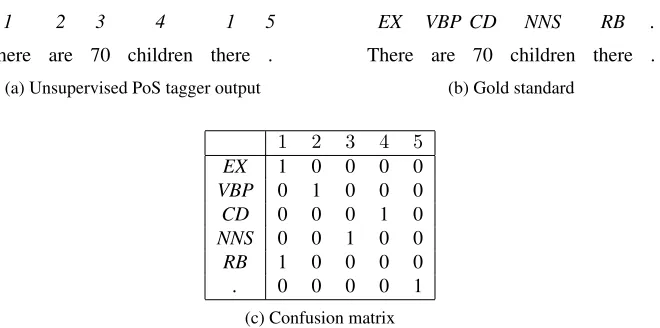
At an abstract level, the unsupervised learning methods applied to PoS tagging take as input tok-enized unlabeled sentences, from which they learn a model. These models are either hidden Markov models (HMMs) (Clark, 2003; Goldwater and Grif-fiths, 2007) or clustering models (Biemann, 2006; Abend et al., 2010). During model learning, state identifiers are assigned to the tokens (Figure 1a).
In-1
According to the ACL wiki, state-of-the-art performance in English is more than 97% per token accuracy.
dependently of the learning method and the model, these identifiers are semantically void, i.e. they have no linguistic meaning. Nevertheless, all the studies conclude that there is a strong correlation between the state identifiers assigned and the PoS tags in a labeled gold standard (Figure 1b).
The most common way of assessing the level of correlation achieved is the use clustering evaluation measures. The latter operate on a confusion matrix (Figure 1c), which is constructed by assuming that each cluster consists of all the tokens assigned the same state identifier. Intuitively, all clustering eval-uation measures provide definitions for the two de-sirable properties that a good clustering should pos-sess with respect to a gold standard, homogeneity and completeness. Homogeneity represents the de-gree to which each cluster contains instances from a single gold standard class, while completeness the degree to which each gold standard class is con-tained in a single cluster. Note that there tends to be a trade-off between these two properties since, increasing the number of clusters is likely to im-prove homogeneity but worsen completeness and vice-versa. Therefore, clustering evaluation mea-sures need to balance appropriately between them.
Some authors proposed clustering evaluation techniques that first induce the mapping from state identifiers to gold standard tags automatically and then use supervised measures to compare the mapped output to the gold standard. For example, Gao and Johnson (2008) proposed to induce a many-to-one mapping of state identifiers to PoS tags from one half of the corpus and evaluate on the second half, which is referred to as cross-validation accu-racy. However, such techniques evaluate the clus-tering together with the induced mapping, thus the quality of the latter influences the results obtained. This can be misleading as unsupervised learning methods for PoS tagging induce the clustering, but not the mapping on which they are eventually eval-uated.
There are 70 children there .
1 2 3 4 1 5
(a) Unsupervised PoS tagger output
There are 70 children there .
EX VBP CD NNS RB .
(b) Gold standard
1 2 3 4 5
EX 1 0 0 0 0
VBP 0 1 0 0 0
CD 0 0 0 1 0
NNS 0 0 1 0 0
RB 1 0 0 0 0
. 0 0 0 0 1
[image:3.612.146.476.51.215.2](c) Confusion matrix
Figure 1: Unsupervised PoS tagging evaluation pipeline.
some kind of bias towards certain solutions though, e.g. V-measure favors clusterings with large number of clusters, while VI exhibits the opposite behavior. While these biases might follow some reasonable in-tuitions, unsurprisingly none is universally accepted as the most appropriate.
In order to avoid these problems, Biemann et al. (2007) proposed to evaluate unsupervised PoS tag-ging as a source of features for supervised learn-ing approaches to NLP tasks, such as named entity recognition and shallow parsing. The intuition be-hind this extrinsic evaluation is that if a task relies on discriminating between PoS labels rather than the PoS labels semantics themselves, then the state iden-tifiers obtained by an unsupervised method can be used in the same way as PoS tags obtained from a gold standard or a supervised system. In their experiments they showed that the features obtained from the unsupervised PoS tagger improve the per-formance in all tasks, and in particular when little training data is available.
Van Gael et al. (2009) evaluated the output of dif-ferent configurations of their unsupervised PoS tag-ging approach both by comparing it against a gold standard via clustering evaluation measures and by using it as a source of features for shallow pars-ing. Table 1 summarizes the results of their exper-iments. In agreement with Biemann et al. (2007), they found that the features provided by the unsu-pervised PoS tagger improved shallow parsing per-formance. However, they observed that the cluster-ing evaluation scores did not correlate with the
re-sults of this extrinsic evaluation. In other words, better clustering evaluation scores did not always result in better features for shallow parsing. Van Gael et al. noted that homogeneity correlated bet-ter with shallow parsing performance, hypothesizing it is probably worse to assign the same state identi-fier to tokens that belong to different PoS tags, e.g. verb and adverbs, rather than to generate more than one state identifier for the same PoS. In the same spirit, Christodoulopoulos et al. (2010) used the out-put of a number of unsupervised PoS tagging meth-ods to extract seeds for the prototype-driven model of Haghighi and Klein (2006). Like Van Gael et al., they also found that better clustering evaluation scores did not result in better seeds.
homogeneity completeness VI V-measure V-beta F-score accuracy DP-learned 69.39 51.21 4.19 58.93 55.37 90.98 94.48
DP-fixed 51.80 54.84 3.94 53.27 52.88 89.99 93.89 PY-fixed 62.02 56.25 3.74 59.00 58.79 90.31 94.15
no PoS - - - 93.81 96.07
[image:4.612.83.532.55.138.2]supervised PoS - - - 88.58 93.25
Table 1: Summary the results reported for the three configurations (DP-learned, DP-fixed, PY-fixed) of the unsupervised PoS tagger of Van Gael et al. (2009) and the two baselines (no PoS tags, supervised PoS tags). Except for VI, higher scores mean better performance. The clustering evaluation scores (VI, measure, V-beta) are obtained by comparing against a PoS gold standard, while F-score and accuracy scores are obtained by extrinsinc evaluation using shallow parsing.
(Turian et al., 2010), and that this should be taken into account in the evaluation. As further evidence of the relation between the two tasks, note that some of the unsupervised PoS tagging methods applied by Christodoulopoulos et al. (2010) were also used by Turian et al. (2010) for clustering-based word repre-sentation induction.
3 In-contextevaluation
All the papers on unsupervised PoS tagging men-tioned in the previous section agree on the fact that its evaluation, at least using clustering evaluation measures, is difficult. This is an important problem for other NLP tasks (e.g. anaphora resolution, word sense induction) in which systems produce clusters that need to be mapped to gold standard classes. In their recent position paper, Guyon et al. (2009) argue that the problem lies in ignoring thecontextin which clustering is performed. They distinguish between two such contexts. The first one is the use of cluster-ing as apre-processingstep for a downstream task, in which the evaluation of the latter is used to eval-uate the former. The second context is that of data explorationin order to assist a human to analyze a large dataset. In this case, performance might not be as straightforward to assess, since it relies on many external factors among which the human computer interaction interface used is likely to be crucial. We cumulatively refer to these evaluation paradigms as in-contextevaluation.
Returning to unsupervised PoS tagging and NLP, the extrinsic evaluation of Biemann et al. (2007) and Van Gael et al. (2009) falls under the pre-processing paradigm. The approach of Christodoulopoulos et
al. (2010) falls between pre-processing and data ex-ploration, as the clusters of tokens produced are semi-automatically processed in order to produce seeds which were then used by the prototype-driven model of Haghighi and Klein (2006).2 In-context evaluation can be used to assess the performance of unsupervised learning methods for tasks other than clustering-based word representation approaches. For example, topic modeling (Blei et al., 2003) has recently been used and evaluated in approaches to learning models of selectional preferences (Ritter et al., 2010; ´O S´eaghdha, 2010).
The issues affecting the evaluation of unsuper-vised learning methods are not restricted to PoS tag-ging. Schwartz et al. (2011) discussed similar issues in the context of unsupervised dependency parsing. Note that some of them arise due to the fact unsu-pervised dependency parsing produces unlabeled di-rected edges which are interpreted as denoting head-dependent relations. However, there are linguistic phenomena where unless the edges are labeled with a specific interpretation, both directions could be considered correct, e.g. the relation between modal verb and main verb. Even though evaluation against a syntactic parsing gold standard is useful, we argue that in-context evaluation of the output of unsuper-vised dependency parsers is likely to be more infor-mative and more appropriate.
Despite the criticism against clustering evaluation measures as well as other methods for comparing the
2
output of unsupervised learning methods against a gold standard, we argue that they are still useful. The various measures proposed, along with their inher-ent biases and definitions of clustering quality, pro-vide quantitative analysis of the behavior of unsu-pervised learning methods by assessing correlations between their output and a gold standard. This can be very useful when developing such methods, as their use is admittedly simpler than the in-context evaluation paradigms discussed. However, they are not as informative as in-context evaluation and they should not be used to draw strong conclusions about the usefulness of a method.
Acknowledging that the evaluation of unsuper-vised learning for NLP is better performed in-context instead of against a labeled gold standard leads to the use of more appropriate experimen-tal setups. Sometimes unsupervised learning meth-ods are restricted to learning models using the un-labeled gold standard against which they are evalu-ated subsequently. Thus, they neither take full ad-vantage of nor they demonstrate their main strength, which is that they can use as much data as possi-ble. Using the pre-processing paradigm, clustering-based word representations induced from a large unlabeled dataset would be evaluated according to whether they improve the performance of the down-stream task they are evaluated with, whose evalua-tion is likely to be on a different dataset. This use of clustering-based word representation is sometimes referred to as semi-supervised learning and has been shown to be effective in a variety of tasks, including named entity recognition, shallow parsing and syn-tactic dependency parsing (Koo et al., 2008; Turian et al., 2010).
The use of large datasets would also help as-sess the scalability of the unsupervised methods pro-posed, as the amount of data that can be handled ef-ficiently by an unsupervised method can be as im-portant as the range of linguistic intuitions it can capture. To examine this trade-off, it would be in-formative to show performance curves with differ-ent amounts of data, which should be straightfor-ward to produce under the pre-processing evalua-tion paradigm. An added benefit is that, as discussed by Ben-Hur et al. (2002), assessing clustering stabil-ity using multiple runs and sub-samples of a dataset can help establish whether a particular combination
of clustering algorithm and user-defined parameters (including the number of clusters to be discovered) is able to discover an appropriate clustering of the dataset considered.
Avoiding comparisons against a labeled gold stan-dard would also remove the temptation of adapting it to the output of the unsupervised learning method. For example, in unsupervised PoS tagging authors sometimes simplify the gold standard by collapsing the original 45 PoS tags of the Penn treebank to 17, e.g. by removing the distinctions between different noun tags. While such simplifications are linguisti-cally plausible, they substitute one problem for an-other, as methods are no longer penalized for miss-ing some of the finer distinctions, but they are pe-nalized for making them. Perhaps more importantly, they result in fitting the gold standard to the output of the method being evaluated, which is unlikely to be informative.
Another related issue is that since unsupervised learning methods do not need labeled data, it is a tempting and common practice to learn a model and report results on the same dataset, which usually consists of all the labeled data available and which is used to tune the parameters of the method evalu-ated. This is equivalent to reporting results for su-pervised learning methods on the development set, while it is generally accepted that results on a sepa-rate test set on which no parameter tuning is allowed provide better performance estimates. The use of the pre-processing evaluation paradigm with a su-pervised learning approach for the downstream task is likely to result in use the standard distinction be-tween training, development and test set for the eval-uation of unsupervised learning methods.
4 Directions for future work
While the previous sections have focused on why unsupervised learning for NLP tasks is hard to eval-uate, our intention is not to discourage further re-search, but to encourage it. Unsupervised learning can help exploit the large amounts of unlabeled text that are available. For this purpose though we need appropriate evaluation, and we argue that in-context evaluation is likely to be more informative than the evaluation against a gold standard.
adds an extra layer in the experimental setup, either in the form of a downstream task or of a human-computer interaction study. This can make compar-isons between methods harder as there are more ex-perimental conditions to control for and discourage researchers from adopting it. Therefore, it would be useful to have a shared task that would provide an experimental setup that can be re-used. Shared tasks have been beneficial in cases where the exis-tence of multiple datasets and task definitions hin-dered progress and we would expect them to have a similar effect on unsupervised learning methods.
As different application contexts are likely to ben-efit from different solutions, this naturally leads to the development of modeling approaches that are adaptable, preferably in ways that enable experts to incorporate their knowledge. This research direction has already been pursued in clustering (Wagstaff and Cardie, 2000; Basu et al., 2006) and more recently in topic modeling (Blei and Mcauliffe, 2008; An-drzejewski et al., 2011). We argue though that the wider adoption of in-context evaluation will help as-sess their performance and merits in a more infor-mative way. An alternative approach to accommo-date for the needs of different application contexts is to induce multiple clusterings simultaneously for the same dataset as proposed by Dasgupta and Ng (2010) in the context of text classification. Such con-siderations are particularly relevant to NLP applica-tions as language exhibits ambiguity and polysemy, which are rather difficult to capture in a context-independent labeled gold standard.
If in-context evaluation must be avoided, it is ad-visable to focus on tasks for which most applica-tion contexts would agree on the clustering or latent structure that must be discovered, such as the Web People Search (Artiles et al., 2010) task on clus-tering webpages about persons who share the same name. Even in this case though, in-context evalua-tion as pre-processing for an informaevalua-tion extracevalua-tion system or as a visualization component in an inter-face for exploring web pages is still likely to be in-formative.
Finally, in this paper we considered methods whose output consists of state identifiers which are semantically void. However, obtaining meaningful labels such as those found in a gold standard is a useful and important goal in many NLP tasks.
How-ever, this purpose is better served by injecting ap-propriate supervision to the model, instead of trying to achieve it as an afterthought. Such approaches in-clude the use of PoS dictionaries by sequential tag-ging models (Haghighi and Klein, 2006; Ravi and Knight, 2009), the use of labeled data from differ-ent languages (Snyder et al., 2008; Das and Petrov, 2011) or the (possibly indirect) assignment of labels to topics (Ramage et al., 2009; Zhu et al., 2009). Re-search in unsupervised learning methods is likely to benefit these partially supervised ones, as they both seek to take advantage of unlabeled data. As the out-put of such methods uses the same labels as those found in the gold standard, they can be evaluated against a labeled gold standard.
5 Conclusions
In this position paper, we discussed the issue of eval-uation of unsupervised learning methods for NLP tasks. Using PoS tagging as our case study, we ex-amined recent attempts of evaluating unsupervised approaches and showed that a lot of confusion is caused due to evaluating their output against a la-beled gold standard. Instead, we argue that it is more appropriate to evaluate unsupervised meth-ods in context, either as a pre-processing step for a downstream task or as a tool for data exploration. Following this, we proposed that future work should focus on adapting to and evaluating unsupervised learning methods in the context in which they are intended to be used and that a shared task would fa-cilitate research in this direction. Finally, we hope that the adoption of in-context evaluation will result in the development of improved unsupervised learn-ing methods for NLP tasks, so that researchers and practitioners can exploit the large amounts of textual data available.
Acknowledgments
The author would like thank Mark Craven and Diar-muid ´O S´eaghdha for helpful comments and discus-sions. The author was funded by NIH/NLM grant R01 / LM07050.
References
pro-totype discovery. InProceedings of the 48th Annual Meeting of the Association for Computational Linguis-tics, pages 1298–1307.
David Andrzejewski, Xiaojin Zhu, Mark Craven, and Benjamin Recht. 2011. A framework for incorporat-ing general domain knowledge into latent Dirichlet al-location using first-order logic. InProceedings of the 22nd International Joint Conferences on Artificial In-telligence.
Javier Artiles, Andrew Borthwick, Julio Gonzalo, Satoshi Sekine, and Enrique Amig´o. 2010. WePS-3 evalu-ation campaign: Overview of the web people search clustering and attribute extraction tasks. In Proceed-ings of the Conference on Multilingual and Multi-modal Information Access Evaluation.
Sugato Basu, Mikhail Bilenko, Arindam Banerjee, and Raymond J. Mooney. 2006. Probabilistic semi-supervised clustering with constraints. In O. Chapelle, B. Schoelkopf, and A. Zien, editors,Semi-Supervised Learning, pages 73–102. MIT Press.
Asa Ben-Hur, Andr´e Elisseeff, and Isabelle Guyon. 2002. A stability based method for discovering struc-ture in clustered data. InProceedings of the Pacific Symposium on Biocomputing, pages 6–17.
Chris Biemann, Claudio Giuliano, and Alfio Gliozzo. 2007. Unsupervised part-of-speech tagging support-ing supervised methods. In Proceedings of the In-ternational Conference in Recent Advances in Natural Language Processing.
Chris Biemann. 2006. Unsupervised part-of-speech tag-ging employing efficient graph clustering. In Proceed-ings of the 21st International Conference on Computa-tional Linguistics and 44th Annual Meeting of the As-sociation for Computational Linguistics: Student Re-search Workshop, pages 7–12.
David Blei and Jon Mcauliffe. 2008. Supervised topic models. In Proceedings of the 22nd Annual Confer-ence on Neural Information Processing Systems. David M. Blei, Andrew Y. Ng, and Michael I. Jordan.
2003. Latent Dirichlet Allocation. Journal of Ma-chine Learning Research, 3:993–1022, January. Christos Christodoulopoulos, Sharon Goldwater, and
Mark Steedman. 2010. Two decades of unsupervised POS induction: how far have we come? In Proceed-ings of the 2010 Conference on Empirical Methods in Natural Language Processing, pages 575–584. Alexander Clark. 2003. Combining distributional and
morphological information for part of speech induc-tion. InProceedings of the 10th Conference of the Eu-ropean Chapter of the Association for Computational Linguistics, pages 59–66.
Dipanjan Das and Slav Petrov. 2011. Unsupervised part-of-speech tagging with bilingual graph-based projec-tions. InProceedings of the 49th Annual Meeting of
the Association for Computational Linguistics: Hu-man Language Technologies.
Sajib Dasgupta and Vincent Ng. 2010. Mining clustering dimensions. InProceedings of the 27th International Conference on Machine Learning, pages 263–270. Jianfeng Gao and Mark Johnson. 2008. A comparison of
Bayesian estimators for unsupervised hidden Markov model POS taggers. InProceedings of the 2008 Con-ference on Empirical Methods in Natural Language Processing, pages 344–352.
Sharon Goldwater and Tom Griffiths. 2007. A fully Bayesian approach to unsupervised part-of-speech tag-ging. InProceedings of the 45th Annual Meeting of the Association of Computational Linguistics, pages 744– 751.
Isabelle Guyon, Ulrike Von Luxburg, and Robert C. Williamson. 2009. Clustering: Science or art. In
NIPS 2009 Workshop on Clustering Theory.
Aria Haghighi and Dan Klein. 2006. Prototype-driven learning for sequence models. InProceedings of Hu-man Language Technology Conference of the North American Chapter of the Association of Computa-tional Linguistics, pages 320–327.
Terry Koo, Xavier Carreras, and Michael Collins. 2008. Simple semi-supervised dependency parsing. In Pro-ceedings of the 46th Annual Meeting of the Associa-tion of ComputaAssocia-tional Linguistics: Human Language Technologies, pages 595–603.
Marina Meil˘a. 2007. Comparing clusterings—an infor-mation based distance. Journal of Multivariate Analy-sis, 98(5):873–895.
Diarmuid ´O S´eaghdha. 2010. Latent variable models of selectional preference. InProceedings of the 48th Annual Meeting of the Association for Computational Linguistics, pages 435–444.
Daniel Ramage, David Hall, Ramesh Nallapati, and Christopher D. Manning. 2009. Labeled LDA: a su-pervised topic model for credit attribution in multi-labeled corpora. InProceedings of the 2009 Confer-ence on Empirical Methods in Natural Language Pro-cessing, pages 248–256.
Sujith Ravi and Kevin Knight. 2009. Minimized models for unsupervised part-of-speech tagging. In Proceed-ings of the Joint Conference of the 47th Annual Meet-ing of the ACL and the 4th International Joint Confer-ence on Natural Language Processing of the AFNLP, pages 504–512.
Roi Reichart and Ari Rappoport. 2009. The NVI clus-tering evaluation measure. In Proceedings of the 13th Conference on Computational Natural Language Learning, pages 165–173.
the Association for Computational Linguistics, pages 424–434.
Andrew Rosenberg and Julia Hirschberg. 2007. V-measure: A conditional entropy-based external cluster evaluation measure. InProceedings of the 2007 Joint Conference on Empirical Methods in Natural guage Processing and Computational Natural Lan-guage Learning, pages 410–420.
Roy Schwartz, Omri Abend, Roi Reichart, and Ari Rap-poport. 2011. Neutralizing linguistically problematic annotations in unsupervised dependency parsing eval-uation. InProceedings of the 49th Annual Meeting of the Association of Computational Linguistics. Rion Snow, Brendan O’Connor, Daniel Jurafsky, and
An-drew Ng. 2008. Cheap and Fast – But is it Good? Evaluating Non-Expert Annotations for Natural Lan-guage Tasks. InProceedings of the 2008 Conference on Empirical Methods in Natural Language Process-ing, pages 254–263.
Benjamin Snyder, Tahira Naseem, Jacob Eisenstein, and Regina Barzilay. 2008. Unsupervised multilingual learning for pos tagging. InProceedings of the 2008 Conference on Empirical Methods in Natural Lan-guage Processing, pages 1041–1050.
Adam R. Teichert and Hal Daum´e III. 2009. Unsuper-vised part of speech tagging without a lexicon. In
NIPS Workshop on Grammar Induction, Representa-tion of Language and Language Learning.
Joseph Turian, Lev Ratinov, and Yoshua Bengio. 2010. Word representations: a simple and general method for semi-supervised learning. InProceedings of the 48th Annual Meeting of the Association for Computational Linguistics, pages 384–394.
Jurgen Van Gael, Andreas Vlachos, and Zoubin Ghahra-mani. 2009. The infinite HMM for unsupervised PoS tagging. InProceedings of 2009 Conference on Empirical Methods in Natural Language Processing, pages 678–687.
Andreas Vlachos, Anna Korhonen, and Zoubin Ghahra-mani. 2009. Unsupervised and Constrained Dirichlet Process Mixture Models for Verb Clustering. In Pro-ceedings of the EACL workshop on GEometrical Mod-els of Natural Language Semantics.
Kiri Wagstaff and Claire Cardie. 2000. Clustering with instance-level constraints. InProceedings of the 17th International Conference on Machine Learning, pages 1103–1110.