Millstream Systems – a Formal Model for
Linking Language Modules by Interfaces
Suna Bensch
Department of Computing Science, Ume˚a University, Ume˚a, Sweden
Frank Drewes
Department of Computing Science, Ume˚a University, Ume˚a, Sweden
Abstract
We introduce Millstream systems, a for-mal model consisting of modules and an interface, where the modules formalise different aspects of language, and the in-terface links these aspects with each other.
1 Credits
This work is partially supported by the project Tree Automata in Computational Language Tech-nology within the Sweden – South Africa Re-search Links Programme. A preliminary but more detailed version of this article is available as a technical report (Bensch and Drewes, 2009).
2 Introduction
Modern linguistic theories (Sadock, 1991; Jack-endoff, 2002) promote the view that different as-pects of language, such as phonology, morphol-ogy, syntax, and semantics should be viewed as autonomous modules that work simultaneously and are linked with each other by interfaces that describe their interaction and interdependency. Formalisms in modern computational linguistics which establish interfaces between different as-pects of language are the Combinatory Categorical Grammar (CCG), the Functional Generative De-scription (FGD), the Head-Driven Phrase Struc-ture Grammar (HPSG), the Lexical Functional Grammar (LFG), and the Extensible Dependency Grammar (XDG).1 Here, we propose Millstream systems, an approach from a formal language the-oretic point of view which is based on the same ideas as XDG, but uses tree-generating modules of arbitrary kinds.
Let us explain in slightly more detail what a Millstream system looks like. A Millstream sys-tem contains any number of tree generators, called
1See, e.g., (Dalrymple, 2001; Sgall et al., 1986; Pollard
and Sag, 1994; Steedman, 2000; Debusmann, 2006; Debus-mann and Smolka, 2006).
its modules. Such a tree generator is any device that specifies a tree language. For example, a tree generator may be a context-free grammar, tree ad-joining grammar, a finite-state tree automaton, a dependency grammar, a corpus, human input, etc. Even within a single Millstream system, the mod-ules need not be of the same kind, since they are treated as “black boxes”. The Millstream system links the trees generated by the modules by an in-terface consisting of logical formulas.
Suppose that a Millstream system has k mod-ules. Then the interface consists of interface rules in the form of logical expressions that establish links between the (nodes of the) trees t1, . . . , tk that are generated by the individual modules. Thus, a valid combination of trees is not just any collection of trees t1, . . . , tk generated by the k modules. It also includes, between these struc-tures, interconnecting links that represent their relationships and that must follow the rules ex-pressed by the interface. Grammaticality, in terms of a Millstream system, means that the individ-ual structures must be valid (i.e., generated by the modules) and are linked in such a way that all in-terface rules are logically satisfied. A Millstream system can thus be considered to perform indepen-dent concurrent derivations of autonomous mod-ules, enriched by an interface that establishes links between the outputs of the modules, thus con-straining the acceptable configurations.
Millstream systems may, for example, be of in-terest for natural language understanding and nat-ural language generation. Simply put, the task of natural language understanding is to construct a suitable semantic representation of a sentence that has been heard (phonology) and parsed (syn-tax). Within the framework of Millstream sys-tems this corresponds to the problem where we are given a syntactic tree (and possibly a phonologi-cal tree if such a module is involved) and the goal is to construct an appropriate semantic tree.
versely, natural language generation can be seen as the problem to construct an appropriate syntactic (and/or phonological) tree from a given semantic tree. In abstract terms, the situations just described are identical. We refer to the problem as the completion problem. While the current paper is mainly devoted to the introduction and motivation of Millstream systems, in (Bensch et al., 2010) the completion problem is investigated for so-called regular MSO Millstream systems, i.e. systems in which the modules are regular tree grammars (or, equivalently, finite tree automata) and the interface conditions are expressed in monadic second-order (MSO) logic. In Section 7, the results obtained so far are briefly summarised.
Now, let us roughly compare Millstream sys-tems with XDG. Conceptually, thekmodules of a Millstream system correspond to thekdimensions of an XDG. In an XDG, a configuration consists of dependency structurest1, . . . , tk. The interface of a Millstream system corresponds to the princi-ples of the XDG. The latter are logical formulas that express conditions that the collection of de-pendency structures must fulfill.
The major difference between the two for-malisms lies in the fact that XDG inherently builds upon dependency structures, whereas the modules of a Millstream system are arbitrary tree genera-tors. In XDG, each oft1, . . . , tkis a dependency analysis of the sentence considered. In particu-lar, they share the yield and the set of nodes (as the nodes of a dependency tree correspond to the words in the sentence analysed, and its yield is that sentence). Millstream systems do not make simi-lar assumptions, which means that they may give rise to new questions and possibilities:
• The purpose of a Millstream system is not necessarily the analysis of sentences. For ex-ample, a Millstream system with two mod-ules could translate one language into an-other. For this, tree grammars representing the source and target languages could be used as modules, with an interface expressing that t2 is a correct translation of t1. This sce-nario makes no sense in the context of XDG, because the sentences represented byt1 and
t2 differ. Many similar applications of Mill-stream system may the thought of, for exam-ple correction or simplification of sentences.
• As the modules may be arbitrary devices specifying tree languages, they contribute
their own generative power and theoretical properties to the whole (in contrast to XDG, which does not have such a separation). This makes it possible to apply known results from tree language theory, and to study the inter-play between different kinds of modules and interface logics.
• The fact that the individual modules of a Millstream system may belong to different classes of tree generators could be linguis-tically valuable. For example, a Millstream system combining a dependency grammar module with a regular tree grammar module, could be able to formalise aspects of a given natural language that cannot be formalised by using only one of these formalisms.
• For Millstream systems whose modules are generative grammar formalisms (such as reg-ular tree grammars, tree-adjoining grammars and context-free tree grammars), it will be in-teresting to study conditions under which the Millstream system as a whole becomes gen-erative, in the sense that well-formed config-urations can be constructed in a step-by-step manner based on the derivation relations of the individual modules.
Let us finally mention another, somewhat sub-tle difference between XDG and Millstream sys-tems. In XDG, the interfaces are dimensions on their own. For example, an XDG captur-ing the English syntax and semantics would have three dimensions, namely syntax, semantics, and the syntax-semantics interface. An analysis of a sentence would thus consist of three dependency trees, where the third one represents the relation between the other two. In contrast, a correspond-ing Millstream system would only have two mod-ules. The interface between them is considered to be conceptually different and establishes direct links between the trees that are generated by the two modules. One of our tasks (which is, however, outside the scope of this contribution) is a study of the formal relation between XDG and Millstream systems, to achieve a proper understanding of their similarities and differences.
are collected in Section 4, the formal definition of Millstream systems is presented in Section 5. Sec-tion 6 contains examples and remarks related to Formal Language Theory. Finally, Section 7 dis-cusses preliminary results and future work.
3 Linguistical Background
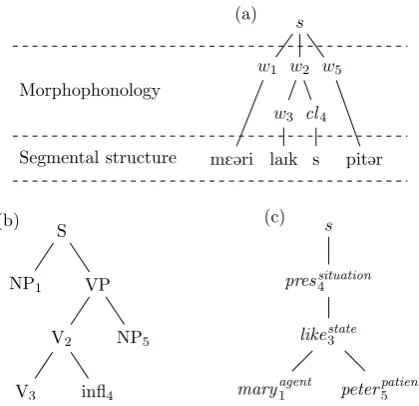
In this section, we discuss an example, roughly following (Jackendoff, 2002), that illustrates the linguistic ideas that have motivated our approach. Figure 1 shows the phonological, syntactical and semantical structure, depicted as trees (a), (b) and (c), respectively of the sentence Mary likes Peter. Trees are defined formally in the next section, for the time being we assume the reader to be familiar with the general notion of a tree as used in linguis-tics and computer science.
s
w1
mE@ri
w2
w3
laIk
cl4
s
w5
pit@r
Morphophonology
Segmental structure
(a)
S
NP1 VP
V2
V3 infl4 NP5
(b) s
pressituation 4
likestate 3
maryagent
[image:3.595.73.283.310.513.2]1 peterpatient5 (c)
Figure 1: Phonological, syntactical and semantical structure of Mary likes Peter.
The segmental structure in the phonological tree (a) is the basic pronunciation of the sentence Mary likes Peter, where each symbol represents a speech sound. This string of speech sound sym-bols is structured into phonological words by mor-phophonolgy. The morphophonological structure in our example consists of the three full phono-logical wordsmE@ri,laIk,pit@rand of the clitic s. The clitic is attached to the adjacent phonologi-cal word, thus forming a larger phonologiphonologi-cal con-stituent. The syntactical tree (b) depicts the syn-tactical constituents. The sentence S is divided into a noun phrase NP and a verb phrase VP. The verb phrase VP is divided into an inflected verbVand a noun phraseNP. The inflected verb
consists of its uninflected form and its inflection, which refers, in our example, to the grammatical features present tense and third person singular. The semantical tree (c) depicts the semantical con-stituents. In our example,likeis a function of type
state and takes two arguments, namelymary and
peter which are of typeagent andpatient.
The structure of Mary likes Peter is not just the sum of its phonological, syntactical and semanti-cal structures. It also includes the relationships be-tween certain constituents in these tree structures. To illustrate these relationships we use indices in Figure 1. The sole role of the indices here is to express the linguistic relationships among coin-dexed constituents. The indices do not occur in the formalisation, where they are replaced by logical links relating the nodes that, in the figure, carry the same indices.2 The morphophonological wordw1, for example, is linked with the noun phraseNP1 in the syntactical tree and with the conceptual con-stituentmaryagent1 in the semantical tree. This il-lustrates thatw1,NP1, andmaryagent1 are the cor-responding morphophonological, syntactical and semantical representations of Mary, respectively. But there are also correspondences that concern only the phonological and syntactical trees, ex-cluding the semantical tree. For example, the in-flected wordV2 in the syntactical structure corre-sponds to the phonological word w2, but has no link to the semantical structure whatsoever.
4 Preliminaries
The set of non-negative integers is denoted byN,
and N+ = N\ {0}. For k ∈ N, we let [k] =
{1, . . . , k}. For a setS, the set of all nonempty finite sequences (or strings) overS is denoted by S+; if the empty sequenceis included, we write S∗. As usual,A1× · · · ×Akdenotes the Cartesian product of setsA1, . . . , Ak. The transitive and re-flexive closure of a binary relation⇒ ⊆A×Aon a setA is denoted by⇒∗. A ranked alphabet is a finite setΣof pairs(f, k), wheref is a symbol andk∈Nis its rank. We denote(f, k)byf(k), or
simply byf ifkis understood or of lesser impor-tance. Further, we letΣ(k)={f(n)∈Σ|n=k}. We define trees overΣin one of the standard ways, by identifying the nodes of a treetwith sequences of natural numbers. Intuitively, such a sequence
2The reader is referred to (Bensch and Drewes, 2009) for
shows that path from the root of the tree to the node in question. In particular, the root is the empty sequence.
Formally, the setTΣof trees overΣconsists of all mappingst:V(t) → Σ(called trees) with the following properties:
• The setV(t)of nodes oftis a finite and non-empty prefix-closed subset ofN∗+. Thus, for every node vi ∈ V(t) (where i ∈ N+), its parentvis inV(t)as well.
• For every nodev ∈V(t), ift(v) =f(k), then
{i∈ N| vi ∈V(t)} = [k]. In other words, the children ofvarev1, . . . , vk.
Lett ∈ TΣ be a tree. The root oftis the node
. For every node v ∈ V(t), the subtree of t
rooted at v is denoted by t/v. It is defined by V(t/v) = {v0 ∈ N∗ | vv0 ∈ V(t)} and, for all v0 ∈ V(t/v), (t/v)(v0) = t(vv0). We shall de-note a tree t as f[t1, . . . , tk] if t() = f(k) and t/i = ti for i ∈ [k]. In the special case where k = 0 (i.e., V(t) = {}), the brackets may be omitted, thus denotingtasf. For a setS of trees, the set of all trees of the form f[t1, . . . , tk]such thatf(k) ∈ Σand t
1, . . . , tk ∈ S is denoted by Σ(S). For a tupleT ∈ TkΣ, we let V(T) denote the set {(i, v) | i ∈ [k]andv ∈ V(ti)}. Thus, V(T) is the disjoint union of the setsV(ti). Fur-thermore, we letV(T, i)denote theith component of this disjoint union, i.e.,V(T, i) = {i} ×V(ti) for alli∈ [k]. A tree language is a subset ofTΣ, for a ranked alphabetΣ, and aΣ-tree generator (or simply tree generator) is any sort of formal device Gthat determines a tree languageL(G)⊆TΣ. A typical sort of tree generator, which we will use in our examples, is the regular tree grammar.
Definition 1 (regular tree grammar). A regular
tree grammar is a tuple G = (N,Σ, R, S) con-sisting of disjoint ranked alphabets N and Σ of nonterminals and terminals, whereN = N(0), a finite set R of rules A → r, where A ∈ N and r∈TΣ∪N, and an initial nonterminalS ∈N.
Given trees t, t0 ∈ TΣ∪N, there is a derivation step t ⇒ t0 if t0 is obtained from tby replacing a single occurrence of a nonterminal A with r, where A → r is a rule in R. The regular tree language generated byGis
L(G) ={t∈TΣ|S ∗
⇒t}.
It is well known that a string language L is context-free if and only if there is a regular tree
language L0, such that L = yield(L0). Here, yield(L0) ={yield(t)|t∈L0}denotes the set of all yields of trees inL0, the yieldyield(t)of a tree t being the string obtained by reading its leaves from left to right.
5 Millstream Systems
Throughout the rest of this paper, letΛdenote any type of predicate logic that allows us to make use ofn-ary predicates symbols. We indicate the ar-ity of predicate symbols in the same way as the rank of symbols in ranked alphabets, i.e., by writ-ingP(n)ifP is a predicate symbol of arityn. The set of all well-formed formulas inΛ without free variables (i.e., the set of sentences ofΛ) is denoted byFΛ. IfSis a set, we say that a predicate symbol
P(n)isS-typed if it comes with an associated type (s1, . . . , sn)∈Sn. We writeP:s1× · · · ×snto specify the type ofP. Recall that ann-ary predi-cateψonDis a functionψ:Dn→ {true,false}. Alternatively,ψcan be viewed as a subset ofDn, namely the set of all(d1, . . . , dn)∈Dnsuch that ψ(d1, . . . , dn) = true. We use these views in-terchangeably, selecting whichever is more conve-nient. Given a (finite) setP of predicate symbols, a logical structurehD; (ψP)P∈Piconsists of a set D called the domain and, for each P(n) ∈ P, a predicate ψP ⊆ Dn. If an existing structure Z is enriched with additional predicates (ψP)P∈P0 (whereP ∩ P0=∅), we denote the resulting struc-ture byhZ; (ψP)P∈P0i. In this paper, we will only consider structures with finite domains. To repre-sent (tuples of) trees as logical structures, consider a ranked alphabet Σ, and let r be the maximum rank of symbols inΣ. A tupleT = (t1, . . . , tk)∈ TkΣwill be represented by the structure
|T|=hV(T); (Vi)i∈[k],(labg)g∈Σ,(↓i)i∈[r]i
consisting of the domainV(T)and the predicates Vi(1) (i ∈ [k]),lab(1)g (g ∈ Σ) and ↓(2)i (i ∈ [r]). The predicates are given as follows:
• For everyi∈[k],Vi =V(T, i). Thus,Vi(d) expresses thatdis a node inti(or, to be pre-cise, thatdrepresents a node oftiin the dis-joint unionV(T)).
• For everyg ∈ Σ, labg = {(i, v) ∈ V(T) | i ∈ [k]andti(v) = g}. Thus,labg(d) ex-presses that the label ofdisg.
expresses thatd0 is the jth child ofdin one of the treest1, . . . , tk. In the following, we writed↓j d0 instead of↓j(d, d0).
Note that, in the definition of |T|, we have blurred the distinction between predicate symbols and their interpretation as predicates, because this interpretation is fixed. Especially in intuitive ex-planations, we shall sometimes also identify the logical structure|T|with the tupleT it represents. To define Millstream systems, we start by for-malising our notion of interfaces. The idea is that a tuple T = (t1, . . . , tk)of trees, represented by the structure|T|, is augmented with additional in-terface links that are subject to logical conditions. An interface may contain finitely many different kinds of interface links. Formally, the collection of all interface links of a given kind is viewed as a logical predicate. The names of the predicates are called interface symbols. Each interface sym-bol is given a type that indicates which trees it is intended to link with each other.
For example, if we want to make use of ternary links called TIE, each linking a node of t1 with a node of t3 and a node of t4, we use the in-terface symbol TIE: 1 ×3 × 4. This interface symbol would then be interpreted as a predicate ψTIE ⊆V(T,1)×V(T,3)×V(T,4). Each triple
inψTIEwould thus be an interface link of typeTIE
that links a node inV(t1)with a node inV(t3)and a node inV(t4).
Definition 2 (interface). Let Σ be a ranked al-phabet. An interface on TkΣ (k ∈ N) is a pair INT = (I,Φ), such that
• Iis a finite set of[k]-typed predicate symbols called interface symbols, and
• Φis a finite set of formulas inFΛthat may, in addition to the fixed vocabulary ofΛ, con-tain the predicate symbols inI and those of the structures|T|(where T ∈ TkΣ). These formulas are called interface conditions.
A configuration (w.r.t.INT) is a structureC =
h|T|; (ψI)I∈Ii, such that
• T ⊆TkΣ,
• ψI ⊆V(T, i1)× · · · ×V(T, il)for every in-terface symbolI:i1× · · · ×ilinI, and
• C satisfies the interface conditions in Φ (if each symbolI ∈ I is interpreted asψI).
Note that several interfaces can always be com-bined into one by just taking the union of their sets of interface symbols and interface conditions.
Definition 3 (Millstream system). Let Σ be a ranked alphabet and k ∈ N. A Millstream sys-tem (MS, for short) is a syssys-tem of the formMS = (M1, . . . , Mk;INT)consisting of Σ-tree genera-torsM1, . . . , Mk, called the modules of MS, and an interface INT on TkΣ. The language L(MS) generated by MS is the set of all configurations
h|T|; (ψI)I∈Ii such that T ∈ L(M1) × · · · ×
L(Mk).
Sometimes we consider only some of the trees in these tuples. For this, if MS is as above and 1≤i1<· · ·< il≤k, we define the notation
LMi1×···×Mil(MS) ={(t
i1, . . . , til)| h|(t1, . . . , tk); (ψI)I∈I|i ∈L(MS)}.
The reader should note that, intentionally, Mill-stream systems are not a priori “generative”. Even less so, they are “derivational” by nature. This is because there is no predefined notion of derivation that allows us to create configurations by means of a stepwise (though typically nondeterministic) procedure. In fact, there cannot be one, unless we make specific assumptions regarding the way in which the modules work, but also regarding the logic Λ and the form of the interface conditions that may be used. Similarly, as mentioned in the introduction, there is no predefined order of im-portance or priority among the modules.
6 Examples and Remarks Related to Formal Language Theory
The purpose of this section is to indicate, by means of examples and easy observations, that Millstream systems are not only linguistically well motivated, but also worth studying from the point of view of computer science, most notably regard-ing their algorithmic and language-theoretic prop-erties. While this kind of study is beyond the scope of the current article, part of our future research on Millstream systems will be devoted to such ques-tions.
Example 1. Let Λ be ordinary first-order logic with equality, and consider the Millstream system
rules3 S → ◦[S, S] | a | b | c | d) and a
sin-gle interface symbolBIJ: 1×2with the interface conditions
∀x: lab{a,b,c,d}(x)↔
∃y:BIJ(x, y)∨BIJ(y, x),
∀x, y, z: (BIJ(x, y)∧BIJ(x, z)∨
BIJ(y, x)∧BIJ(z, x))→y=z, ∀x, y:BIJ(x, y)→
W
z∈{a,b,c,d}
(labz(x)∧labz(y)).
The first interface condition expresses that all and only the leaves of both trees are linked. The second expresses that no leaf is linked with two or more leaves. In effect, this amounts to saying that
BIJ is a bijection between the leaves of the two
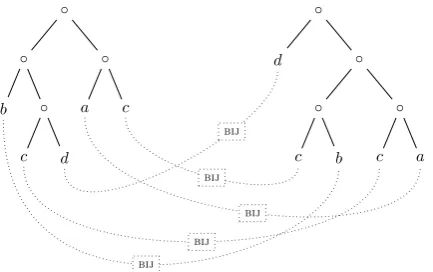
trees. The third interface condition expresses that this bijection is label preserving. Altogether, this amounts to saying that the yields of the two trees are permutations of each other; see Figure 2.
◦
◦
b ◦
c d
◦
a c
◦
d ◦
◦
c b
◦
c a
bij bij
bij
[image:6.595.72.289.339.475.2]bij bij
Figure 2: An element ofL(MS)in Example 1.
Now, let us replace the modules by slightly more interesting ones. For a stringwover{A, B, a, b, c, d}, let w denote any tree over{◦(2), A(0),
B(0), a(0), b(0), c(0), d(0)} with yield(w) = w. (For example, we may choose w to be the left comb whose leaf symbols are given byw.) Let the Millstream systemMS0be defined asMS, but us-ing the modulesM10 = ({A, B, C, D},Σ, R1, A) andM20 = ({A, B},Σ, R2, A)with the following rules:
R01={A→aA|aB, B→bB |bC,
C→cC|cD, D→dD |d}, R02={A→acA|acB, B→bdB |bd}.
Thus,M10 andM20 are the “standard” grammars (written as regular tree grammars) that generate the regular languages {akblcmdn | k, l, m, n ≥
3As usual,A→r|r0
stands forA→r, A→r0.
1} and {(ac)m(bd)n | m, n ≥ 1}. The inter-face makes sure thatLM10×M
0
2(MS0)contains only
those pairs of trees t1, t2 in which yield(t1) is a permutation of yield(t2). As a consequence, it follows that yield(LM10(MS)) = {ambncmdn | m, n≥1}.
The next example discusses how top-down tree transductions can be implemented as Millstream systems.
Example 2 (top-down tree transduction). Recall
that a tree transduction is a binary relation τ ⊆
TΣ × TΣ0, where Σ and Σ0 are ranked alpha-bets. The set of trees that a treet ∈ TΣ is trans-formed into is given by τ(t) = {t0 ∈ TΣ0 | (t, t0) ∈ τ}. Obviously, every Millstream system of the formMS = (M1, M2;INT)defines a tree transduction, namelyLM1×M2(MS). Let us
con-sider a very simple instance of a deterministic top-down tree transduction τ (see, e.g., (G´ecseg and Steinby, 1997; F¨ul¨op and Vogler, 1998; Comon et al., 2007) for definitions and references regarding top-down tree transductions), where Σ = Σ0 =
{f(2), g(2), a(0)}. We transform a treet∈TΣinto the tree obtained fromtby interchanging the sub-trees of all top-mostfs (i.e., of all nodes that are labelled withf and do not have an ancestor that is labelled with f as well) and turning the f at hand into a g. To accomplish this, a top-down tree transducer would use two states, say SWAP
andCOPY, to traverse the input tree from the top down, starting in state SWAP. Whenever an f is reached in this state, its subtrees are interchanged and the traversal continues in parallel on each of the subtrees in state COPY. The only purpose of this state is to copy the input to the output without changing it. Formally, this would be expressed by the following term rewrite rules, viewing the states as symbols of rank1:
SWAP[f[x1, x2]] → g[COPY[x2],COPY[x1]],
COPY[f[x1, x2]] → f[COPY[x1],COPY[x2]],
SWAP[g[x1, x2]] → g[SWAP[x1],SWAP[x2]],
COPY[g[x1, x2]] → g[COPY[x1],COPY[x2]],
SWAP[a] → a,
COPY[a] → a.
us-ing a Millstream system with interface symbols
SWAP: 1×2and COPY: 1×2. Since the mod-ules simply generate TΣ, they are not explicitly discussed. The idea behind the interface is that an interface link labelledq ∈ {SWAP,COPY}links a nodevin the input tree with a nodev0in the output tree if the simulated computation of the tree trans-ducer reachesvin stateq, resulting in nodev0 in the output tree. First, we specify that the initial state isSWAP, which simply means that the roots
of the two trees are linked by aSWAPlink:
∀x, y:root1(x)∧root2(y)→SWAP(x, y),
where rooti is defined as rooti(x) ≡ Vi(x) ∧
@y: y ↓1 x. It expresses that x is the root of treei. The next interface condition corresponds to the first rule of the simulated top-down tree trans-ducer:
∀x, y, x1, x2:SWAP(x, y)∧labf(x)∧x↓1x1∧
x↓2 x2 → labg(y)∧∃y1, y2: y↓1 y1∧y↓2 y2∧
COPY(x1, y2)∧COPY(x2, y1).
In a similar way, the remaining rules are turned into interface conditions, e.g.,
∀x, y, x1, x2:COPY(x, y)∧labf(x)∧x↓1x1∧
x↓2 x2 → labf(y)∧∃y1, y2: y↓1y1∧y↓2y2∧
COPY(x1, y1)∧COPY(x2, y2).
The reader should easily be able to figure out the remaining interface conditions required.
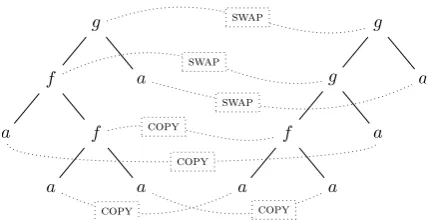
One of the elements ofL(MS)is shown in Fig-ure 3. It should not be difficult to see that, indeed, LM1×M2(MS) =τ.
g
f
a f
a a
a
g
g
f
a a
a a
swap
swap
copy copy
[image:7.595.71.286.508.618.2]copy copy swap
Figure 3: An element ofL(MS)in Example 2.
Extending the previous example, one can eas-ily see that all top-down and bottom-up tree trans-ductions can be turned into Millstream systems in a way similar to the construction above. A similar remark holds for many other types of tree transductions known from the literature. Most no-tably, monadic second-order definable tree trans-ductions (Engelfriet and Maneth, 1999; Engelfriet
and Hoogeboom, 2001; Engelfriet and Maneth, 2003) can be expressed as Millstream systems. Since the mentioned types of tree transductions are well studied, and much is known about their algorithmic properties, future research on Mill-stream systems should investigate the relation-ship between different types of tree transductions and Millstream systems in detail. In particular, it should be tried to formulate requirements on the interface conditions that can be used to ob-tain characterisations of various classes of tree transductions. We note here that results of this type would not only be interesting from a purely mathematical point of view, since tree transduc-ers have turned out to be a valuable tool in, for example, machine translation (Knight and Graehl, 2005; May and Knight, 2006; Graehl et al., 2008).
7 Preliminary Results and Future Work
Millstream systems, as introduced in this article, are formal devices that allow to model situations in which several tree-generating modules are inter-connected by logical interfaces. In a forthcoming paper (Bensch et al., 2010), we investigate the the-oretical properties of regular MSO Millstream sys-tems, i.e., Millstream systems in which the mod-ules are regular tree grammars and the logic used is monadic second-order logic. In particular, we study the so-called completion problem. Given a Millstream system with k modules and l ≤ k
known treesti1, . . . , til (1 ≤i1 <· · · < il ≤ k),
the task is to find a completion, i.e., a configura-tion whoseijth tree istij for allj ∈ [l]. Thus, if
viewed as a pure decision problem, the completion problem corresponds to the membership problem for LMi1×···×Mil(MS). To be useful in
applica-tions, algorithms solving the completion problem should, of course, be required to explicitly con-struct a completion rather than just answering yes. Let us briefly summarize the results of (Bensch et al., 2010).
represent the two parts of a solution to a PCP instance).
2. If there are no direct links between unknown trees (i.e., |{j1, . . . , jm} \ {i1, . . . , il}| ≤ 1 for each interface symbolI:j1× · · · ×jm), then the completion problem is solvable for all regular MSO Millstream systems.
3. Applying some well-known results, the com-pletion problem is solvable for all regular MSO Millstream systems for whichL(MS) is of bounded tree width. Thus, it is of inter-est to inter-establish conditions that guarantee the configurations in L(MS) to be of bounded tree width. Two such conditions, are given in (Bensch et al., 2010). Roughly speaking, they require that the links respect the struc-ture of the trees. Let us informally describe one of them, called nestedness. Say that a link I0(u1, . . . , um) is directly below a link
I(v1, . . . , vl) if there arei, j such that uj is a descendant ofvi and none of the nodes in between carries a link. Now, fix a constant h. A configuration is nested if the roots are linked with each other and the following hold for every linkλ=I(v1, . . . , vl):
(a) There are at mosthlinksI0(u1, . . . , um) directly belowλ.
(b) Each of the nodesuj in (a) is a descen-dant of one of the nodesvi.
As mentioned above, L(MS) is of bounded tree width if its configurations are nested (with respect to the same constanth).
Nestedness, and also the second sufficient con-dition for bounded tree width studied in (Bensch et al., 2010) restrict the configurations themselves. While such conditions may be appropriate in many practical cases (where one knows what the config-urations look like), future research should also at-tempt to find out whether it is possible to put some easily testable requirements on the interface con-ditions in order to force the configurations to be of bounded tree width. Note that, since the prop-erty of being of tree width at mostdis expressible in monadic second-order logic, one can always ar-tificially force the configurations of a given MSO Millstream system to be of bounded tree width, but this is not very useful as it would simply exclude those configurations whose tree width is greater
than the desired constantd, thus changing the se-mantics of the given Millstream system in a usu-ally undesired manner.
Future work should also investigate properties that make it possible to obtain or complete config-urations in a generative way. For example, for reg-ular MSO Millstream systems with interface con-ditions of a suitable type, it should be possible to generate the configurations inL(MS)by generat-ing thek trees in a parallel top-down manner, at the same time establishing the interface links. Re-sults of this kind could also be used for solving the completion problem in an efficient manner. In general, it is clear that efficiency must be an im-portant aspect of future theoretical investigations into Millstream systems.
In addition to theoretical results, a good imple-mentation of Millstream systems is needed in or-der to make it possible to implement nontrivial ex-amples. While this work should, to the extent pos-sible, be application independent, it will also be necessary to seriously attempt to formalise and im-plement linguistic theories as Millstream systems. This includes exploring various such theories with respect to their appropriateness.
To gain further insight into the usefulness and limitations of Millstream systems for Computa-tional Linguistics, future work should elaborate if and how it is possible to translate formalisms such as HPSG, LFG, CCG, FDG and XDG into Mill-stream systems.
Acknowledgments
We thank Dot and Danie van der Walt for pro-viding us with a calm and relaxed atmosphere at Millstream Guest House in Stellenbosch (South Africa), where the first ideas around Millstream systems were born in April 2009. Scientifically, we would like to thank Henrik Bj¨orklund, Stephen J. Hegner, and Brink van der Merwe for discus-sions and constructive input. Furthermore, we would like to thank one of the referees for valu-able comments.
References
Suna Bensch and Frank Drewes. 2009. Mill-stream systems. Report UMINF 09.21, Ume˚a University. Available at http: //www8.cs.umu.se/research/uminf/
Suna Bensch, Henrik Bj¨orklund, and Frank Drewes. 2010. Algorithmic properties of Millstream sys-tems. In Sheng Yu, editor, Proc. 14th Intl. Conf.
on Developments in Language Theory (DLT 2010),
Lecture Notes in Computer Science. To appear.
Hubert Comon, Max Dauchet, R´emi Gilleron, Flo-rent Jacquemard, Christof L¨oding, Denis Lugiez, Sophie Tison, and Marc Tommasi. 2007. Tree Automata Techniques and Applications. Internet publication available athttp://tata.gforge.
inria.fr. Release October 2007.
Mary Dalrymple. 2001. Lexical Functional
Gram-mar, volume 34 of Syntax and Semantics. Academic
Press.
Ralph Debusmann and Gert Smolka. 2006. Multi-dimensional dependency grammar as multigraph de-scription. In Proceedings of FLAIRS Conference, pages 740–745.
Ralph Debusmann. 2006. Extensible Dependency Grammar: A Modular Grammar Formalism Based On Multigraph Description. Ph.D. thesis,
Univer-sit¨at des Saarlandes. Available at http://www.
ps.uni-sb.de/˜rade/papers/diss.pdf.
Joost Engelfriet and Henrik Jan Hoogeboom. 2001. MSO definable string transductions and two-way finite-state transducers. ACM Transactions on
Com-putational Logic, 2:216–254.
Joost Engelfriet and Sebastian Maneth. 1999. Macro tree transducers, attribute grammars, and MSO de-finable tree translations. Information and
Computa-tion, 154:34–91.
Joost Engelfriet and Sebastian Maneth. 2003. Macro tree translations of linear size increase are MSO de-finable. SIAM Journal on Computing, 32:950–1006.
Zolt´an F¨ul¨op and Heiko Vogler. 1998. Syntax-Directed
Semantics: Formal Models Based on Tree Transduc-ers. Springer.
Ferenc G´ecseg and Magnus Steinby. 1997. Tree lan-guages. In G. Rozenberg and A. Salomaa, editors,
Handbook of Formal Languages. Vol. 3: Beyond Words, chapter 1, pages 1–68. Springer.
Jonathan Graehl, Kevin Knight, and Jonathan May. 2008. Training tree transducers. Computational Linguistics, 34(3):391–427.
Ray Jackendoff. 2002. Foundations of Language: Brain, Meaning, Grammar, Evolution. Oxford
Uni-versity Press, Oxford.
Kevin Knight and Jonathan Graehl. 2005. An overview of probabilistic tree transducers for natural language processing. In Alexander F. Gelbukh, edi-tor, Proc. 6th Intl. Conf. on Computational
Linguis-tics and Intelligent Text Processing (CICLing 2005),
volume 3406 of Lecture Notes in Computer Science, pages 1–24. Springer.
Jonathan May and Kevin Knight. 2006. Tiburon: A weighted tree automata toolkit. In Oscar H. Ibarra and Hsu-Chun Yen, editors, Proc. 11th Intl.
Conf. on Implementation and Application of Au-tomata (CIAA 2006), volume 4094 of Lecture Notes
in Computer Science, pages 102–113. Springer.
Carl Pollard and Ivan Sag. 1994. Head-Driven Phrase
Structure Grammar. Chicago University Press.
Jerrold Sadock. 1991. Autolexical Syntax - A Theory
of Parallel Grammatical Representations. The
Uni-versity of Chicago Press, Chicago & London.
Petr Sgall, Eva Hajiˇcov´a, and Jarmila Panevov´a. 1986.
The meaning of the sentence in its semantic and pragmatic aspects. Reidel, Dordrecht.
Mark Steedman. 2000. The Syntactic Process