Evaluating a Meta-Knowledge Annotation Scheme for Bio-Events
Raheel Nawaz
1Paul Thompson
1,2Sophia Ananiadou
1,2 1School of Computer Science, University of Manchester, UK
2
National Centre for Text Mining, University of Manchester, UK
E-mail:
[email protected], [email protected],
[email protected]
Abstract
The correct interpretation of biomedical texts by text mining systems requires the recogni-tion of a range of types of high-level informa-tion (or meta-knowledge) about the text. Ex-amples include expressions of negation and speculation, as well as pragmatic/rhetorical in-tent (e.g. whether the information expressed represents a hypothesis, generally accepted knowledge, new experimental knowledge, etc.) Although such types of information have previously been annotated at the text-span level (most commonly sentences), annotation at the level of the event is currently quite sparse. In this paper, we focus on the evalua-tion of the multi-dimensional annotaevalua-tion scheme that we have developed specifically for enriching bio-events with meta-knowledge information. Our annotation scheme is in-tended to be general enough to allow integra-tion with different types of bio-event annota-tion, whilst being detailed enough to capture important subtleties in the nature of the meta-knowledge expressed in the text. To our knowledge, our scheme is unique within the field with regards to the diversity of meta-knowledge aspects annotated for each event, whilst the evaluation results have confirmed its feasibility and soundness.
1
Introduction
The ability to recognise high-level information (or meta-knowledge) relating to the interpreta-tion of texts is an important task for text mining systems. There are several types of meta-knowledge that fall under this category. For ex-ample, the detection of expressions of specula-tion and negaspecula-tion is important across all do-mains, although the way in which these phenom-ena are expressed may be domain-specific. In scientific texts, it is also important to be able to
determine other types of information, such as the author‟s rhetorical/pragmatic intent (de Waard et al., 2009). This would correspond to whether the information expressed represents a hypothesis, accepted knowledge, new experimental knowl-edge, etc.
The ability to distinguish between these dif-ferent types of information can be important for tasks such as building and updating models of biological processes, like pathways (Oda et al., 2008), and curation of biological databases (Ashburner et al., 2000). Central to both of these tasks is the identification of new knowledge that can enhance these resources, e.g. to build upon an existing, but incomplete model of a biological process (Lisacek et al., 2005) or to ensure that the database is kept up to date. Any new knowl-edge added should be supported though evi-dence, which could include linking hypotheses with experimental findings. It is also important to take into account inconsistencies and contradic-tions reported in the literature.
The production of annotated corpora can help to train text mining systems to recognise types of meta-knowledge, such as the above. Although a number of such corpora have already been pro-duced, different annotation schemes are required according to the exact domain under considera-tion, as well as the types of task that will be un-dertaken by the text mining system.
The work described in this paper is focused on the design and evaluation of the meta-knowledge annotation scheme described in Nawaz et al., (2010). The annotation scheme has been specifi-cally designed to recognise a range of meta-knowledge types for events extracted from bio-medical texts (henceforth bio-events). The aim is to facilitate the development of more useful sys-tems in the context of various biomedical infor-mation extraction (IE) and textual inference (TI) tasks. Although the scheme has been designed
for application to existing bio-event corpora, it is intended to be applied to any type of bio-relation corpora, and can easily be tailored for other types of relations/events within the domain.
1.1 Bio-Event Representation of Text
Searching for relevant information in electronic documents is most commonly carried out by en-tering keywords into a search engine. However, such searches will normally return a huge num-ber of documents, many of which will be irrele-vant to the user‟s needs.
A more promising and efficient way of search-ing is over events that have been extracted from texts through the application of natural language processing methods. An event is a structured rep-resentation of a certain piece of information con-tained within the text, which is usually anchored to a particular word in the text (typically a verb or noun) that is central to the description of the event. Events are often represented by a tem-plate-like structure with slots that are filled by the event participants. Each event participant is also assigned a role within the event. These par-ticipants can be entities, concepts or even other events. This kind of event representation allows the information contained in a text to be repre-sented as a collection of nested events.
A bio-event is an event specialised for the biomedical domain. Kim et al. (2008) define a bio-event as a dynamic bio-relation involving one or more participants. These participants can be bio-entities or (other) bio-events, and are each assigned a semantic role/slot like theme and cause etc. Each bio-event is typically assigned a type/class from a chosen bio-event taxon-omy/ontology, e.g., the GENIA Event Ontology (Kim et al., 2008). Similarly, the bio-entities are also assigned types/classes from a chosen bio-term taxonomy/ontology, e.g., the Gene Ontol-ogy (Ashburner et al., 2000).
As an example, consider the simple sentence shown in Figure 1.
This sentence contains a single bio-event, an-chored to the verb activates. Figure 2 shows a typical structured representation of this bio-event.
The fact that the verb is anchored to the verb activates allows the event-type of positive
regu-lation to be assigned. The event has two slots, i.e. theme and cause whose labels help to charac-terise the contribution that the slot filler makes towards the meaning of the event. In this case, the slots are filled by the subject and object of the verb activates, both of which correspond to different types of bio-entities (i.e. operon and protein).
IE systems trained to extract bio-events from texts allow users to formulate semantic queries over the extracted events. Such queries can specify semantic restrictions on the events in terms of event types, semantic role labels and named entity types etc. (Miyao et al., 2006), in addition to particular keywords. For example, it would be possible to search only for those texts containing bio-events of type nega-tive_regulation where the cause is an entity of type protein. Such queries provide a great deal more descriptive power than traditional keyword searches over unstructured documents. Bio-medical corpora that have been manually anno-tated with event level information (e.g., Pyysalo et al., 2007; Kim et al., 2008; Thompson et al., 2009) facilitate the training of systems such as those described above.
Whilst event-based querying has advantages for efficient searching, the extracted events have little practical use if they are not accompanied by meta-knowledge information to aid in their inter-pretation.
1.2 Existing Meta-knowledge Annotation
Various corpora of biomedical literature (ab-stracts and/or full papers) have been produced that feature some degree of meta-knowledge an-notation. These corpora vary in both the richness of the annotation added, and the type/size of the units at which the meta-knowledge annotation has been performed. Taking the unit of annota-tion into account, we can distinguish between annotations that apply to continuous text-spans, and annotations that have been performed at the event level.
Text-Span Annotation: Such annotations have
mostly been carried out at the sentence level. They normally concentrate on a single aspect (or The results suggest that the narL gene product
activates the nitrate reductase operon.
Figure 1. A Simple Sentence from a Biomedi-cal Abstract
Figure 2. Typical Structured Representation of the Bio-Event mentioned in Figure 1
EVENT-TRIGGER: activates
dimension) of meta-knowledge, normally either speculation/certainty level, (e.g., Light et al., 2004; Medlock & Briscoe, 2007; Vincze et al., 2008) or general information content/rhetorical intent, e.g., background, methods, results, in-sights. This latter type of annotation has been attempted both on abstracts, (e.g., McKnight & Srinivasan, 2003; Ruch et al., 2007) and full pa-pers, (e.g. Teufel et al., 1999; Langer et al., 2004; Mizuta & Collier, 2004), with the number of dis-tinct annotation categories varying between 4 and 14.
Despite the availability of these corpora, anno-tation at the sentence level can often be too granular. In terms of information content, a sen-tence may describe, for example, both an ex-perimental method and its results. The situation becomes more complicated if a sentence contains an expression of speculation. If this is only marked at the sentence level, there may be con-fusion about which part(s) of the sentence are affected by the speculative expression.
Certain corpora and associated systems have attempted to address these issues. The BioScope corpus (Vincze et al., 2008) annotates the scopes of negative and speculative keywords, whilst Morante & Daelemans (2009) have trained a sys-tem to undertake this task. The scheme described by Wilbur et al. (2006) applies annotation to fragments of sentences, which are created on the basis of changes in the meta-knowledge ex-pressed. The scheme consists of multiple annota-tion dimensions which capture aspects of both certainty and rhetorical/pragmatic intent, amongst other things. Training a system to auto-matically annotate these dimensions is shown to be highly feasible (Shatkay et al., 2008).
Event-Level Annotation: Explicit annotation of meta-knowledge at the event-level is currently rather minimal within biomedical corpora. Whilst several corpora contain annotations to distinguish positive and negative events (e.g. Sanchez-Graillet & Poesio, 2007; Pyysalo et al., 2007), the annotation of the GENIA Event Cor-pus (Kim et al., 2008) is slightly more extensive, in that it additionally annotates certainty level. To our knowledge, no existing bio-event corpus has attempted annotation that concerns rhetori-cal/pragmatic intent.
1.3 The Need for an Event-Centric
Meta-Knowledge Annotation Scheme
In comparison to meta-knowledge annotation carried out at the text-span level, the amount of
annotation carried out at the event level is quite sparse. The question thus arises as to whether it is possible to use systems trained on text-span annotated corpora to assign meta-knowledge to bio-events, or whether new annotation at the event level is required.
Some corpora seem better suited to this pur-pose than others – whilst sentence-level annota-tions are certainly too granular for an event-centric view of the text, sentence fragments, such as those identified by Wilbur et al. (2006), are likely to correspond more closely to the extent of text that describes an event and its slots. Like-wise, knowing the scopes of negative and specu-lative keywords within a sentence may be a use-ful aid in determining whether they affect the interpretation of a particular event.
However, the information provided in these corpora is still not sufficiently precise for event-level meta-knowledge annotation. Even within a text fragment, there may be several different bio-events, each with slightly different meta-knowledge interpretations. In a similar way, not all events that occur within the scope of a nega-tion or speculanega-tion keyword are necessarily af-fected by it.
Based on these observations, we have devel-oped a meta-knowledge annotation scheme that is specifically tailored to bio-events. Our scheme annotates various different aspects or dimensions of meta-knowledge. A close examination of a large number of relevant bio-events has resulted in a scheme that has some similarities to previ-ously proposed schemes, but has a number of differences that seem especially relevant when dealing with events, e.g. the annotation of the manner of the event. The scheme is intended to be general enough to allow integration with ex-isting bio-event annotation schemes, whilst being detailed enough to capture important subtleties in the nature of the meta-knowledge expressed about the event.
1.4 Lexical Markers of Meta-Knowledge
Most of the existing corpora mentioned above annotate text spans or events with particular categories (e.g. certainty level or general infor-mation type) in different meta-knowledge di-mensions. However, what they do not normally do is to annotate lexical clues or keywords used to determine the correct values.
interpretation of the text (e.g. Hyland, 1996; Ri-zomilioti 2006). We also performed a similar study (Thompson et al., 2008) although, in con-trast to other studies, we took a multi-dimensional approach to the categorisation of such lexical items, acknowledging that several types of important information may be expressed through different words in the same sentence. As an example, let us consider the example sentence in Figure 3.
The author‟s pragmatic/rhetorical intent to-wards the statement that the catalytic role of these side chains is associated with their interac-tion with the DNA substrate is encoded by the word indicate, which shows that the statement represents an analysis of the evidence stated at the beginning of the sentence, i.e., that the muta-tions at posimuta-tions 849 and 668 have DNA-binding properties. Furthermore, the author‟s certainty level (i.e., their degree of confidence) towards this analysis is shown by the word may. Here, the author is uncertain about the validity of their analysis.
Whilst our previous work served to demon-strate that the different aspects of meta-knowledge that can be specified lexically within texts require a multi-dimensional analysis to cor-rectly capture their subtleties, it showed that the presence of particular lexical items is not the only important feature for determining meta-knowledge categories. In particular, their pres-ence does not guarantee that the “expected” in-terpretation can be assumed (Sándor, 2007). In addition, not all types of meta-knowledge are indicated through explicit markers. Mizuta & Collier (2004) note that rhetorical zones may be indicated not only through explicit lexical mark-ers, but also through features such as the main verb in the clause and the position of the sen-tence within the article or abstract.
For these reasons, we perform annotation on all relevant instances, regardless of the presence of lexical markers. This will allow systems to be trained that can learn to determine the correct meta-knowledge category, even when lexical markers are not present. However, due to the proven importance of lexical markers in
deter-mining certain meta-knowledge dimensions, our annotation scheme annotates such markers, whenever they are present.
2
Annotation Scheme
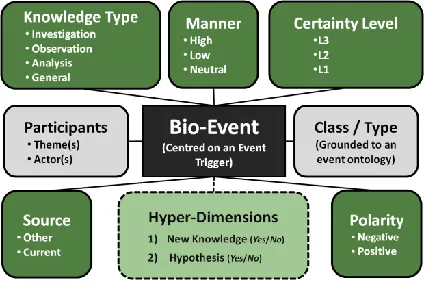
The annotation scheme we present here is a slightly modified version of our original meta-knowledge annotation scheme (Nawaz et al., 2010). The modified scheme consists of five meta-knowledge dimensions, each with a set of complete and mutually-exclusive categories, i.e., any given bio-event belongs to exactly one cate-gory in each dimension. Our chosen set of anno-tation dimensions has been motivated by the major information needs of biologists discussed earlier, i.e., the ability to distinguish between different intended interpretations of events.
In order to minimise the annotation burden, the number of possible categories within each dimension has been kept as small as possible, whilst still respecting important distinctions in meta-knowledge that have been observed during our corpus study.
The advantage of using a multi-dimensional scheme is that the interplay between different values of each dimension can reveal both subtle and substantial differences in the types of meta-knowledge expressed in the surrounding text. Therefore, in most cases, the exact rhetori-cal/pragmatic intent of an event can only be de-termined by considering a combination of the values of different dimensions. This aspect of our scheme is further discussed in section 3.
[image:4.612.313.526.460.602.2]Figure 4 provides an overview of the annota-tion scheme. The boxes with the light-coloured (grey) background correspond to information that is common to most bio-event annotation schemes, i.e., the participants in the event, to-gether with an indication of the class or type of
Figure 4. Bio-Event Annotation Figure 3. Example Sentence
the event. The boxes with the darker (green) backgrounds correspond to our proposed meta-knowledge annotation dimensions and their pos-sible values. The remainder of this section pro-vides brief details of each annotation dimension.
2.1 Knowledge Type (KT)
This dimension is responsible for capturing the general information content of the event. Whilst less detailed than some of the previously pro-posed sentence-level schemes, its purpose is to form the basis of distinguishing between the most critical types of rhetorical/pragmatic intent, according to the needs of biologists. Each event is thus classified into one of the following four categories:
Investigation: Enquiries or investigations, which have either already been conducted or are planned for the future, typically marked by lexi-cal clues like examined, investigated and studied, etc.
Observation: Direct observations, often repre-sented by lexical clues like found, observed and report, etc. Simple past tense sentences typically also describe observations. Such events represent experimental knowledge.
Analysis: Inferences, interpretations, specula-tions or other types of cognitive analysis, typi-cally expressed by lexical clues like suggest, in-dicate, therefore and conclude etc. Such events, if they are interpretations or reliable inferences based on experimental results, can also constitute another type of (indirect) experimental knowl-edge. Weaker inferences or speculations, how-ever, may be considered as hypotheses which need further proof through experiments.
General: Scientific facts, processes, states or methodology. This is the default category for the knowledge type dimension.
2.2 Certainty Level (CL)
The value of this dimension is almost always indicated through the presence/absence of an ex-plicit lexical marker. In scientific literature, it is normally only applicable to events whose KT corresponds either to Analysis or General. In the case of Analysis events, CL encodes confidence in the truth of the event, whilst for General events, there is a temporal aspect, to account for cases where a particular process is explicitly stated to occur most (but not all) of the time, us-ing a marker such as normally,or only occasion-ally, using a marker like sometimes. Events cor-responding to direct Observations are not open to judgements of certainty, nor are Investigation
events, which refer to things which have not yet happened or have not been verified.
Regarding the choice of values for the CL di-mension, there is an ongoing discussion as to whether it is possible to partition the epistemic scale into discrete categories (Rubin, 2007). However, the use of a number of distinct catego-ries is undoubtedly easier for annotation pur-poses and has been proposed in a number of pre-vious schemes. Although recent work has sug-gested the use of four or more categories (Shat-kay et al., 2008; Thompson et al., 2008), our ini-tial analysis of bio-event corpora has shown that only three levels of certainty seem readily distin-guishable for bio-events. This is in line with Hoye (1997), whose analysis of general English showed that there are at least three articulated points on the epistemic scale.
We have chosen to use numerical values for this dimension, in order to reduce potential anno-tator confusions or biases that may be introduced through the use of labels corresponding to par-ticular lexical markers of each category, such as probable or possible, and also to account for the fact that slightly different interpretations apply to the different levels, according to whether the event has a KT value of Analysis or General. L3: No expression of uncertainty or speculation (default category)
L2: High confidence or slight speculation. L1: Low confidence or considerable speculation; typical lexical markers include may, might and perhaps.
2.3 Source
The source of experimental evidence provides important information for biologists. This is demonstrated by its annotation during the crea-tion of the Gene Ontology (Ashburner et al., 2000) and in the corpus created by Wilbur et al. (2006). The Source dimension can also help in distinguishing new experimental knowledge from previously reported knowledge. Our scheme distinguishes two categories, namely: Other: The event is attributed to a previous study. In this case, explicit clues (citations or phrases like previous studies etc.) are normally present.
2.4 Polarity
This dimension identifies negated events. Al-though certain bio-event corpora are annotated with this information, it is still missing from oth-ers. The indication of whether an event is ne-gated is vital, as the interpretation of a nene-gated event instance is completely opposite to the in-terpretation of a non-negated (positive) instance of the same event.
We define negation as the absence or non-existence of an entity or a process. Negation is typically expressed by the adverbial not and the nominal no. However, other lexical devices like negative affixals (un- and in-, etc.), restrictive verbs (fail, lack, and unable, etc.), restrictive nouns (exception, etc.), certain adjectives ( inde-pendent, etc.), and certain adverbs (without, etc.) can also be used.
2.5 Manner
Events may be accompanied by a word or phrase which provides an indication of the rate, level, strength or intensity of the interaction. We refer to this as the Manner of the event. Information regarding manner is absent from the majority of existing bio-event corpora, but yet the presence of such words can be significant in the correct interpretation of the event. Our scheme distin-guishes 3 categories of Manner, namely: High: Typically expressed by adverbs and adjec-tives like strongly, rapidly and high, etc. Low: Typically expressed by adverbs and adjec-tives like weakly, slightly and slow, etc.
Neutral: Default category assigned to all events without an explicit indication of manner.
3
Hyper-Dimensions
Determining the pragmatic/rhetorical intent be-hind an event is not completely possible using any one of our explicitly annotated dimensions. Although the Knowledge Type value forms the basis for this, it is not in itself sufficient. How-ever, a defining feature of our annotation scheme is that additional information can be inferred by considering combinations of some of the explic-itly annotated dimensions. We refer to this addi-tional information as “latent” or “hyper” dimen-sions of our scheme. We have identified two such hyper-dimensions.
3.1 New Knowledge
The isolation of events describing new knowl-edge can be important in certain tasks undertaken by biologists, as explained earlier. Events with
the Knowledge Type of Observation could corre-spond to new knowledge, but only if they repre-sent observations from the current study, rather than observations cited from elsewhere. In a similar way, an Analysis drawn from experimen-tal results in the current study could be treated as new knowledge, but generally only if it repre-sents a straightforward interpretation of results, rather than something more speculative.
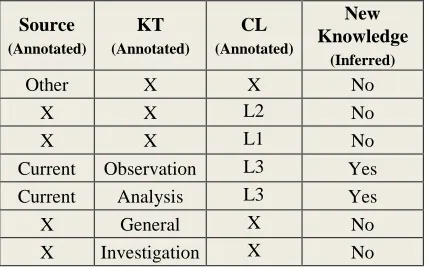
Hence, we consider New Knowledge to be a hyper-dimension of our scheme. Its value (either Yes or No) is inferred by considering a combina-tion of the value assignments for the KT, Source and CL dimensions.
Table 1 shows the inference table that can be used to obtain the value for the New Knowledge hyper-dimension from the assigned values of the Source, KT and CL dimensions. The symbol „X‟ indicates a “don‟t care condition”, meaning that this value does not have any impact on the result.
Source (Annotated)
KT (Annotated)
CL (Annotated)
New Knowledge
(Inferred)
Other X X No
X X L2 No
X X L1 No
Current Observation L3 Yes
Current Analysis L3 Yes
X General X No
[image:6.612.312.526.298.433.2]X Investigation X No
Table 1. Inference-Table for New Knowledge Hyper-Dimension
3.2 Hypothesis
A further hyper-dimension of our scheme is Hy-pothesis. The binary value of this hyper-dimension can be inferred by considering the values of KT and CL. Events with a KT value of Investigation can always be assumed to be a hy-pothesis, However, if the KT value is Analysis, then only those events with a CL value of L1 or L2 (speculative inferences made on the basis of results) should be considered as hypothesis, to be matched with more definite experimental evi-dence when available. A value of L3 in this in-stance would normally be classed as new knowl-edge, as explained in the previous section.
KT (Annotated)
CL (Annotated)
Hypothesis (Inferred)
General X No
Observation X No
Analysis L3 No
Analysis L2 Yes
Analysis L1 Yes
[image:7.612.98.294.48.160.2]Investigation X Yes
Table 2. Inference-Table for Hypothesis Hyper-Dimension
4
Evaluation
The annotation scheme has been evaluated through a small annotation experiment. We ran-domly choose 70 abstracts from the GENIA Pathway Corpus, which collectively contain over 2600 annotated bio-events. Two of the authors independently annotated these bio-events using a set of annotation guidelines. These guidelines were developed following an analysis of the various bio-event corpora and the output of the initial case study (Nawaz et al., 2010).
The highly favourable results of this experi-ment further confirmed the feasibility and soundness of the annotation scheme. The re-mainder of this section discusses the results in more detail.
Dimension Cohen’s Kappa
Knowledge Type 0.9017
Certainty Level 0.9329
Polarity 0.9059
Manner 0.8944
Source 0.9520
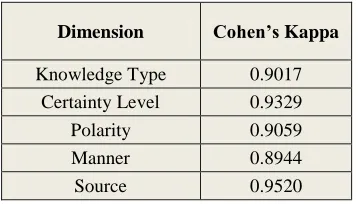
Table 3. Inter-Annotator Agreement
4.1 Inter-Annotator Agreement
We have used the familiar measure of Cohen‟s kappa (Cohen, 1960) for assessing the quality of annotation. Table 3 shows the kappa values for each annotated dimension. The highest value of kappa was achieved for the Source dimension, while the KT dimension yielded the lowest kappa value. Nevertheless, the kappa scores for all an-notation dimensions were in the good region (Krippendorff, 1980).
4.2 Category Distribution
Knowledge Type: The most prevalent category found in this dimension was Observation, with 45% of all annotated events belonging to this category. Only a small fraction (4%) of these events was represented by an explicit lexical clue (mostly sensory verbs). In most cases the tense, local context (position within the sentence) or global context (position within the document) were found to be important factors.
The second most common category (37% of all annotated events) was General. We discov-ered that most (64%) of the events belonging to this category were processes or states embedded in noun phrases (such as c-fos expression). More than a fifth of the General events (22%) ex-pressed known scientific facts, whilst a smaller fraction (14%) expressed experimental/scientific methods (such as stimulation and incubation etc.). Explicit lexical clues were found only for facts, and even then in only 1% of cases.
Analysis was the third most common category, comprising 16% of all annotated events. Of the events belonging to this category, 44% were de-ductions (CL=L1), whilst the remaining 54% were hedged interpretations (CL=L2/L3). All Analysis events were marked with explicit lexical clues.
The least common category was Investigation (1.5% of all annotated events). All Investigation events were marked with explicit lexical clues. Certainty Level: L3 was found to be the most prevalent category, corresponding to 93% of all events. The categories L2 and L1 occurred with frequencies of 4.3% and 2.5%, respectively. The relative scarcity of speculative sentences in sci-entific literature is a well documented phenome-non (Thompson et al., 2008; Vincze et al., 2008). Vincze et al. (2008) found that less than 18% of sentences occurring in biomedical abstracts are speculative. Similarly, we found that around 20% of corpus events belong to speculative sentences. Since speculative sentences contain non-speculative events as well, the frequency of speculative events is expected to be much less than the frequency of speculative sentences. In accordance with this hypothesis, we found that only 7% of corpus events were expressed with some degree of speculation. We also found that almost all speculated events had explicit lexical clues.
[image:7.612.106.285.414.516.2]quency of negated events is lower than the fre-quency of negated sentences. Another reason for finding fewer negated events is the fact that, in contrast to previous schemes, we draw a distinc-tion between events that are negated and events expressed with Low manner. For example, cer-tain words like limited and barely are often con-sidered as negation clues. However, we consider them as clues for Low manner. In all cases, nega-tion was expressed through explicit lexical clues. Manner: Whilst only a small fraction (4%) of events contains an indication of Manner, we found that where present, manner conveys vital information about the event. Our results also re-vealed that indications of High manner are three times more frequent than the indications of Low manner. We also noted that both High and Low manners were always indicated through the use of explicit clues.
Source: Most (99%) of the events were found to be of the Current category. This is to be ex-pected, as authors tend to focus on current work in within abstracts. It is envisaged, however, that this dimension will be more useful for analyzing full papers.
Hyper-dimensions: Using the inference tables
shown in section 3, we calculated that almost 57% of the events represent New Knowledge, and just above 8% represent Hypotheses.
5
Conclusion and Future Work
We have evaluated a slightly modified version of our meta-knowledge annotation scheme for bio-events, first presented in Nawaz et al. (2010). The scheme captures key information regarding the correct interpretation of bio-events, which is not currently annotated in existing bio-event cor-pora, but which we have shown to be critical in a number of text mining tasks undertaken by bi-ologists. The evaluation results have shown high inter-annotator agreement and a sufficient num-ber of annotations along each category in every dimension. These results have served to confirm the feasibility and soundness of the annotation scheme, and provide promising prospects for its application to existing and new bio-event cor-pora.
We are currently working on a large scale an-notation effort, involving multiple independent annotators. Although our main objective is to enrich the entire GENIA event corpus with meta-knowledge information, we also plan to create a small corpus of full papers enriched with bio-event and meta-knowledge annotations.
Acknowledgments
The work described in this paper has been funded by the Biotechnology and Biological Sci-ences Research Council through grant numbers BBS/B/13640, BB/F006039/1 (ONDEX)
References
M. Ashburner, C. A. Ball, J. A. Blake, D. Botstein, H. Butler, J. M. Cherry, A. P. Davis, K. Dolinski, S. S. Dwight, J. T. Eppig, M. A. Harris, D. P. Hill, L. Issel-Tarver, A. Kasarskis, S. Lewis, J. C. Matese, J. E. Richardson, M. Ringwald, G. M. Rubin and G. Sherlock. 2000. Gene ontology: tool for the unification of biology. Nature Genetics 25:25-29.
J. Cohen. 1960. A coefficient of agreement for nomi-nal scales. Educational and Psychological Meas-urement 20: 37–46.
A. de Waard, B. Shum, A. Carusi, J. Park, M. Sam-wald and Á. Sándor. 2009. Hypotheses, Evidence and Relationships: The HypER Approach for Rep-resenting Scientific Knowledge Claims. In Pro-ceedings of the Workshop on Semantic Web Appli-cations in Scientific Discourse. Available at: http://oro.open.ac.uk/18563/
L. Hoye. 1997. Adverbs and Modality in English. London & New York: Longman
K. Hyland. 1996. Talking to the Academy: Forms of Hedging in Science Research Articles. Written Communication 13(2):251-281.
K. Hyland. 2005. Metadiscourse: Exploring Interac-tion in Writing. London: Continuum
J. Kim, T. Ohta and J. Tsujii. 2008. Corpus annotation for mining biomedical events from literature. BMC Bioinformatics 9:10
K. Krippendorff. 1980. Content Analysis: An Intro-duction to Its Methodology. Beverly Hills: Sage Publications
H. Langer, H. Lungen and P. S. Bayerl. 2004. Text type structure and logical document structure. In
Proceedings of the ACL Workshop on Discourse Annotation, pages 49-56
M. Light, X. T. Qui and P. Srinivasan. 2004. The lan-guage of bioscience: Facts, speculations, and statements in between. In Proceedings of the Bio-Link 2004 Workshop on Bio-Linking Biological Litera-ture, Ontologies and Databases: Tools for Users, pages 17-24.
L. McKnight and P. Srinivasan. 2003. Categorization of sentence types in medical abstracts. In Proceed-ings of the 2003 Annual Symposium of AMIA,
pages 440-444.
B. Medlock and T. Briscoe. 2007. Weakly supervised learning for hedge classification in scientific litera-ture. In Proceedings of ACL 2007, pages 992- 999.
Y. Miyao, T. Ohta, K. Masuda, Y. Tsuruoka, K. Yo-shida, T. Ninomiya and J. Tsujii. 2006. Semantic Retrieval for the Accurate Identification of Rela-tional Concepts in Massive Textbases. In Proceed-ings of COLING-ACL 2006, pages 1017-1024.
Y. Mizuta and N. Collier. 2004. Zone identification in biology articles as a basis for information extrac-tion. In Proceedings of the joint NLPBA/BioNLP Workshop on Natural Language for Biomedical Applications, pages119-125.
R. Morante and W. Daelemans. 2009. A metalearning approach to processing the scope of negation. In
Proceedings of CoNLL 2009, pages 21-29.
R. Nawaz, P. Thompson, J. McNaught and S. Ananiadou. 2010. Meta-Knowledge Annotation of Bio-Events. In Proceedings of LREC 2010, pages 2498-2507.
K. Oda, J. Kim, T. Ohta, D. Okanohara, T. Matsuzaki, Y. Tateisi and J. Tsujii. 2008. New challenges for text mining: mapping between text and manually curated pathways. BMC Bioinformatics 9(Suppl 3): S5.
S. Pyysalo, F. Ginter, J. Heimonen, J. Bjorne, J. Boberg, J. Jarvinen and T. Salakoski. 2007. BioIn-fer: a corpus for information extraction in the bio-medical domain. BMC Bioinformatics 8:50.
V. Rizomilioti. 2006. "Exploring Epistemic Modality in Academic Discourse Using Corpora." Informa-tion Technology in Languages for Specific Pur-poses 7, pages 53-71
V. L. Rubin. 2007. Stating with certainty or stating with doubt: Intercoder reliability results for manual annotation of epistemically modalized statements. In Proceedings of NAACL-HLT 2007, Companion Volume, pages 141-144.
P. Ruch, C. Boyer, C. Chichester, I. Tbahriti, A. Geissbühler, P. Fabry, J. Gobeill, V. Pillet, D. Rebholz-Schuhmann and C. Lovis. 2007. Using argumentation to extract key sentences from bio-medical abstracts. International Journal of Medical Informatics 76(2-3):195-200.
O. Sanchez-Graillet and M. Poesio. 2007. Negation of protein-protein interactions: analysis and extrac-tion. Bioinformatics 23(13):i424-i432
Á. Sándor. 2007. Modeling metadiscourse conveying the author‟s rhetorical strategy in biomedical
re-search abstracts. Revue Française de Linguistique Appliquée 200(2):97-109.
H. Shatkay, F. Pan, A. Rzhetsky and W. J. Wilbur. 2008. Multi-dimensional classification of biomedi-cal text: toward automated, practibiomedi-cal provision of high-utility text to diverse users. Bioinformatics
24(18): 2086-2093.
S. Teufel, J. Carletta and M. Moens. 1999. An annota-tion scheme for discourse-level argumentaannota-tion in research articles. In Proceedings of EACL 1999, pages 110-117.
S. Teufel, A. Siddharthan and C. Batchelor. 2009. Towards discipline-independent argumentative zoning: Evidence from chemistry and computa-tional linguistics. In Proceedings of EMNLP-09, pages 1493-1502
P. Thompson, S. Iqbal, J. McNaught and S. Ananiadou. 2009. Construction of an annotated corpus to support biomedical information extrac-tion. BMC Bioinformatics 10: 349.
P. Thompson, G. Venturi, J. McNaught, S. Monte-magni and S. Ananiadou. 2008. Categorising Mo-dality in Biomedical Texts. In Proceedings of the LREC 2008 Workshop on Building and Evaluating Resources for Biomedical Text Mining, pages 27-34.
V. Vincze, G. Szarvas, R. Farkas, G. Mora and J. Csirik. 2008. The BioScope corpus: biomedical texts annotated for uncertainty, negation and their scopes. BMC Bioinformatics 9(Suppl 11): S9.
W. J. Wilbur, A. Rzhetsky and H. Shatkay. 2006. New directions in biomedical text annotations: definitions, guidelines and corpus construction.