Using reading behavior to predict grammatical functions
Maria Barrett and Anders Søgaard University of Copenhagen
Njalsgade 140 DK-2300 Copenhagen S
{barrett,soegaard}@hum.ku.dk
Abstract
This paper investigates to what extent grammatical functions of a word can be predicted from gaze features obtained us-ing eye-trackus-ing. A recent study showed that reading behavior can be used to pre-dict coarse-grained part of speech, but we go beyond this, and show that gaze fea-tures can also be used to make more fine-grained distinctions between grammati-cal functions, e.g., subjects and objects. In addition, we show that gaze features can be used to improve a discriminative transition-based dependency parser.
1 Introduction
Readers fixate more and longer on open syntac-tic categories (verbs, nouns, adjectives) than on closed class items like prepositions and conjunc-tions (Rayner and Duffy, 1988; Nilsson and Nivre, 2009). Recently, Barrett and Søgaard (2015) pre-sented evidence that gaze features can be used to discriminate between most pairs of parts of speech (POS). Their study uses all the coarse-grained POS labels proposed by Petrov et al. (2011). This paper investigates to what extent gaze data can also be used to predict grammatical functions such as subjects and objects. We first show that a sim-ple logistic regression classifier trained on a very small seed of data using gaze features discrimi-nates between some pairs of grammatical func-tions. We show that the same kind of classifier distinguishes well between the four main gram-matical functions of nouns, POBJ, DOBJ, NN and NSUBJ. In §3, we also show how gaze features
can be used to improve dependency parsing. Many gaze features correlate with word length and word
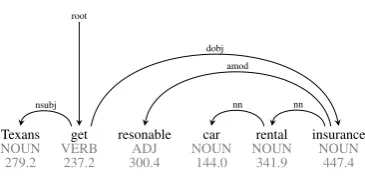
Texans get resonable car rental insurance
NOUN VERB ADJ NOUN NOUN NOUN
279.2 237.2 300.4 144.0 341.9 447.4 root
nsubj
dobj amod
[image:1.595.311.494.242.330.2]nn nn
Figure 1: A dependency structure with average fix-ation durfix-ation per word
frequency (Rayner, 1998) and these could be as good as gaze features, while being easier to obtain. We use frequencies from the unlabelled portions of the English Web Treebank and word length as baseline in all types of experiments and find that gaze features to be better predictors for the noun experiment as well as for improving parsers.
This work is of psycholinguistic interest, but we show that gaze features may have practical rele-vance, by demonstrating that they can be used to improve a dependency parser. Eye-tracking data becomes more readily available with the emer-gence of eye trackers in mainstream consumer products (San Agustin et al., 2010). With the de-velopment of robust eye-tracking in laptops, it is easy to imagine digital text providers storing gaze data, which could then be used as partial annota-tion of their publicaannota-tions.
Contributions We demonstrate that we can dis-criminate between some grammatical functions using gaze features and which features are fit for the task. We show a practical use for data reflect-ing human cognitive processreflect-ing. Finally, we use gaze features to improve a transition-based de-pendency parser, comparing also to dede-pendency parsers augmented with word embeddings.
2 Eye tracking data
The data comes from (Barrett and Søgaard, 2015) and is publicly available1. In this experiment 10
native English speakers read 250 syntactically annotated sentences in English (min. 3 tokens, max. 120 characters). The sentences were ran-domly sampled from one of five different, man-ually annotated corpora from different domains: Wall Street Journal articles (WSJ), Wall Street Journal headlines (HDL), emails (MAI), weblogs (WBL), and Twitter (TWI)2. See Figure 1 for an
example.
Features It is not yet established which eye movement reading features are fit for the task of distinguishing grammatical functions of the words. To explore this, we extracted a broad se-lection of word- and sentence-based features. The features are inspired by Saloj¨arvi et al. (2003) who used a similar exploratory approach. For a full list of features, see Appendix.
2.1 Learning experiments
In our binary experiments, we use L2-regularized logistic regression classifiers with the default pa-rameter setting in SciKit Learn3 and a publicly
available transition-based dependency parser4
trained using structured perceptron (Collins, 2002; Zhang and Nivre, 2011).
Binary classification We trained logistic regres-sion models to discriminate between pairs of the 11 most frequent dependency relations where the sample size is above 100: (AMOD,NN,AUX,PREP, NSUBJ, ADVMOD,DEP, DET, DOBJ, POBJ, ROOT)
only using gaze features. E.g., we selected all words annotated asPREPor NSUBJ and trained a
logistic regression model to discriminate between the two in a five-fold cross validation setup. Our baseline uses the following features: word length, position in sentence and word frequency.
Some dependency relations are almost uniquely associated with one POS, e.g. determiners where
1https://bitbucket.org/lowlands/
release/src
2Wall Street Journal sentences are from OntoNotes 4.0
re-lease of the English Penn Treebank. catalog.ldc.
upenn.edu/LDC2011T03. Mail and weblog sentences
come from the English Web Treebank. catalog.ldc.
upenn.edu/LDC2012T13. Twitter sentences are from the
work of (Foster et al., 2011)
3http://scikit-learn.org/stable/
modules/generated/sklearn.linear_model. LogisticRegression.html
4https://github.com/andersjo/hanstholm
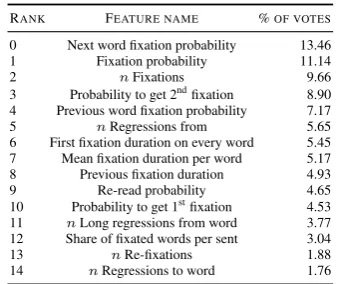
RANK FEATURE NAME %OF VOTES
0 Next word fixation probability 13.46 1 Fixation probability 11.14
2 nFixations 9.66
3 Probability to get 2ndfixation 8.90
4 Previous word fixation probability 7.17
5 nRegressions from 5.65
6 First fixation duration on every word 5.45 7 Mean fixation duration per word 5.17 8 Previous fixation duration 4.93
9 Re-read probability 4.65
10 Probability to get 1stfixation 4.53
11 nLong regressions from word 3.77 12 Share of fixated words per sent 3.04
13 nRe-fixations 1.88
[image:2.595.331.501.61.203.2]14 nRegressions to word 1.76
Table 1: Most predictive features for binary classi-fication of 11 most frequent dependency relations using five-fold cross validation.
84.8% of words with the dependency relationDET
are labeled determiners. This means that in some cases, the grammatical function of a word follows from its part of speech. In another binary exper-iment, we therefore focus on nouns to show that eye movements do make more fine-grained dis-tinctions between different grammatical functions. Nouns are mostly four-way ambiguous: 74.6% of the 946 nouns in the dataset have one of four de-pendency relations to its head. Nouns with POBJ
relations is 18.9% of all nouns, NSUBJ is 17.0%, NN is 27.0% and DOBJ is 14.9%. The remaining
25.4% of the nouns are discarded from the noun experiment since they have 28 different relations to their head.
Parsing In all experiments we trained our pars-ing models on four domains and evaluated on the fifth to avoid over-fitting to the characteristics of a specific domain. All parameters were tuned on the WSJ dataset. We did 30 passes over the data and used the feature model in Zhang and Nivre (2011) – concatenated with gaze vectors for the first to-ken on the buffer, the first toto-ken in the stack, and the left sibling of the first token in the stack. We extend the feature representation of each parser configuration by3×26features. Our gaze vectors were normalized using the technique in Turian et al. (2010) (σ·E/SD(E)) using a scaling factor of σ= 0.001. Gaze features such as fixation duration are known to correlate with word frequency and word length. To investigate whether word length and frequency are stronger features than gaze, we perform an experiment, +FREQ+LEN, where our
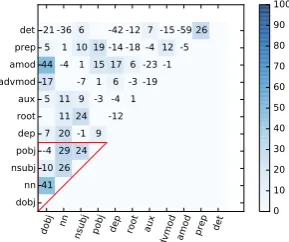
dobj nn nsubj pobj dep root aux advmodamod prep
det
dobjnn nsubjpobj dep rootaux advmodamod prepdet
41 10 26 -4 29 247 20 -1 9
11 24 -12 5 11 9 -3 -4 1 17 -7 1 6 -3 -19 44 -4 1 15 17 6 -23 -15 1 10 19 -14 -18 -4 12 -5 -21 -36 6 -42 -12 7 -15 -59 26
[image:3.595.337.496.63.123.2]0 10 20 30 40 50 60 70 80 90 100
Figure 2: Error reduction over the baseline for bi-nary classifications of 11 most frequent depen-dency relations. 5-fold cross validation. Depen-dency relations associated with nouns in triangle.
3 Results
Predictive features To investigate which gaze features were more predictive of grammatical function, we used stability selection (Meinshausen and B¨uhlmann, 2010) with logistic regression classification on binary dependency relation clas-sifications on the most frequent dependency rela-tions.
For each pair of dependencies, we perform a five-fold cross validation and record the informa-tive features from each run. Table 1 shows the 15 most used features in ranked order with their proportion of all votes. The features predictive of grammatical functions are similar to the features that were found to be predictive of POS (Barrett and Søgaard, 2015), however, the probability that a word gets first and second fixation were not im-portant features for POS classification, whereas they are contributing to dependency classification. This could suggest that words with certain gram-matical functions are consistently more likely or less likely to get first and second fixation, but could also be due to a frequent syntactic order in the sample.
Binary discrimination Error reduction over the baseline can be seen in Figure 2. The mean accu-racy using logistic regression on all binary classifi-cation problems between grammatical functions is 0.722. The frequency-position-word length base-line is 0.706. In other words, using gaze features leads to a 5.6% error reduction over the base-line. The worst performance (where our baseline outperforms using gaze features) is seen where one relation is associated with closed class words
RANK FEATURE NAME %OF VOTES
0 Next word fixation probability 20.66 1 Probability to get 2ndfixation 19.83
[image:3.595.109.254.66.187.2]2 nRegressions from word 14.05 3 Previous word fixation probability 8.68 4 Probability to get 1stfixation 7.44
Table 2: Most predictive features for the binary classification of four most frequent dependency relations for nouns using five-fold cross validation.
(DET, PREP, AUX), and where discrimination is
easier.
Noun experiment Error reductions for pairwise classification of nouns are between -4% and 41%. See Figure 2. The average accuracy for binary noun experiments is 0.721. Baseline accuracy is 0.647. ForPOBJandDOBJthe baseline was better
than using gaze, but for the other pairs, gaze was better. When doing stability selection for nouns with only the four most frequent grammatical functions, the most important features can be seen from Figure 2. The most informative feature is the fixation probability of the next word. Kernel den-sity of this feature can be seen in Figure 3a, and it shows two types of behavior: POBJ and DOBJ,
where the next word is less frequently fixated, and
NNand NSUBJ, where the next word is more
fre-quently fixated. Whether the next word is fixated or not, can be influenced by the word length, as well as the fixation probability of the current word: If the word is very short, the next word can be pro-cessed from a fixation of the current word, and if the current word is not fixated, the eyes need to land somewhere in order for the visual span to cover a satisfactory part of the text. Word length and fixation probabilities for the nouns are re-ported in Figure 3c and Figure 3b to show that the dependency labels have similar densities.
Dependency parsing We also evaluate our gaze features directly in a supervised dependency parser. Our baseline performance is relatively low because of the small training set, but comparable to performance often seen with low-resource lan-guages. Evaluation metrics are labeled attachment scores (LAS) and unlabeled attachment scores (UAS), i.e. the number of words that get assigned the correct syntactic head w/o the correct depen-dency label.
reduc-0.0 0.5 1.0
0.0
0.5
1.0
1.5
Density
dobj nn nsubj pobj
(a) Next word fixation probability
0.0 0.2 0.4 0.6 0.8 1.0 1.2
0.0
0.5
1.0
1.5
2.0
2.5
Density
(b) Fixation probability
0 5 10 15 20 25
0.00
0.05
0.10
0.15
Density
[image:4.595.114.483.71.192.2](c) Word length
Figure 3: Kernel density plots across four grammatical functions of nouns.
LAS UAS
+FREQ+LEN +FREQ+LEN
BL +SENNA +EIGENW +GAZE BL +GAZE BL +SENNA +EIGENW +GAZE BL +GAZE
HDL 0.539 0.539 0.526 0.541 0.535 0.542 0.583 0.600 0.564 0.589 0.582 0.587
MAI 0.667 0.651 0.668 *0.684 0.678 *0.711 0.715 0.699 0.715 *0.747 0.732 *0.759
TWI 0.532 0.569 0.563 *0.561 0.554 *0.569 0.576 0.626 0.615 *0.602 0.607 *0.621
WBL 0.604 0.629 0.592 *0.638 0.631 *0.655 0.668 0.670 0.666 *0.711 0.709 *0.719
WSJ 0.635 0.635 0.622 *0.650 0.629 0.634 0.672 0.681 0.674 *0.695 0.671 0.677
Average 0.595 0.605 0.594 *0.615 0.605 *0.622 0.643 0.655 0.647 *0.669 0.660 *0.672 Table 3: Dependency parsing results on all five test sets using 200 sentences (four domains) for training and 50 sentences (one domain) for evaluation. Best results are bold-faced, and significant (p < 0.01) improvements are asterisked.
tion in UAS is 7.3%. For the +FREQ+LEN
exper-iment, +GAZE also lead to improvements for all
domains, with error reductions of 3.3% for LAS and 4.7% for UAS.
For comparison we also ran our parser with SENNA embeddings5 and EIGENWORDS
embed-dings.6 The gaze vectors proved overall more
in-formative.
4 Related work
In addition to Barrett and Søgaard (2015), our work relates to Matthies and Søgaard (2013), who study the robustness of a fixation prediction model across readers, not domains, but our work also re-lates in spirit to research on using weak supervi-sion in NLP, e.g., work on using HTML markup to improve dependency parsers (Spitkovsky, 2013) or using click-through data to improve POS taggers (Ganchev et al., 2012).
There have been few studies correlating read-ing behavior and general dependency syntax in the literature. Demberg and Keller (2008), hav-ing parsed the Dundee corpus ushav-ing MINIPAR,
show that dependency integration cost, roughly the distance between a word and its head, is
pre-5http://ronan.collobert.com/senna/
6http://www.cis.upenn.edu/˜ungar/
eigenwords/
dictive of reading times for nouns. Our finding could be a side-effect of this, since NSUBJ, NN
and DOBJ/POBJ typically have very different
de-pendency integration costs, whileDOBJandPOBJ
have about the same. Their study thus seems to support our finding that gaze features can be used to discriminate between the grammatical func-tions of nouns. Most other work of this kind fo-cus on specific phenomena, e.g., Traxler et al. (2002), who show that subjects find it harder to process object relative clauses than subject relative clauses. This paper is related to such work, but our interest is a broader model of syntactic influences on reading patterns.
5 Conclusions
[image:4.595.79.525.223.312.2]Appendix: Gaze features
First fixation duration on every word, fixation probability, mean fixation duration per sentence, mean fixation duration per word, next fixation du-ration, next word fixation probability, probability to get 1st fixation, probability to get 2nd fixation,
previous fixation duration, previous word fixation probability, re-read probability, reading time per sentence normalized by word count, share of fix-ated words per sentence, time percentage spent on this word out of total sentence reading time, total fixation duration per word, total regression from word duration, total duration of regressions to word,nfixations on word,nfixations per sent nor-malized by token count, nlong regressions from word,nlong regressions per sentence normalized by token count,nlong regressions to word, n re-fixations on word,nre-fixations per sentence nor-malized by token count,nregressions from word, n regressions per sentence normalized by token count,nregressions to word.
References
Maria Barrett and Anders Søgaard. 2015. Reading behavior predicts syntactic categories. In CoNLL 2015, pages 345–249.
Michael Collins. 2002. Discriminative training meth-ods for Hidden Markov Models. InEMNLP. Vera Demberg and Frank Keller. 2008. Data from
eye-tracking corpora as evidence for theories of syntactic processing complexity. Cognition, 109:193–210.
Jennifer Foster, Ozlem Cetinoglu, Joachim Wagner, Josef Le Roux, Joakim Nivre, Deirde Hogan, and Josef van Genabith. 2011. From news to comments: Resources and benchmarks for parsing the language of Web 2.0. InIJCNLP.
Kuzman Ganchev, Keith Hall, Ryan McDonald, and Slav Petrov. 2012. Using search-logs to improve query tagging. InACL.
Franz Matthies and Anders Søgaard. 2013. With blinkers on: Robust prediction of eye movements across readers. In EMNLP, Seattle, Washington, USA.
Nicolai Meinshausen and Peter B¨uhlmann. 2010. Stability selection. Journal of the Royal Statis-tical Society: Series B (StatisStatis-tical Methodology), 72(4):417–473.
Matthias Nilsson and Joakim Nivre. 2009. Learning where to look: Modeling eye movements in reading. InCoNLL.
Slav Petrov, Dipanjan Das, and Ryan McDonald. 2011. A universal part-of-speech tagset. arXiv preprint arXiv:1104.2086.
Keith Rayner and Susan A. Duffy. 1988. On-line com-prehension processes and eye movements in reading. InReading research: Advances in theory and prac-tice, pages 13–66, New York. Academic Press. Keith Rayner. 1998. Eye movements in reading and
information processing: 20 years of research. Psy-chological bulletin, 124(3):372.
Jarkko Saloj¨arvi, Ilpo Kojo, Jaana Simola, and Samuel Kaski. 2003. Can relevance be inferred from eye movements in information retrieval. InProceedings of WSOM, volume 3, pages 261–266.
Javier San Agustin, Henrik Skovsgaard, Emilie Mol-lenbach, Maria Barret, Martin Tall, Dan Witzner Hansen, and John Paulin Hansen. 2010. Evalua-tion of a low-cost open-source gaze tracker. In Pro-ceedings of the 2010 Symposium on Eye-Tracking Research & Applications, pages 77–80. ACM. Valentin Ilyich Spitkovsky. 2013.Grammar Induction
and Parsing with Dependency-and-Boundary Mod-els. Ph.D. thesis, STANFORD UNIVERSITY. Matthew Traxler, Robin Morris, and Rachel Seely.
2002. Processing subject and object relative clauses: Evidence from eye movements. Journal of Memory and Language, 47:69–90.
Joseph Turian, Lev Ratinov, and Yoshua Bengio. 2010. Word representations: a simple and general method for semi-supervised learning. InACL.
Yue Zhang and Joakim Nivre. 2011. Transition-based dependency parsing with rich non-local features. In