Human versus Machine Attention in Document Classification:
A Dataset with Crowdsourced Annotations
Nikolaos Pappas and Andrei Popescu-Belis
Idiap Research Institute Centre du Parc, Rue Marconi 19 CH-1920 Martigny, Switzerland
{nikolaos.pappas, andrei.popescu-belis}@idiap.ch
Abstract
We present a dataset in which the contribution of each sentence of a review to the review-level rating is quantified by human judges. We define an annotation task and crowdsource it for 100 audiobook reviews with 1,662 sen-tences and 3 aspects: story, performance, and overall quality. The dataset is suitable for intrinsic evaluation of explicit document models with attention mechanisms, for multi-aspect sentiment analysis and summarization. We evaluated one such document attention model which uses weighted multiple-instance learning to jointly model aspect ratings and sentence-level rating contributions, and found that there is positive correlation between hu-man and machine attention especially for sen-tences with high human agreement.
1 Introduction
Classifying the sentiment of documents has moved past global categories to target finer-grained ones, such as specific aspects of an item – a task known as multi-aspect sentiment analysis. An important challenge for this task is that target categories have “weak” relations to the input documents, as it is unknown which parts of the documents convey in-formation about each category refer to. Using su-pervised learning to solve this task requires la-beled data. Several previous studies have adopted a strongly-supervised approach usingsentence-level
[image:1.612.314.534.240.326.2]labels (McAuley et al., 2012; Zhu et al., 2012), ob-tained with a significant human annotation effort. However,document-levellabels are often available in social media, but learning from them requires
Figure 1:Human attention to sentences when attributing aspect ratings (overall, performance, or story) to an audiobook review.
a weakly-supervised approach. Recently, attention mechanisms for document modeling, either using hierarchical neural networks (Yang et al., 2016) or weighted multiple-instance learning (Pappas and Popescu-Belis, 2014), have proved superior in clas-sification performance and are also able to quantify the contribution of each sentence to the document-level category.
While explicit document models can be indirectly evaluated on aspect rating prediction or document segmentation, a more direct way to estimate their qualities is to compare the sentence-level weights or attention scores that they assign with those as-signed by human judges. In this paper, we present a dataset1containing human estimates of the contri-bution of each sentence of an audiobook review to the review-level aspect rating, along three aspects: story, performance, and overall quality.
Following a pilot experiment (Sec. 2), the anno-tation task was fully specified and crowdsourced. Statistics about the resulting dataset are given in Sec. 3. We show how the dataset can be used to eval-uate a document attention model based on multiple-instance learning (outlined in Sec. 4), by comparing
1Available atwww.idiap.ch/paper/hatdoc/.
In this task we ask you to rate the explanatory power of sentences in a user review of an audiobook with respect to the user’s opinion about the following aspects of the audiobook (recorded reading of a paper book):
Overall:General rating based on all aspects, including also author attributes (writing style, imagination, etc.)
Performance:Rating based on narrator attributes (acting, voice, role, etc.)
Story:Rating based on the story attributes (plot, characters, setting, etc.)
We provide: the sentence under examination highlighted in the entire user review; the user’s rating on a five-star scale towards an aspect of the audiobook (namely, 1: very negative, 2: negative, 3: neutral, 4: positive, 5: very positive). The question and possible answers are displayed for each required rating.
The question is:”How much does the highlighted sentence explain the given aspect rating?”or in other words ”How much does the highlighted sentence carry the user’s opinion about each aspect?” The answer is one of the following choices of how much each sentence explains the displayed aspect rating: ’not at all’, ’a little’, ’moderately’, ’rather well’, and ’very well’.
Figure 2:Main annotation instructions given to human judges in the crowdsourced task. the sentence attention scores with those obtained by
humans (Sec. 5). We find a positive correlation be-tween human and machine attention for high confi-dence annotations and show that the system is more reliable than some of the qualified annotators.
2 Pilot Annotation
We defined the requirements for a pilot experiment to reflect our interest in capturing sentence-level jus-tifications of the aspect ratings indicated in a review. The focus is on the sentiment of a sentence, and not merely its topic. For example, in an audiobook re-view, a sentence that lists the main characters of the book is about the story, but it is factual and does not explain the reviewer’s sentiment with respect to the story, i.e whether they liked it or not.
Definition. We recruited three annotators with good command of English among our colleagues. They were given ten audiobook reviews in self-contained files, along with the aspect rating scores (1–5 stars for 3 aspects) assigned by the authors of the re-views. The aspects, namely ‘overall’, ‘performance’ and ‘story’ were briefly defined, e.g. as “about plot, characters or setting” for the latter. The annotators had to answer on a 5-point scale the following ques-tion for each sentence and aspect:“How much does the sentence explain why the user rated the aspect as they did?”We instructed the annotators to assign explanatory scores only when they met opinionated sentences (expressing sentiment) and to ignore fac-tual sentences about the aspects, as well as subtle or indirect expressions of opinions.
Results. We obtained 684 sentence-level scores for 3 aspects in 10 reviews. The agreement between each pair of annotators was computed using Pear-son’s correlation coefficient r (Pearson, 1895) and Cohen’s kappa coefficientκ(Cohen, 1960). For the
latter, since we do not want to treat two different la-bels as a complete disagreement, we incorporated a distance measure, namely the absolute differences of normalized values between annotators.
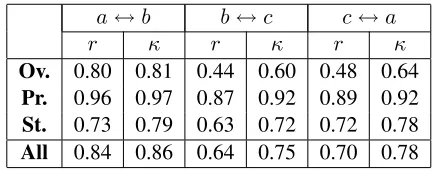
The pairwise scores between annotatorsa,bandc are listed in Table 1. When computed over all rating dimensions, the averagercoefficient is 0.72 (strong positive linear relationship) and the averageκis 0.79 (substantial agreement). Both values show that the obtained sentence labels are to a great extent reli-able. When considering each aspect separately, the largest agreement was achieved on ‘performance’, followed by ‘story’, and then ‘overall’. This is most likely due to our definition of the latter aspect to in-clude all other aspects as well as author attributes.
a↔b b↔c c↔a
r κ r κ r κ
[image:2.612.316.534.415.500.2]Ov. 0.80 0.81 0.44 0.60 0.48 0.64 Pr. 0.96 0.97 0.87 0.92 0.89 0.92 St. 0.73 0.79 0.63 0.72 0.72 0.78 All 0.84 0.86 0.64 0.75 0.70 0.78
Table 1:Pearson’s correlation (r) and Kohen’s kappa (κ) scores computed for each aspect (Ov: overall, Pr: performance, St: story) and each pair of annotators (a,bandc) in the pilot study.
3 Crowdsourced Task
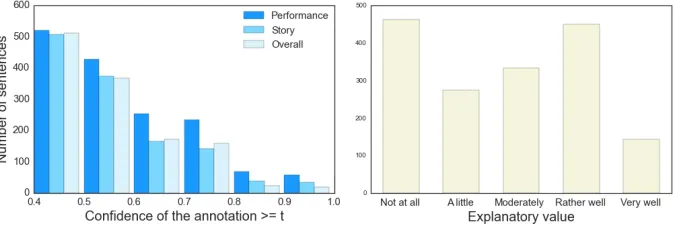
Figure 3:Number of sentences for different confidence values (left) and annotation labels (right). the review. Each of the three aspects was annotated
separately, to avoid confusion.
Results. We collected 100 reviews of audiobooks from Audible (www.audible.com) with 1,662 sentences. There are 20 reviews for each rating value of the ‘overall’ aspect (1–5 stars), to balance the distribution of positive vs. negative reviews. We obtained human judgments over the set of 100 re-views by crowdsourcing the task via Crowdflower
(www.crowdflower.com).
The reliability of the judges was controlled by randomly inserting test questions with known an-swers (“gold” questions). Using these questions, Crowdflower computed a confidence score for each judge and then used it to compute the confidence for each annotated example. We only kept the answers of judges who achieved at least 70% success rate on the gold questions. For each non-gold question, we collected answers from at least four reliable annota-tors, and the majority answer was considered as the gold truth.
We obtained 7,121 judgments of the 1,662 sen-tences, on the entire spectrum of the rating distri-butions, as shown in Fig. 3, right side. The confi-dence of the annotations was computed by Crowd-flower as 57% for the ‘overall’ and ‘story’ aspects, and 63% for ‘performance’. The percentages of sen-tences with a confidence≥0.8 were quite low, at re-spectively 4%, 7% and 12% for each aspect. Still, a substantial proportion of sentences have a confi-dence above 0.5, as shown in Fig. 3, left side. These numbers suggest that the task was the most difficult for the ‘overall’ aspect, followed by the ‘story’ and ‘performance’ aspects.
For evaluating an automatic system, high-confidence annotations (e.g. above 0.6) can be di-rectly compared with labels assigned by a system. An alternative evaluation approach keeps all
annota-tions, but replaces some of the human ratings with system ones, and examines the variation of inter-annotator agreement.
4 System: A Model of Document Attention
We use the data to evaluate a document attention model (Pappas and Popescu-Belis, 2014) which uses multiple-instance regression (MIR, Dietterich et al., 1997) to deal with coarse-grained input labels. The input is a set of bags (here, reviews), each of which contains a variable number of instances (here, sen-tences). The labels used for training (here, the aspect ratings) can be at the bag level (weak supervision), and not at the instance level. Our system learns to as-sign importance scores to individual instances, and to predict the labels of unseen bags.
In past models, the influence of instance labels on bag labels has been modeled with simplifying assumptions (e.g. averaging), whereas our system learns to aggregate instances of a bag according to their importance, like attention-based neural net-works (Luong et al., 2015). To jointly learn instance weights and target labels, the system minimizes a regularized least squares loss. While in our 2014 paper this was done using alternating projections (as in Wagstaff and Lane, 2007), we use here stochas-tic gradient descent (Bottou, 1998) with the efficient ADAGRAD implementation (Duchi et al., 2011). In particular, the attention is modeled by a normalized exponential function, namely a softmax and a linear activation between a contextual vector and the doc-ument matrix (sentence vectors). Essentially, this formulation enables learning with stochastic gradi-ent descgradi-ent while preserving the initial instance rel-evance assumption in the MIR framework and the constraints in our 2014 paper.
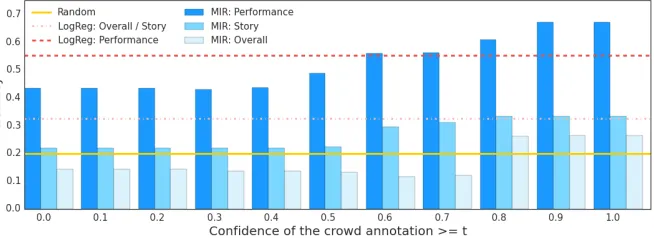
Figure 4:Accuracy of the evaluated system (MIR) on predicting the explanatory value of sentences with respect to review-level ratings of the three aspects, for subsets of increasing crowd confidence values. The accuracy of a supervised system, Logistic Regression, trained on the attention labels with 10-fold cross-validation, is noted LogReg. Random accuracy is 1 out of 5 (20%).
10,000 reviews for each value of the ‘overall’ aspect (1–5 stars). The training set does not include the 100 annotated reviews, used for testing only.
5 Comparison of System to Humans Attention prediction. To evaluate the system’s es-timates of the contribution of each sentence to the review rating, a first and simple metric is the num-ber of sentences for which system and human labels are identical, i.e.accuracy. Identity of labels is how-ever hard to achieve, given that even humans do not have perfect agreement. Fig. 4 displays the accu-racy of the system, for each aspect, for test subsets of increasing crowd confidence, from the entire test set to only the most reliable labels. Our MIR sys-tem appears to achieve the highest accuracy on the ‘performance’ aspect, exceeding 60% for labels as-signed with at least 0.8 confidence by humans. The accuracy for ‘story’ is 33%, while for ‘overall’ it is the lowest, at 26%. The system outperforms the ran-dom baseline at 20% for ‘performance’ and ‘story’. When compared with the expected accuracy of a su-pervised system (10-fold cross-validation over the ground-truth labels), namely Logistic Regression, our system achieves similar accuracy on sentences with confidence greater or equal to 0.6.
When relaxing the constraints of exact label matching, i.e. accepting as matches neighboring la-bels as well (distance 1), the accuracies at the 0.8 confidence level increase to 71%, 43% and 52% re-spectively for each aspect. Interestingly, the ‘over-all’ aspect benefits the most from this relaxation, showing that many predictions were actually close to the gold label. The MIR performance is greater for higher crowd confidence values, which shows that
both the system and the humans find similar diffi-culties in assigning importance scores to sentences wrt. document-level aspects.
While accuracy gives an indication of a system’s quality, it is not entirely informative in the absence of a direct comparison term, such as a better baseline than random guesses. A second evaluation metric enabled by our dataset compares the system’s qual-ity with that of human annotators.
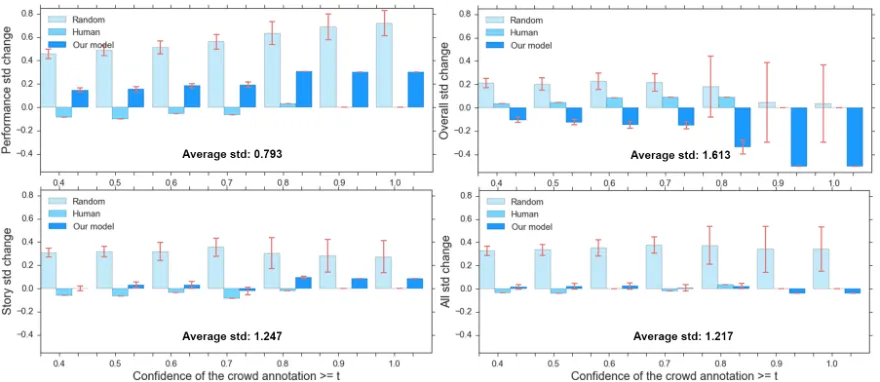
Reliability analysis. This more nuanced evaluation places the system on the same scale of qualification, from the most reliable judges (those who most agree with the average) to the least reliable ones. We con-sider the average standard deviation (STD) among humans, which decreases when the answers of the least reliable judges are removed, and ask: what hap-pens if certain judges are replaced by our system? Fig. 5 displays the difference obtained from the STD of all judges for three replacement strategies: Random: Select a random label per sentence and
replace it with a random value.
Human: Replace the least reliable human judge for each sentence (i.e. largest distance to the aver-age) with the average label of each sentence. Model: Replace at random an annotator label per
sentence with a system one.
Figure 5:Changes in average STD of the explanatory sentence labels in three replacement experiments (color coded), for each of the three aspects separately and then jointly for all of them.
controls enforced by the Crowdflower, we conclude that the labels assigned by the system are compa-rable to those of qualified human judges for ‘story’ and ‘overall’. For ‘performance’, however, the high agreement of judges cannot be matched by the sys-tem, according to this metric. Still, these results pro-vide epro-vidence that the weights found by the system capture the explanatory value of sentences in a way that is similar to humans.
6 Related Work
Multi-aspect sentiment analysis. This task usu-ally requires aspect segmentation, followed by prediction or summarization (Hu and Liu, 2004; Zhuang et al., 2006). Most related studies have engineered various feature sets, augmenting words with topic or content models (Mei et al., 2007; Titov and McDonald, 2008; Sauper et al., 2010; Lu et al., 2011), or with linguistic features (Pang and Lee, 2005; Qu et al., 2010; Zhu et al., 2012). McAuley et al. (2012) proposed an interpretable probabilistic model for modeling aspect reviews. Kim et al. (2013) proposed an hierarchical model to discover the review structure from unlabeled corpora. Previous systems for rating prediction were trained on segmented texts (Zhu et al., 2012; McAuley et al., 2012), while our system (Pappas and Popescu-Belis, 2014) used weak supervision on unsegmented text. Here, we introduced a new eval-uation of such models on sentiment summarization considering human attention.
Document classification. Recent studies have shown that attention mechanisms are beneficial to machine translation (Bahdanau et al., 2014), ques-tion answering (Sukhbaatar et al., 2015), text sum-marization (Rush et al., 2015), and document clas-sification (Pappas and Popescu-Belis, 2014). Most recently, Yang et al. (2016) introduced hierarchical attention networks for document classification. De-spite the improvements, it is yet unclear what ex-actly this attention mechanism captures for the task at hand. Our dataset enables the direct comparison of such mechanism and human attention scores for document classification, thus contributing to a better understanding of the document attention models.
7 Conclusion
We presented a new dataset with human attention to sentences triggered when attributing aspect ratings to reviews. The dataset enables the evaluation of attention-based models for document classification and the explicit evaluation of sentiment summariza-tion. Our crowdsourcing task is sound and can be used for larger-scale annotations. In the future, sta-tistical properties of the data (e.g. numeric scale), should be exploited even further to provide more ac-curate evaluations, for instance by relaxing the exact match rule to tolerate marginal mismatches.
Acknowledgments
References
Dzmitry Bahdanau, Kyunghyun Cho, and Yoshua Bengio. 2014. Neural machine translation by jointly learning to align and translate. CoRR
abs/1409.0473.
L´eon Bottou. 1998. On-line learning and stochastic approximations. In David Saad, editor, On-line Learning in Neural Networks, Cambridge Univer-sity Press, New York, pages 9–42.
Jacob Cohen. 1960. A coefficient of agreement for nominal scales. Educational and Psychological Measurement20(1):37–46.
Thomas G. Dietterich, Richard H. Lathrop, and Tom´as Lozano-P´erez. 1997. Solving the mul-tiple instance problem with axis-parallel rectan-gles. Artificial Intelligence89(12):31 – 71. John C. Duchi, Elad Hazan, and Yoram Singer.
2011. Adaptive subgradient methods for online learning and stochastic optimization. Journal of Machine Learning Research12:2121–2159. Minqing Hu and Bing Liu. 2004. Mining and
sum-marizing customer reviews. In Proceedings of the 10th ACM SIGKDD International Conference on Knowledge discovery and data mining. Seattle, WA, KDD ’04, pages 168–177.
Suin Kim, Jianwen Zhang, Zheng Chen, Alice Oh, and Shixia Liu. 2013. A hierarchical aspect-sentiment model for online reviews. In Proceed-ings of the 27th AAAI Conference on Artificial In-telligence. Bellevue, WA, AAAI’13, pages 526– 533.
Bin Lu, Myle Ott, Claire Cardie, and Benjamin K. Tsou. 2011. Multi-aspect sentiment analysis with topic models. In Proc. of the 11th IEEE Int. Conf. on Data Mining Workshops. Washington, DC, ICDMW ’11, pages 81–88.
Minh-Thang Luong, Hieu Pham, and Christo-pher D. Manning. 2015. Effective approaches to attention-based neural machine translation. In
Proceedings of the 2015 Conference on Empirical Methods in Natural Language Processing. Lis-bon, EMNLP ’15, pages 1412–1421.
Julian McAuley, Jure Leskovec, and Dan Juraf-sky. 2012. Learning attitudes and attributes from multi-aspect reviews. InProceedings of the 12th
IEEE International Conference on Data Mining. Brussels, ICDM ’12, pages 1020–1025.
Qiaozhu Mei, Xu Ling, Matthew Wondra, Hang Su, and ChengXiang Zhai. 2007. Topic senti-ment mixture: modeling facets and opinions in weblogs. In Proceedings of the 16th Interna-tional Conference on the World Wide Web. Banff, Canada, WWW ’07, pages 171–180.
Bo Pang and Lillian Lee. 2005. Seeing stars: Ex-ploiting class relationships for sentiment catego-rization with respect to rating scales. In Proceed-ings of the 43rd Annual Meeting on Association for Computational Linguistics. Ann Arbor, MI, ACL ’05, pages 115–124.
Nikolaos Pappas and Andrei Popescu-Belis. 2014. Explaining the stars: Weighted multiple-instance learning for aspect-based sentiment analysis. In
Proceedings of the 2014 Conference on Empirical Methods in Natural Language Processing. Doha, Qatar, EMNLP ’14, pages 455–466.
Karl Pearson. 1895. Note on regression and inheri-tance in the case of two parents. Proceedings of the Royal Society of London58:240–242.
Lizhen Qu, Georgiana Ifrim, and Gerhard Weikum. 2010. The bag-of-opinions method for review rat-ing prediction from sparse text patterns. In Pro-ceedings of the 23rd International Conference on Computational Linguistics. Beijing, China, COL-ING ’10, pages 913–921.
Alexander M. Rush, Sumit Chopra, and Jason Weston. 2015. A neural attention model for abstractive sentence summarization. CoRR
abs/1509.00685.
Christina Sauper, Aria Haghighi, and Regina Barzi-lay. 2010. Incorporating content structure into text analysis applications. In Proceedings of the 2010 Conference on Empirical Methods in Natural Language Processing. Cambridge, MA, EMNLP ’10, pages 377–387.
Sainbayar Sukhbaatar, Arthur Szlam, Jason Weston, and Rob Fergus. 2015. Weakly supervised mem-ory networks. CoRRabs/1503.08895.
Ivan Titov and Ryan McDonald. 2008. Modeling online reviews with multi-grain topic models. In
on World Wide Web. Beijing, China, WWW ’08, pages 111–120.
Kiri L. Wagstaff and Terran Lane. 2007. Salience assignment for multiple-instance regression. In
Proceedings of the ICML 2007 Workshop on Constrained Optimization and Structured Output Spaces. Corvallis, OR.
Zichao Yang, Diyi Yang, Chris Dyer, Xiaodong He, Alex Smola, and Eduard Hovy. 2016. Hierar-chical attention networks for document classifi-cation. In Proceedings of the 15th Annual Con-ference of the North American Chapter of the As-sociation for Computational Linguistics: Human Language Technologies. San Diego, California, NAACL’16.
Jingbo Zhu, Chunliang Zhang, and Matthew Y. Ma. 2012. Multi-aspect rating inference with aspect-based segmentation.IEEE Transactions on Affec-tive Computing3(4):469–481.
Li Zhuang, Feng Jing, and Xiao-Yan Zhu. 2006. Movie review mining and summarization. In