Simple Tools for Exploring Variation in Code-Switching for Linguists
Gualberto A. Guzman Jacqueline Serigos Barbara E. Bullock Almeida Jacqueline Toribio University of Texas at Austin
{gualbertoguzman,jserigos}@utexas.edu {bbullock,toribio}@austin.utexas.edu
Abstract
One of the benefits of language identification that is particularly relevant for code-switching (CS) research is that it permits insight into how the languages are mixed (i.e., the level of integration of the languages). The aim of this paper is to quantify and visualize the na-ture of the integration of languages in CS doc-uments using simple language-independent metrics that can be adopted by linguists. In our contribution, we (a) make a linguistic case for classifying CS types according to how the languages are integrated; (b) describe our language identification system; (c) intro-duce an Integration-index (I-index) derived from HMM transition probabilities; (d) em-ploy methods for visualizing integration via a language signature (or switching profile); and (e) illustrate the utility of our simple met-rics for linguists as applied to Spanish-English texts of different switching profiles.
1 Introduction
Sociolinguists who focus on CS have been reluc-tant to adopt automatic annotation tools in large part because of the Principle of Accountability (Labov, 1972), which demands an exhaustive and accurate report for every case in which a phenomenon (e.g., a switch) occurs or could have occurred. Thus, in order to encourage linguists to move beyond slow but accurate manual coding and to take ben-efit of computational methods, the tools need to be precise and intuitive and consistent with linguistic concepts pertaining to CS. Herein, we provide a means of quantifying language integration and of
visualizing the language profile of documents, al-lowing researchers to isolate events of single-word other-language insertions (borrowing, nonce bor-rowing) versus spans of alternating languages (code-switching) versus lengthy sequences of monolingual text (translation, author/speaker change). Our meth-ods differ from existing NLP approaches in attend-ing to some issues that are relevant for lattend-inguists but neglected in other approaches, e.g., in classifying the language of Named Entities as they can trigger CS (Broersma & De Bot, 2006) , in using ecologically valid training data, and in not assuming that each text or utterance has a main language.
2 Related Work
2.1 Mixed Texts
Multilingual documents may comprise more than one language for various reasons, including trans-lation, change of author/speaker, use of loanwords, and code-switching (CS). For this reason, the term bilingual (or multilingual) as applied to corpora can be ambiguous, referencing a parallel corpus such as Europarl (Koehn, 2002) as well as a speech corpus in which more intimate language mixing is present (e.g., the BilingBank Spanish-English Miami Cor-pus(Deuchar, 2010)). King & Abney (2013) have noted that it is desirable that a language identifica-tion annotaidentifica-tion system operate accurately irrespec-tive of whether it is processing a document that contains monolingual texts from different languages or texts in which single authors are mixing differ-ent languages (Das & Gamb¨ack, 2013; Gamb¨ack & Das, 2014, Gamb¨ack & Das, 2016; Nguyen & Do˘gru¨oz, 2013; Chittaranjan et al., 2014) . For
guists with interests in patterns of CS there is also a need to be able to classify types of mixed multilin-gual documents. CS is not monolithic—it can range from switching for lone lexical items and multi-word expressions to alternation of clauses and larger stretches of discourse within an individual’s speech or across speech turns—and different types of CS in-vite different types of analyses and reflect different social conditions and types of grammatical integra-tion.
2.2 Mixing Typology
There is consensus that ‘classic’ or intrasentential code-switching, of all mixing phenomena, is most revealing of the interaction of grammatical systems (Joshi 1982, Muysken 2000, Myers-Scotton 1993, Poplack 1980). Muysken (2000) presents a typology of mixing, identifying three processes—insertion, alternation, and congruent lexicalization—each re-flecting different levels of contributions of lexical items and structures from two (or more) languages and each associated with different historical and cul-tural embedding. Insertional switching, (Example 1, Rampton et al. 2006:1) involves the grammat-ical and lexgrammat-ical properties of one language as the Matrix Language (Myers-Scotton, 1993) which sup-plies the morphosyntactic frame into which chunks of the other language are introduced (e.g., borrow-ing and small constituent insertion). Insertion is ar-gued to be prevalent in postcolonial and immigrant settings where there is asymmetry in speakers’ com-petence of both languages. In alternational switch-ing (Example 2, Nortier 1990: 126) the participatswitch-ing languages are juxtaposed and speakers are said to draw on ‘universal combinatory’ principles in build-ing equivalence between discrete language systems while maintaining the integrity of each (MacSwan, 2000; Sebba, 2009). Alternation is purported to be most common among proficient bilinguals in situa-tions of stable bilingualism. In a third type, congru-ent lexicalization (Example 3, Van Dulm, 2007:7; cited in Muysken 2014), the syntax of the languages are aligned and speakers produce a common struc-ture using words from both languages; it is claimed to be attested among bilinguals who are fluent in ty-pologically similar languages of equal prestige as well as in dialect/standard and post-creole/lexifier mixing. Muysken (2013) augments this tripartite
taxonomy by incorporating a fourth strategy, back-flagging (Example 4, DuBois & Horvath, 2002: 276), in which the grammatical and lexical prop-erties of the majority language serve as the base language into which emblematic minority elements are inserted (e.g., greetings, kinship terms); speak-ers may select this strategy to signal ethnic identities once they have shifted to the majority language.
• Example 1, English/Punjabi
I don’t mix with<kAíe:>(‘black boys’)
• Example 2, Moroccan Arabic/Dutch
<Maar ’t hoeft niet>li-?anna ida seft ana (‘But it need not be, for when I see, I . . . ’)
• Example 3, English/Afrikaans
You’ve got no idea how <vinnig> I’ve been <slaan-ing>this<by mekaar>
(‘You have no idea how quickly I’ve been throwing this together’)
• Example 4, English/French in Louisiana <C¸a va>. Why don’t you rewire this place and get some regular light switches? (‘It’s okay.’)
2.3 Mixing types as correlates of social differences
stronger, it is the presence of longer spans of En-glish (3+gram but not uni- and bigram) that corre-lates with higher social prestige.
2.4 Matrix language
In linguistic CS research, the Matrix Language (ML) refers to the morphosyntactic frame provided by the grammar of one of the contributing languages as dis-tinct from lexical items or spans (islands) from em-bedded languages (Myers-Scotton, 1993). The ML cannot be assumed to be the most frequent language, instead it must be discovered via grammatical anal-ysis.
2.5 Multilingual Indexes
For sociolinguists, Barnett et al. (2000) created a mixing index M to calculate the relative distribution of languages within a given document. Values range from 0 (a monolingual text) to 1 (a text with even distribution of languages). The M-index is valuable in that it indicates the degree to which various lan-guages are represented in a text; its limitation is that it does not show how the languages are integrated and, as a consequence, cannot provide an index of CS versus the wholesale shift from one monolingual text to another in a document. Methods of estimat-ing the proportion of languages in large corpora like Wikipedia have been proposed by Lui, Lau & Bald-win (2014) and by Prager (1999).
2.6 Integration Index
Gamb¨ack & Das (2014) created an initial Code-Mixing Index (CMI) based on the ratio of language tokens that are from the majority language of the text, which they call the matrix language. Like the M-index, CMI does not take account of the integra-tion of CS, thus Gamb¨ack & Das (2016) present a more complex formulation that enhances the CMI with a measure of integration that is applied first to the utterance level and then at the corpus level.
2.7 Language Signature of a document
In their description of the Bangor Autoglosser, a multilingual tagger for transcriptions of Welsh, Spanish, and English conversations in which languages are manually annotated, Donnelly & Deuchar (2011) underline the utility of their system for visualizing the shifting of languages during the
course of a conversation, but they make no attempt to quantify language integration, a central point of interest for linguists and one we address here.
2.8 Language Identification
Language identification in multilingual documents continues to present challenges (Solorio et al. 2014 for the first shared task on language identification in CS data). Researchers have tested a combination of methods (dictionaries, n-grams, and machine learn-ing models) for identifylearn-ing language or for predict-ing switchpredict-ing, mostly at the word level, with varypredict-ing degrees of accuracy (Elfardi & Diab, 2014; King & Abney, 2013; Solorio & Liu, 2008a, 2008b; Nguyen & Do˘gru¨oz, 2013; Rodrigues, 2012 ). Because tran-scriptions of spoken CS are rare, researchers have drawn on social media, particularly Twitter (Bali et al., 2014; Vilares, Alonso, & G´omez-Rodr´ıguez, 2016; C¸etinoglu, 2016; Jurgens, Dimitrov & Ruths, 2014; Samih & Maier, 2016), as well as artificially generated texts to develop NLP tools that support the processing of mixed-language data (Lui, Lau & Baldwin, 2014; Yamaguchi & Tanaka-Ishii, 2012) .
3 Language Model
validity of film and television subtitle corpora to best represent word frequency has been successfully tested by Brysbaert & New (2009). For the Named Entity tier, we use the Stanford Named Entity rec-ognizer with both the English and Spanish param-eters. If either Entity recognizer identified the to-ken as a named entity, it was tagged as a named en-tity. Unlike other taggers where named entities are viewed as language neutrals, our named entities re-tained their language identification from their first tier of annotation (C¸etinoglu, 2016).
4 Integration Index
In order to quantify the amount of switching be-tween languages in a text, we offer the I-Index, which serves as a complement to the M-index (Bar-nett et al., 2000). It is a computationally simpler version of the revised CMI index of Gamb¨ack & Das (2016) and one which does not require the segmenta-tion of the corpus into utterances or require comput-ing weights. Consistent with principles of CS, our approach does not assume a matrix language. Con-sider the two examples below.
• Example 5 (Spanish-English, KC)
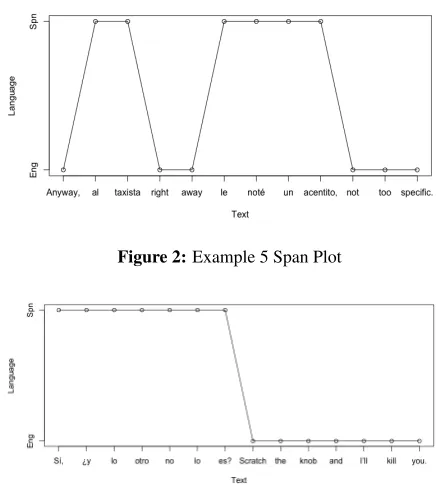
Anyway, al taxista right away le not´e un acen-tito, not too specific.
• Example 6 (Spanish-English, YYB)
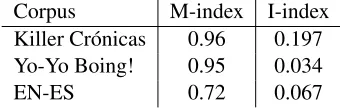
S´ı, ¿y lo otro no lo es? Scratch the knob and I’ll kill you.
Ex. 1 2 3 4 5 6
Lg. 1 4 4 8 2 6 7
Lg. 2 1 5 4 12 6 7
CS 1 1 5 1 4 1
[image:4.612.311.522.463.604.2]M 0.47 0.98 0.8 0.32 1 1 I 0.25 0.125 0.45 0.08 0.36 0.08
Table 1:Spans for Examples
Examples 5 and 6 contain perfectly balanced Spanish/English usage, reflected in their M-index of 1. However, the two languages are much more inte-grated in the first sentence, with four switch points, when compared to the second sentence, with just one switch point. Their respective integration, or I-index, captures this difference. Additionally, Exam-ple 2 and 3 each have high M-index values but differ
in the I-index values in ways that might be predicted by social context: English-Afrikaans contact lends itself to congruent lexicalization, while Moroccan-Arabic-Dutch shows low integration insertion com-mon of immigrant settings. The I-index is calcu-lated as follows. Given a corpus composed of tokens tagged by language{li}where i ranges from 1 ton, the size of the corpus, the I-index is calculated by the following expression:
1 n−1
X
1≤i < j≤n
S(li, lj),
whereS(li, lj) = 1ifli 6= lj and 0 otherwise.The factor of 1/(n−1) reflects the fact that there are n−1 possible switch sites in a corpus of sizen. The I-index can also be calculated using the transi-tion probabilities generated from a first-order Hid-den Markov Model on an annotated corpus (ignor-ing the language independent tags) by summ(ignor-ing only the probabilities where there has been a language switch. The I-index is an intuitive measure of how much CS is in a document, where the value 0 repre-sents a monolingual text with no switching and 1 a text in which every word switches language, a highly unlikely real-world situation. For a 10-word sen-tence in which each word is contributed by a differ-ent language, G¨amback & Das’s (2016) maximum integration is .90 rather than 1.
[image:4.612.72.298.487.573.2]5 Language Signature
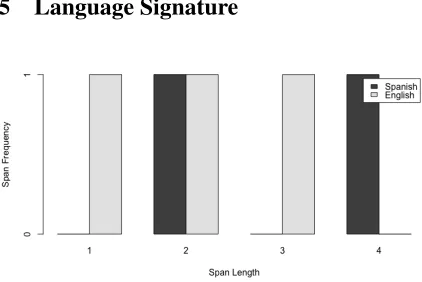
Figure 1:Example 5 Span Distribution
ACTIV-ES & SUBTLEXUS CALLHOME
[image:5.612.120.465.61.115.2]Language Accuracy Precision Recall Accuracy Precision Recall English 0.9507 0.9332 0.9729 0.9343 0.8931 0.9893 Spanish 0.9479 0.9021 0.9853 0.9442 0.9286 0.9422
[image:5.612.69.291.152.399.2]Table 2:Accuracy of language detection on KC using different training corpora
Figure 2:Example 5 Span Plot
Figure 3:Example 6 Span Plot
there are spans in English of length one, two and three words. In Spanish, there are language spans of length two and four words. Although not particu-larly revealing with such a short segment, these dis-tributions result in a histogram plot as shown (Figure 1).
In combination with the I-indices, these plots (Figures 1, 2, and 3) display a unique insight into the nature of language mixing and the extent of inte-gration. In contrast to the singular data point of the I-index, the span plots provide a multi-level view of how and to what extent CS occurs in the text.
6 Experiments
6.1 Dataset
Because our interest here is in exploiting language identification for the purpose of detecting vari-able CS patterns, we draw on two literary texts that we know to employ extensive Spanish-English
CS but in two distinctly different styles. Killer Cr´onicas: Bilingual Memoires (KC), by the Jewish Chicana writer Susana Ch´avez-Silverman (2004), is a 40,469-word work of creative nonfiction that chronicles the author’s daily life through a series of letters that began as email messages written entirely in ‘Spanglish’. Yo-Yo Boing! (YYB), by the Puerto Rican writer Giannina Braschi (1998), is a 58,494-word hybrid of languages and genres, incorporating Spanish, English, and ‘Spanglish’ monologues, dia-logues, poetry, and essays. These popular press texts are available online and were used with the permis-sion of the authors.
6.2 Evaluation
The effectiveness of our model was evaluated on a gold standard of 10k words from KC. The segment was selected from the middle of the text, beginning at token 10,000. It was tagged for language by a Spanish-English bilingual professional linguist and 10% was inspected by a second bilingual profes-sional linguist for accuracy. The annotators agreed on all but 2 of the 1000 tokens. The gold standard includes the following tags: Spanish, English, Punc-tuation, Number, Named Entity, Nonstandard Span-ish, Nonstandard EnglSpan-ish, Mixed along with three other language tags (French, Italian, Yiddish). The Nonstandard tags included forms such as cashe ˜ calle ‘street’ to represent dialectal differences, and the Mixed tags included any tokens with morphol-ogy from two or more languages such as
hangue-ando˜hanging out. Since Spanish, English,
Punc-tuation, Number and Named Entity account for over 98% of the gold standard, only those tags were used in our model. For the evaluation, we relabel the non-standard tags to their respective languages and the other languages were ignored.
6.3 Results
Figure 4:Span Distributions
Figure 5:Distribution of Tags
the difference in CS between them; KC has a higher integration of languages than YYB. In Figure 4, we see that even though both corpora contain switches, KC has a much higher incidence of short, switched spans in both languages, increasing its I-index rela-tive to YYB.
As shown in Figure 4, KC displays a rapid expo-nential decay in span length vs. frequency, whereas YYB does not. In addition, YYB displays a heavy tail, indicating a higher frequency of large spans in both languages compared to KC, which has very few spans longer than twenty words.
Table 2 shows our model’s performance on lan-guage tagging the 10k gold standard of KC using two separate sets of training corpora.
However, as shown in Table 2, our original results
[image:6.612.322.522.229.296.2]Corpus M-index I-index Killer Cr´onicas 0.96 0.197 Yo-Yo Boing! 0.95 0.034 EN-ES 0.72 0.067 Table 3:Language Integration and Mixing
Accuracy Precision Recall Same 96.72% 79.19% 65.30% Opposite 88.92% 33.24% 74.85% English 96.65% 83.94% 58.08% Spanish 89.00% 34.42% 82.06%
Table 4:NER Classification Performance
using the CALLHOME corpus reflect a lower per-formance due to the disparity in size of the corpora (3.1M Eng, 976K Mex). Using these corpora re-sulted in recurring mistakes such as identifying the word “ti” as English due to the overabundance of the acronym “TI” in the English CALLHOME corpus relative to the Mexican Spanish corpus. Addition-ally, common words in both languages such as “a” or “me” were initially tagged as English for similar reasons. In contrast, changing to equal-size corpora of 3.5M words (ACTIV-ES and SUBTLEXUS) re-sulted in a quantitative increase of 1% in language accuracy for both languages as seen in Table 2 and better tagging of “ti”, “me” and “a” in mixed con-texts.
[image:6.612.98.268.631.685.2]accuracy than relying purely on the English classi-fier.
7 Conclusion
In this paper we provided an intuitively simple and easily calculated measure—the I-index—for quan-tifying language integration in multilingual texts that does not require weighting, identification of a matrix language, or dividing corpora into utter-ances. We also presented methods of visualiz-ing the language profile of mixed-language docu-ments. To illustrate the I-index and how it differs from a measure that shows the ratio of languages mixed in a text (the M-index), we created an au-tomatic language-identification system for classify-ing Spanish-English bilclassify-ingual documents. Our an-notation system is similar to that of Solorio & Liu (2008a, 2008b), which includes an n-gram method and a bi-gram HMM model for probabilistically as-signing language tags at the word level. We im-proved accuracy by 1% in our model by using train-ing corpora that reflected natural dialogue and we used different methods of classifying Named Enti-ties in an attempt to reduce the greediness of the Named Entity Recognizer. Our automatic proce-dure achieves high accuracy in language identifica-tion, and although the texts examined proved to be equally bilingual, our analysis demonstrated that the languages are integrated very differently in the two data sets, a distribution that can be intuitively de-picted visually.
The implication is that though texts might be mixed, only some texts are suitable for the study of intrasentential CS. For instance, the I-index met-ric indicates that any random selection from KC, but not YYB, would likely contain intersentential CS. As linguists move to exploit larger multilingual datasets to examine language interaction (Jurgens et al., 2014; Bali et al., 2014), it is crucial to have an uncomplicated metric of how the languages are in-tegrated because different types of integration corre-late with different social contexts and are of interest for different domains of linguistic inquiry.
References
Kalika Bali, Yogarshi Vyas, Jatin Sharma, and Monojit Choudhury. 2014. ‘i am borrowing ya mixing?’ an
analysis of English-Hindi code mixing in Facebook. In Proceedings of the First Workshop on Computational Approaches to Code Switching, EMNLP. pages 116– 126.
R. Barnett, E. Codo, E. Eppler, M. Forcadell, P. Gardner-Chloros, R. van Hout, M. Moyer, M. C. Torras, M. T. Turell, M. Sebba, M. Starren, and S. Wensing. 2000. The LIDES Coding Manual: A document for prepar-ing and analyzprepar-ing language interaction data Version 1.1–July, 1999.International Journal of Bilingualism, 4(2):131–132, June.
Giannina Braschi. 1998. Yo-yo boing! Latin American Literary Review Press.
Mirjam Broersma and Kees De Bot. 2006. Triggered codeswitching: A corpus-based evaluation of the orig-inal triggering hypothesis and a new alternative. Bilin-gualism: Language and cognition, 9(01):1–13. Marc Brysbaert and Boris New. 2009. Moving beyond
Kuˇcera and Francis: A critical evaluation of current word frequency norms and the introduction of a new and improved word frequency measure for American English.Behavior Research Methods, 41(4):977–990, November.
Barbara E. Bullock, Jacqueline Serigos, and Almeida Jacqueline Toribio. 2016. The stratification of English-language lone-word and multi-word mate-rial in Puerto Rican Spanish-language press out-lets: A computational approach. In Rosa Guz-zardo Tamargo, Catherine M. Mazak, and M. Car-men Parafita Cuoto, editors, Spanish-English code-switching in the Caribbean and the U.S., pages 171– 189. Benjamins, Amsterdam ; Philadelphia.
Ozlem Cetinoglu. 2016. A Turkish-German Code-Switching Corpus. Proceedings of the Tenth Interna-tional Conference on Language Resources and Evalu-ation (LREC 2016), pages 4215–4220.
Susana Ch´avez-Silverman. 2004. Killer cr´onicas: bilin-gual memories. Univ of Wisconsin Press.
Gokul Chittaranjan, Yogarshi Vyas, Kalika Bali, and Monojit Choudhury. 2014. Word-level language iden-tification using crf: Code-switching shared task report of msr india system. InProceedings of The First Work-shop on Computational Approaches to Code Switch-ing, pages 73–79.
Amitava Das and Bj¨orn Gamb¨ack. 2013. Code-mixing in social media text: the last language identification frontier. Traitement Automatique des Langues (TAL): Special Issue on Social Networks and NLP, 54(3). Amitava Das and Bj¨orn Gamb¨ack. 2014. Identifying
lan-guages at the word level in code-mixed indian social media text. 11th International Conference on Natural Language Processing.
Kevin Donnelly and Margaret Deuchar. 2011. The Ban-gor Autoglosser: a multilingual tagger for conversa-tional text. ITA11, Wrexham, Wales.
Sylvie Dubois and Barbara M. Horvath. 2002. Sounding Cajun: The Rhetorical Use of Dialect in Speech and Writing. American Speech, 77(3):264–287.
Heba Elfardy, Mohamed Al-Badrashiny, and Mona Diab. 2014. A hybrid system for code switch point detection in informal Arabic text. XRDS: Crossroads, The ACM Magazine for Students, 21(1):52–57, October. Bj¨orn Gamb¨ack and Amitava Das. 2014. On
Measur-ing the Complexity of Code-MixMeasur-ing. InProceedings of the 11th International Conference on Natural Lan-guage Processing, Goa, India, pages 1–7.
Bj¨orn Gamb¨ack and Amitava Das. 2016. Comparing the level of code-switching in corpora. Proceedings of the Tenth International Conference on Language Re-sources and Evaluation (LREC 2016), pages 1850– 1855.
Penelope Gardner-Chloros. 2009. Sociolinguistic fac-tors in code-switching. In Barbara E. Bullock and Almeida Jacqueline Toribio, editors, The Cambridge handbook of linguistic code-switching, pages 97–113. Cambridge University Press, Cambridge, UK. Aravind K. Joshi. 1982. Processing of sentences with
intra-sentential code-switching. InProceedings of the 9th conference on Computational linguistics-Volume 1, pages 145–150. Academia Praha.
David Jurgens, Stefan Dimitrov, and Derek Ruths. 2014. Twitter users# codeswitch hashtags!# moltoimpor-tante# wow. EMNLP 2014, pages 51–61.
Ben King and Steven Abney. 2013. Labeling the lan-guages of words in mixed-language documents us-ing weakly supervised methods. In Proceedings of NAACL-HLT, pages 1110–1119.
Philipp Koehn. 2002. Europarl: A multilingual corpus for evaluation of machine translation.
William Labov. 1972. Some Principles of Linguis-tic Methodology. Language in Society, 1(1):97–120, April.
Jacqueline Rae Larsen. 2014. Social stratification of loanwords: a corpus-based approach to Anglicisms in Argentina. Masters Thesis, University of Texas at Austin.
Marco Lui, Jey Han Lau, and Timothy Baldwin. 2014. Automatic detection and language identification of multilingual documents. Transactions of the Associ-ation for ComputAssoci-ational Linguistics, 2:27–40. Jeff MacSwan. 2000. The architecture of the bilingual
language faculty: Evidence from intrasentential code switching. Bilingualism: Language and Cognition, 3(1):37–54, April.
Pieter Muysken. 2000. Bilingual speech: a typology of code-mixing. Cambridge University Press, Cam-bridge.
Pieter Muysken. 2013. Language contact outcomes as the result of bilingual optimization strategies. Bilin-gualism: Language and cognition, 16(04):709–730. Pieter Muysken. 2014. D ´EJ `A VOODOO OR NEW
TRAILS AHEAD? Linguistic Variation: Confronting Fact and Theory, page 242.
Carol Myers-Scotton. 1993. Duelling languages: gram-matical structure in codeswitching. Oxford University Press (Clarendon Press), Oxford.
Dong-Phuong Nguyen and A. Seza Dogruoz. 2013. Word level language identification in online multilin-gual communication. Association for Computational Linguistics.
Jacomine Nortier. 1990. Dutch-Moroccan Arabic code switching among Moroccans in the Netherlands. Foris, Dordrecht.
Shana Poplack. 1980. Sometimes I’ll Start a Sentence in Spanish Y TERMINO EN ESPA ˜NOL: Toward a Ty-pology of Code-Switching. Linguistics, 18(7-8):581– 618.
Shana Poplack. 1987. Contrasting patterns of code-switching in two communities. In Erling Wande, Jan Anward, Bengt Nordberg, Lars Steensland, and Mats Thelander, editors, Aspects of multilingualism: Pro-ceedings from the Fourth Nordic Symposium on Bilin-gualism, 1984, pages 51–77. Borgstr¨oms, Uppsala. Rebekah Elizabeth Post. 2015. The impact of social
factors on the use of Arabic-French code-switching in speech and IM in Morocco. Ph.D. thesis, University of Texas at Austin.
John M. Prager. 1999. Linguini: Language identification for multilingual documents. Journal of Management Information Systems, 16(3):71–101.
Ben Rampton, Roxy Harris, and Lauren Small. 2006. The meanings of ethnicity in discursive interaction: Some data and interpretations from ethnographic so-ciolinguistics.ESRC Identities and Social Action Pro-gramme, pages 1–14.
Paul Rodrigues. 2012. Processing highly variant lan-guage using incremental model selection. Ph.D. the-sis, Indiana University.
Younes Samih and Wolfgang Maier. 2016. An Arabic-Moroccan Darija Code-Switched Corpus. Proceed-ings of the Tenth International Conference on Lan-guage Resources and Evaluation (LREC 2016), pages 4170–4175.
40–57. Cambridge University Press, Cambridge, UK ; New York.
Thamar Solorio and Yang Liu. 2008. Learning to pre-dict code-switching points. InProceedings of the Con-ference on Empirical Methods in Natural Language Processing, pages 973–981. Association for Compu-tational Linguistics.
Thamar Solorio, Elizabeth Blair, Suraj Maharjan, Steven Bethard, Mona Diab, Mahmoud Ghoneim, Abdelati Hawwari, Fahad AlGhamdi, Julia Hirschberg, Alison Chang, and others. 2014. Overview for the first shared task on language identification in code-switched data. In Proceedings of The First Workshop on Computa-tional Approaches to Code Switching, pages 62–72. Citeseer.
Ondene van Dulm. 2007. The grammar of English-Afrikaans code switching: A feature checking account. Utrecht: LOT.
David Vilares, Miguel Alonso, and Carlos G´omez-Rodr´ıguez. 2016. EN-ES-EC: An English-Spanish code-switching twitter corpus for multilingual senti-ment analysis. Proceedings of the Tenth International Conference on Language Resources and Evaluation (LREC 2016), pages 4149–4153.
Ngoc Thang Vu, Heike Adel, and Tanja Schultz. 2013. An investigation of code-switching attitude dependent language modeling. Statistical Language and Speech Processing, pages 297–308.