Using Integer Linear Programming for Content Selection, Lexicalization,
and Aggregation to Produce Compact Texts from OWL Ontologies
Gerasimos Lampouras and Ion Androutsopoulos
Department of Informatics
Athens University of Economics and Business Patission 76, GR-104 34 Athens, Greece
http://nlp.cs.aueb.gr/
Abstract
We present an Integer Linear Program-ming model of content selection, lexical-ization, and aggregation that we devel-oped for a system that generates texts from OWL ontologies. Unlike pipeline archi-tectures, our model jointly considers the available choices in these three text gen-eration stages, to avoid greedy decisions and produce more compact texts. Experi-ments with two ontologies confirm that it leads to more compact texts, compared to a pipeline with the same components, with no deterioration in the perceived quality of the generated texts. We also present an ap-proximation of our model, which allows longer texts to be generated efficiently.
1 Introduction
Concept-to-text natural language generation (NLG) generates texts from formal knowledge representations (Reiter and Dale, 2000). With the emergence of the Semantic Web (Berners-Lee et al., 2001; Shadbolt et al., 2006; Antoniou and van Harmelen, 2008), interest in concept-to-text NLG has been revived and several methods have been proposed to express axioms of OWL ontolo-gies (Grau et al., 2008), a form of description logic (Baader et al., 2002), in natural language (Bontcheva, 2005; Mellish and Sun, 2006; Gala-nis and Androutsopoulos, 2007; Mellish and Pan, 2008; Schwitter et al., 2008; Schwitter, 2010; Liang et al., 2011; Williams et al., 2011).
NLGsystems typically employ a pipeline archi-tecture. They usually start by selecting the logical facts (axioms, in the case of anOWLontology) to be expressed. The purpose of the next stage, text planning, ranges from simply ordering the facts to be expressed to making more complex decisions about the rhetorical structure of the text.
Lexical-ization then selects the words and syntactic struc-tures that will realize each fact, specifying how each fact can be expressed as a single sentence. Sentence aggregation may then combine shorter sentences to form longer ones. Another compo-nent generates appropriate referring expressions, and surface realization produces the final text.
Each stage of the pipeline is treated as a lo-cal optimization problem, where the decisions of the previous stages cannot be modified. This ar-rangement produces texts that may not be optimal, since the decisions of the stages have been shown to be co-dependent (Danlos, 1984; Marciniak and Strube, 2005; Belz, 2008). For example, deci-sions made during content selection may maxi-mize importance measures, but may produce facts that are difficult to turn into a coherent text; also, content selection and lexicalization may lead to more or fewer sentence aggregation opportunities. Some of these problems can be addressed by over-generating at each stage (e.g., producing several alternative sets of facts at the end of content selec-tion, several alternative lexicalizations etc.) and employing a final ranking component to select the best combination (Walker et al., 2001). This over-generate and rank approach, however, may also fail to find an optimal solution, and it generates an exponentially large number of candidate solutions when several components are pipelined.
In this paper, we present an Integer Linear Pro-gramming (ILP) model that combines content se-lection, lexicalization, and sentence aggregation. Our model does not consider directly text plan-ning, nor referring expression generation, which we hope to include in future work, but it is com-bined with an external simple text planner and an external referring expression generation compo-nent; we also do not discuss surface realization. Unlike pipeline architectures, our model jointly examines the possible choices in the three NLG stages it considers, to avoid greedy local decisions.
Given an individual (entity) or class of an OWL ontology and a set of facts (axioms) about the in-dividual or class, we aim to produce a compact text that expresses as many facts in as few words as possible. This is desirable when space is lim-ited or expensive, e.g., when displaying product descriptions on smartphones, or when including advertisements in Web search results. If an impor-tance score is available for each fact, our model can take it into account to prefer expressing im-portant facts, again using as few words as possi-ble. The model itself, however, does not produce importance scores, i.e., we assume that the scores are produced by a separate process (Barzilay and Lapata, 2005; Demir et al., 2010), not included in our content selection. In the experiments of this article, we treat all the facts as equally important.
Although the search space of our model is very large andILPproblems are in generalNP-hard, off-the-shelf ILP solvers can be used, which can be very fast in practice and guarantee finding a global optimum. Experiments with two ontologies show that our ILP model outperforms, in terms of ex-pressed facts per word, an NLG system that uses the same components connected in a pipeline, with no deterioration in perceived text quality; the ILP model may actually lead to texts of higher quality, compared to those of the pipeline, when there are many facts to express. We also present an approx-imation of ourILPmodel, which is more efficient when larger numbers of facts need to be expressed. Section 2 discusses previous related work. Sec-tion 3 defines our ILP model. Section 4 presents our experimentals. Section 5 concludes.
2 Related work
Marciniak and Strube (2005) propose a general ILPapproach for language processing applications where the decisions of classifiers that consider particular, but co-dependent, subtasks need to be combined. They also show how their approach can be used to generate multi-sentence route di-rections, in a setting with very different inputs and processing stages than the ones we consider.
Barzilay and Lapata (2005) treat content selec-tion as an optimizaselec-tion problem. Given a pool of facts and scores indicating their importance, they select the facts to express by formulating an op-timization problem similar to energy minimiza-tion. The problem is solved by applying a minimal cut partition algorithm to a graph representing the
pool of facts and the importance scores. The im-portance scores of the facts are obtained via super-vised machine learning (AdaBoost) from a dataset of (sports) facts and news articles expressing them. In other work, Barzilay and Lapata (2006) con-sider sentence aggregation. Given a set of facts that a content selection stage has produced, aggre-gation is viewed as the problem of partitioning the facts into optimal subsets. Sentences expressing facts of the same subset are aggregated to form a longer sentence. The optimal partitioning maxi-mizes the pairwise similarity of the facts in each subset, subject to constraints that limit the number of subsets and the number of facts in each sub-set. A Maximum Entropy classifier predicts the semantic similarity of each pair of facts, and an ILPmodel is used to find the optimal partitioning. Althaus et al. (2004) show that ordering a set of sentences to maximize local coherence is equiva-lent to the traveling salesman problem and, hence, NP-complete. They also show an ILPformulation of the problem, which can be solved efficiently in practice using branch-and-cut with cutting planes.
Kuznetsova et al. (2012) useILPto generate im-age captions. They train classifiers to detect the objects in each image. Having identified the ob-jects of a given image, they retrieve phrases from the captions of a corpus of images, focusing on the captions of objects that are similar (color, tex-ture, shape) to the ones in the given image. To select which objects of the image to report and in what order, Kuznetsova et al. maximize (via ILP) the mean of the confidence scores of the ob-ject detection classifiers and the sum of the co-occurrence probabilities of the objects that will be reported in adjacent positions in the caption. Hav-ing decided which objects to report and their order, Kuznetsova et al. use a secondILPmodel to decide which phrases to use for each object and to order the phrases. The secondILPmodel maximizes the confidence of the phrase retrieval algorithm and the local cohesion between subsequent phrases.
al., 2009; Konstas and Lapata, 2012a; Konstas and Lapata, 2012b), but they are currently limited to generating single sentences from flat records, as opposed to ontologies. Our method is the first one to consider content selection, lexicalization, and sentence aggregation as an ILP joint optimization problem in the context of multi-sentence concept-to-text generation.
3 Our ILP model of NLG
LetF ={f1, . . . , fn}be the set of all the factsfi (OWLaxioms) about the individual or class to be described.OWLaxioms can be represented as sets ofRDFtriples of the formhS, R, Oi, whereSis an individual or class,Ois another individual, class, or datatype value, and R is a relation (property) that connectsStoO.1 Hence, we can assume that each factfiis a triplehSi, Ri, Oii.2
For each fact fi, a set Pi = {pi1, pi2, . . .}
of alternative sentence plans is available. Each sentence plan pik specifies how to express fi =
hSi, Ri, Oii as an alternative single sentence. In our work, a sentence plan is a sequence of slots, along with instructions specifying how to fill the slots in; and each sentence plan is associated with the relations it can express. For example,
hexhibit12,foundIn,athensicould be ex-pressed using a sentence plan like “[ref(S)] [findpast] [in] [ref(O)]”, where square brackets denote slots, ref(S) andref(O) are instructions requiring referring expressions for S and O in the corresponding slots, and “findpast” requires the simple past form of “find”. In our example, the sentence plan would lead to a sentence like “Ex-hibit 12 was found in Athens”. We callelements the slots with their instructions, but with “S” and “O” accompanied by the individuals, classes, or datatype values they refer to; in our exam-ple, the elements are “[ref(S: exhibit12)]”, “[findpast]”, “[in]”, “[ref(O:athens)]”.
Different sentence plans may lead to more or fewer aggregation opportunities; e.g., sentences with the same verb are easier to aggregate. We use aggregation rules similar to those of Dalianis (1999), which operate on sentence plans and usu-ally lead to shorter texts, as in the example below.
Bancroft Chardonnay is a kind of Chardonnay. It is 1
Seewww.w3.org/TR/owl2-mapping-to-rdf/. 2We actually convert the
RDFtriples to simplermessage triples, so that each message triple can be easily expressed by a simple sentence, but we do not discuss this conversion here.
made in Bancroft. ⇒ Bancroft Chardonnay is a kind of Chardonnay made in Bancroft.
Let s1, . . . , sm be disjoint subsets of F, each containing 0 to n facts, with m < n. A single sentence is generated for each subsetsj by aggre-gating the sentences (more precisely, the sentence plans) expressing the facts of sj.3 An empty sj generates no sentence, i.e., the resulting text can be at mostmsentences long. Let us also define:
ai=
1, if factfiis selected
0, otherwise (1)
likj=
1, if sentence planpikis used to express factfi, andfiis in subsetsj
0, otherwise
(2) btj=
1, if elementetis used in subsetsj
0, otherwise (3)
and letBbe the set of all the distinct elements (no duplicates) from all the available sentence plans that can express the facts ofF. The length of an aggregated sentence resulting from a subsetsj can be roughly estimated by counting the distinct el-ements of the sentence plans that have been cho-sen to express the facts ofsj; elements that occur more than once in the chosen sentence plans ofsj are counted only once, because they will probably be expressed only once, due to aggregation.
Our objective function (4) maximizes the to-tal importance of the selected facts (or simply the number of selected facts, if all facts are equally important), and minimizes the number of distinct elements in each subset sj, i.e., the approximate length of the corresponding aggregated sentence; an alternative explanation is that by minimizing the number of distinct elements in eachsj, we fa-vor subsets that aggregate well. By a and b we jointly denote all the ai and btj variables. The two parts of the objective function are normalized to[0,1]by dividing by the total number of avail-able facts|F|and the number of subsetsmtimes the total number of distinct elements|B|. We as-sume that the importance scoresimp(fi)are pro-vided by a separate component (Barzilay and La-pata, 2005; Demir et al., 2010) and range in[0,1]. The parameters λ1, λ2 are used to tune the
prior-ity given to expressing many important facts vs.
generating shorter texts; we setλ1+λ2= 1.
max
a,b λ1·
|F|
X
i=1
ai·imp(fi)
|F| −λ2·
m X
j=1
|B|
X
t=1
btj m· |B| (4)
subject to:
ai=
m X
j=1
|Pi|
X
k=1
likj,fori= 1, . . . , n (5)
X
et∈Bik
btj≥ |Bik| ·likj,for
i= 1, . . . , n j= 1, . . . , m k= 1, . . . ,|Pi|
(6)
X
pik∈P(et)
likj≥btj,for t= 1, . . . ,|B|
j= 1, . . . , m (7)
|B|
X
t=1
btj≤Bmax,forj= 1, . . . , m (8)
|Pi|
X
k=1
likj+ |Pi0|
X
k0=1
li0k0j≤1,for
j= 1, . . . , m, i= 2, . . . , n i0= 1, . . . , n−1;i6=i0 section(fi)6=section(fi0)
(9) Constraint 5 ensures that for each selected fact, only one sentence plan in only one subset is se-lected; if a fact is not selected, no sentence plan for the fact is selected either. |σ|denotes the car-dinality of a setσ. In constraint 6,Bikis the set of distinct elementsetof the sentence planpik. This constraint ensures that ifpikis selected in a subset
sj, then all the elements ofpikare also present in
sj. Ifpikis not selected insj, then some of its el-ements may still be present insj, if they appear in another selected sentence plan ofsj.
In constraint 7,P(et)is the set of sentence plans that contain elementet. Ifetis used in a subsetsj, then at least one of the sentence plans of P(et) must also be selected insj. Ifetis not used insj, then no sentence plan ofP(et)may be selected in
sj. Lastly, constraint 8 limits the number of ele-ments that a subsetsj can contain to a maximum allowed numberBmax, in effect limiting the max-imum length of an aggregated sentence.
We assume that each relationR has been man-ually mapped to a singletopical section; e.g., re-lations expressing the color, body, and flavor of a wine may be grouped in one section, and rela-tions about the wine’s producer in another. The section of a fact fi = hSi, Ri, Oii is the section of its relationRi. Constraint 9 ensures that facts from different sections will not be placed in the same subsetsj, to avoid unnatural aggregations.
4 Experiments
We used NaturalOWL(Galanis and los, 2007; Galanis et al., 2009; Androutsopou-los et al., 2013), an NLG system for OWL on-tologies that relies on a pipeline of content selec-tion, text planning, lexicalizaselec-tion, aggregaselec-tion, re-ferring expression generation, and surface realiza-tion components.4 We modified the content
selec-tion, lexicalizaselec-tion, and aggregation components to use our ILP model, maintaining the aggrega-tion rules of the original system. For referring ex-pressions and surface realization, the new system, calledILPNLG, invokes the corresponding compo-nents of the original system. We use branch-and-cut to solve theILPproblems.5
The original system, hereafter calledPIPELINE, assumes that each relation has been mapped to a topical section, as inILPNLG. It also assumes that a manually specified order of the sections and the relations of each section is available, which is used by the text planner to order the selected facts (by their relations). The subsequent components of the pipeline are not allowed to change the order of the facts, and aggregation operates only on sentence plans of adjacent facts from the same section. In ILPNLG, the manually specified order of sections and relations is used to order the sentences of each subset sj (before aggregating them), the aggre-gated sentences in each section (each aggreaggre-gated sentence inherits the minimum order of its con-stituents), and the sections (with their sentences).
4.1 Experiments with the Wine Ontology
In a first set of experiments, we used the Wine On-tology, which had also been used in previous ex-periments withPIPELINE(Androutsopoulos et al., 2013). The ontology contains 63 wine classes, 52 wine individuals, a total of 238 classes and indi-viduals (including wineries, regions, etc.), and 14 properties.6 We kept the 2 topical sections, the ordering of sections and relations, and the sen-tence plans of the previous experiments, but we added more sentence plans to ensure that 3 sen-tence plans were available per relation. We gen-erated English texts for the 52 wine individuals
4
All the software and data that we used will be freely available from http://nlp.cs.aueb.gr/ software.html. We use version 2 of NaturalOWL.
5
We use the branch-and-cut implementation ofGLPKwith mixed integer rounding, mixed cover, and clique cuts; see sourceforge.net/projects/winglpk/.
of the ontology; we did not experiment with texts describing classes, because we could not think of multiple alternative sentence plans for many of their axioms. For each wine individual, there were 5 facts on average and a maximum of 6 facts. We set the importance scoresimp(fi) of all the facts
fi to 1, to make the decisions of PIPELINE and
ILPNLGeasier to understand; both systems use the same importance scores. PIPELINE does not pro-vide any mechanism to estimate the importance scores, assuming that they are provided manually. PIPELINE has a parameter M specifying the maximum number of facts it is allowed to report per text. WhenM is smaller than the number of available facts (|F|) and all the facts are treated as equally important, as in our experiments, it se-lects randomlyM of the available facts. We re-peated the generation of PIPELINE’s texts for the 52 individuals forM = 2,3,4,5,6. For eachM, the texts of PIPELINE for the 52 individuals were generated three times, each time using one of the different alternative sentence plans of each rela-tion. We also generated the texts using a variant of PIPELINE, dubbedPIPELINESHORT, which always selects the shortest (in elements) sentence plan among the available ones. In all cases, PIPELINE and PIPELINESHORT were allowed to form ag-gregated sentences containing up to Bmax = 22 distinct elements, which was the number of dis-tinct elements of the longest aggregated sentence in the previous experiments (Androutsopoulos et al., 2013), wherePIPELINEwas allowed to aggre-gate up to 3 original sentences.7
WithILPNLG, we repeated the generation of the texts of the 52 individuals using different values ofλ1 (λ2 = 1−λ1), which led to texts
express-ing from zero to all of the available facts. We set the maximum number of fact subsets tom = 3, which was the maximum number of (aggregated) sentences in the texts of PIPELINE and PIPELI -NESHORT. Again, we setBmax = 22.
We comparedILPNLGtoPIPELINEandPIPELI -NESHORT by measuring the average number of facts they reported divided by the average text length (in words). Figure 1 shows this ratio as a function of the average number of reported facts, along with 95% confidence intervals (of sample means). PIPELINESHORT achieved better results thanPIPELINE, but the differences were small.
For λ1 < 0.2, ILPNLG produces empty texts,
[image:5.595.307.526.61.169.2]7We modified the two pipeline systems to count elements.
Figure 1: Facts/words of Wine Ontology texts.
because it focuses on minimizing the number of distinct elements of each text. For λ1 ≥ 0.225,
it performs better than the other systems. For
λ1 ≈ 0.3, it obtains the highest fact/words ratio
by selecting the facts and sentence plans that lead to the most compressive aggregations. For greater values ofλ1, it selects additional facts whose
sen-tence plans do not aggregate that well, which is why the ratio declines. For small numbers of facts, the two pipeline systems select facts and sentence plans that offer few aggregation opportunities; as the number of selected facts increases, some more aggregation opportunities arise, which is why the facts/words ratio of the two systems improves. In all the experiments, the ILP solver was very fast (average: 0.08 sec, worst: 0.14 sec per text).
We show below texts produced by PIPELINE (M = 4) andILPNLG(λ1= 0.3).
PIPELINE: This is a strong Sauternes. It is made from Semil-lon grapes and it is produced by Chateau D’ychem.
ILPNLG: This is a strong Sauternes. It is made from Semillon grapes by Chateau D’ychem.
PIPELINE: This is a full Riesling and it has moderate flavor. It is produced by Volrad.
ILPNLG: This is a full sweet moderate Riesling.
In the first pair,PIPELINE uses different verbs for the grapes and producer, whereasILPNLGuses the same verb, which leads to a more compressive ag-gregation; both texts describe the same wine and report 4 facts. In the second pair,ILPNLGhas cho-sen to express the sweetness instead of the pro-ducer, and uses the same verb (“be”) for all the facts, leading to a shorter sentence; again both texts describe the same wine and report 4 facts. In both examples, some facts are not aggregated because they belong in different sections.
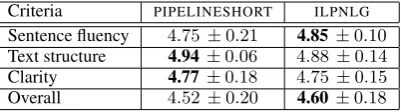
Criteria PIPELINESHORT ILPNLG
Sentence fluency 4.75±0.21 4.85±0.10
Text structure 4.94±0.06 4.88±0.14
Clarity 4.77±0.18 4.75±0.15
[image:6.595.81.282.62.118.2]Overall 4.52±0.20 4.60±0.18
Table 1: Human scores for Wine Ontology texts.
might lead to sentences that sound less fluent or unnatural, though aggregation often helps produce more natural texts. We were also concerned that the more compact texts of ILPNLGmight be per-ceived as being more difficult to understand (less clear) or less well-structured. To investigate these issues, we showed the 52 × 2 = 104 texts of PIPELINESHORT(M = 4) andILPNLG(λ1 = 0.3)
to 6 computer science students not involved in the work of this article; they were all fluent, though not native, English speakers. Each one of the 104 texts was given to exactly one student. Each stu-dent was given approximately 9 randomly selected texts of each system. TheOWLstatements that the texts were generated from were not shown, and the students did not know which system had generated each text. Each student was shown all of his/her texts in random order, regardless of the system that generated them. The students were asked to score each text by stating how strongly they agreed or disagreed with statementsS1–S3 below. A scale
from 1 to 5 was used (1: strong disagreement, 3: ambivalent, 5: strong agreement).
(S1)Sentence fluency: The sentences of the text are fluent, i.e., each sentenceon its ownis grammatical and sounds nat-ural. When two or more smaller sentences are combined to form a single, longer sentence, the resulting longer sentence is also grammatical and sounds natural.
(S2)Text structure: The order of the sentences is appro-priate. The text presents information by moving reasonably from one topic to another.
(S3)Clarity: The text is easy to understand, provided that the reader is familiar with basic wine terms.
The students were also asked to provide an over-all score (1–5) per text. We did not score referring expressions, since both systems use the same com-ponent to generate them.
Table 1 shows the average scores of the two systems with 95% confidence intervals (of sam-ple means). For each criterion, the best score is shown in bold. The sentence fluency and over-all scores ofILPNLGare slightly higher than those ofPIPELINESHORT, whereasPIPELINESHORT ob-tained a slightly higher score for text structure and clarity. The differences, however, are very small, especially in clarity, and there is no statistically significant difference between the two systems in
any of the criteria.8 Hence, there was no evidence in these experiments that the highest facts/words ratio ofILPNLGcomes at the expense of lower per-ceived text quality. We investigated these issues further in a second set of experiments, discussed next, where the generated texts were longer.
4.2 Consumer Electronics experiments
In the second set of experiments, we used the Consumer Electronics Ontology, which had also been used in previous work with PIPELINE. The ontology comprises 54 classes and 441 individ-uals (e.g., printer types, paper sizes), but no in-formation about particular products.9 In previ-ous work, 30 individuals (10 digital cameras, 10 camcorders, 10 printers) were added to the ontol-ogy; they were randomly selected from a publicly available dataset of 286 digital cameras, 613 cam-corders, and 58 printers, whose instances comply with the Consumer Electronics Ontology.10 We kept the 6 topical sections, the ordering of sec-tions and relasec-tions, and the sentence plans of the previous work, but we added more sentence plans to ensure that 3 sentence plans were available for almost every relation; for some relations we could not think of enough sentence plans. Again, we set the importance scores of all the facts to 1.
We generated texts with PIPELINEandPIPELI -NESHORT for the 30 individuals, for M = 3,6,9, . . . ,21. Again for each M, the texts of PIPELINE were generated three times, each time using one of the different alternative sentence plans of each relation. PIPELINE and PIPELI -NESHORT were allowed to form aggregated sen-tences containing up toBmax = 39 distinct ele-ments, which was the number of distinct elements of the longest aggregated sentence in the previous work with this ontology, wherePIPELINE was al-lowed to aggregate up to 3 original sentences. We also setBmax= 39inILPNLG.
There are 14 facts (F) on average and a max-imum of 21 facts for each one of the 30 individ-uals, compared to the 5 facts on average and the maximum of 6 facts of the experiments with the Wine Ontology. Hence, the texts of the Consumer
8
The confidence intervals do not overlap, and we also per-formed paired two-tailedt-tests (α= 0.05) to check for sta-tistical significance. In previous work, where judges were asked to score texts using the same criteria, inter-annotator agreement was strong (sample Pearson correlationr≥0.91).
9
Ontology available fromwww.ebusiness-unibw. org/ontologies/consumerelectronics/v1.
Figure 2: Average solver times forILPNLGfor dif-ferent maximum numbers of fact subsets (m).
Electronics Ontology are much longer, when they report all the available facts. To generate texts for the 30 individuals with ILPNLG, we would have to set the maximum number of fact subsets to
m= 10, which was the maximum number of (ag-gregated) sentences in the texts of PIPELINE and PIPELINESHORT. The number of variables of our ILPmodel, however, grows exponentially tomand the number of available facts|F|. Figure 2 shows the average time the ILP solver took for different values ofmin the experiments with the Consumer Electronics ontology; the results are also averaged forλ1 = 0.4,0.5,0.6(λ2 = 1−λ1). Form= 4,
the solver took 1 minute and 47 seconds on av-erage per text; recall that|F|is also much larger now, compared to the experiments of the previous section. Form= 5, the solver was so slow that we aborted the experiment. Figure 3 shows the aver-age solver time for different numbers of available facts |F|, form = 3; in this case, we modified the set of available facts (F) of every individual to contain 3,6,9,12,15,18,21 facts; the results are averaged for λ1 = 0.4,0.5,0.6. Although
the times of Fig. 3 also grow exponentially, they remain under 4 seconds, showing that the main problem forILPNLGism, the number of fact sub-sets, which is also the maximum allowed number of (aggregated) sentences of each text.
[image:7.595.304.525.61.194.2]To be able to efficiently generate texts with larger m values, we use a variant of ILPNLG, calledILPNLGAPPROX, which considers each fact subset separately. ILPNLGAPPROXstarts with the full set of available facts (F) and uses our ILP model (Section 3) withm= 1to produce the first (aggregated) sentence of the text. It then removes the facts expressed by the first (aggregated) sen-tence fromF, and uses theILPmodel, again with
Figure 3: Average solver times forILPNLGfor dif-ferent numbers of available facts (|F|) andm= 3.
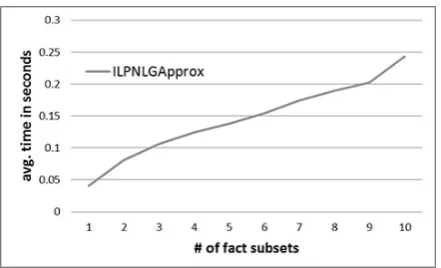
Figure 4: Avg. solver times for ILPNLGAPPROX for different max. numbers of fact subsets (m).
m = 1, to produce the second (aggregated) sen-tence etc. This process is repeated until we pro-duce the maximum number of allowed aggregated sentences, or until we run out of facts. ILPNLGAP -PROXis an approximation ofILPNLG, in the sense that it does not consider all the fact subsets jointly and, hence, does not guarantee finding a globally optimal solution for the entire text. Figures 4–5 show the average solver times ofILPNLGAPPROX for different values ofmand|F|; all the other set-tings are as in Figures 2–3. The solver times of ILPNLGAPPROXgrow approximately linearly tom
and|F|and are under 0.3 seconds in all cases. Figure 6 shows the average facts/words ratio of ILPNLGAPPROX(m= 10),PIPELINEandPIPELI -NESHORT, along with 95% confidence intervals (of sample means), for the texts of the 30 individu-als. Again,PIPELINESHORTachieves slightly bet-ter results than PIPELINE, but the differences are now smaller (cf. Fig. 1). ILPNLGAPPROXbehaves very similarly toILPNLGin the Wine Ontology ex-periments (cf. Fig. 1); forλ1 ≤ 0.35, it produces
empty texts, while forλ1 ≥0.4it performs better
[image:7.595.308.526.248.378.2]Figure 5: Avg. solver times for ILPNLGAPPROX for different|F|values andm= 3.
Figure 6: Facts/words for Consumer Electronics.
the highest facts/words ratio forλ1 = 0.45, where
it selects the facts and sentence plans that lead to the most compressive aggregations. For greater values ofλ1, it selects additional facts whose
sen-tence plans do not aggregate that well, which is why the ratio declines. The two pipeline systems select facts and sentence plans that offer very few aggregation opportunities; as the number of se-lected facts increases, some more aggregation op-portunities arise, which is why the facts/words ra-tio of the two systems improves slightly, though the improvement is now hardly noticeable.
We show below two example texts produced by PIPELINE (M = 6) and ILPNLGAPPROX (λ1 =
0.45). Both texts report 6 facts, but ILPNLGAP -PROX has selected facts and sentence plans that allow more compressive aggregations. Recall that we treat all the facts as equally important.
PIPELINE: Sony DCR-TRV270 requires minimum illumina-tion of 4.0 lux and its display is 2.5 in. It features a sports scene mode, it includes a microphone and an IR remote con-trol. Its weight is 780.0 grm.
ILPNLGAPPROX: Sony DCR-TRV270 has a microphone and an IR remote control. It is 98.0 mm high, 85.0 mm wide, 151.0 mm deep and it weighs 780.0 grm.
We showed the 30 ×2 = 60 texts of PIPELI -NESHORT (M = 6) and ILPNLGAPPROX (λ1 =
Criteria PIPELINESHORT ILPNLGAPPROX
Sentence fluency 4.50±0.30 4.87±0.12
Text structure 4.33±0.36 4.73±0.22
Clarity 4.53±0.29 4.97±0.06
[image:8.595.309.524.61.118.2]Overall 4.10±0.31 4.73±0.16
Table 2: Human scores for Consumer Electronics.
0.45) to the same 6 students, as in Section 4.1. Again, each text was given to exactly one student. Each student was given approximately 5 randomly selected texts of each system. TheOWLstatements that the texts were generated from were not shown, and the students did not know which system had generated each text. Each student was shown all of his/her texts in random order, regardless of the system that generated them. The students were asked to score each text by stating how strongly they agreed or disagreed with statements S1–S3,
[image:8.595.73.292.244.346.2]as in Section 4.1. They were also asked to provide an overall score (1–5) per text.
Table 2 shows the average scores of the two systems with 95% confidence intervals (of sam-ple means). For each criterion, the best score is shown in bold; the confidence interval of the best score is also shown in bold, if it does not overlap with the confidence interval of the other system. Unlike the Wine Ontology experiments, the scores of our ILPapproach are now higher than those of the pipeline in all of the criteria, and the differ-ences are also larger, though the differdiffer-ences are statistically significant only for clarity and over-all quality.11 We attribute these differences to the fact that the texts are now longer and the sentence plans more varied, which often makes the texts of the pipeline sound verbose and, hence, more diffi-cult to follow, compared to the more compact texts ofILPNLGAPPROX, which sound more concise.
Overall, the human scores of the experiments with the two ontologies suggest that the higher facts/words ratio of our ILP approach does not come at the expense of lower perceived text qual-ity. On the contrary, the texts of theILPapproach may be perceived as clearer and overall better than those of the pipeline, when the texts are longer.
5 Conclusions
We presented an ILP model of content selection, lexicalization, and aggregation that jointly con-siders the possible choices in the three stages, to
avoid greedy local decisions and produce more compact texts. The model has been embedded in NaturalOWL, a NLG system for OWL ontologies, which used a pipeline architecture in its original form. Experiments with two ontologies confirmed that our approach leads to expressing more facts per word, with no deterioration in the perceived text quality; theILPapproach may actually lead to texts perceived as clearer and overall better, com-pared to the pipeline, when there are many facts to express. We also presented an approximation of our ILP model, which allows longer texts to be generated efficiently. We plan to extend our model to include text planning, referring expres-sion generation, and mechanisms to obtain impor-tance scores.
Acknowledgments
This research has been co-financed by the Euro-pean Union (EuroEuro-pean Social Fund – ESF) and Greek national funds through the Operational Pro-gram “Education and Lifelong Learning” of the National Strategic Reference Framework (NSRF) – Research Funding Program: Heracleitus II. In-vesting in knowledge society through the Euro-pean Social Fund.
References
E. Althaus, N. Karamanis, and A. Koller. 2004.
Com-puting locally coherent discourses. In42nd Annual
Meeting of ACL, pages 399–406, Barcelona, Spain.
I. Androutsopoulos, G. Lampouras, and D.
Gala-nis. 2013. Generating natural language
descrip-tions from OWL ontologies: the NaturalOWL sys-tem. Technical report, Natural Language Processing Group, Department of Informatics, Athens Univer-sity of Economics and Business.
G. Antoniou and F. van Harmelen. 2008. A Semantic
Web primer. MIT Press, 2nd edition.
F. Baader, D. Calvanese, D.L. McGuinness, D. Nardi,
and P.F. Patel-Schneider, editors. 2002. The
De-scription Logic Handbook. Cambridge Univ. Press.
R. Barzilay and M. Lapata. 2005. Collective content
selection for concept-to-text generation. In
HLT-EMNLP, pages 331–338, Vancouver, BC, Canada.
R. Barzilay and M. Lapata. 2006. Aggregation via set partitioning for natural language generation. In
HLT-NAACL, pages 359–366, New York, NY.
A. Belz. 2008. Automatic generation of weather
forecast texts using comprehensive probabilistic
generation-space models. Natural Language
Engi-neering, 14(4):431–455.
T. Berg-Kirkpatrick, D. Gillick, and D. Klein. 2011.
Jointly learning to extract and compress. In 49th
Meeting of ACL, pages 481–490, Portland, OR.
T. Berners-Lee, J. Hendler, and O. Lassila. 2001. The
Semantic Web.Scientific American, May:34–43.
K. Bontcheva. 2005. Generating tailored textual
sum-maries from ontologies. In2nd European Semantic
Web Conf., pages 531–545, Heraklion, Greece.
J. Clarke and M. Lapata. 2008. Global inference for sentence compression: An integer linear
program-ming approach. Journal of Artificial Intelligence
Re-search, 1(31):399–429.
H. Dalianis. 1999. Aggregation in natural language
generation.Comput. Intelligence, 15(4):384–414.
L. Danlos. 1984. Conceptual and linguistic decisions
in generation. In 10th COLING, pages 501–504,
Stanford, CA.
S. Demir, S. Carberry, and K.F. McCoy. 2010.
A discourse-aware graph-based content-selection
framework. In6th Int. Nat. Lang. Generation
Con-ference, pages 17–25, Trim, Co. Meath, Ireland.
D. Galanis and I. Androutsopoulos. 2007. Generating multilingual descriptions from linguistically anno-tated OWL ontologies: the NaturalOWL system. In
11th European Workshop on Natural Lang.
Genera-tion, pages 143–146, Schloss Dagstuhl, Germany.
D. Galanis, G. Karakatsiotis, G. Lampouras, and I. An-droutsopoulos. 2009. An open-source natural lan-guage generator for OWL ontologies and its use in
Prot´eg´e and Second Life. In12th Conf. of the
Euro-pean Chapter of ACL (demos), Athens, Greece.
D. Galanis, G. Lampouras, and I. Androutsopoulos.
2012. Extractive multi-document summarization
with ILP and Support Vector Regression. In
COL-ING, pages 911–926, Mumbai, India.
B.C. Grau, I. Horrocks, B. Motik, B. Parsia, P. Patel-Schneider, and U. Sattler. 2008. OWL 2: The next
step for OWL. Web Semantics, 6:309–322.
I. Konstas and M. Lapata. 2012a. Concept-to-text
gen-eration via discriminative reranking. In50th Annual
Meeting of ACL, pages 369–378, Jeju Island, Korea.
I. Konstas and M. Lapata. 2012b. Unsupervised
concept-to-text generation with hypergraphs. In
HLT-NAACL, pages 752–761, Montr´eal, Canada.
P. Kuznetsova, V. Ordonez, A. Berg, T. Berg, and Y. Choi. 2012. Collective generation of natural
im-age descriptions. In 50th Annual Meeting of ACL,
P. Liang, M. Jordan, and D. Klein. 2009. Learning semantic correspondences with less supervision. In
47th Meeting of ACL and 4th AFNLP, pages 91–99, Suntec, Singapore.
S.F. Liang, R. Stevens, D. Scott, and A. Rector. 2011. Automatic verbalisation of SNOMED classes using
OntoVerbal. In 13th Conf. AI in Medicine, pages
338–342, Bled, Slovenia.
T. Marciniak and M. Strube. 2005. Beyond the
pipeline: Discrete optimization in NLP. In9th
Con-ference on Computational Natural Language
Learn-ing, pages 136–143, Ann Arbor, MI.
R. McDonald. 2007. A study of global inference
al-gorithms in multi-document summarization. In
Eu-ropean Conference on Information Retrieval, pages 557–564, Rome, Italy.
C. Mellish and J.Z. Pan. 2008. Natural language
di-rected inference from ontologies. Artificial
Intelli-gence, 172:1285–1315.
C. Mellish and X. Sun. 2006. The Semantic Web as a linguistic resource: opportunities for nat. lang.
gen-eration. Knowledge Based Systems, 19:298–303.
E. Reiter and R. Dale. 2000. Building Natural
Lan-guage Generation Systems. Cambridge Univ. Press.
R. Schwitter, K. Kaljurand, A. Cregan, C. Dolbear, and G. Hart. 2008. A comparison of three controlled
nat. languages for OWL 1.1. In 4th OWL
Experi-ences and Directions Workshop, Washington DC.
R. Schwitter. 2010. Controlled natural languages for
knowledge representation. In23rd COLING, pages
1113–1121, Beijing, China.
N. Shadbolt, T. Berners-Lee, and W. Hall. 2006.
The Semantic Web revisited. IEEE Intell. Systems,
21:96–101.
M.A. Walker, O. Rambow, and M. Rogati. 2001. Spot:
A trainable sentence planner. In2nd Annual
Meet-ing of NAACL, pages 17–24, Pittsburgh, PA.
S. Williams, A. Third, and R. Power. 2011. Levels
of organization in ontology verbalization. In 13th
European Workshop on Natural Lang. Generation, pages 158–163, Nancy, France.
K. Woodsend and M. Lapata. 2012. Multiple
as-pect summarization using ILP. InEMNLP-CoNLL,