Program Generation for Intel AES New Instructions
Thesis submitted for the degree of Doctor in Philosophy
2011
Declaration
I declare that this thesis has not been submitted as an exercise for a degree at this or any other university and it is entirely my own work.
I agree to deposit this thesis in the University’s open access institutional repository or allow the Library to do so on my behalf, subject to Irish Copyright Legislation and Trinity College Library conditions of use and acknowledgement.
Acknowledgements
The work presented in this dissertation could have not been completed without the knowledge, experience, and support of my supervisor, Dr. David Gregg. He ensured several years ago that I got the opportunity to study in Ireland. I am as equally thankful to him for that as I am for his influence on my academic pursuits.
I would also like to thank Jason McCandless, Kevin Williams, Paul Biggar, Nicholas Nash, and Bobb Crosbie. As far as research groups go, the members of our group were a social and enjoyable bunch to talk to, both inside and outside the office.
I could not have done any of this work without funding. I would like to thank IRCSET (The Irish Research Council for Science, Engineering and Technology) and Intel Ireland for providing me this unique opportunity.
Abstract
High-performance primitive libraries are used to replace parts of sub-optimal code with optimized implementations. These libraries often come in the form of highly-optimized assembly routines, which raises several issues. Small changes to assembly routines can require significant rewrites. New versions of microarchitectures will often require changes in the assembly to keep code both efficient and functional. Maintaining mul-tiple versions of the same basic piece of assembly code is a costly software engineering problem. One approach to solving this problem is using a program generator.
AES-NI is an instruction-set extension on Intel processors that implement a full round of AES encryption in a single instruction. Existing libraries use hand-tuned assembly language to overlap the execution of multiple AES instructions to extract maximum performance. In this dissertation, we argue that using a program generator is suitable substitute for writing highly-optimized assembly routines that use AES-NI. We present a program generation system that seamlessly integrates high-level algorithmic choices with scheduling strategies that exploit instruction-level parallelism.
Contents
Abstract v
List of Tables xi
List of Figures xiii
List of Code Listings xv
1 Motivation 1
1.1 Thesis . . . 3
1.2 Contributions . . . 3
1.3 Relevant Academic Publications . . . 5
1.4 Dissertation Outline . . . 5
2 Background 7 2.1 Architectural Features . . . 7
2.1.1 Instruction Pipelining . . . 7
2.1.2 Superscalar . . . 9
2.1.3 Simultaneous Multithreading . . . 10
2.1.4 Vector/SIMD . . . 11
2.1.5 Autovectorization . . . 12
2.2 Software ILP Optimizations . . . 13
2.2.1 Instruction Scheduling . . . 13
2.2.2 Loop Unrolling . . . 13
2.2.3 Software Pipelining . . . 14
2.2.4 Modulo Scheduling . . . 15
2.3 Program Generation . . . 17
2.3.1 Domain Specific Code Generators . . . 18
2.3.3 Simulated Annealing . . . 21
2.4 Streaming Languages . . . 23
3 Vector Code Generation for GPPs 27 3.1 Introduction . . . 28
3.2 Brook . . . 29
3.3 Modifications to Brook . . . 30
3.3.1 Modifying the Code Generator . . . 31
3.3.2 Modifying the Runtime . . . 31
3.4 Generating Vector Code . . . 32
3.4.1 General operations . . . 32
3.4.2 Arrays . . . 33
3.4.3 Conditional Assignments . . . 34
3.4.4 For loops inside kernels . . . 35
3.4.5 Reduce Kernels . . . 35
3.4.6 Selective Vectorization . . . 36
3.5 Results . . . 37
3.5.1 Analyzing Performance . . . 38
3.6 Related Work . . . 42
3.7 Conclusion . . . 43
4 AES Encryption in Software and Hardware 47 4.1 AES . . . 48
4.2 Block Cipher Modes . . . 51
4.2.1 Parallel Modes . . . 51
4.2.2 Cyclic Modes . . . 52
4.2.3 Combined Encryption and Authentication . . . 56
4.3 AES Software Acceleration . . . 57
4.4 AES Hardware Acceleration . . . 61
4.5 Intel AES-NI . . . 64
4.6 Conclusion . . . 66
5 CTR and CBC Program Generation 67 5.1 Introduction . . . 67
5.2 CTR and CBC Code Generation . . . 69
5.2.1 CTR Optimizations . . . 70
CONTENTS
5.2.3 CBC Optimizations . . . 73
5.2.4 Simulated Annealing . . . 75
5.3 Results . . . 76
5.3.1 Cycles per Byte . . . 78
5.3.2 Selective-Exhaustive Searches . . . 78
5.3.3 Guided Search using Simulated Annealing . . . 86
5.4 Conclusion . . . 89
6 Generalized AES Program Generation 91 6.1 Introduction . . . 91
6.2 GEN1 vs. AES-GEN . . . 93
6.2.1 Function Stitching . . . 94
6.2.2 Cycles per Round . . . 94
6.3 The AES-GEN Program Generator . . . 95
6.3.1 Algorithmic Choices with Cheetah . . . 96
6.3.2 The ILP Optimizer . . . 98
6.3.3 Code Tuning . . . 101
6.4 Generator Flexibility with Parallel Algorithms . . . 102
6.4.1 Counter (CTR) . . . 102
6.4.2 Electronic Codebook (ECB) . . . 107
6.4.3 Performance Observations for CTR and ECB Modes . . . 109
6.5 Algorithmic Variations with Cyclic Algorithms . . . 110
6.5.1 Cipher-Block Chaining (CBC) . . . 110
6.5.2 PCBC, CFB, and OFB . . . 113
6.5.3 Applicability of XOR Optimizations to Other AES Modes . . . 115
6.6 Combining Algorithms via Function Stitching . . . 116
6.6.1 Galois/Counter Mode (GCM) . . . 116
6.6.2 Counter with CBC-MAC (CCM) . . . 118
6.7 Experimental Results . . . 119
6.7.1 Generated Code Performance . . . 120
6.7.2 AES-GEN vs Hand-tuned Assembly . . . 124
6.7.3 Why Not Optimize with a Standard Compiler? . . . 128
6.8 Related Work . . . 131
7 Final Thoughts 133
7.1 Security . . . 133
7.2 Future Work . . . 134
7.2.1 High-level Choices . . . 135
7.2.2 ILP Optimizations . . . 135
7.2.3 Traversing the Search Space . . . 137
7.3 Applicability to Other Applications . . . 138
7.3.1 Generality . . . 138
7.3.2 Instruction Scheduling for Out-of-Order Architectures . . . 140
7.4 Assessment of Contributions . . . 141
7.5 Conclusion . . . 143
Bibliography 145
Appendix A Commonly Used Acronyms 157
Appendix B Additional Tables 159
Appendix C Additional Source Code Listings 161
List of Tables
3.1 Level 1 cache misses incurred during kernel execution . . . 39
3.2 Level 2 cache misses incurred during kernel execution . . . 40
4.1 AES-NI Instruction Set . . . 65
5.1 GEN1 Simulated Annealing Results . . . 87
5.2 GEN1 Results vs. Intel HPL . . . 87
5.3 GEN1 vs. Baseline Results . . . 87
6.1 AES-GEN Results, CTR mode (cycles/round) . . . 103
6.2 AES-GEN Results, CTR mode (cycles/byte) . . . 106
6.3 AES-GEN Results, CBC mode (cycles/byte) . . . 112
6.4 AES-GEN Results, GCM mode (cycles/byte) . . . 117
6.5 AES-GEN Results, CCM mode . . . 119
6.6 AES-GEN Results for all modes . . . 121
6.7 AES-GEN SMT Results for all modes . . . 123
6.8 AES-GEN vs. Standard Compiler Results . . . 129
B.1 ECB finite results for various modes . . . 159
B.2 ECB-128 finite results with various input sizes . . . 159
B.3 AES-GEN Results, GCM mode using SMT (cycles/byte) . . . 159
B.4 CTR finite results, AES-GEN vs. Intel ASM . . . 160
B.5 CBC finite results, AES-GEN vs. Intel ASM . . . 160
D.1 AES-GEN Results for all modes (Sandy Bridge) . . . 177
List of Figures
2.1 Generic five-stage processor pipeline . . . 8
2.2 Generic superscalar pipeline. . . 9
2.3 SIMD processing . . . 11
2.4 Software pipelining example . . . 15
2.5 Modulo scheduling example . . . 16
2.6 Compiling a Streaming Program . . . 24
3.1 Compiling a Streaming Program in Brook . . . 30
3.2 Data swizzling . . . 31
3.3 Conditional assignments in vector mode. . . 35
3.4 Autovectorization Experimental Results . . . 38
4.1 AES round encryption process . . . 50
4.2 Electronic Code Book (ECB) mode . . . 53
4.3 Counter (CTR) mode . . . 53
4.4 Cipher-block Chaining (CBC) mode . . . 53
4.5 Propagating Cipher-block Chaining (PCBC) mode . . . 55
4.6 Cipher Feedback (CFB) mode . . . 55
4.7 Output Feedback (OFB) mode . . . 55
4.8 Galois/Counter Mode (GCM) authentication . . . 57
5.1 XOR Tree for CBC Mode . . . 76
5.2 Simulated CTR results with 2 cycle latency on Core 2 . . . 80
5.3 Simulated CTR results with 5 cycle latency on Core 2 . . . 80
5.4 Simulated CBC4 results with 2 cycle latency on Core 2 . . . 82
5.5 Simulated CBC4 results with 5 cycle latency on Core 2 . . . 82
5.6 CTR results on Core i5 . . . 84
5.7 CBC4 results on Core i5 . . . 84
6.1 Structure of the AES-GEN System. . . 95
6.2 Structure of the ILP Optimizer. . . 98
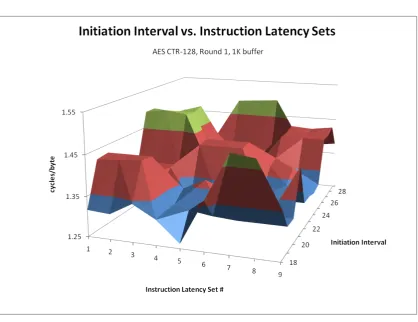
6.3 CTR R1 128, Initiation Interval vs. Latency Set. . . 101
6.4 ECB Results with 1K buffer . . . 108
6.5 ECB 128 results with various input buffer sizes . . . 108
6.6 CBC algorithm implementations . . . 111
6.7 PCBC algorithm implementations . . . 113
6.8 CFB algorithm implementations . . . 114
6.9 OFB algorithm implementations . . . 115
6.10 GCM 128 Results using SMT . . . 118
6.11 Counter Results, AES-GEN vs. Intel Assembly . . . 126
List of Code Listings
2.1 Simulated annealing pseudocode. . . 22
3.1 Stream source code, general operations. . . 32
3.2 Generated vector code, general operations. . . 33
3.3 Stream source code, array lookups. . . 33
3.4 Generated vector code, array lookups. . . 34
3.5 Stream source code, for-loops . . . 35
3.6 Generated vector code, for-loops . . . 36
4.1 Pseudo-AES code using ECB block cipher mode . . . 48
4.2 Using AES-NI in AES-128 CTR mode. . . 65
5.1 Using AES-NI in AES-128 CBC mode. . . 69
5.2 Interleaving three iterations in CTR mode. . . 70
5.3 Software pipelining with an initiation interval of 2 . . . 72
5.4 Interleaving three encryption streams in CBC mode. . . 75
5.5 Psuedocode of our implementation of simulated annealing. . . 77
6.1 Cheetah templated AES-128 Counter code. . . 97
6.2 Modulo scheduling example, standard CTR. . . 99
6.3 AES CTR (round 1) encryption in C using AES-NI instructions. . . 104
6.4 AES CTR (round 2) encryption in C using AES-NI instructions. . . 105
6.5 AES-128 ECB Encryption loop . . . 107
6.6 Strict interleaving four streams of CFB mode . . . 130
C.1 Fastest scheduled CTR (round 1) code found by AES-GEN. . . 161
Chapter 1
Motivation
There is no shortage of sensitive information that is transmitted on a daily basis. Medical records, financial transactions, and military communications1 are all examples of sensitive information that we do not want to freely share with others. To prevent unintended parties from accessing this type of information, encryption is the only answer. Encryption is a vital and necessary component of communicating through several media.
Encryption (or more generally, cryptography) often conjures an image of mathe-maticians trying to detect patterns in some sort of encrypted text vital to national security. However, modern cryptography actually encompasses several disciplines of study. Mathematical, electrical engineering, and computer science concepts must be combined in order for modern encryption processes to work effectively. As such, the study of modern cryptology surrounding these topics is massive and often appeals to specific fields. Mathematicians are generally concerned with the security and complex-ity of an encryption algorithm which is referred to as cryptanalysis. Engineers and computer scientists find themselves with the task of implementing these algorithms in hardware and software.
Implementing encryption algorithms on modern architectures has its downside. It can be costly in both time and power requirements. Crucial financial transactions for both investment firms and personal credit card based purchases alike depend on data being encrypted and decrypted as fast as possible for optimal usability. Implementing fast encryption software can be problematic for developers.
The Advanced Encryption Standard (AES) [Daemen and Rijmen, 2002; The Na-tional Institute of Standards and Technology (NIST), 2001] is a common and widely used method of encrypting data on computer networks. AES was developed as a
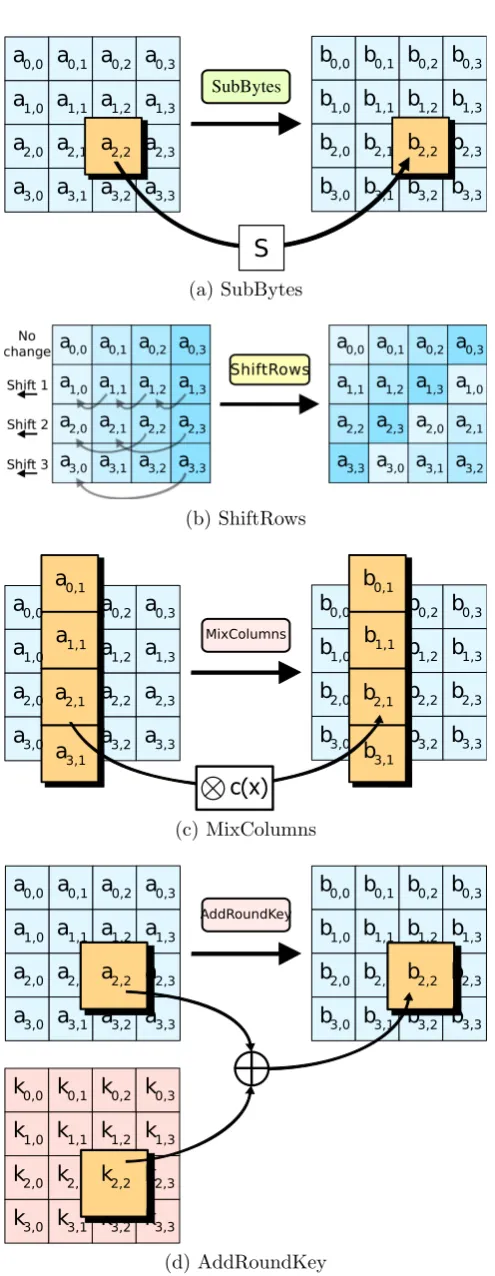
cessor to the Data Encryption Standard (DES), which for many years was the most analyzed, important, and widely used cryptoalgorithm [Smid and Branstad, 1988]. Se-quential software implementations of the AES algorithm take large amounts of CPU clock time. The AES algorithm uses repeated byte substitutions, shifts, and bitwise xor operations to encrypt the data. Generalized byte substitutions are difficult to im-plement efficiently in software. Optimized software imim-plementations combine multiple operations with table lookups. These optimized solutions still require 10 to 14 memory operations to encrypt every byte of data. Due to the importance of using AES, faster implementations are required.
In January 2010, in order implement these costly AES instructions on-chip, In-tel released the Westmere microarchitecture that dedicated an instruction-set exten-sion called AES New Instructions (AES-NI) [Gueron, 2010] to its x86 64 architecture. These instructions have dramatically increased the performance of traditional AES im-plementations by an order of magnitude. The instructions have high throughput rates, but long latencies. Achieving good encryption performance using these instructions requires the use of hand-tuned assembly libraries. However, relying on assembly li-braries has its problems. Assembly implementations are not necessarily optimal for all systems. As new hardware emerges, existing assembly libraries need to be re-evaluated and modified to reflect architectural features. Modifying an algorithm even slightly can require massive changes at the assembly-level and in turn limits exploratory ap-proaches to solving problems. Making both architectural and algorithmic changes to assembly code is incredibly expensive and time-consuming.
With AES-NI being included on new architectures from the world’s market share leader of computer microprocessors, opportunities to use local encryption2 are rapidly increasing. Using AES-NI effectively is rapidly becoming an important problem to solve. Different processor architectural properties greatly affect the performance of AES-NI code. This dissertation presents a program generation system that can build and search many possible AES implementations in a short time-span to find a near optimal solution. Based on the impressive results of this system, it is reasonable to suggest that the scope of these techniques could be widened by further research; the generator could possibly be adapted to optimize other algorithms that use instruction-set extensions.
2Such as encrypting entire hard-disks, subsections of a hard-disk for private user account files, or
1.1 Thesis
1.1
Thesis
This dissertation argues that using AES-NI instructions effectively is not a trivial pro-cess. Current sequentially executing AES-NI based implementations rely too much on the out-of-order architecture to exploit instruction-level parallelism. The thesis of this work is that using a generalized program generator is an effective solution for easily finding near optimal AES implementations that use AES-NI instructions and it serves as a suitable alternative to generating assembly code. We argue that a program generator can accomplish this with three important techniques: (1) making high-level algorithmic changes automatically allows significant opportunities for opti-mization. Combining these changes seamlessly with traditional optimizations, such as (2) scheduling the AES code to exploit instruction-level parallelism, is a valuable strategy. The program generator also (3) finely tunes arguments that affect (1) and (2) and searches this space using an adapted simulated annealing algorithm that finds a solution quickly. This system allows near optimal AES code to be generated for any base architecture supporting AES-NI in a variety of execution environments3.
1.2
Contributions
This dissertation makes the following contributions:
• Vector Code Generation — In Chapter 3, we find generating vector code is an effective strategy to map streaming languages to general purpose processors. Using a streaming language as a framework to generate vector instructions is a minor, but important contribution. We found that this strategy worked, but allowed us to investigate different systems for code generation.
• AES Program Generation — In Chapter 5, we present a program genera-tor that builds CTR and CBC AES implementations. We show this generagenera-tor can build AES code that performs similarly to hand-coded assembly language libraries. The generator automatically tunes implementations to the underlying architecture.
• Flexible Program Generation — In Chapter 6, we present a generalized pro-gram generation system that can easily schedule optimized AES code from high-level source files. We present evidence that using software pipelining and modulo
3Execution environments such as sequential execution, encryption using simultaneous
scheduling can lead to very good schedules and superior performance for paral-lelizable AES modes.
• Algorithmic Choices — We explore the use of automating algorithmic choices through the use of optimizations such as: assigning round keys to registers, set-ting restrict pointers, adding software prefetch directives, andxoroptimizations. These choices make small but crucial changes in encryption runtime. Making these changes manually is difficult if one has to completely reschedule the code. We find applying these algorithmic changes seamlessly with other optimizations is important in achieving best performance.
• Exploiting xor for Cyclic Modes — With block ciphers, the plaintext of each block must be added into the key stream at some point. This is done with anxoroperator. Xoris both an associative and a commutative logical operation. We propose a novel way of generating AES code that exploits its mathematical properties. Doing this results in a reduction of the dependency chain and allows additional parallelism within the loop body. We also exploit this property at different “levels” within the generation system.
• Function Stitching— For function stitched code (like combined encryption/au-thentication GCM mode), our program generation system can still schedule code effectively. In assembly, function stitching requires merging two assembly func-tions. Rescheduling two merged functions in assembly code is difficult. We show the ease of finding an optimized schedule in our system by using loop fusion to merge encryption and authentication functions.
• Simulated Annealing — Our program generation systems can effectively pro-duce an infinite number of possible AES solutions. With an adapted simulated annealing algorithm, we show that it is a useful code tuning tool to traverse the search space quickly while finding a good solution.
1.3 Relevant Academic Publications
1.3
Relevant Academic Publications
In chronological order, from earliest:
(1) Mapping Streaming Languages to General Purpose Processors through Vectoriza-tion — Raymond Manley and David Gregg —The 22nd International Workshop on Languages and Compilers for Parallel Computing 2009 — Newark, DE, USA — Volume 5898 of Lecture Notes in Computer Science, pp. 95–110. Springer Berlin / Heidelberg.
(2) Code Generation for Hardware Accelerated AES — Raymond Manley, Paul Ma-grath, and David Gregg — 21st IEEE International Conference on Application-specific Systems Architectures and Processors(ASAP), 2010 — Rennes, France — pp. 345 –348.
(3) A Program Generator for Intel AES-NI Instructions — Raymond Manley and David Gregg —11th International Conference on Cryptology in India, Indocrypt 2010— Hyderabad, India — Volume 6498 ofLecture Notes in Computer Science, pp. 311–327. Springer.
The work in publications listed above was primarily conducted by the author of this dissertation under the supervision of Dr. David Gregg. Additional background research was provided by Paul Magrath in (2). Mike O’Hanlon at Intel Shannon, provided feedback and suggestions for our work in addition to facilitating early access to AES-NI hardware for work done in both (2) and (3). Vinodh Gopal at Intel provided additional feedback on our work in (3).
1.4
Dissertation Outline
Chapter 2
Background
This chapter provides background material and literature surveys on the topics neces-sary to the discussion of the work presented in this dissertation. Namely: Architecture in Section 2.1, Software ILP Optimizations in Section 2.2, Program Generation in Section 2.3, and Streaming Languages in Section 2.4.
2.1
Architectural Features
As this dissertation deals with exploiting instruction-level parallelism (ILP) when using high latency instructions through code generation, this section provides background on the architectural features that enable these optimizations. The following techniques that improve ILP deal with an idea that latency, or the number of clock cycles an instruction takes to complete, is not uniform for all instructions. In addition, the number of clock-cycles that must elapse before a new instruction can be issued (or the
throughput) will also affect the amount of ILP that can be exploited on multi-issue architectures.
2.1.1
Instruction Pipelining
On multiple-issue architectures, pipelining is a technique that allows machine level instructions to be completed in stages. The number of stages that exist in the pipeline and how the stages are grouped varies for each processor. An instruction will “occupy” a stage in the pipeline, allowing multiple instructions to be executed in parallel.
Cycle
Instruction 0 1 2 3 4 5 6 7 8
1 if id ex mem wb
2 if id ex mem wb
3 if id ex mem wb
4 if id ex mem wb
5 if id ex mem wb
Figure 2.1: Generic five-stage instruction pipeline.
are often broken down into several additional stages for instructions that take longer to complete within the pipeline. The number of stages implemented on a processor is influenced by the latency and throughput of its instruction set. While the length of pipelines has gradually increased since their widespread adoption in the 1980s, more stages does not necessarily result in reduction of run-time. The Pentium 4 has a 31 stage pipeline [Hinton et al., 2001], but the Core i7 has reduced this number to 14 [Intel Corp., 2011]. The classic five-stage instruction pipeline [Hennessy and Patterson, 1992] is shown in Figure 2.1 with the following stages:
1. (IF) Instruction Fetch Instructions are fetched from the cache.
2. (ID) Instruction DecodeInstructions are decoded in divided into parts needed for execution.
3. (EX) Execute Now decoded, instructions execute and take a variable number of cycles to complete, depending on type of instruction.
4. (MEM) Memory OperationsThis stage accommodates long-latency memory operations if the executing instruction needs to fetch data.
5. (WB) Write-back Write results of the instruction back to memory.
2.1 Architectural Features
On in-order processors, if an instruction is held up in a particular stage, the pro-cessor must wait to push instructions down the pipeline. This stall wastes clock cycles while the processor waits to complete the instruction. Stalls are caused by structural stalls, control stalls, or data stalls. Structural stalls happen when a multiple instruc-tions require the same processor resource. Control stalls occur with conditional state-ments that could change the target of the following instruction. Branch predictors try to prevent these stalls. Data stalls occur when an instruction has a data dependency on another instruction already in the pipeline. The instruction cannot continue until its predecessor completes executing. There are a number of possible solutions to pre-vent and/or limit these pipeline stalls. However, limiting data stalls are of particular interest to us1.
Cycle
Instruction 0 1 2 3 4 5 6 7 8
1 if id ex mem wb
2 if id ex mem wb
3 if id ex mem wb
4 if id ex mem wb
5 if id ex mem wb
6 if id ex mem wb
7 if id ex mem wb
8 if id ex mem wb
9 if id ex mem wb
10 if id ex mem wb
Figure 2.2: Generic superscalar pipeline.
2.1.2
Superscalar
Instructions on a single-issue scalar processor execute sequentially and process one or two operands. Functional units that are not needed while the current instruction is being executed remain idle when they could be doing something useful. Superscalar architectures were designed to improve instruction scheduling by dispatching instruc-tions to idle functional units. A superscalar architecture is a multiple-issue processor
1As we will see in Chapter 4, the AES algorithm is a block-cipher that has a chain of dependent
which implements a form of instruction-level parallelism by executing more than one instruction at a time on different functional units. Figure 2.2 shows a superscalar pipeline that fetches and executes two instructions at a time.
Using a superscalar pipeline allows the CPU to have greater throughput than its clock speed would suggest and would normally process more than one instruction per clock cycle. The ability to parallelize at this level depends on several factors. One such factor is the number and types of functional units. Different functional units can process different types of instructions. For example, given a processor has a functional unit that can process integer and float operations and a functional unit that can process integer and memory operations, two integer operations could be completed in parallel, whereas two sequential float instructions would cause a stall. The data dependency between instructions is also checked by the hardware at run time to ensure that programs execute properly. This is a important limitation of superscalar hardware to note, as other optimization techniques must be exploited in these instances.
2.1.3
Simultaneous Multithreading
Research has shown that superscalar architectures are limited at saturating the avail-able resources (functional units) with multi-issue processors [Eggers et al., 1997]. Si-multaneous multithreading (SMT) is a modern architectural feature on superscalar CPUs that implements hardware multithreading by permitting independent threads of execution in an effort to better utilize processor resources. To do this, instructions are issued from independent threads to multiple functional units. While increased resources are required to fetch instructions from multiple threads and keep thread in-formation, the use of SMT will theoretically allow instructions from different threads to be used by idle parts of the processor. This is why SMT is implemented on a su-perscalar processor. This technique is very similar to susu-perscalar pipelines but with multiple instruction queues to fetch from.
Work by Tullsen et al. [1995] showed that SMT has potential to increase resource usage on single-chip multiprocessors. They compared SMT to single-chip multiprocess-ing. While the two systems have similar organization layouts—both have their own set of registers, multiple functional units, and high issue-bandwidth—they have a very different strategy for partitioning and scheduling resources. Multiprocessing issues in-structions to a fixed number of functional units to complete each thread. SMT can change this assignment every cycle. This allows for more efficient use of functional units.
2.1 Architectural Features
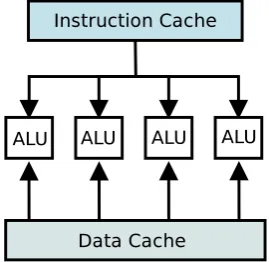
Figure 2.3: SIMD example, a single instruction is applied to multiple data.
found in this thesis),hyper-threading is the term used for Intel’s SMT implementation [Intel Corp., 2011]. Intel implements SMT by addressing two virtual or logical proces-sors for every one physical processor. It is possible to pin a process to one of these virtual processors, but this remains transparent to the operating system. The hard-ware does this so the operating system can think it is scheduling multiple processes simultaneously on “different processors”, allowing the processor to send instructions down the pipeline from multiple threads. This limits structural stalls.
2.1.4
Vector/SIMD
SIMD (Single Instruction, Multiple Data) is a technique employed to achieve data level parallelism. On modern architectures, SIMD serves as a vector processor. In SIMD computer architecture [Flynn, 1972], the computer exploits multiple data streams against a single instruction stream in order to perform operations that may be eas-ily parallelized. This is shown in Figure 2.3. By processing multiple data elements in parallel, SIMD processors provide a way to utilize data parallelism in applications that apply a single operation to all elements in a vector.
XMM7 can be accessed in 32-bit operating mode. Other generations of SSE have been added to current x86 architectures. The latest iteration of SSE is version 4.2 which was released in 2009.
Intrinsics
Compilers are limited in applying vectorization from high-level code without addi-tional annotations. While writing assembly-level vector instructions can be done, a set of macros called intrinsics exist to allow high-level language programmers to make use of SIMD instructions. Intrinsics are written as high-level language functions that often have a 1:1 correspondence to their assembly level counterparts. Code that uses intrinsics can also benefit from further low-level optimizations applied by a high-level language compiler as he compiler will manage register allocation and instruction scheduling. Instrinsics are also used in source-to-source translators and code generators that attempt to automatically vectorize code.
2.1.5
Autovectorization
2.2 Software ILP Optimizations
2.2
Software ILP Optimizations
Hardware mechanisms to improve instruction-level parallelism can only go so far. For in-order architectures, exploiting ILP depends entirely on the compiler. Preventing stalls in the pipelines on superscalar machines depend on the sequence of instructions and which resources they wish to use. Both in-order and out-of-order execution archi-tectures can benefit from high-level code that encourages standard compilers to exploit ILP in software using differentinstruction scheduling techniques.
2.2.1
Instruction Scheduling
Compilers use instruction scheduling to expose more instruction-level parallelism for superscalar architectures. On in-order architectures, the compiler uses instruction scheduling to re-arrange the operations into groups that can be independently exe-cuted. A simple but effectivelist scheduling algorithm can be applied to a basic block to create the independent groups and this can result in a near optimal scheduling so-lution [Lawler et al., 1987]. Groups are created by building a data dependence graph (DDG), in which operations are represented by nodes with directed edges that show dependencies between the operations. Exploiting ILP when scheduling basic blocks which execute repeatedly is an important problem.
2.2.2
Loop Unrolling
these problems while continuing to exploit ILP.
2.2.3
Software Pipelining
Software pipelining is an instruction scheduling technique that takes instructions from several loop iterations and combines them to build a new, parallelized basic block [Lam, 1988]. Figure 2.4 shows how code from a simple loop is scheduled using software pipelining. In Figure 2.4a, the control flow graph representation shows a loop with four statements. Using an acyclic schedule (shown in Figure 2.4b), the statements are executed sequentially. In Figure 2.4c, software pipelining is applied to the loop and the four statements are scheduled to execute simultaneously, exploiting ILP. This is achieved by breaking down software pipelining into three stages:
1. Theprologuecontains all instructions that are required to be executed before the instructions of the current loop that will be included in the loop body.
2. The loop body is referred to as the kernel or steady state, as once the program reaches this point, this body of code will repeat until it must exit. The kernel contains all instructions needed to complete one iteration of the loop, but as instructions will be from different iterations, they can be scheduled in parallel.
3. When the kernel finishes executing, some loop iterations are still live. The epi-logue consists of code required to finish these iterations correctly.
While Figure 2.4 shows a simple four statement loop body, the number of statements from each iteration included inside the steady state needs to be flexible. It might be pertinent to allow long-latency instructions to be scheduled further down the pipeline, or across several kernel stages. Low-latency instructions may be grouped together and executed in a single pipeline stage. The “length” of the kernel is measured in machine cycles and is known as theinitiation interval (ii). This value can be adjusted to exploit different levels of ILP. Theii sets the throughput of the pipeline.
2.2 Software ILP Optimizations
B
C
A
D
(a) Original CFG A B C D(b) Acyclic schedule
A B C D A B C D A B C D A B C D Prologue Kernel Epilogue
(c) Software pipelining
Figure 2.4: Software pipelining example. Images taken from [Gregg, 2001]
can increase register pressure, but the variables created by the renaming and copy instructions can be optimized out at compile time.
The prologue and epilogue also contribute to code growth, but the amount is dic-tated by how many loop iterations exist in the kernel. Inherently, the instructions in both stages can also be out-of-order which benefits during global instruction scheduling. Compilers can unroll loops to high degrees, causing an inflated number of instructions scheduled and this increases compensation code which is needed to support the over-lapped iterations. Software pipelining also does not require an expensive clean up loop, as the epilogue finishes the loop cleanly.
2.2.4
Modulo Scheduling
The initiation interval determines how a software pipelining kernel is built. From our experience, we used ii slightly differently in Chapters 5 and 6. In Chapter 5, the throughput is measured in number statement lines without any regard to what their corresponding throughput and latency would be at the machine level. In Chapter 6, we can assign specific values to each statement in the graph andii value will schedule them accordingly. The approach we used to build our software pipelined loops in Chapter 6 is calledmodulo scheduling [Rau and Glaeser, 1981]. Modulo scheduling is a method of implementing software pipelining in loops that do not contain branches that produces good code while minimizing code growth.
load x load y mul store x = a[i]
t = x * y c[i] = t y = b[i]
(a) Original code
0 1 2 3
load x load y mul
store
cycle FU1 FU2
(b) Acyclic schedule
load x load y
mul
store
load x load y
mul
store
load x load y
mul store 0 1 2 3 4 5 6 7 cycle
II = 2
(c) Overlapping execution
load x load y mul
store load x load y
mul
store
Prologue Kernel
Epilogue
(d) Software pipelined schedule
load x load y
cycle FU1 FU2
0,2,4,...
1,3,5,...store mul (e) Modulo reservation table
2.3 Program Generation
values from separate arrays, multiplies these values together, and stores the result into a third array. Given that the load and store instructions take one cycle each and the multiply takes two cycles, the acyclic schedule for this loop on a processor with two functional units is scheduled as seen in Figure 2.5b. There is no cyclic dependency from one iteration to the next; each iteration completes in four cycles and successive iterations can be overlapped and execute in parallel as shown in Figure 2.5c using anii
value of 2. Figure 2.5d, shows the software pipelined schedule of the loop. The prologue contains the first three instructions. The kernel then contains the loads ofx[i+1] and
y[i+1] executes mul on those values while the previous iteration’s mul instruction finishes and stores the value in t[i] before the loop continues. The epilogue then contains the clean up code, which in this case is a store. The order in which these instructions execute is listed in Figure 2.5e. While software pipelining and modulo scheduling are very effective techniques for instruction scheduling, they are many other methods to optimize entire algorithms or programs and is sometimes done with a
program generator (or code generator).
2.3
Program Generation
The origin of early code generators were “superoptimizers” and “peephole optimizers”. The scope of these optimizers were limited to small programs or sections of a pro-gram to reduce the number of instructions in a propro-gram through instruction selection, constant folding, and removing redundant code. Massalin [1987] created a “superopti-mizer” to find the fewest instructions required to compute a given function. However, the author states that often this technique is only practical for programs that have 13 machine instructions or less, and the effectiveness is largely dependent on the target architecture (and which instructions are available). Peephole optimizers were often in-tegrated into code generators. Davidson and Fraser [1984] described techniques on how to automatically generate peephole optimizations using a description of the underlying architecture. Fraser and Wendt [1988] extended this work to integrate a set of peephole optimizations with a na¨ıve code generator to create an automatic code generator and optimizer that could be retargetted to different architectures with minimal effort.
with the challenge of optimizing an algorithm, many optimization techniques need to be considered. A system that considers these architectural or algorithmic changes, and generates an optimized version of the code is called a program generator.
Iterative program generators take a piece of code and try to find the fastest ver-sion by trying combinations of different techniques to optimize the code, just like a programmer would by hand. The difference is that a code generator does not have to make guesses like a programmer would. An iterative program generator can try all the conceivable combinations of the optimization techniques to find the best solution. The lack of user intervention is convenient and cost saving. The work involved in optimizing even a small piece of code can take weeks by hand. A code generator can generate all the combinations possible almost instantly. While it completes a time-consuming search for a solution, it requires no attention. In exchange for this one expensive search, the time saved by running a faster version of the code on a continual basis is desirable.
2.3.1
Domain Specific Code Generators
There are several well known code generators (also referred to as library generators) that focus on a particular subset of problems. One of the most successful code gener-ators is Fastest Fourier Transform in the West (FFTW) [Frigo et al., 2005; Frigo and Johnson, 1998]. It is a library for computing the discrete Fourier transform (DFT) and is designed to adapt to hardware features to maximize performance. It is able to tune code for machine-specific instruction-set extensions, like SIMD, and uses a specialized compiler to generate optimized implementation of discrete cosine and sine transforms from the parent DFT algorithm. The DFT algorithm can be of real- or complex-type valued arrays of varied size and dimensions. Depending on these defined algorithmic properties and the underlying architecture, the derived DFT algorithm could work very differently from machine to machine.
2.3 Program Generation
series of plan-permutations eventually returns a “correct” plan. These transformations yield various solutions that will nest loops differently with varying vector sizes and so on. The cost to compute the DCT given these high-level code constructs is calculated given the architectural properties. This is how a “correct” plan is determined.
Whaley et al. [2000] presents a code generator called ATLAS, which generates linear algebra routines and focuses the optimization process on the implementation of matrix multiplication. Like the FFTW planner, the parameter values of a matrix multiplication implementation influence how the code is generated. The generator tries multiple values for the tile size and loop unrolling degrees and evaluates the costs of the various configurations. The almost exhaustive search proceeds by generating different versions (different sizes) of matrix multiplication that are dependent on the input values.
SPIRAL, or Signal Processing Implementation Research for Adaptable Libraries, is another code generation library. SPIRAL can generate code for several subsets and formulae associated with digital signal processing (DSP), such as linear transformations [P¨uschel et al., 2005]. Through SPIRAL, researchers have investigated the use of automatic vectorization of both the Discrete Fourier Transform (DFT) [Franchetti and P¨uschel, 2003] and the FFT [Franchetti and P¨uschel, 2007].
In those works, Franchetti and P¨uschel discuss the difficult process of exploiting SSE instructions on scalar code. In addition, they also mention the problem of finding an optimal solution when generating code for a target architecture. They offer a specific dynamic programming search to find a “good match” between the formula space and architecture it is being mapped to. Of more direct relevance is their work on the SPL compiler [Xiong et al., 2001]. The SPL compiler, developed for SPIRAL is a system that uses formula transformations and intelligent search strategies to create optimized DSP libraries.
2.3.2
Traversing the Search Space
As mentioned earlier, early code generators had a limited scope for optimization. In-struction sets were smaller and “useful programs” were about a dozen machine instruc-tions long. With Massalin [1987]’s superoptimizer, he considered that it was feasible to exhaustively search every possible program. However, he concedes that the search grows exponentially with each additional instruction.
expands with small options that can be turned on and off that may or may not improve the code depending on another option’s state. Consider the optimization flags that could be passed to gcc alone. The resulting possibilities of a complex program could be in the billions. There needs to be a way to search the search space more efficiently because exhaustively trying all combinations is rarely computationally feasible. Several techniques have been developed to traverse these vast search spaces.
PEAK is a system introduced by Pan and Eigenmann [2006b] which considers a feedback-directed approach to making the most use of 38 of gcc’s on/off optimization flags2. They find solutions quickly (in comparison to other iterative compilation
tech-niques) by creating program “sections”. PEAK detects which parts of the program could benefit from optimization and places them into a “section”. The system then profiles each applies compiler optimizations independently to these sections. Once each section is tuned, the program is compiled and given to the user. To traverse the ex-ponential search space, they apply an algorithm called combined elimination [Pan and Eigenmann, 2006a]. This algorithm combines several ideas to reduce the search space. It first identifies which optimizations increase runtime. Then it iteratively tries to elim-inate each negative-optimization one at a time. The authors claim similar performance gains can be achieved from a search that takes several minutes, as opposed to a few hours.
Related work by Hoste and Eeckhout [2008] attempts to find the best gcc op-timizations again amongst an even greater search space3. Their system, Compiler Optimization Level Exploration (COLE), uses a multi-objective search based on an evolutionary algorithm to adjust for code size, code quality, and/or compilation time. Acovea is a tool developed by Ladd [2009] that uses genetic algorithms to find the best options when compiling a program with gcc. Similar ideas have been proposed for code generators.
Work on using machine-learning algorithms to find the best general compiler op-tions when tuning code for a particular target has also been investigated. Li et al. [2005] used SPIRAL to demonstrate the power of using machine learning techniques in automatic algorithm selection and optimization. Li et al. argue that while generators like SPIRAL and FFTW can find near-optimal performance for a particular machine just by using empirical searches, these algorithms have only been shown to work with-out considering the characteristics of input data. By using genetic algorithms and a classifier system that consider and adapt specifically to input data, Li et al. are able
2These options create 238combinations, and are used in their experiments.
2.3 Program Generation
to increase performance of classic sorting algorithms. They argue that using a genetic algorithm is necessary because the deep cache hierarchy and complex architectural fea-tures in modern systems are not considered when studying the complexity of sorting algorithms.
The MILEPOST GCC project [Fursin et al., 2008] also uses machine learning during the gcc compilation process for a broader range of inputs and hardware targets. What is unique about their approach is that gcc may be used to compile any program that could target a number of different platforms. As such, the machine learning compiler they describe can automatically adjust its optimization heuristics to make applications faster, reduce the code size, or even the compilation time. To train the machine-learning algorithm, they use a set of 500 random sequences that each applied a range of compiler flags turned on and off to a benchmark. They found that while being a time-consuming process, this training pass worked effectively to build other code when run on a particular architecture.
Expanding on the MILEPOST project, Leather et al. [2009] presented work that automatically finds “features” of a given program that are likely to be improved by the machine-learning techniques. It sends feature data to the machine learning tool and in return, influences the genetic algorithm. Tournavitis et al. [2009] extended work on MILEPOST as well by adapting machine-learning to generating auto-parallelized code. The authors argued that weaknesses exist in traditional parallelizing compilers (such as autovectorizing compilers—see Section 2.1.5). They found that adapting the learning techniques to this problem found more code that could be parallelized compared to that found by other automatic tools. The work far exceeds other tools and comes close to performance of manually parallelized code, such as manually tuned OpenMP.
The heuristic methods mentioned this section are based on genetic programming approaches, decision trees, and thek-nearest neighbours classifier to perform machine-learning. There are other methods of traversing a search space without narrowing the scope. One such algorithm is simulated annealing.
2.3.3
Simulated Annealing
Listing 2.1: Simulated annealing pseudocode.
1 S i m u l a t e d A n n e a l i n g ( )
2 C r e a t e i n i t i a l s o l u t i o n S
3 I n i t i a l i z e t e m p e r a t u r e t
4 repeat
5 f o r i = 1 to i t e r a t i o n−l e n g t h do
6 G e n e r a t e a random t r a n s i t i o n from S to S [ i ]
7 i f (C( S ) >= C( S [ i ] ) ) then S = S [ i ]
8 e l s e i f ( e ˆ (C( S ) − C( S [ i ] ) ) / ( k∗t ) ) > random [ 0 , 1 ) ) then S = S [ i ]
9 Reduce t e m p e r a t u r e t
10 u n t i l ( no change in C( S ) )
11 Return S
kB is Blotzmann’s constant. Using simulated annealing has been found to be an ef-fective solution for graph partitioning and traveling salesman problems4[Kirkpatrick,
1984].
This equation is used in the simulating annealing algorithm to accept or reject the current solution. The solutions are evaluated by a cost function. In the beginning, the search can and should be quite erratic in direction, but always testing a neighbouring solution. One of the ideas behind simulated annealing is that bad solutions are accepted earlier in an effort to prevent the search from being stuck in local minima. As the search goes on, the probability of accepting bad solutions reduces. This is done through a temperature variable that “cools down” when progress is made. Once the temperature is fairly low, the algorithm suggests that it has found a good solution and is more likely to test solutions closer to the “good” solution.
Finding a practical cooling solution requires a trial-and-error approach and needs to be tailored for the cost function used (functionC(S) in Listing 2.1). This function evaluates the solution and returns a value or cost. The temperature variable itself cools down exponentially after every set number of iterations. The temperature rapidly cools because good solutions are starting to become evident. Solutions will always be accepted if the cost of the current solution is lower than the cost of the previous solution. In addition, the probability function noted above is compared against a random value between 0 and 1. If it the probability function is greater than the random number, then the solution is accepted regardless of cost. A general outline of the simulated annealing algorithm is shown with pseudocode in Listing 2.1.
4In Chapters 5 and 6, we use simulated annealing to find solutions among a search space that is
2.4 Streaming Languages
2.4
Streaming Languages
As discussed in the previous section, using a program generator can be a way to expose parallelism in a program. However, some algorithms have properties that are simple and straightforward enough to benefit from a set of optimizations geared for parallel processing. The essential idea of stream processing is that large quantities of data are brought into local memory, manipulated with a single or very few instructions, stored back into memory and then are unlikely to be used again. An example of this type of application5 is presented in work by Manavski [2007], in which they implement
the AES encryption algorithm using a stream language. This programming paradigm has been implemented in a series of streaming languages designed to easily exploit parallel processing. Streaming languages were originally (and concurrently) developed for specialized streaming processors, such as RAW [Taylor et al., 2004] and Imagine [Khailany et al., 2001]. Stream processing then found a home on the more commonly found graphics card (GPU) through CUDA [NVIDIA, 2007] and gaming processors, such as the Cell BE [Zhang, 2007], which led to the idea that streaming languages could provide the necessary structure to effectively map their code onto general-purpose processors. More recent streaming efforts like OpenCL [Munshi, 2009] have partnered several corporate entities to develop an open standard for specifying these languages.
Streaming languages are often defined very differently. They can be developed as simple libraries that target a specific processing unit. Rapidmind [Monteyne, 2008] (and later, Intel Array Building Blocks Intel Corp. [2010b]) do this for GPPs. CUDA specifically targets NVIDIA GPUs. OpenCL tries to optimize stream processing by targeting both GPPs and GPUs simultaneously. Some streaming languages, such as Brook [Buck et al., 2004], are defined by simply extending a more familiar language such as C/C++. Others, like StreamIt [Thies et al., 2002], were created with the belief that an entirely new language is essential to representing the stream model. Both platforms share common attributes such as facilities to read and write stream data, kernels (or filters), and control techniques such as reductions. Kernels are defined as the function that operates on all elements of a stream. Both platforms also have a compiler to generate code and a runtime (or back-end) to serve as the computational engine. Figure 2.6 shows the general process of compiling a stream program with Brook and Streamit.
Thecomputational intensity property of streaming is represented by a kernel. Ker-nels operate on every element in the stream and are the only place individual stream
Figure 2.6: General Process of compiling a Streaming Program in Brook and Streamit.
elements can be accessed. It is usually required that streams be initialized and writ-ten back out to normal arrays to keep the streams separated between the main body of the program and kernels. In Brook, this is done with a set of runtime functions called streamRead and streamWrite. It ensures that the language implementation is in complete control of the data structures.
When compiling streaming code, a source-to-source translation is commonly used on the source with resulting output in another high-level language [Das et al., 2006; Amarasinghe et al., 2005]. This allows the C++ compiler to apply low-level optimiza-tions. When translating the kernels, a loop is generated to iterate through the size of the input stream(s). The code contained within the kernel function is then evalu-ated within the loop for every single element of the stream. Further optimizations are applied, dependent on the target architecture.
The other part of compiling and executing a stream program is the runtime. The responsibilities of the runtime vary depending on the target architecture. The run-times are stand-alone back-ends that allow a programmer to write stream programs independently of the architecture they run on. Specific optimizations are also built into runtimes to make certain features more efficient on a given platform [Advanced Micro Devices, Inc., 2007]. The runtimes are linked with the streaming application at compile time. Some of the responsibilities of a runtime include: checking the stream size during kernel invocation, bounds checks on array indexing, and managing threads. The runtime also manages the interaction between the kernels and the main body of the program.
2.4 Streaming Languages
Chapter 3
Using Streaming Languages to
Automatically Generate Vector
Code for General Purpose
Processors
Making good use of vector/SIMD hardware is a research topic that has been going for decades. Making the most of parallel execution is critical for significant speedups. The vector instructions on common x86 machines usually do 2 to 4 instructions in place of their scalar equivalents. Many vector instructions on modern architectures have similar throughput and latency times compared to their scalar equivalents as well. Often, disassembling code that has been compiled by gcc or icc will reveal that common multiply or add instructions simply use vector instructions and operate only on the lower bits, ignoring up to three possible operations that could be computed at the same cost. Much of the autovectorization research mentioned in Section 2.1.4 has many limitations and requirements that must be met for compilers to effectively vectorize scalar code. This chapter investigates using streaming languages to encourage better vector code generation for general purpose processors that have instruction-set extensions to accommodate SIMD processing.
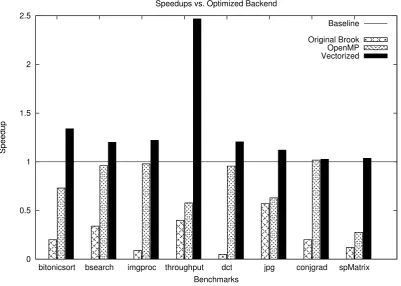
generating vectorized code for these streaming operations is a potential solution. We use the streaming language Brook as our syntax base and augment it to generate vector intrinsics targeting the x86 architecture. This compiler uses both existing and novel strategies to transform high-level streaming kernel code into vector instructions without requiring additional annotations. We compare our system’s results to existing mapping strategies aimed at using stream code on GPPs. When evaluating performance, we see a wide range of speedups from a few percent to over 2x and discuss the effectiveness of using vector code over scalar equivalents in specific application domains.
3.1
Introduction
As the demand for large scale multimedia processing increases, a high-level abstrac-tion to represent the inherent parallelism found in certain applicaabstrac-tions has yet to be agreed upon. However, the stream programming model continues to be proposed as such a platform [Owens et al., 2002]. Faced with an ever increasing processor core count, streaming languages become an attractive solution as general-purpose proces-sors (GPPs) start to mirror the architectural structure of the more traditional targets like GPUs. Traditional programmers require new tools and new representation mod-els [Zhang et al., 2007] to make use of this advanced hardware. While some streaming languages have focused primarily on generating code for GPUs to perform general com-putation, others have put effort into adequately making use of the streaming model on GPPs [Buck et al., 2004; Amarasinghe, 2006] and it is not without challenges.
Previous research into mapping streaming languages on GPPs have led some [Talla et al., 2003; Gummaraju and Rosenblum, 2005; Gummaraju et al., 2007] to conclude that without the addition of extra hardware on the processor or chipset, it would be difficult for GPPs to match the performance of their GPU counterparts for programs that need high floating point operations per second (FLOPS) rates to process large chunks of memory—such as digital signal processing operations.
3.2 Brook
With work being done on load balancing and generating threads intelligently based on GPP hardware features—such as core count and cache sizes [Kudlur and Mahlke, 2008; Gummaraju et al., 2008; wei Liao et al., 2006]—we look at a technique to improve the problems with stream data locality and stream data parallelism on GPPs. We argue generating vectorized code for streaming operations is a potential solution. Due to the nature of reading, writing and executing streams, we believe that building a compiler that exploits the vector hardware on today’s GPPs allows us to make a case for further research into mapping streams onto these architectures. In this chapter:
• We outline both existing and modified vectorization techniques that can be used within the stream framework.
• We show that vectorization is an effective strategy to map stream code to general purpose processors.
• We analyze application and algorithm properties to suggest reasons for different levels of vectorization effectiveness when generating stream code.
The chapter is organized as follows: Section 3.2 describes the Brook streaming lan-guage. In Section 3.3, we elaborate on the modifications required to the stream compiler and the stream runtime to integrate our vectorization techniques. The strategies and techniques required to generate vector code are outlined in Section 3.4. Section 3.5 presents and offers analysis on our experimental results including speedup and cache miss data over several backends. Work related to this chapter is mentioned in Section 3.6. Section 3.7 summarizes the conclusions presented in this chapter.
3.2
Brook
Figure 3.1: Compiling a Streaming Program in Brook using the CPU backend.
3.3
Modifications to Brook
Due to the cooperation of the generated code and the runtime when executing a stream program, changes need to be reflected in the stream compiler. In our case, we build upon and modify Brook to implement classical and our own vectorization techniques. Generating this vectorized code requires us to modify the runtime to support the dif-ference in the way a stream was being represented in memory. Likewise, augmenting the runtime to support certain hardware features requires code to be generated differ-ently. While we talk about the specific techniques of generating vector code later on, we modify both the code generator and the runtime. That work is discussed in Section 3.4. The implementation of our techniques uses Brook v0.5 Beta1 [Buck et al., 2004] as the base platform and our code targets the x86 architecture.
Autovectorization
3.3 Modifications to Brook
Figure 3.2: Swizzling data from an Array of Structures to a Structure of Arrays.
3.3.1
Modifying the Code Generator
The code generator creates the “for-loop function” that iterates through the size of the stream and parses the internal kernel code. The runtime requires a function to be created that calls the “for-loop function” and kernel code. We modify the stream loop and the data representation as both are necessary modifications.
We change the loop to index every n elements, where n is the SIMD size, or the number of values which are packed into the vector register. The value n changes depending on the data type used. As the intrinsics require a pointer to the start of the block of values, we are required to change the argument list since we now iterate over
n elements. If the streaming language allows structures to be defined, like Brook does, we must modify the argument list further by expanding the arguments to as many separate streams as necessary representing each data field of the structure.
3.3.2
Modifying the Runtime
The runtime manages several things during execution that alleviates certain burdens from generating verbose code. However, changing the code generator requires us to make changes to the runtime and vice-versa due to their co-dependence. Multi-dimensional data representation needs to be implemented by both. For example, a stream of structures (containing three floats named x, y and z) will essentially be an array of structures (AoS). To make use of vectorization techniques, data needs to be
Listing 3.1: Stream source code, general operations.
1 k e r n e l void k (f l o a t inStream1<>, f l o a t inStream2<>,
2 o u t f l o a t outStream<>){
3 outStream += i n S t r e a m 1 ∗ i n S t r e a m 2 ;
4 }
Since stream languages require that all streams be initialized before being used by a kernel, we swizzle the data at this point. To swizzle the data, we also use vector intrinsics. After the kernel executes and we write the stream back to memory, the data is swizzled back to AoS format. This allows the behaviour of structures to never change for the programmer. Intel’s optimizations manual [Intel Corp., 2011] details an algorithm for swizzling multi-dimensional data.
3.4
Generating Vector Code
When translating the Brook kernel, the block statement containing the original code is parsed. To generate our vectorized code, we use a C++ parser and code generator. It also has the ability to exit out of our vector mode and generate the standard Brook generated code if our compiler cannot produce equivalent vectorizable code. The re-mainder of this section deals with some of the general and more interesting techniques used to automatically generate vectorized code within a stream compiler.
3.4.1
General operations
Generating the intrinsics for general computation, assignments, and declarations are fairly straightforward. When the grammar finds an expression likeexpr1 ‘+’ expr2, it generates the equivalent intrinsics instruction (_mm_add_ps(expr1, expr2)).
Assignment expressions such as unary_expr = expr use the previously defined
3.4 Generating Vector Code
Listing 3.2: Generated vector code, general operations.
1 s t a t i c void k c p u i n n e r (const f l o a t∗ inStream1 ,
2 const f l o a t∗ inStream2 ,
3 f l o a t∗ outStream ){
4 m128 v 0 , v 1 , v 2 ;
5 v 0 = m m l o a d p s ( i n S t r e a m 1 ) ;
6 v 1 = m m l o a d p s ( i n S t r e a m 2 ) ;
7 m128 t 0 = mm mul ps ( v 0 , v 1 ) ;
8 m128 t 1 = mm add ps ( v 2 , t 0 ) ;
9 v 2 = t 1 ;
10 mm stream ps ( outStream , v 2 ) ;
11 }
Listing 3.3: Stream source code, array lookups.
1 k e r n e l void k (f l o a t s t r e a m I n d e x<>, f l o a t a r r a y [ ] ,
2 o u t f l o a t outStream<>){
3 outStream = a r r a y [ s t r e a m I n d e x ] ;
4 }
3.4.2
Arrays
Lookups
The challenge with vectorized array lookups occurs when indexing on a value that is not known during compilation time. If the index is known, then we use constant expansion to load the same value into all four slots of the vector register. However, real world problems need to index on more than constants and we see this in programs using a stream of values as the index for an array. Even knowing the addresses of the four elements to load into a vector register will not help as there is no instruction to load values from four different memory locations. The compiler generates scalar code to accomplish the task.
Listing 3.4: Generated vector code, array lookups.
1 s t a t i c void k c p u i n n e r (const f l o a t∗ s t r e a m I n d e x ,
2 f l o a t∗ a r r a y , f l o a t∗ outStream ){
3 // . . .
4 f l o a t TVF0 [ 4 ] ;
5 f o r( i =0; i<4; i ++)
6 TVF0 [ i ] = a r r a y [ (i n t) s t r e a m I n d e x [ i ] ] ;
7 v 2 = t 0 = m m l o a d p s (TVF0 ) ;
8 // . . .
9 }
Float2 Indexing
Augmenting floating point indexing support, Brook allows a float2 structure to act as an index for 2-dimensional arrays. Float2 structures contain float x and float y components. These act as the first and second index values when accessing an array. Whereiis of type float2,array[i]is essentially equivalent toarray[i.x][i.y]. Our compiler treats float2s as two separate float variables and does the appropriate pointer math required to access the data. We then use the same strategy as described earlier for loading array values.
3.4.3
Conditional Assignments
Vectorizing if and if/else statements is difficult. When a conditional statement is evaluated in vectorized code, the “true” elements need to perform different actions to those of the evaluated “false” elements. This technique is not suited for easy vectoriza-tion. Conditional assignments suffer from a similar problem. Conditional assignments reduce to a single true expression and a single false expression. We only need to assign those single values to the appropriate elements. Conversely, an entire block of code may follow when vectorizingif statements.
To enable conditional assignments in kernels, we augment a well known bit-masking technique as shown in Figure 3.3 for inclusion in a streaming compiler. Defined roughly asconditional ? true_expr : false_expr, the conditional evaluation will produce a vector filled with four values, each having a value of0xFFFFFFFF or0x0. We bitwise
3.4 Generating Vector Code COND TRUE_EXPR 1 0 0 1 5 5 5 5
1. cond AND true_expr = x
AND 5 0 0 5 =
X !COND FALSE_EXPR 0 1 1 0 3 3 3 3
2. cond ANDNOT false_expr = y
AND 0 3 3 0 =
Y X Y
5 0 0 5 0 3 3 0 3. x OR y = result
OR 5 3 3 5 = RESULT
Figure 3.3: Conditional assignments in vector mode.
Listing 3.5: Stream source code, for-loops
1 k e r n e l void k (f l o a t inStream<>, f l o a t outStream<>){
2 // . . .
3 f o r( i = 0 . 0 ; i < 5 . 0 ; i += 1 . 0 )
4 outStream += i n S t r e a m ;
5 // . . .
6 }
3.4.4
For loops inside kernels
At first glance, vectorizing loops found inside kernels seemingly run into the same problems that face normal loop vectorization. However, since the loop inside a kernel is really focusing on at most one element of the stream, we can assume a few things. To clarify, we do not vectorize inner loops1. We generate scalar code to process them with the vectorization code that would likely surround the inner loop bodies to process the streams.
Our code generator will produce code for loops that are countable2. While it is conceivable that the loop’s conditional statement could use a stream or some other dynamic element, we feel accounting for this would occur in very extreme cases and would generally break the essential concepts about streaming applying the same kernel on every element in a stream. Given this concession, we generate loop code using a set of gotostatements as we can see in Listing 3.5 and Listing 3.6.
3.4.5
Reduce Kernels
A reduction kernel in the stream model is simply a function that performs a mathemat-ical operation over every element in a stream and returns a result or a set of results. Due to this, reduction kernels have very restrictive rules. They only support operations
1Inner loops are loops that are inside kernels.