Establishing sentential structure via realignments from small parallel
corpora
George Tambouratzis ILSP/Athena Res. Centre 6 Artemidos & Epidavrou,
Paradissos Amaroussiou, Athens, GR-15125, Greece.
Vasiliki Pouli ILSP/Athena Res. Centre 6 Artemidos & Epidavrou,
Paradissos Amaroussiou, Athens, GR-15125, Greece.
Abstract
The present article reports on efforts to im-prove the translation accuracy of a corpus– based hybrid MT system developed using the PRESEMT methodology. This methodology operates on a phrasal basis, where phrases are linguistically-motivated but are automatically determined via a dedicated module. Here, em-phasis is placed on improving the structure of each translated sentence, by replacing the Ex-ample-Based MT approach originally used in PRESEMT with a sub-sentential approach. Re-sults indicate that an improved accuracy can be achieved, as measured by objective metrics.
1 Introduction
In the present article, a corpus-based methodolo-gy is studied, which allows the creation of MT systems for a variety of languages using a com-mon set of software modules. This methodology has been specifically designed to address the scarcity of parallel corpora needed to train for instance a Statistical Machine Translation system (Koehn, 2010), in particular for less widely-resourced languages. Thus the main source of information is a large collection of monolingual corpora in the target language (TL). This collec-tion is supplemented by a small parallel corpus of no more than a few hundred sentences, which the methodology employs to extract information about the structural transfer from the source lan-guage (SL) to the target one. The aim in the pre-sent article is to investigate how the translation quality can be improved over the best results re-ported so far (Tambouratzis et al., 2014). Em-phasis is placed on extracting the salient infor-mation from the small parallel corpus, to most
accurately define the structure of the sentences being translated. The efficacy of this effort is verified by a set of experiments.
2 Summary of Translation Process
The PRESEMT methodology studied here is de-signed to address the very limited availability of parallel corpora (of a few hundred sentences at most) with large amounts of monolingual corpo-ra, and achieve a competitive translation quality without explicit provision of linguistic knowledge. Instead, linguistic knowledge is ex-tracted from the corpora available, via algorith-mic means (Sofianopoulos et al., 2012). The par-allel corpus comprises a number of aligned sen-tences (these are referred to as ACS – Aligned Corpus Sentences).
The PRESEMT methodology comprises two phases, which process the text to be translated on a sentence-by-sentence basis. The first phase de-termines the structure of the translation (Phase 1– Structure selection phase) using the parallel cor-pus. The second phase rearranges the sequence of tokens in each phrase and decides on the op-timal translation of each token (Phase 2 – Trans-lation equivalent selection).
PRESEMT adopts a phrase-based approach, where the phrases are syntactically motivated and the text-to-be-translated is processed on the basis of the phrases contained. These phrases are determined in a pre-processing phase, just before the beginning of the translation process, via the Phrase Model Generator (PMG) module. PMG is trained on the small parallel corpus to port the phrasing scheme from the target language (in which a chunker is available) towards the source language. Thus PMG is able to chunk arbitrary
input sentences into phrases, in the process elim-inating the need for a suitable SL chunker.
As a result, in the first translation phase each input sentence (InS) is handled as a sequence of phrases. The reordering of these phrases in the TL translation is determined by comparing the
InS structure to the SL-side structures of all sen-tences of the parallel corpus. To this end, a Dy-namic Time Warping (DTW) algorithm, as dis-cussed in Myers et al. (1980), is used. The DTW implementation chosen is that of Smith et al. (1981), with all comparisons being performed on a phrase-by-phrase basis, on the SL-side. When the best-matching SL-side sentence structure is determined, the structure of the InS translation is defined by the corresponding TL-side sentence. This process is summarized in Fig.1.
Figure 1: Schematic description of PRESEMT translation methodology.
In turn, Phase 2 samples the indexed mono-lingual TL corpus to determine the most likely token translations and sequence of tokens within the boundaries of each phrase, using the stable-marriage algorithm (Mairson, 1992). The PRE-SEMT translation methodology is of a hybrid nature, as Phase 1 is EBMT-inspired (Nagao, 1984 & Hutchins, 2005), while Phase 2 is con-ceptually much closer to SMT (Brown et al., 1988).
In the present article, emphasis is placed on improving specifically the first translation phase, aiming for an improvement in the resulting quali-ty. The aim is to algorithmically establish rea-lignment rules that cover sub-sentential seg-ments. Conceptually, this possesses similarities to the preordering methods proposed for SMT systems (cf. Lerner et al., 2013 and Stymne, 2009). In (Lerner et al., 2013) preordering is aimed to pre-process the input text so as to ren-der the sequence in SL closer to the sequence in
TL. This can simplify the translation process sig-nificantly, and result in improved translation scores. However, a dependency parser in the SL-side is assumed and preordering is performed prior to any processing of the input string to sim-plify the training of the SMT.
On the contrary, in the present article the aim is to determine sub-sentential re-orderings which are applied within the translation process. Fur-thermore, in PRESEMT the SL-side parsing scheme is induced via the TL-side shallow parser and thus is not sufficiently detailed to provide subject-object relationships or to determine de-pendencies as required by preordering algo-rithms. Finally, as the parallel corpus only num-bers a few hundred sentences, the SL-side infor-mation is not sufficiently extensive to support the extraction of large numbers of rules as reported by e.g. Stymne (2009).
3 Porting the Sentence Structure from SL to TL
The structure selection phase serves to determine for each sentence to be translated the structure of the translation. For each phrase in the sentence, the following tuple is created:
_ ; ; (1)
where _ indicates the phrase-type of the phrase, is the Part-of-Speech (PoS) tag of the phrase head, and is the case of the phrase head. Then the sen-tence is expressed as an ordered sequence of j
tuples:
; ; . . ; (2)
To determine the optimal structure of the trans-lated sentence InS, the information existing in the small parallel corpus of N sentences is exploited. More specifically, this corpus contains a number of N aligned sentences ACS (Aligned Corpus Sentences), for which the SL and the TL sen-tence are direct equivalents of each other (denot-ed as ACS_SL and ACS_TL respectively). Then, the structure of the InS translation is the one of the cth sentence pair ACS, for which the follow-ing expression is maximized:
max
[image:2.595.90.289.299.451.2]In (3), simil expresses the phrase-wise structural similarity between sentences InS and ACS_SL
determined via a phrase-by-phrase comparison (as discussed in Sofianopoulos at el., 2012). The similarity of two phrases is calculated as the weighted sum of three constituent similarities, (a) the phrase type, (b) the phrase head PoS tag and (c) the grammatical case of the phrase head.
3.1 Analysing translation problems
An analysis of PRESEMT results has shown that a large proportion of translation errors are due to the first phase of the translation process. In such cases, the structure of the translation of an input sentence InS fails to be accurately determined, and the translation quality suffers accordingly. It should be noted that within the PRESEMT sys-tem, the diversity of sentences in the parallel corpus is limited. Due to the limited size of the parallel corpus, the number of archetypes sup-porting the transfer of structures from SL to TL is smaller than is desirable.
To indicate the effect of the limited coverage provided by the restricted number of parallel SL-TL sentence pairs, an example is provided in Figure 2, based on the Greek-to-English transla-tion pair. In this example only the phrase types are quoted, without any additional differentiation (such as case or PoS of the phrase head). In this example, the original sentence in Greek is shown in (1) while in (2) and (3) the translation is shown in terms of lemmas and tokens, when us-ing the standard Structure selection algorithm of PRESEMT. In (4) and (5), the translation using our proposed novel structure selection algorithm is shown, which has an improved structure.
(1) Initial Sentence
PC2(Ο πατέρας της) VC6(προσπαθεί) ADVC8(μάταια) να PC11(τη) VC13(μεταπείσει) .
Standard Structure Selection (2) Lemmas (3) Tokens PC2(her father) VC6(try)
ADVC8(in vain) to
PC11(her) VC13(dissuade).
Her father tries in vain to her dissuade.
Proposed Structure Selection (4) Lemmas (5) Tokens PC2(her father) VC6(try)
ADVC8(in vain) to
VC13(dissuade) PC11(her).
[image:3.595.66.293.539.699.2]Her father tries in vain to dissuade her.
Figure 2: translation of input sentence (1) as gen-erated by the standard PRESEMT structure se-lection [cf.(2) and (3)] & the new one [cf.(4) and (5)] in terms of lemmas and tokens respectively.
For this language pair, four phrase types exist (namely ADVC, PC, VC and ADJC), as deter-mined by the Treetagger (Schmid, 1995) version for the English language. To simplify the analy-sis, it is assumed that all sentences have a fixed structure size k (that is, they comprise exactly k phrases each). Then, the number of possible combinations,
N
phr depends on the number ofphrase types ptype (not taking into account lin-guistic constraints that may render certain com-binations ungrammatical):
k phr
ptype
N
=
(4)In the case of only four phrase types and a se-quence of ten phrases, the number of combina-tions as determined by eqn. (1) is 410, which is
approximately equal to 106. However, the size of
the parallel corpus in PRESEMT is typically constrained to only 200 sentences. Consequently, for the EBMT approach used by PRESEMT, the maximum number of possible structural trans-formations from SL to TL is at most 200. In real-ity there are bound to be identical entries within the structures of the aligned sentences, ACS, with more than one sentence pairs having the same structure in terms of phrase sequences in both SL and TL. For instance, in the default par-allel corpus of 200 sentences used in the Greek-to-English PRESEMT system, the actual number of unique SL/TL phrase-based structures (de-fined as a sequence of phrase types) is approxi-mately 100. Hence, the population of archetypes covers the pattern space much more sparsely than is ideal, and the likelihood of a representative exemplar existing in the small parallel corpus is very low.
3.2 Replacing the classic structure selection
Based on the aforementioned discussion, the question becomes how to use more effectively the information inherent in the small parallel corpus of SL-TL sentences, to determine rea-lignments when translating sentences from SL to TL. In the original Structure selection algorithm an EBMT-type algorithm (Nagao, 1984) is used where a single sentence from the parallel corpus defines the structure of the translation, implicitly assuming an appropriate coverage of the pattern space. An alternative approach is investigated in the present article, where from each sentence pair of the parallel corpus, knowledge is extracted about realignments of phrases when transferring a sentence from SL to TL. Thus sub-sentential templates (hereafter termed realignment tem-plates) are created which describe the necessary reorderings of phrases for relatively short se-quences in preference to longer templates that operate on the entire sentence (as is the case in the standard Structure selection). The aim then becomes to extract a representative set of such templates that is applicable to the large majority of sentences.
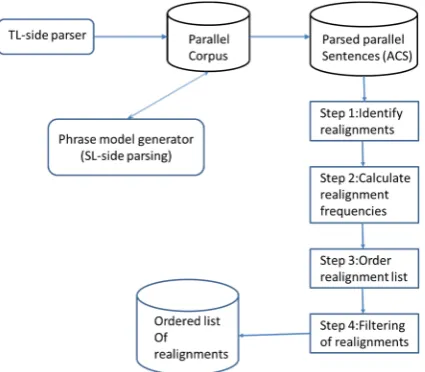
Figure 3: Sequence of steps to extract realign-ment templates from a parallel corpus.
The underlying assumption of this approach is that when translating from SL to TL, the struc-ture should not be modified, in the absence of evidence that a realignment is required. Hence, the aim is to determine templates that model phrase realignments between the SL and TL sides, and which are then applied to the input sentence structure depending on certain criteria. An example of such phenomena includes the subject which in Greek may follow the
corre-sponding verb chunk, though in English this or-der is reversed. What is needed is to determine realignments that consistently occur when transi-tioning from SL to TL and to estimate their cor-responding likelihood. Regarding the linguistic resources available, this information may only be extracted from the small parallel corpus. The cri-teria for estimating the likelihood comprise:
- the length of the realignment template in terms of phrases,
- the frequency of occurrence of the tem-plate in the small parallel corpus.
A different realignment template is defined for each reordering of phrase sequences, from the SL and TL side sentences. To support direct comparisons with earlier results, each phrase is defined by the phrase type (e.g. verb phrase or noun phrase), the phrase head part-of-speech (PoS) tag and its case (if this exists for the given language). Of course, additional characteristics may also be chosen, depending on the specific language pairs studied, to attain a better perfor-mance.
The outline of the algorithm to create a set of realignment templates is depicted in Figure 3. Initially (in Step 1) every parallel sentence pair is scanned to find phrase realignments, and each realignment is recorded in a list. Then (in Step 2), identical realignments (where sequences of phrases in both SL and TL match exactly) are assimilated to record the frequency of occurrence of each realignment template. In Step 3, a heuris-tic is used to score each one of the templates and a new ordered list of templates is created. Based on the heuristic, a higher score indicates a higher likelihood of correct activation. Finally, a filter-ing Step 4 is used to eliminate templates that are considered unlikely to be correct, based on their frequency of occurrence in the parallel corpus (more details on the heuristic function and filter-ing process are provided in sub-section 3.4). The resulting list of templates is then used to define the structure of the input sentence InS when translated, by consecutively trying to apply each of the realignment templates, one at a time, start-ing with the highest-ranked one, as discussed in the next sub-section.
3.3 Application of realignment templates
[image:4.595.72.285.405.591.2]with-out taking into account the identities of any neighbouring phrases (this being denoted as “Align-nC”, where nC stands for No Context).
In the second case, the context of the realign-ment template to the left and the right is also considered. Thus, one additional phrase to the left and to the right is recorded within an extend-ed realignment template. In this approach, three distinct variants are considered, depending on the degree of the context match. More specifically:
a. If the left and right contexts need to ful-ly-match (i.e. the type of phrases need to coin-cide but the PoS tag and case of the phrase heads also need to agree), this is termed as type-0 (and is denoted as “Align-C0”, where C0 stands for Context-type-0). This type of match is the most restrictive as it requires matching of all charac-teristics but on the other hand it allows for more finely-detailed matching.
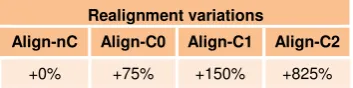
b. If the left and right context need to be matched only in terms of the type of phrases (but not the PoS tag and case of the phrase heads), this is termed as type-1 (denoted as “Align-C1”). In contrast to context phrases, for the phrases within the realignment templates, matching ex-tends to both the PoS tag and case of the phrase head. The alignment of type-1 is thus relaxed in comparison to that of type-0 in terms of context-defining phrases, allowing a potentially larger number of matches of the alignment template to the parallel corpus, as observed in Table 1.
c. If for both the context and realignment phrases, only the phrase-type is required to match, (i.e. not the head PoS tag or its case) then this is termed as type-2, (denoted as “Align-C2”) and corresponds to the least restrictive match in terms of the context, giving the largest number of matches, as seen in Table 1. However, this relax-ation in matching might allow for realignment cases where the PoS tags of the phrases and their neighboring ones do not match, thus resulting in lower translation accuracy.
Table 1: increase of realignments detected for different variations with context in comparison to the no-context (Align-nC) case, for the standard Greek-to-English parallel corpus.
Realignment variations
Align-nC Align-C0 Align-C1 Align-C2
+0% +75% +150% +825%
Two examples of realignment templates ex-tracted from a small parallel corpus are depicted
[image:5.595.306.528.120.277.2]in Figure 4. For a specific realignment, the dif-ferent realignment templates extracted with and without context are depicted in Figure 5.
[image:5.595.307.525.320.484.2]Figure 4: Examples of realignment templates.
Figure 5: Types of realignment template without context and with context – the parallel SL/TL sentence is shown on top, followed by the differ-ent templates that can be extracted.
[image:5.595.92.269.681.725.2]3.4 Heuristic function for ranking realign-ment templates
The heuristic function has a key role in determin-ing the system behavior, by defindetermin-ing the appro-priate ranking of the templates. As the system attempts to iteratively match the sequence of phrases in the chunked input sentences with each realignment template, it first applies the highest-ranked templates and progressively moves to lower-ranked ones. A lower-ranked template is applied to a specific set of phrases provided that no higher-ranked template has been applied to any of these phrases. Thus, the ranking dictates the selection of one realignment template over another, and can affect the accuracy of the trans-lation structure.
Based on a preliminary study, it was decided to rank higher realignment templates which oc-cur more frequently within the given training set (parallel corpus). Also, the application of larger templates is preferred over smaller ones. The actual heuristic function chosen for translation simulations is expressed by equation (5):
0 1 + ∗ ' (5)
Where is the score of the i-th realign-ment template, 0 1 corresponds to the frequen-cy of occurrence of the template in the training corpus and ' is the length of the realignment template in terms of phrases. Parameter is used to weigh the two factors appropriately.
In addition, a number of constraints serve to eliminate cases where potentially spurious rea-lignments may be chosen as valid ones. These constraints have been developed by studying ini-tial translation results. For this description, a rea-lignment between the SL and TL-sides is defined as 145675. On the other hand, 145 is used to denote only the part of the realignment in the SL-side of the parallel corpus.
Constraint 1: If a realignment involving a se-quence of phrases 145675 is encountered very infrequently in comparison to the occurrences of the sequence in the SL-side of the parallel cor-pus, 145, then it is rejected. The aim of this constraint is to eliminate unlikely realignments, which are not applicable for the majority of SL-side patterns 1. This is expressed by (6), where
0 1_ ℎ is a user-defined threshold:
1In contrast to training, where both SL and TL infor-mation is available, during operation only the SL-side pattern is available and the TL-side one is unknown.
89:;(9<:;=>?@>)
89:;(9<:;=> )
≥ 0 1_ ℎ (6)
Constraint 2: If a realignment 145675 oc-curs in the parallel corpus only very rarely, then it is removed from the list of applicable realign-ments. This is implemented by setting a mini-mum threshold value min_freq for a realignment template to be retained, allowing the reorderings that are rarely applied to specific phrase se-quences to be filtered out.
Constraint 3 (hapax legomena): This con-straint refines the elimination process of rea-lignments dictated by Constraint 2. More specifi-cally, it introduces an exception to Constraint 2, to prevent certain realignment templates from being filtered-out. If the filtering-out concerns a sequence 145675that appears only once in the parallel corpus SL-side, Constraint 3 is activated to retain this rare realignment.
4 Experiments
4.1 Experimental Setup
In the present article, the Greek-to-English lan-guage pair is used for experimentation. To ensure compatibility with earlier results, the standard language resources of PRESEMT are used, in-cluding the basic parallel corpus of 200 sentences and the two test sets of 200 sentences each, de-noted as testsetA and testsetB (all these resources have been retrieved from the www.presemt.eu
website). Regarding the parameters related to the realignment templates, the value used for
freq_thres is 0.50, while min_freq is set to 3. Fi-nally, parameter of eqn (5) is set to 100 for the given experiments, indicating a strong preference to larger realignment templates. These parameter values have been chosen by performing trial simulations during the development phase.
Different PMG modules resulting in different phrase sizes have been studied to investigate al-ternative SL phrasing schemes applied on the sentences to be translated. This test is performed, to determine whether the proposed realignment method is robust. Comparative evaluation with a selection of PMG modules with different phrase sizes can indicate the effectiveness of realign-ment templates in this MT methodology. Exper-iments are performed by considering or not the context (cases: Align-nC, Align-C) or by varying
the type of match when Align-C is applied (cas-es: Align-C0, Align-C1, Align-C2). The best rea-lignments have been compared to the baseline i.e. the case when the classic Structure selection algorithm is used (Tambouratzis et al., 2014).
Regarding the PMG modules, the first ver-sion, termed PMG-s gives the highest reported translation accuracy (Tambouratzis, 2014), split-ting sentences into smaller phrases2. The
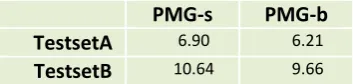
alterna-tive PMG (PMG-b) evaluated, favours larger phrases than PMG-s and results in smaller aver-age sentence lengths expressed in terms of phrases. The average sentence sizes for each phrasing scheme in both testsets can be seen in Table 2, while the numbers of realignment tem-plates applied to the input sets for testsets A and B are detailed in Table 3. The difference in rea-lignments between the two testsets reflects the fact that TestsetA has smaller sentences of on average 15.3 words per sentence, while for Test-setB this is 22.6 words (the sentence size being increased by 48% in terms of words). Hence, the occurrence of realignments is higher for Test-setB.
Table 2: Average sentence sizes in terms of phrases for the two evaluation testsets when dif-ferent PMG modules are applied.
PMG-s PMG-b
TestsetA 6.90 6.21
TestsetB 10.64 9.66
Table 3: Total number of realignments recorded per testset, for different realignment variations.
TestsetA Realignment variations
Align-nC Align-C0 Align-C1 Align-C2
PMG-s 4 7 10 37
PMG-b 11 11 14 38
TestsetB Realignment variations
Align-nC Align-C0 Align-C1 Align-C2
PMG-s 7 9 18 76
PMG-b 7 10 16 59
MT setups are evaluated regarding the trans-lation quality, based on a selection of
2
Based on the experiments reported in (Tambouratzis, 2014) both PMG-s and PMG-b correspond to criterion CF,
the differentiation being that PMG-b (PMG-s) allows (pre-vents) the formation of phrases containing multiple cases.
used MT metrics: BLEU (Papineni et al., 2002), NIST (NIST, 2002), Meteor (Denkowski et al., 2011) and TER (Snover et al., 2006). For BLEU, NIST and Meteor, the score measures the transla-tion accuracy and a higher score indicates a bet-ter translation. For TER the score counts the er-ror rate and thus a lower score indicates a more successful translation. For reasons of uniformity, when comparing scores, an improvement in a metric is depicted as a positive change (for all metrics, including TER).
4.2 Experimental Results
Fig. 6 depicts the BLEU scores for different phrasing schemes when the different cases and variations of the realignments are applied (cases: Align-nC, Align-C0, Align-C1, Align-C2). As observed, the PMG-s variant achieves the highest score in general and especially when neighboring phrases are not taken into account (Align-nC BLEU score = 0.3626), thus not limiting the rea-lignments to specific environments.
Figure 6: BLEU scores for the different re-alignment cases, for both PMGs and Testset A.
Figure 7 indicates how translation quality is improved when the best realignment case (Align-nC) is applied compared to the baseline, for dif-ferent PMGs, using TestsetA. The use of re-alignments improves metric scores in both PMGs, indicating the improved robustness of the MT system towards this choice. The highest im-provement of 1.63% observed for the BLEU score is obtained with PMG-s, which leads to sentences of larger length (with more phrases but of fewer words each).
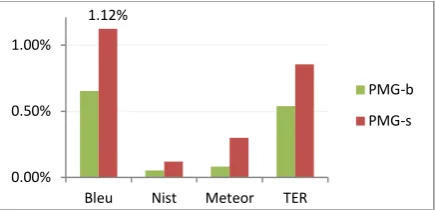
When applying the best realignment variant (Align-nC) to TestsetB with the two phrasing schemes (i.e. PMG-s, PMG-b) a substantial im-provement is achieved, reaching 1.12% for BLEU (cf. Figure 8). As before, PMG-s achieves the greatest improvement, showing that the rea-lignment template algorithm benefits to a greater degree phrasing schemes that generate larger numbers of phrases per sentence.
0.3626
0.28 0.3 0.32 0.34 0.36 0.38
Align-nC Align-C0 Align-C1 Align-C2
PMG-b
[image:7.595.309.525.361.466.2] [image:7.595.92.269.438.480.2] [image:7.595.67.293.535.674.2]Figure 7: Improvement in scores for the Align-nC case compared to the baseline, for the two phrasing schemes when applied to TestsetA.
A further evaluation effort has involved ex-amining how the proposed realignment template method compares to a zero-baseline, where the SL structure is retained without change in TL. In this case, the improvement amounts to 0.53% in terms of the BLEU score.
Figure 8: Improvement in scores for Align-nC case compared to the baseline, when the two phrasing schemes are applied to TestsetB.
To compare against another benchmark, TestSetA was translated with a MOSES-based SMT (trained with a parallel corpus of approx. 1.2 million sentences - the parallel corpus is 4 orders of magnitude larger than that used by PRESEMT) and resulted in BLEU and NIST scores of 0.3795 and 7.039 respectively. These MOSES scores are comparable to the scores achieved by PRESEMT with Align-nC (0.3626 and 7.086 for BLEU and NIST respectively).
4.3 Statistical Analysis of Results
To determine whether the results are statistically significant, paired-sample T-tests were applied at a sentence level. Comparing the use of realign-ment templates with and without context (Align-nC versus Align-C2), the scores for each of the 200 sentences were used to form two distinct populations for TestsetA. By comparing the two populations, for both PMG-b and PMG-s, a sta-tistically significant difference is found at a con-fidence level of 95%, showing that Align-nC
gives a significantly better translation quality over Align-C2. On the other hand, the improve-ment of Align-nC compared to the baseline sce-nario is small, thus not resulting in statistically significant differences.
5 Conclusions and Future Work
The proposed method of applying realignments to sentence structure has been shown to provide a useful increase in translation accuracy over the best configurations established in earlier experi-ments. Still, a number of possible extensions of the work presented here have been identified. These focus primarily on how to extract a more comprehensive set of templates from the limited-size parallel corpus available. To achieve this, one method would be to integrate linguistic knowledge. For instance, by identifying gram-matical categories (i.e. different PoS tags) which are equivalent, it is possible to extend knowledge to introduce new realignment templates based on known ones and thus cover more cases.
Also, it is possible to concatenate different re-alignment templates to larger groups, in order to make more accurate calculations of the statistics underlying each template. For instance, it may be assumed that whether the PoS tag of the phrase head is a noun or pronoun, the template remains the same and such cases can be grouped together. By extrapolating these new templates, an in-crease in the pattern space coverage can be ex-pected, leading to an improved translation accu-racy.
A point which is of interest is applicability to other language pairs. As is the case for the PRE-SEMT MT methodology as a whole, a key deci-sion was not to design the methodology for one specific language pair. For instance, initial exper-imentation has shown that the application of rea-lignment templates has correctly generated tem-plates for the case of split verbs when German is the TL (here the Greek-to-German language pair). This is important, as split verbs have been identified as one of the key problems when trans-lating into German. Of course, more experimen-tation is needed in terms of the generalisation abilities of such realignment templates to cover more cases than those encountered in the training set, and to efficiently model the shift of the sec-ond part of the verb to the end of the relevant sentence. Still, the ability of the proposed rea-lignment template method to identify such occur-rences is promising.
1.63%
0.00% 0.50% 1.00% 1.50%
Bleu Nist Meteor TER
PMG-b
PMG-s
1.12%
0.00% 0.50% 1.00%
Bleu Nist Meteor TER
PMG-b
[image:8.595.73.291.316.421.2]Acknowledgements
The research reported in this article has been funded partly by a number of projects including the PRESEMT project (ICT-FP7-Call4/248307) and the POLYTROPON project (KRIPIS-GSRT, MIS: 448306).
The authors wish to acknowledge the assis-tance of Ms. M. Vassiliou of ILSP/Athena R.C. on the setting up of experiments and of Dr. S. Sofianopoulos of ILSP/Athena R.C., in integrat-ing the new structure selection algorithm to the PRESEMT prototype and on providing the trans-lation results for the MOSES-based SMT system.
References
Peter F. Brown, John Cocke, Stephen A. Della Pietra, Vincent J. Della Pietra, Frederick Jelinek, Robert L. Mercer, P. Roossin. 1988. A statistical approach to language translation. Proceedings of COLING'88
Conference, Vol. 1, pp.71–76.
Michael Denkowski and Alon Lavie. 2011. Meteor 1.3: Automatic Metric for Reliable Optimization and Evaluation of Machine Translation Systems, Proc. of the 6th Workshop on Statistical Machine Translation, Edinburgh, Scotland, UK, July 30–31, pp. 85–91.
John Hutchins. 2005. Example-Based Machine lation: a Review and Commentary. Machine Trans-lation, Vol. 19, pp.197-211.
Harry Mairson. 1992. The Stable Marriage Problem. The Brandeis Review, Vol.12, No.1. Available at: http://www.cs.columbia.edu/~evs/intro/stable/write up.html
Cory S. Myers, Lawrence R. Rabiner, and Aaron E. Rosenberg. 1980. Performance tradeoffs in dy-namic time warping algorithms for isolated word recognition, IEEE Transactions on Acous-tics, Speech, and Signal Processing, vol. 28, no. 6, pp. 623-635.
Philipp Koehn. 2010. Statistical machine translation. Cambridge University Press, Cambridge, UK [ISBN: 978-0-521-87415-1].
Uri Lerner, and Slav Petrov. 2013. Source-Side Clas-sifier Preordering for Machine Translation. In Pro-ceedings of EMNLP-2013 Conference, Seattle, USA, October 2013, pp.513-523.
Makoto Nagao. 1984. A framework of a mechanical translation between Japanese and English by anal-ogy principle. Artificial and human intelligence: edited review papers presented at the international NATO Symposium, October 1981, Lyons, France; A. Elithorn and R. Banerji (eds.), Amsterdam: North Holland, pp. 173-180.
NIST. 2002. Automatic Evaluation of Machine Trans-lation Quality Using n-gram Co-occurrences Statis-tics (Report). Available at: http://www.itl.nist.gov/iad/mig/tests/mt/doc/ngram-study.pdf
Kishore Papineni, Salim Roukos, Todd Ward and Wei-Jing Zhu. 2002. BLEU: A Method for Auto-matic Evaluation of Machine Translation. Proceed-ings of the 40th Annual Meeting of the Association for Computational Linguistics, Philadelphia, U.S.A., pp. 311-318.
Helmut Schmid. 1995. Improvements in Part-of-Speech Tagging with an Application to German.
Proceedings of the ACL SIGDAT-Workshop. Dub-lin, Ireland.
Temple F. Smith, Michael S. Waterman. 1981. Identi-fication of Common Molecular Subsequences. Journal of Molecular Biology, Vol.147, pp.195– 197.
Matthew Snover, Bonnie Dorr, Richard Schwartz, Linnea Micciulla and John Makhoul. 2006. A Study of Translation Edit Rate with Targeted Hu-man Annotation. Proceedings of the 7th AMTA Conference, Cambridge, MA, USA, pp.223-231. Sokratis Sofianopoulos, Marina Vassiliou, and George
Tambouratzis. 2012. Implementing a language-independent MT methodology. Proceedings of the First Workshop on Multilingual Modeling, held within the ACL-2012 Conference, Jeju, Republic of Korea, 13 July, pp.1-10.
Sara Stymne. 2012. Clustered Word Classes for Pre-ordering in Statistical Machine Translation Pro-ceedings of the 13th EACL Conference, April
23-27, Avignon, France, pp.28-34.
George Tambouratzis. 2014. Conditional Random Fields versus template-matching in MT phrasing tasks involving sparse training data. Pattern Recognition Letters, Vol. 53, pp.44-52.

![Figure 2: translation of input sentence (1) as gen-erated by the standard PRESEMT structure se-lection [cf.(2) and (3)] & the new one [cf.(4) and (5)] in terms of lemmas and tokens respectively](https://thumb-us.123doks.com/thumbv2/123dok_us/1497594.690331/3.595.66.293.539.699/figure-translation-sentence-standard-presemt-structure-lection-respectively.webp)