Provable Data Integrity in Multi Cloud using IB Encryption
M AMARESWARA KUMAR1 & ANITHA REDDY YAPARLA2
1
ASSISTANT PROFESSOR Dept. of CSE SVR ENGINEERING COLLEGE, AYYALURU,
NANDYAL Email:- [email protected]
2
PG-Scholar Dept. of CSE SVR ENGINEERING COLLEGE, AYYALURU, NANDYAL
Abstract
In recent years, cloud storage accommodation
has become a more expeditious profit
magnification by providing its features for
client’s data. Privacy preservation and data
integrity are the two main issues faced by
single cloud accommodation providers. Hence
distributed cloud environment, multi cloud is
utilized. In the subsisting system, when client
shops his information on multi-cloud servers,
ye distributed store plus integrity checking are
in peril. Provable data possession is a method
for ascertaining the integrity of data in storage
outsourcing. The proposed ID-DPDP protocol
able to provide client’s identity with his
private key and provably secure under the
hardness postulation of the standard CDH
quandary... It will check clients data kept
safely without downloading the whole data.
This protocol eliminates certificate
management, efficient and flexible.
Keywords: Cloud Computing, Multi Cloud,
Provable Data Possession, Data Integrity
Checking.
1.
Introduction
In recent years, cloud storage accommodation
has become a more expeditious profit
magnification point by providing a
commensurably low-cost, scalable,
position-independent platform for clients’ data. Since
cloud computing environment is constructed
predicated on open architectures and
interfaces, it has the capability to incorporate
multiple internal and/or external cloud
accommodations together to provide high
interoperability. We call such a distributed
cloud environment as a multi-Cloud (or hybrid
infrastructure management (VIM) , a
multi-cloud sanctions clients to facilely access
his/her imaginations remotely by interfaces
such as Web accommodations provided by
Amazon EC2. There subsist sundry
implements and technologies for multicloud,
such as Platform VM Orchestrator, VMware
vSphere, and Ovirt. These implements avail
cloud providers construct a distributed cloud
storage platform (DCSP) for managing clients’
data. However, if such a consequential
platform is vulnerably susceptible to security
attacks, it would bring irretrievable losses to
For example, the confidential data in an
enterprise may be illicitly accessed through a
remote interface provided by a multi-cloud, or
germane data and archives may be disoriented
or tampered with when they are stored into a
dubious storage pool outside the enterprise.
Therefore, it is indispensable for cloud
accommodation providers (CSPs) to supply
surety techniques for dealing their storage
accommodations. Provable data possession
(PDP) (or proofs of recoverable (POR) is this
a probabilistic validation technique for a
storage provider to prove the integrity and
ownership of clients’ information without
downloading information. The proof-checking
without downloading makes it especially
paramount for immensely colossal-size files
and folders (typically including many clients’
files) to check whether these data have been
tampered with or expunged without
downloading the latest version ofdata. Thus, it
is able to supersede traditionalistic hash and
signature operates in storage outsourcing.
Sundry PDP schemes have been recently
proposed, such as Scalable PDP plus Dynamic
PDP. However,these schemes mainly fixate on
PDP issues at untrusted servers in a single
cloud storage provider and are not felicitous
for a multi-cloud environment.
2.
Related Work
Existing System:
Identity-Based Encryption (IBE) is an
interesting alternative to public key
encryption, which is proposed to simplify key
management in a certificate-based Public Key
Infrastructure (PKI) by using
human-intelligible identities (e.g., unique name, email
address, IP address, etc) as public keys. Boneh
and Franklin suggested that users renew their
private keys periodically and senders use the
receivers’ identities concatenated with current
time period. Hanaoka et al. proposed a way for
users to periodically renew their private keys
without interacting with PKG. Lin et al.
proposed a space efficient revocable IBE
mechanism from non-monotonic
Attribute-Based Encryption (ABE), but their
construction requires times bilinear pairing
operations for a single decryption where the
number of revoked users is.
Disadvantages of existing system:
Boneh and Franklin mechanism would result in an overhead load at PKG. In
another word, all the users regardless
of whether their keys have been
revoked or not, have to contact with
PKG periodically to prove their
identities and update new private keys.
It requires that PKG is online and the
secure channel must be maintained for
all transactions, which will become a
bottleneck for IBE system as the
Boneh and Franklin’s suggestion is
more a viable solution but impractical.
In Hanaoka et al system, however, the
assumption required in their work is
that each user needs to possess a
tamper-resistant hardware device.
If an identity is revoked then the
mediator is instructed to stop helping
the user. Obviously, it is impractical
since all users are unable to decrypt on
their own and they need to
communicate with mediator for each
decryption.
PROPOSED SYSTEM:
In this paper, we introduce outsourcing
computation into IBE revocation, and
formalize the security definition of outsourced
revocable IBE for the first time to the best of
our knowledge. We propose a scheme to
offload all the key generation related
operations during key-issuing and keyupdate,
leaving only a constant number of simple
operations for PKG and eligible users to
perform locally. In our scheme, as with the
suggestion, we realize revocation through
updating the private keys of the unrevoked
users. But unlike that work which trivially
concatenates time period with identity for key
generation/update and requires to re-issue the
whole private key for unrevoked users, we
propose a novel collusion-resistant key issuing
technique: we employ a hybrid private key for
each user, in which an AND gate is involved
to connect and bound two sub-components,
namely the identity component and the time
component. At first, user is able to obtain the
identity component and a default time
component (i.e., for current time period) from
PKG as his/her private key in key-issuing.
Afterwards, in order to maintain
decryptability, unrevoked users needs to
periodically request on keyupdate for time
component to a newly introduced entity
named Key Update Cloud Service Provider
(KU-CSP).
Advantages of proposed system:
Compared with the previous work, our
scheme does not have to re-issue the
whole private keys, but just need to
update a lightweight component of it at
a specialized entity KU-CSP.
We also specify that
with the aid of KU-CSP, user needs
not to contact with PKG in key-update,
in other words, PKGis allowed to be
offline after sending the revocation list
to KU-CSP.
No secure channel or user
authentication is required during
key-update between user and KU-CSP.
Furthermore, we consider to realize
revocable IBE with a semi-honest
KU-CSP. To achieve this goal, we present
the recently formalized Refereed
Delegation of Computation (RDoC)
model.
Finally, we provide extensive
experimental results to demonstrate the
efficiency of our proposed
construction.
3.
Implementation
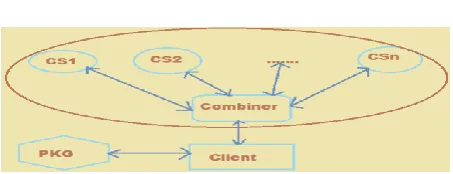
The ID-DPDP system model and security
definition are presented in this section. An
ID-DPDP protocol constitutes four different
entities which are illustrated in Fig 3.
Described as below:
(i) Client: an entity, which has massive data to
be stored on the multi-cloud for maintenance
and computation, can be either single user or
corporation.
(ii)CS (Cloud Server): an entity, which is
managed by cloud service provider, has
substantial storage place plus computation
resource to maintain the clients’ data.
(iii)Combiner: an entity, which gets the
storage petition and disseminates the block-tag
pairs to the corresponding cloud servers.
When receiving the challenge, it splits the
challenge plus disseminates them to the
different cloud servers. Whenreceiving the
responses from the cloud servers, it mixes
them plus sends out the combined response to
the verifier.
(iv)PKG (Private Key Generator): an entity,
when getting the identity, it outputs the
representing private key
Fig 1:ID-DPDP Architecture
This protocol constitutes four procedures:
Setup, Extract, TagGen, and Proof. The fig.1
can be described as follows:
1. In the phase Extract, PKG engenders the
private key for the client.
2. The client engenders the block-tag pair and
uploads it to mix. The combiner disseminates
the block-tag pairs to the different cloud
servers according to the storage metadata.
3. The verifier sends the challenge to
combiner and the combiner distributes the
challenge query to the representing cloud
servers granting to the storage information.
4. The cloud servers respond the challenge and
the combiner aggregates these replications
from the cloud servers. The combiner sends
the aggregated replication to the verifier.
Determinately, the verifier checks whether the
aggregated replication is valid. The concrete
ID-DPDP construction mainly emanates from
the signature, provable data possession and
distributed computing. The signature relates
Distributed calculating is utilized to store the
client’s data on multi-cloud servers.
Concurrently, distributed computing is withal
used to coalesce the multi-cloud servers’
replications to respond the verifier’s
challenge. Predicated on the provable data
possession protocol, the ID-DPDP protocol is
constructed by making utilization of the
signature and distributed computing.
4. Experimental Work
Fig 2: File Upload with Encryption.
Fig 3: Out Sourced Data
5. Conclusion
This paper formalizes the ID-DPDP system
model and security model. ID-DPDP protocol
works efficiently in multi cloud environment.
Besides of the elimination of certificate
management, our ID-DPDP protocol has
additionally flexibility and high efficiency.
Concurrently, the proposed ID-DPDP protocol
can realize private verification, delegated
verification and public verification predicated
on the client’s sanction.
6. References
[1] P. Mell and T. Grance, “Draft nist working definition of cloud computing,” Referenced on
June. 3rd, 2009.
[2] G. Ateniese, R. DiPietro, L. V. Mancini,
G. Tsudik, “Scalable and Efficient Provable Data Possession”, SecureComm 2008, 2008.
[3] G. Ateniese, R. Burns, R. Curtmola, J.
Herring, L. Kissner, Z. Peterson,D. Song,
“Provable Data Possession at Untrusted Stores”, CCS’07, pp.598-609, 2007.
[4] C. C. Erway, A. Kupcu, C. Papamanthou,
R. Tamassia, “DynamicProvable Data Possession”, CCS’09, pp. 213-222, 2009.
[5] F. Seb´e, J. Domingo-Ferrer, A.
Mart´ınez-Ballest´e, Y. Deswarte,
J.Quisquater, “Efficient Remote Data Integrity
checking in Critical
InformationInfrastructures”, IEEE
Transactions on Knowledge and
DataEngineering, 20(8), pp. 1-6, 2008.
[6] H.Q. Wang, “Proxy Provable Data Possession in Public Clouds,” IEEE
Transactions on Services Computing, 2012.
[7] Y. Zhu, H. Hu, G.J. Ahn, M. Yu,
IEEE Transactions on Parallel and Distributed
Systems, 23(12), pp. 2231-2244, 2012.
[8] Y. Zhu, H. Wang, Z. Hu, G. J. Ahn, H. Hu,
S. S. Yau, “Efficient Provable Data Possession for Hybrid Clouds”, CCS’10, pp. 756-758,
2010.
[9] R. Curtmola, O. Khan, R. Burns, G.
Ateniese, “MRPDP: Multiple-Replica
Provable Data Possession”, ICDCS’08, pp.
411-420, 2008.
[10] A. F. Barsoum, M. A. Hasan, “Provable
Possessionand Replication of Data over Cloud
Servers”, CACR,University of Waterloo,