This report is available online:
Foreword
Ireland’s economic future depends critically on the supply of an increasing number of people qualified in science and engineering. But at the very time this demand is increasing, there has been a sharp fall-off in interest in the sciences throughout our education system.
This dilemma drove the setting-up of the Task Force on the Physical Sciences, which now presents its unanimous report.
The Task Force found that the problem is real; indeed, if anything its extent and importance have been under-stated. Unless there is a major national effort to reverse the fall-off, any other money we spend on attracting overseas investment will go largely to waste.
The positive side of the picture is our belief that prompt and comprehensive action, begun at once and carried out with commitment, can reverse the present decline in interest in the sciences. The result can be to increase not only the quantity but the quality of future graduates – equally important dimensions of the challenge.
Our 6-point action strategy addresses the many inter-linking facets of the problem, at all levels of the education system. The strategy is holistic: for success, it must all be carried out in full and simultaneously. Equally, it requires whole-hearted support – not only from the political system but also from all players in the education system and from industry. A readiness to change attitudes and to embrace new ways of doing things will be as important as the financial investment.
Carrying out this strategy will not be cheap: an additional €178 million in capital investment, plus additional recurrent costs of €66m each year. But to put this spending in context: what is at stake is the ability of our young economy to continue to grow, and to maintain the success already achieved.
Daniel O’Hare
Summary
The Challenge
Ireland has positioned itself to take advantage of technological change by encouraging the inward investment of high-tech industries and by providing a highly-educated workforce to sustain and enlarge them. Employment of science, engineering and technology graduates at all levels has been a
hallmark of the modern Irish economy, as the educational sector responded to the mix of skills demanded by industry. An outstanding record of graduate output has contributed to the phenomenal growth in Irish-based technology.
In an era of rapid technological change, the goal of "scientific literacy for all" has become a primary objective of a general education. Science is one of three literacy domains, along with reading and mathematics, that is included in measures of educational achievement by the OECD.
The vision to develop Ireland as a centre for world-class research is reflected in recent government investments in Science Foundation Ireland,in the Irish Research Council for Science, Engineering and Technology and in the
Programme for Research in Third Level Institutions. But these programmes depend upon appropriate human resources in the key areas identified as the future niches of Irish expertise, biotechnology and information and
communications technologies. This creates a new demand for highly-qualified graduates to take up positions as career scientists and engineers and as postgraduate researchers in disciplines based on the physical sciences.
It is critical that the demands of the labour market which supports the emerging technologies underpinning our economy are anticipated and strategically catered for. A continued supply of graduates with Science, Engineering and Technology (SET) skills must be guaranteed to ensure continued investment in these technologies. That investment will be
strengthened by the ability of Irish graduates to drive the modern technologies higher up the ‘value chain’.
In sharp contrast to this strengthening of demand, there has in recent years been a decline of interest in science throughout the education system.
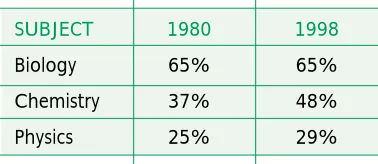
Science declining at second-level: Since the early 1990s there has been a decline in take-up of science among second-level students. Although
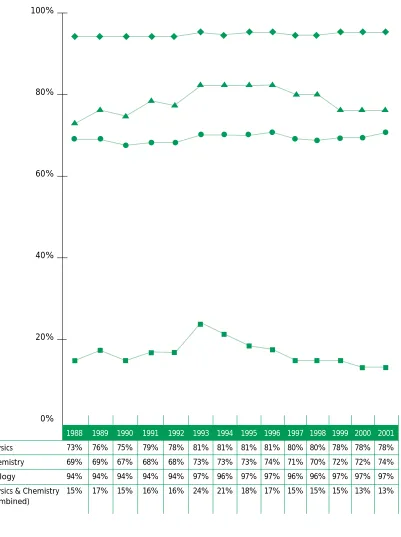
Gender equity is a concern:at lower secondary level only 80% of girls in single-sex schools take science compared with 96% of boys; at upper secondary, only 8% of girls take Physics compared with 25% of boys.
The problem is compounded by a decline in the overall size of the Irish school-going population. Together these factors contribute to lower follow through to the study of science-related subjects at third level.
Science declining at third level:Recruitment of students to science,
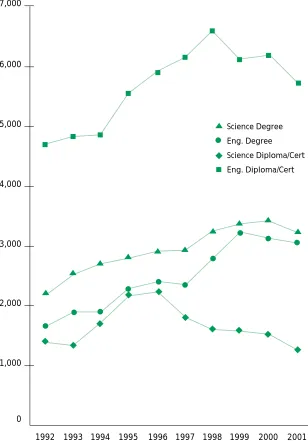
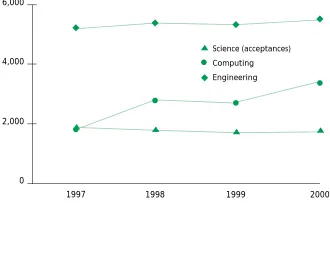
engineering and technology courses in higher education is, in many instances, below capacity, with not enough first preference applicants to match the places on offer. Acceptances on to science, engineering and technology courses (including computing) as a proportion of total acceptances are
declining. For degree courses the share dropped from 33% in 1999 to 30% in 2001; for certificate/diploma courses the share dropped from 51% in 1997 to 46% in 2001. The most dramatic decline is in science (including computing) at certificate/diploma level, where in 2001 there were only 1,282 student
acceptances, down 43% from the 1996 peak of 2,268 acceptances.
There is a lowering of points for entry to science courses, with many certificate and diploma courses now offering places to "all qualified
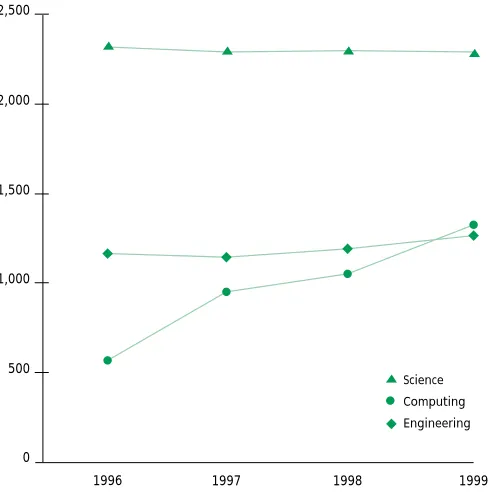
applicants". Moreover, there has been a shift in the last five years towards the computing area and away from the physical sciences and engineering courses whose graduates underpin the present success and future growth in the communications, chemical, pharmaceutical and biotechnology sectors.
Non-completion rates worsen the problem. Despite variations in non-completion for different subject areas across institutions, the SET areas consistently exhibit the highest non-completion rates in both universities and institutes of technology. These rates range from in excess of 20% for the university sector to in excess of 40% for the institute of technology sector.
A large pool of research scientists is necessary for value added, research-based development. But the level of postgraduates from Irish higher education institutions is below the strategic target set by various review bodies. The number of PhDs in science and engineering per head of population in Ireland is below the OECD mean.
The Situation Now
The Task Force researched the present situation in Ireland and abroad, received submissions and had discussions with all the main stakeholders, and
conducted an extensive survey among second-level and third-level students and parents. A study of schools with a high take-up in the physical sciences was also undertaken.
We outline below some of the key factors that emerged, and which informed our development of the recommended action strategy that is set out in the next section.
Schools
At primary level, only a small number of pupils are presently exposed to the physical sciences – although this will start to change in 2003 with the implementation of a new science component within the primary curriculum.
At lower secondary, while very few students go to schools that do not offer science, over 10% of the total lower secondary cohort is not enrolled in science. Within all-girls schools, the non-participation rate is 20%.
14% of Leaving Certificate students are in schools that do not offer Chemistry and 11% are in schools that do not offer Physics as separate Leaving
Certificate subjects (compared with 1% of students in schools not offering Leaving Certificate Biology).
At upper secondary, 3% of the student cohort is in the 66 post-primary schools that do not offer any physical science subject to Leaving Certificate. These students are consequently at an obvious disadvantage in further study or careers related to the physical sciences.
Large variations in participation rates show up at upper secondary level. Many schools operate with relatively few pupils in Leaving Certificate physical science classes; there is concern that these schools may stop offering these subjects altogether.
Where schools have zero or low take-up of the physical sciences at upper secondary, they may not be able to justify employing a teacher with a background in the physical sciences. This can impact detrimentally on the treatment of the physical sciences in other programmes, particularly at lower secondary.
There are significant variations in the extent to which schools engage in practical work. While about half of the students do practical work each week, about 10% never work with apparatus or materials.
Our studies of schools with high take-up in the physical sciences suggest a number of strategies for increasing take-up; amongst these are:
(i) a high priority attached to science at school management level;
(ii) good subject-level co-ordination and planning;
(iii) an emphasis on building positive student experiences at Junior Certificate and Transition Year;
(iv) an emphasis on practical work.
These schools also had a higher level of laboratory resources than the norm.
Student Choice
Choice emerges from our survey as the key factor influencing student take-up.
While it is necessary on grounds of equity to make science more widely available, it seems likely this will have only limited impact on up-take unless accompanied by strong action aimed at influencing student choice.
In general, students choose to study the physical sciences because of personal ability, personal interest, or because they feel they need the subject(s) for a college course or career. Some students, particularly in schools with lower take-up of science subjects, cite "school timetable" and "teacher" as factors also influencing their choice against take-up.
Two influencers for low uptake of the physical sciences are the perception of the science subjects per se and the perception of science-related careers.
Many Leaving Certificate students say they did not choose physics or chemistry because of the difficulty of the subjects. They also agreed they would be more likely to choose these subjects if it was easier to get good Leaving Certificate grades and if the subjects involved less mathematics.
The link between science and careers in technology is not well appreciated. The work of a scientist/technologist is seen as difficult, complicated and boring, as well as poorly paid. These perceptions are in place when students are making choices based on career aspirations. Attitudes are formed by the end of lower second level; if promotion is to be effective, students must be influenced by then.
There are many individual promotional initiatives for science, but none that integrates the many factors that together lead to informed decisions by students. Resources are not pooled nationally to promote the study of science at all stages of education. Promotion by science teachers and guidance counsellors is hampered by the lack of partnership between third level and industry.
There is a poorly-developed culture of science in Ireland. We are one of the few countries among the progressive economies that does not have a National Interactive Science Centre. The promotion of science in the wider arena, among parents and the general public is compromised by this shortcoming.
Teaching & Learning
Only a minority of primary teachers have taken a physical science subject to upper secondary level. The successful integration of science into the primary curriculum depends on adequate in-service training and support for the 22,000 serving primary teachers. Priority must be attached to the physical sciences in this training. There are major concerns about insufficient priority and time within pre-service teacher training to fully address both pedagogy and content relating to science.
The junior cycle science curriculum requires teachers to address all three sciences: physics, chemistry and biology. While two thirds of the syllabus is drawn from the physical sciences, the background of the approximately 3,000 junior cycle science teachers is primarily in the life sciences. There is also concern around Transition Year science, both in the extent of exposure to, and the quality of treatment of, science. Experience suggests that a strong
emphasis on science in Transition Year may contribute to high science take-up at Leaving Certificate.
There is no evidence of an impending shortage of post-primary science teachers but this scenario is likely if Ireland’s experience follows that of other countries. Our survey of student attitudes raised some concerns about this. Science teaching needs to remain an attractive and challenging career for graduates. A low demand for teachers may discourage science graduates from entering teaching, particularly when set against other employment
opportunities.
Curriculum reform is a constant feature of modern education. There is a parallel movement towards more flexible and creative approaches to teaching and learning, and particularly towards more active learning by students. Our student survey confirmed the positive impact of practical work. All these changes depend on comprehensive, effective and on-going professional development and support if they are to effect real change in classrooms.
Curriculum & Assessment
The introduction of a revised junior cycle science curriculum in 2003 is an opportunity to broaden access to a science education for all. Ireland would appear to be unusual in not requiring that all students continue to study science until the conclusion of the lower secondary phase of education. Girls are much more likely than boys to miss out on a science education.
The planned introduction of science into primary schools will demand careful co-ordination between schools at first and second level. There is an
opportunity to build partnerships between schools and all other public and private sector bodies who are "stakeholders" in Irish science.
The opportunity to use Transition Year to provide students with a balanced exposure to the sciences - and helping students to make informed subject choices for Leaving Certificate - needs to be developed.
Submissions to the Task Force have identified deficiencies in the Irish science curriculum. These assert that it:
• emphasises science education as a preparation for further study, rather than as a broad preparation for citizenship;
• is dominated by historical thinking and out of line with modern ideas, both scientific and pedagogic;
• promotes rote learning and recall of scientific facts, with insufficient emphasis on building higher-order skills;
• is too theoretical, missing opportunities to develop practical and investigative skills;
• is lacking in relevance to students’ own lives and fails to examine the role and contribution of science in society.
There is a particular frustration with the slow pace of curriculum change. Many submissions argued the need to shorten the time taken for curriculum design and implementation. There is anxiety that the revised junior cycle curriculum, with its new approach to the learning of science, should be introduced as quickly as possible. Our student survey confirms that a positive experience of science at junior cycle has a strong influence on student choice subsequently.
Curriculum reform must be supported by changes in assessment, and this requires clarity about the outcomes anticipated from a science education. There is almost universal support for including practical work as a component in assessment.
Mathematics
Serious concern about the mathematical competence of students in schools and in higher education permeates the debate on the declining uptake of the sciences. The decline in performance in mathematics at second level was highlighted by the highest-ever failure rate (17%) in ordinary level Leaving Certificate Mathematics in 2001. This high failure rate rendered one-sixth of school leavers ineligible for many science, engineering and technology (SET) courses in higher education. Because failure among males was higher (19%), this reduced the pool of potential candidates for engineering technology courses in institutes of technology, whose applicants are predominantly male.
The Chief Examiner’s report on the ordinary level Mathematics exam for Leaving Certificate 2001 highlighted a "noticeable increase in the incidence of difficulties experienced by candidates" .Causes suggested for low grades included the knock-on effects of difficulty with the old junior cycle syllabus (which was revised in 1999), and the increase in part-time work by students. Many science, engineering and technology departments in higher education report a lack of adeptness in basic mathematical skills on the part of students with ordinary level Mathematics.
Students’ perception of the difficulty of mathematics and their poor
performance in the subject both act as barriers to participation and success in the sciences at second and at third level. The risk in not addressing the
problem with mathematics is that of undermining reform in science education.
Higher Education
We cannot assume that remedies to second level science uptake will translate automatically into a complete solution for the supply of graduates. The challenge facing third level institutions is, while maintaining the growth in numbers on computing/information technology courses, to encourage more applicants to the other SET courses. This recruitment effort has to reflect the complex interrelation between the supply of sub-degree graduates and more highly skilled graduates, and be tailored to meet strategic targets set by market forecasts.
Recruitment
School-leaver decline must not put Ireland at a competitive disadvantage. The focus of recruitment must widen to include students other than immediate school-leavers: mature students, students from Post Leaving Certificate courses, from apprenticeship courses, from access and foundation courses. All categories of other learners should be considered more seriously as part of the potential pool of applicants. Mature students constitute only about 4% of CAO acceptances, and an even lower percentage of participants on SET courses, by contrast with 20% plus in many OECD countries.
Access
the widening social/academic background of these other learner groups. To enable access to higher education for this group, formats of further education and part-time education should be provided which lead to science and mathematics qualifications equivalent to Leaving Certificate. Apprenticeship has become a significant and important destination for young males;
opportunities should be available for talented apprentices and craftspeople to progress to higher qualifications in advanced craft skills and other SET technical courses.
Information
Clear, comprehensive information on college courses should be available to all prospective students. Studies show that some students entering higher education have poor information about their course, and know very little about their lower choices. They also have a poor understanding of the demands that course content will place on them. This has particular relevance for SET courses, where an increasing percentage of entering students are undertaking the study of the physical sciences for the first time. This lack of background can be a significant contributor to failure in first year.
Retention
Measures to enhance recruitment must be accompanied by equally aggressive measures to combat the high levels of non-completion in the SET areas of study in every university and every institute of technology.
As the demand for places on SET courses has declined, there has been a broadening of profile of students on these courses. SET departments must meet the challenge of integrating an increasingly diverse student body into a quality teaching and learning environment.
The Solution: A 6-Part Action Strategy
The view of the Task Force is that Ireland can achieve a world-class system in relation to science education. There are many reasons to believe that this is achievable. For example, the results of an OECD study (PISA: Programme for International Student Assessment) demonstrate that Irish students are
performing to a high level, taking into account levels of educational investment that have historically been less than that seen elsewhere. Similarly, our surveys of student attitudes demonstrate very positive views of science in society.
The Task Force believes that no single action will achieve the desired impact on take-up. The problem is multifaceted and consequently so too must be the solution. The actions form a single, holistic strategy. They are designed for impact simultaneously at all levels of the education system, reflecting the interrelatedness of the issues concerned. It is crucial that the timing of provision respects this design and that connected actions are implemented in parallel. The recommended strategy is based around six areas for action:
1. Planning and Resources for School Science
2. Equity of Access
3. Teaching and Learning of Science
4. School Curriculum and Assessment
5. Promotion of Science and Careers
6. Science Education at Third-Level
Cost
The cost of the actions recommended is €178 million in capital investment, plus an annual recurrent cost of €66 million (based on costs in February 2002).
Actions have been fully costed on the basis of information provided to the Task Force by the Department of Education and Science and others. The figures provide an estimate of the level of investment needed and are additional to present expenditure. They are based on costs at the time of writing (February 2002) and will need to be adjusted upwards to take account of inflation.
Implementation Group
The importance of these proposals has already been stressed and cannot be exaggerated. It is important therefore that they are put carefully and
effectively in place over a short period of time. Reflecting the high priority and urgency for action, we recommend the establishment by Government of a high level Science and Technology Implementation Groupwhose function would be to source the finances and to otherwise ensure the implementation of these proposals.
Continuing Review and Annual Report
which is the subject of this report is addressed and reviewed regularly. It should not be a matter which is addressed occasionally or when a crisis occurs. If a strategic review is carried out on an ongoing basis, it may point to the need for new elements to be grafted on to the strategy; changing demographics and evolving conditions in higher education and in the workplace may require that new initiatives are introduced or that the original ones are adjusted.
The Task Force recommends that the Irish Council for Science, Technology and Innovation(ICSTI) is the appropriate body to be responsible for this role and that it should establish a Standing Committee of the ICSTI Board for this purpose; it should report to Government annually on the state of science educational provision and the relevant Oireachtas Committee should receive that annual report and be expected to comment on it.
National Data Base
During the course of its work the Task Force has identified a significant number of instances in which the national data is weak. For example: the extent of practical work in schools; the quantity, quality and level of usage of school laboratories; the background and qualifications of teachers; the level of expenditure on science at the school level. The efficacy and success of any future review is dependent upon good quality information on these and other issues. The Task Force recommends that the Department of Education and Science should take immediate steps to review its procedures in this regard. It also needs to be stated that building an accurate picture of school science is not solely the responsibility of the Department but also requires the co-operation of other stake-holders. For example, school managers must provide information on expenditure; teachers must facilitate the building of a picture of student experience and classroom practice.
Chief Scientist
The Task Force also recommends to Government the creation of a position as
1.1
Ensure That Science Education Is Addressed
In Every School Plan (page 116)
• Support local planning for primary science
Augment the existing planning and curriculum support team for primary science by appointing an additional 20 science trainers to support implementation of the science component of the primary curriculum in 2002/03.
(€1m recurrent)
• Provide a national infrastructure to support science planning in every post-primary school
Establish a planning and support team to ensure co-ordination between activity at schools-level and the provision of resources by the Department of Education and Science.
(€1m recurrent)
• Ensure target-setting and resource management at school-level
Within each post-primary school a teacher should be designated to take responsibility for the local co-ordination of the planning process and associated resources. This appointment will take the form of an ex-quota post of responsibility.
(€5.2m recurrent)
Actions in this area will provide, at national, regional and local levels, the resources and support needed to enable all schools to target science education as a developmental priority.
A collaborative approach to planning and action will systematically address barriers to take-up of the physical sciences and will emphasise, particularly, increased levels of practical work within schools
1.2
Provide adequate resources to support practical
science in schools (page 117)
• Augment start-up funding for primary science
Provide additional funds to all schools for "start-up" equipment to support the new primary science component commencing
2002/2003.
(€3.9m capital)
• Provide on-going funding for primary science
Provide all primary schools with an annual grant to fund "hands-on" practical science commencing 2002/03.
(€5.8m recurrent)
• Improve the stock of laboratories and equipment for post-primary science
Provide access to first-class laboratories and equipment in all post-primary schools through a 2 year capital investment programme commencing 2002/03.
(€142.8m capital)
• Provide technical assistants in post-primary schools
Establish a scheme to provide technical assistance and support for practical laboratory work in all post-primary schools adopting a "science plan" commencing 2003/04.
(€18.8m recurrent)
• Augment funding for Junior Certificate and Transition Year science
Augment annual funding to schools based on student numbers in Junior Certificate and Transition Year science programmes.
(€2.0m recurrent)
• Augment funding for Leaving Certificate physical sciences
Increase annual funding to schools based on student numbers in any of the three Leaving Certificate physical sciences subjects.
2.1 Enhance teacher allocation to post-primary schools
with low physical sciences enrolments (page 120)
• Provide additional teaching resources to schools with small numbers of students enrolled in the Leaving Certificate physical science subjects
Provide ex-quota teaching support to any school with fewer than 16 students enrolled in Leaving Certificate Chemistry and/or Physics and/or Physics & Chemistry (combined). This will benefit both schools with existing low enrolments (€5.2m recurrent)and schools taking up the Leaving Certificate physical sciences subjects
ab initio(€3.7m recurrent).
2.2 Intervene to build school capacity to offer the physical
sciences curriculum e.g. extend the number of
schools offering Leaving Certificate physical
science subjects (page 121)
• Provide national planning and support to target equity and to broaden take-up of the physical sciences
Establish a planning and support team to ensure that equity consid-erations are fully addressed and that all pupils (regardless of gender, socio-economic status, school size and geographical location etc.) benefit from the provision of resources by the Department of Education and Science.
(€0.3m recurrent)
• Provide local support to increase the number of schools offering the physical sciences on their curriculum
Develop school capacity by providing appropriate support (e.g. the provision of a visiting teacher with expertise in the physical sciences).
(€2.2m recurrent)
The Goal is to build capacity and broaden access so that every student has the
opportunity to study the physical sciences from the beginning of primary to the end of post-primary education. In practice this means that the physical sciences should be on the curriculum menu in every school.
Actions here will ensure that students are not disadvantaged because of gender, school size, geographical location etc. Schools requiring additional intervention over and above the provision of physical resources will be targeted to ensure they derive maximum benefit from Area 1: School Planning and Resources.
Action Area 2:
3.1
Establish a Virtual Learning Environment for Science
(page 124)
• Provide a software infrastructure to support the teaching and learning of science
To include…
– a software environment for science education utilisable by all schools, students, teachers and teacher trainers;
– a system accessible, via the Internet, for learners outside the conventional school system, including adult learners;
– a system, populated by e-learning content for science,
particularly the physical sciences; open-ended system protocols so that teachers and others can seek to add their own content;
– a framework allowing teachers and others to structure and manage learning resources, curriculum content, student access, collaboration and assessment.
(€1m recurrent).
3.2
Promote innovation and research in the teaching
and learning of science (page 125)
• Provide funding for research and innovation in the teaching and learning of science
To stimulate…
– design, piloting and evaluation of innovative curricula, including Transition Year;
– piloting of innovative approaches to teaching and learning;
– development of innovative programmes for teacher training;
– development of science teaching resources;
– development of e-learning resources for science;
– research on effective pedagogy for the teaching of science;
– research on science education e.g. student attitudes.
(€1m recurrent).
The Goal is to catalyse innovation in teaching and learning in schools and to promote and support high calibre teaching as a critical determinant of a quality education in science.
Seed funding will promote the development of research and innovative models for pre-service and in-service training, including exploiting the potential of new technologies. Partnership across educational levels and the public and private sectors will be critical.
3.3 Provide Incentives for the Recruitment
& Retention of Teachers (page 126)
• Provide funding for innovative ideas to support the teaching profession
To include, amongst other initiatives:
– teacher sabbaticals in industry and research;
– work in schools by science graduates from industry and research;
– involvement by teachers in scientific research;
– support for participation by individual teachers in further education.
(€1m recurrent).
3.4
Review Pre-service Training for Primary & Post-Primary
Teachers of Science (page 126)
This action will ensure that appropriate steps are taken to address needs identified in relation to the pre-service preparation of teachers.
• Conduct a review of how science is handled within pre-service teacher training
4.1 Prioritise Curriculum Reform in Science (page 129)
• The National Council for Curriculum and Assessment to fast-track action on school science
To include:
– revised syllabus for Junior Certificate Science to be ready for implementation in schools commencing 2003;
– science curriculum and student experience within Transition Year must be reviewed and developed commencing 2002;
– immediate action to be taken to provide for the assessment of practical work within the sciences commencing 2002;
– an impact study to determine the feasibility of introducing a new, general science subject at Leaving Certificate to be completed in 2002;
– a revised Physical Science syllabus, with a particular focus on broadening up-take at Leaving Certificate, to be completed for implementation in schools in 2003;
– the physical science content of subjects within the technology and applied science grouping, particularly Construction Studiesand Engineering, should be highlighted and enhanced;
– an evaluation of science content within the Leaving Certificate Applied to be completed in 2002;
– science to be a priority for the introduction of the on-going rolling review of subject syllabuses and programmes from 2002;
– planning for curriculum co-ordination across all phases of the education system should commence in 2002.
• The National Council for Curriculum and Assessment to set a two-year target for the curriculum design process
• The Department of Education and Science to examine its procedures for curriculum implementation to facilitate the achievement of these actions within the specified time-scales
The Goal is to advance, speedily, curriculum and assessment priorities.
This will include systematically addressing the well-documented difficulties of achieving high grades in the Leaving Certificate physical sciences.
Actions will work in partnership with the appropriate agencies to catalyse change in the existing curriculum and assessment structures.
Action Area 4:
4.2 Establish science as a core subject in the lower
secondary curriculum (page 130)
• Ensure that all students study science until the end of lower secondary education by establishing science as a core curriculum requirement
Broaden intake to the Junior Certificate Science curriculum in 2003/04, to coincide with the introduction of a revised syllabus.
(€1.6m recurrent)
4.3
Undertake a Review of Mathematics (page 130)
• The Department of Education and Science should institute an urgent investigation into the problem of decline in
mathematics performance
In addition to an examination of academic factors, this investigation should also include an examination of the social and behavioural factors identified in the Chief Examiner’s report on 2001 Ordinary Level Mathematics.
• A Higher Education SET group should be appointed to consult with the National Council for Curriculum and Assessment course committee on Leaving Certificate Mathematics
This SET group should be formed by the Universities and the Institutes of Technology.
• The National Council for Curriculum and Assessment should undertake a review of Leaving Certificate Mathematics
• Higher education institutions should consider taking into account higher grades in Foundation Level Leaving Certificate Mathematics, in assessing entry requirements for certain courses
4.4 Ensure equity in grading physical science subjects in
the Leaving Certificate (page 131)
• A Standardising Committee should be established to conduct an annual review of the Leaving Certificate examinations in the physical sciences
The Department of Education and Science should re-establish the annual practice of Standardising Committees reviewing the standard of the Leaving Certificate examination papers, commencing 2002.
• Take immediate action to provide for equality of grading across Leaving Certificate subjects
• Introduce practical assessment in the Leaving Certificate physical science subjects
The introduction of a practical assessment component should pro-ceed as quickly as possible – beginning with students commencing the Leaving Certificate programme in 2002/03.
(€0.6m recurrent)
4.5 Establish an Annual Forum on science education
(page 131)
• Bring together stakeholders within all sectors (public, private) and levels (primary, post-primary, tertiary) to critically
examine science education on an annual basis
This forum, to be organised by the Irish Council for Science, Technology and Innovation with the assistance of the National Council for Curriculum and Assessment, should draw on expertise from both Ireland and abroad to identify opportunities for collabora-tion and innovacollabora-tion within Irish science educacollabora-tion. The first of these annual forums should be held before the end of July 2002.
5.1 Establish an integrated, national science awareness
programme (page 133)
• Coordinate promotional activities for one national effort
This will require one publicly funded body to take charge of drawing together all the many science promotional activities in order to maximise their effectiveness. It should subsume the existing awareness promotion activities under Forfás, involving the Department of Education and Science and the Department of Enterprise, Trade and Employment. Industry groups and professional bodies should formally co-ordinate or integrate their promotional efforts with this national strategy. This body will:
– Audit promotional activity vis-à-vis geographical reach and regional equality;
– Provide advice to all participants on how to benefit from activities and provide advice on best practice;
– Dispense funding for the maintenance of worthy initiatives and the establishment of new initiatives;
– Undertake an evaluation of activities.
It will ensure that all schools benefit from a specially designed promotional package containing resources for students (at all levels), teachers and guidance counsellors. This will require the joint
participation of academic institutions, industrial partners and professional bodies.
This school-focussed programme will include the following elements:
– roadshow (college and career stands ‘manned’ by academics, scientists and engineers);
– awareness programmes/ career seminars for science teachers and guidance counsellors;
– partnership scheme to link schools and local industry;
– schools-college links for science promotion by SET lecturers;
The Goal is to raise the level of awareness of the physical sciences among school students and parents both for their intrinsic value and for their potential to open up career
opportunities.
This action will involve schools, industry, higher education institutions and professional bodies in a coordinated effort to increase interest in the study of science and to promote a positive attitude towards careers in science, engineering and technology.
– volunteer programme for teacher-scientist network;
– resource material (customised for different student groups: Junior Certificate, Transition Year, Leaving Certificate, and including information to address gender balance);
– associated interactive website.
The role of the Irish Science Teachers’ Association in science promotion should be supported and reinforced through the secondment of a member to a full-time position, to work with this coordinating team.
(€3.0m recurrent)
• Industry to participate in a co-ordinated strategy
Industry must become more proactive in raising the awareness of the science sector amongst the Irish population in general and use every opportunity to develop the profile of science careers as both interesting and rewarding.
• Evaluate the School Guidance Enhancement Initiative with a view to its extension
The Task Force has noted the priority given by the Department of Education and Science to proposals within this initiative that focussed on school links with industry and on the promotion of science in the senior cycle. The Department of Education and Science should review the experience of this initiative at the earliest opportunity, with a view to extending an enhanced career guidance provision to further schools in 2002/2003.
• National Interactive Science Centre
6.1 Promote Recruitment to Higher Education Science,
Engineering and Technology (page 137)
• Support links with schools
Provide funding and invite bidding by SET departments to collabo-rate with the national promotional effort to foster schools links and develop resources. Incentivise school-college links for promoting Transition Year science and for maximising the preparedness of disadvantaged students.
(€0.5 m recurrent)
• Advertise courses effectively
Ensure that college brochures/prospectuses are re-designed in consultation with all stakeholders to ensure that effective advertising reaches all potential student target groups.
6.2 Promote Access, Transition and Transfer (page 138)
• Fund course development for wider access and for successful transition to higher education for students
To include:
– new foundation courses for mature students;
– introductory courses for disadvantaged groups and other learners;
– enabling courses in mathematics and engineering science for apprentices to prepare them for further appropriate SET courses;
– part-time SET courses in higher education for different student groups;
– additional preliminary and bridging courses in science and mathematics aimed at poorly prepared students in higher education institutions.
(€8.0m recurrent)
The goal is to increase recruitment to science, engineering and technology courses in higher education institutions and to improve the teaching and learning experience within SET departments.
The underpinning rationale is that quality is a driver of participation, integration and retention.
Action Area 6:
Science
• Improve access routes for all applicants
Ensure that SET departments within each sector (university and insti-tute of technology) draw up a common system of selection and assessment for mature student applicants (to be guided by the prin-ciples laid out by the Action Group on Access to Third Level
Education). Ensure that pathways for progression, for full-time and part-time courses, are facilitated within the new national qualifica-tions framework.
• Provide recognition for prior learning
Encourage SET departments, within the framework of individual institutional assessment structures, to give course credits – or subject exemptions - to first year students with high grades in the physical sciences in the Leaving Certificate.
• Facilitate student movement between third level institutions
Ensure that a review of transfer mechanisms between different third level institutions is undertaken and agreements drawn up to facili-tate the movement of students across institutions.
6.3 Promote Quality in Teaching and Learning within
Undergraduate SET (page 139)
• Provide start-up and on-going funding for a Collaborative Centre for Teaching and Learning in SET
Encourage participation by individuals and partnerships within and across institutions and sectors to develop and disseminate new teaching and learning and assessment techniques in SET and in mathematics and to share best practice in the development of resources for science promotion.
(€1m capital, €0.5m recurrent) • Promote Quality Teaching
Provide a fund for staff development related to SET teaching and for the development of, and incentivising of participation in, pedagogic training courses for lecturers.
(€1m recurrent)
6.4 Provide Physical Infrastructure to support Quality in
the Teaching and Learning Environment (page 140)
• Upgrade undergraduate teaching laboratories
Provide capital expenditure for refurbishment and for equipment upgrading of science laboratories for the benefit of undergraduate SET students and for students on science teacher training
(concurrent and consecutive) courses. Make a structured assessment of the physical infrastructure and equipment provision, and invite applications to the fund.
Table of Contents
ForewordSummary i
Chapter 1 The Work of the Task Force
1.1 Establishment 2
1.2 Terms of Reference 2
1.3 Membership 3
1.4 Submissions 3
1.5 Work Programme 3
1.6 Research Commissioned 4
1.6.1 Survey of attitudes of students and parents 4 1.6.2 Comparability of grading of Leaving
Certificate subjects 6
1.6.3 Case Studies of schools with high science take-up 7
Chapter 2 Participation in Science
2.1 Participation in the Physical Sciences at School 10
2.1.1 Primary 10
2.1.2 Take-up at Post-Primary Junior Cycle 10
2.1.3 Post-primary Senior Cycle 12
2.1.4 Gender differences in science take-up
in post-primary schools 17
2.2 Participation in Higher Education Science,
Engineering & Technology (SET) 18
2.2.1 Enrolment on Science, Engineering
and Technology Courses 19
2.2.2 Retention (Non-Completion) on Science,
Engineering and Technology Courses 23
Chapter 3 International Comparisons
3.1 Decline in Science Take-up at School 26
3.1.1 Australia (Victoria) 27
3.1.2 Finland 29
3.1.3 Scotland 31
3.2 Higher Education – International Context 32
3.2.1 Australia (Victoria) 33
3.2.2 Finland 34
3.2.3 UK and Scotland 35
Chapter 4 Issues
4.1 Take-up of Science in Schools 40
4.1.1 Science at Junior Certificate 40
4.1.2 Science at Leaving Certificate 41
4.1.3 Relative popularity of different science subjects 42 4.1.4 Provision of Leaving Certificate physical
science subjects in schools 45
4.2 Student Attitudes 47
4.2.1 Student Attitudes towards Science in Society 47
4.2.2 Student Attitudes towards School Science 47
4.2.3 Reasons for not choosing Science 49
4.3 Differences between Schools 50
4.3.1 Classroom Practice 52
4.4 Curriculum and Assessment 55
4.4.1 Curriculum Outcomes 55
4.4.2 Science as General Education 55
4.4.3 Curriculum Goals 57
4.4.4 Curriculum Content 58
4.4.5 Assessment 59
4.4.6 Comparability of Grading 60
4.4.7 Curriculum Change 62
4.4.8 Transition Year and Leaving Certificate Applied 64
4.4.9 Co-ordination of Provision 66
4.4.10 Professional Development and Curriculum Change 66
4.5 Teaching Science 67
4.5.1 Pre-service Training (Primary) 67
4.5.2 Pre-service Training (Second-Level) 68
4.5.3 Teacher Supply at Second-level 69
4.5.4 Background of Science Teachers 72
4.5.5 Recruitment and Retention of Teachers 74
4.5.6 Career Guidance 76
4.6 Resources for Practical Science 77
4.6.1 Existing Level of Laboratory Provision 77
4.6.2 Quality of Existing Laboratory Space 78
4.6.3 Quality of Laboratory Equipment 78
4.6.4 Funding of Equipment and Consumables 79
4.6.5 Optimum level of Laboratory Provision 81
4.6.6 Management of Resources 84
4.7 Promotion 85
4.7.1 Range of Promotional Activities 85
4.7.2 Role of Industry 90
4.7.3 Careers Awareness 93
4.7.4 Effectiveness of Initiatives 95
4.7.5 Interactive Science Centre 96
4.7.6 Government Chief Scientist 96
4.8 Higher Education 97
4.8.1 Transition to Higher Education 97
4.8.2 Awareness of the Nature and Demands of Courses 98
4.8.3 Access for Other Learners 103
4.8.4 Retention 105
Chapter 5 Recommendations
5.1 Action Area #1: School Planning
and Resources 114
5.1.1 Aim 114
5.1.2 Issue to be Addressed 114
5.1.3 Objectives 115
5.1.4 Description of Actions 116
5.2 Action Area #2: Equity 118
5.2.1 Aim 118
5.2.2 Issue to be Addressed 118
5.2.3 Objectives 119
5.2.4 Description of Actions 119
5.3 Action Area #3: Teaching and Learning 122
5.3.1 Aim 122
5.3.2 Issue to be Addressed 122
5.3.3 Objectives 123
5.3.4 Description of Actions 123
5.4 Action Area #4: Curriculum & Assessment 127
5.4.1 Aim 127
5.4.2 Issue to be Addressed 127
5.4.3 Objectives 128
5.4.4 Description of Actions 129
5.5 Action Area #5: Promotion of Science 132
5.5.1 Aim 132
5.5.2 Issue to be Addressed 132
5.5.3 Objectives 132
5.5.4 Description of Actions 133
5.6 Action Area #6: Science Education
in Higher Education 135
5.6.1 Aim 135
5.6.2 Issue to be Addressed 135
5.6.3 Objectives 136
5.6.4 Description of Actions 137
Chapter 6 Implementation
6.1 Management 142
6.1.1 Implementation Group 142
6.1.2 Continuing Review and Annual Report 143
6.1.3 Government Chief Scientist 143
6.2 Financial Summary 144
Bibliography 145
Appendices 155
1 Membership of the Task Force 156
2 List of Submissions received 159
3 Comparability of Grading - a study 161
The Work of the Task Force
1.1
Establishment
The Minister for Education and Science, Dr Michael Woods, announced the setting up of a Task Force on the Physical Sciences on 26 October 2000. This action was taken to address concerns about the declining levels of participation in the physical sciences at second level and in higher education and in recognition of the fact that the development of the skills base in the area of the physical sciences is central to sustaining Ireland’s economic growth.
Dr Daniel O’Hare, President Emeritus of Dublin City University, was appointed as Chairman of the Task Force. Two National Strategy Coordinators were appointed to assist the Task Force in its work, one with a background in second level teaching in the physical sciences, and the other with a background in higher education teaching in the physical sciences.
1.2 Terms of Reference
The Task Force was asked to examine the issues surrounding the decline in take-up of the physical sciences and to report on its the findings to the Minister for Education and Science along with a set of
recommendations for action.
The terms of reference of the Task Force were as follows:
• Devise and recommend additional measures to address the issue of low take up rates.
• Consider how physics and chemistry can be most effectively promoted among students, particularly those at Junior Certificate and Transition Year.
• Review the impediments to the selection by students of the physical sciences as second level subjects and as options at third level.
The Task Force was also expected to address issues in the following areas:
• The support and promotion of high quality teaching provision in the physical sciences as well as awareness of the career opportunities open to students.
• The identification of how third level institutions can assist with the promotion of the subjects, skills-upgrading and in-service training of teachers.
• The support and promotion of a strengthening in the contacts between Physics and Chemistry Departments and Education Departments within universities and also their interaction with teachers and students in schools.
1.3 Membership
The Task Force consisted of 44 members, representative of a wide range of educational and industrial interests. The intention was that the Task Force could draw on the perspectives of a broadly based membership to canvass a wide range of opinion and expertise. A letter of invitation was circulated in early December 2000 to Department of Education and Science executive bodies, third level institutions, second level
representative bodies, scientific and professional institutes, some science based industries and other relevant bodies, requesting nominations to the Task Force of a person within their respective organisation whose disposition towards the brief of the Task Force would be enthusiastic and informed.
There was recognition that the full complement of appropriate representation might not be established by this means and that the Task Force so formed could agree to invite additional members on to the Task Force as they would see fit. The full list of Task Force members and their affiliations is provided in Appendix I.
1.4 Submissions
A press advertisement invited interested parties to submit their views on issues relevant to the terms of reference of the Task Force. A full list of formal submissions received by the Task Force is provided in Appendix II. A significant number of the submissions have, with the agreement of the authors, been published on the Task Force website
(http://www.sciencetaskforce.ie).
The Task Force website was designed with a discussion board inviting opinion, information and debate deemed relevant to its work.
A synthesis of the submissions revealed that many factors were perceived to be impacting on the take-up of the physical sciences. Many submissions referred to the complex and multi-factorial nature of the problem. A meta-analysis of the submissions identified 189 different issues which were considered to be either impacting on, or to have the potential to impact on, the situation.
1.5 Work
Programme
Two small working groups were set up in April 2001, under the
The Third Level/Industry working group was concerned with the role of third level institutions and industry in contributing to a reversal of the decline in numbers of students taking the physical sciences. In addition, the group dealt with the factors relating to the success rate of students on science, engineering and technology (SET) courses at third level.
The work of the Task Force was divided into two distinct phases. The first phase was concerned with the gathering of data and a clarification of the issues surrounding participation in science education in Ireland, research into science education and intervention projects in other countries, the exploration of issues and the identification of focussed areas for action.
In the second phase, specific goals and detailed objectives for each of the action areas were defined and the policy recommendations were formulated. The development of an implementation plan was
accompanied by a consultative process with stakeholders to ensure the appropriate accommodation of new actions within existing structures.
Consultation
The co-ordinators sought to optimise their research into current practice in science education by availing of the opportunities provided by meetings, seminars and visits.
A range of meetings and consultations took place with representatives of many of the stakeholders within Irish science education including: American Chamber of Commerce Ireland; Deans of Science of the Irish Universities; Department of Enterprise, Trade and Employment;
Department of Education and Science; Enterprise Ireland; Expert Group on Future Skills Needs; Heads of Schools of Science of the Institutes of Technology ; Irish Association of Science Education Lecturers; Irish Business and Employers Confederation; Industrial Development Agency; Institute of Engineers of Ireland; Physical Sciences Initiative (DES); Primary Curriculum Support Programme; National Council for Curriculum and Assessment; Science, Technology and Innovation Awareness Group; the Irish Council for Science, Technology and Innovation.
1.6 Research
Commissioned
Three major pieces of research were commissioned by the Task Force in order to provide additional insight into particular areas of interest. These are outlined in the following sections.
1.6.1 Survey of attitudes of students and parents
A total of 1,100 interviews were conducted with second level and third level students and parents of second and third level students. A sample of 57 schools was taken to represent the range based on size, type, gender and geographical location. A total of 411 students from first through to sixth year were interviewed.
Proportional samples of third level students from universities and the institutes of technology were selected for the third level student survey. A total of 436 students in first, second and third year - on science, engineering, computing and arts/business courses - were interviewed.
A total of 199 parents were interviewed, 40% with children at second level only, approximately 30% with children at third level only and 30% with children at both levels of education.
The results of the surveys are to be found on the Task Force website (http://www.sciencetaskforce.ie) and have been drawn upon in the analysis of issues in the Task Force report. Student responses have been used to test the validity of claims made in submissions regarding student perceptions.
The encouraging outcome of the survey is that Irish students, and their parents, have a positive response to the impact of science on society, its importance for Ireland’s development, its contribution to improving health and living conditions and solving the world’s problems. The task of promoting the study of science is made less onerous by virtue of these positive attitudes.
In common with trends among students in other developed countries, Irish students’ enthusiasm for school science decreases between the beginning and the end of junior cycle. The challenge is to turn this phase of science education into a more positive one that encourages students to continue with the physical sciences into the senior cycle. Students have a poor and uninformed perception of careers in science and technology but yet it is on the basis of career information – as well as the experience of junior cycle science – that they make decisions for or against the physical sciences. This points to the need for Irish industry to raise the level of awareness among students and to advertise opportunities for interesting and rewarding careers.
Overall, among students and parents there is a low level of
engagement with science in the media – TV, radio, print or electronic media. This provides a challenge if Ireland is to belong to the
scientifically literate community of the modern technological world.
The MRBI research summary is published on the Task Force website at www.sciencetaskforce.ie.
1.6.2 Comparability of grading of Leaving Certificate subjects
The Task Force commissioned the Educational Research Centre (ERC), Drumcondra to carry out research on the grading of the Leaving Certificate Physics and Chemistry examinations.1The objective of the
research was to ascertain whether Leaving Certificate candidates in the physical sciences (Physics and Chemistry) are treated unfairly by the examination system; that is, whether it is more difficult for candidates to achieve high grades in the physical sciences in comparison with other subjects. The preliminary report from this study is included as Appendix III to this Report; the full report from the ERC will be completed at the end of March 2002.
A methodology, Subject Pair Analysis (SPA), was used for the
preliminary study. SPA relies on comparing the mean grade of students sitting a target subject with their mean grade on a comparison subject (or group of comparison subjects).2The Subject Pair Analysis carried out
in this instance drew on the results of the Leaving Certificate examinations of 1996, 2000 and 2001.
The findings confirm that Leaving Certificate candidates are less likely to perform as well in Physics and Chemistry than in other subjects.
Students sitting Higher Level Chemistry and Physics in 2000 and 2001 did consistently less well in these subjects than they did in the other higher level subjects that they sat. Comparison with the data from 1996 demonstrated that there was little improvement in performance in the physical sciences in relative terms in the last six years, in spite of improved mean grades in absolute terms.
These findings lend weight to the commonly quoted perception of students, teachers and guidance counsellors – and recurring observations in submissions to the Task Force – that the physical sciences are the "difficult" subjects.3This research highlights the need
for an urgent review of the comparability of grading of Leaving
Certificate subjects; specific action by the Department of Education and Science to rectify this damaging anomaly is both necessary and urgent.
1 This work has been led by Dr David Millar, Educational Research Centre, Drumcondra, Dublin.
2 For a particular target subject and comparison subject, a mean grade is calculated in each subject for the common group of students who take both subjects. A measure of relative leniency or severity of the one subject (relative to the other) can be derived from the difference between the two means. This procedure can be repeated for several subjects in a group of comparison subjects. Calculating the difference between the two sets of means can provide a general leniency/severity rating for the target subject.
1.6.3 Case Studies of schools with high science take-up
This study was undertaken by Dr Odilla Finlayson, School of Chemical Sciences, DCU and Dr Lynn Killen, School of Computer Applications, DCU. The purpose of the study was to explore issues around the science provision in a set of schools with a high take-up of the physical sciences at Leaving Certificate. A group of twelve schools,
representative in size, type and gender, in the Dublin area were included for the study. Questionnaires were prepared to reflect the set of school factors to be investigated for their impact on the successful uptake of physical science e.g. science ethos, resources for science, science management and budget, junior cycle science, senior cycle science, the expertise and professional development of teachers.
Face-to-face or telephone interviews were conducted with the Principal, the Guidance Counsellor and the junior cycle science teacher in each school. The main findings were:
• Transition Year was compulsory in the majority of schools, and science was a compulsory module in Transition Year.
• Science teachers played an important role in guidance and science promotion.
• Resources for practical work were generally rated as high or reasonable; only three schools had technical assistance but all schools indicated a strong need for technicians/assistants.
• In two thirds of the schools there was a head of science or science coordinator position.
• 90% of science teachers were teaching the subject in which they had qualified at degree level.
• The Principals attributed the success with science in their schools to excellent, innovative teaching.
• Other "success" factors suggested were: providing junior cycle science as a core subject, a strong emphasis on Transition Year science, a strong school tradition of science and good resources.
The recommendations from the schools for improving the teaching of science, generally, were:
• upgrading resources and facilities;
• provision of laboratory assistance;
• good training of teachers;
• more practical work in junior cycle science.
Participation in Science
2.1
Participation in the Physical Sciences at School
2.1.1 Primary
Science is being introduced to Irish primary schools as part of the implementation of the revised primary school curriculum. A new curriculum area Social, Environmental and Scientific Education (SESE)
will provide primary pupils with exposure to learning in the physical sciences .4To date only approximately 5% of primary schools have had
the opportunity to participate in the new programme.5Implementation
of the programme in all schools will commence in 2003, following on from the provision of in-service training for all teachers during the 2002/2003 academic year.
2.1.2 Take-up at Post-Primary Junior Cycle
Department of Education and Science statistics for the school year 2000/01 show that in only 5 of the 733 post-primary schools offering the Junior Certificate programme, were there no students enrolled in Science. Thus, out of a total of 180,998 students enrolled in the Junior Certificate programme nationally, only 110 students were enrolled in schools that did not offer Science.6The pattern of take-up of Science in
the 733 schools that offer the Junior Certificate programme
demonstrates that a large majority, 489 schools, operate with 90% or higher enrolments (Table 1). Indeed, 436 of the 489 schools have enrolments of 95% or higher.
In the school year 2000/2001 the overall participation rate was 88.4% (Table 2) with the consequence that over 21,000 Junior Certificate students did not study science during that year.
% ENROLMENT 0-9 10-19 20-29 30-39 40-49 50-59 60-69 70-79 80-89 90-100
# SCHOOLS 5 1 1 15 18 21 51 60 72 489
YEAR 1992 1993 1994 1995 1996 1997 1998 1999 2000 2001
Total JC enrolment 203,377 207,904 210,262 208,917 205,417 199,571 192,944 187,068 183,883 180,998
JC Science enrolment 179,246 184,448 187,548 186,923 184,455 178,211 172,817 166,991 163,033 159,927
% Science enrolment 88.1% 88.7% 89.2% 89.5% 89.8% 89.3% 89.6% 89.3% 88.7% 88.4%
4 Although science is a new element in the revised curriculum, the 1971 curriculum did expose students to the biological sciences through a nature and environmental studies programme.
5 Only 207 schools participated in the science developmental project for the primary sector.
6 These were generally schools with a majority of enrolment at senior cycle or in post-leaving certificate programmes.
Figure 1 illustrates the decline in the number of students enrolled in Junior Certificate Science since the mid 1990s.
Figure 1: Number of students taking Junior Certificate Science (1992 2001)
Figure 2 takes changes in the cohort size into account, by showing the proportion of the total Junior Certificate population enrolled in Junior Certificate Science in the period 1992-2001. While this shows that proportional enrolment has been relatively stable (ca. 89%), there are some concerns about what may be an emerging trend of decline in the take-up of Junior Certificate Science in recent years.
Figure 2: Proportion of Junior Certificate students taking Science (1992-2001)
150,000
1992 1993 1994 1995 1996 1997 1998 1999 2000 2001
160,000 170,000 180,000 190,000
86%
1992 1993 1994 1995 1996 1997 1998 1999 2000 2001
2.1.3 Post-primary Senior Cycle7
There are three different Leaving Certificate subjects based on the physical sciences. These are (i) Physics (ii) Chemistry and (iii) Physics and Chemistry Combined. The number of students enrolled in these subjects during the academic year 2000/2001 is shown in Figure 3.
Figure 3: Number of 5th & 6th Year students enrolled in Leaving Certificate physical sciences (2000/2001)
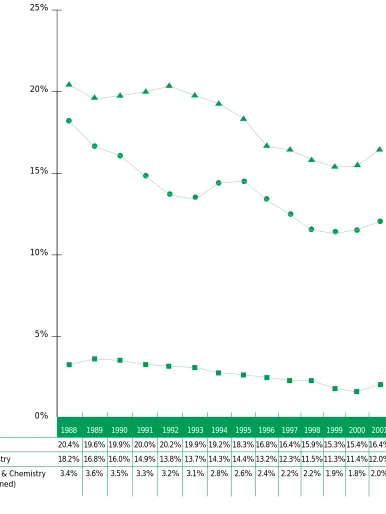
In 2000/2001, Physics was taken by 16.4% of Leaving Certificate students, Chemistry by 12.0% and Physics and Chemistry (combined) by 2.0%. Table 3 shows the total number of students enrolled in the Leaving Certificate programme in each of the physical science subjects in 2000/2001, the most recent data available at the time of writing.
Table 3: Number of 5th & 6th Year students and % of the cohort enrolled in selected Leaving Certificate subjects (2000/2001)
The changes in participation rates over time are demonstrated in Figure 4.
Physics 17,762
Chemistry 12,999
2,182 Physics & Chemistry
(combined)
MALES FEMALES TOTAL % COHORT
Physics & Chemistry (combined) 1,559 623 2,182 2.0%
Agricultural Science 4,847 1,297 6,144 5.7%
Engineering 10,260 677 10,937 10.1%
Technical Drawing 12,587 937 13,524 12.5%
Construction Studies 17,568 1,280 18,848 17.4%
Chemistry 6,105 6,894 12,999 12.0%
Physics 13,329 4,434 17,763 16.4%
Home Economics 4,761 31,777 36,538 33.7%
Biology 15,631 31,823 47,454 43.7%
Mathematics 52,404 55,947 108,351 99.8%
Figure 4 indicates an apparent recovery in participation in recent years. However the number of Leaving Certificate students opting to study the physical sciences has continued to decline during this period as shown in Figure 5.
Thus, while the proportion of students opting to study the Leaving Certificate physical sciences did show an increase in 2001, the actual number of students continued to drop. This is in line with the on-going decline in the total number of students enrolled in the Leaving
Certificate programme as a whole (reflecting demographic changes in the Irish school-going population).
1998 15.9% 11.5% 2.2% 0% 1988 20.4% 18.2% 3.4% Physics Chemistry
[image:46.595.99.485.94.608.2]Physics & Chemistry (combined) 1989 19.6% 16.8% 3.6% 1990 19.9% 16.0% 3.5% 1991 20.0% 14.9% 3.3% 1992 20.2% 13.8% 3.2% 1993 19.9% 13.7% 3.1% 1994 19.2% 14.3% 2.8% 1995 18.3% 14.4% 2.6% 1996 16.8% 13.2% 2.4% 1997 16.4% 12.3% 2.2% 1999 15.3% 11.3% 1.9% 2000 15.4% 11.4% 1.8% 2001 16.4% 12.0% 2.0% 5% 10% 15% 20% 25%