On the verbalization patterns of part-whole relations in isiZulu
C. Maria Keet1 and Langa Khumalo2
1 Department of Computer Science, University of Cape Town,
South Africa,[email protected]
2 Linguistics Program, University of KwaZulu-Natal,
South Africa,[email protected]
Abstract
In the highly multilingual setting in South Africa, developing computational tools to sup-port the 11 official languages will facilitate ef-fective communication. The exigency to de-velop these tools for healthcare applications and doctor-patient interaction is there. An im-portant component in this set-up is generating sentences in the language isiZulu, which in-volves part-whole relations to communicate, for instance, which part of one’s body hurts. From a NLG viewpoint, the main challenge is the fluid use of terminology and the con-sequent complex agreement system inherent in the language, which is further complicated by phonological conditioning in the linguistic realisation stage. Through using a combined approach of examples and various literature, we devised verbalisation patterns for both meronymic and mereological relations, being structural/general parthood, involvement, con-tainment, membership, subquantities, partic-ipation, and constitution. All patterns were then converted into algorithms and have been implemented as a proof-of-concept.
1 Introduction
Hitherto text-based human language technologies in South Africa have been developed by CTexT through the Autshumato project, whereas speech technologies have been developed by the Meraka In-stitute, which include Automatic Speech Recogni-tion (ASR), pronunciaRecogni-tion dicRecogni-tionaries and text-to-speech (TTS) technologies under the auspices of the Lwazi project. However, there is no computational
technology in all indigenous official languages (in-cluding isiZulu), and the HLT audit (Sharma Grover et al., 2011) indicated a huge gap in information and knowledge processing in particular. This is impor-tant to address for application areas such as doctor-patient interactions, for which now only a small app with canned bilingual text exist1. The app was
well-received for being a very small step toward meet-ing a well-known need of personalised health com-munication (Mettler and Kemper, 2003; Wilcox et al., 2011). However, due to the entirely manual ef-forts, the mobilezulu app with its canned text is ob-viously not scalable to cover all areas of medicine, like captured in standards such as SNOMED CT2
and for which terminology in isiZulu is being de-veloped (Engelbrecht et al., 2010) and standardised following PANSALB terminology development pro-cesses (Khumalo, 2016). SNOMED CT has a logic-based foundation by having the terms, relations, and the constraints that hold among them represented in the Description Logics-based OWL 2 EL ontology language (Motik et al., 2009a). OWL is also becom-ing popular as structured input for NLG (Bouayad-Agha et al., 2014) and CNLs (Safwat and Davis, 2016). Some results have been obtained in gener-ating grammatically correct natural language sen-tences in isiZulu for the OWL 2 EL constructors (Keet and Khumalo, 2016), which makes it look promising to use. Exploratory experiments revealed several issues with verbalising axioms involving the pervasive part-whole relations (OWL object proper-ties), however. The part-whole relation is
compli-1mobilezulu.org.zaandmobilexhosa.org.za 2http://www.ihtsdo.org/snomed-ct/
cated by the fluid use in speech and terminology. For instance, structural parts (e.g., the jawbone of the head), involvement (swallowing as part of eat-ing), and membership is generalised asingxenyein isiZulu, yet participation is divided into individual (e.g., the patient) and collective (e.g., the operat-ing team) participation, usoperat-ing different terms. The isiZulu-English dictionary lists 19 translations for ‘part’ alone (Dent and Nyembezi, 2009). It also in-troduces the need to process prepositions, which are present only in the deep structure in isiZulu (Math-onsi, 2001), rather than as identifiable isolated words in the better-resourced languages (such as ‘of’,von [DE],van[NL],de [SP]) that generally do have to be considered in NLG (Baldwin et al., 2009).
Linguistic and cognitive analyses of part-whole relations have resulted in part-whole relation tax-onomies, notably the seminal first one by (Winston et al., 1987) and the most recent update in (Keet and Artale, 2008), which have been used successfully in NLP (e.g., (Tandon et al., 2016)). Such anal-yses start from the underspecified ‘part’ in natural language to examine what it really is ontologically. For NLG in isiZulu, we face a ‘double direction’ of analyses for non-English languages:which parts are there, which terms are used for that, and how? The general task at hand, thus, is to figure out how the lexicalisation and linguistic realisation of part-whole relations work in isiZulu.
We solve this problem by starting from an estab-lished taxonomy of part-whole relations and adjust where needed to cater for differences in conceptu-alisation as expressed in grammatically correct nat-ural language. Unlike in English, where the same string—like ‘has part’, ‘is part of’, and ‘contains’— can be plugged in a template unaltered3, the
lexical-isation and linguistic reallexical-isation in isiZulu depend on other constituents in the sentence. These include the noun class of the noun that plays the part or whole role in the sentence, the agreement system be-tween a noun and a verb, phonological conditioning, and processing a preposition. In total, there are 13 such constituents for the part-whole relations cov-ered. Instead of templates, this demands for verbal-isation patterns such that a complete sentence can be generated during runtime. The results presented
3check, e.g., SWAT NL (Third et al., 2011) or ACE online
(Fuchs et al., 2010).
here thus also provide a first account of how to con-struct a full—albeit still highly con-structured—sentence in isiZulu that has more dependent components (so-called ‘concordial agreement’) than just verb conju-gation with the subject concord and quantification with the quantitative concord. These patterns have been converted into algorithms and have been im-plemented as a proof-of-concept, substantially ex-tending algorithms for verbalising OWL 2 EL ax-ioms with ‘simple’ relations (verbs) and for plural-ising nouns (Keet and Khumalo, 2016; Byamugisha et al., 2016), notably regarding locatives, concords, a preposition, and more comprehensive phonologi-cal conditioning.
The remainder of the paper is structured as fol-lows. In Section 2 we outline the preliminaries on part-whole relations and CNLs for isiZulu. We spell out the patterns for the parts and wholes in isiZulu in Section 3. We describe the tool design consider-ations and implementation in Section 4. We discuss in Section 5 and conclude in Section 6.
2 Preliminaries
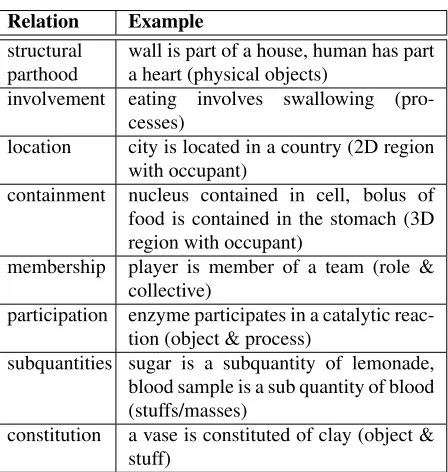
Part-whole relations in the context of natural lan-guage commenced seriously with (Winston et al., 1987), with various modifications to its latest in-stalment by (Keet and Artale, 2008) as to which part-whole relations there are. These part-whole re-lations are also used in NLP (e.g., (Tandon et al., 2016)), and in ontologies and controlled vocabular-ies in medicine, such as openGalen and SNOMED CT. There is a principal distinction between mereol-ogy (parthood) and meronymy (parts in natural lan-guage), where the latter includes the former. They are summarised with an example in Table 1.
Table 1:Main part-whole relations. Relation Example
structural
parthood wall is part of a house, human has parta heart (physical objects) involvement eating involves swallowing
(pro-cesses)
location city is located in a country (2D region with occupant)
containment nucleus contained in cell, bolus of food is contained in the stomach (3D region with occupant)
membership player is member of a team (role & collective)
participation enzyme participates in a catalytic reac-tion (object & process)
subquantities sugar is a subquantity of lemonade, blood sample is a sub quantity of blood (stuffs/masses)
constitution a vase is constituted of clay (object & stuff)
classes for isiZulu with relevant concords affecting other words in a sentence is shown in Table 2. The noun class system is one of the salient features of the isiZulu language. Every noun belongs to a noun class (NC). The noun is made up of two formatives, the prefix and the stem (e.g., for NC2: aba- + fana = abafana‘boys’). Crucially, the NC governs the agreement of all words that modify the noun. Most NCs are set off into pairs in isiZulu such that most nouns have a singular form in one class and a plu-ral form in another as summarised in Table 2. It must also be pointed out that for the most part the semantics of a noun determines its class (cf. (Twala, 1992)).
So-called ‘verbalisation patterns’ and algorithms have been developed by (Byamugisha et al., 2016; Keet and Khumalo, 2016), which cover knowledge representation language features from the Descrip-tion Logic (DL)ALC(Baader et al., 2008)—hence, OWL 2 EL (Motik et al., 2009a)—such as existen-tial and universal quantification, subsumption, and negation, which have been implemented by the au-thors in the meantime. The relevant aspects are sum-marised here to keep the paper self-contained:
– Conjunction ‘and’ (uin DL notation), enumer-ative: na- is added to the second noun, using phonological conditioning (see below).
– Subsumption: The copulative is eithery-or
ng-, depending on the first letter of the name of the superclass, and added to the name of the super-class; e.g.,inja yisilwane‘dog is an animal’. – Quantification, restricted to usage in simple
in-clusions of the formC v ∃R.D, i.e., ‘all Cs R at least one D’. The ∀ ‘all’ is determined by the noun class of the plural of C’s name, R is a present tense verb conjugated in concor-dance with the head noun (C, in plural), and the ‘at least one’ is made up of the relative concord and quantitative concord of the noun class ofD’s name and ends with-dwa. For in-stance, uSolwaziv-fundisa.isifundo becomes bonke oSolwazi bafundisa isifundo esisodwa ‘all professors teach at least one course’: First, uSolwazi, in NC3, is pluralised tooSolwazi, in NC4. Second, the word for∀for NC4 isbonke and, third, the subject concord for it is ba-, making bafundisa. Fourth, the noun class of isifundois 7, so the relative concord isesi-and quantitative concord is-so-, formingesisodwa for the verbalisation of∃.
Phonological conditioning occurs in multiple oc-casions (Miti, 2006), but the one relevant here con-cerns adding a concord to the noun, because isiZulu does not have two successive vowels in a word. This is known as vowel coalescence, and the ba-sic rules are: -a + a- = -a-, -a + e- = -e-, -a + i-= -e-, -a + o- = -o-, and -a + u- = -o-. For in-stance, ubisi na+ibhotelabecomes ubisi nebhotela (‘milk and butter’), ibhotela na+ubisibecomes ib-hotela nobisi, andnga+ubumbabecomesngobumba ‘of clay’. Further, the locative suffix-iniis phono-logically conditioned by the final vowel: -a+-ini= -eni,-e+-ini=-eni,-o+ini=-weni,u+ini=-wini,-phu+ -wini=-shini, and the few loanwords that end in -phubecome-phini.
3 Patterns for Parts and Wholes
To describe the patterns, we systematically take the axioms for ‘has part’ (wp),W v ∃hasP art.P, and ‘is part of’ (pw), P v ∃isP artOf.W to demon-strate what is going on linguistically. Ontologically, in a majority of cases, only one of the two reading directions is applicable despite the pervasive infor-mal use of the inappropriate one4; such ontological
4e.g., it is true that all humans have some heart (Humanv
hu-Table 2: Zulu noun classes with examples and a selection of concords. NC: Noun class; PRE: prefix; QC: quantitative con-cord; RC: relative concon-cord; PC: possessive concord.
NC Full
PRE QC(∀) RC QC(∃) SC PC
1 um(u)- wonke o- ye- u- wa-2 aba- bonke aba- bo- ba-
ba-1a u- wonke o- ye- u-
wa-2a o- bonke aba- bo- ba-
ba-3a u- wonke o- ye- u-
wa-2a o- bonke aba- bo- ba- ba-3 um(u)- wonke o- wo- u- wa-4 imi- yonke e- yo- i- ya-5 i(li)- lonke eli- lo- li-
la-6 ama- onke a- wo- a-
a-7 isi- sonke esi- so- si- sa-8 izi- zonke ezi zo- zi-
za-9a i- yonke e- yo- i-
ya-6 ama- onke a- wo- a-
a-9 i(n)- yonke e- yo- i- ya-10 izi(n)- zonke ezi- zo- zi- za-11 u(lu)- lonke olu- lo- lu- lwa-10 izi(n)- zonke ezi- zo- zi- za-14 ubu- bonke obu- bo- bu- ba-15 uku- konke oku- ko- ku- kwa-17 ku- lonke olu- lo- lu-
kwa-aspects are beyond the scope of this paper.
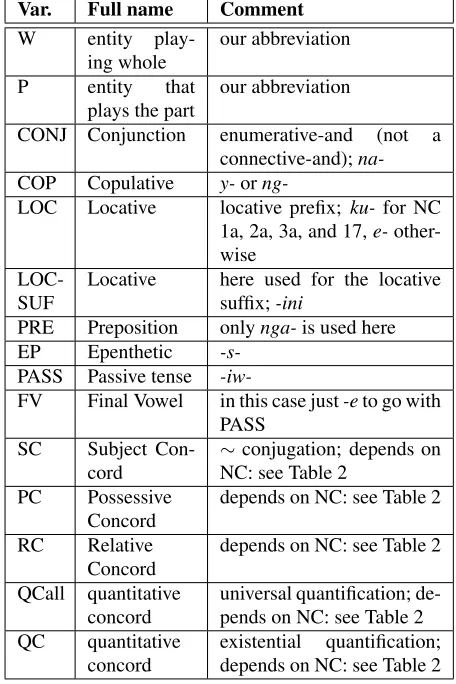
Regarding notation, ultimately what is needed is a detailed grammar for the verbalisation patterns. At this stage, however, there is insufficient linguistic knowledge to pursue this. Therefore, we use vari-ables in the patterns, as listed in Table 3, where each variable is to be substituted with the appro-priate string (terminal, if it were a CFG), and sub-scripts, omitting the orthogonal phonological condi-tioning that is included in the explanation instead. A dash between variables indicates they are part of one word. Subscripts indicate ‘agreement’ of the various elements. So, for instance, a “Wncx,pl” is the entity
(its name assumed to be given in the singular) that plays the role of the whole, which is of noun class (“nc”) x that is to be pluralised, and its preceding
“QCallncx,pl” is the term for the universal
quantifi-cation for the noun class that is the plural of noun class x; e.g., if W isinja, in NC9, then Wncx,pl is
man (∗Heartv ∃isP artOf.Human), as there are hearts that
[image:4.612.312.540.68.410.2]are part of another, non-human, animal.
Table 3:Abbreviations (Var.) used in the verbalisation patterns. Var. Full name Comment
W entity
play-ing whole our abbreviation P entity that
plays the part our abbreviation
CONJ Conjunction enumerative-and (not a connective-and); na-COP Copulative y-or
ng-LOC Locative locative prefix; ku-for NC 1a, 2a, 3a, and 17,e- other-wise
LOC-SUF Locative here used for the locativesuffix;-ini PRE Preposition onlynga-is used here EP Epenthetic
-s-PASS Passive tense
-iw-FV Final Vowel in this case just-eto go with PASS
SC Subject
Con-cord ∼NC: see Table 2conjugation; depends on PC Possessive
Concord depends on NC: see Table 2 RC Relative
Concord depends on NC: see Table 2 QCall quantitative
concord universal quantification; de-pends on NC: see Table 2 QC quantitative
concord existential quantification;depends on NC: see Table 2
izinjain NC10, and its QCallncx,pliszonke.
structural/general parts and wholes Let us com-mence with a parthood relation between objects. The verbalisation patterns in isiZulu (for any noun class) in the ‘has part’ (wp) and ‘part of’ (pw) read-ing directions are as follows:
wp: QCallncx,pl Wncx,pl SCncx,pl-CONJ-Pncy
RCncy-QCncy-dwa
pw: QCallncx,pl Pncx,pl SCncx,pl-COP-ingxenye
PCingxenye-WncyRCncy-QCncy-dwa
[image:4.612.74.304.105.391.2]be-ingya-, taking into account vowel coalescence. The SC for concordance with the P has been included be-cause, while in multiple examples, either SC-COP-ingxenyeor COP-ingxenyesuffices, in some cases it really does not. The patterns are illustrated in the following two examples for heart (inhliziyo, NC9) standing in a part-whole relation to human (umuntu, NC1), with the ‘has part’ and ‘is part of’ underlined: wp-ex: bonke abantu banenhliziyo eyodwa
pw-ex: zonke izinhliziyo ziyingxenye yomuntu oyedwa
involved in is the same as for general parts. The salient difference is that both P and W belong to nominals that are in NC15. An example is that eat-ing (ukudla) involves swallowing (ukugwinya): wp-ex: konke ukudla kunokugwinya okukodwa pw-ex: konke ukugwinya kuyingxenye yokudla
okukodwa
Observe that “bane-” in the previous example is dif-ferent from the “kuno-” here, due to the different SCs (abantu is in NC2 (ba-) and ukudla in NC15 (ku-), and vowel coalescence:na+i=-ne-in the for-mer example andna+u=-no-here, yet the pattern is exactly the same.
containment has a spatial component to it, which is indicated with the locative affixes (LOC) in the pw direction of verbalisation. Because isiZulu pro-scribes vowel sequencing, the epenthetic -s- is re-quired between the SC and the LOCe-. Patterns, for any noun class:
wp: QCallncx,pl Wncx,pl SCncx,pl-CONJ-Pncy
RCncy-QCncy-dwa
pw: QCallncx,pl Pncx,pl SCncx,pl-EP-LOC-Wncy
-LOCSUF RCncy-QCncy-dwa
This is illustrated for the usual example (Donnelly et al., 2006) of a bolus of food (indilinga yokudla, NC9) that is contained in the stomach (isisu, NC7): wp-ex: Zonke izisu zinendilinga yokudla eyodwa pw-ex: Zonke izindilinga zokudla zisesiswini
es-isodwa
The zine- comes from the SC of NC10 of izisu ‘stomachs’, which is followed by thena+i=-ne-for CONJ. Thezise-is the result of NC10’s SC,zi-(see Table 2), the EP-s-, and LOCe-, and then-u+-ini= -winias LOCSUF.
membership The patterns are as for general part-hood; e.g., a doctor (udokotela, NC1a) is a member
of an operating team (iqembu labahlinzi, NC5): wp-ex: onke amaqembu abahlinzi anodokotela
oyedwa
pw-ex: bonke odokotela bayingxenye yeqembu labahlinzi elilodwa
subquantities Ontology has so far recognised two core different usages of subquantities. First, as parts, like alcohol is a subquantity of wine, flour of bread and so on. While many of the mass nouns are in NC5 or NC6 in isiZulu, this is not always the case and if in the singular it stays singular and in some cases, the term can be both a count noun and a mass noun, as is the case in English (e.g., ‘stone’). Therefore, we change the pattern for part-subquantities so that it omits the pluralisation. Also, one does not count stuffs, so the ‘at least one’ is omitted as well. wp: QCallncx Wncx SCncx-CONJ-Pncy
pw: QCallncx Pncx SCncx-COP-ingxenye
PCingxenye-Wncy
For instance, water (amanzi, NC6) as a subquantity of urine (umshobingo, NC3):
wp-ex: wonke umshobingo unamanzi
pw-ex: onke amanzi ayingxenye yomshobingo The second reading of subquantities is portions, i.e., parts of the whole amount of stuff that are made of the same stuff, be this a tissue sample under the microscope glass that came from a patient’s tissue, or the left-half of someone’s brain. In isiZulu, there are two types: umunxa(NC3) as a kind of ‘spatial’ portion as in ‘the portion of the kitchen where the kitchen utensils are’, andisiqephu (NC7) as a por-tion for solid objects, like the tissue. For the ‘spatial’ portion, we obtain:
wp: QCallncx,plWncx,pl SCncx,pl-CONJ-Pncy
pw: QCallncx,pl Pncx,pl SCncx,pl-COP-umunxa
PCumunxa-Wncy
Observe that the COP is ng-, not y-, because of the u-commencing umunxa; e.g., a hospital ( isib-hedlela, NC7) has a portion that is an operating the-atre (ithiyetha yokuhlinzela, NC9a):
wp-ex: zonke izibhedlela zinethiyetha yokuhlinzela pw-ex: onke amathiyetha okuhlinzela angumunxa
wesibhedlela
For the solid objects type of portion, the whole is an amount of matter (mass noun), thus remains in the noun class it is rather than being pluralised: wp: QCallncx Wncx SCncx-CONJ-Pncy RCncy
pw: QCallncx,pl Pncx,pl SCncx,pl-COP-isiqephu
PCisiqephu-Wncy RCncy-QCncy-dwa
with as example a blood sample as a portion of blood wp-ex: Lonke igazi linesampula legazi elilodwa pw-ex: Onke amasampula egazi ayisiqephu segazi
elilodwa
For the W in the pw, there is again vowel coales-cence:sa-+igazi=segazi, withsa-the PC for isiqe-phu’s NC7. The part P is computationally compli-cated. It may be a noun phrase, like ‘slice of bread’, where the ‘of’ is again catered for by a PC, being the one for the noun class of the noun that is the quantity (slice, piece, bowl, etc). So, e.g.,ucezu(NC11) has PClwa-, resulting inlwa-+isinkwa=lwesinkwa‘of bread’. Yet, a ‘sample of blood’,isampula legazi, is considered a compound noun, not a noun phrase. participation can be divided into two typologies in isiZulu. There is individual type of participation and a group type of participation, like a citizen vs the electorate participating (taking part) in an elec-tion. For individual objects, one can include an op-tional ASP between the SC and COP, restricted to -be-in this case. This is not used here so as to match with the rest, assuming that it will suffice. As ex-ample, a doctor (udokotela, NC1a) participates in an operation (ukuhlinza, NC15):
wp-ex: Konke ukuhlinza kunodokotela oyedwa pw-ex: bonke odokotela bayingxenye yokuhlinza
okukodwa
For the collective/group participation, a different ‘part’ is used, -hlanganyele, which is part in the sense of participating by combining to do some-thing, acting in unison (perfect tense). This is ver-balised in the singular only:
wp: QCallncx Wncx SCncx-CONJ-Pncy RCncy
-QCncy-dwa
pw: QCallncx PncxSCncx-hlanganyeleLOC-Wncy
-LOCSUF RCncy-QCncy-dwa.
Either a LOC as prefix only is allowed, or a locative circumfix can be used, i.e., LOC-W-LOCSUF with vowel elision for the W on both sides. Here, the latter is chosen. For instance, the operating team, (iqembu labahlinzi, NC5) participating in an opera-tion (ukuhlinza, NC15):
wp-ex: Konke ukuhlinza kuneqembu labahlinzi elilodwa
pw-ex: Lonke iqembu labahlinzi lihlanganyele okuhlinzeni okukodwa
Decomposing the locative aspects that result in okuhlinzeni: theo-is the outcome of the vowel coa-lescence of LOCe-+u-and-weniis the outcome of the phonological conditioning-o+-ini’s LOCSUF. constitution Also in this case of meronymic part-whole relation, it partially diverges in that there is no variation of ‘part’ as a noun, but a verb is used, as in the previous case: it is either-akha‘build’ for objects that are made/constituted of some matter in some structural sense or-enzaotherwise. As this is verbalised only as wholes being constituted of some-thing, only that one is included:
wp: QCallncx,pl Wncx,pl SCncx,pl-akh-PASS-FV
PRE-Pncy.
wp: QCallncx,pl Wncx,pl SCncx,pl-enz-PASS-FV
PRE-Pncy.
The PRE here is restricted tonga-, with phonolog-ical conditioning. Relatively, this construction is similar to the notion of preposition contraction in Romance languages (de Oliveira and Sripada, 2014). For instance, in ‘all houses (izindlu‘house’) are con-stituted of stone (itshe, NC5)’, the passive and fi-nal vowel causes the-iweend, and likewise for ‘all pills (amaphilisi, NC6) are made of starch (isitashi, NC7)’:
wp-ex: zonke izindlu zakhiwe ngetshe wp-ex: onke amaphilisi enziwe ngesitashi
The SC is modified because the stem starts with a vowel: if the vowel of the SC is a high vowel (i-; u-) and precedes the vowel of the stem which is low (a-), there is hiatus resolution (Mudzingwa and Kadenge, 2011). The pattern is as follows: i- + a- = yand u- + a- = w. Hiatus resolution is followed by the elision of the initial vowel with the semi-vowel at-taching to the initial vowel of the stem (u- + akhiwe = yakhiwe).
This concludes the list of patterns.
4 Design and Implementation
We describe the transformation from the patterns to the algorithms, some tool design considerations, and the architecture of the implementation.
there are the variables that algorithmically amount to straight-forwardlook-up functionsto retrieve some-thing using the noun class, such as the SC, RC, and QC as listed in Table 2. Second, there are func-tions that change a word, notably the pluraliser, which is not simply a case of list look-up (Bya-mugisha et al., 2016). Third, there are thefunctions for phonological conditioning that are needed for CONJ, LOC, LOCSUF, PC, and PRE. Most of the algorithms to verbalise part-whole relations need all three groups of functions. For instance, Algorithm 1 for the verbalisation of the basic whole-part has the straightforward look-up ones (“get...”), the call to another algorithm for pluralisation (line 7), and one call to the rules for vowel coalescence (phonologi-cal conditioning) in line 11. The algorithm for the ‘is part of’ direction is similar except that instead of line 11, the phonological conditioning is phono-Condition(’ya’,c2)andsc1stringed together with
yingxenye.
4.2 Design considerations
As the patterns demonstrate, the actual string for ‘has part’ depends on the noun of the entity that plays the role of the whole and noun of the entity that plays the role of the part, which means that it is not feasible to store all possible strings, but this has to be computed on-the-fly. Yet, OWL requires a single, fixed, string of text for its ‘object prop-erty’ (relationship), i.e., a single IRI (Motik et al., 2009b). Integrating this with OWL means handling object properties differently and full integration with a linguistic model, yet thelemonmodel (McCrae et al., 2012) already needs an extension to deal with the noun classes (Chavula and Keet, 2014), or: that structured representation does not suffice for isiZulu at present. As solving that diverts away from a proof-of-concept implementation of the algorithms for part-whole relations to evaluate whether they and the patterns they implement are correct, we chose an incremental approach with Python instead. Also, the patterns and algorithms presented in (Keet and Khu-malo, 2016; Byamugisha et al., 2016) have been im-plemented in Python, so we extended that with the algorithms for the novel part-whole patterns.
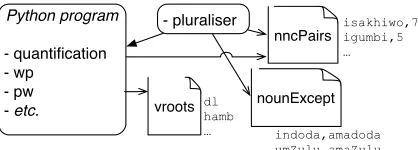
The architecture of the components of the ver-baliser are straightforward (see Fig. 1): nouns are stored with their noun class, whereas verb stems
Algorithm 1:Determine the verbalisation of ba-sic whole-part in an axiom
1: Cset of classes, languageL,vfor subsump-tion,∃for existential quantification; varia-bles:Aaxiom,NCinoun class,c1, c2∈ C,
o∈ R,a1a term;r2, q2concords;
Require: axiom of the formW v ∃wp.P has been retrieved for verbalisation
2: c1 ←getF irstClass(A) {get whole} 3: c2 ←getSecondClass(A) {get part} 4: wp←getObjP rop(A)
{getwptype (‘default’ parthood here)} 5: NC1←getNC(c1) {obtain noun class whole} 6: NC2←getNC(c2) {obtain noun class part} 7: cpl ←pluralise(c1, NC1)
{generate plural, using the pluraliser algorithm} 8: NC0
1←getP lNC(NC1)
{obtain plural NC, from known list} 9: a1←getQCAll(NC10)
{obtain quantitative concord (QC(all))} 10: sc1←getSC(NC10) {obtain subject concord} 11: conjp←phonoCondition(’na’,c2)
{prefix P with the CONJ, phonologically conditioned} 12: r2 ←getRC(NC2) {obtain relative conc. forc2}
13: q2←getQC(NC2)
{obtain quant. concord forc2from the QC (exists)-list}
14: RESULT←‘a1cplsc1conjp r2q2dwa. ’ {verbalise the simple axiom} 15: return RESULT
vroots
Python program
- quantification - wp
- pw - etc.
nncPairs
nounExcept
isakhiwo,7 igumbi,5 …
dl hamb
… indoda,amadoda umZulu,amaZulu
[image:8.612.80.289.59.134.2]- pluraliser
Figure 1:Components of the proof-of-concept implementation of the isiZulu verbaliser. The three txt files were created manu-ally (examples of their contents are shown incourierfont).
Figure 2:Screenshot of working code; wp/pw: general wholes/ parts; wp cp: collective participation; wp s: subquantity; pw ci: containment.
5 Discussion
The patterns showed that, like in English, isiZulu has several more specific terms for ‘part’—ingxenye, indawo, isiqephu, umunxa, and hlanganyele— although they do not match 1:1 with the established part-whole relation categorisations as in Table 1. Such ontological analyses are left for future work. It does illustrate that in this case sentence planning was a major hurdle compared to just linguistic real-isation.
The patterns reconfirm results by (Keet and Khu-malo, 2016) that the template-based approach is not feasible for isiZulu, and, by extension, Bantu lan-guages that all share the features of noun classes and concordance. This, however, also makes it an imperative to develop a grammar. While this ex-ercise broadened the scope on understanding what linguistic elements are needed for an NLG, and a quasi pattern language was still sufficient to specify the patterns, with the increased number of elements to keep track of compared to (Keet and Khumalo, 2016), soon this limit will be reached. In addition, rules need to be found so as to processgroupsof to-kens so as to know which one is a compound noun
and which one is a noun phrase, in order to pro-cess them correctly. Hopefully then also sufficient insight is gained to construct a set of requirements for the grammar and either practical ones might be extended, such as the CFG of Ukwabelana (Spiegler et al., 2010), explorations of (Zeller, 2005) worked out in detail, or a natural language-independent ap-proach like in (Kuhn, 2013) may be adjusted, or a new one devised to handle the syntactic elements to generate sentences with the intended semantics.
Finally, although the patterns have been specified for isiZulu only, bootstrapping resources for related Bantu languages—Xhosa, Swati, and Ndebele— based on isiZulu resources have yielded good re-sults (Bosch et al., 2008), and thus solving it for isiZulu will open up HLT prospects for even lesser resourced languages.
6 Conclusions
We devised verbalisation patterns for both meronymic and mereological relations. New constituents in the patterns with respect to related works are, notably, the possessive concord, locative affixes, and a basic treatment of prepositions and the passive tense. The verbalisation patterns were implemented successfully using a proof-of-concept implementation of the algorithms, and tested with 42 examples, resulting in a 90.5% success rate. The patterns reaffirm the infeasibility of the template-based approach for isiZulu and Bantu languages because of the complex morphosyntax.
The patterns also indicated that it is becoming a pressing matter to commence with formally defining a generative grammar for isiZulu. Another avenue will be to take the latest medical terminology terms in isiZulu and create a fully functional medical app.
Acknowledgments
This work is based on the research supported in part by the National Research Foundation of South Africa (CMK: Grant Number 93397).
References
Timothy Baldwin, Valia Kordoni, and Aline Villavicen-cio. 2009. Prepositions in applications: A survey and introduction to the special issue. Computational Lin-guistics, 35(2):119–149.
Sonja Bosch, Laurette Pretorius, and Axel Fleisch. 2008. Experimental bootstrapping of morphological analy-sers for nguni languages. Nordic Journal of African Studies, 17(2):66–88.
N. Bouayad-Agha, G. Casamayor, and L. Wanner. 2014. Natural language generation in the context of the se-mantic web. Semantic Web Journal, 5(6):493–513. Joan Byamugisha, C. Maria Keet, and Langa Khumalo.
2016. Pluralising nouns in isiZulu and similar lan-guages. In A. Gelbkuh, editor, Proceedings of CI-CLing’16, page in print. Springer.
Catherine Chavula and C. Maria Keet. 2014. Is lemon sufficient for building multilingual ontologies for Bantu languages? In C. Maria Keet and Valentina Tamma, editors,Proceedings of the 11th OWL: Expe-riences and Directions Workshop (OWLED’14), vol-ume 1265 ofCEUR-WS, pages 61–72. Riva del Garda, Italy, Oct 17-18, 2014.
Rodrigo de Oliveira and Somayajulu Sripada. 2014. Adapting simplenlg for brazilian portuguese realisa-tion. InProceedings of the 8th International Natural Language Generation Conference (INLG), pages 93– 94, Philadelphia, Pennsylvania, U.S.A., June. Associ-ation for ComputAssoci-ational Linguistics.
G. R. Dent and C. L. S. Nyembezi. 2009. Scholar’s Zulu Dictionary. Shuter & Shooter Publishers, 4 edition. M. Donnelly, T. Bittner, and C. Rosse. 2006. A
for-mal theory for spatial representation and reasoning in biomedical ontologies. Artif Intell Med, 36(1):1–27. C. Engelbrecht, N.C. Shangase, S.J. Majeke, S.Z.
Mthembu, and Z.M. Zondi. 2010. Isizulu terminol-ogy development in nursing and midwifery. Alterna-tion, 17(1):249–272.
Norbert E. Fuchs, Kaarel Kaljurand, and Tobias Kuhn. 2010. Discourse Representation Structures for ACE 6.6. Technical Report ifi-2010.0010, Dept of Infor-matics, University of Zurich, Switzerland.
C. Maria Keet and Alessandro Artale. 2008. Represent-ing and reasonRepresent-ing over a taxonomy of part-whole rela-tions. Applied Ontology, 3(1-2):91–110.
C. M. Keet and L. Khumalo. 2016. Toward a knowledge-to-text controlled natural language of isiZulu. Language Resources and Evaluation, in print:DOI: 10.1007/s10579–016–9340–0.
L. Khumalo. 2016. Disrupting language hegemony: Intellectualizing African languages. In M. Samuel, R. Dunpath, and N. Amin, editors, Towards a post-humanist higher education curriculum: Undoing cog-nitive damage, page (accepted). SENSE Publishers, Rotterdam.
Tobias Kuhn. 2013. A principled approach to gram-mars for controlled natural languages and predictive editors. Journal of Logic, Language and Information, 22(1):33–70.
N. N. Mathonsi. 2001. Prepositional and adverb phrases in Zulu: a linguistic and lexicographic problem. South African Journal of African Languages, 2:163–175. John McCrae, Guadalupe Aguado de Cea, Paul Buitelaar,
Philipp Cimiano, Thierry Declerck, Asunci´on G´omez-P´erez, Jorge Gracia, Laura Hollink, Elena Montiel-Ponsoda, Dennis Spohr, and Tobias Wunner. 2012. The Lemon cookbook. Technical report, Monnet Project.
M. Mettler and D.W. Kemper. 2003. Information ther-apy: Health education one person at a time. Health Prom. Prac., 4(3):214–217.
L. Miti. 2006. Comparative Bantu phonology and mor-phology. Cape Town: The Center for Advanced Stud-ies of African SocietStud-ies (CASAS).
Boris Motik, Bernardo Cuenca Grau, Ian Horrocks, Zhe Wu, Achille Fokoue, and Carsten Lutz. 2009a. OWL 2 Web Ontology Language Profiles. W3C recommen-dation, W3C, 27 Oct.
Boris Motik, Peter F. Patel-Schneider, and Bijan Parsia. 2009b. OWL 2 web ontology lan-guage structural specification and functional-style syntax. W3c recommendation, W3C, 27 Oct. http://www.w3.org/TR/owl2-syntax/.
C. Mudzingwa and M. Kadenge. 2011. Comparing hia-tus resolution in karanga and nambya: An optimality theory account. Nordic Journal of African Studies, 20(3):203–240.
L. Pretorius and E. S. Bosch. 2003. Finite-state compu-tational morphology: An analyzer prototype for Zulu. Machine Translation, 18(3):195–216.
Hazem Safwat and Brian Davis. 2016. CNLs for the se-mantic web: a state of the art. Language Resources & Evaluation, in print:DOI: 10.1007/s10579–016–9351– x.
A. Sharma Grover, G.B. Van Huyssteen, and M.W. Pre-torius. 2011. The South African human language technology audit. Language Resources & Evaluation, 45:271–288.
Sebastian Spiegler, Andrew van der Spuy, and Peter A. Flach. 2010. Ukwabelana – an open-source mor-phological Zulu corpus. In Proceedings of the 23rd International Conference on Computational Linguis-tics (COLING’10), pages 1020–1028. Association for Computational Linguistics. Beijing.
of the Thirtieth AAAI Conference on Artificial Intelli-gence (AAAI’16), pages 243–250. AAAI Press. Allan Third, Sandra Williams, and Richard Power.
2011. OWL to English: a tool for generating or-ganised easily-navigated hypertexts from ontologies. poster/demo paper, Open Unversity UK. 10th Inter-national Semantic Web Conference (ISWC’11), 23-27 Oct 2011, Bonn, Germany.
E. K. Twala. 1992. The noun class system of isizulu. M.A. dissertation. University of Johannesburg. Kees van Deemter, Emiel Krahmer, and Mari¨et Theune.
2005. Real versus tempalte-based natural language generation: a false opposition? Computational Lin-guistics, 31(1):15–23.
L. Wilcox, D. Morris, D. Tan, J. Gatewood, and E. Horvitz. 2011. Characterising patient-friendly micro-explanations of medical events. In SIGCHI Conference on Human Factors in Computing Systems (CHI’11), pages 29–32. ACM.
M.E. Winston, R. Chaffin, and D. Herrmann. 1987. A taxonomy of partwhole relations. Cognitive Science, 11(4):417–444.