Arduino Mega Based Pill Reminder
Tahseen Fatima1, Pallavi B V 2, Dr. Baswaraj Gadgay 3
1
Student Dept. Of VLSI Design & Embedded Systems VTU Centre for PG Studies Kalaburagi, Karnataka, India
2
Assistant Professor, VTU Centre for PG Studies Kalaburagi, Karnataka, India
3
Research Guide & Professor, VTU Centre for PG Studies Kalaburagi, Karnataka, India
Abstract: This paper proposes the design of Arduino mega based pill reminder which will help the patients to take their prescribed medicine in correct quantity and at appropriate time. Assistive Technology (AT) maintains and improves the individual's functioning and independence, thereby promoting their well-being. But today only 5 from each 50 people in need have access to AT due to high costs and a lack of awareness, availability, personal training, policy and financing. By 2050, more than 2.5 billion people will need at least 1 assistive product with many elderly needing 2 or more. It is a frequent observation that people give more preference to their work and other material things than taking care of their health. This system aims to reduce this problem by reminding patients about their medications and showing them the correct amount of medication to take. It is a combination of physical and digital reminder that will be helpful for people of any age, but is especially helpful to old people who forget taking their medications. The major objective is to keep the device simple and cost efficient. The major components of this device are Arduino mega 2560, GSM module, Speaker, RTC, APR33A3 and LCD.
Keywords: Liquid Crystal Display (LCD), Real Time Clock (RTC), Global System for mobile (GSM), assistive technology, APR33A3.
I. INTRODUCTION
Most common reason for the failure of a method of cure is the failure of the patient to administer the dosage in the right quantity and at right time. People those aged 50 or above, are the important member of family, active economy participants and volunteers etc. Though some people aged well, many other become frail and some of them at risk of disease and a costly dependence. It has been observed that people in general neglect their health and give preference to other things than taking their medicines. This is also the reason they forget to take their prescriptions on time. In this paper, I propose a first approach related to the design of AT device, to give a new choice of taking medicines which uses new techniques linked to free hardware and software, with a low cost that does not have limitations on licenses and functions. This project will be helpful for people who forget to take their medicine on time and also the people who have many medicines to take and confused about which medicine at what time.so this project will help people to prevent from taking wrong medicines at wrong times and helps the patient to take correct dose at the correct time and also it provide the information about the patients’ health condition as well as whether he has taken the medicine or not to the doctor and keeper. In the modern age it is difficult for family members to be available all the time to support the aged. Today, in our society most families are nuclear. Elderly would prefer to remain independent and their desire for independence in natural, but it is a worry for their children. Sometimes despite their best effort, the aged fail to remember to take their medication on time. This device is one such approach to help them take their medicines efficiently.
II. PREVIOUS WORK
Several different pillbox were available in the market.
A. Traditional Medicine box
It is the cheapest one, which contained seven boxes for seven different days of a week, costing around 200 rupees. However, user had to load the pills to the boxes every week. Mixing different pills in the same box would increase the risk of making mistakes and it does not provide any reminder for patient.
B. Smart phone application
C. Pill tray
The pill tray has a number of compartments that can be filled with medication. Each compartment can hold different sizes and combination of medicines. The user is required to take the medicine from each tray each day for a maximum of 28 days. It does not provide any alarm to indicate the time of taking the medicine.
D. Arduino based medicine reminder
This system makes the work of patient very easy. Arduino mega 2560 is the main controller used. The user just need to update the system once and after that system will perform all the tasks itself. This system just not reduces the complexity but is also reliable for use. But this system does not inform the doctor or keeper about the patient condition and whether he or she taken the pill or not.
E. Pill-Mate-Medicine reminder
It is a gadget that uses both visual and audible signals to remind user. It reminds at a pre-set time to take medicines or attend certain events. It doesn’t have any notification system for doctor and guardian about patient condition.
III. PROPOSED DESIGN METHODOLOGY
A. Block Diagram Description
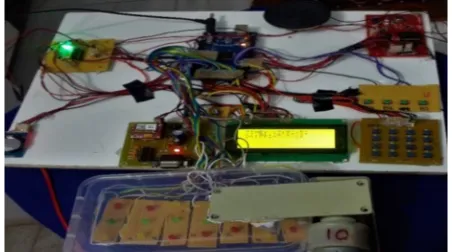
Now days the people are having busy scheduled life due to which it is common to suffer from diseases. Person suffering from small disease may also result in late recovery if not able to take right dosage at right time. This can even cause severe health issues. Also People those aged 45 or above forget to take the pills at time because of memory loss. To overcome these problems the proposed device is helpful. In this paper I am going to create a device consists of ARDUINO mega 2560 module, GSM module, LCD, keypad ,push button, RTC system and voice APR kit with speaker module. The device consists of a small box divided into seven compartments for storing pills for a week, each compartment is sub divided into 3 section. The box is connected to a real time clock, a microcontroller device Arduino mega 2560, which processes the activities and accordingly displays the pill details and time of intake on the LCD attached to the box and a GSM module which sends message to the family physician or members in case the pill is taken or not taken and also sends message about patient health condition. The real time clock will start beating and as it reaches the stipulated time of pill-intake, the audio will play on and message will be displayed on LCD and same is send to the doctor/keeper and patient and motor will open the door of device. The appropriate compartment led will glow indicating the patient to take medicine from that compartment.
Fig 1: Block diagram
B. Hardware & Software description
1) Arduino mega 2560 microcontroller: The Mega 2560 is a microcontroller board based on the ATmega2560. It has 54 digital input/output pins (of which 15 can be used as PWM outputs), 16 analog inputs, 4 UARTs (hardware serial ports), a 16 MHz crystal oscillator, a USB connection, a power jack, an ICSP header, and a reset button. It contains everything needed to support the microcontroller; simply connect it to a computer with a USB cable.
2) RTC module: The DS1307 serial real-time clock (RTC) is a low power, full binary-coded decimal (BCD) clock/calendar plus 56 bytes of NV SRAM. Address and data are transferred serially through an I2C, bidirectional bus. The clock/calendar provides seconds, minutes, hours, day, date, month, and year information. The end of the month date is automatically adjusted for months with fewer than 31 days, including corrections for leap year.
3) GSM: The GSM is one the wireless networks, it is a low power and low cost communication device. It requires a SIM (Subscriber Identity Module) card just like mobile phones to activate communication with the network. It follows attention commands to communicate with other devices.
4) LCD: Liquid crystal Display is used to display the commands for that particular gesture made. LCD of 20*4 dimension is used in this prototype. It means 20 characters per line and there are 4 such line. LCD shows the current time and date which RTC sends to LCD module.
5) LED: A light emitting diode is a two lead semiconductor light source. It is a p-n junction diode that emits light when activated.
6) Push button: Push button is a switch for controlling some part of the device. This are made up of a hard material, normally plastic or a metal.
7) Keypad: A 4x4 16 buttons keypad is used for the device. A matrix keypad consists of a set of push button or switches which are arranged in a matrix format of rows and columns. These keypads are available in configurations like 3×4 and 4×4 based on the application it is implemented for.
8) L293D IC: Motor Driver will drive DC motor depending upon signal received from microcontroller. Motor driver IC can drive maximum 2 motors. The L293D is an integrated circuit motor driver that can be used for simultaneous, bidirectional control of two small motors.
9) APR33A3: Maximum 8 messages can be Recorded & Playback by using APR33A3 module. To control this board from a Microcontroller connect the I/O port pins to M0 - M7. Make the particular Port pin LOW to play back the Recorded message.
10) Speaker: Speaker are one of the most common output device, speaker are transducer that convert electromagnetic waves into sound waves.
11) Arduino Software (IDE): The Arduino IDE (Integrated Development Environment) software has an editor to write a code also a toolbar for other functions and a menu series. For uploading a programme it is connected to the Arduino board through a USB cable. It also helps in communicating. It act as an interfacing between the speaker and the Arduino.
IV. RESULT
[image:3.612.193.419.581.707.2]The device helps in keeping track of regular medicine taking activities and reduces manual supervision and human effort. With simple circuitry and effort, the easy-to-use and cheap device comes as a boon for the young and the elderly, a simple solution for mothers for their adolescents, and caretakers for the aged and suffering. It can find its use in every household or hospital that has medical supervision problem and can be marketed as an efficient solution to us. This device is useful for those people that are taking pills regularly, for elderly and patient who need to take more than 3 different medicines in a day.
A. The desired output results are shown in the below figures:
1) The device time, date, month and year as well as the prescription details can be entered by selecting the below options:
Fig 3: Prescription details to be entered
Fig 4: Option 3 for setting the device date and time
[image:4.612.39.563.58.739.2]Fig 5: Option 1 for entering the start date of medicine
Fig 6: Option 2 for entering the information of different dosages
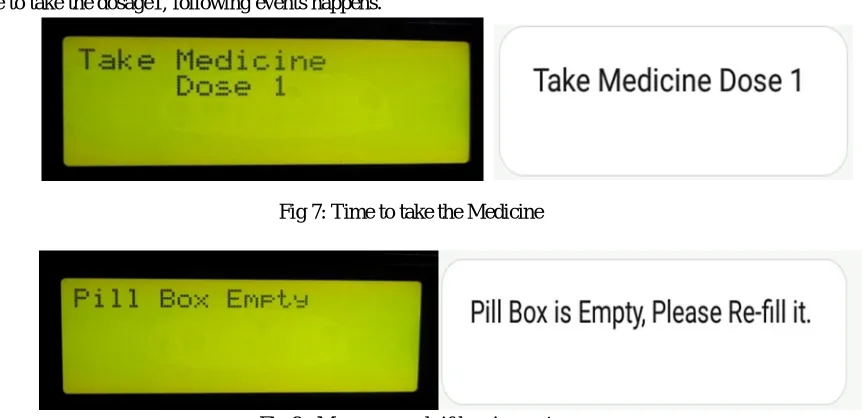
2) When time to take the dosage1, following events happens.
[image:4.612.183.427.94.484.2]
Fig 7: Time to take the Medicine
[image:4.612.101.532.500.709.2]
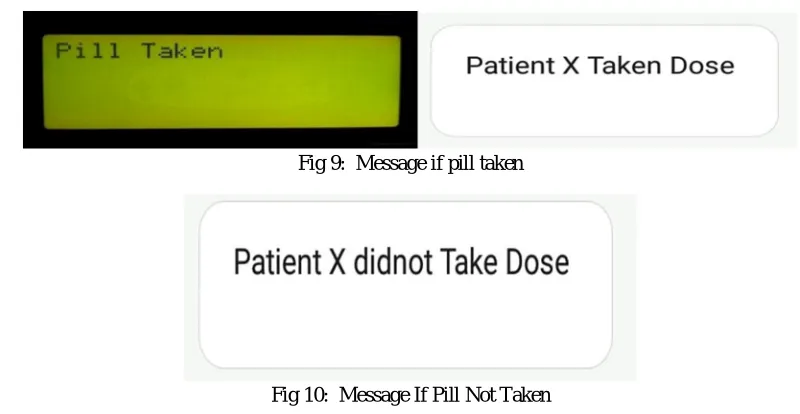
Fig 9: Message if pill taken
Fig 10: Message If Pill Not Taken
3) Patient’s health condition (good or bad).
Fig 11: Message if patient feeling well
Fig 12: Message if patient is not good
4) Last day of week, message send to doctor or keeper to fill the box.
Fig 13: Message sent to doctor/keeper to fill box
V. CONCLUSION
[image:5.612.101.501.72.279.2]REFERENCES
[1] T.L. Hayes, J.M. Hunt, A. Adami and J.A. Kaye, “An electronic pillbox for Continuous monitoring of medication adherence,” in Processing’s of the 28th IEEE EMBS Annual International Conference, Aug. 30-Sept. 3, 2006.
[2] G H.-W. Kuo, “Research and Implementation of Intelligent Medical Box”, M.S.thesis, Department of Electrical Engineering, I-Shou University, Kaohsiung, TW, 2009.
[3] Corey McCall, Branden Maynes, Cliff C. Zou, Ning J.Zhang, “An Automatic Medication Self-Management and Monitoring System for Independently Living Patients”, Med Eng Phys.2013.
[4] Kale Sapna, Bhadane, Ashwini, PawarPallavi, P.N.Achaliya, “An Android base Medication Reminder System based on OCR using ANN”, International Journal of Computer Applications (0975 – 8887) International Conference on Recent Trends in Engineering & Technology - 2013(ICRTET' 2013). [5] Priyadarshini, Ramya, Kalaiyarasi, “A Novel Approach of Microcontroller Based Automatic Medication Reminder (AMR) System for Patient”, International
Journal of Engineering and Technology Vol. 4 april4, 2015 page no. 974-978.