Interpreting and Generating Indirect
Answers
Nancy Green"
U n i v e r s i t y of N o r t h Carolina at G r e e n s b o r o
Sandra Carberry t
U n i v e r s i t y of D e l a w a r eThis paper presents an implemented computational model for interpreting and generating indirect answers to y e s - n o questions in English. Interpretation and generation are treated, respectively, as recognition of and construction of a responder's discourse plan for a full answer. An indirect answer is the result of the responder providing only part of the planned response, but intending for his discourse plan to be recognized by the questioner. Discourse plan construction and recognition make use of shared knowledge of discourse strategies, represented in the model by discourse plan operators. In the operators, coherence relations are used to characterize types of information that may accompany each type of answer. Recognizing a mutually plausible coherence relation obtaining between the actual response and a possible direct answer plays an important role in recognizing the responder's discourse plan. During generation, stimulus conditions model a speaker's motivation for selecting a satellite. Also during generation, the speaker uses his own interpretation capability to determine what parts of the plan are inferable by the hearer and thus do not need to be explicitly given. The model provides wider coverage than previous computational models for generating and interpreting indirect answers and extends the plan-based theory of implicature in several ways.
1. Introduction
In the following e x a m p l e , 1 Q asks a question in (1)i a n d R p r o v i d e s the r e q u e s t e d i n f o r m a t i o n in (1)iii, a l t h o u g h not explicitly giving (1)ii. (In this paper, w e use s q u a r e b r a c k e t s as in (1)ii to indicate i n f o r m a t i o n which, in o u r j u d g m e n t , the s p e a k e r in- t e n d e d to c o n v e y b u t d i d n o t explicitly state. For consistency, w e refer to the ques- tioner a n d r e s p o n d e r as Q a n d R, respectively. For readability, w e h a v e s t a n d a r d i z e d p u n c t u a t i o n a n d capitalization a n d h a v e o m i t t e d p r o s o d i c i n f o r m a t i o n f r o m sources since it is n o t u s e d in o u r model.)
(1) i. Q: Actually y o u ' l l p r o b a b l y get a car w o n ' t y o u as s o o n as y o u get there?
ii. R: [No.]
iii. I c a n ' t drive.
I n t e r p r e t i n g s u c h responses, w h i c h w e refer to as indirect answers, requires the h e a r e r to derive a c o n v e r s a t i o n a l i m p l i c a t u r e (Grice 1975). For e x a m p l e , the inference that R
Department of Mathematical Sciences, Greensboro, NC 27412-5001 t Department of Computer and Information Sciences, Newark, DE 19716
will not get a car on arrival, although licensed by R's use of (1)iii in some discourse contexts, is not a semantic consequence of the proposition that R cannot drive.
According to one study of spoken English (Stenstr6m 1984) (described in Sec- tion 2), 13% of responses to certain yes-no questions were indirect answers. Thus, a robust dialogue system should be able to interpret indirect answers. Furthermore, there are good reasons for generating an indirect answer instead of just a yes or no answer. First, an indirect answer m a y be considered more polite than a direct answer (Brown and Levinson 1978). For example, in (1)i, Q has indicated (by the manner in which Q expressed the question) that Q believes it likely that R will get a car. By avoiding explicit disagreement with this belief, the response in (1)iii would be considered more polite than a direct answer of (1)ii. Second, an indirect answer m a y be more efficient than a direct answer. For example, even if (1)ii is given, including (1)iii in R's response contributes to efficiency by forestalling and answering a possible follow-up of well, why not? from Q, which can be anticipated since the form of Q's question suggests that Q m a y be surprised by a negative answer. Third, an indirect answer m a y be used to avoid misleading Q (Hirschberg 1985), as illustrated in (2). 2
(2) i. Q: Have you gotten the letters yet? ii. R: I've gotten the letter from X.
This example illustrates a case in which, provided that R had gotten some but not all of the letters in question, just yes would be untruthful and just no would be misleading (since Q might conclude from the latter that R had gotten none of them).
We have developed a computational model, implemented in Common LISP, for interpreting and generating indirect answers to yes-no questions in English (Green 1994). By a yes-no question we mean one or more utterances used as a request by Q that R convey R's evaluation of the truth of a proposition p. Consisting of one or more utterances, an indirect answer is used to convey, yet does not semantically entail, R's evaluation of the truth of p, i.e., that p is true, that p is false, that p might be true, that p might be false, or that p is partially true. In contrast, a direct answer entails R's eval- uation of the truth of p. The model presupposes that Q and R mutually believe that Q's question has been understood by R as intended by Q, that Q's question is appro- priate, and that R can provide one of the above answers. Furthermore, it is assumed that Q and R are engaged in a cooperative and polite task-oriented dialogue. 3 The model is based upon examples of uses of direct and indirect answers found in tran- scripts of two-person telephone conversations between travel agents and their clients (SRI 1992), examples given in previous studies (Brown and Levinson 1978; Hirschberg 1985; Kiefer 1980; Levinson 1983; Stenstr6m 1984) and constructed examples reflecting our judgments.
To give an overview of the model, generation and interpretation are treated, re- spectively, as construction of and recognition of the responder's discourse plan spec- ification for a full answer. In general, a discourse plan specification (for the sake of brevity, hereafter referred to as discourse plan) explicitly relates a speaker's beliefs and discourse goals to his program of communicative actions (Pollack 1990). Dis- course plan construction and recognition make use of the beliefs that are presumed
2 (2) is Hirschberg's example (59).
Green and Carberry Indirect Answers
to be shared b y the participants, as well as shared k n o w l e d g e of discourse strategies, r e p r e s e n t e d in the m o d e l b y a set of discourse p l a n o p e r a t o r s e n c o d i n g generic pro- grams of c o m m u n i c a t i v e actions for c o n v e y i n g full answers. A full a n s w e r consists of a direct answer, w h i c h w e refer to as the nucleus, a n d "extra" a p p r o p r i a t e infor- mation, w h i c h w e refer to as the satellite(s). 4 In the operators, coherence relations are u s e d to characterize types of satellites that m a y a c c o m p a n y each t y p e of answer. S t i m u l u s c o n d i t i o n s are used to characterize the s p e a k e r ' s m o t i v a t i o n for including a satellite. A n indirect a n s w e r is the result of the speaker (R) expressing o n l y p a r t of the p l a n n e d response, i.e., omitting the direct a n s w e r (and possibly more), b u t intending for his discourse plan to be r e c o g n i z e d b y the hearer (Q). F u r t h e r m o r e , w e a r g u e that because of the role of i n t e r p r e t a t i o n in generation, Q's belief that R i n t e n d e d for Q to recognize the a n s w e r is w a r r a n t e d b y Q's recognition of the plan.
The inputs to the interpretation c o m p o n e n t of the m o d e l (a m o d e l of Q's inter- pretation of an indirect answer) are the semantic representation of the q u e s t i o n e d proposition, the semantic representation of the utterances given b y R d u r i n g R's turn, shared pragmatic k n o w l e d g e , a n d Q's beliefs, including those p r e s u m e d b y Q to be shared w i t h R. (Beliefs p r e s u m e d b y an a g e n t to be shared b y a n o t h e r agent are here- after referred to as s h a r e d beliefs, a n d those that are not p r e s u m e d to be shared as n o n s h a r e d beliefs). 5 The o u t p u t is a set of alternative discourse plans that m i g h t be ascribed to R b y Q, r a n k e d b y plausibility. R's inferred discourse p l a n p r o v i d e s the i n t e n d e d a n s w e r a n d possibly other i n f o r m a t i o n a b o u t R's beliefs a n d intentions. The inputs to the generation c o m p o n e n t (a m o d e l of R's construction of a response) are the semantic representation of the q u e s t i o n e d proposition, shared pragmatic k n o w l e d g e , and R's beliefs (both shared a n d nonshared). The o u t p u t of generation is R's discourse plan for a full answer, including a specification of w h i c h parts of the plan do not n e e d to be explicitly given b y R, i.e., w h i c h parts s h o u l d be inferable b y Q f r o m the rest of the answer. 6
This p a p e r describes the k n o w l e d g e a n d processes p r o v i d e d in o u r m o d e l for interpreting a n d generating indirect answers. (The m o d e l is not i n t e n d e d as a cogni- tive model, i.e., w e are not claiming that it reflects the participants' cognitive states d u r i n g the time course of c o m p r e h e n s i o n a n d generation. Rather, its p u r p o s e is to c o m p u t e the e n d p r o d u c t s of c o m p r e h e n s i o n a n d generation, a n d to contribute to a c o m p u t a t i o n a l t h e o r y of conversational implicature.) As b a c k g r o u n d , Section 2 de- scribes some relevant generalizations a b o u t questions a n d answers in English. Sec- tion 3 describes the r e v e r s i b l e k n o w l e d g e in o u r model, i.e., k n o w l e d g e u s e d b o t h in interpretation a n d generation of indirect answers. Sections 4 a n d 5 describe the inter- pretation a n d generation c o m p o n e n t s , respectively. Section 5 includes a description of additional pragmatic k n o w l e d g e required for generation. Section 6 p r o v i d e s an eval- uation of the work. Finally, the last section discusses future research and p r o v i d e s a summary.
4 This terminology was adopted from Rhetorical Structure Theory (Mann and Thompson 1983, 1988), discussed in Section 2.
5 Our notion of shared belief is similar to the notion of one-sided mutual belief (Clark and Marshall 1981). However, following Thomason (1990), a shared belief is merely represented in the conversational record as if it were mutually believed, although each participant need not actually believe it.
2. Background
This section b e g i n s w i t h s o m e results of a c o r p u s - b a s e d s t u d y of questions a n d re- s p o n s e s in English that p r o v i d e the m o t i v a t i o n for the n o t i o n of a full a n s w e r in o u r model. Next, w e describe i n f o r m a l l y h o w
coherence relations
(similar to subject- m a t t e r relations of Rhetorical Structure T h e o r y [ M a n n a n d T h o m p s o n 1983, 1988]) are u s e d to characterize the possible t y p e s of indirect a n s w e r s h a n d l e d in o u r m o d e l .2.1 Descriptive Study of Questions and Responses
S t e n s t r 6 m (1984) describes characteristics of q u e s t i o n s a n d r e s p o n s e s in English, b a s e d o n her s t u d y of a c o r p u s of 25 c o n v e r s a t i o n s (face-to-face a n d telephone). She f o u n d that 13% of r e s p o n s e s to p o l a r questions (typically e x p r e s s e d as subject-auxilliary in- v e r t e d questions) w e r e indirect a n s w e r s , a n d that 7% of r e s p o n s e s to r e q u e s t s for con- f i r m a t i o n (expressed as t a g - q u e s t i o n s a n d declaratives) w e r e indirect. 7 F u r t h e r m o r e , she p o i n t s o u t the similarity in function of indirect a n s w e r s to the extra i n f o r m a t i o n , r e f e r r e d to as qualify acts in h e r classification s c h e m e , often a c c o m p a n y i n g direct an- s w e r s (Stenstr/)m 1984). 8 S t e n s t r 6 m notes that b o t h are u s e d
• to a n s w e r a n implicit wh-question, as in (3), 9 (3) i. Q: I s n ' t y o u r c o u n t r y seat there s o m e w h e r e ?
ii. R: [Yes/No].
iii. Stoke d ' A b e r n o n . • for social reasons, as in (4),
(4) i. Q: D i d y o u go to his lectures? ii. R: [Yes.]
iii. O h he h a d a really caustic sense of h u m o u r actually. • to p r o v i d e a n explanation, as in (5),
(5) i. Q: A n d also d i d y o u find m y b l u e a n d g r e e n s t r i p e d tie? ii. R: [No.]
iii. I h a v e n ' t l o o k e d for it.
(6)
or to p r o v i d e clarification, as in (6).
i. Q: I d o n ' t think y o u ' v e b e e n u p s t a i r s yet. ii. R: [Yes, I h a v e b e e n upstairs.]
iii. U m o n l y just to the loo.
In the a b o v e e x a m p l e s , coherence w o u l d n o t b e affected b y m a k i n g the associated direct a n s w e r explicit. She s u g g e s t s that the m a i n distinction b e t w e e n qualify acts a n d indirect a n s w e r s is the a b s e n c e or p r e s e n c e of a direct answer.
7 Both of these types of requests are classified as yes-no questions in our model. Also, in Stenstr6m's scheme, an utterance may be classified as performing more than one function. For example, an utterance may be classified as both a polar question and a request for identification (i.e., an implicit wh-question).
8 Other types of acts noted by StenstrOm as possibly accompanying direct answers, amplify and expand, are not relevant to the problem of modeling indirect answers,
Green and Carberry Indirect Answers
Thus, in o u r m o d e l , the n o t i o n of a full a n s w e r is u s e d to m o d e l b o t h indirect a n s w e r s a n d direct a n s w e r s a c c o m p a n i e d b y qualify acts. A full a n s w e r consists of a direct answer, w h i c h w e refer to as the nucleus, a n d p o s s i b l y extra i n f o r m a t i o n of v a r - ious types, w h i c h w e refer to as satellites} ° Then, a n indirect a n s w e r can b e m o d e l e d as the result of R giving one or m o r e satellites of the full answer, w i t h o u t giving the n u c l e u s explicitly, b u t i n t e n d i n g for the full a n s w e r to be recognized. A benefit of this a p p r o a c h is that it also can b e u s e d to m o d e l the g e n e r a t i o n of qualify acts a c c o m - p a n y i n g direct a n s w e r s . (That is, a qualify act w o u l d b e a result of R p r o v i d i n g the satellite(s) a l o n g w i t h a n explicit nucleus.) In the next section, w e i n f o r m a l l y describe h o w different t y p e s of satellites of full a n s w e r s (i.e., t y p e s of indirect a n s w e r s ) can be characterized.
2.2 Characterizing Types of Indirect Answers
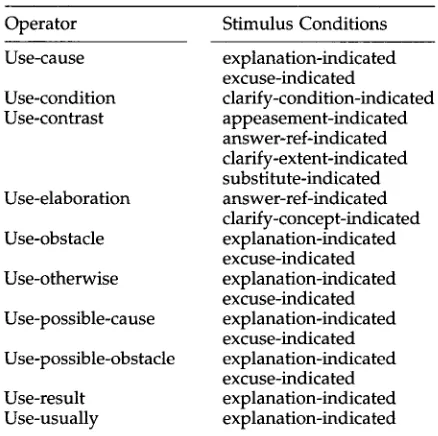
C o n s i d e r the c o n s t r u c t e d r e s p o n s e s s h o w n in (1) t h r o u g h (5) of Table 1, w h i c h are r e p r e s e n t a t i v e of the t y p e s of full a n s w e r s h a n d l e d in o u r m o d e l , u The (a) sentences are yes-no questions a n d each (b) sentence expresses a possible t y p e of direct answer. 12 Each of the sentences labeled (c) t h r o u g h (e) could a c c o m p a n y the p r e c e d i n g (b) sen- tence in a full answer, ~3 or could be u s e d w i t h o u t (b), i.e., as a n indirect a n s w e r u s e d to c o n v e y the a n s w e r g i v e n in (b). Also, to the right of e a c h of the (c)-(e) sentences is a n a m e i n t e n d e d to s u g g e s t the t y p e of relation h o l d i n g b e t w e e n that sentence a n d the associated (b) sentence. For e x a m p l e , (lc) p r o v i d e s a condition for the t r u t h of (lb), (ld) elaborates u p o n (lb), a n d (le) p r o v i d e s the a g e n t ' s m o t i v a t i o n for (lb). M a n y of these relations are similar to the s u b j e c t - m a t t e r relations of Rhetorical Structure The- o r y (RST) ( M a n n a n d T h o m p s o n 1983, 1988), a general t h e o r y of discourse coherence. Thus, w e refer to these as coherence relations. O t h e r sentences p r o v i d i n g the s a m e t y p e of i n f o r m a t i o n , i.e., satisfying the s a m e coherence relation, c o u l d b e s u b s t i t u t e d for each (c)-(e) sentence w i t h o u t d e s t r o y i n g coherence. For e x a m p l e , a n o t h e r p l a u - sible condition could be s u b s t i t u t e d for (lc). Thus, as this table illustrates, a small set of coherence relations characterizes a w i d e r a n g e of possible indirect a n s w e r s } 4 F u r t h e r m o r e , as it illustrates, certain coherence relations are characteristic of o n l y one or t w o t y p e s of answer, e.g., g i v i n g a cause instead of yes, or a n obstacle i n s t e a d of no.
To give a brief o v e r v i e w of Rhetorical Structure T h e o r y as it relates to o u r m o d e l , o n e of the goals of RST is to p r o v i d e a set of relations for describing the o r g a n i z a t i o n of c o h e r e n t text. A n RST relation is d e f i n e d as a relation b e t w e e n t w o text spans, called the n u c l e u s a n d satellite. The n u c l e u s is the s p a n w h i c h is " m o r e essential to the w r i t e r ' s p u r p o s e [than the satellite is]" ( M a n n a n d T h o m p s o n 1988, 266). A relation definition p r o v i d e s a set of constraints on the n u c l e u s a n d satellite, a n d a n effect field. A c c o r d i n g to RST, implicit relational p r o p o s i t i o n s are c o n v e y e d in discourse.
10 As noted earlier, this terminology is borrowed from Rhetorical Structure Theory, described below. 11 Constructed examples are used here to provide a concise means of demonstrating the classes of
satellites.
12 Specifically, the possible types of direct answers handled in the model are: (lb) that p is true, (2b) that p is false, (3b) that there is some truth to p, (4b) that p may be true, or (5b) that p may be false, where p is the questioned proposition.
13 When more than one of the (c)-(e) sentences is used in the same response, coherence may be improved by use of discourse connectives.
Table 1
Examples of coherence relations in full answers. 1.
2.
3.
4.
5.
a. Are you going shopping tonight? b. Yes.
c. If I finish my homework. d. I ' m going to the mall. e. I need new running shoes.
a. Aren't you going shopping tonight?
b. No.
c. I wouldn't have enough time to study. d. My car's not running.
e. I ' m going tomorrow night. a. Is dinner ready?
b. To some extent. c. The pizza is ready. a. Is Lynn here? b. I think so.
c. Her books are here. d. She's usually here all day.
e. I think she has a meeting here at 5. a. Is Lynn here?
b. I don't think so. c. Her books are gone.
d. She's not usually here this late. e. I think she has a dentist appointment
this afternoon.
Condition Elaboration Cause
Otherwise Obstacle Contrast
Contrast
Result Usually Possible Cause
Result Usually
Possible Obstacle
For e x a m p l e , (7) c o n v e y s , in a d d i t i o n to the p r o p o s i t i o n a l content of (7)i a n d (7)ii, the relational p r o p o s i t i o n that the 1899 D u r y e a is in the w r i t e r ' s collection of classic cars. 15
(7) i. I love to collect classic a u t o m o b i l e s . ii. M y favorite car is m y 1899 D u r y e a .
Such relational p r o p o s i t i o n s are d e s c r i b e d in RST in a relation definition's effect field. The o r g a n i z a t i o n of (7) w o u l d b e d e s c r i b e d in RST b y the relation of Elaboration, w h e r e (7)i is the n u c l e u s a n d (7)ii a satellite. To see the usefulness of RST for the analysis of full a n s w e r s to yes-no questions, consider (8).
(8)
i. Q: Do y o u collect classic a u t o m o b i l e s ? ii. R: Yes.iii. I recently p u r c h a s e d a n A u s t i n - H e a l e y 3000.
A l t h o u g h (8)ii is n o t s e m a n t i c a l l y entailed b y (8)iii, R could u s e (8)iii alone in r e s p o n s e to (8)i to c o n v e r s a t i o n a l l y implicate (8)ii. Further, just as (7)ii p r o v i d e s a n e l a b o r a t i o n
Green and Carberry Indirect Answers
Table 2
Similar RST relations. Coherence Relation Cause
Condition Contrast Elaboration Obstacle Otherwise Possible-cause Possible-obstacle Result
Usually
Similar RST Relation Name(s)
Non-Volitional Cause, Purpose, Volitional Cause Condition
Contrast Elaboration Otherwise
Non-Volitional Result, Volitional Result
of (7)i, (8)iii p r o v i d e s an e l a b o r a t i o n of (8)ii, w h e t h e r (8)ii is g i v e n explicitly as a n a n s w e r or not. 16 Also, in giving just (8)iii as a response, R i n t e n d s Q to recognize not o n l y (8)ii b u t also this relation, i.e., that the car is p a r t of R's collection.
Table 2 lists, for e a c h of the coherence relations d e f i n e d in o u r m o d e l ( s h o w n in the left-hand column), similar RST relations ( s h o w n in the r i g h t - h a n d column), if any. A l t h o u g h other RST relations can b e u s e d to describe other p a r t s of a r e s p o n s e (e.g., Restatement), o n l y relations that contribute to the i n t e r p r e t a t i o n of indirect a n s w e r s are i n c l u d e d in o u r m o d e l . The f o r m a l r e p r e s e n t a t i o n of the coherence relations p r o v i d e d in o u r m o d e l is discussed in Section 3.
3. Reversible K n o w l e d g e
As s h o w n i n f o r m a l l y in the p r e v i o u s section, coherence relations can be u s e d to char- acterize v a r i o u s t y p e s of satellites of full answers. C o h e r e n c e rules, d e s c r i b e d in Sec- tion 3.1, p r o v i d e sufficient conditions for the m u t u a l plausibility of a coherence rela- tion. D u r i n g generation, plausibility of a coherence relation is e v a l u a t e d w i t h respect to the beliefs that R p r e s u m e s to be s h a r e d w i t h Q. D u r i n g interpretation, the s a m e rules are e v a l u a t e d w i t h respect to the beliefs Q p r e s u m e s to be s h a r e d w i t h R. Thus, d u r i n g g e n e r a t i o n R a s s u m e s that a coherence relation that is plausible w i t h respect to his s h a r e d beliefs w o u l d be plausible to Q as well. That is, Q o u g h t to be able to recognize the implicit relation b e t w e e n the n u c l e u s a n d satellite.
H o w e v e r , the g e n e r a t i o n a n d i n t e r p r e t a t i o n of indirect a n s w e r s requires a d d i t i o n a l k n o w l e d g e . For e x a m p l e , for R's c o n t r i b u t i o n to b e r e c o g n i z e d as an answer, there m u s t be a discourse e x p e c t a t i o n (Levinson 1983; R e i c h m a n 1985) of an answer. Also, d u r i n g interpretation, for a p a r t i c u l a r a n s w e r to be licensed b y R, the attribution of R's intention to c o n v e y that a n s w e r m u s t be consistent w i t h Q ' s beliefs a b o u t R's intentions. For e x a m p l e , a p u t a t i v e i m p l i c a t u r e that p h o l d s w o u l d n o t be licensed if R p r o v i d e s a disclaimer that it is not R's intention to c o n v e y that p holds. This a n d other t y p e s of k n o w l e d g e a b o u t full a n s w e r s is r e p r e s e n t e d as discourse p l a n operators, described in Section 3.2. In o u r m o d e l , a discourse p l a n o p e r a t o r c a p t u r e s shared, d o m a i n - i n d e p e n d e n t k n o w l e d g e that is used, a l o n g w i t h coherence rules, b y
It is mutually plausible to the agent that (cr-obstacle q p) holds,
where q is the proposition that a state Sq does not hold during time period tq, and p is the proposition that an event e v does not occur during time period t v, if the agent believes it to be mutually believed that Sq is a precondition
of a typical plan for doing ev, and that tq is before or includes tv,
unless it is mutually believed that sq does hold during
tq,
or that ep does occur during tp.
It is mutually plausible to the agent that (cr-obstacle q p) holds,
where q is the proposition that a state sq holds during time period tq, and p is the proposition that a state sv does not hold during time period tv, if the agent believes it to be nmtually believed that 8q typically prevents sp, and that tq is before or includes tv,
unless it is mutually believed that Sq does not hold during
lq,
or that s v does hold during t v.
Figure 1
Glosses of two coherence rules for cr-obstacle.
the g e n e r a t i o n c o m p o n e n t to construct a discourse p l a n for a full answer. Interpreta- tion is m o d e l e d as inference of R's discourse p l a n f r o m R's response u s i n g the same set of discourse p l a n operators a n d coherence rules. Inference of R's discourse p l a n can account for h o w Q derives an implicated answer, since a discourse p l a n explicitly represents the relationship of R's c o m m u n i c a t i v e acts to R's beliefs a n d intentions. Together, the coherence rules a n d discourse p l a n operators described in this section m a k e u p the reversible pragmatic k n o w l e d g e , i.e., p r a g m a t i c k n o w l e d g e u s e d b y b o t h the g e n e r a t i o n a n d interpretation c o m p o n e n t s , of the model. O t h e r p r a g m a t i c k n o w l - edge, u s e d only b y the g e n e r a t i o n process to constrain content planning, is p r e s e n t e d in Section 5.
3.1 Coherence Rules
Coherence rules specify sufficient conditions for the plausibility to an a g e n t w i t h re- spect to the agent's shared beliefs (which w e hereafter refer to as the m u t u a l p l a u s i - bility) of a relational p r o p o s i t i o n (CR q p), w h e r e CR is a coherence relation a n d q a n d p are propositions. (Thus, if the relational p r o p o s i t i o n is plausible to R w i t h respect to the beliefs that R p r e s u m e s to be shared w i t h Q, R assumes that it w o u l d be plausible to Q, too.) To give some examples, glosses of some rules for the coherence relation, w h i c h w e refer to as cr-obstacle are given in Figure 1.17 The first rule characterizes a subclass of cr-obstacle, illustrated in (9), relating the n o n o c c u r r e n c e of an agent's voli- tional action (reported in (9)ii) to the failure of a p r e c o n d i t i o n (reported in (9)iii) of a potential p l a n for d o i n g the action.
(9)
i. Q: Are y o u going to c a m p u s tonight? ii. R: No.iii. M y car's not running.
Green and Carberry Indirect Answers
In other w o r d s , it is m u t u a l l y plausible to an agent that the propositions c o n v e y e d in (9)iii a n d (9)ii are related b y
cr-obstacle,
p r o v i d e d that the agent has a shared belief that a typical plan for R to go to c a m p u s has a p r e c o n d i t i o n that R's car is running. The second rule in Figure 1 characterizes a n o t h e r subclass ofcr-obstacle,
illustrated in (10), relating the failure of one condition (reported in (10)i) to the satisfaction of a n o t h e r condition (reported in (10)ii).(10) i. R: M y car's n o t running. ii. The timing belt is broken.
In other words, it is m u t u a l l y plausible to an agent that the propositions c o n v e y e d in (10)ii a n d (10)i are related b y
cr-obstacle,
p r o v i d e d that the agent has a shared belief that h a v i n g a b r o k e n timing belt typically prevents a car from running.Coherence rules are e v a l u a t e d w i t h respect to an agent's shared beliefs. Coherence rules a n d the agent's beliefs are e n c o d e d as H o r n clauses in the i m p l e m e n t a t i o n of o u r model. The sources of an agent's shared beliefs include:
terminological k n o w l e d g e : e.g., that driving a car is a t y p e of action, d o m a i n k n o w l e d g e , including
- - d o m a i n p l a n n i n g k n o w l e d g e : e.g., that a subaction of a typical plan to go to c a m p u s is to drive to campus, a n d that a typical plan for driving a car has a p r e c o n d i t i o n that the car is running,
- - other d o m a i n k n o w l e d g e : e.g., that a b r o k e n timing belt typically p r e v e n t s a car f r o m running, a n d
• the discourse context: e.g., that R has asserted that R's car is not running.
3.2 D i s c o u r s e Plan O p e r a t o r s
The discourse plan operators p r o v i d e d in the m o d e l e n c o d e generic p r o g r a m s for expressing full answers (and s u b c o m p o n e n t s of full answers). TM For example, the dis-
course plan operators for constructing full
yes (Answer-yes)
a n d fullno (Answer-no)
answers are s h o w n in Figure 2.19
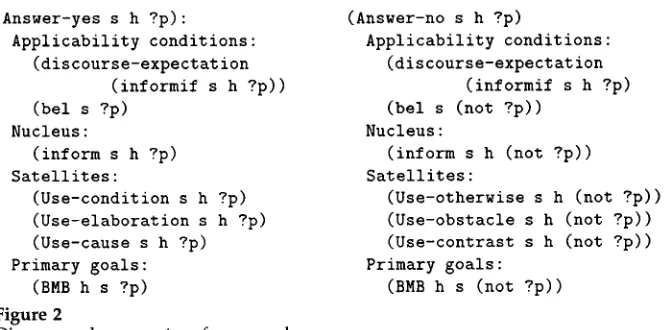
The first line of a discourse p l a n operator, its h e a d e r , e.g.,
(Answer-yes s h ?p),
gives the t y p e of discourse action, the participants (s denotes the speaker a n d h the hearer), a n d a propositional variable. (Propositional variables are d e n o t e d b y symbols prefixed with "?".) In top-level operators such asAnswer-yes
a n dAnswer-no,
the h e a d e r vari- able w o u l d be instantiated w i t h the q u e s t i o n e d proposition. A p p l i c a b i l i t y c o n d i t i o n s ,w h e n instantiated, specify necessary conditions for a p p r o p r i a t e use of a discourse p l a n operator. 2° For example, the first applicability condition of
Answer-yes
a n dAnswer-no
requires the speaker a n d hearer to share the discourse expectation that the speaker will i n f o r m the hearer of the s p e a k e r ' s e v a l u a t i o n of the t r u t h of the q u e s t i o n e d p r o p o s i t i o n p. Present in each of the five top-level a n s w e r operators, this particular applicability condition restricts the use of these operators to contexts w h e r e an a n s w e r is expected,
18 The particular formalism we adopted to encode the operators was chosen to provide a concise and perspicuous organization of the knowledge required for our interpretation and generation components. We make no further claims about the formalism itself.
19 There are three other "top-level" operators in the model for expressing the remaining types of full answers illustrated in Table 1.
(Answer-yes s h ?p): Applicability conditions:
(discourse-expectation (informif s h ?p)) (bel s ?p)
Nucleus:
(inform s h ?p) Satellites:
(Use-condition s h ?p) (Use-elaboration s h ?p) (Use-cause s h ?p) Primary goals:
(BMB h s ?p)
Figure 2
(Answer-no s h ?p)
Applicability conditions: (discourse-expectation
(informif s h ?p) (bel s (not ?p))
Nucleus:
(inform s h (not ?p)) Satellites:
(Use-otherwise s h (not ?p)) (Use-obstacle s h (not ?p)) (Use-contrast s h (not ?p)) Primary goals:
(BMB h s (not ?p))
Discourse p l a n operators for yes and no answers.
a n d is n e e d e d t o a c c o u n t f o r t h e h e a r e r ' s a t t e m p t t o i n t e r p r e t a r e s p o n s e a s a n a n - s w e r , e v e n w h e n it is n o t a d i r e c t a n s w e r , m T h e s e c o n d a p p l i c a b i l i t y c o n d i t i o n o f t h e t o p - l e v e l o p e r a t o r s r e q u i r e s t h e s p e a k e r to h o l d t h e e v a l u a t i o n o f p t o b e c o n v e y e d ; e.g., i n A n s w e r - n o it r e q u i r e s t h a t t h e s p e a k e r b e l i e v e t h a t p is false. T h e p r i m a r y g o a l s o f a d i s c o u r s e p l a n s p e c i f y t h e d i s c o u r s e g o a l s t h a t t h e s p e a k e r i n t e n d s f o r t h e h e a r e r to r e c o g n i z e , n F o r e x a m p l e , t h e p r i m a r y g o a l o f A n s w e r - y e s c a n b e g l o s s e d a s t h e g o a l t h a t Q w i l l a c c e p t t h e yes a n s w e r , a t l e a s t for t h e p u r p o s e s o f t h e c o n v e r s a t i o n . 23
T h e n u c l e u s a n d s a t e l l i t e s o f a d i s c o u r s e p l a n d e s c r i b e p r i m i t i v e o r n o n p r i m i t i v e a c t s t o b e p e r f o r m e d to a c h i e v e t h e p r i m a r y g o a l s o f t h e p l a n . 24 I n f o r m is a p r i m i t i v e act t h a t c a n b e r e a l i z e d d i r e c t l y . T h e n o n p r i m i t i v e a c t s a r e d e f i n e d b y d i s c o u r s e p l a n o p e r a t o r s t h e m s e l v e s . ( T h u s , a d i s c o u r s e p l a n m a y h a v e a h i e r a r c h i c a l s t r u c t u r e . ) A f u l l a n s w e r m a y c o n t a i n z e r o , o n e , o r m o r e i n s t a n c e s o f e a c h t y p e o f s a t e l l i t e , a n d t h e d e f a u l t ( b u t n o t r e q u i r e d ) o r d e r o f n u c l e u s a n d s a t e l l i t e s i n a f u l l a n s w e r is t h e o r d e r g i v e n i n t h e c o r r e s p o n d i n g o p e r a t o r .
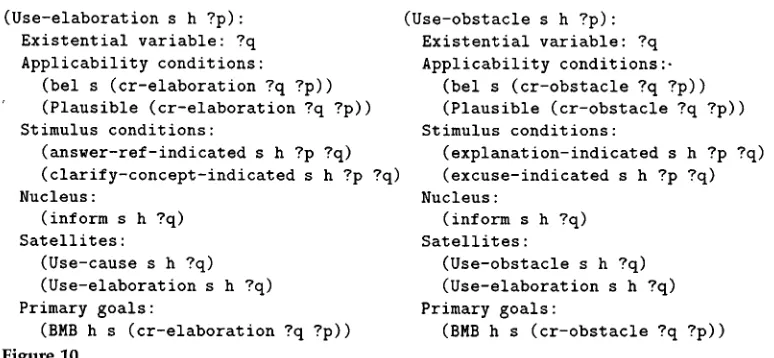
C o n s i d e r t h e Use-elaboration a n d Use-obstacle d i s c o u r s e p l a n o p e r a t o r s , s h o w n i n F i g u r e 3, d e s c r i b i n g p o s s i b l e s a t e l l i t e s o f A n s w e r - y e s a n d A n s w e r - n o , r e s p e c t i v e l y . A l l s a t e l l i t e o p e r a t o r s i n c l u d e a s e c o n d p r o p o s i t i o n a l v a r i a b l e r e f e r r e d to a s t h e e x i s t e n t i a l
21 Without recourse to the notion of discourse expectation, it is difficult to account for the interpretation in (9)iii of My car's not running as The speaker is not going to campus tonight, while blocking interpretations such as The speaker will rent a car. Note that the latter interpretation may be licensed when the discourse expectation is that R will provide an answer to Are you going to rent a car? In general, discourse expectations provide a contextual constraint on what inferences are licensed by the speaker. (Similarly, it has been argued that scalar implicatures depend on the existence of a salient partially ordered set in the discourse context; see Section 4.3.) For a discussion of the overall role of discourse expectations in our model, see Section 4.2. One might argue that this type of applicability condition limits the generality of the operators and thus, could lead to a proliferation of context-specific operators, which would result in inefficient processing. First, we are not claiming that all discourse operators require this type of applicability condition, only those operators characterizing discourse-expectation-motivated units of discourse. Second, with an indexing scheme sensitive to discourse expectations, this would not necessarily lead to efficiency problems.
22 We refer to these as primary to distinguish them from other discourse goals the speaker may have but that he does not necessarily intend for the hearer to recognize.
23 During interpretation (see Section 4.1), in order for the implicature to be licensed, the applicability conditions and primary goals of any plan ascribed to R must be consistent with Q's beliefs about R's beliefs and goals. Thus, applicability conditions and primary goals play an important role in canceling spurious putative implicatures.
[image:10.468.60.392.59.224.2]Green and Carberry Indirect Answers
(Use-elaboration s h ?p): Existential variable: ?q Applicability conditions:
(bel s (cr-elaboration ?q ?p)) (Plausible (cr-elaboration ?q ?p)) Nucleus:
(inform s h ?q) Satellites:
(Use-cause s h ?q) (Use-elaboration s h ?q) Primary goals:
(BMB h s (cr-elaboration ?q ?p))
Figure 3
Two satellite discourse plan operators.
(Use-obstacle s h ?p): Existential variable: ?q Applicability conditions:
(bel s (cr-obstacle ?q ?p)) (Plausible (cr-obstacle ?q ?p)) Nucleus:
(inform s h ?q) Satellites:
(Use-obstacle s h ?q) (Use-elaboration s h ?q) Primary goals:
(BMB h s (cr-obstacle ?q ?p))
variable. For example, (9)ii-(9)iii could be described by a plan constructed from an Answer-no discourse plan operator
whose header variable is instantiated with the proposition p that R is going to campus tonight, and
which has a satellite constructed from a Use-obstacle discourse plan operator whose header variable is instantiated with (not p), the
proposition that R is not going to campus tonight, and whose existential variable q is instantiated with the proposition that R's car is not running. In general, each satellite operator in our model has applicability conditions and primary goals analogous to those shown in Figure 3. (Each satellite operator has a name of the form, Use-CR, where CR is the name of a coherence relation.) The first ap- plicability condition of a satellite operator, Use-CR, requires that the speaker believes that the relational proposition (CR q p) holds for propositions q and p instantiating the existential variable and header variable, respectively. The second applicability condi- tion requires that, given the beliefs that the speaker presumes to be shared with the hearer, this relational proposition is plausible. (Mutual plausibility is evaluated using the coherence rules described in Section 3.1.) The primary goal of a satellite operator can be glossed as the goal that the hearer will accept the relational proposition. 4. Interpretation
This section describes the interpretation process. In our model, implicated answers are derived by an answer recognizer. Algorithms for the answer recognizer are de- scribed in Section 4.1. Of course, dialogue consists of more than questions and answers. Section 4.2 describes the role of the answer recognizer in a discourse-processing ar- chitecture. Finally, Section 4.3 discusses how this model relates to previous models of conversational implicature.
4.1 Answer Recognizer
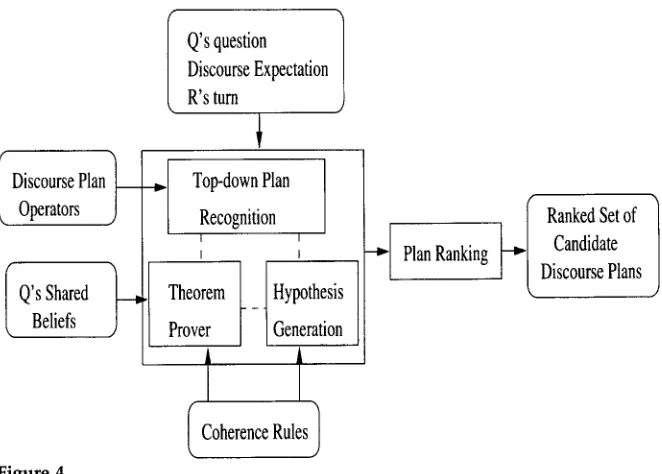
4.1.1 Main Algorithm. The structure of the answer recognizer is shown in Figure 4. The inputs to the answer recognizer include:
I DiscoursePlanl
Operators
I Q's Shared ~_~
Beliefs
Q's question
Discourse Expectation
R's turn
_l Top-down Plan
r
Recognition
I I
Theorem t -[ Hypothesis
Prover
Generation
[image:12.468.54.385.59.296.2]Coherence Rules I
Figure 4
Structure of the answer recognizer.
~~I Ranked Set of
--~ Plan Ranking
Candidate
Discourse Plans
•
Q's beliefs (including the discourse expectation that R will provide an
answer to the questioned proposition p),
•
the semantic representation of p, and
•
for each utterance performed by R during R's turn, the type of
communicative act signaled by its form (e.g., to inform), and the
semantic representation of its content. 25
Answer recognition is performed in two phases. The goal of the first phase is to derive
a set of candidate discourse plans plausibly underlying R's response. The first phase
makes use of two subcomponents: one that we refer to as the hypothesis
generationcomponent, and a theorem prover. The output of the first phase of answer recognition
is a set of candidate discourse plans since there may be alternate interpretations of R's
response. The goal of the second phase of answer recognition is to evaluate the relative
plausibility of each candidate discourse plan. The final output of answer recognition
consists of a partially ordered set of the candidates ranked by plausibility.
Plan recognition is primarily top-down, i.e., expectation-driven. More specifically,
Q26
attempts to interpret the response as having been generated from a discourse
plan constructed from the discourse plan operators for full answers. The problem of
reconstructing R's discourse plan has several aspects (to be described in more detail
shortly):
•
Instantiating discourse plan operators with the questioned proposition
and appropriate propositions from R's response.
25 The turn in question need not be the turn immediately following Q's asking of the question, as discussed in Section 4.2. Also, we make the simplifying assumption that R's answer is given within a single turn.
Green and Carberry Indirect Answers
•
Consistency checking:
d e t e r m i n i n g w h e t h e r the beliefs a n d goals that w o u l d be attributed to R b y virtue of ascribing a particular discourse plan to R are consistent w i t h Q's beliefs a b o u t R's beliefs a n d goals. •Coherence evaluation:
d e t e r m i n i n g w h e t h e r a p u t a t i v e satellite of a candidate p l a n is plausibly coherent, i.e., given a candidate plan's (or subplan's) nucleus p r o p o s i t i o n p, p u t a t i v e satellite p r o p o s i t i o n q, a n d the p u t a t i v e satellite's coherence relation CR, d e t e r m i n i n g w h e t h e r Qbelieves that (CR q p) is m u t u a l l y plausible. C o h e r e n c e evaluation m a k e s use of the coherence rules described in Section 3.1.
•
Hypothesis generation:
h y p o t h e s i z i n g a n y "missing p a r t s " of the response that are r e q u i r e d in o r d e r to assimilate acts in R's response into a coherent candidate plan. H y p o t h e s i s g e n e r a t i o n also m a k e s use of the coherence rules.Initially, the h e a d e r variable of each "top-level" a n s w e r discourse p l a n o p e r a t o r 27 is instantiated w i t h the q u e s t i o n e d p r o p o s i t i o n p, i.e., all occurrences of the h e a d e r variable are replaced w i t h p. Next, consistency checking is p e r f o r m e d to eliminate a n y candidates w h o s e applicability conditions or p r i m a r y goals are not consistent w i t h Q's beliefs a b o u t R's beliefs a n d goals. For all r e m a i n i n g candidates, the a n s w e r recognizer next a t t e m p t s to recognize an act f r o m R's t u r n as the nucleus of the plan, i.e., to check w h e t h e r R gave a direct answer. If no acts in R's t u r n m a t c h the nucleus, then the n u c l e u s is m a r k e d as h y p o t h e s i z e d . For all remaining acts in R's turn, the a n s w e r recognizer attempts to recognize all possible satellites, as specified in each remaining candidate plan. In the m o d e l the discourse p l a n operators do not specify a required o r d e r i n g of satellites. 2s The s u b p r o c e d u r e of
satellite recognition
is described in m o r e detail in Section 4.1.2.4.1.2 Satellite Recognition. Satellite recognition is the (recursive) process of recogniz- ing an instance of a satellite of a candidate plan. The inputs consist of:
• sat-op, a discourse p l a n o p e r a t o r for a possible satellite,
• the p r o p o s i t i o n p c o n v e y e d b y the nucleus of the higher-level plan (i.e., the plan w h o s e satellites are currently being recognized),
• act-list, a list of acts in R's t u r n that h a v e not yet b e e n assimilated into
the candidate plan,
• cur-act, the current act (inform s h q) in act-list, w h e r e s is the speaker, h is the hearer, a n d q is the propositional content of the act.
The o u t p u t is a set (possibly e m p t y ) of candidate instances of sat-op. To give a sim- plified, p r e l i m i n a r y version of the algorithm, first, the h e a d e r variable and existential variable of sat-op are instantiated with p a n d q, respectively. Then, coherence evalu- ation a n d consistency checking are p e r f o r m e d . If successful, cur-act is r e c o g n i z e d to
27 Five of these are defined in our model, corresponding to the five types of answers illustrated in Table 1. 28 The operators do specify a preferred order, however, which is used in generation. Also, our process
A n s w e r - n o
[ii] Use-obstacle
[iii]
Use-obstacle [image:14.468.56.223.59.210.2]1v Figure 5
Candidate discourse plan with hypotheses.
be the nucleus of
sat-op,
a n d for each remaining act inact-list,
satellite recognition is p e r f o r m e d for each satellite ofsat-op.
However, the satellite recognition algorithm as described so far w o u l d not be able to handle R's response in (11), since there is no plausible coherence relation in the model directly relating (11)iv to (11)ii (or to a n y other direct answer that could be recognized in the model).
(11) i. Q: Are y o u driving to c a m p u s tonight? ii. R: [No.]
iii. [My car's not running.]
iv. M y car has a broken timing belt.
Whenever the answer recognizer is unable to recognize
cur-act
as the nucleus ofsat-op,
a subprocedure we refer to as hypothesis generation is invoked. Hypothesis genera- tion will be described in detail in the following section. It returns a set of alternative hypothesized propositions, each of which represents the content of a possible implicit
inform
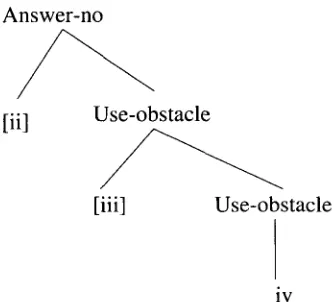
act to be inserted at the current point of e x p a n d i n g the candidate plan. 29 In this example, the proposition conveyed in (11)iii w o u l d be returned as a h y p o t h e s i z e d proposition, w h i c h is used to instantiate the existential variable of aUse-obstacle
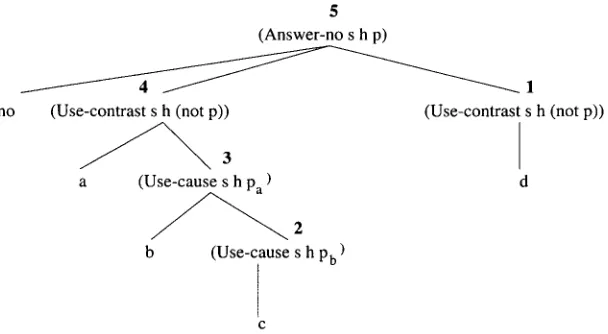
satel- lite, thereby enabling satellite recognition to proceed. Then, (11)iv can be recognized (without hypothesis generation being required) as a satellite of (11)iii. Ultimately, the plan s h o w n in Figure 5 w o u l d be inferred. (Only the hierarchical structure a n d com- municative acts are shown. By convention, the left-most child of a n o d e is the nucleus and its siblings are the satellites. Labels of sentences in (11) that could realize a leaf n o d e are used to label the node. H y p o t h e s i z e d nodes are indicated b y square brack- ets.) The complete satellite recognition algorithm, e m p l o y i n g hypothesis generation, is given in Figure 6.Green and Carberry Indirect Answers
INPUT
OUTPUT
p: proposition from nucleus of higher-level plan cur-act: current act, (inform s h q), to be recognized act-list: list of remaining acts in R's turn
op: discourse plan operator (Use-CR s h ?p) sat-cand-set: set of candidate instances of op
underlying part of R's response 1. Instantiate header variable ?p of op with p.
2. Instantiate existential variable ?q of op with q of cur-act. a. Prove that it is plausible that q and p are related by CR.
If not, go to step 2c.
b. Check consistency. If not consistent, then go to step 2c; else go to step 3a.
c. Try substituting each q returned by hypothesis generation for ?q: Check consistency and coherence as in steps 2a and 2b.
For each q passing both checks, proceed with step 3b. If none pass, then fail.
3. a. Mark cur-act as used. Go to step 4. b. Mark nucleus as hypothesized.
4. For each unused act in act-list, attempt to recognize each satellite of op.
Figure 6
Satellite recognition algorithm.
4.1.3 Hypothesis Generation. Based upon the assumption that the response is co- herent, the goal of hypothesis generation is to fill in missing parts of a candidate plan in such a way that an utterance in R's turn can be recognized as part of the plan. The use of hypothesis generation broadens the coverage of our model to cases where more is missing from a full answer than just the nucleus of a top-level op- erator. (From the point of view of generation, it enables the construction of a more concise, though no less informative, response.) The hypothesis generation algorithm constructs chains of mutually plausible propositions, each beginning with the propo- sition (e.g., the proposition conveyed in (11)iv) to be related to a goal proposition in a candidate plan (e.g., the proposition conveyed in (11)ii), and ending with the goal proposition, where each pair of adjacent propositions in the chain is linked by a plau- sible coherence relation. The algorithm returns the proposition (e.g., the proposition conveyed in (11)iii) immediately preceding the goal proposition in each chain. Thus, when top-down recognition has reached an impasse, hypothesis generation (a type of bottom-up data-driven reasoning) provides a hypothesis that enables top-down recog- nition to continue another level of growth. An example of hypothesis generation is given in Section 4.1.5.
INPUTS
OUTPUT
P0: initial proposition pg: goal proposition
GCR: goal coherence relation, i.e., coherence relation
that must hold between hypothesized proposition and Pa S: set of coherence relations
N: maximum search depth
hypoth-list: list of alternative hypothesized propositions 1. Initialize root of search tree with p0.
2. Expand nodes of tree ill breadth-first order until either
no more expansion is possible or maximum tree depth of N is reached, whichever happens first. To expand a node pi:
a. Find all nodes pi+l such that for some relation CR in S, (Plausible (CR Pi pi+l)) is provable.
b. Make each such Pi+l a child of Pi, linked by CR. c. A goal state is reached whenever Pi+l is pg and
CR is identical to GCR.
d. Whenever a goal state is reached, add the parent of pg to hypoth-list.
Figure 7
Hypothesis generation algorithm.
be h y p o t h e s i z e d also. 3° Finally, the search for a p r o p o s i t i o n Pi+l in step 2a is p e r f o r m e d in o u r i m p l e m e n t a t i o n using a t h e o r e m prover.
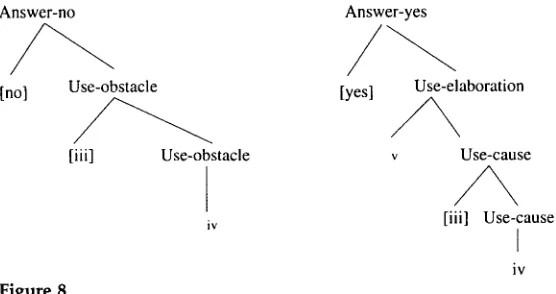
4.1.4 Ranking Candidate Plans. Two heuristics are u s e d to r a n k the relative plausi- bility of the set of candidate plans o u t p u t b y the first p h a s e of a n s w e r recognition. First, plausibility decreases as the n u m b e r of h y p o t h e s e s in a c a n d i d a t e increases. (Assuming that all else is equal, it is safer to favor interpretations requiring f e w e r hypotheses.) Second, plausibility increases as the n u m b e r of utterances in R's t u r n that are a c c o u n t e d for b y the p l a n increases. (The m o r e of R's t u r n a c c o u n t e d for, the m o r e coherent the t u r n is likely to be, a l t h o u g h n o t all of the utterances in R's t u r n are necessarily part of the full answer.) To give an example, consider the t w o c a n d i d a t e plans s h o w n in Figure 8, c o r r e s p o n d i n g to alternative interpretations of R's response in (12). 31
(12) i. Q: Are y o u going to c a m p u s tonight? ii. R: [No/Yes]
iii. [My car's not running.]
iv. M y car has a b r o k e n timing belt, v. [so] I'm going to take the bus. vi. Do y o u k n o w h o w m u c h the fare is?
30 The implementation saves the chains to avoid the expense of recomputing intermediate hypotheses. 31 This constructed example was designed to illustrate multiple aspects of the model. In our judgement,
Green and Carberry Indirect Answers
Answer-no Answer-yes
[no] Use-obstacle [yes] Use-elaboration
[iii] Use-obstacle v Use-cause
iv [iiil Use-cause
I
iv Figure 8
Ranking candidate plans.
By these heuristics, a yes answer would be the preferred interpretation, since the candi- date Answer-yes plan uses the same number of hypotheses as the candidate Answer-no plan, and accounts for more of R's response. ((12)vi is not recognized as part of ei- ther answer.) The preference heuristics are intended to capture local coherence only. Since global information m a y play a role in selecting the correct interpretation, the higher-level discourse processor (described in section 4.2) must decide which plan to attribute to the speaker.
4.1.5 A n s w e r R e c o g n i t i o n E x a m p l e . In this section, we illustrate the interpretation of indirect answers in the model by describing how the two candidate plans shown in Figure 8 would be derived from R's response of (12)iv through (12)vi. First, each of the five top-level answer discourse plan operators would be instantiated with the ques- tioned proposition p, the proposition that R is going to campus tonight. Assuming that Q has no beliefs about R's beliefs and goals that are inconsistent with the applicability conditions and primary goals of these candidates, none of the candidates would be eliminated yet. Second, for each candidate the recognizer would check whether the communicative act specified in the nucleus was present in R's turn. In this example, since a direct answer was not explicitly provided by R, the recognizer would mark the nucleus of each candidate as hypothesized. The hypothesized nucleus of the candidate Answer-no and Answer-yes plans would be (inform s h (not p)) and (inform s h p), respec- tively. Next, the recognizer would try to recognize the acts expressed as (12)iv through (12)vi as satellites of each candidate plan. Assume that these acts are represented as (inform s h piv), (inform s h pv), and (inform s h pvi), respectively.
[image:17.468.33.311.58.205.2]of the form (Plausible (CR q p)) must be provable using the coherence rules described in Section 3. For example, given the beliefs that Q presumes to be shared with R and the coherence rules provided in the model, the act underlying (12)iv could not be the nucleus of a candidate Use-obstacle satellite of the Answer-no candidate, because the recognizer would not be able to prove that cr-obstacle is a plausible coherence relation holding between Piv and (not p). On the other hand, the act underlying (12)v would be interpreted as the nucleus of a candidate Use-elaboration satellite of the Answer-yes candidate, since the above tests are satisified, e.g., the recognizer could prove that cr-elaboration is a plausible coherence relation holding between pv and p.
To return to consideration of the recognition of the Answer-no candidate, upon finding that the act underlying (12)iv cannot serve as a satellite, hypothesis genera- tion would be attempted. Recall that the goal of hypothesis generation is to supply a hypothesized missing act of the plan so that top-down recognition can continue. Hypothesis generation w o u l d search for a chain of plausibly related propositions, be- ginning with the proposition (i.e., Piv) to be related to the candidate Answer-no plan, and ending with the goal proposition (i.e., (not p)). As mentioned in Section 4.1.3, each pair of adjacent propositions in the chain must be linked by a plausible coherence re- lation. In this example, hypothesis generation would construct the chain
(piv,
piii, (not p)), where both pairs of adjacent propositions w o u l d be related b y cr-obstacle and Piii is the hypothesis that R's car is not running. Hypothesis generation w o u l d return the proposition immediately preceding the goal proposition in this chain, i.e., pill.Thus,
piii w o u l d be used to instantiate the existential variable of a Use-obstacle satellite of the Answer-no candidate plan, and satellite recognition w o u l d proceed. (The nucleus of this satellite would be marked as hypothesized.) Then, the recognizer would recognize piv (without requiring hypothesis generation) as a Use-obstacle satellite of this Use-obstacle satellite. No remaining utterances in R's turn can be related to the candidate Answer-no plan, resulting in the candidate shown on the left in Figure 8.
Finally, to finish consideration of the recognition of the Answer-yes candidate, since neither the act underlying (12)iv nor the act underlying (12)vi can serve as a satellite of the Answer-yes candidate or its Use-elaboration satellite, hypothesis generation w o u l d again be invoked. Hypothesis generation w o u l d provide Piii, the hypothesis that R's car is not rtmning, as a plausible explanation for w h y R is going to take the bus. Thus, piii would be used to instantiate the existential variable of a Use-cause satellite of the Use- elaboration satellite of the Answer-yes candidate plan, and satellite recognition w o u l d proceed. (The nucleus of the Use-cause satellite w o u l d be marked as hypothesized.) Then, the recognizer would recognize piv (without requiring hypothesis generation) as a Use-cause satellite of this Use-cause satellite. No remaining utterances in R's turn can be related to the candidate Answer-yes plan, resulting in the candidate shown on the right in Figure 8.
Given the shared beliefs and the coherence rules provided in the model, none of the utterances in R's turn would be recognized as satellites of the other three top- level candidate answer plans. Candidates that do not account for any actual parts of the response are eliminated at the end of phase one. Thus the output of phase one of interpretation would be just the two candidates shown in Figure 8. Phase two would evaluate the Answer-yes candidate as more preferred than the Answer-no candidate, since the former interpretation requires the same number of hypotheses and also accounts for more of R's response.
4.2 Role of the Answer Recognizer in Discourse Processing
Green and Carberry Indirect Answers
(directly or indirectly), if possible. Other acceptable, though less preferred, responses include I don't know and replies that provide other helpful information. Furthermore, an answer need not be given in the turn immediately following the turn in which the question was asked. For example, in (13) the yes-no question in (13)i is not answered until (13)v, separated by a request for clarification in (13)ii and its answer in (13)iii.
(13) i. Q: Is Dr. Smith teaching CS360 next semester?
ii. R: Do you mean Dr. Smithson?
iii. Q: Yes.
iv. R: [No.]
v. He will be on sabbatical next semester.
In Carberry's discourse-processing model for ellipsis interpretation (Carberry 1990), a mechanism is provided for updating the shared discourse expectations of dialogue participants throughout a conversation. Our answer recognizer w o u l d have the follow- ing role in such an architecture: The answer recognizer w o u l d be invoked whenever the current discourse expectation is that R will provide an answer. (If answer recog- nition were unsuccessful, then the discourse processor w o u l d invoke other types of recognizers for other types of responses.) The answer recognizer returns a partially ordered set (possibly empty) of answer discourse plans that it is plausible to ascribe to R as underlying (part or all of) the turn. The final choice of which discourse plan to ascribe to R should be made by the higher-level discourse processor, since it must select an interpretation consistent with the rest of the discourse.
4.3 Comparison to Previous Approaches to Conversational Implicature
Grice (1975) has proposed a theory of conversational implicature to account for certain types of conversational inferences. According to Grice, a speaker may convey more than the conventional meaning of an utterance by making use of the hearer's expec- tation that the speaker is adhering to general principles of cooperative conversation. Two necessary (but not sufficient) properties of conversational implicatures involve cancelability and speaker intention (Grice 1975; Hirschberg 1985). First, potential con- versational implicatures may be canceled explicitly, i.e., disavowed by the speaker in the preceding or subsequent discourse context, or even canceled implicitly given a particular set of shared beliefs. In fact, potential implicatures may undergo a change in status from cancelable to noncancelable in the subsequent discourse (Gunji 1981). Second, conversational implicatures are part of the intended meaning of an utter- ance. Grice proposes several maxims of cooperative conversation that a hearer uses as justification for inferring conversational implicatures. However, Grice's theory is inad- equate as the basis for a computational model of how conversational implicatures are derived. As frequently noted, Grice's maxims may support spurious or contradictory inferences. To date, few computational models have addressed the interpretation of conversational implicatures.
It is mutually plausible to the agent that (cr-contrast q p*) holds, where q is a proposition
and p* is the proposition that p is partly true,
if the agent believes it to be mutually believed that q is less than p in a salient partial order, unless it is mutually believed that p is true or that q is not true.
It is mutually plausible to the agent that (cr-contrast q (not p)) holds, where q and p are propositions,
if the agent believes it to be mutually believed that q is an alternate to p in a salient partial order, unless it is mutually believed that p is true or that q is not true.
Figure 9
Glosses of two coherence rules for cr-contrast.
licensed in terms of values in the set that are l o w e r than, alternate to, or h i g h e r than the value referred to in an utterance. For example, g i v e n a salient partially o r d e r e d set such that the value for the letter from X is l o w e r than the value for all of the letters in question, in saying (2)ii (repeated b e l o w in (14)ii) R licenses the implicature that R has n o t gotten all of the letters in question.
(14) i. Q: H a v e y o u gotten the letters yet?
ii. R: I ' v e gotten the letter from X.
In o u r model, the response in (14)ii w o u l d be a n a l y z e d as g e n e r a t e d f r o m an Answer- hedge discourse plan w h o s e n u c l e u s has n o t b e e n explicitly g i v e n a n d w h i c h has a single Use-contrast satellite w h o s e nucleus is expressed in (14)ii. 3a The coherence rules for cr-contrast, w h i c h are b a s e d u p o n the notions elucidated b y Hirschberg, are glossed in Figure 9. 33 H o w e v e r , the discourse p l a n o p e r a t o r s in o u r m o d e l also characterize a variety of indirect a n s w e r s that are n o t scalar implicatures, i.e., indirect a n s w e r s b a s e d on the other coherence relations s h o w n in Table 2.
A m o d e l such as Hirschberg's, w h i c h does n o t take the full r e s p o n s e into account, faces certain p r o b l e m s in h a n d l i n g cancellation b y the s u b s e q u e n t discourse context ( " b a c k w a r d s " cancellation). For example, g i v e n a salient partially o r d e r e d set such that going to campus is r a n k e d as an alternate to going shopping, H i r s c h b e r g ' s m o d e l w o u l d predict, correctly in the case of (15) a n d incorrectly in the case of (16), that R i n t e n d e d to c o n v e y a no.
(15) i. Q: Are y o u g o i n g s h o p p i n g ?
ii. R: [no]
iii. I ' m g o i n g to campus.
iv. I h a v e a n i g h t class.
(16) i. Q: Are y o u g o i n g s h o p p i n g ?
ii. R: [yes]
32 The nucleus of such a plan conveys that the questioned proposition is partly but not completely true. 33 The uppermost rule in the figure is the one applying to this example. The other rule applies to