Polynomial algorithms for clearing multi-unit single-item
and multi-unit combinatorial reverse auctions
Viet Dung Dang and Nicholas R. Jennings
1Abstract. This paper develops new algorithms for clearing multi-unit single-item and multi-multi-unit combinatorial reverse auctions. Specifically, we consider settings where bids are submitted in the form of a supply function and the auctions have sub-additive pric-ing with free disposal. Our algorithms are based on a greedy strategy and we show that they are of polynomial complexity. Furthermore, we show that the solutions they generate are within a finite bound of the optimal.
1
INTRODUCTION
Online auctions are a key enabling component of e-commerce since they are an efficient method of allocating goods/services in dynamic situations to the agents who value them most highly [8]. Tradition-ally, the most common forms of online auction are the simple, single-sided auctions in which a single item is traded (examples of such protocols are English, Dutch, first price sealed-bid and Vickrey auc-tions). However as more trading takes place in such environments, we believe their inherent limitations will become more apparent. This will, in turn, increase the demand for more sophisticated market-places in which multiple units of multiple (potentially inter-related) items are traded simultaneously. Such auctions are called multi-unit combinatorial auctions [8]. In this type of auction, bidders may bid for arbitrary combinations of items. For example, a single bid may be forqunits of item 1 and2∗qunits of item 2 at price40∗qif
q < 20, and at price30∗qifq ≥ 20. This degree of flexibility in expressing requirements, we believe, will be especially useful in business-to-business e-commerce where there is often a need to trade multiple, inter-related goods or services on a massive scale.
While multi-unit combinatorial auctions have many potential ben-efits from an economic perspective [1], their main disadvantages stem from the lack of computationally tractable clearing (winner determination) algorithms for determining the prices, quantities and trading partners as a function of the bids made. Without such algo-rithms, multi-unit combinatorial auctions are simply not practicable. To overcome this problem, there has been considerable recent work in this area (e.g. [1], [2], [3], [4], [6], [7]). However, almost all of this work has considered bids to be atomic propositions that are either accepted in their entirety or rejected. This view can limit the poten-tial profit available to the auctioneer. For example, consider the case where there are only two bids:x1units of one good at pricep1andx2
units at pricep2, and the quantity the auctioneer wants to trade is less
thanx1+x2units . In this case, the auctioneer has no choice other
than selecting one or other of the two bids. This may prevent the auc-tioneer from maximising its payoff. For example, the aucauc-tioneer may
1 Intelligence Agents Multimedia Group, Department of Electronics and
Computer Science, University of Southampton, Southampton SO17 1BJ, UK. Email:{vdd00r,nrj}@ecs.soton.ac.uk
find it more beneficial to accept both bids partially; that is, tradey1
(y1< x1) units with bidder 1 at priceyx1
1·p1and tradey2(y2< x2)
units with bidder 2 at pricey2
x2·p2. Moreover, if the bids are expressed
in terms of the correlation between the quantity of items and the price (rather than the simple linear extrapolation above), there will be even more choice for the auctioneer, and, consequently, even more chance of maximising its payoff. When viewed from the bidder’s perspec-tive, the atomic nature of bids and the inability to explicitly relate price and quantity means that opportunities for trade are lost because the auctioneer may not want the entire package being offered, even though elements of it may be acceptable.
To overcome the aforementioned shortcomings associated with atomic propositions, Sandholm and Suri consider the case in which agents can submit bids that correspond to a demand or supply curve depending on whether it is an auction or a reverse auction respec-tively [5]. Thus, bids are expressed in terms of a curve which corre-lates the quantity with the price of an item. For example, an agent may express the bid asq= 2∗p+ 1, which means that the agent is willing to trade up toq= 2∗p+ 1units if the unit price equalsp.2 Unfortunately, their work is limited to multi-unit single-item auctions and does not deal with the combinatorial case. This means their al-gorithm cannot explicitly cope with any interdependencies that may exist between the purchasing of multiple items.
In this paper, we develop novel clearing algorithms that remove the shortcomings associated with the atomic proposition nature of previ-ous combinatorial clearing algorithms and the non-combinatorial na-ture of Sandholm and Suri’s supply curve functions. Specifically, we consider multi-unit single-item and multi-unit combinatorial reverse auctions in which bids contain an agent’s supply function. The algo-rithms that we develop have polynomial complexity and are shown to be within a finite bound of the optimal. For the time being, our approach is limited to reverse auctions (in which there is one buyer and multiple sellers). Nevertheless, in the future, we aim to remove this limitation and develop algorithms for forward auctions.
The remainder of the paper is organised as follows. Section 2 for-malises the problem of reverse auction clearing. Section 3 developes an algorithm for the multi-unit single-item case and proves a num-ber of properties about the algorithm. Section 4 generalises the al-gorithm to the multi-unit combinatorial case. Section 5 discusses re-lated work. Section 6 concludes and presents future work.
2
REVERSE AUCTION CLEARING
This section formalises the problem of clearing in multi-unit combinatorial reverse auctions. Assume there are m items
2Their price function calculates the quantity from the unit price. However, in
(goods/services):1,2, ..., mandnbiddersa1, a2, ..., an. The auc-tioneer has a demand(q1, q2, ..., qm), in whichqjis the quantity of itemjthat the auctioneer wants. Letujibe the maximum quantity of itemjthataiis able or willing to provide (ifaidoes not provide an itemj, thenuji = 0). LetNbe the set of natural numbers andR∗be the set of non-negative real numbers.
The supply function is the price function of the items that each bid-der is willing to sell. Bidbid-deri’s supply function is:Pi:Nm→R∗, wherePi(r1, r2, .., rm)is the price offered by bidderifor the pack-age of items(r1, r2, ..., rm)andrjis the quantity of itemj,rj∈N,
0 ≤rj ≤ uji,∀1≤ j ≤ m. For example, suppose thatm = 3, thenP1(1,3,2)will be the price agent 1 offers for a package which
is composed of 1 unit of item 1, 3 units of item 2 and 2 units of item 3 altogether. We consider settings where the price function satisfies two properties:
• Discount: if∀j:rj+sj≤uji, then:
Pi(r1+s1, r2+s2, ..., rm+sm)
≤Pi(r1, r2, ..., rm) +Pi(s1, s2, ..., sm) (1)
That is, buying any combination of two packages altogether is cheaper than or equal to buying these two bundles separately. In game-theoretic terms, this property is also called sub-additive [7].
• Free Disposal: if∀j: 0 ≤rj≤sj≤uji, then:
Pi(r1, r2, ..., rm)≤Pi(s1, s2, ..., sm) (2)
That is, if one package has no fewer units of each item than an-other package, the former is not less expensive than the latter.
The above assumptions are needed for the subsequent analysis of our algorithm and we believe they are applicable to a wide range of applications (free disposal is a standard assumption adopted in most of the aforementioned work on auction clearing, sub-additivity is less frequently used but is still realistic). Thus, they do not significantly limit the scope of our results.
We now consider the supply allocation which is the amount the auctioneer buys from each supplier.
Definition 1 A supply allocation is a tuple{rij},1≤ i≤ n,1 ≤
j ≤msuch that the auctioneer buysrijunits of itemjfrom each agentai.3
Given the definitions of the supply function and the supply alloca-tion, the problem of reverse auction clearing is then to find a supply allocation{αji},1≤i≤n,1≤j≤mthat:
• Satisfies the demand
n X
i=1
αji ≥qj,∀1≤j≤m (3)
That is, the quantity of each item that the auctioneer buys from all bidders is not less than the auctioneer’s demand for that item.
• Optimises the cost
n X
i=1
Pi(α1i, α
2
i, .., α m
i )is minimal. (4)
That is, the total price of all the units of all the items supplied by the bidders should be as small as possible.
3Because items are bought at the price the bidders offer, the auctioneer may
buy the same package from two different bidders at different prices, i.e., the auctions have discriminatory pricing [5].
However, this problem has been shown to be NP-complete, even for the simplified case of single-items with piecewise linear supply curves [5].4 Thus, it is impossible to find a polynomial algorithm, unless P = NP. Given this, a heuristic method is appropriate. To this end, the next section presents our algorithm for the single-item case (i.e. wherem= 1), then we will deal with the combinatorial case as a generalisation in section 4.
3
MULTI-UNIT SINGLE-ITEM REVERSE
AUCTIONS
Using the notation of the previous section, the multi-unit single-item case can be formulated as follows. Letqbe the demand of the auc-tioneer anduibe the maximum quantity of the item thataiwill pro-vide. The supply function (in the single-item case it can be drawn as a curve, so we can call it the supply curve) is the price function of the item:Pi :N→R∗wherePi(r)is the price forrunits when they are sold altogether by bidderi.
For mathematical convenience, in this section we will use the unit price function instead of the price function. The unit price function for each bidderiis:pi : N → R∗ wherepi(r) is the unit price for the item whenrunits are sold altogether by bidderi. That is,
pi(r) = Pir(r).
As before, we consider settings where the supply curve satisfies the following properties:
• Discount:
pi(r)≥pi(s),∀0≤r≤s≤ui (5)
That is, the more units that are sold, the less the unit price is.5
• Free Disposal:
r·pi(r)≤s·pi(s),∀0≤r≤s≤ui (6)
That is, the more units of the item that are sold, the more the total price is.
The clearing problem is then one of finding a supply allocation
{αi},1≤i≤n, i.e., agentaiwill provideαiunits, such that:
• The sum of supplies from bidders fulfills the auctioneer’s demand:
n X
i=1
α(i)≥q (7)
• The total price paid by the auctioneer is minimised:
n X
i=1
αi·pi(αi)is minimal. (8)
We are now in a position to express our algorithm for solving this problem. Like [6] we adopt a greedy approach for solving this prob-lem and our algorithm is presented in Figure 1.
Theorem 1 If there is a solution, then this algorithm will find it. That
is, if the bidders can supply the units that the auctioneer demands, then this algorithm will produce an allocation. Also, the solution will supply exactly the number of units demanded by the auctioneer.
4Although [5] does not explicitly consider sub-additive pricing, their proof
also holds for this case.
5This is stronger than the Discount definition in the general case (inequation
Algorithm 1 Repeat the following steps:
• For allisuch thatui> q, setui=q.
That is, we truncate the supply function to consider only quantities that are not bigger than the demand. This is because in order to minimise the total price, the auctioneer does not need to buy more units than its demand, since the price functions satisfy the free disposal property (inequation (6)).
• At each step, find the bidderak that provides the smallest unit price, then takeak to provide all its quantityuk. The smallest unit price is found by determining the smallest element of the set
{p1(u1), p2(u2), .., pn(un)}.
• Repeat the steps above for the set of biddersA\akandqnew =
[image:3.595.303.555.83.355.2]q−uk.
Figure 1. The clearing algorithm for the multi-unit single-item case.
PROOF. In each step, the algorithm selects exactly one agent from the set of bidders. If its supply is less than the auctioneer’s remain-ing demand, the algorithm takes all its supply. Otherwise it takes the quantity that is equal to the remaining demand. So, if the algorithm does not terminate beforehand, it will eventually select all bidders and take all supplies. Thus, if the bidders can supply enough units to meet the demand, the algorithm will produce an allocation. More-over, in each step, the algorithm takes at most all the remaining de-mand, so the solution it produces will have the total units being equal to the auctioneer’s demand.
Theorem 2 The complexity of algorithm 1 isO(n2)
.
PROOF. At each step, it requiresO(n)to find the smallest element of the set{p1(u1), .., pn(un)}. So each step hasO(n)complexity. As there are at mostnsteps, the complexity isO(n2)
Theorem 3 The solution generated from algorithm 1 is within a
boundb = nfrom the optimal. That is, letPn(O)be the optimal total price andPn(S)be the total price of the solution of the algo-rithm. Then:
Pn(S)
Pn(O)
≤n (9)
PROOF. We prove by induction of the number of biddersn.
Base case (n= 1): In the case wheren= 1the solution is optimal (because we have only one bid) so (9) is true withn= 1.
Inductive step: Suppose that (9) is true forn, we will prove that (9) is also true forn+ 1. That is, let(r1, r2, ..., rn+1)be the supply
allocation that the algorithm generates. Then we have to prove that: Pn+1
i=1 ri·pi(ri)≤(n+ 1)·Pn+1(O). Or equivalently, for all other
supply allocations(t1, t2, .., tn+1)that satisfy the demand, their total
price is greater thann1+1times the total price of the supply allocation produced by algorithm 1. That is,∀t1, t2, .., tn+1such that:0 ≤ ti≤ui,∀1≤i≤n+1andPni=1+1ti≥q, then:Pni=1+1ri·pi(ri)≤
(n+ 1)·(Pn+1
i=1 ti·pi(ti)). Proof of inductive step
Without loss of generality, assume that agentan+1 provides the
smallest unit price, that is,p(un+1) = minni=1+1p(ui). This means that agentan+1is selected in the first step of algorithm 1 and:
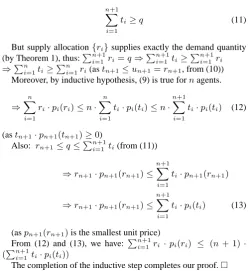
rn+1=un+1 (10)
Because supply allocation{ti}satisfies the demand (as in (7)):
n+1
X
i=1
ti≥q (11)
But supply allocation{ri}supplies exactly the demand quantity (by Theorem 1), thus:Pn+1
i=1 ri=q⇒
Pn+1
i=1 ti≥
Pn+1
i=1 ri
⇒Pn
i=1ti≥Pni=1ri(astn+1≤un+1=rn+1, from (10))
Moreover, by inductive hypothesis, (9) is true fornagents.
⇒
n X
i=1
ri·pi(ri)≤n· n X
i=1
ti·pi(ti)≤n· n+1
X
i=1
ti·pi(ti) (12)
(astn+1·pn+1(tn+1)≥0)
Also: rn+1≤q≤Pni=1+1ti(from (11))
⇒rn+1·pn+1(rn+1)≤
n+1
X
i=1
ti·pn+1(rn+1)
⇒rn+1·pn+1(rn+1)≤
n+1
X
i=1
ti·pi(ti) (13)
(aspn+1(rn+1)is the smallest unit price)
From (12) and (13), we have: Pn+1
i=1 ri ·pi(ri) ≤ (n+ 1)· (Pn+1
i=1ti·pi(ti))
The completion of the inductive step completes our proof. Although multi-unit single-item auctions are not our main target case, this algorithm still represents a novel contribution in its own right. While [5] targets the same environment as this, the algorithms are only applicable in the specific case where the supply curves are linear. In contrast, our result is applicable to the more general case; that is, sub-additive, free disposal supply curves.
4
MULTI-UNIT COMBINATORIAL REVERSE
AUCTIONS
To deal with the multi-unit combinatorial case, we need to add one more assumption about the price functions of the items, namely there exists a numberK > 1such that for any price function from any bidder,Kunits of any item will be more expensive than 1 unit of any other item:∀1≤j, k≤m,j6=k,d∈N:
Pi(r1, .., rj+d, .., rk, .., rm)≤Pi(r1, .., rj, .., rk+Kd, .., rm) (14) That is, for any package, if we substitutedunit of any item in this package byK·dunits of any other item, then the price of the new package will be more expensive or equal to the price of the old pack-age. We believe this is a realistic assumption because in a competitive market the unit price of any item is always likely to be within a finite range; that is, it cannot be arbitrarily high or low.
From this, a number of lemmas follow:
Lemma 1 For any package of items, if we replacedunits of any item withdunits of any other item, then the total price of the new package of items is not bigger thanKtimes the total price of the old package:
∀1≤j, k≤m,j6=k,d∈N:
Pi(r1, .., rj+d, .., rk, .., rm)≤K·Pi(r1, .., rj, .., rk+d, .., rm) (15)
PROOF. We have: Pi(r1, .., rj + d, .., rk, .., rm) ≤
AlsoPisatisfies the free disposal property (in (2)), thus:
Pi(r1, .., rj+d, .., rk, .., rm)
≤Pi(Kr1, .., Krj, .., Krk+Kd, .., Krm)
≤K·Pi(r1, .., rj, .., rk+d, .., rm)(by (1))
Lemma 2 For any two packages, if the total number of units of the
first package is not bigger than the total number of units of the second package, then the total price of the first package is not bigger than
Km−1 times the total price of the second package:∀1 ≤ i ≤ n,
∀r1, r2, ..., rm, s1, s2, ..., smsuch thatPmj=1rj≤Pmj=1sj, then:
Pi(r1, r2, ..., rm)≤Km−1Pi(s1, s2, ..., sm) (16)
PROOF. Letdj= (sj−rj)
⇒
m X
j=1 dj=
m X
j=1 sj−
m X
j=1
rj≥0 (17)
Now there are 2 cases:
• Case 1:di≥0,∀1≤i≤m. Then we have:Pi(r1, r2, ..., rm)≤
Pi(s1, s2, ..., sm)(becausePisatisfies the free disposal property in (2)). ThusPi(r1, r2, ..., rm)≤Km−1Pi(s1, s2, ..., sm).
• Case 2: There exists adk <0. Then without loss of generality, suppose thatdm<0. We have:Pi(r1, r2, ..., rm−1, rm) ≤K·
Pi(r1−dm, r2, ..., rm−1, sm)(by lemma 1). Letr(2)1 =r1−dm,r
(2)
i =ri,∀2≤i≤m−1.
⇒Pi(r1, r2, ..., rm−1, rm)≤K·Pi(r(2)1 , r (2) 2 , ..., r
(2)
m−1, sm) Also: Pm−1
j=1 r (2)
j =
Pm−1
j=1 rj − dm ⇒
Pm−1
j=1 r (2)
j ≤
Pm−1
j=1 sj(by (17)).
Repeat the whole step above, it will take at most m−1steps to terminate. Thus, after at most m − 1 steps, we will have:
Pi(r1, r2, ..., rm)≤Km−1Pi(s1, s2, ..., sm)
Lemma 3 For any two packages, if the total number of units of
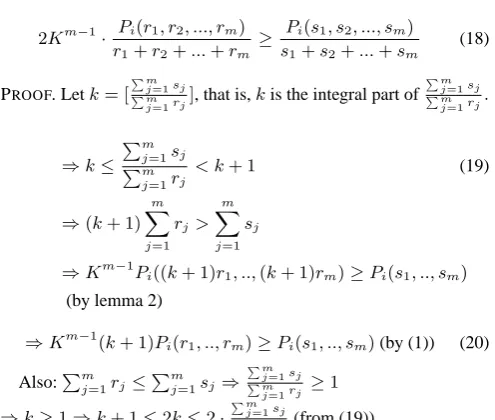
the first package is not bigger than the total number of units of the second package, then the average unit price of the first package is not smaller than 2Km1−1 times the average unit price of the
sec-ond package:∀1 ≤ i ≤ n, r1, r2, ..., rm, s1, s2, ..., sm such that Pm
j=1rj≤
Pm
j=1sj, then:
2Km−1· Pi(r1, r2, ..., rm)
r1+r2+...+rm
≥ Pi(s1, s2, ..., sm)
s1+s2+...+sm
(18)
PROOF. Letk= [ Pm
j=1sj
Pm
j=1rj], that is,kis the integral part of
Pm j=1sj
Pm j=1rj.
⇒k≤
Pm j=1sj
Pm j=1rj
< k+ 1 (19)
⇒(k+ 1)
m X
j=1 rj>
m X
j=1 sj
⇒Km−1Pi((k+ 1)r1, ..,(k+ 1)rm)≥Pi(s1, .., sm)
(by lemma 2)
⇒Km−1(k+ 1)Pi(r1, .., rm)≥Pi(s1, .., sm)(by (1)) (20)
Also:Pm j=1rj≤
Pm j=1sj⇒
Pm j=1sj
Pm j=1rj ≥1
⇒k≥1⇒k+ 1≤2k≤2·
Pm j=1sj
Pm
j=1rj (from (19))
Algorithm 2 Repeat the following steps:
• For alli, jsuch thatuji > qj, setuji =qj.
That is, we truncate the supply function to consider only quantities that are not bigger than the demand. This is because to minimise the total price, the auctioneer does not need to buy more units than its demand, as the price functions satisfy the free disposal property (in (2)).
• Find the bidderaksuch that:
Pk(u1k, u
2
k, ..., u m k)
u1
k+u
2
k+...+u m k
is minimal,
then selectakto provide all its units(u1k, u
2
k, ..., u m k).
That is, we consider all the biggest packages offered by the bid-ders, then choose the package that offers the lowest average unit price.
Note that this is not necessarily the package that offers the lowest average in all packages, because a smaller package may have a smaller average unit price.
• Repeat the steps with the new set of biddersA\akand demand
qnew
[image:4.595.42.290.522.732.2]j =qj−ujk.
Figure 2. The clearing algorithm for the multi-unit combinatorial case.
⇒2Km−1
·
Pm j=1sj
Pm
j=1rjPi(r1, .., rm)≥Pi(s1, .., sm)(by (20))
⇒2Km−1·Pi(r1,r2,...,rm) r1+r2+...+rm ≥
Pi(s1,s2,...,sm) s1+s2+...+sm
With these lemmas in place, we can now present the generalisation of the single-item algorithm to the combinatorial case (Figure 2).
We can now analyse this algorithm to assess its properties.
Theorem 4 If there is a solution, then this algorithm will find it. That
is, if the bidders can supply the units that the auctioneer demands, then this algorithm will produce an allocation. Also, the solution sup-plies exactly the number of units demanded by the auctioneer.
PROOF. The proof is the same as that of theorem 1.
Theorem 5 The complexity of algorithm 2 isO(n2)
PROOF. At each step, it requiresO(n)to find the smallest element
of the set{Pk(u1k,u2k,...,umk) u1
k+u2k+...+umk
}n
i=1. So each step hasO(n)complexity.
As there are at mostnsteps, the complexity isO(n2).
Theorem 6 The solution generated from algorithm 2 is within a
boundb= 2n·Km−1from the optimal. That is, letPn(O)be the optimal total price andPn(S)be the total price of the solution of the algorithm. Then:
Pn(S)
Pn(O)
≤2n·Km−1 (21)
PROOF. We prove by induction of the number of biddersn.
Base case (n= 1): In this case, the solution is optimal (because there is only one bid to choose from), so (21) is true withn= 1.
Inductive step: Suppose that (21) is true forn, we will prove that (21) is also true forn+ 1. That is, let{rji},1 ≤i ≤n+ 1,1 ≤
j≤mbe the supply allocation that algorithm 2 generates. Then we have to prove that:Pn+1
i=1 Pi(r 1
Or equivalently, for every other supply allocation{tji}that satisfies the auctioneer’s demand, the total price of{rji}is not bigger than
2n·Km−1times the total price of{tji}: Pn+1
i=1 Pi(r 1
i, ri2, ..., rmi )≤
2(n+ 1)·Km−1Pn+1
i=1 Pi(t1i, t
2
i, ..., t m i ).
Proof of inductive step
Without loss of generality, assume that agentan+1 provides the
lowest average price in all the biggest packages:
Pn+1(u1n+1, u2n+1, ..., umn+1) u1
n+1+u2n+1+...+umn+1 =
n+1 min
i=1
Pi(u1i, u2i, ..., umi )
u1
i+u2i+...+umi (22)
That meansan+1is selected in the first step of the algorithm and:
rjn+1=u
j
n+1, for all1≤j≤m (23)
For all1 ≤j ≤m, because supply allocation{tji}satisfies the auctioneer’s demand (inequation (3)):
⇒
n+1
X
i=1
tji≥qj (24)
But supply allocation{rij}supplies exactly the demand quantity (by Theorem 4)⇒Pn+1
i=1 r
j
i =qj⇒Pni=1+1tji≥ Pn+1
i=1 r
j i
⇒Pn i=1t
j i ≥
Pn i=1r
j i (ast
j n+1≤u
j n+1=r
j
n+1by (23))
Moreover, by inductive hypothesis, (21) is true fornagents
⇒Pn
i=1Pi(r1i, r
2
i, ..., r m
i )≤2nK
m−1·Pn
i=1Pi(t1i, t
2
i, ..., t m i ) ⇒ n X i=1 Pi(ri1, r
2
i, ..., r m
i )≤2nK m−1
·
n+1
X
i=1 Pi(t1i, t
2
i, ..., t m i ) (25)
(becausePn+1(t1n+1, tn2+1, ..., tmn+1)≥0)
Also:Pn+1(rn1+1, rn2+1, ..., rmn+1) =Pn+1(u1n+1, u2n+1, ..., umn+1)(by (23))
= (Pm j=1u
j n+1)·
Pn+1(u1n+1,u2n+1,...,umn+1) Pm
j=1u
j n+1
Butujn+1≤qj,∀1≤j≤m.⇒Pn+1(r1n+1, r2n+1, ..., rnm+1)
≤(Pm j=1qj)
Pn+1(u1n+1,u2n+1,...,umn+1) Pm
j=1u
j n+1
≤(Pm j=1
Pn+1
i=1 t
j i)
Pn+1(u1n+1,u2n+1,...,umn+1) Pm
j=1u
j n+1
(by (24))
≤Pn+1
i=1(
Pm j=1t
j i
Pi(u1i,u2i,...,umi )
Pm j=1u
j i
)(because of (22))
≤Pn+1
i=1(
Pm j=1t
j i2K
m−1Pi(t1i,t2i,...,tmi )
Pm j=1t
j i
)(by lemma 3)
⇒Pn+1(r1n+1, r 2
n+1, ..., r
m
n+1)≤2K
m−1
·(
n+1
X
i=1 Pi(t1i, t
2
i, ..., t m i ))
(26) From (25) and (26) we have:Pn+1
i=1 Pi(r 1
i, ri2, ..., rmi )≤2(n+ 1)·
Km−1Pn+1
i=1 Pi(t1i, t
2
i, ..., t m i )
The completion of the inductive step completes our proof.
5
RELATED WORK
As already discussed, most of the previous work on clearing algo-rithms for combinatorial auctions has been based on atomic propo-sition auctions. So by removing this restriction, our algorithm pro-duces more efficient allocations. In particular, Sandholm et. al. [6] have categorised and analysed the complexity of various kinds of atomic proposition types (e.g. auctions, reverse auctions, exchanges). They showed that clearing combinatorial atomic proposition auctions is NP-complete, even for the simple case of single-units (i.e. each
item has only one unit). Thus, heuristic methods are typically used to tackle this problem.
In more detail, for single-unit combinatorial auctions, Nisan [4] showed that Linear Programming can produce the optimal solu-tion in a reasonable time in some specific cases (e.g. linear order bids, mutual exclusion bids and substructure bids), and suggested us-ing greedy and Branch-and-Bound algorithms based on Linear Pro-gramming for the other cases. However, in our view, this Linear Programming-based approach cannot easily be applied to our situ-ation because the problem of clearing auctions with supply/demand functions cannot easily be modeled. Other researchers such as Gonen and Lehmann [2] and Leyton Brown et. al. [3] have further investi-gated the use of Branch-and-Bound techniques to solve the clear-ing problem. Unfortunately, however, these Branch-and-Bound al-gorithms cannot guarantee to produce the optimal solution in poly-nomial time.
In contrast to the above, Sandholm and Suri [5] considered multi-unit single-item auctions with bids in the form of supply/demand curves of some specific types (linear and piecewise linear curves). However, as discussed in section 1, this work does not deal with multi-unit combinatorial auctions.
6
CONCLUSIONS AND FUTURE WORK
In this paper we provided, for the first time, polynomial algorithms for clearing multi-unit combinatorial reverse auctions with supply functions. While previous work has concentrated on single-item auc-tions with supply/demand curves or combinatorial aucauc-tions with atomic propositions, we generalised the problem to multi-unit single-item and multi-unit combinatorial auctions with supply functions. For this very general case, we showed that our algorithms are of polynomial complexity and can generate solutions that are within a bound of the optimal. We believe this generalisation is an important step towards realising the full application potential of combinatorial auctions since it enables us to deal with a maximally flexible and efficient scheme in a computationally tractable manner.
For the future, we aim to reduce the bound from the optimal within this framework or to prove the optimality of the error bound. More-over, we aim to extend our algorithms so that they are also applicable to the forward case. We also aim to develop the algorithms for par-ticular classes of domain in which stronger assumptions can be made about the supply and supply allocation functions in order to find bet-ter approximations for these more specific cases.
REFERENCES
[1] Y. Fujishima et. al., ‘Taming the computational complexity of combina-torial auctions: Optimal and approximate approaches’, IJCAI, pp. 548– 553, (1999).
[2] R. Gonen and D. Lehmann, ‘Optimal solutions for multi-unit combina-torial auctions: Branch and bound heuristics’, EC, pp. 13–20, (2000). [3] K. Leyton-Brown et. al., ‘An algorithm for multi-unit combinatorial
auc-tions’, AAAI, pp. 56–61, (2000).
[4] N. Nisan, ‘Bidding and allocation in combinatorial auctions’, EC, pp. 1–12, (2000).
[5] T. Sandholm and S. Suri, ‘Market clearability’, IJCAI, pp. 1145–1151, (2001).
[6] T. Sandholm et. al., ‘Winner determination in combinatorial auction gen-eralizations’, Proc.5thIntl. Conf. on Autonomous Agents, Workshop on
Agent-based Approaches to B2B, pp. 35–41, (2001).
[7] M. Tennenholtz, ‘Some tractable combinatorial auctions’, AAAI, pp. 98– 103, (2000).
[8] P. R. Wurman, ‘Dynamic pricing in the virtual marketplace’, IEEE