Abstract— Plates are usually subject to moving forces or moving masses, sometimes referred to as moving loads. This paper analyses the effects of foundations, shear deformation, rotatory inertia, angle of inclination and the contact area of the load, on the dynamic behaviour of an elastic rectangular plate under moving load. The method used involved transforming the set of second order partial differential (PDE) equations, governing the moving load problem, to its non-dimensionalised set of first order PDE so as to obtain general solution. Computer programs were then developed and used in conjunction with MATLAB in order to obtain the desired solution. The findings show that the subgrade, rotatory inertia, shear deformation, the angle of inclination and the contact area of the load with the plate, have effects on the dynamic response of the rectangular plate to a moving load. Specifically, the effects of rotatory inertia and shear deformation on the deflection of the Mindlin plate gives a more realistic results for practical application, especially when such plate is considered to rest on a subgrade.
Index Terms— Subgrades, Inclination, Rectangular plate, Deflection, Rotatory Inertia, Shear Deformation,
I. INTRODUCTION
HE moving load problem is a fundamental problem in several fields of Applied Mathematics, Engineering and Applied Physics. The importance of this type of problems also manifested in numerous applications in the area of transportation. Rails and bridges are examples of plates usu-ally designed to support moving loads such as rail vehicles and Cars [1,2,3,4]. Attempts have been made to analyse the dynamic response of a plates under the influence of moving loads, putting into consideration the influence of rotatory inertia and shear deformation by different authors [4,5,6,7]. Such plates are known as Mindlin Plates.[3] One of the works of Gbadeyan and Dada [7] likewise considered the dynamic reaction of versatile rectangular Mindlin plates under uniform somewhat conveyed moving mass [7]. For practical application, it is helpful to consider plates upheld by a versatile foundation[8,9]. For example, an examination including such foundation can be utilized to decide the con-duct of scaffolds crossed by rail vehicle. Moreover,
Manuscript received July 1, 2017; revised July 30, 2017.. This work was supported in full by Covenant University.
M.C. Agarana is with the Department of Mathematics, Covenant University,Nigeria,+2348023214236,michael.agarana@covenantuniversity. edu.ng
O.O. Ajayi is with the Department of Mechanical Engineering, Covenant University, Nigeria.
S. Bishop is with Mathematics Department, Covenant University, Nigeria.
iary individuals, especially, plates laying on versatile foun-dation have wide applications in present day designing prac-tices, for example, railroad spans, roadway asphalts and ceaselessly bolstered pipelines [9,10,11,12]. The objectives of the study were to investigate the dynamic response of Mindlin rectangular elastic inclined plates, resting on sub-grades, and being affected by the shear deformation, rota-tory inertia, angle of inclination and contact area of the load with the plate, to partially distributed moving load. This was achieved by developing a theory describing the response of the Mindlin rectangular elastic inclined plates, resting on subgrades, to partially distributed moving load. Develop a finite-difference analysis of the problem. Investigate the effects of variation of velocity of moving load on the re-sponse of the plate under investigation. Compare the effect of different foundations on the deflection of the Mindlin plate under the influence of a moving load. Investigate the effect of the contact area of a moving load on the response of Mindlin plate resting on a foundation and subjected to partially distributed moving load. In this paper, therefore, the impacts of foundation, rotatory inertia, shear deforma-tion and inclinadeforma-tion on the vibradeforma-tion of rectangular plates were investigated. The foundations under consideration were Winkler and Pasternak types.
II. PROBLEMDEFINITION
A rectangular plate, with moving load and different bound-ary conditions is considered. The load is relatively large, that is, its inertia cannot be neglected, and is moving along the mid-space on the surface of the plate, supported by a foundation,.[12]
A. Assumptions
(i) The plate is of constant cross – section,
(ii.) The moving railway vehicle moves with a constant speed.
(iii) The moving load is guided in such a way that it keeps contact with the plate throughout the motion,
(iv). The plate is continuously supported by a subgrade (v). The moving load is partially distributed.
(vi). The plate is elastic. (vii).No damping in the system. (viii).Uniform gravitational field
(ix). Constant mass of the load on the plate.
T
Effects of Subgrades, Shear Deformation,
Rotatory Inertia, Contact Area and Inclination
on the Deflection of Rectangular Plates
III. PROBLEM SOLUTION
The set of dynamic equilibrium equations which govern the behaviour of an inclined Mindlin plate supported by subgrade and traversed by a partially distributed moving load may be written as [12]:
2 2 2
2
2 2
2
2 2 2 2 2 2
2
1 1
2 2 2 2 2 2
3 2 2 2 3 2
1 2
2 2 2
2 2 2 sin 2 (1) 2 12 12 L S y x f
L x x x x
y y
M B W W W
g U U F
A T x T x
W W W W W W
k Gh KW M G G h
x x y y T x y T
B h h
U U
T x T x T
D x x 2 2 2 2
2 2 2 2
3 3
1 2
2 2 2
2 2 2 2
2 2 (1 ) (2) 2 2 12 12 (1 ) 2 y x x
y y y y
L
y
y x x y
W
D k Gh
y y x y x
B h h
U U
T y T T
D D
y y x x y x
2 (3) y W k Gh y
The notations are as in references [12].
Finite difference technique was used to transform the sim-plified non-dimensionalised set of first order partial differ-ential equations to a set of algebraic equations.
A. Finite Difference Algorithm for the model
The governing equations were solved using a numerical method based on the finite difference algorithm. These equations were transformed into their equivalent algebraic forms. The finite difference definition of first order partial derivative of a function E(x,y,t) say, with respect to x, y and t respectively are as follows[15,16]:
1 1 1 1
1, 1 1, , 1 , 1, 1 1, , 1 ,
1 1 1 1
1, 1 1, , , 1 1, 1 1, , 1 ,
1 (4) 4 1 (5) 4 1 4
k k k k k k k k
i j i j i j i j i j i j i j i j
k k k k k k k k
i j i j i j i j i j i j i j i j
i
E
E E E E E E E E
t r E
E E E E E E E E
x h E E y k
1 1 1 1
1, 1 , 1 1, , 1, 1 , 1 1, , (6)
k k k k k k k k
j Ei j Ei j Ei j Ei j Ei j Ei j Ei j
where E is the function value of the centre of a grid, which is well approximated by the average of its values at the grid nodes. Notations are as in the reference [15, 16,17,18,19].
1 1 1 1
1, 1 1, , 1 , 1, 1 1, , 1 ,
,
,
2
2
2
1
(7)
8
k k k k k k k k
i j i j i j i j i j i j i j i j
h
k
r
E x
y
t
E
E
E
E
E
E
E
E
An equivalent set of algebraic equations obtained by using the above finite difference definition was solved after written in matrix form as follows [15,16 17,18,19].
Hi,j+1 S’i,j+1 + Ii+1,j+i S’i+1,j+1= - Gi,jS’I,,j – Ji+1,j S’i+1,j + Ki, j S°i,j + Li,j +i , S°i,j+1 Mi+1 S°i+1,j + Ni+1,
j+1 S°i+1,j+1 + P1
(8) i = 1, 2, 3 ..., N-1; j = 1, 2, 3, ... M -1 where N and M are the numbers of the nodal points along X
and Y axes respectively. The matrices were solved with the aid of computer program and MATLAB to arrive at the results.
IV. RESULTSANDDISCUSSION
The results of a simply supported rectangular plate resting on subgrades and subjected to a moving load are presented and discussed in this section. Figure 1 shows that the Mindlin plate on Winkler foundation deflects more than that on Pasternak foundation.
For a specific value of foundation stiffness K, G and con-stant area (Ar), deflections of the Mindlin plate were calcu-lated and plotted. It is observed that the response amplitude of the Mindlin plate resting on a Winkler foundation de-creases with an increase in the value of the foundation’s constant (K), for fixed value of both velocity and constant area of the partial distributed moving load. This was de-picted in figures 11, 12 and 13.
The response maximum amplitude of the Mindlin plate sup-ported continuously by an elastic Winkler subgrade de-creases with an increase in the contact area(Ar) of the mov-ing partial distributed mass for fixed values of K and veloc-ity (Uw). This was shown in figure 19.
Keeping the values of K and Ar constant, the response maximum amplitudes of the Mindlin plate, resting on a Winkler foundation, increases with an increase in velocity of the moving mass. This can be seen in figure 17.
The response maximum amplitude of Mindlin plate sup-ported by a Pasternak subgrade, decreases as the contact area (Arp) of the moving load deceases for fixed values of velocity foundation constant K and G. Figure 10 shows thi clearly.
For fixed values of K and Arp the response amplitude of a Mindlin plate resting on a Pasternak subgrade increases as K increases. However, the effect of G on the behaviour of the Mindlin plate on the Pasternak foundation is more notice-able than that of K.
The response amplitude of the Mindlin plate not resting on a Pasternak subgrade (i.e. the case K=G=0) is greater than that of the plate continuously supported by the subgrade. As the velocity (Up) of the moving mass increases the response maximum amplitude of the Mindlin plate resting on a Pasternak foundation decreases for fixed values of Arp, K, and G. Figures 8 and 9 depicts this.
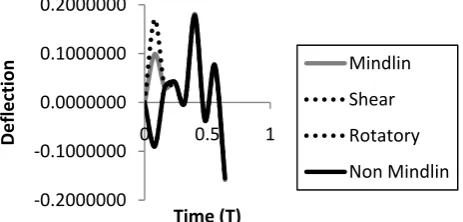
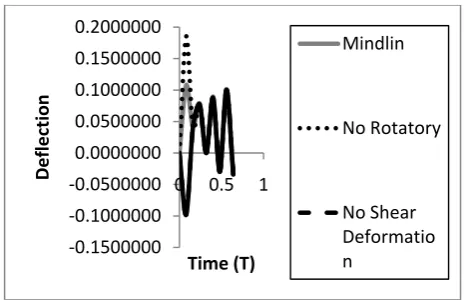
For fixed values of K, G, Arp and Up, non-rotatory plate has the highest response maximum amplitude when compared to Mindlin, non-shear and non-Mindlin plates. This can be seen in figure 6
As G increases, the response maximum amplitude for rota-tory, Mindlin and non-Mindlin plates, supported by Paster-nak foundation, decreases for fixed values of K, Arp and Up. However, the effect of rotatory inertia is minimal when compared with that of shear deformation.
As Arp increases the response maximum amplitude for both Mindlin and rotatory plates resting on Pasternak foundation increase for fixed values of K, G and Up.
Fig. 1. Deflection of the plate for K=100, G=0.09, Arp=0.5, u=1.5 and various values time
[image:3.595.62.288.242.357.2]Fig. 2. Deflection of the plate for K=200, G=0.09, Arp=0.5 andvarious values time
Fig. 3. Deflection of the plate for K=100, G=0.09, Arp=0.5, and various values of time
[image:3.595.317.554.249.385.2]Fig. 4. Deflection of the Mindlin, Non Mindlin, Rotatory and Shear plates for K=100, G=0.18, Arp=0.02, u=1.5 and various values of time
[image:3.595.60.280.415.537.2]Fig. 5. Deflection of the Mindlin, Non Mindlin, Rotatory and Shear plates for K=100, G=0, Arp=0.02, u=1.5 and various values of time
Fig..6. Deflection of the Mindlin, Non Mindlin, Rotatory and Shear plates for K=100, G=0.09, Arp=0.02, u=1.5 and various values of time
Fig. 7. Deflection of the Mindlin, Non Mindlin, Rotatory, Shear plates at K=100, G=0.09, Up=1.5 and different val-ues of 'Arp' and time
Fig. 8. Deflection of the Mindlin, Non Mindlin, Rotatory and Shear plates for K=100, G=0.09, Arp=0.02, u=2.5 and various values of time
0 0.2 0.4 0.6 0.8
-1.0000000 -0.5000000 0.0000000 0.5000000 1.0000000
Time (T)
Deflection
Ww
Wp
0 0.5 1
-0.200000 -0.100000 0.000000 0.100000 0.200000 0.300000 0.400000
Time (T)
Deflection
Wu=1.5
Wu=2.5
Wu=3.5
Wu=4.5
Wu=5.5
0 0.5 1
-0.200000 -0.100000 0.000000 0.100000 0.200000 0.300000 0.400000
Time (T)
Deflection
(W)
Urp=1.5
Urp=2.5
Urp=3.5
Urp=4.5
Urp=5.5
0 0.5 1
-0.2000000 -0.1500000 -0.1000000 -0.0500000 0.0000000 0.0500000 0.1000000 0.1500000 0.2000000
Time (T)
Deflection
Mindlin
Shear
Rotatory
Non Mindlin
0 0.5 1
-0.2000000 -0.1000000 0.0000000 0.1000000 0.2000000 0.3000000
Time (T)
Deflection
Mindlin
Shear
Rotatory
Non Mindlin
0 0.5 1
-0.2 -0.1 0 0.1 0.2
Time (T)
Deflection
Mindlin
No Rotatory
No Shear Deformation
Non Mindlin
0 0.5 1
-0.2000000 -0.1000000 0.0000000 0.1000000 0.2000000 0.3000000
Time (T)
Deflection
Mindlin Arp=0.02
Mindlin Arp=0.125
Rotatory Arp=0.02
Rotatory Arp=0.125
0 0.5 1
-0.2000000 -0.1000000 0.0000000 0.1000000 0.2000000
Time (T)
Deflection
Mindlin
Shear
Rotatory
[image:3.595.316.551.442.577.2] [image:3.595.61.286.589.732.2] [image:3.595.320.552.644.755.2]Fig. 9. Deflection of the Mindlin, Non Mindlin, Rotatory, and Shear plates for K=100, G=0.09, Arp=0.02, Up=1.5 and various values of time
[image:4.595.320.560.243.362.2]Fig. 10. Deflection of the plate for K=200, G=0.09 and various values of Arp and time
[image:4.595.60.274.262.387.2]Fig. 11. Deflection of the plate for K=100, G=0.09 and various values of Arp and time
Fig. 12. Deflection of the plate for K=0, G=0.09 and vari-ous values of Arp and time
Fig. 13. Deflection of the plate at Arp=0.5 and different values of k, G for various values time
[image:4.595.318.543.418.569.2]Fig. 14. Deflection of the plate for K=200, Arp=0.5, and various values of G and time t.
Fig. 15 Deflection of the plate for K=100, Arp=0.5 and various values of G and time t.
Fig. 16. Deflection of the plate for K=0, Arp=0.5 and various values of G and time t.
0 0.5 1
-0.1500000 -0.1000000 -0.0500000 0.0000000 0.0500000 0.1000000 0.1500000 0.2000000
Time (T)
Deflection
Mindlin
No Rotatory
No Shear Deformatio n
0 0.5 1 -0.1000000
0.0000000 0.1000000 0.2000000 0.3000000 0.4000000
Time (T)
Deflection
(W)
W; Arp=0.02
W; Arp=0.125
W; Arp=0.15
0 0.5 1 -0.1000000
0.0000000 0.1000000 0.2000000 0.3000000 0.4000000
Time (T)
Deflection
(W)
W; Arp=0.02
W; Arp=0.125
W; Arp= 0.15
0 0.5 1
-0.1000000 -0.0500000 0.0000000 0.0500000 0.1000000 0.1500000 0.2000000 0.2500000 0.3000000 0.3500000
Time (T)
Deflection
(W) Arp=0.02
Arp=0.125
Arp=0.15
0 0.5 1
-0.2 -0.1 0 0.1 0.2 0.3 0.4
Time (T)
Deflection
Wk=0, G=0
Wk=100, G=0.09
Wk=200, G=0.9
0 0.5 1
-0.200000 -0.100000 0.000000 0.100000 0.200000 0.300000 0.400000
Time (T)
Deflection
(W)
W; K=200 G=0
W; K=200 G=0.09
W; K=200 G=0.9
0 0.5 1
-0.200000 -0.100000 0.000000 0.100000 0.200000 0.300000 0.400000
Time (T)
Deflection
(W)
W; K=100 G=0
W; K=100 G=0.09
W; K=100 G=0.9
0 0.5 1
-0.200000 -0.100000 0.000000 0.100000 0.200000 0.300000 0.400000
Time (T)
Deflection
(W)
W; K=0 G=0
W; K=0 G=0.09
[image:4.595.319.543.621.775.2] [image:4.595.69.288.622.768.2]Fig. 17. Deflection of the Mindlin plate for K=200 and dif-ferent values of velocity and time
Fig.18. Comparing the effect of K=100 with K=200 on the deflection of Mindlin plate resting on Winkler founda-tion when velocity U=5.5
Fig.19. Deflection of the plate for K=100 and various val-ues of Ar and time
[image:5.595.313.554.242.343.2]Fig.20 Deflection of plate at various values of applied load and different time.
[image:5.595.61.282.263.397.2]Fig.21. Acceleration of deflection of inclined plate at vari-ous values of . k
Fig.22. Acceleration of deflection of the plate at different values of applied load and different angles of inclination.
V. CONCLUSION
The structure of interest was a Mindlin rectangular elastic inclined plate on either Winkler or Pasternak elastic founda-tion, respectively, under the influence of a uniform partially distributed moving load. The problem was to determine the dynamic response of the whole system. Finite Difference technique was adopted in solving the resulting first order coupled partial differential equations obtained from the gov-erning equations, for the simply supported Mindlin plate. The study has contributed to scientific knowledge by show-ing that elastic subgrade, on which the Mindlin plate rests has a significant effect on the dynamic response of the plate to partially distributed load. The effect is rotatory inertia and shear deformation on the dynamic response of the Mindlin plate to the moving load gives a more realistic results for practical application , especially when such plate is consid-ered to rest on a foundation.
The study has contributed to scientific knowledge by show-ing that the elastic subgrade, on which the Mindlshow-ing plate rests has a significant effect on the dynamic response of the plate, to a partially distributed load. In conclusion, the effect of rotatory inertia, shear deformation, subgrades, contact area and inclination on the dynamic response of the Mindlin plate to the moving load gives more realistic results for practical application, especially when such plate is consid-ered to rest on a foundation. The main contribution of the research are :
The development of theory for the dynamic response of Mindlin Elastic plate resting on a Winkler foundation under partially distributed moving load.
The development of theory for the dynamic response of Mindlin Elastic plate resting on a Pasternak foundation un-der partially distributed moving load
0 0.5 1
-0.12 -0.1 -0.08 -0.06 -0.04 -0.02 0 0.02
Time (T)
Deflection
U=3.5
U=4.5
U=5.5
0 0.5 1
-0.250000 -0.200000 -0.150000 -0.100000 -0.050000 0.000000 0.050000
Time (T)
Deflection
K=100
K=200
0
0.2
0.4
0.6
0.8
-0.0080000
-0.0060000
-0.0040000
-0.0020000
0.0000000
Time (T)
Wa=0.02Wa=0.125
[image:5.595.52.278.464.594.2] [image:5.595.53.294.640.770.2]The use of Finite difference method for solving the govern-ing equations for the above movgovern-ing load problems.
REFERENCES
[1] Agarana, M. C. and Gbadeyan, J.A. and Emetere, Moses (2016) On Response of Elastic Isotropic Damped Shear Highway Bridge Sup-ported by Sub-grade to Uniform Partially Distributed MovingVehicle.
International Journal of Applied Engineering Research, 11 (1). pp. 244-258. ISSN 0973-4562 [2] Agarana, M. C. and Gbadeyan, J.A. and Agboola, O.O. and Anake, T.
A. and Adeleke, O. J. (2015) Dynamic Response of an Inclined way Bridge Supported by Winkler Foundation Under a Moving Rail-way Vehicle. Australian Journal of Basic and Applied Sciences,, 9 (11). pp. 355-361. ISSN 1991-8178 .
[3] Agarana M.C., and Ede A., "Free Vibration Analysis of Elastic Orthotropic Rectangular Inclined Damped Highway Supported by Pasternak Foundation under Moving Aerodynamic Automobile," Lec-ture Notes in Engineering and Computer Science: Proceedings of The World Congress on Engineering 2016, 29 June - 1 July, 2016, Lon-don, U.K., pp978-981
[4] Agarana, M. C. and Agboola, O.O. (2015) Dynamic Analysis of Damped Driven Pendulum using Laplace Transform Method. Interna-tional Journal of Mathe , 26 (3). ISSN 570X (online) 0974-5718(Print)
[5] Agarana, M. C. and Gbadeyan, J.A. (2015) Dynamic Response of Mindlin Elastic Plate Supported by Pasternak Foundation under Uni-form Partially Distributed Moving Load. Australian Journal of Ap-plied Mathematics. pp. 17-26. ISSN 203-9478 (Print) ISSN: 2203-9486 (Online)
[6] Gbadeyan, J.A. and Agarana, M. C. (2008) Dynamic Analysis of Railway Bridges Supported by Winkler Foundation under Uniform Partially Distributed Moving Railway Vehicle. Dynamic Analysis of Railway Bridges Supported by Winkler Foundation under Uniform Partially Distributed Moving Railway Vehicle. pp. 1-12
[7] Gbadeyan, J.A. and Dada, M.S. (2006). Dynamic Response of a Mindlin Elastic Rectangular Plate Under a Distributed Moving Mass. International Journal of Mechanical Sciences 48, 323-340.197 [8] Ajayi, O. O. and Agarana, M. C. and Adeniyi, M.O and Ogbonnaya,
Mercy (2017) Modelling and Control of Flow Induced Vibration of Top–Tensioned Marine Risers Using Analytical Methods. Procedia Manufacturing, 7. pp. 609-615. ISSN 2351-9789
[9] ] Ajayi, O. O. and Agarana, M. C. and Animasaun, T.O (2017) Vibra-tion Analysis of the Low Speed Shaft and Hub of a Wind Turbine Us-ing Sub StructurUs-ing Techniques. Procedia Manufacturing, 7. pp. 602-608. ISSN 2351-9789
[10] Agarana, M. C. and Iyase, S.A . (2015) Analysis of Hermite’s equa-tion governing the moequa-tion of damped pendulum with small displace-ment. International Journal of Physical Sciences, 10 (12). pp. 364-370. ISSN 1992 - 1950
[11] Zhang, T. and Zheng, G. (2010). Vibration Analysis of an Elastic Beam Subjected to a Moving Beam with Flexible Connections. Amer-ica Association of Civil Engineers, 136(1), 120-130.
[12] Idowu, I.A., Gbolagade, A.W. and Olayiwola, M.O. (2009). The Response of loaded beam subjected to moving masses and external forces. Report and Opinion, 68-78.
[13] Gbadeyan, J.A. and Dada, M.S. (2007). The effects of linearly Vary-ing Distributed MovVary-ing Loads on Beams. Journal of EngineerVary-ing and Applied Sciences, 2(6), Pp 1006-1011
[14] Friswell, M.I., Adhikan, S. and Lei, Y. (2007). Vibration Analysis of Beams with non-local foundations using the finite element method.International Journals of Numerical Methods in Engineering, 71, 1365-1386.
[15] M. C. Agarana, and J. A. Gbadeyan, "Finite Difference Dynamic Analysis of Railway Bridges Supported by Pasternak Foundation un-der Uniform Partially Distributed Moving Railway Vehicle," Lecture Notes in Engineering and Computer Science: Proceedings of The World Congress on Engineering and Computer Science 2015, 21-23 October, 2015, San Francisco, USA, pp996-1000
[16] Agarana M.C., Gbadeyan J.A., and Ajayi O.O., "Dynamic Response of Inclined Isotropic Elastic Damped Rectangular Mindlin Plate rest-ing on Pasternak Foundation under a Movrest-ing Load," Lecture Notes in Engineering and Computer Science: Proceedings of The International MultiConference of Engineers and Computer Scientists 2016, 16-18 March, 2016, Hong Kong, pp713-718
[17] Agarana, M. C. and Gbadeyan, J.A. (2016) A Comparison of Dynamic Behaviours of Mindlin, Shear, Rotatory and Kirchoff Plates Sup-ported by Subgrade under Moving Load. In: International Conference on “Engineering & Technology, Computer, Basic & Applied Science , January 22-23, 2016. , Dubai, UAE.
[18] Agarana M.C., and Ede A.N., "Application of Differential Transform Method to Vibration Analysis of Damped Railway Bridge on Paster-nak Foundation under Moving Train," Lecture Notes in Engineering and Computer Science: Proceedings of The World Congress on Engi-neering 2016, 29 June - 1 July, 2016, London, U.K., pp1177-1179 [19] Agarana M.C., Gbadeyan J.A., and Ajayi O.O., "Dynamic Response