Title: Attachment styles and clinical communication performance in trainee doctors
Author: Ian Fletcher Rachel McCallum Sarah Peters
PII: S0738-3991(16)30226-9
DOI: http://dx.doi.org/doi:10.1016/j.pec.2016.05.019
Reference: PEC 5351
To appear in: Patient Education and Counseling Received date: 22-1-2016
Revised date: 13-5-2016 Accepted date: 28-5-2016
Please cite this article as: Fletcher Ian, McCallum Rachel, Peters Sarah.Attachment styles and clinical communication performance in trainee doctors.Patient Education and Counselinghttp://dx.doi.org/10.1016/j.pec.2016.05.019
Attachment styles and clinical communication performance in trainee doctors
Ian Fletchera, Rachel McCallumb, Sarah Petersc
a Division of Health Research, Lancaster University, Lancaster, UK
b Central Manchester University Hospitals NHS Foundation Trust, Manchester, UK
c School of Psychological Sciences, University of Manchester, Manchester UK
Corresponding author
Sarah Peters CPsychol, PhD
School of Psychological Sciences, The Manchester Centre of Health Psychology
University of Manchester
Manchester, M13 9PL
UK
Tel +44 161 2752558
Highlights
Trainee doctors’ attachment style predicts summative communication and clinical performance
Attachment anxiety predicts clinical competency and examiner global impression of communication
Attachment avoidance additionally predicts interviewing style
Abstract
Objective: To investigate the relationship between trainee doctors’ attachment style and their
performance in qualifying clinical and communication skills assessments.
Methods: Participants were 190 undergraduate medical students whose performance was
assessed by examiners across two areas (communication and clinical skills) during their
qualifying Objective Structured Clinical Examination (OSCE). Simulated patients also rated
communication skills. Participants’ attachment style was rated across two dimensions,
avoidance and anxiety, with the Relationship Questionnaire (RQ).
Results: Lower levels of attachment avoidance and anxiety were significant predictors of
higher performance in both communication and clinical skills.
Conclusion: Trainee doctors’ attachment styles are associated with patient communication
and clinical performance. Further research is needed to investigate the impact of attachment
on consultations between doctors and patients within clinical settings.
Practice implication: Attachment theory can inform our understanding why, for some student
doctors, interacting with patients may be particularly challenging and require additional
support by medical educators.
1. Introduction
Effective health-care requires practitioners to understand biological, psychosocial and
cultural factors of relevance for each patient [1]. Successful provider-patient communication
is crucial for the identification of such factors, and has been associated with improved health
outcomes [2-5]. With a shift in medical practice towards advocating and emphasising
patients’ views, concerns and emotions, patient-centred communication skills have become
an important aspect of the medical education curriculum [6-7]. It is expected that through a
combination of teaching and clinical experience, medical students will improve and develop
their communication skills throughout training [8]. Trainee doctors are commonly assessed
through Objective Structured Clinical Examinations (OSCEs) which provides a systematic
method for testing specific clinical and communication skills [7, 9]. OSCEs often involve an
encounter with a ‘simulated patient’ (an actor trained to play the part of the patient) and
scenarios target different skills including communication with patients. Simulated patients
(SPs) are used widely in medical education for teaching and assessment purposes, and
provide a standardized method for assessing students’ skills [10-11]. Using SPs within
OSCEs is viewed as a useful method of assessing medical students’ communication skills
within a clinical consultation [9, 12]. Reliable and valid measures have been developed to
assess clinical communication during these types of exams e.g. Liverpool Communication
Skills Assessment Scale (LCSAS) [13-14].
The role of attachment processes in provider-patient relationships has been suggested by a
number of researchers [16-19]. Attachment theory posits that an early child-caregiver
relationship leads to internal working models which will continue to influence relationships
for care-oriented feelings and care-giving behaviours, whereas attachment insecurity can
interfere with care towards others and provides a theoretical explanation for why some adults
experience difficulty in forming interpersonal relationships and avoid intimacy [24-25].
Attachment status can be conceptualised as two dimensions: Anxiety/dependency (horizontal
axis) and Avoidance of intimacy (vertical axis) [26-28]. Attachment anxiety is characterised
by fear of rejection, unwarranted need for approval and distress if support is not available
from close partners. Attachment avoidance is indicated by fears of intimacy and dependence
on others, self-reliance and non-disclosure.
Attachment theory is becoming increasingly recognised as relevant to provider-patient
relationships and interaction styles, however, the focus has principally been on patients’
attachment style [30-31]. It is argued that when threatened by illness, patients can view
doctors as an attachment figure and their working models of attachment relationships
influences how they communicate during medical consultations. Recently the influence of the
doctor’s own attachment style has been considered within this interaction. It has been
hypothesised that practitioners with positive working models of relationships will have the
necessary internal resources to respond to patients’ emotional needs. Whereas those who
have less positive models of relationships will find managing interactions with patients,
particularly those that are emotionally charged, more challenging [32, 33].
Research findings concerning health providers suggest provider attachment style can affect
responses to patients’ emotional/psychological distress, with securely-attached mental-health
case managers better able to attend and respond to patient [34]. Attachment avoidance has
in psychiatric setting, and higher attachment anxiety is significantly related to lower levels of
therapeutic alliance [35]. Elsewhere it has been shown that GPs’ interpersonal models affects
whether they are likely to propose somatic interventions for patients presenting with
medically unexplained symptoms [36]. It has been asserted that securely-attached doctors can
respond most flexibly to client needs and trainee doctors should learn about their own
attachment styles, to better understand how their relationship experiences may influence their
clinical capabilities [37]. Hence, doctors’ attachment style might have important bearing on
communication within doctor-patient relationships.
The attachment paradigm may be particularly important to explore within health
professionals who are still training: It has been found that dimensions of attachment
(avoidance and anxiety) of trainee counsellors was associated with their level of emotional
empathy and it is argued that training programmes should focus on the personal development
of students [38]. During the phase of training, there is evidence that attachment styles can
develop which makes this an ideal opportunity to intervene [39]. Hence it is important to
understand further the relationship between attachment and trainee doctors’ interactions with
patients.
A systematic review of the literature tentatively suggested evidence for a relationship
between medical provider attachment status and communication [40] identified only one
published study that had explored doctors during their training [41] which was replicated
more recently (Cherry et al, 2013). Both focused on formative communication assessments in
students very early in their training and found only tentative evidence for a relationship [42].
performance in qualifying assessments of both communication and clinical skills. The main
prediction was that securely-attached medical students would perform better than those with
insecure attachment styles, and specifically medical students with lower attachment anxiety
and/or lower attachment avoidance scores will have higher communication and clinical
performance OSCE scores.
2. Methods
2.1. Participants
The study was conducted at a large UK medical school. At this institute, students are assessed
in a final summative OSCE on their competency across clinical and communication domains
at the end of their 4th year of undergraduate study. This marks the end of their undergraduate
studies. All students registered for this qualifying examination were invited to take part in the
study, which was approved by a University Research Ethics committee.
2.2. Procedure
The entire cohort (n=291) was informed about the investigation approximately one month
prior to their summative examinations. Consent was collected and self-report questionnaires
completed in a briefing session immediately prior to the participants attending their
summative OSCEs. All students were offered the option to take part and gave written
consent. Those that didn’t stayed in the waiting room and took the exam with the other
students. This was a pragmatic arrangement because prior to the exam students are
geographically dispersed on clinical placements. There were 24 OSCE stations, one of which
was designed to assess history taking communication in a psychiatry theme, in which
were unaware of the simulator’s clinical history or presentation and they received
standardised instructions from the examiner in the station, who instructed them to conduct a
consultation with the patient to find out why they had come to see a GP. The investigators
made an a priori decision to focus on the psychiatry OSCE station because the scenarios
were designed as emotive consultations which would maximise the opportunities for students
to respond to patient distress, allowing an optimal platform to investigate the relationship
between attachment theory and clinical communication. The SP script was developed through
a collaboration of medical educators and clinicians with experience in psychology and
psychiatry. As part of the medical school assessment procedures, training sessions were held
with all SPs and examiners as a calibration exercise. Clinical competency was assessed across
the remaining 23 stations. Our analysis did not seek to categorise students as failing or
passing, and the OSCE measure was used as a continuous variable. Hence no threshold was
identified. Participants were not offered individual results but an overall summary of the
study findings were available on request.
2.3. Measures
Attachment was assessed with the Relationship Questionnaire (RQ) [43] which has been
demonstrated to be a valid and reliable self-report measure of adult attachment [44, 45],
measuring strength of attachment along two dimensions of anxiety and avoidance. The
measure has been employed to assess attachment styles in both patients and doctors (e.g. 46,
47], and used by all studies identified in a recent systematic review as the principal
methodology used to assess attachment within medical education research [40], [46-49].
Attachment theory suggests that under highly emotional challenging situations, validity of the
attachment measure will be greatest, because individuals are more likely to default to their
Participants were presented with four short descriptions of differing attachment style and
instructed to select one most like them and then rate each description on a seven point Likert
scale from 1 “very like me” to 7 “not at all like me”. The RQ generates a negative to positive
score (-12 to +12) on the attachment dimensions of anxiety and avoidance, with higher scores
indicating less anxiety and avoidance respectively.
Communication performance in the OSCE was measured with a validated examiner scoring
sheet with 13 items, each scored on a 4-point Likert scale from 0 ‘unacceptable’ to 3 ‘good’
(maximum = 39) [14]. This measure assessed five areas: 1) greetings and introduction; 2)
general; 3) respect and empathy; 4) questionings; 5) giving information. The measure was
developed explicitly to assess communication with this population (undergraduate medical
students) and within OSCE settings [13].
Patient Satisfaction with the consultation was rated by the simulated patients on a Likert
scale from 0 ‘not at all satisfied’ to 10 ‘very satisfied’.
Clinical competency was assessed independently in 23 clinical skills stations by examiners
who were blind to the study hypotheses. The scores from the 23 clinical skills OSCE stations
were summed to compute a measure of overall clinical competence (minimum = 0, maximum
= 49) for each student.
2.4.Data analysis
Group comparisons conducted with either Χ2(exact method option), or independent samples
t-tests that were adjusted for unequal size variance if deemed necessary by Levene’s test. The
underlying dimensions of the examiner communication scores were identified with principal
components analysis, and relationships between variables were assessed with Pearson’s r.
Variables with significant relationships to communication performance and patient
satisfaction with the consultation were entered into multiple linear regression models to
determine their relative importance. The data analysis was performed with IBM SPSS version
20.
3. Results
3.1. Participant characteristics
Two hundred and ninety-one students were examined in the summative OSCE, of which 190
(65.3%) consented and completed the questionnaires, of which 123 were female (64.7%) and
67 male (35.3%). There were no gender differences between non-participants and participants
(Χ2 = 1.59, df = 1, p = 0.21). The mean age of non-participants (24.27 years) was higher than
participants (22.93 years); however despite the statistical difference the mean difference (1.3
years) between the two groups was small (t = 2.73, df = 138.5, p < 0.001).
3.2. OSCE examiner communication data
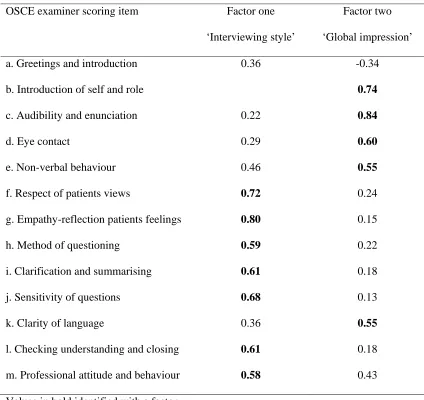
A principal components factor analysis with a Varimax rotation was conducted with the
clinical communication examiner scores awarded in the psychiatry OSCE station. The data
were adequate for factor analysis e.g. Kaiser-Meyer-Olkin Measure of Sampling Adequacy
identified that were positively correlated with other (r = 0.66, p<0.001), and they accounted
for 51.7% of the variance in the clinical communication scores: factor one (29.4%), and
factor two (22.3%) respectively (Table 1). Seven items loaded on factor one and described
the ‘interviewing style’ of the trainee doctors, with 5 items loaded onto factor two which
indicated their ‘global impression’ aspects of clinical communication with 5 items. A
summary score for each factor was generated by summing the scores of the items that loaded
onto interviewing style (0 to 21) and global impression (0 to 15). A single item was discarded
(‘Greeting and introduction’) because it loaded with approximately equal values and opposite
signs onto both components, and this particular item assessed whether the trainee doctors had
both greeted the patient and undertaken a patient identity check e.g. name and date of birth.
[INSERT TABLE 1 ABOUT HERE]
3.3. Clinical communication, patient satisfaction, and clinical competency
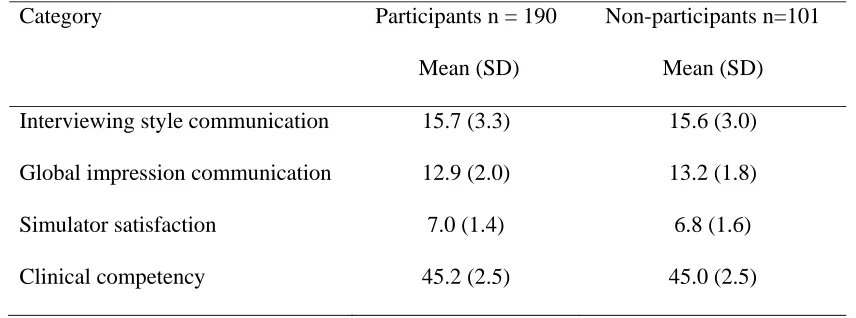
Initially data from the participants (n = 190) and non-participants (n=101) were compared
and there were no differences found between: clinical communication (interviewing style,
global impression), simulator satisfaction, and overall clinical competency: Interviewing style
(t = 0.26, df = 289, p = 0.79, global impression (t = 1.28, df = 228.3, p = 0.20), satisfaction (t
= 1.29, df = 289, p = 0.20), and overall clinical competency (t = 0.51, df = 289, p = 0.61).
The range of scores for participants included in the analysis (n = 190) were; interviewing
style 7 to 21, global impression 8 to 15, satisfaction 4 to10, and overall clinical competency
39 to 49.
Relationships between demographic data (gender, age) and the participants’ clinical
communication (interviewing style, global impression), overall clinical competency,
simulator satisfaction, and attachment styles (anxiety, avoidance) were examined. There were
no gender differences across the measures. There was a positive correlation between age and
global impression communication scores (r = 0.18, p = 0.01), indicating that older students
scored higher global impression communication scores. Age and attachment anxiety were
negatively correlated (r = -0.17, p = 0.02) with increases in age associated with increases in
anxiety, because lower attachment style scores indicated higher levels of anxiety or
avoidance.
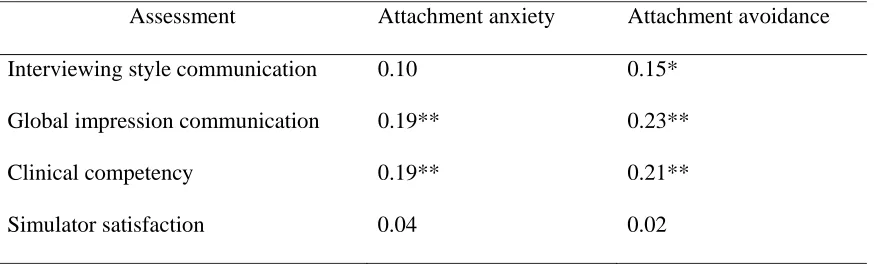
To test the study predictions, the relationships between attachment styles (anxiety, avoidance)
and OSCE performance (clinical communication, overall clinical competency) were
examined. Attachment anxiety and avoidance were both positively correlated with global
impression clinical communication and overall clinical competency scores, and attachment
avoidance was also positively correlated with interviewing style clinical communication. The
direction of all these relationships indicated that lower levels of attachment anxiety and
avoidance were associated with higher communication and overall clinical competency
scores. Attachment styles were not related to simulator satisfaction ratings. See Table 3.
[INSERT TABLE 3 ABOUT HERE]
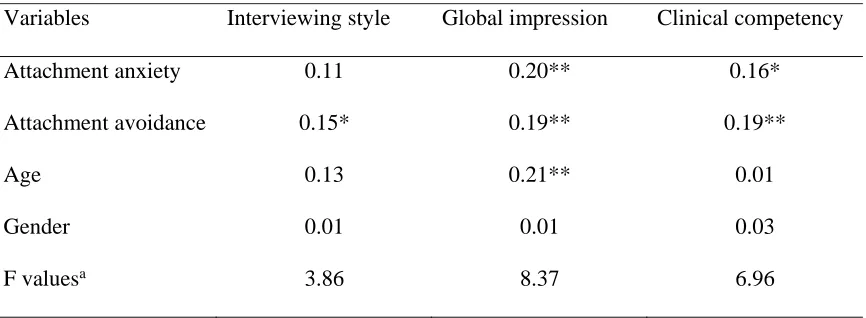
A series of multivariate linear regressions examined the degree to which attachment anxiety
gender were entered into the initial regression models with the attachment measures. See
Table 4.
Interviewing style communication was only significantly predicted by attachment avoidance.
Global impression communication was predicted by participants’ age, attachment anxiety,
and attachment avoidance.
Clinical competency was predicted by both attachment anxiety and attachment avoidance.
The direction of attachment anxiety and avoidance variables replicated the results from the
correlation analyses i.e. lower levels of attachment anxiety and/or avoidance predicted higher
global communication and clinical competency examination scores. In addition, increases in
age predicted higher global communication scores. Lower levels of attachment avoidance
predicted higher interviewing style scores.
[INSERT TABLE 4 ABOUT HERE]
4. Discussion and Conclusion
4.1. Discussion
This is the first study to consider whether final year undergraduate students’ attachment
styles are related to their performance on a clinical communication OSCE, and the results
support the research hypotheses. There were significant relationships between attachment
measures. In general, attachment avoidance had a greater influence on forms of
communication identified in this investigation than attachment anxiety, whereas both
attachment styles similarly impacted on the assessment of the trainee doctors’ levels of
clinical competency.
An unexpected finding was that there was no association between attachment style and
ratings by simulated patients, as the simulators were interacting directly with the students.
Although the literature on simulated patients suggests they are invaluable in teaching and
assessment situations [12, 50], evaluations as proxy measures of patient experiences are
problematic because simulators are inevitably involved in the training and it is unclear what
factors may contribute to a single item score as used in this study. Interestingly, a more
recently published version of the OSCE communication instrument no longer includes
simulated patient rating [51] and the authors argue that, although SP ratings should correlate
with examiner ratings (as they did in our study), the quality of clinical interactions extends
beyond ‘customer communication’ and SP ratings should not be used within high-stakes
university assessments [51]. In contrast, the examiners assessments, which were multi-item
and guided by specific marking criteria for each item and across the exam stations, gave less
opportunity for individual variability in marking. The influence of attachment styles on both
global impression communication and overall clinical competency illustrates that the
examiners assessments were probably still subject to the overall manner of the trainee
doctors. This suggests that trainees with high levels of attachment avoidance and/or anxiety
may demonstrate a less intensive, more evasive interaction style due to their avoidance in
relationships with others which was apparent to the examiners. These findings and
interpretation are in accord with attachment theory which posits that individuals with low
relationships with other people, whereas those with high attachment anxiety and/or avoidance
tend to be distrusting in relationships with others [43].
Our findings with trainee doctors support the findings from other studies with qualified
healthcare professionals that demonstrate that attachment style influences the behaviours in
clinical settings. For example, mental health case managers classified as having a
preoccupied-dismissing attachment style (high levels of attachment avoidance) were
observed to intervene less intensively with patients, compared to managers with secure
attachment (low levels of attachment anxiety and avoidance) [34]. Other investigators have
reported that psychiatric staff, identified as having high levels of attachment avoidance, have
also been observed to have had problems making psychological inferences about patients
behaviours [35]. This study suggests that associations are already in place during health
professionals training.
4.2. Methodological considerations
The standardised scenario ensured that the trainee doctors would have similar opportunities to
respond to emotionally distressed simulated patients. There is much literature attesting to the
validity of the use of simulated patients [11,12,50,52] and studies investigating potential bias
have failed to find consistent patterns or effects [53,54]. However, the standardised exam
context does somewhat limit generalisablity to ‘real’ clinical settings. The six-function model
of medical communication specifies that doctors are expected to: foster the relationship,
gather information, provide information; make decisions, enable disease/treatment-related
behaviour, and respond to emotions [55]. The nature and function of the psychiatry OSCE is
likely to have influenced the trainee doctors, who were aware that it was an assessment of
the simulator and responding to their emotions would be viewed as crucial aspects of the
interaction, as well taking a history of the presenting problem, which they were required to
present in a subsequent OSCE station along with their formulation of the presenting problem.
These functions clearly map onto four of the aspects outlined in the six-function model and
are likely to have some degree of generalisability to clinical practice, but with an added
assessment dimension. The communication assessment tool used covers a wide range of
communication behaviours and considers trainee doctors’ interactions with simulators in
terms of: showing empathy, respecting patients’ views, using
open/closed/clarifying/summarising questions effectively, tackling personal issues with
sensitivity, appropriate eye contact, and appropriate non-verbal behaviour. The psychiatry
communication OSCE score therefore takes into account the participant’s empathy and
sensitivity, as well as the clinical appropriateness of their questions. However, the study was
limited by focusing on one aspect of communication, and a single measure of communication
should not be interpreted as reflective of the trainee doctors’ communication abilities across
different situations.
4.2. Conclusion
The study provides novel information on the relationship between trainee doctors’ attachment
styles and their clinical and communication performance during summative assessment. It
adds to the growing body of evidence attesting to the importance of considering attachment
theory with respect to doctor-patient relationships, specifically regarding doctor-patient
communication and, interestingly, clinical competency. It furthermore suggests that an
understanding of attachment theory may be beneficial to the teaching of clinical
communication in medical education, by highlighting the role and importance of developing
particularly struggle with this [33]. Future research should investigate whether these findings
are replicated with ‘real’ patients in clinical practice, and whether doctors’ attachment styles
influence patient judgements of their perception of the quality of the consultation i.e. to
include and focus on patients’ ratings of clinical communication.
4.3. Practice implications
Findings indicated that attachment style influences trainee doctors’ ability to communicate
with patients in a way that is currently valued in modern medical education, in terms of
communication and clinical competency. As well as adding to the increasing evidence base
concerning the importance of considering doctors’ attachment style within the context of the
doctor-patient relationship [18, 32, 36], this finding has potential implications for the medical
curriculum. It supports the view that an understanding of attachment theory may have a role
in the development and delivery of providing effective medical training [37]. There is a
growing understanding of the importance of patient attachment style in engaging with health
care (e.g. 16, 30, 31), and increasing awareness in the interaction role of doctor attachment
style [17, 36). The findings may help begin to understand why some students find
communicating with patients more challenging than others [33] and are less able to seek
support under high stress conditions [56]. They also point towards the value of medical
educators to be informed of the role that student attachment has in their ability and interest
when engaging with patients. Making all medical students aware of these issues could benefit
consultation skills generally [37], by reflecting upon and understanding their own responses
to different interactions, and having exposure to peers and SPs portraying differing
attachment styles in practice consultations to gain experience of differing patient needs as to
their preferred communication approach. Furthermore, if medical students with insecure
difficult to respond effectively to patients’ underlying needs, an explicit emphasis on
attachment theory may have particular benefit in terms of these students’ communication and
clinical skills – helping them to recognise the value to patients of interviewing skills and how
they can provide an impression of trust e.g. via experiential learning through video feedback.
It is too simplistic to conclude that a secure attachment style is always going to be beneficial
for patient care [32], nor that giving facilitative responses to cues will always be appropriate
and helpful. With the application of attachment theory to medical care comes an
understanding that sometimes providers will need to respond in ways that counter
inappropriate dependence in their patients [32]. There may be value however in helping
medical students and other health-care providers to think about their own experiences in
relationships, how these may influence the way they relate to others, and their abilities to
communicate effectively with patients in emotional distress.
Author contributions
SP and IF conceived of the study and oversaw data collection. IF acts as guarantor for the
study. RM collated the data and led the analysis and initial drafting of the manuscript. All
References
[1] Gude T, Vaglum P, Anvik T, Baerheim A, Eide H, Fasmer OB, et al. Observed
communication skills: How do they relate to the consultation content? A nation-wide study of
graduate medical students seeing a standardized patient for a first-time consultation in a
general practice setting. BMC Medical Education 2007; 7:43.
[2] Hall JA. Some observations on provider-patient communication research. Patient
Education and Counseling 2003; 50: 9-12.
[3] Taylor K. Paternalism, participation and partnership - The evolution of patient
centeredness in the consultation. Patient Education and Counseling 2009; 74: 150-155.
[4] Stewart MA. Effective physician-patient communication and health outcomes: A review.
Canadian Medical Association Journal 1995; 152: 1423-1433.
[5] Street Jr RL, Makoul G, Arora NK, & Epstein RM. How does communication heal?
Pathways linking clinician-patient communication to health outcomes. Patient Education and
Counseling 2009; 74: 295-301.
[6] Brown J. How clinical communication has become a core part of medical education in the
UK. Medical Education 2008; 42: 271-278.
[7] von Fragstein M, Silverman J, Cushing A, Quilligan S, Salisbury H, & Wiskin C. UK
consensus statement on the content of communication curricula in undergraduate medical
education. Medical Education 2008; 42: 1100-1107.
[8] General Medical Council. Tomorrow’s doctors. London: GMC, 2009.
[9] Hodges B, Turnbull J, Cohen R, Bienenstock A, Norman G. Evaluating communication
skills in the objective structured clinical examination format: reliability and generalizability.
Medical Education 1996; 30: 38-43.
[10] Kurtz S, Silverman J, & Draper J. Teaching and learning communication skills in
[11] Sanson-Fisher RW & Poole AD. (1980). Simulated patients and the assessment of
students’ interpersonal skills. Medical Education; 14: 249-253.
[12] Bokken L, Rethans J, Jobsis Q, Duvivier R, Scherpbier A, van der Vleuten C.
Instructiveness of Real Patients and Simulated Patients in Undergraduate Medical Education:
A Randomized Experiment. Academic Medicine 2010; 85: 148-154.
[13] Humphris GM & Kaney S. Assessing the development of communication skills in
undergraduate medical students. Medical Education 2001; 35: 225-231.
[14] Humphris GM & Kaney S. The Liverpool brief assessment system for communication
skills in the making of doctors. Advances in Health Sciences Education 2001; 6: 69-80.
[16] Ciechanowski PS, Katon WJ, Russo JE, Walker EA. The patient-provider relationship:
Attachment theory and adherence to treatment in diabetes. American Journal of Psychiatry
2001; 158: 29-35.
[17] Tan A, Zimmermann C, Rodin G. Interpersonal processes in palliative care: An
attachment perspective on the patient-clinican relationship. Palliative Medicine 2005; 19:
143-150.
[18] Salmon P & Young B. Core assumptions and research opportunities in clinical
communication. Patient Education and Counseling 2005; 58: 225-234.
[19] Hooper LM, Tomek S, Newman CR. Using attachment theory in medical settings:
Implications for primary care physicians. Journal of Mental Health 2012; 21: 23-37.
[20] Bowlby J. The making and breaking of affectional bonds. British Journal of Psychiatry
1977; 130: 201-210.
[21] Bowlby J. A secure base: Parent-child attachment and healthy human development. New
York: Basic, 1988.
[22] Hazan C & Shaver P. Romantic love conceptualized as an attachment process. Journal of
[23] Waters E, Merrick S, Treboux D, Crowell J, Albersheim L. Attachment security in
infancy and early adulthood: A twenty-year longitudinal study. Child Development 2000; 71:
684-689.
[24] Bartholomew K. Avoidance of intimacy: An attachment perspective. Journal of Social
and Personal Relationships 1990; 7: 147-178.
[25] Mikulincer M, Shaver PR, Gillath O, Nitzberg RA. Attachment, caregiving and altruism:
Boosting attachment security increases compassion and helping. Journal of Personality and
Social Psychology 2005; 89: 817-839.
[26] Brennan KA, Clark CL, Shaver PR. Self-report measurement of adult attachment: An
integrative overview. In: Simpson JA & Rholes WS, eds. Attachment theory and close
relationships. New York: Guilford, 1998; 46-76.
[27] Fraley RC, Waller NG, Brennan KA. An item response theory analysis of self-report
measures of adult attachment. Journal of Personality and Social Psychology 2000; 78: 350–
365.
[28] Mikulincer M, Shaver PR, Pereg D. Attachment theory and affect regulation: The
dynamic development, and cognitive consequences of attachment-related strategies.
Motivation and Emotion 2003; 27: 77–102.
[30] Stuart S & Noyes R. Attachment and interpersonal communication in somatization.
Psychosomatics 1999; 40: 34-43.
[31] Ciechanowski PS, Walker EA, Katon WJ, Russo JE. Attachment theory: A model for
health care utilization and somatization. Psychosomatic Medicine 2002; 64: 660-667.
[32] Salmon P & Young B. Dependence and caring in clinical communication: The relevance
of attachment and other theories. Patient Education and Counseling 2009; 74: 331-338.
[33] Peters S, Young K, McCracken C. What do medical trainees think is so difficult about
[34] Dozier M, Cue KL, Barnett L. Clinicans as caregivers: Role of attachment organization
in treatment. Journal of Consulting and Clinical Psychology 1994; 62: 793-800.
[35] Berry K, Shah R, Cook A, Geater E, Barrowclough C, Wearden A. Staff attachment
styles: A Pilot study investigating the influence of adult attachment styles on staff
psychological mindedness and therapeutic relationships. Journal of Clinical Psychology
2008; 64: 355-363.
[36] Salmon P, Wissow L, Carroll J, Ring A, Humphris GM, Davies JC, Dowrick CF.
Doctors' attachment style and their inclination to propose somatic interventions for medically
unexplained symptoms. General Hospital Psychiatry 2008; 30:104-11.
[37] Wilkinson SR. Coping and complaining: Attachment and the language of dis-ease.
England: Brunner-Routledge, 2003.
[38] Trusty R, Ng K, Watts RE. Model of effects of adult attachment on emotional empathy
of counselling students. Journal of Counseling & Development 2005; 83: 66-77.
[39] Kaya N. Attachment styles of nursing students: A cross-sectional and a longitudinal
study. Nurse Education Today 2010; 30: 666–673.
[40] Cherry MG, Fletcher I, O’Sullivan H. The influence of medical students’ and doctors’
attachment style and emotional intelligence on their patient-provider communication. Patient
Education and Counselling 2013; 93: 177-187.
[41] Atherton K, Chisholm A, Rutter L, Peters S, Fletcher I. Breaking barriers in clinical
communication: are securely attached doctors more empathic doctors? Reinvention J
Undergraduate Research. 2009; 2.
[42] Cherry MG, Fletcher I, O’Sullivan H. Exploring the relationships among attachment,
emotional intelligence and communication. Medical Education 2013; 47: 317-325.
[43] Bartholomew K & Horowitz LM. Attachment styles among young adults: A test of a
[44] Bartholomew K & Shaver PR. Methods of assessing adult attachment: Do they
converge? In: Simpson JA & Rholes WS, eds. Attachment theory and close relationships.
New York: Guilford, 1998; 22-45.
[45] Scharfe E & Bartholomew. Reliability and stability of adult attachment patterns.
Personal Relationships 1994; 1: 23-43.
[46] Salmon P, Wissow L, Carroll J, Ring A, Humphris GM, Davies JC, Dowrick CF.
Doctors' attachment style and their inclination to propose somatic interventions for medically
unexplained symptoms. General Hospital Psychiatry 2007; 29:454-460.
[47] Clarke L, Beesley H, Holcombe C, Salmon P. The influence of childhood abuse and
adult attachment style on clinical relationships in breast cancer care. General Hospital
Psychiatry 2011; 32: 579-86.
[48] Ciechanowski PS, Russo JE, Katon WJ, Walker EA. Attachment theory in health care:
The influence of relationship style on medical students’ specialty choice. Medical Education
2004; 38: 262-270.
[49] Ciechanowski PS, Worley LLM, Russo JE, Katon WJ. Using relationship styles based
on attachment theory to improve understanding of specialty choice in medicine. BMC
Medical Education 2006; 6: 3.
[50] Lane C & Rollnick S. The use of simulated patients and role-play in communication
skills training: A review of the literature in August 2005, Patient Education and Counseling
2007; 67: 13-20.
[51] Huntley CD, Salmon P, Fisher P, Fletcher I, Young B. LUCAS: a theoretically informed
instrument to assess clinical communication in objective structured clinical examinations.
[52] Cohen L, Baile WF, Henninger E, Agarwal SK, Kudelka AP, Lenzi, R. et al.
Physiological and psychological effects of delivering medical news using a simulated
physician–patient scenario. Journal of Behavioral Medicine 2003; 26: 459-71.
[53] Colliver JA, Swartz MH, Robbs RS. The effect of examinee and patient ethnicity in
clinical-skills assessment with standardized patients. Advances in Health Sciences Education
2001; 6: 5-13.
[54] De Champlain AF, Schoeneberger, J, Boulet JR. Assessing the impact of examinee and
standardized patient ethnicity on test scores in a large-scale clinical skills examination:
Gathering evidence for the consequential aspect of validity. Academic Medicine 2004;
79(S10): 12-14.
[55] de Haes H. & Bensing J. Endpoints in medical communication research, proposing a
framework of functions and outcomes. Patient Education and Counseling 2009; 74: 287-94.
[56] Adshead G Becoming a caregiver: attachment theory and poorly performing doctors.
Table 1
Factor loadings in the psychiatry clinical communication OSCE.
OSCE examiner scoring item Factor one
‘Interviewing style’
Factor two
‘Global impression’
a. Greetings and introduction 0.36 -0.34
b. Introduction of self and role 0.74
c. Audibility and enunciation 0.22 0.84
d. Eye contact 0.29 0.60
e. Non-verbal behaviour 0.46 0.55
f. Respect of patients views 0.72 0.24
g. Empathy-reflection patients feelings 0.80 0.15
h. Method of questioning 0.59 0.22
i. Clarification and summarising 0.61 0.18
j. Sensitivity of questions 0.68 0.13
k. Clarity of language 0.36 0.55
l. Checking understanding and closing 0.61 0.18
m. Professional attitude and behaviour 0.58 0.43
Values in bold identified with a factor
Table 2
Trainee doctors’ clinical communication and overall clinical competency scores.
Category Participants n = 190
Mean (SD)
Non-participants n=101
Mean (SD)
Interviewing style communication 15.7 (3.3) 15.6 (3.0)
Global impression communication 12.9 (2.0) 13.2 (1.8)
Simulator satisfaction 7.0 (1.4) 6.8 (1.6)
Clinical competency 45.2 (2.5) 45.0 (2.5)
Table 3
Correlations between attachment styles, clinical communication and clinical competency.
Assessment Attachment anxiety Attachment avoidance
Interviewing style communication 0.10 0.15*
Global impression communication 0.19** 0.23**
Clinical competency 0.19** 0.21**
Simulator satisfaction 0.04 0.02
Table 4
Regression results of attachment styles, age, gender on clinical communication and
competency.
Variables Interviewing style Global impression Clinical competency
Attachment anxiety 0.11 0.20** 0.16*
Attachment avoidance 0.15* 0.19** 0.19**
Age 0.13 0.21** 0.01
Gender 0.01 0.01 0.03
F valuesa 3.86 8.37 6.96
Values are standardized regression coefficients.
aF values from the final model with significant variables.