Abstract—This paper proposes a chance-constrained multi-objective goal programming model for supplier selection problem with uncertain factors. Considering uncertain factors of demand, capacity and lead time and several objectives, the proposed approach provides chance constraints leading to a order allocation decision-making result. The decision keeps the confidence and risk of constraints to a certain level. Therefore, the optimization model makes sure of the procurement cost, including purchasing cost and penalty cost, being restricted within an acceptable level according to the confidence and risk value initially set. The paper also provides a comparison between the conventional model (deterministic constraints) and proposed model (chance constraints) and shows the superiority of the latter.
Keywords—supplier selection, chance constraint, goal programming, uncertainty
I. INTRODUCTION
UPPLIER selection problem is a multi-objective multi-criteria problem in which both conflicting objectives and various factors should be considered to select a proper supplier portfolio. The contemporary supply management is to maintain long term partnership with suppliers, and use fewer but reliable suppliers [1]. Furthermore, by using optimization programming method, the demand allocation of the portfolio can be achieved. Now due to global sourcing, it’s obvious that supplier selection must deal with multi-product situation which means company has to make a decision of how much of every kind of product should be purchased from which supplier. Management should split order quantities among the available suppliers for a variety of reasons including creating a constant environment of competitiveness (multiple sourcing) [2]. The company should consider both the qualified suppliers and its related order allocation.
Vendor selection decisions are complicated by the fact that various criteria must be considered in the decision making process [3]. Choosing the right suppliers involves much more than scanning a series of price list, and choices will depend on a
Xi Li1 is a master student of Graduate school of Information, Production and System of Waseda University, Japan (e-mail: [email protected]). Tomohiro Murata2 is a professor of Graduate school of Information, Production and System of Waseda University, Japan (e-mail: [email protected]).
wide range of factors. In previous researches, the criteria considered in a supplier selection model covers a large range, and cost, quality and lead time are the most significant ones. Many factors influencing international supplier selection decisions are in conflict with one another. For instance, the low price of purchased materials from a certain foreign supplier can be offset by the firm’s loose quality standards or chronic financial instability [4]. And 3 major objectives including cost minimization, quality maximization and lead time minimization are also centered in previous researches and usually decision-makers have aspired goals for each objectives. So for solving the problem, there is variety of approaches. DM techniques are identified from three perspectives: (1) Multi-criteria decision making (MCDM) techniques, (2) Mathematical programming (MP) techniques, and (3) Artificial intelligence (AI) techniques [5]. However, not all methods are equally useful in every possible purchasing situation [6]. From these technologies, optimization programming (especially goal programming) is mostly used. Because goal programming is a multi-objective optimization method in which each of measures is given a goal or target to be achieved. What’s more, objectives could be achieved by a certain priority order. Goal programming is used as a multi-criteria decision analysis tool [7].
Though optimization programming method can be effectively and frequently used for such kind of problem, another trend in current supplier selection environment which includes fluctuating demand, unreliable capacity and lead time adds risk in supply chain management. Risk is an inherent part of supply chain operations and the presence of outside suppliers is a major driver of supply chain risks. The study of uncertainty is centered on risks related to capacity, demand and variable cost uncertainty [8]. Few researches have considered the uncertainty of lead time. In real scenario, it is a problem with uncertain capacity, lead time and customer demand. The company will face a loss in case the demand can’t be satisfied or supplier fails in delivering adequate products on time. Therefore, effective and cost efficient supplier selection in a stochastic or uncertain scenario helps an organization in achieving its goal [9].
The problem of uncertainty in supplier selection process has been studied and method to solve it has been suggested for long. Apart from fuzzy technology, one of the most popular
Chance Constrained Multi-objective Programming
for Supplier Selection and Order Allocation
under Uncertainty
Xi Li
1, Tomohiro Murata
2methodologies applied in a supplier selection problem is chance constrained programming. The problem of stochastic (chance-constrained) programming is defined as follows: select certain random variable as function of random variables with known distributions in such a manner as constraints on these variables which must be maintained at prescribed levels of probability [10]. However, it is still not recommended to combine chance constrained programming in a multi-objective goal programming to solve the supplier selection and order allocation problem under uncertainty.
Therefore, the paper proposes a chance constrained goal programming method to help solve the multi-objective supplier selection problem with uncertain factors. There are 3 major purposes in the research. First is to complete multi-objective supplier selection programming with cost, product quality and lead time. Second is to propose robust supplier selection and order allocation method with chance constrained goal programming under uncertainties. Third is to evaluate the proposed method by experiment and comparison with conventional supplier selection goal programming.
II. MODEL CONSTRUCTION
A.Objective
There are 3 objectives making up the multi-objective part in supplier selection programming model: cost minimization, quality maximization and lead time minimization.
Minimize
= + (1)
Maximize (2)
Minimize (3)
Eq. (1) to Eq. (3) represent objectives of cost minimization, quality maximization and lead time minimization respectively where j means jth supplier, k means kth product, means the amount of product k delivered from supplier j and is a binary variable equal to 1 if supplier j is assigned as supplier of product k, 0 otherwise. These are objectives that ought to be achieved simultaneously restricted by the constraints. B.Conventional constraint (deterministic) (4)
(5)
(6)
(7)
(8)
Eq. (4) represents demand constraint meaning that the amount of product k ordered from supplier j must exceed the customer’s total demand. Eq. (5) represents capacity constraint meaning that the amount of product k ordered from supplier j should not exceed the real capacity of product k of supplier j. Eq. (6) represents lead time constraint meaning that the total lead time of one product required by the customer or the market. C. Chance constraint (stochastic) (9)
(10)
(11)
There is uncertainty or risk when the fluctuating demand, supplier capacity and lead time required by customer is unknown or uncertain. Then to respond to this uncertainty, chance constraint that keeps the condition to be achieved at a certain level is proposed. Eq. (9) means that the probability that total supply of each product satisfies the aspired demand of each product must exceed of confidence level. Eq. (10) means that the probability that supply of each product satisfies the real capacity of each product must exceed of confidence level. Eq. (11) means that the probability that total lead time exceeds the aspired lead time must be less than . Stochastic form could not be solved in a optimization model and according to chance constrained methodology, it can be transformed to its equivalent deterministic form. For demand chance constraint: (12)
For capacity chance constraint: (13)
For lead time chance constraint: (14)
Assuming follows probability distribution with cumulative distribution function (e.g.: normal distribution). Then (9) can be transformed to the equivalent condition (12) by using inverse cumulative probability distribution function. Eq. (13) is transformed assuming follows cumulative distribution function with known mean and standard deviation. It is same with (14) and the data is based on historical evidence. D.Chance constrained goal programming The chance constrained goal programming model is depicted as follows where represents deviation variable of each goal and represents weights of each goal. , and are goal values of each goal condition from (16) to (18). Minimize + + (15)
Subject to + - = (16)
+ - = (17)
+ - = (18)
(12)
(13)
(7)
(8)
The achievement function (15) is a minimization function because we require the total cost and lead time should be less than or equal to the goal value and quality level should be greater than or equal to the goal value. III. EXPERIMENT A.Case description, source of data and optimization tool The paper chose a single-buyer 5-supplier and 3-product situation. All of data used in the experiment is randomly generated under normality assumption. Specific information is shown in table I. Confidence level is initially set at =80%, =80% and risk level is set at =0.2. LINGO 11 is used to solve both conventional and proposed model. TABLEI DATA PREPARED FOR EXPERIMENT Data Data type Data size Demand mean and variable 3 (each product) Capacity mean and variable 15 (each product of each supplier) Cost mean 15 Quality percentage 15 Lead time mean and variable 15 B. Experiment purpose The objective of the experiment is to evaluate the effectiveness of the proposed model by comparing the cost both conventional (deterministic) and (stochastic) model would result in. C.Experiment process The experiment is carried out in the following steps: 1) First of all, goal values should be obtained by solving the conventional model. The paper set the optimal value of an objective from solution ignoring other objectives as its goal value. The following model show2 the process of getting goal value of objective (1). Single-objective optimization: Minimize (1)
Subject to (9)
(10)
(11)
(7)
(8) The other 2 goal values can be obtained by the same way. 2) Solve the conventional model (deterministic) in LINGO 11
and get the solution. Schedule with certain data which means there is no uncertainty on demand, capacity and lead time. Use average demand, full (100%) capacity and average lead time.
3) Solve the proposed model (stochastic) in LINGO 11and get the solution. Schedule with uncertain constraints. Use 80%probable demand, 80% probable capacity and 20% delay risk.
4) Randomly select 10 sets of data as real situations and use the data in the deterministic model and get related solutions. The results are regarded as comparative items.
D.Result
Table II and table III show the results of order allocation solution using conventional model and proposed model as follows:
TABLEII
SOLUTION OF CONVENTIONAL MODEL
purchasing cost P1 P2 P3
10532 S1 177 0 0
S2 73 57 0 S3 0 0 93 S4 27 189 219 S5 0 1 0
TABLEIII
SOLUTION OF PROPOSED MODEL
purchasing cost P1 P2 P3
10525 S1 143 0 0
S2 62 0 0 S3 0 0 41 S4 52 152 189 S5 0 78 57
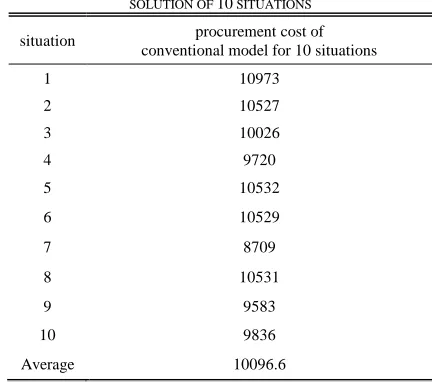
Table IV shows the results of conventional model under 10 randomly generated situations:
TABLEIV
SOLUTION OF 10 SITUATIONS
situation procurement cost of conventional model for 10 situations
[image:3.612.329.545.546.737.2]IV. EVALUATION
A.Evaluation measurement
In this paper, a measurement function is designed to evaluate the effectiveness and superiority of the proposed model: Procurement cost C = purchasing cost + penalty cost.
In this function, purchasing cost represents the cost directly calculated using order allocation solution and related unit cost and fixed cost. And penalty cost is calculated when the supply of each product is not satisfied according to the real demand, the order allocation exceeds the real capacity or total lead time of each product exceeds the optimized value compared with the result from real situations. The average of cost C of 10 situations is calculated to make the comparison between conventional model and proposed model.
B.Evaluation result
TABLEV
COST C OF CONVENTIONAL MODEL UNDER 10 SITUATIONS
situation penalty cost cost C 1 3160 13692 2 3140 13672 3 4104 14636 4 1176 11708 5 9076 19608 6 6144 16676 7 2432 12964 8 4504 15036 9 5996 16528 10 3072 13604 Average 5752.4 16284.4
Table V shows results of cost C of conventional model under 10 situations.
TABLEVI
COST C OF PROPOSED MODEL UNDER 10 SITUATIONS
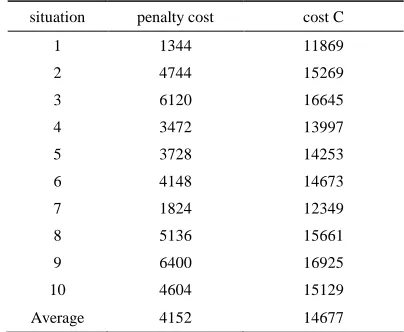
[image:4.612.318.533.47.123.2]situation penalty cost cost C 1 1344 11869 2 4744 15269 3 6120 16645 4 3472 13997 5 3728 14253 6 4148 14673 7 1824 12349 8 5136 15661 9 6400 16925 10 4604 15129 Average 4152 14677
[image:4.612.70.272.281.447.2]Table VI shows results of cost C of proposed model under 10 situations.
Fig. 1 Comparison between procurement cost of conventional model and proposed model under uncertain environment
Fig. 2 Comparison between purchasing cost of conventional model and proposed model under uncertain environment
Fig. 1 and 2 show the comparison between 2 models under uncertain environment.
C.Analysis
It is obvious that the result of conventional model and proposed model is different and the former leads to a lower purchasing cost. With known data of demand, capacity and lead time, the constraints in the multi-objective problem could be fixed and constructed with uncertain value. Then the solution would be most compromised without penalty cost. However with chance constraints (or confidence level assigned to constraints), there must be deviation of demand, capacity and lead time from the real situation so that not only the purchasing cost is much larger than that of deterministic model, there appears an evident penalty cost as well. Furthermore, with uncertain data, the deterministic model no longer kept its advantages of low procurement cost because of significant penalty cost.
Specifically, On the one hand, the procurement cost decreased by 9.8% using proposed model under uncertain environment.
On the other hand, the purchasing cost of deterministic model (without chance constraints) is similar with that of proposed model. However, the penalty cost decreased by 27.8% using proposed model.
From the analysis above, we can draw a conclusion: The proposed model is proved robust under uncertain environment. And it relaxes the value range of uncertain factors to diminish the penalty cost and maintain the purchasing cost at the same time. Therefore the proposed model is superior to deterministic model under uncertain environment.
Procuration cost
Deterministic model solution 16277.4
[image:4.612.70.272.516.682.2]V.CONCLUSION
Supplier selection is one of the most important stages of supply chain management. Due to global sourcing, firms have to make a decision of optimal order allocation under uncertainties in demand, capacity and lead time which increase in global manufacturing industry.
The paper provides a chance constrained multi-objective optimization model to handle the uncertainty factors including demand, capacity and lead time associated with supplier which can minimize total cost and lead time and maximize quality level of supply goods.
Deterministic equivalents of capacity, demand, cost and lead time chance constraints are derived under the normality assumption.
Goal programming methodology is used to solve the multi-objective optimization. The goal values are generated from single-objective model with each objective at one time.
The research also proposes an evaluating method using a procurement cost function (purchasing cost plus penalty cost) to compare the cost of conventional method and that of proposed method to test its superiority in multi-objective and robust supplier selection from a cost perspective. The experiment proves that the proposed model is superior to the conventional model under uncertain environment.
The research achievements can be applied to other similar multi-objective optimization problem under uncertainty. It can be improved by incorporating other qualitative issues including objective and constraint. However, it also has some drawbacks. The proposed method can only solve small-scale multi-objective optimization problem. Large-scale problem requires suitable optimization method such as genetic algorithm. This is one of the points to be considered in the future research.
REFERENCES
[1] Ho W, Xu X, Dey P K. Multi-criteria decision making approaches for supplier evaluation and selection: A literature review[J]. European Journal of Operational Research, 2010, 202(1): 16-24.W.-K. Chen, Linear Networks and Systems (Book style). Belmont, CA: Wadsworth, 1993, pp. 123–135.
[2] Sanayei A, Mousavi S F, Abdi M R, et al. An integrated group decision-making process for supplier selection and order allocation using multi-attribute utility theory and linear programming[J]. Journal of the Franklin Institute, 2008, 345(7): 731-747.B. Smith, ―An approach to graphs of linear forms (Unpublished work style),‖ unpublished. [3] Weber C A, Current J R, Benton W C. Vendor selection criteria and
methods[J]. European journal of operational research, 1991, 50(1): 2-18.J. Wang, ―Fundamentals of erbium-doped fiber amplifiers arrays (Periodical style—Submitted for publication),‖ IEEE J. Quantum Electron., submitted for publication.
[4] Min H. International supplier selection: a multi-attribute utility approach[J]. International Journal of Physical Distribution & Logistics Management, 1994, 24(5): 24-33.Y. Yorozu, M. Hirano, K. Oka, and Y. Tagawa, ―Electron spectroscopy studies on magneto-optical media and plastic substrate interfaces(Translation Journals style),‖ IEEE Transl. J. Magn.Jpn., vol. 2, Aug. 1987, pp. 740–741 [Dig. 9th Annu. Conf. Magnetics Japan, 1982, p. 301].
[5] Chai J, Liu J N K, Ngai E W T. Application of decision-making techniques in supplier selection: A systematic review of literature[J]. Expert Systems with Applications, 2013, 40(10): 3872-3885.J. U. Duncombe, ―Infrared navigation—Part I: An assessment of feasibility (Periodical style),‖ IEEE Trans. Electron Devices, vol. ED-11, pp. 34–39, Jan. 1959.
[6] De Boer L, Labro E, Morlacchi P. A review of methods supporting supplier selection[J]. European journal of purchasing & supply management, 2001, 7(2): 75-89.R. W. Lucky, ―Automatic equalization for digital communication,‖ Bell Syst. Tech. J., vol. 44, no. 4, pp. 547–588, Apr. 1965.
[7] Karpak B, Kumcu E, Kasuganti R. An application of visual interactive goal programming: a case in vendor selection decisions[J]. Journal of Multicriteria Decision Analysis, 1999, 8(2): 93.G. R. Faulhaber, ―Design of service systems with priority reservation,‖ in Conf. Rec. 1995 IEEE Int. Conf. Communications, pp. 3–8.
[8] Bilsel R U, Ravindran A. A multiobjective chance constrained programming model for supplier selection under uncertainty[J]. Transportation Research Part B: Methodological, 2011, 45(8): 1284-1300.
[9] Aggarwal R, Singh S P. Chance constraint-based multi-objective stochastic model for supplier selection[J]. The International Journal of Advanced Manufacturing Technology, 2015, 79(9-12): 1707-1719. [10] Charnes A, Cooper W W. Chance-constrained programming[J].