Abstract— A Social Business solution is composed of integrated components that functions differently but have one objective. In this view, this paper proposed a Mobile Component Integration Agent for Social Business Application as a software development methodology to simply integrate the different technology building blocks into one web-based solution. Agents are specialized kinds of components that offer great flexibility than traditional components. This paper proposed a mobile component integration agent for social business networking application as a software development methodology to simply integrate the different technology building blocks into one web-based solution. This study is focus in developing a software agent that could be used to assemble different type of components which were written and built by different developers of different platforms. We propose a systematic development process for software agent using component and UML. We first developed the agent components specification and modeled it. Based on this, we developed a mobile application for social business application as a case study. We integrate the developed software framework as a module in Drupal content management System.
Index Terms—Social business, Component Agent, CBD, web-based solution
I. INTRODUCTION
Distributed software agents offer great promise in building an increasingly pervasive middleware and component technology. The Social Business solutions are developed through the integration of different components.
Social Collaboration is an integrated set of tools that enable real-time knowledge sharing, increased productivity and faster innovation. The most effective approach to enabling a Social Business solutions around helping people discover expertise, develop social networks and capitalize on relationships. A Social Business enables its employees and customers to more easily find the information and expertise they seek. It helps groups of people bind together into communities of shared interest and coordinate their efforts to deliver better business results faster. It encourages, supports and takes advantage of innovation and idea creation and builds on the intelligence of the crowd.
This study aims to design a framework for social business application which will apply a component based development methodology. To these days, there is a need for fast development of mobile application which is platform independent.
Yvette Gelogo, School of Information Technology, Catholic University of Daegu KyungSan, Daegu, 712-702, Korea. Email: [email protected]
Heang-Kon Kim is with School of Information Technology, Catholic University of Daegu KyungSan, Daegu, 712-702, Korea (corresponding author to provide phone: 053-850-2743; fax: 053-850-2740;
e-mail: hangkon@ cu.ac.kr).
There is a need for flexible design for Social Business application systems for mobile.
The objectives of this study are to develop a framework with component based development methodology, design a social business application as a case study and develop a mobile application as an output of this study.
The contributions of this paper are the development of framework using component based development methodology for fast software integration regardless of the platform. This study designs a new model of social business application using content management system, Drupal and the output of this study is the integration and development of mobile application.
II. BACKGROUND OF THE STUDY A. Software Reuse
Software engineering has been more focused on original development but it is now recognized that to achieve better software, more quickly and at lower cost, we need to adopt a design process that is based on systematic software reuse.
Application system reuse
The whole of an application system may be reused either by incorporating it without change into other systems (COTS reuse) or by developing application families.
Component reuse
Components of an application from sub-systems to single objects may be reused.
Object and function reuse
Software components that implement a single well-defined object or function may be reused.
B. Component Based Development
Component-Based Development claims to offer a radically new approach to the design, construction, implementation and evolution of software applications. Software applications are assembled from components from a variety of sources; the components themselves may be written in several different programming languages and run on several different platforms. CBD architecture is being used nowadays and the research on how to make it more efficient is the focus of this study. A component re-used is one of the most convenient ways for the fast software production. There have been many methods on how to do this and it does involve more technical and detailed view. In this paper we tried to integrate the concept of CBD to develop a mobile enterprise application. We believed that enterprise application uses software components that are being re-used repeatedly; hence, component re-used for mass application developments is necessary [7][8]. Component Based Development (CBD) is popular methodology to develop a
A Design of Mobile Component Integration
Agent for Social Business Networking
Application
mobile component through component re-used. One of the interesting researches is the enterprise mobile application development with CBD.
C. Social Business Systems
Social business, as the term has been commonly used since, was defined by Nobel Peace Prize laureate Prof. Muhammad Yunus and is described in his books creating a world without poverty [1]. A social business is a company created with the sole purpose of solving a social problem in a financially self-sustainable way. A good social business combines an unwavering focus on meeting social needs with entrepreneurial energy, market discipline, and great potential for replicating and scaling successful enterprises.
As the rapid growth of social networking and mobility has erased some of the boundaries that separated individuals in the past, people increasingly use their relationships with other people to discover and use information to accomplish innumerable tasks. New opportunities for growth, innovation and productivity exist for organizations that encourage people – employees, customers and partners – to engage and build trusted relationships. Individuals are using social networking tools in their personal lives, and many are also incorporating it into their work lives – regardless of whether it’s sanctioned by their employers. Astute organizations will embrace social software and find the most effective ways to utilize it to drive growth, improve client satisfaction and empower employees [2].
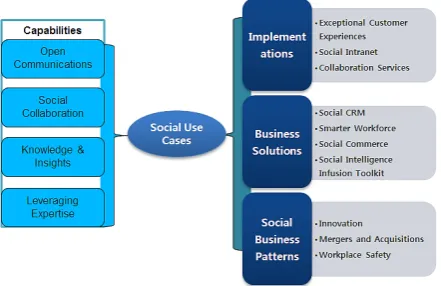
Figure 1 show the Social Business use case centric model based on IBM architecture. It has four components, the social collaboration, social analytics, and social content and social user experience. There four components should be meet for successful social business solution. Integrating these components requires different type of technology integration. There are four main Platforms for Social Business. These are social networking, social analytics, social content, and social user experience [2].
Social networking platforms should be met some considerations
Social Networking
People-centric, relationship driven
Openness
Transparent work and open decision making
Connected and discoverable
Business driven
Adaptable
Social Analytics
Infused into social platform
Leverage social data to under hidden relationships
Make determinations on what people think and might do
Integrated solutions
Social Content
User Contributed
Co-creation
Developing content to web, mobile, and social channels
Engaging
Social User Experience
Role-based, relationship driven social, web, and mobile experiences
Dynamic, adaptable, and personal
[image:2.595.320.541.60.203.2] Engaging
Fig.1. Social Business use case centric model
III. SOCIAL BUSINESS SYSTEM MODELING A. Component Identification
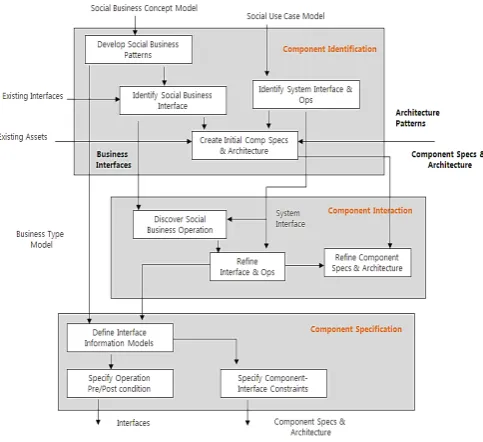
The component identification stage takes as input the business concept model and the use case model from the requirements workflow. It assumes an application layering that includes a separation of system components and business components. Its goal is to identify an initial set of business interfaces for the business components and an initial set of system interfaces for the system components, and to pull these together into initial component architecture. The business type model is an intermediate artifact from which the initial business interfaces are formed. It is also used later, in the component specification stage, as the raw material for the development of interface information models [6].
Any existing components or other software assets need to be taken into account too, as well as any architecture patterns you plan to use. At this stage it’s fairly broad-brush stuff, intended to set out the component and interface landscape for subsequent refinement.
B. Component Interaction
The component interaction stage examine how each of the system operations will be achieved using the component architecture. It uses interaction models to discover operations on the business interfaces. As more interactions are considered, common operations and patterns of usage emerge that can be factored out and reused. Responsibility choices become clearer and operations are moved from one interface to another. Alternative groupings of interfaces into components can be investigated. This is the time to think through the management of references between component objects so that dependencies are minimized and referential integrity policies are accommodated.
The component interaction stage is the stage where the full details of the system structure emerges, with the clear understanding of the dependencies between components, down to the individual operation level.
C. Component Specification
component specification of and independent of each interface. These component specification constraints determine how the type definitions in individual interfaces will correspond to each other in the context of the component.
[image:3.595.314.537.129.442.2]The architecture should not materially change at this stage. This detailed specification tasks should be undertaken once the architecture is stable and all the operation of the interfaces have been identified. The act of writing the precise rules for each operation may help you discover missing parameters, or missing information, but emphasis is on filling in detail onto a stable framework.
Fig.2 Social Business specification workflow
IV. MOBILE COMPONENT INTEGRATION AGENT (MCIA)
A. UML Modeling Technique for Social Business System Application
[image:3.595.55.297.192.413.2]The Social Business Concept Model Diagram is a class diagram depicting the business concept model. An Interface Specification Diagram depicts the interface specification. And so it continues, with the Business Type model Diagram, the Component Specification Diagrams, and the Component Architecture Diagram, each depicting their corresponding artifacts.
Fig. 3 Social Business component Modeling Diagram
Figure 4 shows the Component Architecture. This is a set of application level software components, their structural relationships, and their behavioral dependencies. A component architecture may apply to a single application or to a wider context, such as a set of applications serving a particular social business process area.
Fig. 4 Component Architecture
Fig. 5 Mobile Component Integration Agent (MCIA) method
Figure 5 show the Mobile Component Integration Agent. The social business enablers are different technology which functions individually. With the component integration process, we come up with one solution. First, we analyze the business process and study the role and relationship of each component.
B. MCIA Specification Development
[image:3.595.49.283.614.775.2]The mobile agent specification development shows the model and concepts of integrating the different social technology building blocks. Figure 6 shows the representation of the MCIA Model concepts and relations.
[image:3.595.308.519.624.741.2]Implication
• Links one or more elements that have an attribute of type state to a single element that has an attribute of type state.
Assignment
• Links an element of type Autonomous Entity to an element that has an attribute of type Autonomous Entity.
• Assignment from one Autonomous Entity to another following the direction of the arrow.
Data flow
• Links a DataProsumer to an InformationEntity that is produced or consumed.
• Relation as the ObjectFlow relation defined in UML. Mobile Agent Identification and Role Model Creation
Focuses on the individual Agents and Roles
For each agent/role it uses scheme supported by diagrams to its characteristics
• what goals it is responsible for • what events it needs to sense • what resources it controls • what tasks it informs • how to perform
The component specifications include the interface specifications they support or depend on, and the component architecture shows how the components interact with each other. The identified information based on component users and performance must be provided in specification form for integration. Also, this information can be provided and acquired by producer, consumer and agent in interoperating system. The information of component design and development, and also functional and non-functional information must be provided by producer, and agent must provide the commercial information with this. This information is the important standard for choice and the ground for reuse to acquire the component.
V. CASE STUDY
This study proposes a development of social business mobile application using drupal as a case study. Drupal is a content management system (CMS) Drupal allow the user to create a customize module with its own source code to meet the requirements. Drupal makes it very easy to manipulate the content using the hooks. The main node API is implemented by a single hooks that provides a module with the ability to manipulate the node at various stages in its life cycle. The hook gets passed the node object and a parameter indicating what operation is being performed on it, such us load, update, or view. It is the last of this operation that you want to intercept, because the node is loaded with its HTML content at that point, ready to be rendered, and you can make changes to it if required.
With the use of Content construction Kit (CCK) and views the module is almost part of the CMS as a whole. The CCK module allows site administrator to add extra fields to nodes and augment the standard data model of title, body, author, published date, and so on. These capabilities allow the developer to for flexible design of the web app and the content that needed.
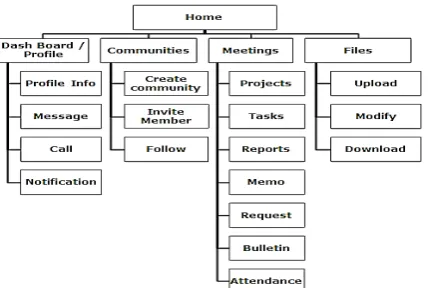
Figure 8 shows the general overview of the Social Business system for mobile. There are 4 main components design in this model, the profile, communities, meetings and files. We came up with this components based on the social business specifications. The Profile component allows the user to create his/her profile. This also includes messaging, calling, adding friends and notification about the updates. The community components allow the user to create a community, follow other communities, or participate with the discussions and so on. The meeting component is the most complex component. This includes the projects, tasks, reports, memos, request, bulleting and attendance. This is where the meeting is done with other members in the social business. Basically, this is the room for working in the tasks, project and etc. which allow users to collaborate with each other. This component is the biggest component which requires the developer to be more attentive to the integration of different components. Another component that is included is the file. This allows the user to upload files, share it, modify the content and can also be downloaded. This may include spreadsheets and other type of documents.
The tedious task in development of mobile application is the development of hooks and views for social business application. This is where the component development methodology is applied. The way the module is developed in drupal needs the plug-ins and other necessary components for social media application.
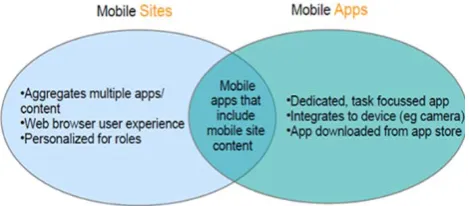
[image:4.595.305.540.528.631.2]Figure 8 shows the concept of web-based solution. This can be access via micro-browser or a mobile application. With a minimal number of taps, users can access their social information. Using the proposed Mobile Component Integration Agent method we came up with the social business system for mobile web-based solution.
Fig. 7 Concept of web-based social business solution
A. Implementation
The following are needed software and steps to develop the mobile application:
1. Install Web Server (xampp) 2. Install drupal
3. Customize the installed drupal based on web lay-out and contents
Fig. 8 General overview of the Social Business System for mobile
VI. CONCLUSION
This study is focus in developing a software agent that could be used to assemble different type of components which were written and built by different developers of different platforms. This paper proposed a Mobile Component Integration Agent for Social Business Application as a software development methodology to simply integrate the different technology building blocks into one web-based solution. We first developed the agent components specification and modeled it. Based on this, we developed a mobile application for social business application as a case study. We integrate the developed software framework as a module in Drupal content management System as our case study.
ACKNOWLEDGEMENT
This research was Supported by the MSIP (Ministry of Science, ICT and Future Planning), Korea, under the C-ITRC (Convergence Information Technology Research Center) support program (IITP-2015-H8601-15-1007) supervised by the IITP (Institute for Information & communication Technology Promotion).
This research was also supported by the International Research & Development Pro-gram of the National Research Foundation of Korea (NRF) funded by the Ministry of Science, ICT & Future Planning (Grant number: K 2013079410).
REFERENCES
[1] Yunus, Muhammad (2009). Creating a World without Poverty: Social Business and the Future of Capitalism. Public Affairs. p. 320. ISBN 978-1-58648-667-9.
[2] Social Business Architecture, IBM Corporation 2014, Retrieved: March 10, 2015
[3] John Cheesman and John Daniels, “UML Components: A Simple Process for Specifying Component-Based Software”, The Addison-Wesley Object Technology Series 2000, ISBN: 0-201-70851-5
[4] The Social Business, Advent of a new age, White Paper, EPW14008-USEN-00, Retrieved: February 10, 2015, https://www.ibm.com/smarterplanet/global/files/us__en_us__socialbu siness__epw14008usen.pdf
[5] Luciane Telinski Wiedermann Agner, Inali Wisniewski Soares, Paulo Cezar Stadzisz and Jean Marcelo Simao “Model Refinement in the Model Driven Development Context”, Journal of Computer Science 8 (8): 1205-1211, 2012, ISSN 1549-3636
[6] John Cheesman and John Daniels, UML Components, A simple Process for Specifying Component-Based Software, The Addison-Wesley Object Technology Series (2001)
[7] Vasian Cepa, “Product-Line Development for Mobile Device Applications with Attribute Supported Containers”, PhD Dissertation, Software Technology Group, Technical University of Darmstadt, 2005
[8] Haeng-Kon Kim, Mobile Agent Development with CBD on ABCD Architectures, International MultiConference of Engineers and Computer Scientists 2013.