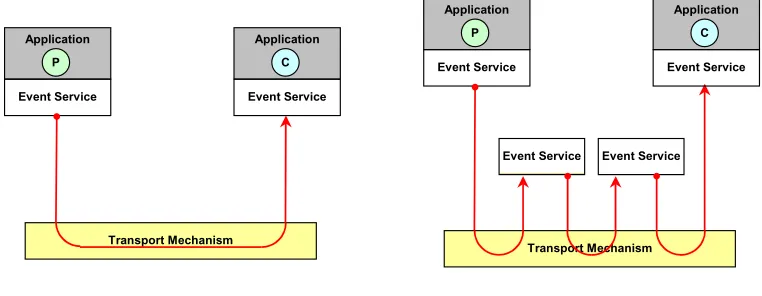
Event-Based Middleware
for Collaborative Ad Hoc Applications
A thesis submitted to the
University of Dublin, Trinity College,
in fulfilment of the requirements for the degree of
Doctor of Philosophy (Computer Science).
René Meier
Distributed Systems Group,
Department of Computer Science,
Trinity College, University of Dublin.
- i -
D
ECLARATIONI, the undersigned, declare that this work has not previously been submitted as an exercise for a degree at this or any other University, and that, unless otherwise stated, it is entirely my own work.
________________________________
René Meier,
- ii -
P
ERMISSION TOL
END AND/
ORC
OPYI, the undersigned, agree that the Trinity College Library may lend and/or copy this thesis upon request.
________________________________
René Meier,
- iii -
A
CKNOWLEDGEMENTSFirst and foremost, I would like to express my gratitude to my supervisor, Prof. Vinny Cahill, for supporting me throughout my PhD studies. His support, both in terms of encouragement as well as technical have provided the best possible foundation for this thesis and are very much appreciated. Many thanks also to Prof. Paddy Nixon for advising me during the early stage of my studies and for helping to initially formulate the basis for this research.
I am also thankful to all the other academics in the Distributed Systems Group, Dr. Siobhán Clarke, Dr. Christian Jensen, and Dr. Simon Dobson. Their technical expertise has been invaluable.
Further thanks go to Brendan O’Brien and Dublin City Council for providing the traffic data that made the evaluation of this research possible.
I would like to specially thank all former and current members of the Anois and the CORTEX project teams, especially Raymond Cunningham for always willingly lending a hand, as well as Dr. Stefan Weber, Dr. Marco Killijian, Dr. Tilman Schaefer, Mads Haahr, Jim Dowling, Peter Barron, Tim Walsh, and Sotirios Terzis, for fruitful collaboration and good spirit.
- iv -
“Now gentlemen, let us do something which the world may talk of hereafter.”
- v -
A
BSTRACTMiddleware supporting event-based communication is widely recognised as being well suited to interconnecting the components of mobile applications since it naturally accommodates a dynamically changing population of components and the dynamic reconfiguration of the connections between them. Existing research on event-based middleware for wireless networks has mainly focussed on accommodating nomadic applications using infrastructure networks while relatively little work has been done to address the distinct requirements associated with supporting collaborative applications, especially those that use ad hoc networks.
Traditionally, event-based middleware employs logically centralised or intermediate components to implement key properties of the middleware. Application components may utilise centralised lookup and naming services to discover peers in order to communicate with them. Intermediate components may be used to route event notifications from producers to consumers and to apply event notification filters. Moreover, they may be used to enforce non-functional attributes, such as event notification delivery order and priority. The central problem with this approach arises with increasing system scale as such middleware components may become a liability due to availability and bandwidth limitations.
Centralised or intermediate middleware components are typically hosted by physical machines that are part of a designated service infrastructure in order to ensure that they are always accessible to application components. The disadvantage of exploiting such an infrastructure is that its installation and maintenance requires substantial resources while limiting communication between components to the geographical areas in which the infrastructure has previously been made available.
A similar approach is generally used when designing event-based middleware for wireless communication using infrastructure networks. Designated middleware components can be hosted naturally by parts of the network infrastructure, such as access points. However, alternative approaches have to be adopted by event-based middleware for ad hoc networks since ad hoc networks allow application components to communicate and collaborate in a spontaneous manner without the aid of a separate service infrastructure.
- vi -
the presence of any infrastructure or on centralised or intermediate components. Our approach allows the components comprising collaborative applications to come together anywhere and at any time in order to interact through wireless communication using ad hoc networks without depending on a previously installed service infrastructure.
This design supports distributed approaches to discovering peers and to filtering event notifications. Filters may be applied to a range of functional and non-function attributes associated with event notifications including subject, content, and context. Combining event notification filters increases the filtering precision allowing a component to subscribe to the subset of event notifications in which it is interested using multiple criteria, such as meaning, time, location, and quality of service. In particular, event notification filters may be used to define geographical areas within which certain event notifications are valid; hence delivering event notifications at the specific location where they are relevant. Such geographical scopes represent a natural way to identify event notifications of interest for mobile components. In addition, we have discovered decentralised techniques that improve system scalability for mobile computing applications comprising of large numbers of interconnected components distributed over large geographical areas as well as the predictability of the event service. Event notification filtering in general and our approach of combining filters in particular improves system scalability by limiting the forwarding of event notifications. Moreover, limiting event notification forwarding and bounding the event notification dissemination scope improves the predictable behaviour of the middleware.
A further contribution of this thesis is a taxonomy of distributed event-based programming systems. The taxonomy is structured as a hierarchy of the fundamental properties of a distributed event-based programming system and may be used as a framework to describe an event system according to a variety of criteria including its event, organisation, and interaction models.
- vii -
R
ELATEDP
UBLICATIONSJournal Papers:
• R. Meier, "Communication Paradigms for Mobile Computing," ACM SIGMOBILE Mobile Computing and Communications Review (MC2R), vol. 6, pp. 56-58, 2002.
Refereed Conference and Workshop Papers:
• R. Meier and V. Cahill, "Exploiting Proximity in Event-Based Middleware for Collaborative Mobile Applications," in Proceedings of the 4th IFIP International Conference on Distributed Applications and Interoperable Systems (DAIS'03), LNCS 2893. Paris, France: Springer-Verlag Heidelberg, Germany, 2003, pp. 285-296.
• R. Meier and V. Cahill, "Location-Aware Event-Based Middleware: A paradigm for Collaborative Mobile Applications?," presented at the 8th CaberNet Radicals Workshop, Ajaccio, Corsica, France, 2003.
• R. Meier and V. Cahill, "STEAM: Event-Based Middleware for Wireless Ad Hoc Networks," in Proceedings of the International Workshop on Distributed Event-Based Systems (ICDCS/DEBS'02). Vienna, Austria, 2002, pp. 639-644.
• R. Meier and V. Cahill, "Taxonomy of Distributed Event-Based Programming Systems," in Proceedings of the International Workshop on Distributed Event-Based Systems (ICDCS/DEBS'02). Vienna, Austria, 2002, pp. 585-588.
• M. O. Killijian, R. Cunningham, R. Meier, L. Mazare, and V. Cahill, "Towards Group Communication for Mobile Participants," in Proceedings of Principles of Mobile Computing (POMC'2001). Newport, Rhode Island, USA, 2001, pp. 75-82.
• R. Meier, M. O. Killijian, R. Cunningham, and V. Cahill, "Towards Proximity Group Communication," presented at Advanced Topic Workshop on Middleware for Mobile Computing (IFIP/ACM Middleware 2001), Heidelberg, Germany, 2001.
- viii -
C
ONTENTSCHAPTER 1: INTRODUCTION ... 1
1.1 Mobile Computing Environments... 2
1.2 Nomadic and Collaborative Applications ... 2
1.3 Event-Based Middleware and Mobile Computing... 4
1.4 Aims and Objectives ... 4
1.5 STEAM... 5
1.6 Contribution of this Thesis ... 6
1.7 Organisation of this Thesis ... 8
CHAPTER 2: DISTRIBUTED EVENT MODELS ... 10
2.1 The Event-Based Communication Model ... 11
2.1.1 The Participants ... 11
2.1.2 Characteristics of Event-Based Communication... 12
2.2 Functional Design Issues... 14
2.2.1 Typed Events ... 15
2.2.2 Event Filtering ... 15
2.2.3 Announcing Events ... 16
2.2.4 Subscribing to Events... 16
2.2.5 Delivery Semantics... 17
2.2.6 Subject-Based Event Models ... 17
2.2.7 Content-Based Event Models ... 18
2.3 Non-Functional Design Issues... 18
2.3.1 Quality of Service ... 19
2.3.2 Real-Time... 20
2.3.3 Scalability ... 21
2.4 OMG CORBA Event Models... 22
2.4.1 CORBA Event Service ... 23
2.4.2 CORBA Notification Service... 26
2.4.3 Summary ... 31
2.5 OMG CORBA Event Model Extensions... 32
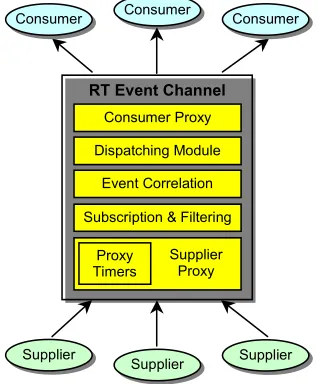
2.5.1 TAO Real-Time Event Service ... 32
- ix -
2.5.3 Summary ... 35
2.6 JAVA Event Models ... 36
2.6.1 Java AWT Delegation Event Model ... 36
2.6.2 Java Distributed Event Model ... 39
2.6.3 Summary ... 41
2.7 CEA... 42
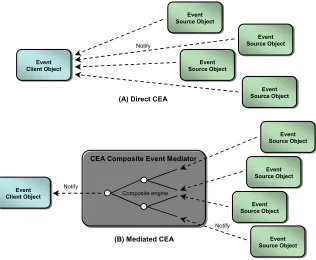
2.7.1 Cambridge Event Architecture ... 42
2.7.2 Summary ... 45
2.8 ECO ... 46
2.8.1 ECO Architecture ... 46
2.8.2 Summary ... 49
2.9 JEDI ... 49
2.9.1 JEDI Architecture ... 50
2.9.2 Summary ... 52
2.10 SIENA ... 53
2.10.1 SIENA Architecture ... 53
2.10.2 Summary ... 58
2.11 Elvin ... 59
2.11.1 Elvin4 Architecture ... 59
2.11.2 Summary ... 61
2.12 Perspectives ... 62
CHAPTER 3: TAXONOMY OF DISTRIBUTED EVENT-BASED PROGRAMMING SYSTEMS ... 65
3.1 Introduction ... 65
3.1.1 Exploiting the Taxonomy... 66
3.1.2 Related Work... 66
3.1.3 Interpreting the Taxonomy ... 67
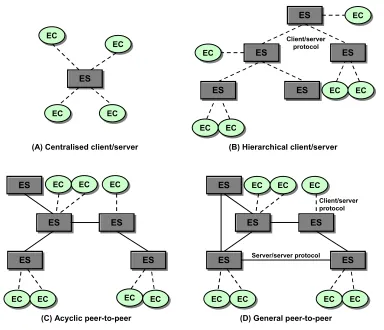
3.2 The Taxonomy ... 68
3.2.1 Event Model ... 69
3.2.2 Event Service ... 74
3.3 Classification of Event Systems... 100
3.4 Summary... 101
CHAPTER 4: THE STEAM EVENT-BASED MIDDLEWARE FOR COLLABORATIVE APPLICATIONS... 103
4.1 Proximity-Based Event Notifications... 103
- x -
4.1.2 Programming Model... 106
4.1.3 Architecture ... 107
4.1.4 Summary ... 108
4.2 The STEAM Event Model ... 109
4.2.1 Supporting Mobility... 110
4.2.2 Proximities... 112
4.2.3 Event Types ... 114
4.3 Event Notification Filtering in STEAM... 122
4.3.1 Exploiting Distributed Event Notification Filters ... 122
4.3.2 Applying Distributed Event Notification Filters ... 124
4.3.3 Defining Distributed Event Notification Filters... 126
4.4 Communications Architecture... 128
4.4.1 Exploiting Proximity Groups ... 128
4.4.2 Locating Proximity Groups ... 130
4.4.3 Mapping to Proximity Groups... 131
4.4.4 Mapping to Ad Hoc Networks... 133
4.4.5 Routing Event Notifications ... 135
4.5 Interface Functions ... 136
4.5.1 Delivering Event Notifications ... 136
4.5.2 STEAM Application Programming Interface ... 137
4.6 Discussion... 137
4.6.1 Mobility ... 138
4.6.2 Scalability ... 138
CHAPTER 5: STEAM ARCHITECTURE AND ALGORITHMS ... 140
5.1 STEAM Architecture ... 140
5.1.1 Overview ... 140
5.1.2 Distribution ... 142
5.1.3 Proximity-Based Event Notification Management... 143
5.2 The STEAM Event Service ... 146
5.2.1 Event Notifications and Event Types ... 146
5.2.2 Event Notification Filters ... 149
5.2.3 Repositories ... 151
5.2.4 Addressing Scheme ... 151
5.3 Discovering Proximities... 155
5.3.1 Announcing Event Types and Proximity Filters ... 155
- xi -
5.3.3 Maintaining Event Types and Proximity Filters ... 158
5.3.4 Discovery Range ... 158
5.4 Disseminating Event Notifications and Announcements ... 159
5.4.1 Proximity-Based Multicast Groups ... 159
5.4.2 Routing Messages... 160
5.5 Exploiting Geographical Location Information ... 163
5.6 Summary... 164
CHAPTER 6: EVALUATION ... 166
6.1 Disseminating Event Notifications ... 167
6.1.1 The Application Scenarios ... 167
6.1.2 The Experiment ... 169
6.1.3 Results and Analysis... 172
6.2 Discovering Proximities... 176
6.2.1 The Application Scenarios ... 177
6.2.2 The Experiment ... 177
6.2.3 Results and Analysis... 178
6.3 Event Notification Filtering Precision ... 180
6.3.1 The Intersection Scenario ... 180
6.3.2 The Experiment ... 182
6.3.3 Results and Analysis... 184
6.4 Raising and Delivering Event Notifications ... 186
6.4.1 The Experiment ... 187
6.4.2 Results and Analysis... 188
6.5 Summary... 190
CHAPTER 7: CONCLUSIONS AND FUTURE WORK ... 193
7.1 Achievements ... 193
7.2 Open Research Issues ... 197
7.3 Conclusion ... 198
APPENDIX: SUMMARY OF TAXONOMY PROPERTIES... 199
- xii -
L
IST OFF
IGURESFigure 1.1. Accident warning application scenario... 3
Figure 2.1. Client/server and event-based communication model... 12
Figure 2.2. Announcing and subscribing to events. ... 16
Figure 2.3. The CORBA event channel... 24
Figure 2.4. Communication styles... 24
Figure 2.5. CORBA event channel interfaces. ... 25
Figure 2.6. The CORBA notification channel. ... 27
Figure 2.7. The general structure of structured event data... 30
Figure 2.8. Notification Service event data filter object... 31
Figure 2.9. The TAO RT event channel. ... 33
Figure 2.10. The CONCHA event channel... 35
Figure 2.11. EventListener interface and EventObject class. ... 37
Figure 2.12. The Java Delegation Event Model... 38
Figure 2.13. Using event adapters in the Delegation Event Model... 39
Figure 2.14. RemoteEventListener interface and RemoteEvent class. ... 40
Figure 2.15. Using distributed event adapters in the Distributed Event Model. ... 41
Figure 2.16. An event source object of an active badge system. ... 42
Figure 2.17. An event client object of an active badge system... 43
Figure 2.18. Overview of the Cambridge Event Architecture... 43
Figure 2.19. Defining event filters using parameter templates... 44
Figure 2.20. Defining composite event filters using multiple parameter templates... 45
Figure 2.21. The application programming interface defined by ECO... 47
Figure 2.22. Overlapping zones. ... 48
Figure 2.23. Nested zones. ... 48
Figure 2.24. Targeting zones. ... 49
Figure 2.25. Overview of the JEDI architecture. ... 50
Figure 2.26. JEDI dispatching server topology. ... 51
Figure 2.27. JEDI events... 51
Figure 2.28. Overview of the SIENA architecture. ... 54
Figure 2.29. SIENA application programming interface... 54
- xiii -
Figure 2.31. SIENA event... 57
Figure 2.32. SIENA event filter... 57
Figure 2.33. SIENA event pattern. ... 57
Figure 2.34. Overview of the Elvin4 architecture. ... 59
Figure 2.35. The Elvin4 security framework... 61
Figure 3.1. Taxonomy legend... 67
Figure 3.2. The root of the taxonomy. ... 69
Figure 3.3. Event system overview. ... 69
Figure 3.4. Event model categories. ... 70
Figure 3.5. A producer and a consumer application using the peer to peer-based Java distributed event model. ... 71
Figure 3.6. A producer and a consumer application using the mediator-based CORBA event model... 72
Figure 3.7. A producer and a consumer application using the implicit Direct CEA... 73
Figure 3.8. The event service... 75
Figure 3.9. Event service organisation... 76
Figure 3.10. Centralised event service with collocated middleware. ... 77
Figure 3.11. Distributed event service with collocated middleware. ... 77
Figure 3.12. Centralised event service with separated single middleware. ... 78
Figure 3.13. Distributed event service with separated single middleware. ... 78
Figure 3.14. Centralised event service with separated multiple middleware. ... 78
Figure 3.15. Distributed event service with separated multiple middleware. ... 78
Figure 3.16. Event service interaction model. ... 80
Figure 3.17. No intermediate... 81
Figure 3.18. Distributed intermediate. ... 81
Figure 3.19. Single centralised intermediate... 82
Figure 3.20. Multiple centralised intermediate. ... 82
Figure 3.21. Event service features. ... 85
Figure 3.22. Event propagation model. ... 86
Figure 3.23. Event type. ... 87
Figure 3.24. Event filter. ... 88
Figure 3.25. Event filter location... 89
Figure 3.26. Event filter definition... 90
Figure 3.27. Event filter implementation... 90
Figure 3.28. Event filter evaluation... 91
- xiv -
Figure 3.30. Mobility support... 93
Figure 3.31. Composite events. ... 94
Figure 3.32. Quality of service. ... 96
Figure 3.33. Ordering. ... 97
Figure 3.34. Security. ... 98
Figure 3.35. Failure mode. ... 99
Figure 4.1. STEAM event model. ... 109
Figure 4.2. Proximity definition... 110
Figure 4.3. Stationary proximity... 111
Figure 4.4. Mobile proximity. ... 111
Figure 4.5. Disseminating event notifications using overlapping proximities... 114
Figure 4.6. Moving between proximities... 115
Figure 4.7. STEAM event type and instance definition. ... 116
Figure 4.8. Dependencies between non-functional attributes... 119
Figure 4.9. Traffic light event type and event instance example... 122
Figure 4.10. Matching distributed event notification filters. ... 125
Figure 4.11. Example of the subject and content of an event notification. ... 126
Figure 4.12. Defining a subject filter... 127
Figure 4.13. Filter term definition. ... 127
Figure 4.14. Defining a conjunctive content filter. ... 127
Figure 4.15. Defining a stationary proximity filter... 128
Figure 4.16. Single-hop event dissemination... 133
Figure 4.17. Multi-hop event dissemination. ... 134
Figure 4.18. Network partitions in multi-hop event dissemination... 135
Figure 4.19. Delivering event notifications in STEAM... 136
Figure 4.20. The application programming interface of STEAM. ... 137
Figure 5.1. The architecture of the STEAM middleware. ... 141
Figure 5.2. Mobile devices hosting STEAM middleware... 142
Figure 5.3. Announcing and discovering proximity-based event notifications. ... 143
Figure 5.4. Subscribing to proximity-based event notifications... 144
Figure 5.5. Raising proximity-based event notifications... 145
Figure 5.6. Delivering proximity-based event notifications... 146
Figure 5.7. Defining the structure of an event type. ... 147
Figure 5.8. Instantiating an event notification... 148
Figure 5.9. Content filter term operators. ... 149
- xv -
Figure 5.11. Maintaining announcement and subscription information. ... 151
Figure 5.12. Computing group identifiers from event type and proximity pairs... 153
Figure 5.13. A producer generating event notifications. ... 154
Figure 5.14. A consumer receiving event notifications. ... 154
Figure 5.15. Announcing event type and proximity filter pairs. ... 156
Figure 5.16. Discovering event type and proximity filter pairs. ... 157
Figure 5.17. The programming interface of the proximity-based group communication service. ... 160
Figure 5.18. Receiving single-hop and multi-hop messages. ... 162
Figure 6.1. Application scenario overview... 169
Figure 6.2. Cost of event notification dissemination in scenario (A1) as a function of proximity range. ... 172
Figure 6.3. Cost of event notification dissemination in scenarios (B1) and (C) as a function of proximity range... 173
Figure 6.4. Cost of event notification dissemination in scenarios (D) and (E) as a function of proximity range... 174
Figure 6.5. Cost of event notification dissemination in scenario (A2) for a saturation of 120 as a function of subscriber speed. ... 174
Figure 6.6. Cost of event notification dissemination in scenario (B2) for a saturation of 120 as a function of producer speed... 175
Figure 6.7. Event notification dissemination cost reduction due to gossiping... 175
Figure 6.8. Fraction of gossiping consumers losing event notifications in scenarios with a saturation of 60... 176
Figure 6.9. Cost of proximity discovery in scenarios (C) and (D) as a function of the discovery range. ... 178
Figure 6.10. Discovery coverage ratio in scenarios (C) and (D) as a function of the discovery range. ... 179
Figure 6.11. The North Circular Road and Prussia Street intersection... 181
Figure 6.12. Example phase scheme for a two-approach intersection... 182
Figure 6.13. Modelling the intersection. ... 182
Figure 6.14. The number of event notifications delivered on each of the lanes. ... 185
Figure 6.15. The average number of events delivered by individual vehicles on each lane. 185 Figure 6.16. Precision of event notification filtering for various filter combinations. ... 186
Figure 6.17. Definition of the “Performance” event type. ... 187
Figure 6.18. Definition of the conjunctive content filter applied to the disseminated event notifications... 188
Figure 6.19. Latency of a producer raising an event notification as a function of the number of announced event notification types and the number of subscribers... 189
- xvi -
L
IST OFT
ABLESTable 2.1. Event model terminology... 12
Table 2.2. The administrative properties of notification channels... 28
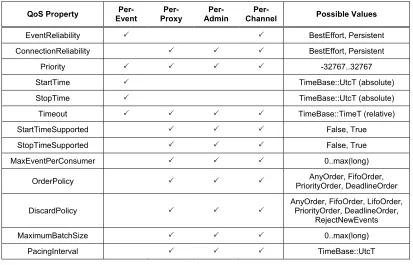
Table 2.3. Notification Service QoS properties. ... 29
Table 3.1. Categorisation of event systems... 101
Table 4.1. Defining functional attributes... 116
Table 4.2. Defining non-functional attributes... 117
Table 4.3. Classification of attributes. ... 121
Table 5.1. Maintaining proximity filters... 158
Table 6.1. Description of the application scenarios. ... 168
Table 6.2. The first three records of the intersection data. ... 181
Table 6.3. The configuration of the experiment... 183
- 1 -
CHAPTER 1: INTRODUCTION
The term middleware applies to a layer of software whose purpose is to mask the heterogeneity of the underlying distributed system and to provide a convenient programming model to application programmers [1]. Modern middleware platforms, such as CORBA [2] and Java Remote Method Invocation (RMI) [3], have mainly focussed on supporting a programming model based on the traditional client/server communication model, which typically provides synchronous, point-to-point communication between client and server. This communication model requires clients and servers to have some knowledge of each other, i.e., they must be aware of each other’s addresses, in order for a client to be able to send a service request and for a server to send the corresponding response.
Emerging mobile and ubiquitous computing applications typically comprise large numbers of interconnected components distributed over large geographical areas. Middleware supporting such applications must deal with the increased complexity that comes with such scale and the geographical dispersion of components as well as the spontaneously changing connections between components that may be either static or mobile.
The synchronous nature of middleware based on the client/server paradigm results in stable, relatively long lasting connections between communicating participants in which the server blocks an interaction while computing its response. However, mobile and ubiquitous applications that involve unanticipated interactions between loosely coupled components require a different approach to application component integration, due to the dynamic character of such interactions.
The event-based communication model, a paradigm for middleware that asynchronously [4] interconnects the components that comprise an application, is widely recognised as being well suited to addressing the requirements of mobile applications [5-8]. It avoids centralised control and requires a less tightly coupled communication relationship between components compared to the client/server communication model.
- 2 -
population of components and is particularly useful in wireless networks, where communication relationships amongst heterogeneous application components are dynamically reconfigured.
1.1 Mobile Computing Environments
Mobile computing environments can use either the infrastructure or the ad hoc network model for wireless communication [9]. The infrastructure model exploits access points to enable communication among the mobile application components under its direct control and to coordinate their transmissions analogous to the base station in a cellular communications network. Access points may be connected to a fixed network, such as a company intranet or the Internet, and act as portals allowing the components under their control to connect to the fixed network.
In contrast, the ad hoc network model allows application components to communicate with each other without the aid of access points or a fixed network. Any application component can establish a direct (single-hop) communication relationship with any other application component within its transmission reach without having to channel the transmission through an access point. An application component may communicate with components potentially located beyond its transmission reach through multi-hop communication where intermediate application components forward a transmission towards its destination. Hence, the ad hoc network model allows application components to communicate and collaborate in a spontaneous manner at any time and without restrictions, except for connectivity limitations, in the absence of a conventional fixed network.
The term mobile device is used to refer to portable computing devices, such as notebook computers and handheld devices. A mobile device may be capable of wireless networking, thus allowing its application components to interact with components hosted by other mobile devices through wireless communication while moving in a mobile computing environment.
1.2 Nomadic and Collaborative Applications
- 3 -
to handle disconnection while nodes migrate from one designated access gateway to another. This implies that such middleware has focused on providing a means to cache and synchronise relevant information on behalf of a disconnected node and to forward it via the new access gateway upon reconnection. Nomadic applications typically employ infrastructure networks when connecting to the fixed backbone network. An example of a nomadic application might include a news ticker hosted by a handheld device accessing an Internet-based breaking news service through a wireless connection. Such a ticker application might be disconnected from the news server while the user travels from her home to her office. In contrast, collaborative applications can be characterized by the fact that mobile nodes use the wireless network to interact with other mobile nodes that have come together at some common location. Collaborative nodes migrate within some area, establish associations with other nodes dynamically, and typically group into formations of nodes that have a common goal. The members of such a group may migrate together, similar to a fleet of vehicles or the participants of a guided tour on an excursion. Although these applications may use infrastructure networks, they will often use ad hoc networks since they are immediately deployable in arbitrary environments and support communication without the need for a separate infrastructure. This collaborative style of application may be useful in the ubiquitous [10] and sentient computing [11] domain allowing loosely coupled, highly mobile components to communicate and collaborate in a spontaneous manner. Such applications might include scenarios in which a crashed car disseminates an accident warning to approaching vehicles and players in augmented reality games being interested in the status of game objects or indeed other players residing at their current location. Figure 1.1 further illustrates the accident warning application scenario. The car shown in the centre of Figure 1.1 has crashed and as a result establishes associations with vehicles that are currently near the location of the accident. The crashed car may subsequently establish associations with other vehicles that approach the accident site as well as cancel associations with vehicles that have passed the site.
Accident site
[image:20.595.120.472.590.649.2]Dynamically established association Movement of vehicle
- 4 -
1.3 Event-Based
Middleware and Mobile Computing
Middleware services supporting event-based communication have been developed by both industry [12, 13] and academia [4, 5, 14, 15]. Most of these assume that the components comprising an application are stationary and that a fixed network infrastructure is available. Existing research on event-based middleware for mobile applications has mainly concentrated on supporting nomadic applications and wireless data communication based on infrastructure networks [4-6, 16, 17], assuming the availability of a fixed service infrastructure. Intermediate middleware components, which typically implement the mechanisms for handling disconnection as well as for enforcing many middleware properties, are naturally hosted by parts of the designated service infrastructure.
Relatively little work has been done to address the distinct requirements associated with event-based middleware accommodating collaborative applications, especially those that use ad hoc networks. Such applications may lack any service infrastructure and therefore can not rely on the aid of access points when routing event notifications or when discovering peers. Moreover, event notifications can not depend on intermediate components applying event notification filters or enforcing non-functional policies, such as event notification delivery order and priority. Consequently, alternative approaches have to be adopted by event-based middleware for collaborative applications in order to provide the desired middleware properties in the absence of a designated service infrastructure as well as centralised or intermediate components typically hosted by such an infrastructure.
1.4 Aims and Objectives
The general objective of this thesis is to design an event-based middleware architecture for collaborative applications, especially for those that use ad hoc networks. The middleware should allow collaborative application components to interact through wireless data communication while featuring a number of desirable functional and non-functional properties. From the application programmer’s point of view, the design of such middleware should provide for:
- 5 -
• Inherently distributed architecture. The middleware should exclusively use the same physical machine as the components that comprise the collaborative application and not rely on the presence of a designated service infrastructure.
• Event notification filtering precision. The middleware should support a range of event notification filters that may be applied to various attributes of event notifications including subject, content, and context, such as geographical location. Moreover, it should allow a subscriber to combine event notification filters in order to describe the exact subset of event notifications in which it is interested exploiting multiple criteria, such as meaning, time, location, and quality of service.
• System scalability. A system exploiting event-based middleware for collaborative applications should be able to easily cope with a large, dynamically changing population of mobile components distributed over a large geographical area and the resulting dynamic reconfiguration of the connections between the components.
These middleware properties are not orthogonal and hence can not be addressed independently. We therefore have to find a good compromise when designing the middleware supporting the properties described above. For example, an inherently distributed architecture implies absence of components that have global knowledge. Such components are traditionally exploited when applying event notification filters. Consequently, a new technique for applying event notification filters in a distributed manner is needed.
1.5 STEAM
We envisage event-based middleware for collaborative applications being used in various areas including indoor and outdoor smart environments, augmented reality, and traffic management. In these application scenarios, components may represent mobile objects ranging from robots and cars to buses and fire engines, as well as objects with a fixed location, such as office appliances, information points, traffic signals, and traffic lights.
- 6 -
We present an implementation of our middleware architecture for collaborative applications, called STEAM (Scalable Timed Events And Mobility) [18, 19]. STEAM is intended for applications that include a large number of highly mobile, collaborative application components typically distributed over a large geographical area. Unanticipated interaction between nearby components is supported enabling a component to dynamically establish connections to other components within its current vicinity. This allows components representing real world objects currently residing within the same geographical area to deliver events at the location where they are relevant.
1.6 Contribution of this Thesis
Within the context of this thesis we have designed and implemented an event-based middleware for collaborative applications. Our work has focused on designing an event-based middleware that is especially suited for those collaborative applications that use ad hoc networks while supporting a number of middleware features typically desired by application programmers in this domain.
Traditionally, event-based middleware employs logically centralised or intermediate components to implement key properties of the middleware. Application components may utilise centralised lookup and naming services to discover peers in order to communicate with them. Intermediate components may be used to route event notifications from producers to consumers and to apply event notification filters. Moreover, they may enforce non-functional attributes, such as event notification delivery order and priority. However, the central problem with this approach arises with increasing system scale as such middleware components may become a liability due to availability and bandwidth limitations.
Centralised or intermediate middleware components are typically hosted by physical machines that are part of a designated service infrastructure in order to ensure that they are always accessible to application components. The disadvantage of exploiting such an infrastructure is that its installation and maintenance requires substantial resources while limiting communication between components to the geographical areas in which the infrastructure has previously been made available.
- 7 -
The main challenge of our work has been to design event-based middleware supporting collaborative applications that adopts alternative approaches addressing these problems without the aid of a separate service infrastructure while avoiding centralised and intermediate components. A further challenge has been to provide event notification filtering with high precision allowing a component to use multiple functional and non-function criteria when identifying event notifications of interest. The final challenge of this thesis has been to develop decentralised techniques that improve system scalability for applications composed of large numbers of interconnected mobile (and static) components distributed over large geographical areas.
The main contribution of the work described in this thesis is the design of an event-based middleware for collaborative applications addressing these challenges. Consequently, our middleware has a number of important differences from other event services:
• Mobility support. Collaborative application components interact through wireless communication utilising the ad hoc network model without the aid of access points or connections to a conventional fixed network. Our design accommodates a changing pool of collaborative application components coming together at a location and supports spontaneous communication between these components without preceding infrastructure deployment.
• Inherently distributed architecture. The middleware is exclusively collocated with the collaborative application components and does not depend on centralised or intermediate components. Decentralised techniques for discovering peers and for filtering of event notifications are supported. This is beneficial as it avoids components typically hosted by a designated service infrastructure that may become communication bottlenecks with increasing system scale.
- 8 -
• Distributed event notification filtering. Event notifications may be filtered at both the producer and the consumer side or may be filtered implicitly. Filters may be applied to a range of functional and non-function attributes associated with an event notification including subject, content, and context, such as geographical location. Combining distributed event notification filters is beneficial to the precision of filtering allowing a component to define the subset of event notifications in which it is interested using multiple criteria, such as meaning, time, location, and quality of service. Event notification filtering in general and our approach of combining filters in particular improves system scalability by limiting forwarding of event notifications.
• Geographical scoping of event propagation. To support ad hoc networks, event notification filters may be used to define geographical areas within which certain event notifications are valid, hence bounding the geographical scope within which these event notifications are propagated. Such geographical scopes represent a natural way to identify event notifications of interest for mobile components. Geographical scoping is essentially filtering of event notifications using the space criteria and consequently increases system scalability further. Bounding the dissemination range of event notifications improves the predictable behaviour of the middleware.
• Non-functional application requirements. The middleware architecture and the decentralised techniques for peer discovery and event notification filtering have been designed to improve system scalability and the predictability of the filter engine for event notifications. Other non-functional application requirements, such as event notification delivery order and priority, may be associated with either a specific event notification or a group of event notifications using attributes.
A further contribution of this thesis is a taxonomy of distributed event-based programming systems. The taxonomy is structured as a hierarchy of the fundamental properties of a distributed event-based programming system and may be used as a framework to describe an event system according to a variety of criteria including its event, organisation, and interaction models. The taxonomy has been applied to our middleware as well as a selection of other event systems to compare their middleware properties.
1.7 Organisation of this Thesis
- 9 -
- 10 -
CHAPTER 2: DISTRIBUTED EVENT MODELS
The first part of this chapter introduces the characteristics, related terminology, and main concepts of distributed event-based programming models as well as the issues that arise when designing distributed event models. The subsequent sections then review a number of event-based communication models related to the work described in this thesis, which have been selected based on their popularity and according to the features they support. We conclude this chapter by discussing the mobility support provided by the event-based communication models surveyed.
- 11 -
2.1 The Event-Based Communication Model
The general idea behind the use of an event-based communication model is to enable one application component to react to a change in the state of another component. Event-based communication models, or simply event models, are omnipresent in applications ranging from small-scale, centralised to large-scale, highly distributed systems [23]. On one hand, they are exploited to interconnect individual components of applications, for example the components comprising graphical user interfaces [24, 25]. Such graphical components may disseminate user driven and hence sporadic changes to their state to other components of the application that are required to react to these changes. At the other extreme, publishers of stock trading information may utilise a system with an event service to post the latest trading rates to a group of brokers, potentially located in different cities or even countries [26, 27]. Smart environments often employ event-based communication models to interconnect a large number of application components [28] ranging from light and door actuators and sensors to robotic vehicles moving within and between buildings.
2.1.1 The Participants
An event system is an application that uses event-based communication to allow the components that comprise the application to interact using event notifications. Event notifications, or simply events, contain data that represent a change to the state of the sending application component. They are propagated from the generating application components, called the producers, to the receiving application components, called the consumers, which process the events delivered.
In conventional distributed event systems, application components, called entities, are located on a number of physical machines that are interconnected by means of a fixed network infrastructure through which communication takes place. Middleware using event-based communication may support intermediate components. Intermediate components typically route events from producing to consuming entities and are potentially hosted by separate machines that are part of the infrastructure.
Event Model Source Sink Intermediate
STEAM [18, 19, 29] Producer Consumer N/A CORBA [12, 30] Supplier Consumer Channel TAO RT CORBA [31] Supplier Consumer Real-time channel
- 12 -
Event Model Source Sink Intermediate
Java AWT [24] Source Listener Event adapter Java Distributed [13] Generator Listener Event adapter
CEA [4, 33] Source object Client object Mediator ECO [14, 34] Object Object N/A
JEDI [5] Active object Active object Dispatching server SIENA [15] Object of interest Interested party Event server Elvin [17, 35]. Producer Consumer Server
Table 2.1. Event model terminology.
There is no generally accepted standard for the terminology used for event-based communication. As a result, the event models reviewed in this thesis use a variety of alternative terminology, which is summarised in Table 2.1, when referring to event producer (source), consumer (sink), and intermediate. Although some event models use alternative terminology for event notification, such as event object, event message, and event data, Table 2.1 omits these as the term “event” is widely accepted.
2.1.2 Characteristics of Event-Based Communication
The traditional client/server computing [36] model allows application components to behave as service consumers, called clients, and service providers, called servers. A client/server relationship is established between two application components when one component acting as a client initiates a service request to another component acting as a server that is capable of responding to the service request.
Request B
(A) Client/server communication model (B) Event-based communication model
Event Notification A Request A
Response A
Response B
Event
Producer A Producer B Event
Event Consumer
Event Consumer Event
Consumer
Client B Client A
Server
Event Notification B
- 13 -
Figure 2.1(A) illustrates request/response interactions between clients and a server, which often reside on separate physical machines and communicate through a network connection. This computing model essentially provides synchronous, one-to-one communication between client and server and requires clients and servers to have some knowledge of each other. In order to be able to send a request, a client needs to know the name and the location of the server and the server needs to know the name and the location of the client when responding. In contrast, computing models based on the event paradigm, as shown in Figure 2.1(B), require a less tightly coupled communication relationship between application components acting as either event producer or consumer, allowing them to interact in an asynchronous, anonymous, one-to-many (many-to-many) manner.
Asynchronous Communication
Coulouris et al. [1] have identified asynchronous interaction as a main characteristics of event-based communication. Event producers disseminate event notifications asynchronously to event consumers without having to synchronise. Asynchronous communication prevents slow, temporarily unavailable, or indeed blocked application components from delaying interactions between components. Producers are not required to wait for responses from consumers before proceeding to propagate subsequent event notifications. An event notification destined for a temporary unavailable consumer may be buffered in order to be delivered once the consumer has recovered.
Anonymity
The event-based communication model allows application components to interact anonymously without concern for either the number or the location of the components involved. Event-based middleware typically manages the connections between producers and consumers transparently on behalf of an application. Such middleware implements a level of decoupling that enables producers to disseminate event notifications to consumers without targeting specific destinations and consumers to deliver events without having directly communicated with producers. However, consumers may derive a certain awareness of their producers from the content of the events they receive. For example, a producer may raise events on behalf of a door disseminating the door’s status without targeting specific consumers. A consumer receiving these events will be able to determine whether the door is open or closed and in addition, might discover the location of the door.
- 14 -
client/server communication model. Producers and consumers connect to a middleware and may subsequently publish and receive event notifications whereas clients are required to explicitly establish a two-way connection to each specific server with which they intend to interact.
One-to-Many and Many-to-Many Communication
Figure 2.1(B) illustrates how a producer initiates event-based communication by propagating an event notification to a group of consumers. A single producer disseminates specific event notifications to a group of consumers in a one-to-many fashion. Many-to-many communication may be established by a set of collaborating producers disseminating related event notifications to a group of consumers. One-to-many and many-to-many communication may be implemented as a set of unicast interactions [14] sequentially delivering a particular event notification to a group of consumers but are frequently based on multicast protocols [14, 32, 37, 38].
Heterogeneity
Utilising event-based middleware to integrate distributed application components results in loose coupling between these components. Essentially, all that is required for components to interact is for producers to disseminate event notifications and for consumers to recognise event notifications of interest and to provide an interface for receiving them. Hence, event notifications may be used as a means of communication between distributed application components in a heterogeneous system that were not inherently designed to interoperate [1].
2.2 Functional Design Issues
- 15 -
Functional requirements are statements of services the system should provide, how the system should react to particular inputs and how the system should behave in particular situations. In some cases, the functional requirements may also explicitly state what the system should not do [39, p.118].
2.2.1 Typed Events
In general, events generated by a producer are said to be either generic or typed. The information that describes a generic event is a data blob without an explicit structure. Typed events on the other hand, provide a well-defined, explicit, and expressive data structure into which a wide variety of event data can be mapped. The structure of typed events ranges from simple to complex; from a single string to a programming language specific object with an associated set of attributes and methods. However, many event models support typed events that typically have a name and may have an associated set of typed parameters whose specific values describe the specific change to the producer's state.
It may be argued that simple forms of typed events are merely generic and not typed. However, we consider events that have some structure which may be recognised or interpreted by the event model as typed. Significantly, the structure associated with typed events is essential for applying event filters. For example, events that are based on a single string have an explicit data structure to which filters may be applied whereas events enclosing a binary file do not define a recognisable data structure.
2.2.2 Event Filtering
An event system may consist of a potentially large number of producers, all of which can generate events that contain different, application-specific information. As a result, the number of events to be disseminated in an event-based system may be very large.
- 16 -
communication and computation resources. Essentially, a consumer’s event filters are matched against events and only events for which the matching produces a positive result are subsequently delivered to the consumer.
2.2.3 Announcing Events
Producers may indicate their intention to generate events using advertisements. A specific producer may announce the instances of events it intends to raise. Once certain events have been announced, a producer may publish such events until it indicates that it no longer wishes to produce them by cancelling the corresponding advertisement. A producer unannounces the events it ceases to raise. The announcement mechanism is an optional event model feature and thus may not be explicitly supported. However, an event service may exploit the additional information provided by announcements when routing events from producers to consumers [15].
2.2.4 Subscribing to Events
In order to receive events, event consumers have to subscribe to the instances of events in which they are interested. When doing so, consumers are said to register interest in events. Once consumers have subscribed to events, they receive all subsequently disseminated events until they unsubscribe (de-register). Consumers may pass event filters to the event service when subscribing thereby specifying the events of interest. In essence, announcements describe the events generated by producers whereas subscriptions (and the associated event filters) specify the subsets that specific consumers wish to receive.
Announced Producer
t0
Subscribed Consumer
t2
t1 t3 t4 t5 t6
e0 e1 e2 e3 e4 e5 e6
time
a: announce ua: unannounce s: subscribe us: unsubscribe tx: time x
ex: event x
a ua
s us
- 17 -
Figure 2.2 summarises the concept of producers announcing and consumers subscribing to events. It depicts an event producer announcing (a) the events it intends to generate, subsequently raising events (e0 to e6), and eventually unannouncing (ua) them. Note that no
events are published either prior to the announcement or after the unannouncment. A consumer registers interest in these events for a period of time (from s to us) and as a result receives the events disseminated while it has been subscribed. This subscription causes the consumer to deliver events e2, e3, and e4 while prior and subsequent events are disregarded.
2.2.5 Delivery Semantics
Event models support a variety of different delivery guarantees for event notifications. A particular event model may provide several delivery semantics allowing an application to select the semantics that appropriately addresses its requirements. These guarantees naturally relate to the semantics described by the underlying mechanism for sending events to a group of subscribers. For example, exploiting IP multicast for disseminating events will provide a best-effort delivery semantics, which does not guarantee that any subscriber will necessarily receive a specific event. Some applications may have stronger reliability requirements. In order to address these requirements, event models may employ event dissemination protocols that provide at-least-once, at-most-once, or exactly-once delivery semantics.
In addition to providing a certain delivery reliability, event models may enforce delivery semantics disseminating events in a specific order or with some timeliness constraints. A weak delivery order disseminates event in any order whereas a stronger ordering semantics causes events to be delivered in FIFO, causal, or total order. Timeliness constraint are important when delivering events on behalf of real-time applications, such as vehicle control and hospital patient monitoring.
2.2.6 Subject-Based Event Models
- 18 -
A subject-based event model may support event types that have a name and an associated set of typed parameters. The name of such an event naturally represents its subject and events of the same subject have an identical structure. Hence, the subject of an event allows consumers to subscribe to a specific group of events and identifies their type.
Significantly, subject-based event models allow for an efficient approach to matching events against a large number of subscriptions. For example, a CORBA event channel [30] can be set up as a component handling all events of a particular subject and as a result matches events implicitly. Consumers subscribe to a specific subject by connecting to the corresponding channel. Producers disseminate events by forwarding them to the channel associated with the subject, which then delivers them to its subscribers sequentially.
2.2.7 Content-Based Event Models
As an alternative to subject-based event subscription, event-based communication models may support subscription mechanisms based on the content of an event. The content-based approach allows producers to disseminate events that essentially consist of a set of parameters defining the event information. Consumers subscribe to events by defining a predicate that may test arbitrary parameters of an event. A subscriber subsequently receives all events whose parameters match the subscriber’s predicate.
Compared to subject-based approaches, content-based subscription mechanisms provide a more powerful paradigm, allowing consumers to chose filtering criteria along multiple, orthogonal dimensions of the content of events without defining subjects. However, while content-based approaches provide a more expressive subscription mechanism they are difficult to implement [40]. The problem of efficiently matching events against a large number of subscribers has been addressed by the work of Banavar et al. [37] and Opyrchal et al. [38].
2.3 Non-Functional Design Issues
- 19 -
Non-functional requirements are constraints on the services or functions offered by the system. They include timing constraints, constraints in the development process, standards and so on. .. Examples are reliability, response time and store occupancy [39, p.119].
2.3.1 Quality of Service
The non-functional behaviour of an event system may be influenced by a variety of Quality of Service (QoS) constraints. Event-based middleware may support QoS properties that are an integral part of the system and consequently cannot be customised by an application. However, QoS properties may be configurable allowing an application to chose the non-functional behaviour that appropriately addresses its requirements.
- 20 -
2.3.2 Real-Time
Krishna and Shin [41] state that there is no precise, cogent definition of what a real-time system is. They admit that their definition (stated below) raises as many questions as it answers. Notably, it provokes the question as to what “timely” means. However, based on the definitions of real-time systems stated below, we can define the term “timely” as a real-time system hosting tasks that have associated deadlines for their completion.
Any system where a timely response by the computer to external stimuli is vital is a real-time system [41, p.1].
A real-time system is any information processing activity which has to respond to externally generated input stimuli within a finite and specified time [42, p.2].
A system in which the time at which the output is produced is significant. This is usually because the input corresponds to some movement in the physical world, and the output has to relate to that same movement. The lag from input time to output time must be sufficiently small for acceptable timeliness [43].
Real-time systems can be divided into two categories: hard time systems and soft real-time systems. Hard real-real-time (or critical) systems are systems where something “bad” will happen if the output is not delivered in time. Soft real-time (or non-critical) systems are systems where nothing catastrophic happens if some deadlines are missed. Missed deadlines in a soft real-time system will merely result in degradation of performance below what is generally considered acceptable. A deadline can be called hard or soft deadline depending on whether it has been given for a hard or a soft real-time system.
- 21 -
such as earliest and latest delivery time, and event delivery timeouts. Delivery deadlines describe a time window within which an event is to be delivered and are characteristically expressed using absolute time. Hence, the nodes that comprise an event system exploiting such deadlines require a notion of global time. In contrast, delivery timeouts define a relative duration during which an event is meant to be delivered and thus, do not require synchronised participants.
2.3.3 Scalability
The term scalability (some definitions can be found below) is used to describe the behaviour of a distributed system when changing the number of interconnected participants that form the network. Coulouris et al. [1] state that controlling performance loss and the cost of physical resources as well as preventing software resources from running out and avoiding performance bottlenecks as the challenges presented to the design of a scalable distributed system. A telephone system using up all the available numbers and the Internet (using the 32 bit protocol version 4) running out of computer addresses are examples of systems that show lack of scalability as they run out of software resources. An example of a system in which certain components may become performance bottlenecks is a file server unable to cope with an increasing number of access requests.
A scalable distributed system is one that can easily cope with the addition of users and sites, and whose growth involves minimal expense, performance degradation, and administrative complexity [44, p.363].
The system and application software should not need to change when the scale of the system increases. .. Rather, as the demand for a resource grows, it should be possible to extend the system to meet it [1, p.20-21].
Considering these definitions and examples, it can be observed that the scale of an event system depends on several factors. The parameters that influence the scale of a distributed event system include:
- 22 -
• The number of activities such as announcements, subscriptions, and event communication.
In principle, these parameters are independent, but in practice they are likely to increase simultaneously. For example, an increase in the number of entities is likely to cause the number of activities to rise. In order for an event system to scale well changing one parameter should not cause another factor to become a performance bottleneck. For example, increasing the number of entities should not result in an intermediate becoming overloaded with event messages. In general, it can be observed that the importance of scalability increases with the complexity of a distributed system and indeed a distributed event system.
2.4 OMG CORBA Event Models
The Common Object Request Broker Architecture (CORBA) is an open standard for object management specified by the Object Management Group (OMG). The architecture uses Object Request Brokers (ORBs) as the middleware for application component integration across boundaries such as networks, operating systems, and programming languages. In order to extend the ORB core capabilities, the CORBA 2 specification [2] defines a wide range of general-purpose services including the CORBA Event Service [30]. This service allows the components that comprise an application to interact using event-based communication in addition to the request/response communication model provided by the bare ORB. The main limitation of the CORBA Event Service is its lack of event filtering and QoS capabilities required by applications such as large-scale and real-time services. The OMG addressed these shortcomings in 1996 by issuing a Request For Proposal [45] for defining an extension to its Event Service. A consortium including Borland International, IONA Technologies, IBM Corporation, and Oracle Corporation submitted a revised proposal [46] that was accepted by the OMG at the end of 1998 and resulted in the specification of an extended version of the Event Service called CORBA Notification Service [12].
- 23 -
2.4.1 CORBA Event Service
The CORBA Event Service supports an event model that defines two roles for application components. The role of a supplier object producing event data and the role of a consumer object processing event data. Suppliers and consumers are collectively termed clients.
There are two approaches to initiating event communication between suppliers and consumers referred to as the push model and the pull model. The push-model, which is considered the typical event communication model, allows the supplier to initiate the transfer of event data to consumers whereas the pull-model allows a consumer to request event data from a supplier. A consumer may use either a blocking (pull) or a non-blocking (try_pull) mechanism when polling for event data.
The CORBA Event Service allows suppliers and consumers to invoke each other’s interface methods directly when exchanging event data. This approach requires clients to be aware of the object references of their peers and hence prevents anonymous event communication. Alternatively, clients may interact through an event channel acting as intermediate between suppliers and consumers. In order to connect to an event channel, clients need to obtain a reference to the channel.
The Event Channel Architecture
- 24 -
Event Consumers
CORBA Event Channel
Consumer Admin Proxy Supplier Proxy Supplier Supplier Admin Proxy Consumer Event Suppliers
Consumer Side Supplier Side
Proxy Supplier
Proxy Consumer
Figure 2.3. The CORBA event channel.
Consumers and suppliers may use the same or different communication models when interacting with an event channel. Figure 2.4 (A) and (B) show push-style and pull-style communication between supplier and channel and consumer and channel respectively. Figure 2.4 (C) illustrates an example of mixed style communication where a consumer uses the pull model to obtain event data from the channel while a supplier uses the push model to pass event data to the channel.
Consumer CORBA Event Channel Supplier Push Push
(A) Push style communication
Consumer CORBAEvent Channel
Supplier
Pull Pull
(B) Pull style communication
Consumer CORBA Event Channel Supplier Push Pull
(C) Mixed style communication
Figure 2.4. Communication styles.
- 25 -
administration interfaces, called SupplierAdmin and ConsumerAdmin. These administration objects act as factory objects - objects that instantiate other objects. Essentially, clients register with a channel by obtaining proxy objects. Each client requires a separate proxy through which it exchanges event data with the channel. Event channels use administration objects for establishing and maintaining the connections to their clients and use those connections when propagating event data.
Figure 2.5 depicts a simplified version of some of the interfaces of an event channel which are described using the CORBA Interface Definition Language (IDL) [47]. The event channel interface defines two operations for clients to obtain the consumer and supplier administration interface. The ConsumerAdmin and the SupplierAdmin interface are similar. Both serve as object factories and each defines two operations for obtaining proxies. They define the operations for obtaining push and pull proxies for suppliers and consumers respectively.
Interface EventChannel{
ConsumerAdmin for_consumers();
SupplierAdmin for_suppliers();
}
Interface ConsumerAdmin{
ProxyPushSupplier obtain_push_supplier();
ProxyPullSupplier obtain_pull_supplier();
}
Interface SupplierAdmin{
ProxyPushConsumer obtain_push_consumer();
ProxyPullConsumer obtain_pull_consumer();
}
Figure 2.5. CORBA event channel interfaces.
Although the CORBA Event Service specification does not define additional event channel capabilities, a particular vendor may provide an event channel implementation supporting features such as event filtering and delivery semantics. An application may combine the features of different event channels by composing them. Event channel composition allows one channel to consume the event data supplied by another channel. However, tunnelling event data through multiple channels requires additional computational resources and increases event delivery latency.
- 26 -
addresses this by implicitly supporting the use of multiple event channels within a system. In this approach, a client may connect to one or more channels, each propagating a subset of the event data in the system. This implies that a client needs to connect to the particular channel handling the event data in which the client is interested and as a result provides a means for implicit, subject-based filtering.
The CORBA Event Service specification does not define the means by which clients obtain references to event channels. It is therefore left to the application programmer to provide a mechanism such as a naming service for obtaining these references.
Generic and Typed Event Channels
An event channel may be implemented as either generic or typed. A generic event channel supports generic event data only whereas a typed event channel supports both typed and generic event data. Suppliers and consumers interacting through a generic event channel must agree on the content of their event data since generic event data are data blobs without an explicit structure. Typed event data is described using CORBA IDL. A typed event channel can handle event data supplied and consumed in any combination of the forms push/pull and generic/typed. Event data supplied in a typed form can be consumed in a generic form and vice versa.
The CORBA Event Service specification explicitly states that typed event channels support the conversion of typed into generic and generic into typed event data. However, it admits that this requires a profound understanding of the interfaces of an event channel and depends on the particular event channel implementation. Mapping typed into generic event data is relatively simple. However, converting a generic data blob into typed event data is challenging. [46] notes that many users have found typed event communication (described in IDL) difficult to understand and implementers have found it particularly difficult to deal with.
2.4.2 CORBA Notification Service
The CORBA Notification Service extends the CORBA Event Service by supporting typed events with a predefined structure, called structured events, filtering, and quality of service constraints.
The Notification Channel Architecture
- 27 -
interfaces of the notification channel directly from those defined by the event channel allowing for interoperability between Event Service and Notification Service clients. As a result, the notification channel encapsulates all interfaces and functionality supported by the event channel.
Figure 2.6 outlines how the notification channel extends the event channel architecture by supporting multiple instances of both ConsumerAdmin and SupplierAdmin objects. Both the supplier and the consumer side of the notification channel allow clients to obtain proxy objects from any one of these administration objects. The symmetric nature of the notification channel and the administration objects are essential for the Notification Service capabilities described below.
Event Consumers
CORBA Notification Channel
Consumer Admin Proxy Supplier Proxy Supplier Supplier Admin Proxy Consumer Event Suppliers Proxy Consumer Consumer Admin Proxy Supplier Proxy Supplier Supplier Admin Proxy Consumer Proxy Consumer
Figure 2.6. The CORBA notification channel.
The Notification Service specification defines an event type repository that may be used for discovering the structure of typed event data and for performing run-time type checking. However, using an event type repository is not essential for the Notification Service to operate correctly and consequently, using such a repository is optional.
Administrative Capabilities
- 28 -
disseminated to consumers. Such a queue acts as buffer to prevent events from being discarded in case of a temporary surplus of supplied events.