SPATIAL COGNITION IN THREE DIMENSIONS
Ileana Nuri Flores Abreu
Thesis submitted to the University of St Andrews for
the degree of Doctor of Philosophy
ABSTRACT
To date, most studies of spatial learning have been conducted in the horizontal plane,
with few addressing the vertical dimension. I aimed to investigate learning of 3-D
locations by wild, free-living hummingbirds and compare them with rats. In my first
experiment, I found that hummingbirds can encode a 3-D rewarded location after a
single visit. Using a one-dimensional array, I then found that the birds more readily
learned a location in a horizontal than in a vertical linear array. However, the ease of
learning was a product not only of the orientation of the array but also of its spacing
scale. By the end of training, hummingbirds visited the central rewarded flower and
the two adjacent flowers more than they visited the distal flowers for all arrays.
However, when the array was horizontal and the flowers spaced 30 cm apart, they
learned the absolute location of the rewarded flower. In a diagonal array birds
learned the 2-D reward location but they chose at random when tested on a vertically
or horizontally oriented array. However, when birds trained in the diagonal array
were tested on a 180 rotated diagonal array they chose the flower with the same
horizontal component as the rewarded flower rather than with the flower with the
same vertical component. Finally in order to compare the spatial learning of animals
that move in volumes with those who move in two dimensions I trained
hummingbirds and rats to a rewarded location in a cubic maze. Although both
hummingbirds and rats learned a 3-D location within a cubic maze, hummingbirds
appeared to learn the rewarded location as a 3-D coordinate while rats seemed to
learn the vertical and horizontal component of the 3-D location independently. In
addition, hummingbirds were more accurate in the vertical and rats in the horizontal,
terrestrial and climbing animals are needed in order to determine whether the
contrasting search strategies and learning accuracies constitute adaptations to
I would like to start by thanking Sue Healy for all her support during my entire PhD,
especially for reading endless drafts and for all our motivating meetings. I also want to
thank Andy Hurly for helping me to plan all my experiments together with Sue in the
wonderful atmosphere of the Canadian Rockies, for all the great discussions we had together,
for taking us to Table Mountain and of course for all the intensive and enjoyable email
exchanges we had towards the end of my thesis. I am also grateful to Jamie Angie for
making my rat experiment possible. Thanks to Andy Burnley and Pete Wilcox for building
the rats’ cubic maze and to Jerico Guzmán for his excellent training on how to handle the
rats. I also want to thank Mike Oram for his statistical advice in the few but very inspiring
meetings we had and for being a great stats teacher.
Regarding field work I would like to thank Cam Finaly and Ida Bacon for their
training on banding hummingbirds and for sharing their experience. I would also like to
thank all the people who shared the cabin with me during my three field seasons and for the
unforgettable moments we spent together. A very special thank to David Pritchard who was
my field assistant during my last field season and who shared all the practical and intellectual
excitement of my 3-D experiment.
I would also like to thank CONACYT for funding my PhD, Sue Healy for funding
my field expenses, the University of Lethbridge for allowing me to live in their mountain
cabin during all my field work, The School of Psychology of The University of St Andrews
for its logistical support and funding for conferences, and ASAB for funding me every time I
attended to one of their great conferences.
Thanks to Velia and Nacho my Mexican friends living in London for sharing the
non-touristic side of that great city which I now feel closer to me because of them, for their
hospitality each time I was in London and for visiting me in Scotland. Thanks to all my
friends in Edinburgh and St Andrews (in particular, Christelle, David, Lluna, Vilma, Paris,
psychology with a special mention to Guill, Rachael, Kate, Emily, María and David. To
Sally, for our piano and Spanish evenings and to Felicity, for taking me climbing, swimming
in and running by the North Sea, and for all our conversations that made anything we did
much more special. Thanks to both for all the music nights (together with Jorge). Overall,
thanks to all of you for becoming my friends.
Thanks to Jorge, who became my friend and changed my life in St Andrews to a
point that we decided to continue our lives together. Thanks for all your help throughout my
PhD. Thanks for being the way you are, for all of our adventures and for making me so
happy.
I would like to make a very special acknowledgement to all those who were always
present, although not physically: To Ileana Abreu, my mum, for teaching me to enjoy life
and to be happy. Thank you for teaching me that it is worth it to be free in every sense. In
that way, life might be harder but it will also be more interesting and enjoyable. Thanks for
visiting me, which I was looking for since I got accepted for my PhD in UK. I would also
like to thank my Grandparents and rest of my family: Claudia, Paty, Norma, Rodrigo,
Macarena, Ale and Rodri for being part of my life in your very own way and for encouraging
me in everything I’ve done until now. In summary for being the best family anyone could
imagine. To Yuriria, who has been always present regardless of where we are. Thanks for
keeping our friendship alive. I would also like to thank the rest of my friends back in
Mexico who form part of what I am, people with which I have a very special connection.
Thanks to Sol, Hugo, Martha, Violeta, Agustina, Germán, René and to all my other friends
that make me want to stay in Mexico to spend time together.
I would like to thank the Fuentes Fernandez family for offering me their home with a
friendly and relaxing atmosphere ideal for working on my final thesis drafts, for our
“Somos nuestra memoria, somos ese quimérico museo de formas inconstantes, ese montón de espejos rotos.”
Jorge Luis Borges
“It’s a poor sort of memory that only works backwards”
CHAPTER 1. GENERAL INTRODUCTION ... 1
STUDY SUBJECT ... 11
THESIS AIMS ... 14
CHAPTER 2. ONE-TRIAL SPATIAL LEARNING ... 19
ABSTRACT ... 19
INTRODUCTION ... 20
METHODS ... 22
RESULTS ... 25
DISCUSSION ... 30
CHAPTER 3. ROLE OF AXIS ORIENTATION IN SPATIAL LEARNING ... 34
ABSTRACT ... 34
INTRODUCTION ... 35
METHODS ... 38
RESULTS ... 43
DISCUSSION ... 50
CHAPTER 4. THREE-DIMENSIONAL LEARNING IN RATS ... 54
ABSTRACT ... 54
INTRODUCTION ... 55
METHODS ... 57
RESULTS ... 65
DISCUSSION ... 74
CHAPTER 5. THREE-DIMENSIONAL LEARNING IN FREE-LIVING HUMMINGBIRDS 80 ABSTRACT ... 80
INTRODUCTION ... 81
METHODS ... 83
RESULTS ... 89
DISCUSSION ... 97
CHAPTER 6. GENERAL DISCUSSION ... 100
MAIN EMPIRICAL FINDINGS ... 100
CONCLUSIONS ... 111
CHAPTER 1. GENERAL INTRODUCTION
Cognition can be defined as the processes concerned with acquisition, retention and
use of information and it influences behavioural traits that themselves affect animal
ecology and evolution (Dukas 2004). Spatial learning and memory has played a
central role in the development of a general theory of animal cognition not only
because of its ecological relevance but also because of the discovery and
understanding of its neural correlate, the hippocampus. The neurobiological
approach seeks to identify brain areas involved in spatial tasks and to understand
how those brain regions encode and retrieve information through the use of animal
models (mainly rats) in the laboratory (Kamil 1994; Shettleworth 1998). Cognitive
ecologists, on the other hand, try to understand how animals learn about the spatial
properties of their natural environment in an evolutionary context. Within this
perspective, unrelated taxa that share similar selective pressures are expected to have
similar cognitive abilities (convergence) while closely related species faced with
different ecological pressures are expected to possess different cognitive abilities
(Healy &Hurly 2004).
Navigation, which here I consider to be self-controlled movement in space
toward an unseen goal while keeping track of where you are, where you have been
and where you are going, is crucial for the survival (foraging, finding their nest,
escaping from predators) and reproduction (finding mates) of all non-sessile animals
(Sherry 1998). All animals must learn and remember relevant locations to take
journeys that minimize risk and energetic cost. These may differ depending on their
egocentrically, whereby locations in the environment are represented relative to the
organism (e.g. to my right and below me), and allocentrically, whereby relationships
among landmarks in the environment are represented outwith the perspective of the
organisms. This latter kind of representation can be used to estimate trajectories
regardless of the position or orientation of the animal (Fortin 2008).
Which navigational strategy is used depends not only on the type of
representation of the environment but also on the scale of navigation. For example,
for large-scale navigation, such as long-distance migrations, animals may use the
position of the sun and stars at specific times of the day to orient themselves, or use
gradients in the earth magnetic field, perhaps integrated with landmark information
as the scale of navigation decreases. At least for birds it is now accepted that
different components of avian migration (distance, direction and timing) have a
genetic basis (Berthold et al. 2003). Birds also use their sun compass for
determining direction in small-scale orientation but the directional information needs
to be combined with information from familiar landmarks as shown by data from
black-capped chickadees Parus atricapillus, which had been thought touse only
landmarks to relocate their caches (Sherry &Duff 1996). However, a shift in the
locations in which they search after a clock shift suggests that they combine both
sources of information. The combination is most clearly seen in that the chickadees’
search patterns do not fit the 90 rotation expected from the clock shift or the exact
location where the cache would be according to the landmarks. Similarly, in homing
pigeons, clock-shift effects are also often smaller than those predicted by the use of
sun-compass information alone (Wiltschko et al. 1994). In addition, chickadees need
landmark arrays birds search randomly (Sherry &Duff 1996). An apparent lack of
the sun-compass use in novel surroundings has been also oberved in scrub jays and
pigeons (Wiltschko &Balda 1989; Chappell &Guilford 1995).
In short-range navigation, landmarks, which are the fixed features of the
landscape that form their habitat and which can be perceived via any of multiple
sensory systems (i.e. visual, odour, auditory and tactile), appear essential to animals
(Gagliardo et al. 2001; Meade et al. 2005; Waller &Lippa 2007). Animals use these
landmarks for bearings and for gauging distances among the landmarks so as to
navigate through their habitat. When landmarks are not available or reliable, animals
rely on idiothetic information, which are cues generated by the animal’s own
movements (e.g. sensory flow, vestibular information), using a navigational strategy
known as path integration (Gallistel 1990; Whishaw &Wallace 2003).
Most animals live in a 3-D world regardless of their type of locomotion,
which, in turn, determines the extent to which animals can move (i.e. their degrees of
freedom of movement) through three-dimensional space. While the horizontal
dimension is constituted by two axes parallel to the ground, the vertical dimension
involves a single axis perpendicular to the ground and is, therefore, uniquely affected
by the force of gravity. Terrestrial animals’ vertical movements are constrained by
the surface they move on, while arboreal animals (e.g. squirrels, monkeys), despite
also moving along surfaces, are far less limited in their vertical moves because they
climb. In contrast, flying and swimming animals move with three degress of freedom
because they do not require a surface on which to move i.e. they move in volumetric
animal’s type of locomotion plays a key role in the three-dimensional spatial
cognition of different animals.
Three dimensional (3-D) spatial cognition, that is, how animals acquire and
remember locations defined by both horizontal and vertical information, is poorly
understood. Most of what we know about spatial learning and memory comes from
studies in the horizontal plane using a variety of mazes, which have excluded a
vertical dimension (Morris 1984; Poucet et al. 1986; Poucet et al. 1988; Eilam
&Golani 1989; Packard et al. 1989; Rifa et al. 1992; Healy &Hurly 1995;
Tchernichovski &Golani 1995; D’Hooge &De Deyn 2001; Wohlgemuth et al. 2001;
Reisel et al. 2002; Sovrano et al. 2002; Royer et al. 2010). Furthermore, for the
majority of the spatial experiments rodents have been used as the subjects. Pigeons
have been used to some extent, although despite being able to fly, they have typically
not been required to during most of the laboratory-based spatial tasks on which they
have been tested.
Various spatial studies using insects, however, suggest that the relevance
given to the vertical information might be related to the animals’ type of locomotion.
Desert ants (Cataglyphis fortis), which are known for their relatively long-distance
path integration, do not use a three-dimensional odometer to do this: ants trained to a
food source over undulating terrain and tested in a flat terrain, or vice versa, travelled
homing distances that reflected the horizontal distance and not the actual one
(Wohlgemuth et al. 2001; Wohlgemuth et al. 2002; Grah et al. 2005). In addition,
ants do not remember the order or the distance at which they encounter vertical
changes, such that, if they are trained to walk over a flat surface to a food source but
climbing a slope provisioned during the test (Grah et al. 2007; Grah &Ronacher
2008). From these data, then, it would appear that ants do not use a vertical vector.
In contrast, bumble bees (Bombus impatiens) learn relative and absolute heights of
food sources depending on the context in which flowers are sampled. If they are
trained to a single flower they will learn its absolute height. However, if they are
trained to a medium-height flower filled with sucrose that is paired with a tall, empty
flower and then presented with a choice between a new pair of flowers in which one
is at medium-height but the other is now shorter, bees will choose the shorter flower
(Wiegmann et al. 2000). Honey bees (Apis mellifera) trained to fly to a feeder along
3-D tunnels communicate the total (not just the horizontal) distance travelled to their
nest mates, through their waggle dance, suggesting that, in contrast to ants, the
odometric signal of bees includes the horizontal and the vertical segments making no
distinction between them. However, it is not clear how the recipients of the danced
message relocate the 3-D goal without being informed which part of the total
distance was horizontal and which vertical i.e. information about the goal’s height, or
the angle at which to head to the goal (Dacke &Srinivasan 2007). Honey bee scouts
might communicate the vertical component in a non-visual modality as has been
suggested for other bees: some stingless bees communicate, although it is not known
how, to their nest-mates the distance and direction of a food source to which they had
been trained (Nieh &Roubik 1998). In some species it appears that information
about the height is also communicated (also via an unknown mechanism): for
example Melipona bicolor, a species that lives in rainforest with variable canopy
heights, communicate the height of the feeder at which they were trained to feed (at a
and none to a control feeder that was placed at the same distance and direction but a
different height. In contrast, M. mandacaia newcomers arrived equally to the
training and to the control feeders, suggesting that the feeder’s height location was
not communicated to them. This lack of communicating the height of a resource
might be correlated with this species’ ecology: it lives in a semi-arid ecosystem with
food resources at a relatively constant height(Nieh et al. 2003).
Whether the ability of animals to learn the vertical component of a 3-D
location results from the extent at which they move within the three dimensions (i.e.
idiothetic cues generated while exploring each dimension), or from the intrinsic
properties of their spatial neural correlates is not yet known. The study of the neural
basis of navigation has been motivated by the possibility of better understanding the
neural basis of human spatial cognition and, like the behavioural experiments of
spatial learning and memory, has been based almost entirely on rats performing tests
in the horizontal plane. Therefore, little is known about the neural basis of 3-D
navigation with a few, fairly recent, exceptions in which the electrophysiological
properties of spatial regions of the rat and bat brains have been examined. The rat
experiments involved recording rat’s place and grid cells while they explored a tilted
(30) box, climbed a vertical wall or climbed a helix (Hayman et al. 2011). In the other hand, bat’s place and grid cells were recorded while foraging in a large arena
using novel wired and wireless promising techniques for the study of 3-D navigation
(Yartsev and Ulanovsky 2011).
In contrast, those studies in which researchers have sought to examine the
relationship between variation and ecological demand have involved a diversity of
example of variation in spatial cognitive abilities associated with a relevant neural
substrate, the hippocampus. The size of the hippocampus is positively correlated
with a demand for an increased spatial memory in a variety of ecological situations:
food hoarding, brood parasitism, migration, homing and home range size (Healy
&Hurly 2004). The hippocampus is responsible for memory formation and spatial
mapping not only in mammals but also in reptiles, birds and fish (Suzuki &Clayton
2000; Rodriguez 2002; Ulanovsky 2011). Caching birds can remember for hours,
days or months the locations of many food items that they have hidden and also have
a larger hippocampus than do non-caching birds (Sherry 1985). Caching birds are
able not only to remember where they have hidden their food but also when and what
they stored, constituting the first demonstration of episodic-like memory in a
non-primate species (Sherry 1984; Clayton &Dickinson 1998). The hippocampus is not
only the neural correlate for spatial cognition but also a system for the automatic
recording of attended experience that enables the encoding, storage and private
recollection of experience in a form that would be advantageous to an animal (Morris
2001).
More than three decades of research have demonstrated a role for
hippocampal place cells in representing the spatial environment in the brain
(O’Keefe &Dostrovsky 1971). When rats move around a horizontal plane,
populations of place cells fire at high frequency whenever the animal is at a
particular location with respect to the landmarks (i.e. the place field rotates with the
cues) in the environment. Neighboring place cells fire at different locations such
that, throughout the hippocampus, the entire environment is represented in the
Place cells have been found in a number of mammal species (Robinson 1980; Ono et
al. 1993; Ludvig et al. 2004; Ulanovsky &Moss 2007; Pastalkova et al. 2008) and in
birds (Siegel et al. 2000). However, more recent studies have shown that place cells
are part of a broader circuit for dynamic representation of self-location in which the
enthorinal grid-cells are key components of this network providing the elements of a
path integration-based neural map (Moser et al. 2008). Grid cells constitute an
intrinsic (independent of any input from the environment) metric system that
emerges from the periodic firing of entorhinal cortex neurons (Fyhn et al. 2004). If
the firing pattern of these neurons (grid cells) were to be plotted it would form a grid
that covered the whole environment (Hafting et al. 2005). However, grid cells
exhibit different properties when the animal is moving vertically: rats appear to
estimate vertical distance at a lower resolution than in the horizontal as the firing
fields of grid cells were vertically elongated when rats climbed a vertical wall or a
helix (Hayman et al. 2011). This would suggest the vertical component of space is
encoded anisotropically, at least in rats.
If rats do indeed encode 3-D space anisotropically we might expect that they
might also learn about the vertical and horizontal components of rewarded locations
differently. However, this does not appear to be the case. Rats (Rattus norvegicus)
can learn a rewarding location in 3-D as readily as in the horizontal plane as shown
by possibly the first experiment on three-dimensional spatial cognition (Grobéty
&Schenk 1992). In that experiment, rats learned a rewarded location in a 3-D maze.
When tested after 15 trials of training, in the absence of reward, the rats spent more
time searching for the reward in the horizontally adjacent units than they did in the
they did the opposite: they spent more time searching for the reward in the vertically
adjacent units rather than in the horizontally adjacent units. It is not clear why rats
appeared to have changed their search strategy. Perhaps, after 15 training trials the
rats were more certain about the vertical component of the rewarded location or they
had learned the location as a 3-D coordinate and then spent more time moving
horizontally in their first test simply because they prefer moving in the horizontal
plane. Rats moved less in the vertical than in the horizontal dimension during the
whole training even when one considers that the horizontal is composed of two axes
and the vertical of just one (Grobéty &Schenk 1992). It is not clear if the rats’
preference for moving horizontally results from their type of locomotion or because
they encode vertical information at a lower resolution than that with which they
encode horizontal information.
If the horizontal preference of the rats was a result of their constrained
vertical movement, we would expect animals that move freely through 3-D space not
to exhibit any preference. Fish (Astyanax fasciatus) trained to a reward on a rotating
Y-maze learned the location in the same number of trials regardless of the orientation
of the maze, showing no difference in the rate of learning the vertical and the
horizontal components (Holbrook &Burt de Perera 2009). However, when fish were
trained to a rewarding location in a Y-maze with both a vertical and a horizontal
component (e.g. they had to move up and right) and when tested with the maze
rotated, which placed the vertical and horizontal components in conflict, the fish
chose the vertical component over the horizontal one (e.g. swam upwards rather than
to the right: (Holbrook &Burt de Perera 2009). This would suggest that these fish
way. Data from field experiments in which hummingbirds have been required to
remember spatial locations in 3-D space also seem to suggest that vertical
information may be treated differently from horizontal information. For example,
rufous hummingbirds (Selasphorus rufus), trained to a 3-D location within their
territory, relocated more accurately the vertical than the horizontal component of the
location when the goal was either moved or removed (Hurly et al. 2010). One can
see this relocation in the absence of the reward because hummingbirds will hover in
midair at previously rewarded locations, even in the absence of those rewards.
Although in that experiment, when the hummingbirds experienced a single rewarding
location, they appeared to learn the absolute height, when they were trained to visit
two artificial flowers at different heights on a stake, the birds learned the relative
height of the rewarded flower and not its absolute location (Henderson et al. 2006).
It could be that the birds did not learn the absolute height in the Henderson’s et al.
(2006) experiment because the two flowers were only 20cm apart. In previous
experiments in which the flowers were all at the same height but less than 40cm apart
in horizontal space, rufous hummingbirds learned which was the rewarded flower(s)
relative to the other flowers (Healy &Hurly 1998). When flowers were further apart
than 40cm, birds learned the absolute location of the flowers. In yet another
experiment, rufous hummingbirds that were presented with flowers that varied in
their height as well as in their horizontal location (i.e. an array of flowers that varied
in height) learned the location of the reward in fewer trials than when the flowers
were all at the same height (Henderson et al. 2001). Thus, the 3-D component
appears to have facilitated learning a location. It does appear that 3-D location
locations in the horizontal plane. However, there has been no explicit testing of this
possibility.
In this thesis, therefore, I investigated learning and memory in 3-D in wild
free-living rufous hummingbirds to characterize the role that the vertical plane plays
in the learning of spatial locations by these birds. By starting from evaluating
learning in one dimension I sought to evaluate whether learning in the vertical and
the horizontal dimensions were equivalent, and whether learning in 3-D was a
product of the birds integrating the vertical and horizontal dimensions by
subsequently adding dimensions. In addition I compared the performance by the
hummingbirds in a 3-D spatial cognition task with that of a terrestrial mammal, the
rat, in an analogous 3-D task.
STUDY SUBJECT
Rufous hummingbirds Selasphorus rufus are members of the order Apodifomes all
grouped in the polyphyletic family Trochilinae. Rufous hummingbirds are
pollinators, with high metabolic requirements although they also carry out the
longest bird migration as measured in body lengths. They migrate from southern
Alaska to central Mexico after, and prior to, their breeding season (Healy &Calder
2006). During their migration, rufous hummingbirds feed on various flowering
plants in a nectar corridor along the Pacific Coast, a corridor that not only supports
the rufous hummingbird migration but also the migrations of lesser long-nosed bats
(Leptonycteris curasoae yerbabuenae), white-winged doves (Zenaida asiatica
mearnsii) and monarch butterflies (Danaus plexippus). During their migration,
the Sonora dessert, prairies, the Rocky Mountains and the tundra. In these various
ecosystems these birds are generalists that feed from flowers that vary greatly in
nectar volume and concentration, colour, shape and spatial distribution. Some of
these flowers, for example, the flowers in columnar cacti, agave plants and ocotillo
(Fouquieria splendens), which are among the most abundant in the Sonora desert,
also vary in their heights. In contrast, in the prairies most flowers share an
approximate height but vary widely in their horizontal coordinates.
When rufous hummingbirds arrive at their breeding ground, male rufous
hummingbirds establish feeding territories, which they defend vigorously mainly
against male conspecifics but also against any conspecific females and a range of
heterospecifics (Hurly et al. 2001). In contrast, females are not territorial during the
breeding season. Females build the nest and raise their two chicks, without any help
from the males. For the duration of the season, the males are visible and feeding at
the feeders very regularly while the females are seen only sporadically. For this
reason, all of my experiments were carried out using males only.
In the Westcastle River Valley, Alberta, Canada, which is part of the breeding
grounds of the rufous hummingbird, these birds also feed from a variety of flowers
that vary in the height at which the flowers can be found (e.g. Ribes oxyacanthoides,
Lithospermum incisum, Castilleja sp., Geranium viscosissimum, Lonicera
involucrate, Lonicera utahensis and Salix sp.; Bacon 2010).
Rufous hummingbirds constitute a useful model to study 3-D spatial
cognition, both logistically and biologically. The logistic advantages are multiple:
(1) the birds readily habituate to humans within very close proximity (1m). This
the need of a hide; (2) the birds are readily caught for marking, which means they
can be individually identified; (3) due to the energy demands for hovering flight and
for regulating the temperature of such small bodies, rufous hummingbirds feed
frequently (every 10-15 min); (4) males defend their feeding territory very
vigorously and exclude female and other male hummingbirds (and frequently
heterospecifics).
Rufous hummingbirds, like food-storing birds, prefer to use the spatial
arrangement of visual cues around the rewarded location rather than visual features
of the goal itself to relocate the reward. When visual and spatial cues are
experimentally put into conflict, the hummingbirds seem to prefer to rely on spatial
versus visual cues to revisit rewarded locations: hummingbirds appeared to ignore
the switching of colour patters of flowers in an array when returning to a previously
rewarded location. Rather, the birds returned to the flower in the previously
rewarded location, even though it had the colour pattern of a previously unrewarded
flower (Hurly &Healy 1996; Hurly &Healy 2002). However, it is not always clear
which of the cues around the rewarded location are used to return to a rewarded
location. For example, black-capped chickadees typically use distal landmarks to
relocate their caches; however, if they do not find the cache at that site they then use
proximal cues (i.e. those cues nearest to the goal) and they can also remember the
visual features of the goal. Likewise, rufous hummingbirds will pay attention to the
colour of the flowers they visit, although demonstrating that they remember this
information can be problematic: if there is any relevant spatial information available,
they will use it. The role of the visual information combined with spatial cues is
particular flower and a second flower was simultaneously presented, the bird’s
response appeared to depend on the visual features of this second flower: the birds
visited the new flower only when it was the same colour as the flower on which he
was trained (Hurly &Healy 1996).
THESIS AIMS:
In the research conducted for my thesis I aimed to investigate learning and memory
in three-dimensions using free-living, wild hummingbirds in their breeding range. I
wanted to determine whether these birds learn about and use the vertical and the
horizontal dimensions of 3-D space in an equivalent way and whether the degree to
which an animal uses each of these dimensions influences its learning and accuracy
of 3-D goals. My experiments were designed to address the following questions:
1. Can wild, free-living rufous hummingbirds learn a 3-D location after a single
experience?
Rufous hummingbirds can learn 3-D locations after multiple visits to that location
and they can learn the location of one of several flowers in an array in which all the
flowers are at the same height after a single visit. However, it is not clear whether
they can learn the height of a reward after a single visit and, therefore, if they will
search for the 3-D location in the absence of the goal itself. Although this was the
primary reason for asking this question in this first experiment, single visits to
rewarding locations share features with the kinds of memories for one-off events that
are being examined in an episodic-like memory context. The spatial aspect of
the case of the foraging hummingbird, which flower contained a food reward) and
the temporal element (i.e. when in the past the event happened), has been studied in
detail in scrub jays (Aphelocoma coerulescens)in the laboratory. However,
episodic-like memory has rarely been addressed in the wild. In addition, for most
spatial tasks performed in the laboratory, including those with scrub jays, the animal
can use proximal cues close to find the rewarded location. In contrast, I was
interested to see if hummingbirds were able to relocate an absent (un-cued recall)
flower in their own territory, testing only the spatial aspect of episodic like memory
without.
To answer this question I allowed a hummingbird to feed from an artificial
flower once before I removed the flower and placed another flower at some distance
from the first flower. The new flower had the same visual features as the first one
except that it differed in its height. The location where the bird hovered when it
returned to feed on the first flower was recorded. Each bird experienced four
different locations in total. If the birds hovered at the location where the flower used
to be (now empty) it would show that they can relocate a goal without using the
visual features of the goal and it would suggest that the birds can learn and remember
a 3-D location after a single experience.
2. Are the vertical and horizontal dimensions of a 3-D location learned equally
readily by rufous hummingbirds?
To determine whether the vertical and the horizontal dimensions of a 3-D location
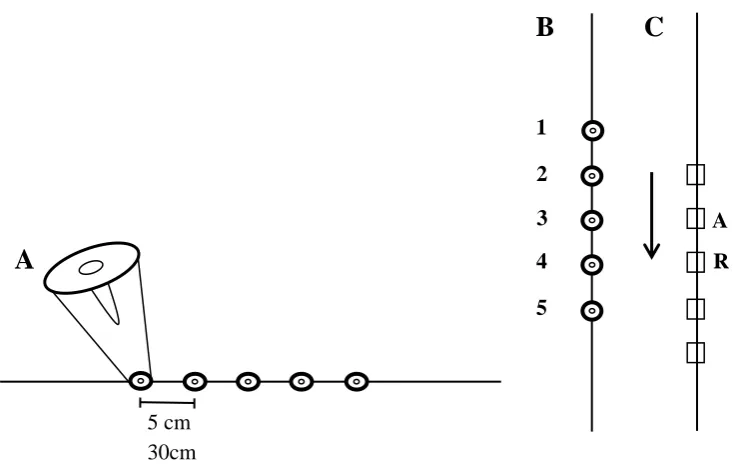
might be equivalent from a flying bird perspective, I designed a task to look at spatial
location within an array of five artificial flowers mounted on a wooden stake that
was oriented either vertically or horizontally. I set the learning criterion to five
consecutive first choice visits to the rewarded flower, testing only the birds once they
had reached the learning criterion. To determine which cues the birds used to learn
the location of the reward, I tested them in the same array on which they had been
trained but having displaced the flowers one unit, either up or down, if the array was
oriented vertically, or right or left, if it was oriented horizontally. I also trained the
birds on each of the array types with two spacing scales between the flowers, small
(5cm between the flowers) and large (30cm between the flowers), to determine
whether the ease with which the location of the reward was learned and the cues used
was a result of the array orientation or whether the spatial scale between the flowers
was also relevant.
3. Do rufous hummingbirds learn a 3-D location as an integrated coordinate or
do they learn the vertical and horizontal components separately?
To determine whether, when birds learn a rewarding location, they encode, and can
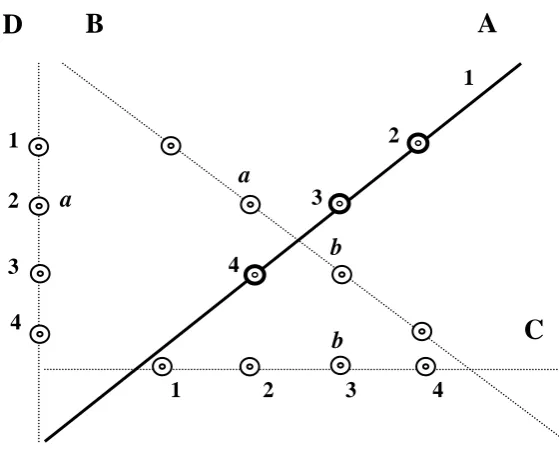
retrieve, the vertical and horizontal components separately, I trained hummingbirds
to feed from a diagonal flower array which consisted of four artificial flowers
mounted on a wooden stake with a 30cm distance between them. The rewarded
flower was always located in positions two or three of the four flowers, never at the
ends of the array. After a bird had made 40 visits to the array, I tested them with the
array presented in three different orientations, keeping the spacing between the
flowers constant but displacing all of them either up or down, or right or left. If the
occupied by the rewarded flower during training, it would suggest that they can
retrieve the vertical and horizontal component of a location separately.
Finally, to compare the vertical and horizontal use of space in learning the
location of a 3-D reward and the accuracy in relocation of that reward, by a terrestrial
and a flying animal, I performed two very similar experiments, in which I tested rats
in the laboratory in one and rufous hummingbirds in the field in the other. The
question for that experiment was:
4a. Do rats use the horizontal and vertical dimensions to the same extent while
learning a rewarding 3-D location? Do they exhibit the same accuracy in both
dimensions?
In this experiment,I trained rats to visit a 3-D rewarded location within a cubic
maze. Half of the rats were trained using a reference memory task and the other half
were trained on a working memory version of the task. In the reference memory
task, the reward remained at the same location throughout the experiment, while in
the working memory task, the rats had several trials a day at one rewarding location
but they experienced a different rewarding location each day. At the end of the
training period, rats were tested on the same maze but without a reward. From the
tests I determined whether the rats first moved to a horizontally or vertically adjacent
location after reaching the previously rewarded location. If the rats first crossed to a
vertically adjacent unit this would suggest that they were more certain about the
horizontal location of the reward and vice versa. Using the training data, I compared
moving in the three axes (x, y and z). This provided a measure of the way in which
the rats used space while learning the location of the reward.
4b. Do hummingbirds use the horizontal and vertical dimensions to the same
extent while learning a rewarding 3-D location? Do they exhibit the same
accuracy in both dimensions?
I trained hummingbirds to feed from a rewarding location within a cubic maze,
which contained an artificial flower on each intersection of the subunits that made up
the maze. Once the birds had learned the location of the reward, they were tested
with the reward removed. As with the rats, to determine whether birds were more
certain of the vertical or horizontal component of the learned 3-D location, in the test
I compared the number of birds that crossed to the unit vertically or horizontally
adjacent to the previously rewarded location. Also as with the rats I used the training
data of the number of crossings of the maze subunits and the time spent moving
through each axis (x, y and z) to determine the birds’ use of space while learning the
location of the reward. Together with the data from Experiment 4a, I could
determine whether the rats and hummingbirds used space in a similar way while
learning the 3-D location of a reward and whether, in the absence of that reward,
their certainty of the location was similar with regard to its horizontal or vertical
CHAPTER 2. ONE-TRIAL SPATIAL LEARNING
This chapter has been published in Flores-Abreu, I., T. Hurly and S. Healy (2012) One-trial spatial learning: wild hummingbirds relocate a reward after a single visit. Animal Cognition 15: 631-637. This version differs from the published version in that Figure 3 is now presented separately as Figure 3, 4 and 5, whereas they were published as part of the same figure.
ABSTRACT
Beaconing to rewarded locations is typically achieved by visual recognition of the
actual goal. Spatial recognition, on the other hand, can occur in the absence of the goal
itself, relying instead on the landmarks surrounding the goal location. Although the
duration or frequency of experiences that an animal needs to learn the landmarks
surrounding a goal have been extensively studied with a variety of laboratory tasks,
little is known about the way in which wild vertebrates use them in their natural
environment. Here we allowed hummingbirds to feed once only from a rewarding
flower (goal) before it was removed. When we presented a similar flower at a different
height in another location birds frequently returned to the location the flower had
previously occupied (spatial recognition) before flying to the flower itself (beaconing).
After experiencing three rewarded flowers, each in a different location, they were more
likely to beacon to the current visible flower than they were to return to previously
rewarded locations (without a visible flower). These data show that hummingbirds can
encode a rewarded location on the basis of the surrounding landmarks after a single
visit. After multiple goal location manipulations, however, the birds changed their
strategy to beaconing presumably because they had learned that the flower itself reliably
signalled reward.
INTRODUCTION
Successful small-scale navigation relies on animals being able to remember a goal’s
features plus proximal and distal landmarks and to use them either as a single beacon or
as associative cues in order to relocate that goal (Gould et al. 2010). In order to relocate
a goal, animals may form a memory either of the visual characteristics of the goal itself
(goal recognition, beaconing) or of the landmarks surrounding that goal (spatial
recognition) i.e. the goal need not be visible. In instances where the goal is very
conspicuous, the animal does not need to learn the surrounding landmarks to reach the
goal but when it is less conspicuous it may be more efficient for the animal to encode
routes to the goal by learning those landmarks. In some cases beacons are used in
establishing the spatial recognition system. For example, wood ants Formica rufa use
beacons as a “scaffold” when learning a route such that when it is learned, removing the
beacons has no impact and the ants follow exactly the same route as they had when the
beacons were present (Graham et al. 2003). The ants’ use of landmarks is context
specific and depends on their foraging round-trip stage: they use panoramic landmark
cues when experimentally displaced while departing from the nest or from the artificial
feeder, whereas they rely on local landmark cues for arrival at either location (Fukushi
&Wehner 2004). Rats, too, may use landmarks in a kind of scaffolding: when trained to
find an escape platform signalled by a landmark at a constant orientation and distance
from the platform they can relocate it in the absence of that landmark (Pearce et al.
1998). Beacons appear to facilitate learning about spatial information in pigeons (Kelly
&Spetch 2004) and in humans (Kelly &Spetch 2004) as they do in ants and rats (Pearce
et al. 2001; Pearce et al. 2006). Pigeons trained to a single rewarded corner in a
associated with reward but also the geometrical properties, even though these are
unnecessary for successful completion of the task (Kelly &Spetch 2004). Finally,
Clark’s nutcrackers Nucifraga columbiana, trained to a single rewarded location in a
similar rectangular arena, required that location to be identifiable with a visually-unique
landmark: when all of the objects were identical, the birds did not learn the rewarded
location. Furthermore, when the landmark information was put in conflict with the
geometric information, the birds used the landmark (Kelly 2010).
This facilitation of location learning by the features of the goal itself (used as a
beacon) is also seen in wild, free-living hummingbirds Selasphorus rufus, which learn
the location of a reward faster when it is marked by a location-specific colour than when
it is not (Hurly &Healy 2002; Hurly et al. 2010). However, since birds return to the
location of the reward regardless of a change in the colour of the flower, it appears that
birds encode a goal’s location using landmarks in addition to the beacon (Hurly &Healy
2002). This is seen most strikingly when the rewarded flower at which a bird has fed on
multiple occasions need not be present for the bird to fly to its location (Hurly et al.
2010). Examination of the birds’ flight paths shows that even when the flower is
displaced only 2m from the original rewarded location the birds flew first to the original
location of the now absent flower before flying to the flower that was present.
Furthermore, rufous hummingbirds’ accuracy in relocating a rewarded location without
being guided by a beacon is related to the size of the flower used for training: accuracy
of relocation in three dimensions increases as the flower gets smaller. From now on we
will call Spatial Recognition the strategy by which the birds relocate a previously
rewarded location in the absence of a beacon, due to the need of identifying the
We do not know whether the hummingbirds in the field require multiple
experiences to learn a rewarded location, as do the ants and species tested in laboratory
experiments. The aim of this study, then, was to determine whether rufous
hummingbirds could relocate a location after one rewarded visit. Birds were allowed to
feed from an artificial flower only once before we moved that flower to a novel nearby
location. If the birds returned to the previously rewarded location, from which the
flower was now absent, it would appear that the birds had learned the goal’s location
(spatial recognition) without needing to use the goal’s visual features (beaconing) after a
single experience.
METHODS
Study species and site
The subjects used in this experiment were 14 free-living male rufous hummingbirds,
Selasphorus rufus. The experiment was run from 08:00-19:00 hr Mountain Standard
Time in May and June in 2009 in a valley in the eastern Rocky Mountains, 20 km
southwest of Beaver Mines, Alberta, Canada, (49º 20’ 56.61’’ N 114º 24’ 38.49’’ W).
On return from overwintering in Mexico, males set up territories along this valley
centred on artificial feeders at an approximate height of 2-3m from the ground
containing 14% sucrose. Territorial males were caught, banded and colour marked
(with nontoxic waterproof ink on the breast) for individual identification.
Description of experimental arena
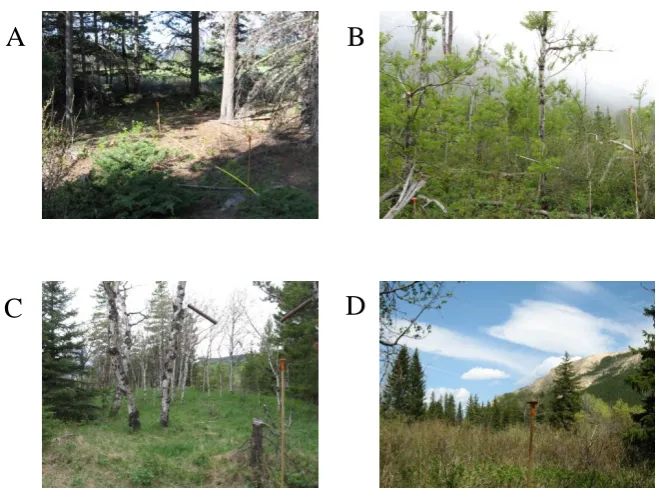
size (Hurly et al. 2001) and largely forested with multiple open, grassy spaces (Figure
1).
[image:34.595.100.430.162.409.2]
Figure 1 Examples of an experimental arena within a male hummingbird territory
Initial training
To train a bird to feed from artificial flowers containing sucrose, his feeder was lowered
in three steps of approximately 1m, until the feeder reached the height of the training
flower 60cm (2ft) which was always placed immediately below (at the exact ground
position of) the feeder. The feeder was removed either once the bird fed from the
training flower or when the bird had fed from the feeder beside the training flower. The
experimental flower was made of a 6cm (2.4in) diameter disc of orange cardboard
mounted vertically on a wooden stake. This stake was one of three different heights
(short: 60cm (2ft) = S; medium: 120cm (4ft) = M; tall: 180cm (6ft) = T). In the centre
of the flower was a syringe tip filled with 200µl of 25 % sucrose solution. As
A
B
hummingbirds fly through three dimensions, we used flowers of different heights so as
to change the flower’s location within three-dimensional space and not only in the
horizontal plane. In this way we could determine whether the birds revisited locations
at the correct height as well as the correct x-y location. The bird was allowed to feed
twice from the training flower in the same location before the experiment began.
Therefore, whenever a bird hovered at the training flower location this was considered a
visit based on two trials. Training took no longer than two hours.
Experimental Procedure
Once the bird had fed twice from the training flower (TF) it experienced three
successive one-trial learning presentations in different 3-D locations: three horizontal
displacements at a different height each. First, the training flower was removed and the
first experimental flower (F1) was placed 2.74m (9ft) from the location of the training
flower (Stage 1). After the subject had fed once from F1, that flower was removed and
the second experimental flower (F2) was placed 2.74m (9ft) away from the location F1
had occupied (Stage 2). The bird was allowed to feed once from F2, that flower was
removed and the third (F3) and last experimental flower was placed 2.74m (9ft) from
the location F2 had occupied (Stage 3). All birds experienced the three different flower
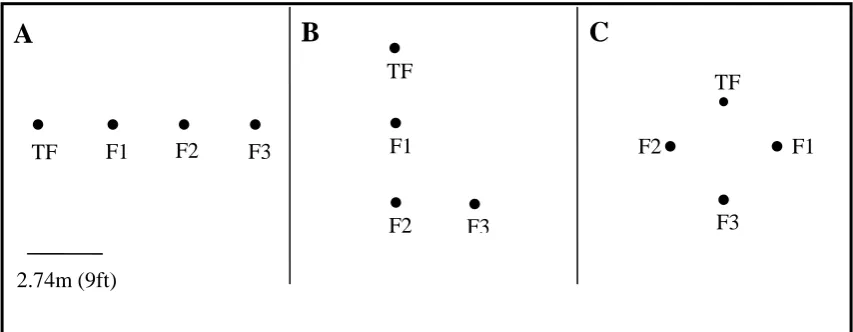
heights in a pseudo-randomized order. The placement of flowers was either linear, in
the shape of an “L” or a diamond (Figure 2) so that successive flowers were not simply
further from the location that had been occupied by the training flower.
When a bird flew in to feed from a nearby perch, he could fly directly to the
visible flower or to any of the locations previously occupied by flowers. The
hovered in the air in the vicinity of a flower’s previous location. All visits as well as
their order were recorded. All of male’s visits to his meadow ended by his feeding at
the visible flower. After feeding from a flower, the male perched high up in a tree in his
territory, chased other males or displayed to females. Once the bird had fed from F3 the
feeder was returned to its original location and the bird’s behaviour was recorded for a
[image:36.595.84.511.279.445.2]further foraging bout.
Figure 2 A schematic of the spatial patterns in which flowers were presented: A) linear, n = 3
B) L-shape, n = 3 and C) diamond shape, n = 8. Solid circles represent the location of artificial flowers. The bird was only ever presented with a single flower at any one time
RESULTS
All the birds returned to previously rewarded locations, hovering for 1-3sec, in one or
more experimental stages. None of the birds hovered at locations other than those at
which they had fed at some point in this experiment (the feeder, TF, F1 and F2). Most
of them (10/14) required a single visit to relocate a relevant location, returning to it after
a single rewarded visit in at least one experimental stage, i.e. F1 and F2, having TF FF
F2 F1
F3 F3
F2 F1
TF F1
TF
F2 F3
2.74m (9ft)
previously visited each of these just once to feed. The interval between foraging bouts
was 15.0 ± 0.5 (SE) min.
Spatial recognition
A bird could make two kinds of visits when he returned to forage in the experimental
area: either to the present flower or to an empty space where there used to be a rewarded
flower. We designated all those occasions on which the birds hovered very near
(approximately 20cm of the flower’s previous location) to the location of an absent
flower, spatial recognition, while flying directly to a flower we designated as beaconing.
The flower could have been the training flower (TF) or any of the subsequent three
experimental flowers (F1, F2 or F3). Hovering at the locations of absent flowers always
ended (in less than 10sec) with the bird feeding from the present flower.
0 2 4 6 8 10
TF (1st choice) F1 (1st choice) TF after F1
Locations visited
N
o. of
b
ir
d
s
When F1 was present 10/14 birds also visited the training flower’s location
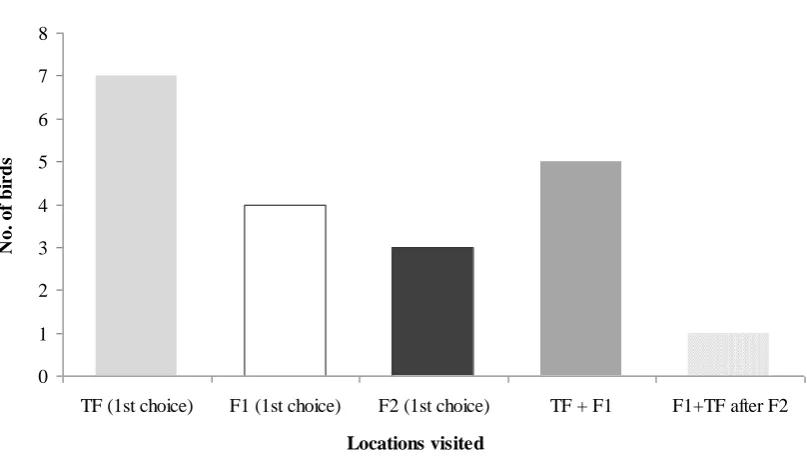
(Figure 3). When F2 was present 12/14 birds visited the locations of either the training
flower only (two-trial learning: 3/12 birds) or F1 (with or without visiting TF, single
trial learning: 9/12 birds; Figure 4). When F3 was present 8/13 birds visited the
locations of either only TF (1/8) or F1 and/or F2 (with or without visiting TF, single
trial learning: 7/8; Figure 5). The proportion of birds that performed spatial recognition
(regardless of being its 1st choice or not) at any time during a trial was similar
throughout the experiment (Figure 6).
0 1 2 3 4 5 6 7 8
TF (1st choice) F1 (1st choice) F2 (1st choice) TF + F1 F1+TF after F2
Locations visited
N
o. o
f b
ir
d
[image:38.595.94.498.354.589.2]s
0 1 2 3 4 5 6 7 8
TF (1st choice) F2 (1st choice) F3 (1st choice) TF + F1 + F2 TF+F1+F2 after F3
Locations visited
N
o.
o
f b
ir
d
[image:39.595.106.493.102.325.2]s
Figure 5 Locations visited during the third experimental stage (when F3 was the visible flower). The light grey bar represents the number of birds that used spatial recognition as their first strategy after two visits to TF, while the white bars also represent the number of birds that used spatial recognition but after a single experience. The dark grey bar represents the number of birds that beaconed for their first choice. The horizontal striped bar represents visits to F2, F1 and/or TF after visiting F3. TF = Training flower, F1 = Flower 1, F2 = Flower 2, F3 = Flower 3, n = 13
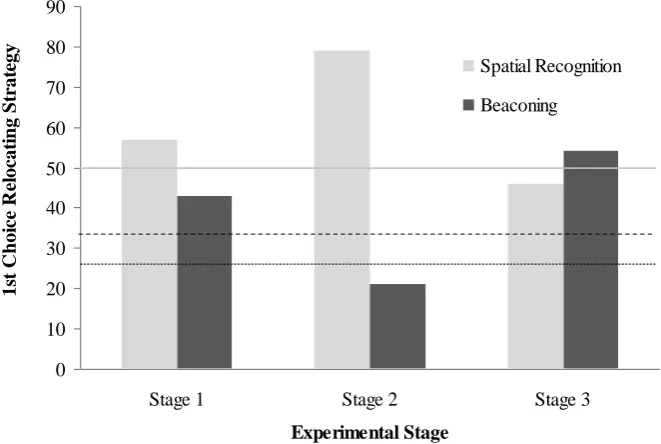
To evaluate the birds’ strategy for relocating flowers, we compared the
proportion of birds that hovered at one of the flower’s previous locations (spatial
recognition) as their 1st choice before going on to the actual flower with a chance
expectation of the same probability of a visit to each flower location. We did this for
each of the three stages. The probability of spatial recognition increases throughout the
experiment from 0.5 in Stage 1 to 0.67 and 0.75 in Stages 2 and 3 respectively due to
the increase in flower locations (i.e. during Stage 3, chance would be 25% as there were
choice) was significantly higher than chance only at Stage 3 (Stage 1: X2= 0.286, df =
1, p = 0.593; Stage 2: X2 = 0.986, df = 1, p = 0.321; Stage 3: X2 = 5.770, df = 1, p =
0.016; 0 20 40 60 80 100
Stage 1 Stage 2 Stage 3
Experimental Stage S p at ial R ec og n it ion two-trials one-trial
Figure 6 The proportionof birds that used spatial recognition in each experimental stage. One-trial learning refers to visiting the previous location of F1 at Stage 2 or to that one of F1 or F2 in Stage 3. Two-trials refers to visitng the previous location of the training flower at any stage
0 10 20 30 40 50 60 70 80 90
Stage 1 Stage 2 Stage 3
Experimental Stage 1s t C h oi ce R el oc at in g S tr at
egy Spatial Recognition
[image:40.595.131.462.454.676.2]Beaconing
line represents the chance level for stage 1 (line A), the dot-dash line the chance level for stage 2 (line B) and the dotted line the chance level for stage 3 (line C), respectively
see Figure 7). In addition, a significant proportion of birds (7/11) switched from spatial
recognition during Stage 2 to beaconing in Stage 3 (X2= 8.757, df = 1, p = 0.004).
DISCUSSION
Wild, free-living rufous hummingbirds can relocate a goal in the absence of the goal’s
visual features after a single feeding event. As far as we know this is the first time that
spatial recognition, in the absence of any marker at the previously rewarded locations,
after a single trial has been demonstrated in the field. In all previous experiments
memory has been tested after considerable training or when the beacon remains in place
during the one-trial spatial experiments (Brodbeck et al. 1992; Healy &Krebs 1992;
Clayton &Krebs 1994; Hurly &Healy 1996; Henderson et al. 2001; Hurly &Healy
2002; Hurly et al. 2010). The hummingbirds’ ability to relocate a reward in the absence
of a beacon is consistent with the evidence that they attend to other environmental
spatial cues in addition to just the features of the goal (Hurly &Healy 1996; Healy
&Hurly 1998; Hurly &Healy 2002; Healy &Hurly 2003). We assume that the birds
used a combination of landmarks surrounding the goal to do so (e.g. the meadow’s
geometry, trees, bushes, trunks, rocks, flowers etc.), perhaps as a cognitive map, which
is an allocentric representation in terms of distances and directions among items in the
environment (O’Keefe &Nadel 1978; Collett &Graham 2004). However, as the
experiment progressed the birds appeared to switch from using spatial recognition to
eventually learning to use the beacon signalling a goal’s location when the beacon is a
more reliable indicator of reward than are the surrounding landmarks (Pearce et al.
1998).
Different brain regions appear to underpin the use of beacons and the encoding
of locations with regard to the surrounding landmarks: rats with hippocampal damage
appear to rely on beaconing regardless of cue reliability, as do rats with medial lesions
to the dorsal striatum (Devan &White 1999). FMRI data recorded during the
performance of virtual reality task support a similar spatial recognition/beaconing
dichotomy in humans too, in the right posterior hippocampus and dorsal striatum,
respectively (Doeller et al. 2008).
The behaviour of the birds during experimental Stage 2 shows that
hummingbirds can encode and retrieve the spatial position within their environment
after a single experience. In addition, the birds’ first choice at Stage 3 suggests both
primacy and recency effects: more visits to both TF (primacy) and F2 (recency)
locations (6/6 birds) than to F1 (0 birds) appears somewhat similar to the performance
of humans on word-list learning and with the performance on spatial and non-spatial
tasks by other animals (Bjork &Whitten 1974; Castro &Larsen 1992; Crystal
&Shettleworth 1994).
That a rufous hummingbird, while visiting a rewarded flower for the first time,
encodes the spatial location and then remembers this information to revisit the flower is
a remarkable phenomenon when viewed in an ecological context. Hummingbirds visit
hundreds of flowers each day, taking a tiny amount of nectar from each. Given the
birds’ behaviour in our experiment, it seems possible that the spatial location of each
that empty some flowers in an array can avoid these flowers on their next visit and
direct their foraging to previously unvisited flowers (Healy &Hurly 1995). If locations
of numerous flowers are encoded each day, one must question how much spatial
information can be retained and how out-of-date information is eliminated or
discounted.
Our experimental design is comparable to those used to test spatial memory in
the absence of the beacon e.g. delayed-matching-to-place water-maze tasks (Steele
&Morris 1999) and one-trial place memory (Bast et al. 2005) as well as cued recall in
rats e.g. place-odour paired-associate task (Day et al. 2003), all of which involve the
animal retrieving a location after a single experience. Retrieving a single experience is
one of several characteristics of episodic-like memory. Since the ground-breaking
experiments with scrub jays retrieving different kinds of stored food, the evidence that
birds and rodents have episodic-like memory has mounted (Clayton &Dickinson 1998;
Clayton &Dickinson 1999; Clayton et al. 2003; Day et al. 2003; Eacott et al. 2005;
Babb &Crystal 2006; Dere et al. 2006; Naqshbandi &Roberts 2006; Eacott &Easton
2007; Roberts et al. 2008; Zinkivskay et al. 2009; Crystal 2010). However, all of these
experiments have been carried out in the laboratory. It is not yet clear whether
hummingbirds are capable of episodic-like memory but as they can learn the refill rate
of flowers (Gill 1988; Henderson et al. 2006), as well as what flowers look like and
their locations (Hurly 1996; Hurly &Healy 2002), it may be that they will prove to be a
useful system in which to explore episodic-like memory. The fact that they show
learning in a trial-unique way is a key aspect for the study of episodic memory. It is
possible that if hummingbirds can encode the location of a reward from a single
the flower they sample was empty or full and if it contained nectar with a high or a low
sugar concentration), which would imply that wild birds encoded the “what and where”
aspects of episodic-like memory. Such episodic-like memory is yet to be tested in wild
hummingbirds.
Acknowledgements
This research was supported by CONACYT (Consejo Nacional de Ciencia y
Teconología), the University of Lethbridge and the Natural Sciences and Engineering
Council of Canada. We thank Cam Finlay and Ida Bacon for support in the field and
Rosamund Langston and three anonymous reviewers for comments on an earlier version
CHAPTER 3. ROLE OF AXIS ORIENTATION IN SPATIAL
LEARNING
ABSTRACT
Rufous hummingbirds learn about the flowers they forage on, which vary widely in
their spatial distribution. These flowers may share a horizontal location but vary in the
vertical plane. To date, most studies of spatial learning have been conducted in the
horizontal plane, with few addressing the vertical dimension. The aim of this study was
to compare the hummingbirds’ learning a rewarded location that differed from other
similar but unrewarded locations either in only the vertical or in the horizontal axis. We
also wanted to determine whether birds could dissociate the vertical and horizontal
components of a learned 2-D location. We found that the hummingbirds’ learning
performance on a linear flower array depended on the orientation of the array and on the
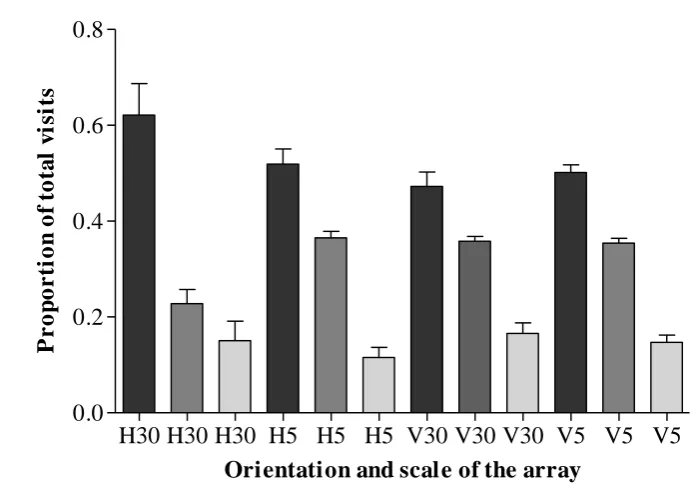
spacing distance between the flowers in the array: birds chose the flower in the
rewarded location more than any of the other four flowers when the array was oriented
horizontally but only when flowers were spaced 30 cm (rather than 5cm) apart. In
contrast, when the array was oriented vertically or when the flowers were 5cm apart in
the horizontal array, birds visited the rewarded flower and its two adjacent flowers more
than they visited the two distal flowers. In addition, which cues are used to learn the
rewarded location depended on the spacing scale in the horizontal dimension: at 30cm
flower spacing, birds learned the absolute location whereas at 5cm spacing they chose
the relative and absolute locations equally. Birds did not reach the learning criterion in
the vertical arrays. In the diagonal linear array, birds chose the rewarded flower more
than any other. When the array was displaced to either the vertical or the horizontal for
training location. Our findings are consistent with hummingbirds encoding the vertical
dimension less precisely than they encode the horizontal dimension.
Keywords: Selasphorus, hummingbirds, spatial learning and memory, orientation,
vertical, horizontal
INTRODUCTION
Much of animal behaviour has a spatial component. For example, territoriality, predator
avoidance, provisioning young, and foraging all require animals being able to move
through space and to keep track of where they have been, where they are and where
they are going (Sherry 1998). Although space itself is three-dimensional, spatial
cognition has traditionally been studied in the horizontal plane, using an array of
bi-dimensional mazes or arrays in which the animal has either to escape or to relocate a
reward in a rather small-scale spatial tasks in an experimental room (i.e. open arena,
T-maze, E-T-maze, radial T-maze, Morris water maze). Most of these tasks require the animal
to navigate across a horizontal surface without moving through a vertical component
(Cheng &Gallistel 2005). In a few experiments, the surface itself has been vertical but
the task either involved animals learning locations in only two dimensions (Hurly
&Healy 1996; Thiele &Winter 2005) or animals being presented with alternative
locations that varied only in the horizontal, even though the animals had to move
vertically between them (Jacobs &Shiflett 1999). Path integration, which is the
capacity to use egocentric cues (generated by the animal’s movements) to calculate the
updated position of the animal by monitoring its direction and velocity in relation to a
route in the absence of landmarks (Whishaw &Wallace 2003), has also been
traditionally studied only in the horizontal plane in laboratory vertebrates as well as in
invertebrates and humans in tests outside the laboratory (Seyfarth et al. 1982; Etienne et
al. 1986; Séguinot et al. 1993; Müller &Wehner 1994; Etienne et al. 1996; Drai et al.
2000; Whishaw et al. 2001; Wallace et al. 2002).
The role of the vertical component in estimating the distance travelled was
investigated for the first time in desert ants (Cataglyphis fortis). Ants did not appear to
use a three-dimensional odometer: ants trained to a food source over hilly terrain and
tested in flat terrains or vice versa, travelled homing distances that reflected the
horizontal distance, and not the actual distance, suggesting they either do not encode, or
that they discount their vertical movements (Wohlgemuth et al. 2001; Grah et al. 2005).
Ants also do not compensate for vertical changes while relocating their goal: they did
not climb up a slope provided so that they might compensate for the distance they were
forced to walk down a slope at the beginning of the test (Grah et al. 2007).
To our knowledge, the first explicit attempt to examine the learning and memory
of both vertical and horizontal components of a location required rats to relocate a
rewarded location within a cubic maze (Grobéty &Schenk 1992). Rats took fewer visits
to learn locations on a maze that included a vertical dimension (either a vertical wall or
a cubic maze) than they did on a purely horizontal maze (Grobéty &Schenk 1992). In
contrast, fish took as many trials to learn a location in the horizontal, as they did a
location in the vertical and one in a two-dimensional Y-maze (Holbrook &Burt de
Perera 2009). However, rats and fish both may favour vertical over horizontal
information: rats trained to a 3-D location on a cubic maze spent more time at the height